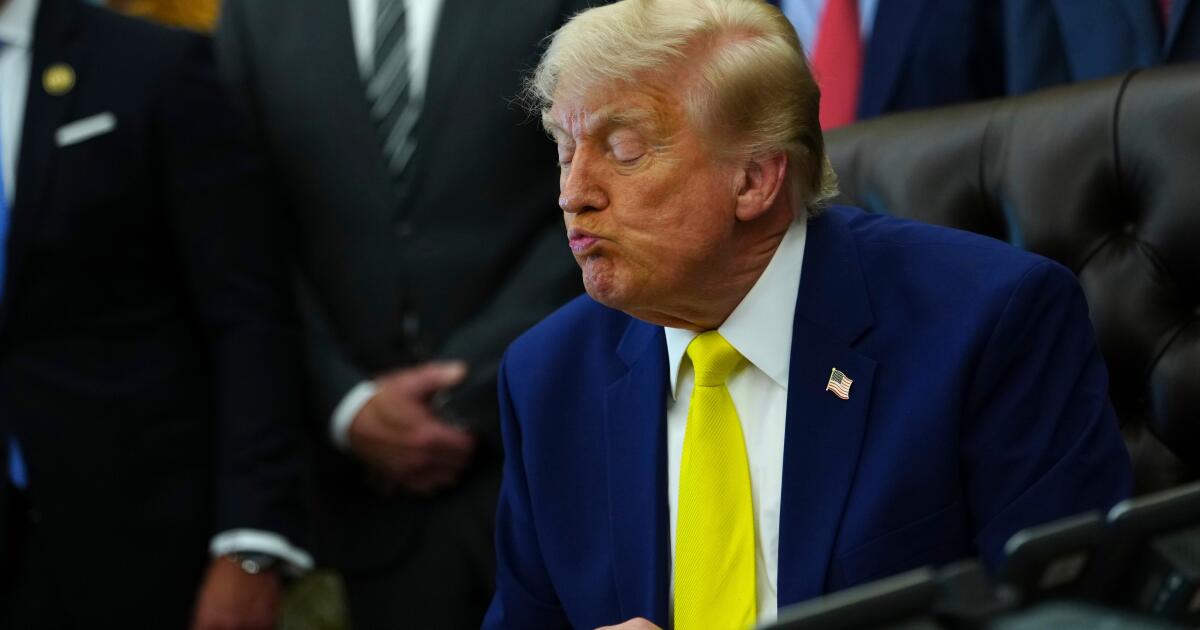
WASHINGTON — Former FBI Director James Comey was indicted Tuesday in an investigation over a social media photo of seashells arranged on a beach that officials said constituted a threat against President Trump, according to a person familiar with the matter.
The person was not authorized to publicly discuss the matter and confirmed the indictment to the Associated Press on the condition of anonymity. The charge or charges against Comey were not immediately known.
It’s the second criminal case the Justice Department has brought against the longtime Trump foe, who said he assumed the arrangement of shells he saw on a walk, reading “86 47,” was a political message, not a call to violence. Comey is among multiple foes of the Republican president to come under scrutiny by the Justice Department over the last year, as acting Atty. Gen. Todd Blanche aims to position himself as the right person to hold the job permanently.
Comey was interviewed by the Secret Service in May after Trump administration officials asserted that he was advocating the assassination of Trump, the 47th president. Comey deleted the post shortly after it was made, writing: “I didn’t realize some folks associate those numbers with violence” and “I oppose violence of any kind so I took the post down.”
His lawyer did not immediately respond to a request seeking comment Tuesday.
Merriam-Webster, the dictionary used by the Associated Press, says 86 is slang meaning “to throw out,” “to get rid of” or “to refuse service to.” It notes: “Among the most recent senses adopted is a logical extension of the previous ones, with the meaning of ‘to kill.’ We do not enter this sense, due to its relative recency and sparseness of use.”
Trump, in a Fox News Channel interview in May, accused Comey of knowing “exactly what that meant.”
“A child knows what that meant,” Trump said. “If you’re the FBI director and you don’t know what that meant, that meant assassination. And it says it loud and clear.”
The fact that the Justice Department pursued a new case against the ex-FBI director months after a separate and unrelated indictment was dismissed will likely spark defense claims that the Trump administration is going out of its way to target Comey, who had overseen the early months of an investigation into whether the Republican president’s 2016 campaign had coordinated with Russia to sway the outcome of that year’s election.
The former FBI director was indicted in September on charges that he lied to and obstructed Congress related to testimony he gave in 2020 about whether he had authorized inside information about an investigation to be provided to a journalist. He denied any wrongdoing, and the case was subsequently dismissed after a judge concluded that the prosecutor who brought the indictment was illegally appointed.
Comey was the FBI director when Trump took office in 2017, having been appointed by then-President Obama, a Democrat, and serving before that as a senior Justice Department official in President George W. Bush’s Republican administration.
But the relationship was strained from the start, including after Comey resisted a request by Trump at a private dinner to pledge his personal loyalty to the president — an overture that so unnerved the FBI director that he documented it in a contemporaneous memorandum.
Trump fired Comey in May 2017 amid an FBI investigation into potential ties between Russia and Trump’s presidential campaign. That inquiry, later taken over by special counsel Robert Mueller, would ultimately find that while Russia interfered in the 2016 election and the Trump team welcomed the help, there was insufficient evidence to prove a criminal collaboration.
The department, for instance, is also pursuing a criminal investigation into former CIA Director John Brennan, another key figure in the Russia investigation — one of Trump’s chief grievances and a saga for which he and his supporters have long sought retaliation.
CNN was the first to report the second indictment against Comey.
Ninety-five years ago next month, Aurelio Manrique Jr. landed a job as a mild-mannered L.A. Times columnist. But the resume this native of the central Mexico state of San Luis Potosí brought to the paper was that of a firebrand.
You’re reading the Essential California newsletter
Sign up to start every day with California’s most important stories.
By continuing, you agree to our Terms of Service, which include arbitration and a class action waiver. You agree that we and our third-party vendors may collect and use your information, including through cookies, pixels and similar technologies, for the purposes set forth in our Privacy Policy such as personalizing your experience and ads.
Medical student turned political prisoner. Fought in the Mexican Revolution. Governor of his home state. Trusted advisor of general-turned-president Álvaro Obregón. Founder of a left-wing political party. Mexican legislator. He even took to the floor of Mexico’s congress to denounce former president Plutarco Elías Calles as a farsante — a phony — and then pull a gun on a rival who took issue with his vitriol.
Tall, with round wire glasses and a shock of black hair that was the inverse of his Moses-like beard, Manrique cut an exciting figure in Latino L.A. when he arrived as a political exile in 1929 after the so-called Escobar rebellion, which was an attempt to overthrow the Mexican government. A Oct. 28, 1929 Times dispatch noted that “it is not uncommon to find among the shabby, shuffling street venders [sic] of Sonoratown” former Mexican bigwigs “offering sweetmeats and trinkets from trays” in an effort to survive.
Finding a home in L.A.
They, like so many other political refugees before and since, made L.A. a home but also a place to fight for the freedom of their homeland.
Manrique, on the other hand, was hailed as the “intellectual head” of his fellow Mexican refugee politicos and an “accomplished linguist” who spoke Spanish, English, French and German.
“He stands in my memory as a pillar of fire because, at all times, he has never been afraid to do or say what he considered to be right, regardless of his own personal or political fate,” an admirer would recall decades later in the Virginia Quarterly Review.
The revolutionary found welcome audiences across the Southland with lectures and Spanish-language radio show appearances to talk about what was going on in his home country. He participated in Mexican Independence Day and Cinco de Mayo festivities and even found work in Hollywood films as everything from a British lord to an Arab sheikh.
But reputation doesn’t pay the bills, so Manrique also offered translation and interpreter services from a small Bunker Hill office. He also held Spanish-language classes twice a week at the L.A. Central Library. Soon after, The Times — a paper that back then loathed leftists of all stripes — hired Manrique as a columnist in May 1931. He was to be in charge of its daily Spanish-language roundup of world and local events, which the paper had regularly published since 1922.
The revolutionary plays a more reserved role
I wish I could say that Manrique used his platform to inveigh against the mass roundups of Mexican Americans that kicked off that year and that would lead to the repatriation of hundreds of thousands of Mexican Americans, citizens and not, during the 1930s. Or that Manrique taught his Times bosses that Latinos were more than domestic help or a societal scourge. Or that he deserves a spot in the pantheon of legendary Times metro columnists like Jack Smith, Ruben Salazar and Steve Lopez.
Alas, it was not to be.
The daily columna was just a roundup of wire stories published in Spanish, part of The Times’ effort to teach the language of Cervantes to those interested. Every Monday, the 40-year-old Manrique also wrote Platicas de Los Lunes [Monday Lessons], a place for the professor to teach new words to readers via translations, poems and sample sentences.
Manrique’s last byline was April 25, 1932. In the hundreds of columnas he wrote for us, I found nothing even remotely hinting at the progressive lion that Mexicans in Southern California knew him as. But in an era in which Latino visibility in Anglo Southern California was nonexistent when it wasn’t heavily stereotyped, Manriquez’s brief tenure at The Times was an important step for future Latino writers at the paper, all of us whom owe a debt to the man.
He returned to Mexico in early 1933 after President Abelardo L. Rodríguez announced amnesty for him and other exiles. The former revolutionary spent the rest of his life working for the Mexican government, most notably as ambassador to Scandinavian countries from 1946 to 1956.
In 1962, the retired Manrique returned to his old L.A. stomping grounds one final time five years before his death for a lecture at the Alexandria Hotel.
“He finds Los Angeles completely changed,” La Opinión reported, “and told us, with a tone of barely concealed sadness, that many of those who knew him had disappeared.”
The fate of all Angelenos, alas.
Today’s top stories
Republican gubernatorial candidate Steve Hilton speaks at a March 7 town hall in Mentone.
(Gina Ferazzi / Los Angeles Times)
A Trump-endorsed Republican could become California’s next governor
A second ticket drop for the Olympics
A second ticket drop is set to open in August and will offer refreshed inventory across all sports at a range of prices.
Those who registered but did not receive a slot in the first ticket drop or did not buy all 12 of their tickets will be enrolled in a lottery for a spot in the second ticket drop.
The parks will serve historically underserved communities with recreation and historic preservation.
What else is going on
Commentary and opinions
This morning’s must-read
Other must-reads
For your downtime
The waffle with maple butter is the drive-across-town dish at celebrity-backed Max & Helen’s, the Larchmont diner opened by Phil Rosenthal and Nancy Silverton.
(Ron De Angelis / For The Times)
Going out
Staying in
A question for you: What’s your favorite California-themed book?
Marya says, “Hard Times in Paradise” by David and Micki Colfax.
Cristina says, “Grapes of Wrath” by John Steinbeck.
On this day 21 years ago, “Me at the zoo” was the first video uploaded to YouTube, opening the door to a new medium of television.
For the 20th anniversary last year, The Times’ Wendy Lee wrote about the video sharing platform and how it changed TV as we know it.
Have a great day, from the Essential California team
Jim Rainey, staff reporter Hugo Martín, assistant editor, fast break desk Kevinisha Walker, multiplatform editor Andrew Campa, weekend writer Karim Doumar, head of newsletters
Much of the news dominating the local restaurant scene has focused on sadness.
Two Los Angeles icons, Cole’s French Dip and Echo Park’s Taix restaurant, closed after more than 215 combined years of service.
It’s easy to be down and not necessarily want to go out.
Fortunately, our Food team, led by senior editor Danielle Dorsey, has some amazing recommendations for new favorites and old haunts that will fill your stomach and lift your spirits.
This month’s highlighted selections include locales from Altadena and Echo Park to Malibu and Westwood that the team feels are all worth your time.
The iconic restaurant along PCH was on the heels of reopening after the Pacific Palisades fire last February when heavy rain caused mudslides that led to flooding and extensive damage.
Fourteen months later, Duke’s Malibu is open with significant renovations and limited lunch and dinner menus featuring Hawaiian-influenced seafood staples such as crispy coconut shrimp, Korean sticky ribs and hula pie.
As the restaurant celebrates 30 years in operation, plans are underway for an anniversary party this summer.
City officials have encouraged Golden Leaf restaurant to install an expensive filter to address the pungent smell, though owners insist that none of their immediate shopping center neighbors have complained about the odor.
Supporters launched a Change.org petition last summer backing the preparation of the dish.
From married couple Omar Limon and Blanca Flores Torres, with help from Omar’s brother Arnold Limon, Hoja Blanca offers a playful take on modern Mexican food with dishes such as quesabirria tacos, esquites with cauliflower and a tetela topped with pork belly, all served alongside Bryan Jimenez’s classic cocktails.
(Stella Kalinina/For The Times)
Meymuni Cafe (Rancho Park)
As war unfolds in Iran and neighboring countries, L.A.’s Persian community has found comfort and support at restaurants such as Meymuni, a modern Persian cafe that offers free tea and cookies to diners, many of whom stop by after related protests at the nearby Federal Building.
The cafe opened in 2025 with barbari bread and lavash wrap sandwiches, tahini-date shakes and chai lattes, plus a full slate of events aimed at uplifting the local Persian community.
(Stephanie Breijo / Los Angeles Times)
NADC Burger (Westwood)
The rapidly expanding smashburger chain from Pasta Bar and Sushi by Scratch Restaurants chef Phillip Frankland Lee has opened its first L.A. location in Westwood Village, with plans to open additional locations in the city.
The signature burger at NADC — an acronym for “not a damn chance” — features two Wagyu patties, American cheese, grilled onions, jalapeños, pickles and a house sauce, with beef tallow fries and brown butter chocolate chip cookies rounding out the short menu.
Roshona Bilash, which translates to “luxurious taste,” features Bengali classics such as bone marrow nihari, rice pilafs and meats and breads cooked in a clay oven, with plans to expand with regional specialties such as seafood dishes popular along the Bangladesh coast.
You’re reading the Essential California newsletter
Sign up to start every day with California’s most important stories.
By continuing, you agree to our Terms of Service, which include arbitration and a class action waiver. You agree that we and our third-party vendors may collect and use your information, including through cookies, pixels and similar technologies, for the purposes set forth in our Privacy Policy such as personalizing your experience and ads.
The week’s biggest stories
(Kyra Saldana/For De Los)
Los Angeles Times Festival of Books
California living
Crime, courts and policing
Entertainment and media news
What else is going on
Must reads
Other meaty reads
For your downtime
(Illustrations by Lindsey Made This; photograph by Frazer Harrison / Getty Images)
Going out
Staying in
L.A. Affairs
Get wrapped up in tantalizing stories about dating, relationships and marriage.
Have a great day, from the Essential California team
Jim Rainey, staff reporter Hugo Martín, assistant editor, fast break desk Kevinisha Walker, multiplatform editor Andrew J. Campa, weekend writer Karim Doumar, head of newsletters
WASHINGTON — U.S. Immigration and Customs Enforcement acting director Todd Lyons, a key executor of President Trump’s mass deportations agenda, will resign at the end of May, federal officials announced Thursday.
Homeland Security Secretary Markwayne Mullin announced Lyons’ departure, calling him a great leader of ICE who helped to make American communities safer. Mullin said Lyons’ last day will be May 31.
“We wish him luck on his next opportunity in the private sector,” Mullin said in a statement. The Department of Homeland Security did not immediately respond to an email from the Associated Press asking why he is resigning.
Lyons, who was named acting director in March 2025, led the agency at the center of President Trump’s plans to reshape immigration to the U.S.
Under his leadership, the agency was granted a massive infusion of cash through Congress, which it used to expand hiring and detention capabilities, and it ramped up arrests to meet demand from the administration.
ICE was also central to a series of high-profile immigration enforcement operations in American cities, including Chicago and Minneapolis, a deployment that ended after backlash erupted over the deaths of two American protesters at the hands of federal immigration officers.
Stephen Miller, the president’s deputy chief of staff and the main architect of his immigration policy, called Lyons a “dedicated leader.”
“His courageous work at ICE has saved countless thousands of American lives and helped deliver safety and tranquility to millions of Americans,” Miller said in a statement.
White House spokesperson Abigail Jackson described Lyons in a post on X as “an American patriot who made our country safer.”
It’s not clear who might replace Lyons. But whoever does will take over an agency flush with cash while still a flashpoint for controversy. ICE is at the center of a battle in Congress, with Democratic lawmakers demanding restraints on immigration officers before agreeing to restore routine funding for DHS.
On Thursday, Lyons, along with two other top immigration officials, appeared before a House subcommittee to argue for his agency’s budget and faced continued scrutiny from lawmakers of ICE’s actions.
Lyons’ departure also comes as DHS is under new leadership after Trump fired former Secretary Kristi Noem, who led the department through the administration’s major immigration policy changes.
Mullin, who took over as secretary last month, is likely to continue to advance the president’s agenda but has struck a softer tone on some of the administration’s most contentious policies.
Public perceptions of ICE during Lyons’ tenure were low. In a February AP-NORC poll, most U.S. adults, including independents, said they have an unfavorable view of the agency.
Lyons faced questions in Congress over the shooting deaths of Renee Good and Alex Pretti and was asked if he would apologize for the way some Trump administration officials characterized Good as an agitator. He declined to do so.
“I welcome the opportunity to speak to the family in private. But I’m not going to comment on any active investigation,” Lyons said.
Lyons said he had seen video that captured Pretti’s shooting but said he could not comment, citing an active investigation.
Lyons, who joined ICE in 2007 as an immigration enforcement agent in Texas, signed off on a memo, first obtained by the Associated Press, that granted federal immigration officers sweeping powers to forcibly enter homes and make arrests without a judge’s warrant.
Trump’s border advisor Tom Homan described Lyons as serving selflessly and “a highly respected and effective acting Director of ICE.”
Goldenberg and Golden write for the Associated Press. Golden reported from Seattle.
Commenters who never have been — and never will go — complain about the cost, the influencers, the hype. Purists wax poetic about the days when they disappeared into three days of music and the field wasn’t overtaken by brands like Barbie and e.l.f. cosmetics. Defenders claim they can camp their way to an affordable weekend, and others spend the whole time posting. A select few even talk about great performances they saw — it’s still a music festival.
You’re reading the Essential California newsletter
Sign up to start every day with California’s most important stories.
By continuing, you agree to our Terms of Service, which include arbitration and a class action waiver. You agree that we and our third-party vendors may collect and use your information, including through cookies, pixels and similar technologies, for the purposes set forth in our Privacy Policy such as personalizing your experience and ads.
But one thing everybody can agree on: Coachella has changed. I should know. I’ve been covering it as a journalist since 2007.
Rapid advancements in technology and mass adoption of social media have brought out the best and worst of the festival — not just on screens thousands of miles away, but to those of us trying not to trip over the makeshift photoshoot you might have seen on Instagram.
In the early years, there were no brand activations on the field; nobody knew what an influencer was and the only corporate sign you saw was for Heineken in the beer gardens. (There was no Heineken House with its own stage, just signs advertising the beer.)
The grounds were also considerably smaller, making it easier to explore the different stages and discover new music. You didn’t have fancy food options, but a slice of Spicy Pie was less than $10. (Coachella upgraded its food options from festival staples to weekend outposts of L.A. restaurants in 2014.)
The music was the draw. The festival’s track record includes artists like the Killers, the Black Keys, Childish Gambino and Kendrick Lamar climbing up from small type to headliner on the lineup poster.
Livestreams and influencers made Coachella’s reach global
The vibes started to shift in 2010 as smartphones grew in popularity, although the service on the field was spotty. It was the first year Coachella offered a livestream — available via Facebook and MySpace. The next year, the stream moved to YouTube, where it remains and draws millions of viewers.
As Coachella expanded to twin weekends due to popular demand on the ground in 2012, it also had the first viral moment fans could enjoy from thousands of miles away: Dr. Dre and Snoop Dogg brought 2Pac back to life via a hologram.
Celebrities were always at Coachella (I spotted Ryan Seacrest, Corbin Bernsen, David Hasselhoff and Danny DeVito in my early years), but the rise of social media made celebrity culture a key part of the event. By 2011, TMZ was posting about stars like Lindsay Lohan. Clips from Coachella went viral and ended up on shows like “Tosh.0” and referenced in “Community.”
The art, which was always part of the festival, became bigger and more iconic. On the growing photo app Instagram, larger-than-life sculptures of astronauts started appearing in selfies.
Brands saw an opportunity. American Express, H&M and Samsung launched activations on-site in 2015. The party scene outside the festival, with non-affiliated events that were timed because everyone was in town for Coachella, became marketing vehicles. Brands are still cashing in more than a decade later.
The next watershed moment was Beyoncé in 2018. Today, most headlining sets at the fest feel as if they are designed for the viewing experience on the livestream rather than the fans on the field (ahem, Justin Bieber and his laptop). But Beyoncé’s spectacle was just as mind-blowing on-site as it was at home. A year later, the “Homecoming” special debuted on Netflix, widening the reach.
Coachella became a key part of the pop culture landscape, and then it became a cornerstone of the influencer economy.
Behind all the hype, there’s still a music festival hiding
I inadvertently photobombed approximately 500 people just trying to go to and from the press tent last weekend and my inbox is overflowing with requests for coverage of off-site events with brands, celebs and TikTok influencers, including social media clips.
Coachella is what you make of it. And besides, everyone knows there are fewer influencers on Weekend 2.
Today’s top stories
A health worker administers a measles test on Fernando Tarin, of Seagraves, Texas, at a mobile testing site outside Seminole Hospital District on Feb. 21, 2025.
The Automated People Mover system began construction in 2019 and was initially slated to open to the public in 2023.
Nationwide recall of a popular anxiety drug
Specific bottles of Xanax, one of the most widely prescribed medications to treat anxiety and panic disorders, has been recalled due to its failure to dissolve at a standard rate.
FDA officials are not warning against consuming the product at this time.
What else is going on
Commentary and opinions
This morning’s must-read
Another must-read
For your downtime
Reporter Deborah Vankin gets a massage by an “Aescape” robot at Pause Wellness Studio.
(Christina House / Los Angeles Times)
Going out
Staying in
A question for you: Are you planning on leaving California for another state? If so, tell us why.
Laura says, “I left California during the pandemic. Part of the push factor for me was politics, but not blue politics. I had been living in OC since 2018 and was surprised it was so Conservative (and conservative). That became a bigger source of discomfort for me as the vaccine question demonstrated how our neighbors’ decisions can impact us directly. Rather than moving elsewhere in California, which would have sorted out the political discomfort nicely, I moved to a much more affordable state where I had family.”
Have a great day, from the Essential California team
Jim Rainey, staff reporter Hugo Martín, assistant editor, fast break desk Kevinisha Walker, multiplatform editor Andrew Campa, weekend writer Karim Doumar, head of newsletters
In summer, it’s too hot. And in rain, the muddy dirt roads threaten to swallow your car.
But if you can hit Carrizo Plain National Monument on a spring day when the hills and grasslands are green and a few wildflowers remain in the meadows — well, you’re winning. And you’ll be seeing a lonely, raw corner of California that few people ever find.
The monument is about 38 miles long and 17 miles wide — hard to miss, you’d think. But it lies along the San Andreas fault in the usually dry hills between Bakersfield and Santa Maria, far from Interstate 5 or U.S. 101, about 170 driving miles northwest of Los Angeles.
Signs warn motorists what’s ahead in Carrizo Plain National Monument in San Luis Obispo County.
(Christopher Reynolds/Los Angeles Times)
Within the monument, most of the roads are gravel or dirt, and there is no drinkable water, no food, no gas and spotty cellphone coverage. The education center and two semi-primitive campgrounds feature vault toilets.
It’s almost perfect, in other words, for repelling crowds. Yet it’s pretty good as the centerpiece of an overnight road trip probing small towns and back roads of the western San Joaquin Valley and eastern San Luis Obispo County.
If you happen to arrive Friday, Carrizo staffers and volunteers will be celebrating the 25th anniversary of the monument, which was created from former ranch land under President Clinton. (Free tours and refreshments will be offered at the event, which takes place from 10 a.m. to 1 p.m. at the Guy L. Goodwin Education Center.) But next week might be greener, because rain on the plain is probable Saturday and Sunday.
For many visitors, Carrizo’s big draw is wildflowers. The grasslands and hillsides act as a vast, uncluttered canvas for their colors, which typically bloom in March and last through April. But every year is different, especially in this era of climate change. This year, after unusually heavy rains in February, Carrizo Plain erupted in a dramatic bloom in March, attracting several hundred visitors per day.
In Carrizo Plain National Monument on a spring day, the hills and grasslands were green and a few wildflowers remained in the meadows.
(Christopher Reynolds/Los Angeles Times)
By the time my wife and I arrived in the first days of April, the flowers were past their peak, but the hills were still green and many meadows popped with yellow, purple and blue. If I’m reading my wildflowers handbook right, these were tidy tips, Goldfields, Owl’s Clover, thistle sage, Valley Larkspur, coreopsis, phacelia and hillside daisies.
Meanwhile, the 3,000-acre Soda Lake, which lies dusty, crusty, dry and white in summer, still had some water in it. Imagine the salty lake beds of Mono Lake, the Salton Sea or Death Valley’s Badwater, but surrounded by green hills. It was startling — the opposite of an oasis in the desert.
To get there, we drove north on I-5 into the San Joaquin Valley, then veered west by way of State Routes 166, 33 and 58, pausing for gas at Maricopa (population: 984).
Within the monument, we rambled along Soda Lake Road, admiring windmills, an old ranch house now reserved for bats, and a few hills dotted with lazy cows. (The monument is run by the Bureau of Land Management, which allows grazing.)
Looking a little bit more closely, you realize that the monument is all but torn in two by the San Andreas fault. On Elkhorn Road, you remember that those mountains to the east (the Temblor Range) are slowly lurching to the southeast. Meanwhile the Caliente Range — those mountains just to the west — are lurching the opposite way. The “offset” is growing by about 1.5 inches per year — at least, until the next big quake.
A lone visitor stands at the edge of Soda Lake in Carrizo Plain National Monument.
(Christopher Reynolds/Los Angeles Times)
Slowly rolling through this scene, we spotted two critters scurrying along the roadside — fist-size creatures hopping on their back legs. These were probably giant kangaroo rats, a native species whose numbers have been growing since their listing as an endangered species in 1987.
We didn’t spot any blunt-nosed leopard lizards or San Joaquin Valley kit foxes (which eat giant kangaroo rats) but those species, too, are endangered and native to the area. Pronghorn antelope and Tule elk are out there, too, the experts say, along with California condors soaring overhead. We just saw crows, loitering on fence posts.
The Goodwin Education Center, the monument’s main gathering spot, is open Thursdays through Sundays, December through May. We looked at maps, got advice on where to go next and ate our sack lunches at a picnic table, marveling at those green slopes.
A San Joaquin kit fox is displayed at the Goodwin Education Center within Carrizo Plain National Monument.
(Christopher Reynolds/Los Angeles Times)
In this long valley, scientists have found signs of Native campsites up to 10,000 years old — a hint of how much wetter this area once was. Not far from the education center is a short hike to Painted Rock, a protected site that includes Native pictographs on a horseshoe-shaped sandstone formation. The red, black and white images go back 100-4,000 years. (We didn’t see them. From March through May, visitors can see the pictographs only on Saturday guided tours. From July 16 through February, visitors can book self-guided tours.)
After lunch we nosed around nearby Soda Lake, exited the north end of the monument, joined State Route 58 and headed west over a series of whoop-de-doos — those rises and falls in the road that will help you defy gravity, if you take them fast enough.
One of them, I realize now, was the San Andreas fault itself.
Through all of this, we saw no more than 15 or 20 people, cars included. Continuing from State Route 58, we joined State Route 41, watched oak trees and vineyards pop up and multiply, continued into Paso Robles and spent the night.
On the return trip we lingered for an hour or two in Santa Margarita (population: 1,149), checking out the Porch Cafe, the Barn (antiques) and the Giddy Up vintage goods and gift shop, which operates in a blue Quonset structure known as the Rainbow Hut.
Holli Rae owns and runs the Giddy Up vintage goods and gift shop on El Camino Real in Santa Margarita.
(Christopher Reynolds/Los Angeles Times)
“It’s just a sweet little town. So quiet,” said Holli Rae, a filmmaker and former Angeleno who opened the Giddy Up about two years ago. She moved north, she said, for “the nature, the animals, the deer, the birds. The creatures!”
Thanks to U.S. 101, we were home and grateful within three and a half hours.
Soon, we knew, summer will come and fry the Carrizo Plain until everything green is brown. Beginning June 1, in fact, the Goodwin Education Center will close for six months.
For a few more weeks, Angelenos, your window of opportunity is open.
If you go
Where to explore: Check out the Carrizo Plain National Monument website or call the visitor center at (661) 391-6191. The recorded information line is (661) 391-6193. Also check the weather; most roads in the monument are dirt or gravel and can become impassable in rain.
Where to sleep: Adelaide Inn, 1215 Ysabel Ave., Paso Robles; (805) 238-2770. This hotel, located near 24th Street and U.S. 101, includes a pool and children’s play area. Rates start at about $100.
River Lodge, 1955 Theatre Drive, Paso Robles; (805) 221-7377. This hotel, born as a motel in 1947, was reborn as a boutique property in 2024. It has 28 rooms, a patio restaurant (Ciao Papi) and an adult-only pool. It stands alongside U.S. 101, about 3 miles south of downtown Paso. Midweek rates often start at $149, often doubling on weekends.
Melody Ranch Motel, 939 Spring St., Paso Robles; (805) 238-3911. This is a throwback 1950s motel with a swimming pool, open May through September. From the start, it has had 19 rooms and a prime spot on Spring Street, the main artery of Paso Robles. Rates start at about $100. Most reservations are taken by phone, in person or through Expedia.
Where to eat: Joe’s Place, 205 Spring St., Paso Robles; (805) 238-5637. Since 1995, this breakfast-and-lunch spot has been a local favorite for casual family meals.
The Porch Cafe, 22322 El Camino Real, Santa Margarita; (805) 438-3376. This all-day cafe (with beer and wine) stands along the main drag in sleepy little Santa Margarita.
Sorry, Orlando. Southern California is the theme park capital of the world. Yes, I believe that.
A brief history: Knott’s Berry Farm created a framework that allowed Disneyland to invent the theme park, which Universal Studios tweaked. SoCal innovations, all of them — and the industry remains centered here.
Theme parks are integral to SoCal life. They’re institutions, as familiar as Dodger Stadium, Griffith Park or the Getty. Many of us grew up going to the parks and have archives of fading photos to prove it.
That’s why The Times is launching its first-ever theme park newsletter, a weekly guide to what matters and how to best experience these themed wonderlands. Welcome to Mr. Todd’s Wild Ride, where I’ll take you on my adventures in make-believe, share news and tips, and go deep on the hidden artistry behind SoCal’s most beloved attractions. (Sign up, and we’ll be in your inbox soon.)
Why theme parks are magical
Maybe you haven’t been to a theme park in a while. And maybe that’s intentional. Yes, ticket prices increase every year, crowds frustrate and your ankle will probably be struck by a stroller. But theme parks are art. They’re meticulously designed, as real as our ability to pretend. Few spaces exist in which so many artistic endeavors collide: architecture, costuming, landscaping, animation, engineering, urban design and more. The delight is in the details.
Theme parks are more than an escape — they reflect and respond to culture. Maybe these are simply the ramblings of a Disney adult and fan of all theme parks, but I won’t apologize for seeking joy, wonder and play. It’s what’s needed right now.
I visit theme parks regularly — probably too often by some people’s standards — but I’m excited every time. The key is to stop viewing them as a checklist of activities. So as we enter the busy spring break and summer seasons, here are some ways to develop a deeper appreciation (and simply have more fun) at our most iconic parks.
Sign up for Mr. Todd’s Wild Ride
An insider guide to the ever-changing world of theme parks, coming to you straight from SoCal — the theme park capital of the world.
By continuing, you agree to our Terms of Service, which include arbitration and a class action waiver. You agree that we and our third-party vendors may collect and use your information, including through cookies, pixels and similar technologies, for the purposes set forth in our Privacy Policy such as personalizing your experience and ads.
Embrace the Disneyland classics
I received pushback when I declared It’s a Small World the best attraction at the Anaheim resort, but hear me out. The ride is designed in the look of animator turned theme park artist Mary Blair, reflective of her color clashes and childlike whimsy. It’s akin to a boat trip through an art gallery. No other attraction is so reflective of a singular art style. The facade, designed by renown Disney Imagineer Rolly Crump and inspired by Blair, mixes glistening white metals and fiberglass with gold leaf accents that nod to the Eiffel Tower, Tower of Pisa, a Dutch windmill and more. How many more landmarks can you spot amid the jagged edges and byzantine shapes?
Fun fact: Legend tells that Disneyland used the entire U.S. supply of gold leaf to make the facade. Germany, apparently, came to the rescue.
Don’t skip a ride on the greatest tram tour ever built
Visitors enter the set of Jupiter’s Claim from the movie “Nope” while taking the Universal Studios tram tour in May 2023.
(Genaro Molina/Los Angeles Times)
Universal Studios’ World-Famous Tram Tour, as it is officially designated, is the most important modern theme park attraction in America. The slow-moving backlot trek existed long before Universal Studios had a theme park, but it changed the industry.
In 1976, one year after Steven Spielberg’s “Jaws” opened, the studio put guests face-to-face with a 24-foot shark. Never before had a cultural phenomenon like “Jaws” been so quickly replicated in a theme park. “Ride the movies” is a phrase coined by Spielberg, and it’s an industrywide trend that hasn’t stopped.
Fun fact: Universal consulted submarine builders General Dynamics to construct a shark that could survive long term under water.
Spend an afternoon in America’s first theme park
Knott’s Berry Farm’s entrance as parkgoers ride the Silver Bullet roller coaster behind it in May 2021.
(Allen J. Schaben/Los Angeles Times)
There are times I go to Knott’s Berry Farm and never leave its Ghost Town area, which predates Disneyland and is filled with oddities. A toy shop, for instance, sells actual puppets, and a train ride still features a staged robbery. The park also just remodeled its 72-year-old Bird Cage Theatre, home to outrageous vaudeville-style shows, where a young Steve Martin once performed. It’s a rarity these days to have live theater at a theme park.
Fun fact: The theater’s facade is a replica of the original Bird Cage in Tombstone, Ariz., which has long had a bawdy reputation.
So I hope you’ll sign up for Mr. Todd’s Wild Ride, where we’ll geek out on the history, the artistry and the future of these spaces. Have a theme park question? Email me, and I hope to answer it in an upcoming edition of the newsletter. Life is tough. We can all use more fun.
Today’s top stories
Billionaire Tom Steyer speaks during Jewish California: Governor 2026 Candidate Forum at the Skirball Cultural Center in Los Angeles on Feb. 26.
(Ronaldo Bolanos/Los Angeles Times)
Billionaire candidate for California governor faces criticism
Tom Steyer, a Democratic candidate for California governor, faces mounting criticism over his former hedge fund’s prior investments in private prisons now housing undocumented immigrants.
Steyer says he deeply regrets the investment and left his hedge fund 14 years ago and has since spent hundreds of millions on Democratic causes, particularly efforts to fight climate change.
Artemis II crew flies past the moon
NASA’s Artemis II crew flew past the moon Monday, traveling farther from Earth than any humans in history and becoming the first to see some sections of the moon’s far side in the sunlight with the naked eye.
The four astronauts described the far side in eloquent detail: Geometric patterns of browns, blues and greens amid the moon’s typical shades of gray.
L.A.-based relatives of a deceased Iranian leader were arrested
The general’s daughter has disputed the family connection, according to Iranian media, which has quoted a statement attributed to her saying that the two women bear no relation to the general.
What else is going on
Commentary and opinions
This morning’s must read
For your downtime
State Route 78.
(Josh Jackson)
Going out
Staying in
And finally … your photo of the day
The Flaming Lips’ Wayne Coyne travels over the Coachella 2004 crowd in an inflated plastic bubble.
(Robert Gauthier / Los Angeles Times)
Today’s great photo is from Times photographer Robert Gauthier during 2004 Coachella. Here’s a look at The Times’ photos from every year of the festival, including its origins in 1999, legendary performances from Daft Punk, Prince and Beyoncé, and the iconic art installations the festival has hosted over the years.
Have a great day, from the Essential California team
Jim Rainey, staff reporter Hugo Martín, assistant editor, fast break desk Kevinisha Walker, multiplatform editor Andrew Campa, weekend writer Karim Doumar, head of newsletters
CNN will host a California gubernatorial primary debate May 5.
The two-hour debate will take place at 6 p.m Pacific time at a venue in the Los Angeles area that is yet to be determined. CNN anchors Elex Michaelson and Kaitlan Collins will serve as moderators.
The debate will air live across CNN, CNN International, CNN en Español and, for viewers without cable, on CNN’s subscription streaming service.
Participating candidates must have at least 3% support among likely primary voters in two state polls or an average of 3% across two polls that meet CNN’s methodology standards. The polls must be released between Feb. 1 and April 27.
The candidates must also have raised, contributed or lent to their campaigns at least $1 million, based on publicly available data from the California secretary of state.
Candidates from both parties are eligible to participate due to California’s “jungle primary” system, in which all candidates appear on the same ballot regardless of political affiliation. The top two finishers advancing to a November runoff, even if they are both from the same party.
The poll showed six Democratic candidates currently qualifying for the debate under CNN’s standards: U.S. Rep. Eric Swalwell, former House Rep. Katie Porter, philanthropist Tom Steyer, former U.S. Secretary of Health and Human Services Xavier Becerra, former state Assembly Speaker Antonio Villaraigosa and San José Mayor Matt Mahan.
CNN typically does not carry debates involving candidates in statewide races, but the network believes that the California contest is significant enough for a national platform.
“One out of approximately every eight Americans lives in the Golden State and it is at the forefront of some of the most complex challenges of our time,” said David Chalian, CNN’s political director and Washington bureau chief. “California’s jungle primary system also allows for the debate to include a wide spectrum of viewpoints and proposals to tackle those challenges that will reverberate across the country in this pivotal election year.”
Covered marquees. Downed statues. Painted-over murals. A canceled holiday.
California has effectively exorcised César Chávez from the public sphere just weeks after a New York Times investigation found two women who said the legendary labor leader sexually assaulted them when they were teenage girls in the 1970s. Just as explosive was the revelation by his longtime lieutenant, Dolores Huerta, that he raped her in the 1960s.
You’re reading the Essential California newsletter
L.A. Times reporters guide you through the most important news, features and recommendations of the morning.
By continuing, you agree to our Terms of Service, which include arbitration and a class action waiver. You agree that we and our third-party vendors may collect and use your information, including through cookies, pixels and similar technologies, for the purposes set forth in our Privacy Policy such as personalizing your experience and ads.
My prediction for the next place we’ll see a Chávez purge: books about him, which number into the dozens and span from academic treatises to children’s tales. But before critics relegate those texts to the banned section, folks should read some of them to see how writers helped establish the Chávez myth and propagated it for decades.
The books that created the Chávez legend
The tendency to elevate him above other activists was there from the start. In 1967, John Gregory Dunne published “Delano: The Story of the California Grape Strike,” which saw the author (and husband to Joan Didion) capture the essence of el movimiento in its earliest days through on-the-ground reporting and interviews with Chávez, whom Dunne described in the introduction as “the right man at the right place at what was, sadly, both the right and the wrong time.”
Famed writer Peter Matthiessen cemented Chávez’s image as a humble hero fighting a lone, brave battle against philistine farmers with a two-part New Yorker profile that became the basis for 1969s “Sal Si Puedes: Cesar Chavez and the New American Revolution.” That narrative continued with Jacques Levy’s 1975 release “Cesar Chavez: Autobiography of La Causa.” Talk about getting too close to the subject: The author’s archived papers disclosed he served as Chávez’s literal notetaker during the 1970 negotiations that ended the grape strike and led to the UFW’s first union contracts.
Chávez came under strong scrutiny
Rose-tinted biographies tellingly stopped around the time Chávez created a commune in what’s now currently the César E. Chávez National Monument in Keene and began to target perceived enemies within the UFW. Critics instead appeared in the media — one of the first was a 1979 Reason article that alleged he was misusing federal funds and contained the prescient line, “Many people will be reluctant to believe anything that could cast a shadow over this man.”
Other critical dispatches included pieces in the L.A. Times, Village Voice and one in the Sacramento Bee so damning in its indictment of how Chávez had, on his own, sabotaged the movement so many associated with him that its author, Marcos Breton, recently wrote how Chávez was left “hostile and angry” by his simple questions.
In the wake of Chávez’s decline and eventual death in 1993, authors created a new genre: Saint César. Titles like “Cesar Chavez and the Common Sense of Nonviolence,” “Conquering Goliath: Cesar Chavez at the Beginning” (by his mentor, Fred Ross Sr., the most important California organizer you’ve never heard of) and “The Rhetorical Career of César Chávez” pushed forth the gospel of their subject as a plainspoken prophet out of the Good Book.
Chávez inspired millions — but those books will now forever read as hollow and sadly myopic.
Rethinking the Chávez myth
True reappraisals of Chávez and his work wouldn’t start until after former Times editor and reporter Miriam Pawel published a 2006 series for this paper that showed the ugly, domineering side of Chávez and the UFW’s decline. Six years later, longtime activist Frank Bardacke simultaneously praised and damned Chávez in his “Trampling Out the Vintage: Cesar Chavez and the Two Souls of the United Farm Workers.” Though a good read, it pales in importance and poignant lyricism to two double whammies that dropped in 2014: “From the Jaws of Victory The Triumph and Tragedy of Cesar Chavez and the Farm Worker Movement” by Dartmouth College professor (and my distant cousin!) Matthew Garcia and Pawel’s own “The Crusades of Cesar Chavez: A Biography.”
Garcia and Pawel are now making media appearances and writing essays to opine on where they think Chávez went wrong. Expect updates to all of these books and so many others in the months and years to come — if they’re ever published again.
Today’s top stories
Red diamond rattlesnakes are among species in the Golden State. One reptile expert who relocates snakes says her phone has been “ringing off the hook.”
(Christina House/Los Angeles Times)
Weird rattlesnake season
Unseasonably warm March weather triggered an unusually active rattlesnake season in California, with experts fielding record calls about sightings statewide.
Two fatal bites in Southern California in March and 77 Poison Control calls in three months far exceed typical annual patterns.
Those former Californians said the move saved them almost $700 in monthly housing costs, and they became 48% more likely to own a home in their new state.
Minimal snow in California mountains
More big stories
Commentary and opinions
This morning’s must read
Other great reads
For your downtime
(Stella Kalinina / For The Times; Bill Addison / Los Angeles Times; Stephanie Breijo / Los Angeles Times; Kayla Bartkowski / Los Angeles Times)
Going out
Staying in
A question for you: How are you celebrating Easter this year?
Dodgers pitcher Shohei Ohtani delivers during the second inning of a 4-1 win over the Cleveland Guardians at Dodger Stadium on Tuesday night.
(Ronaldo Bolaños/Los Angeles Times)
Today’s great photo is from Times photographer Ronaldo Bolaños at Tuesday night’s Dodgers’ game. Shohei Ohtani battled through the rain to throw a one-hit gem in the Dodgers’ 4-1 win over the Cleveland Guardians.
Have a great day, from the Essential California team
Jim Rainey, staff reporter Hugo Martín, assistant editor Kevinisha Walker, multiplatform editor Andrew Campa, weekend reporter Karim Doumar, head of newsletters
Plus, every time you drive, you can see the escalating average cost for a gallon of gas throughout the state that ranges from $5.77 in Orange County, $5.78 in San Diego County, $5.80 in Los Angeles County and $5.86 in San Francisco County to the high of $6.57 in Mono County, according to AAA.
It can easily make anyone think having fun is unaffordable.
Fortunately, our Travel and Experiences team has put together a list of 75 fun things to do for under $20.
On warm days, it’s hard to beat a ride on the swan boats at Echo Park.
They’re powered by foot paddles, and the pedaling is easy because you’re in no hurry. Maybe you’ll want to do a circuit of the lake (really a man-made reservoir). Maybe you’ll sidle up to the towers of whitewater rising from the mid-lake fountain.
Maybe you’ll wait until after dark (because the swans light up).
(Christina House / Los Angeles Times)
Experience L.A.’s esoteric history at the Philosophical Research Society (Los Feliz)
Cost: Free to visit, workshops and lectures from $10 and up.
Located at the intersection of Los Feliz and Griffith Park boulevards, the Philosophical Research Society has long been a place of mystery, intrigue and, for some, apprehension.
The Mayan Revival campus painted in Southwestern shades of clay, cream and sage was built in 1935 by the celebrated author and esoteric lecturer Manly P. Hall.
Today, it hosts a dizzying array of events each week including poetry readings, death cafes, sound baths, a weekly class on Buddhism, tarot and astrology salons and musical performances — some of which have a suggested donation of just $10.
If you visit, make sure to make time to browse the excellently curated metaphysical bookstore.
(Gina Ferazzi / Los Angeles Times)
Find the perfect meditation spot at the Self-Realization Fellowship Lake Shrine (Pacific Palisades)
Cost: Free.
Whether or not you’re familiar with the work of Paramahansa Yogananda, who founded the Self-Realization Fellowship in 1920, if you live in Los Angeles you owe him a debt of gratitude for the smattering of lush, meditative gardens in Southern California that are still open to the public today.
Among those is Lake Shrine, a beautifully landscaped 10-acre property in the Pacific Palisades surrounding a spring-fed lake that is dotted with quiet meditation spots.
It is free to visit, but you will need to make a reservation online before you go. (Reservations open each Saturday at 10 a.m. for the week ahead, and they can fill up quickly.)
(Wally Skalij / Los Angeles Times)
Cozy up with a flick at the Paramount Drive-In Theater (Paramount)
Cost: $14 per adult, $7 per kid (ages 3-11).
For a night out that feels as cozy as a night in, head to the Paramount Drive-In Theater. In the comfort of your own car, you can spread out, munch popcorn and make all the commentary you want without getting looks from other moviegoers.
Tickets are purchased on arrival, and the parking lot is huge, so you’re bound to secure a good view of the big screen. There is a concession store on site with candy, chips and drinks, but you are free to bring all the snacks you want from home. Recline your seat all the way back, relax and enjoy the show.
You’re reading the Essential California newsletter
Sign up to start every day with California’s most important stories.
By continuing, you agree to our Terms of Service, which include arbitration and a class action waiver. You agree that we and our third-party vendors may collect and use your information, including through cookies, pixels and similar technologies, for the purposes set forth in our Privacy Policy such as personalizing your experience and ads.
The week’s biggest stories
(Irfan Khan / Los Angeles Times)
Heat wave and environmental news
Los Angeles mayor, city council news
Cesar Chavez fallout
California governor’s race
Crime, courts and policing
What else is going on
Must reads
Other meaty reads
For your downtime
(Illustrations by Lindsey Made This; photograph by Myung J. Chun / Los Angeles Times)
Going out
Staying in
L.A. Affairs
Get wrapped up in tantalizing stories about dating, relationships and marriage.
Have a great day, from the Essential California team
Jim Rainey, staff reporter Hugo Martín, assistant editor, fast break desk Kevinisha Walker, multiplatform editor Andrew J. Campa, weekend writer Karim Doumar, head of newsletters
Sveindís Jónsdóttir scored two goals and Gisele Thompson also scored to lead Angel City to a 3-1 win on the road Saturday over rival Bay FC.
Kennedy Fuller’s long and pinpoint pass found Jónsdóttir who calmly finished on the breakaway for the 1-0 lead in the third minute. Jónsdóttir assisted on Thompson’s goal in the 32nd minute to double Angel City’s lead.
Jónsdóttir scored again in the 54th minute when she headed home Evelyn Shores’ corner kick to make it 3-0.
Taylor Huff scored Bay FC’s lone goal in the 55th minute. The midfielder was later sent off with two yellow cards, both in second-half stoppage time.
Angel City FC defender Savy King played 82 minutes in her first start since suffering a cardiac event during a game on May 9 that led to heart surgery.
The win snapped a nine-match road winless streak for Angel City. Their last win away from BMO Stadium came on May 2 versus Washington Spirit.
All the predictions, drama and pageantry of Hollywood’s biggest night will play out at the Dolby Theatre this afternoon as the 98th Academy Awards get underway.
How many awards will “Sinners,” directed by Ryan Coogler, win from its record-setting 16 nominations? And will Coogler win best director? Our critic says, “no.”
Tonight is also a big evening for our entertainment team, which has been producing features, previews, explainers, predictions and so much more.
The 2026 Oscars will air on ABC, and those with cable subscriptions can also watch by logging into the ABC app or abc.com.
The telecast will also stream live on Hulu, YouTubeTV, AT&T TV and FuboTV. Internationally, the ceremony will be broadcast in more than 200 territories. You can check your local listings here.
When the red carpet viewing gets underway
“Chicken Shop Date” host Amelia Dimoldenberg will return, for a third-straight year, as social media ambassador and correspondent for the official red carpet, which will kick off at 3:30 p.m. on ABC and Hulu.
For extended coverage, E! will begin its red carpet broadcast at 1 p.m. ABC’s coverage begins at 12:30 p.m., followed by “The Oscars Red Carpet Show,” hosted by Tamron Hall and Jesse Palmer.
“Sinners” is picking up steam heading into the show
My colleague Greg Braxton wrote about how award prognosticators believe Sinners gained positive press after its stars — Delroy Lindo and Michael B. Jordan — were called a racial slur at the BAFTAs.
Jordan’s and Lindo’s handling of the BAFTA incident, along with warmly received victories for the “Sinners” cast at the Actor Awards on March 1, has given the Warner Bros. release unexpected momentum leading up to Sunday’s Oscars ceremony.
Although it received a record-breaking 16 nominations, the film has been largely overshadowed through much of awards season by Paul Thomas Anderson’s political thriller “One Battle After Another.”
And Timothée Chalamet of “Marty Supreme” had been considered for months as an almost-certain lock for lead actor. But the events in past weeks have seemingly positioned “Sinners” for upset wins in the picture race and lead actor for Jordan.
Every character — from Miles Caton’s rebellious guitarist and Jack O’Connell’s lilting vampire to Wunmi Mosaku’s soulful witch and Michael B. Jordan’s bootlegging twins Smoke and Stack — has been scarred by life in 1930s Mississippi.
She also said the film “Eddington” should’ve been a contender (perhaps a nod to “On the Waterfront”). Ari Aster’s merciless black comedy drags us back to May 2020 when tempers, temperatures and misinformation were heating up across America.
Dueling civic leaders Sheriff Joe (Joaquin Phoenix) and Mayor Ted (Pedro Pascal) agree that COVID has yet to arrive in their New Mexican hamlet.
But with the Oscars, quality is often secondary to an awards narrative. Both movies have cultural relevance.
Both won critical acclaim and, to a degree, commercial success. (Though “One Battle” wasn’t the blockbuster “Sinners” was, it still grossed more than any other movie in Anderson’s career.) “Sinners” scored 16 Oscar nominations, the most in history; “One Battle” was close behind with 13.
There’s much more to read in the above links. Enjoy them and the Oscars.
You’re reading the Essential California newsletter
The week’s biggest stories
(Chris Putnam/FiledIMAGE – stock.adobe.com)
Election news
Oil and the Iran War
Crime, courts and policing
What else is going on
Must reads
Other meaty reads
For your downtime
(Illustrations by Lindsey Made This; photograph by Richard Shotwell / Invision / AP)
Going out
Staying in
L.A. Affairs
Get wrapped up in tantalizing stories about dating, relationships and marriage.
Have a great day, from the Essential California team
Jim Rainey, staff reporter Hugo Martín, assistant editor, fast break desk Kevinisha Walker, multiplatform editor Andrew J. Campa, weekend writer Karim Doumar, head of newsletters
When I think of the solidarity of musicians, I recall an iconic scene from the film “Titanic.”
It’s the one where a quartet plays “Nearer, My God, to Thee” as the great, “unsinkable” ship sinks into the North Atlantic Ocean.
They attempted to offer calm amid a sea of panic as passengers and crew feverishly boarded lifeboats. The events were based on a true story and historians note that the body of the Titanic band leader Wallace Hartley was found floating in the ocean “with his music case strapped to it.”
Even in tragedy, we seek music to bring us solace.
Much closer to home, musicians from Pacific Palisades, Altadena and other affected areas have been challenged to keep the music going after losing instruments, studio equipment and business along with their homes in the January 2025 fires that claimed the lives of 31 people.
One organization, Altadena Musicians, launched the app Instrumental Giving to connect donors who can spare an old piano or a gently used cello with those who lost similar instruments.
KC Mancebo, an Altadena Musicians advisor, spoke with The Times about the group’s mission and success.
The campaign’s genesis
It started with composers Brandon Jay and his wife, Gwendolyn Sanford, who saw their Altadena home, music studio and several instruments destroyed by the Eaton fire.
Shortly after the fire, Jay posted about the lost equipment and what each piece meant to his family.
He said the response from that post — hundreds of people offering their instruments and other types of aid — left him “overwhelmed and gobsmacked.”
He called friends and helpers from throughout the music industry, including Mancebo, chief executive of the event production and talent booking agency Clamorhouse, hoping to offer to others the same help he received.
Mancebo had been helping homeowners navigate fire insurance paperwork and processes.
“Brandon Jay asked, ‘Why don’t we start gathering instruments for our friends,” Mancebo said. “We had 25 friends in the Palisades and 15 friends in the Eaton fire that lost everything, so we and others got involved.”
How’s it going so far?
The organization has passed out around 3,500 instruments to 1,200 families since the first donations in late January 2025, Mancebo said.
The donations range from ukuleles to Steinway & Sons pianos.
“We’re providing instruments to anyone from children who lost their first instruments to people who lost their entire studio,” she said. “The need is great.”
The gifts have come from individual donors and corporate benefactors such as JBL, which has provided speakers and equipment, as well as guitar makers Fender and Gibson, among others.
Rebuilding from the ashes
Mancebo lost her Westside home eight years ago because of a defective dryer that caught fire, she said.
“I went through the whole process of insurance, permitting and rebuilding and we didn’t have FEMA or anyone to help,” she said. “I want to provide that help to those in a similar situation.”
Mancebo said it took eight years to recover and rebuild her home.
“No one is fine after the first year,” she said. “Everyone needs help.”
Brentwood resident Amy Engelhardt, a singer/songwriter, composer, lyricist and playwright, donated her Kawai Upright Piano to the Altadena Musicians organization on March 10, 2026.
(Courtesy of Amy Engelhardt)
One person’s goodbye is another’s hello
Brentwood resident Amy Engelhardt, a singer/songwriter, composer, lyricist and playwright, loved her Kawai upright piano she purchased through a PennySaver ad in 2000.
“It was a deal for the starving artist,” she said. “I paid so little and I always considered it a gift.”
Since then, Engelhardt said she has written all of her music on that piano. She didn’t, however, play it while recording her Grammy-nominated vocal group, the Bobs.
Still, she donated her piano this week to a woman who lost her home. The instrument would not be making the permanent move with Engelhardt back to New York, where her playwriting services are in demand.
“I did get emotional about it, but it’s OK,” Engelhardt said. “It’s comforting knowing that someone else will love it and create their own memories.”
You’re reading the Essential California newsletter
The week’s biggest stories
(Hiro Komae / Associated Press)
War with Iran
Oscars on Sunday
Television and entertainment news
Dangerous situations
What else is going on
Must reads
Other meaty reads
For your downtime
Going out
Staying in
L.A. Timeless
A selection of the very best reads from The Times’ 143-year archive.
Have a great day, from the Essential California team
Jim Rainey, staff reporter Hugo Martín, assistant editor, fast break desk Kevinisha Walker, multiplatform editor Andrew J. Campa, weekend writer Karim Doumar, head of newsletters