maximalist

Coronado’s new Baby Grand hotel is a maximalist dream

Brace yourself, Coronado. The hospitality maven who brought San Diego its most over-the-top maximalist hotel — the Lafayette in North Park — is back with another glitzy project, this time in the wealthy island city known for its traditional bent.

Opening Thursday, Baby Grand includes a 35-foot faux rock wall, a 20-foot waterfall, a Mediterranean restaurant that feels like a Greek ruin being consumed by a jungle and a hidden oyster bar full of crystal and mirrors. All of this, including the Spanish statuary, Moroccan fixtures and Murano glass, is squeezed onto an Orange Avenue lot that once held a 1950s motel. If Liberace had run away with an art historian, they might have landed here.

The idea was “to create this little mirage within the mirage that is Coronado,” said Arsalun Tafazoli, founder of CH Projects, the group behind a multitude of design-intensive establishments across San Diego including the speakeasy Raised by Wolves, the hi-fi listening bar Part Time Lover and the Middle Eastern restaurant Leila.

The Baby Grand hotel and its restaurant Night Hawk stands along Orange Avenue about a block from the Hotel del Coronado.

The Baby Grand hotel and its restaurant Night Hawk stands along Orange Avenue about a block from the Hotel del Coronado.

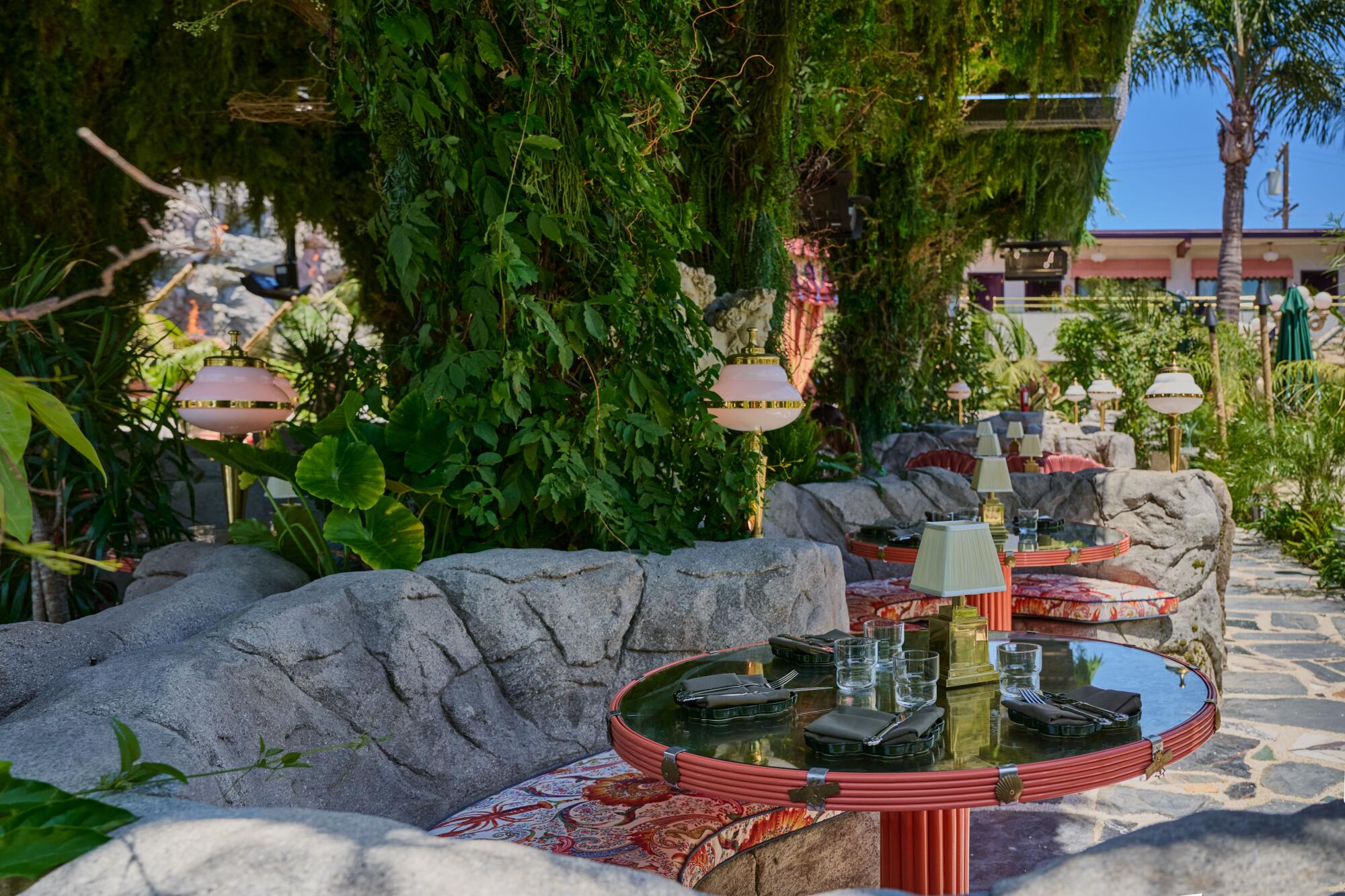
The patio dining area of Coronado's new Night Hawk includes seating for about 150.

The patio dining area of Coronado’s new Night Hawk includes seating for about 150.

Baby Grand’s high-density, high-gloss environment, which cost about $17 million and took about five years to complete, will come as no surprise to those who have followed Tafazoli’s earlier ventures.

Asked about the design philosophy behind the 2023 renovation of the Lafayette — the company’s first hotel — Tafazoli had a simple answer: “More is more.”

The Baby Grand project, put together in collaboration with design studio Post Company, is cut from the same cloth, describing itself as a “polychromatic pastiche” on its website. The goal, Tafazoli said, is to enrich Coronado’s culture and give people a respite in an anxiety-ridden time. But “it is different,” he said. “I don’t know if it is going to be embraced.”

Getting the necessary city permissions “was definitely a struggle,” Tafazoli said. “Had I known how difficult this was going to be, I don’t know …”

In the days before the hotel’s opening, Tafazoli, 44, led a tour of the site. The entrepreneur, whose heritage is Persian, wore his hair in braids and a button-down Supreme shirt featuring Barack Obama.

The Baby Grand hotel's guest rooms feature separate tub and shower.
A shadow is cast on marble flooring in courtyard near oyster bar.
Wall detail outside the lobby.

The Baby Grand hotel’s guest rooms feature separate tub and shower.

“I have a very one-dimensional existence. I’m single. I have no kids. This is what I do,” said Tafazoli, who grew up in San Diego and studied at UC San Diego. He lives now in downtown San Diego’s East Village, where his company is based and where his first CH venture, Neighborhood, opened in 2007.

Though his company started with eating and drinking establishments, Tafazoli said, his goals were always to create and run hotels, “the pinnacle of hospitality.” As a child of divorce, he said, he may have a heightened awareness of when the energy feels right in a room and when it doesn’t. Creating social environments, he said, gives him some control over that. Moreover, he added later, “beauty is important to me, because it conveys care.”

To make the most of Baby Grand’s compact location (2/3 of an acre), the CH team has exported parking. Instead of leaving their cars on site, guests will hand keys to valets who will deposit vehicles in a Bank of America parking structure a block away. That move freed up space for not only palm trees, torches, tables, booths and 21 pieces of statuary from Spain, but also a little faux beach with a 4-foot-deep wading pool that can hold a handful of people.

“I can’t tell you how many iterations of sand were brought in and taken out,” Tafazoli said. “Sand is its own universe. You want local sand. But local sand was not conducive to that feeling.” So the sand is from Turkey.

1

Guest shower in an en suite bathroom.

2

Hotel design touches include guest bathroom door handles.

3

Fiberglass clamshells serve as headboard in guest rooms.

1. Guest shower in an en suite bathroom. 2. Hotel design touches include guest bathroom door handles. 3. Fiberglass clamshells serve as headboard in guest rooms.

The property’s main restaurant, Night Hawk, is Mediterranean, with cooking by open fire, a Greek ruins vibe and seating for about 150. The second restaurant lurks behind the lobby — a hidden oyster-and-Champagne bar that holds about 35 people, reservation only. The space, called Fallen Empire, features red mohair booths, built-in Champagne buckets, mirrored walls and chandeliers, sconces and lamps from the Italian glass-blowing island of Murano. The floor is a custom mosaic of sea creatures.

There are 31 guest rooms, beginning at $350 per night. Each is dominated by a custom-made clamshell headboard (fiberglass). Beds are surrounded by animal-print seating, parquet oak flooring, marble tables, mirrored cabinets and custom wallpaper. The rooms measure roughly 300 square feet each, nearly half of that space taken up by their elaborate bathrooms, each with separate tub and shower, sinks from Morocco.

Now picture all of that placed in the heart of Coronado (population 20,192), which sits next to Naval Air Station North Island and is known for attracting well-heeled retirees. The median home value is $2.5 million.

Up the block from the Baby Grand is the grand dame of San Diego County tourism, the Hotel del Coronado, which went up in 1888, completed a $550-million renovation last year and starts its rates north of $600. Another option is the Bower Coronado, also a dramatically upgraded motel that reopened in 2025 with prices similar to Baby Grand’s but a much more buttoned-down style.

This view from above at the Night Hawk restaurant space shows a stone booth, elaborately patterned cushion and table top.

This view from above at the Night Hawk restaurant space shows a stone booth, elaborately patterned cushion and table top.

All of those properties stand close to Coronado’s wide, sandy beaches — which means they all face challenges as waters are often fouled by the northward flow of untreated sewage from greater Tijuana. The longstanding problem has worsened in recent years, and Coronado’s Central Beach was closed to bathers on 129 days in 2025 because of unsafe bacteria levels. The U.S. and Mexican government say they have sewage-treatment projects in progress, with improvements expected by the end of 2027.

“We are, unfortunately, not marine scientists just a group of deeply overcaffeinated hoteliers with strong opinions about lighting, linen textures, and good design. So please check local water conditions before swimming,” Tafazoli wrote in a statement.

Asked his target market for the new hotel, Tafazoli said he was looking close to home.

“I see this as a staycation for locals” from San Diego County, Tafazoli said. “The big risk is that we don’t get locals and it doesn’t resonate with tourists who like the status quo.”

That said, Baby Grand and Coronado might be a better match than some imagine. Christine Stokes, executive director of the Coronado Historical Assn. and Museum, sees at least a few parallels to Baby Grand in local history, beginning with the historical association’s own building. From the 1950s into the 1990s, Stokes noted in an email, Marco’s Restaurant operated in the space, with a “Roman Room” bar — “a dark and immersive hidden gem where bartenders performed sleight-of-hand magic tricks.”

Guest rooms, including No. 103, are labeled with inscribed brass clamshells.

Guest rooms, including No. 103, are labeled with inscribed brass clamshells.

Then there was the Hotel del Coronado’s Circus Room restaurant, open from the 1930s into the 1960s. That was “an immersive environment, using specialized murals and striped tents on the walls,” Stokes wrote. It’s also where, in 1950, the manager of an L.A. TV station spotted a promising young piano player and decided to give him a chance on screen. The pianist’s name was Liberace.

However people respond to the particulars of the new hotel, Tafazoli said, he knows that the larger setting of Coronado is a special place.

From his office in San Diego’s East Village, “it’s a six-minute drive,” he said. “I come off that bridge, and I feel like I’m in a different place.” It’s amazing, he said, “to be so close and feel so far away.”
Source link

L.A. ‘barn’ explodes with colorful thrifted finds and maximalist flair

“Gambrel roofed Barnhaus,” the listing read, “next door to the best burritos in town.”

Its photos revealed something unusual for Inglewood, which is famous for its mix of architectural styles, including Midcentury Modern homes by R.M. Schindler and Googie-style coffee shops: a brick-red barn-style house on a large corner lot, listed at $449,000.

When Meeshie Fahmy and her husband, Aaron Snyder, toured the house, they learned that the burrito claim was true. The photos, however, had clearly been touched up to make the house, located just a few miles from the Kia Forum and SoFi Stadium, look better than it actually was.

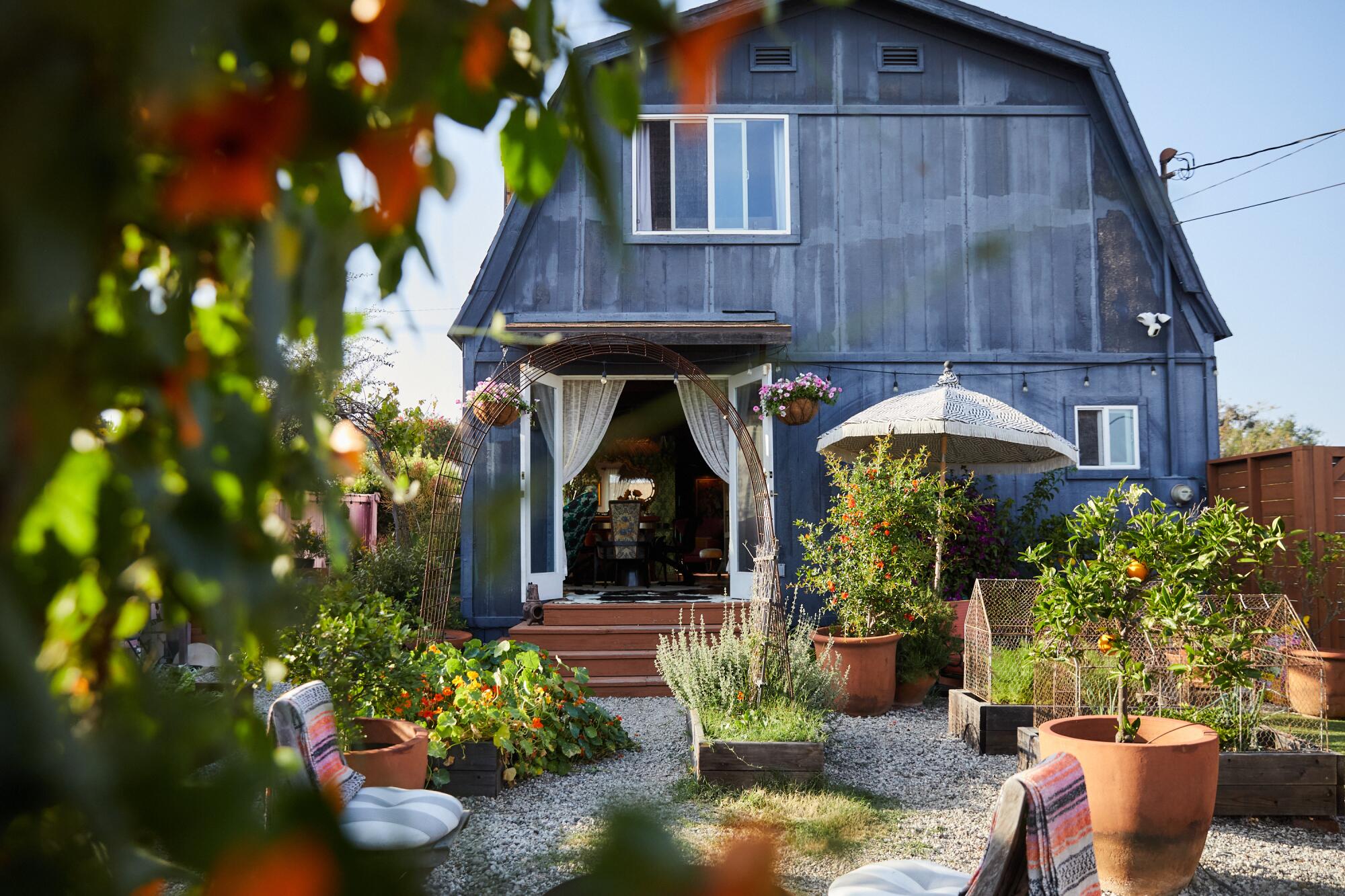
A blue barn-style house with a lush garden filled with flowers.

Outside, the former dirt lot is now a lush garden with towers of colorful black-eyed susans on arches, planters full of nasturtiums and vegetables, a firepit and pergola.

Inside, the house had “wall-to-wall carpets on both floors that were heavily stained and worn, dated wood paneling on the walls, holes in the walls,” Fahmy says.

Despite these flaws, the couple saw the home’s potential and decided to buy it, even though a leaning retaining wall nearly derailed their escrow. “It was a blank canvas for us to play and experiment,” she recalls a decade later.

  • Share via

After they moved in, neighbors revealed the house was not original to the site. Years earlier, the original Craftsman had been torn down; the current house, a sweepstakes prize, arrived in two pieces by crane. “Our neighbors recalled it was quite a sight,” Fahmy says.

At the time, Fahmy, 44, worked as an event planner at the Getty Museum. As renovations started and she followed her passion for interior design, Snyder proudly introduced her to staff at the local Carniceria as “an interior designer.” She replied, “That’s not what I do.”

“I told her, ‘If you don’t start saying it, it’s not going to happen,’” says Snyder, 49, who pursued his own dream of becoming a professional skateboarder before moving into video editing. “Speak it to existence.”

Finishing the house took years, patience and a lot of DIY projects because of their budget. But Fahmy didn’t just dream — she made it happen. In 2018, she started working for interior designer Willa Ford, who mentored her at WFord Interiors. By 2020, Fahmy launched her own design firm, Haus of Meeshie. “It’s been a progressive layering of colors, furniture, reupholstering, adding art, wallpaper, lighting,” she says. “Low and slow; the flavor is richer.”

Meeshie Fahmy and Aaron Snyder's family room, a colorful and over the top maximalist dream.

Meeshie Fahmy and Aaron Snyder’s family room is a colorful maximalist dream with thrifted furnishings, art and layered textures and patterns.

A trippy clock stands next to a large scale print
A living room with green walls, art and eclectic furnishings

Ninety percent of the furnishings are thrifted. “Nothing is too precious,” Fahmy says.

Today, their home reflects Fahmy’s fearless approach — it’s a true “petri dish for experimentation.” The vibrant, layered four-bedroom house is a maximalist fever dream, packed with furniture, accessories and art sourced from Facebook Marketplace, vintage shops, flea markets (Long Beach flea is a favorite), estate sales and secondhand stores in L.A. and elsewhere.

She estimates about 90% of the furnishings and accessories in her home are thrifted, antiques or things she found on the side of the road, and nothing is too precious, reaffirming her playful approach to decor.

A dining room with art hung salon style on the wall.

A Jonathan Adler dining table, found on sale, sits in front of a wall filled with art arranged salon-style. Among the pieces is Fahmy’s favorite: a wedding portrait her father, Walter Fahmy, painted of her.

A colorful lounge with green wallpaper.

The speakeasy features a vintage standing bar from Craigslist, barstools and a Geo pendant light by Los Angeles designer Jason Koharik and a mirror Fahmy found at a neighborhood estate sale.

She likes to refer to her decorating style as “creatively unhinged.”

“It all flows,” she says, curled up with her dogs on a CB2 couch she found on Craigslist. “There’s a rhythm. Every piece tells a story. Pick one — I’ll share it.” She recalls throwing herself on a vintage Baker sideboard at a Florida Goodwill without knowing how she’d get it back to Los Angeles and laughs when Snyder discovers a tiny Jack Black-as-Jesus portrait tucked into a gilded dining-room oil painting.

The sink and vanity in the guest bathroom? That used to be a dresser she found on Craigslist.

Although others have questioned their home purchase, Fahmy never doubted they could transform the space into something special.

A kitchen with blue cabinets.
A purple bathroom with artworks hanging on the walls.

A red wall with photographs.
A staircase leading up to the second level, backed by a pink wall.

Color ties the house together. The powder room is purple, the entry hall is red, the kitchen has blue cabinets and the hallway is painted pink.

“When I first saw the house, when they bought it, I thought she was crazy,” Meeshie’s friend and former colleague, Talene Kanian, says in an email. “Other than keeping the ‘barn’ shape, she completely transformed the interior. Now, when you step inside, you’re welcomed into a home full of color, pattern and playfulness.”

Snyder adds: “Meeshie is able to visualize things 10 steps ahead of everyone else, even things that seem like a complete mess.“

Working together, the couple removed the shag carpeting and wood paneling from the first floor and the stairway, installing drywall in their place.

Next, they painted the walls — no beige here. The deep green living room sets a bold scene: a clock worthy of Dalí, leopard prints, pink Persian rugs, a snake ottoman and a thrifted tufted chair with Art Deco vibes from CB2.

Designer Meeshie Fahmy pictured with her pet dogs in her garden.

“I did not venture into interior design formally,” Fahmy says. “I feel very lucky to have found this passion.”

The color story flows through the house: The powder room is purple, the entry hall red and the dining room walls pink, with one wall in a bold 1970s-style mushroom-pattern wallpaper from Londubh Studio. The speakeasy features a vintage standing bar from Craigslist that Snyder squeezed into his car, barstools and a Geo pendant light by Los Angeles designer Jason Koharik and a mirror Fahmy found at a nearby estate sale.

In the kitchen, they removed the 1970s-era wooden cabinets and Formica countertops, replacing them with more pink walls, Moroccan-style tile flooring and blue cupboard fronts from Semihandmade, which creates cabinet doors for IKEA cabinets.

Fahmy painted a Keith Haring-style black-and-white mural at the top of the stairs and continued onto the second-floor walls using a paintbrush taped to a broomstick. She finished by painting the handrail bright blue and wrapping each stair with a Persian-style runner.

Outside, the couple leveled the once-dirt backyard, added pea gravel, built a pergola with a handyman and installed a firepit where they enjoy entertaining their friends.

A bedroom with burgandy walls
A bathroom with perisan rug print wallpaper

The main bedroom features burgundy walls, while the bathroom next to it has Persian rug-patterned wallpaper from House of Hackney.

Now the once-empty backyard is a lush garden: towers of colorful black-eyed susans on arches, planters of nasturtiums and homegrown vegetables. A trickling fountain greets visitors as they walk through the French doors. Snyder, an avid cook, can easily step out to cut fresh herbs mid-simmer, making the outdoors a true extension of the home.

The couple’s home is full of memories, and as you walk through, you can sense how much their stories matter to them. In the downstairs hallway, Snyder smiles as he points out photos of his family in Wisconsin. Similarly, Fahmy proudly shows a photo of her great-great-grandmother Theresa “Tessie” Cooke Haskins, a noted harpist whose daughter Maud Haskins was the first harpist to perform with the orchestra at the Hollywood Bowl.

Art is everywhere, from the Polaroids pinned to the walls in the powder room to the ceramics and masks hanging throughout the house. Yet Fahmy’s favorite possession is deeply personal: a portrait of her on her wedding day, painted by her father, Walter Fahmy, who studied art in Egypt before coming to America.

A staircase with pink walls leads to the downstairs.
Upstairs hallway leading into designer Meeshie Fahmay and Aaron Snyder's primary bedroom.

Upstairs, Fahmy created a black-and-white mural inspired by Keith Haring at the top of the stairs, then kept going along the second-floor walls using a paintbrush taped to a broomstick. She finished by painting the handrail a bright blue and wrapping each stair with a Persian-style runner.

View of designer Meeshie Fahmy and Aaron Snyder's dining room looking onto their outdoor garden in their home.

French doors connect the house to the garden, so the backyard feels like a natural part of the home.

For Fahmy, these details matter. “I feel like our home is a love letter to my upbringing,” she says, referring to her parents, who were both pharmacists. “It’s an ode to them and the sacrifices they made for me.”

Visitors feel the same way. Their house is a true labor of love, apparent the second you enter,” Kanian adds. “It radiates warmth and love.”

Snyder feels it too. “I feel an immense amount of pride when I walk into our house,” he says.

Like a barn raising that brings people together, their house has become a welcome part of the neighborhood with its blue siding, bright yellow front door and a playful mural by Venice artist and skateboarder Sebo Walker. “We’ve had neighbors knock on our door and tell us, ‘We love what you’re doing,’” says Snyder.

A blue kitchen looking into the living room.

“I love color,” Fahmy says. “I love to experiment.”

With the main house finished for now, Fahmy hopes to turn the garage into an accessory dwelling unit, or ADU, in the style of Mexican architect Luis Barragán: bold with color and texture. “I’m envisioning a mini boutique hotel,” she says. “Simple to execute, yet unique in L.A. I’d love a pink building.”

Like the possibility of a pink building — or not — Fahmy’s freewheeling style proves it’s OK to experiment and make mistakes. (She wants to demo the kitchen next for a fresh look.)

“You’re not tattooing your face. You’re painting your walls,” she says as a way to encourage others to experiment. “Your home should be a reflection of who you are. I hope our home inspires others to live how they want to live.”

Source link