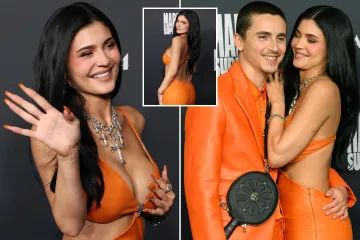
Odessa A’zion was a glamorous vision at the New York premiere of Marty SupremeCredit: SplashShe stars alongside Timothee Chalamet in the hot new filmCredit: Thunder Kick Photos / SplashNews.comOdessa A’zion plays Timothee’s on-screen childhood sweetheart Rachel MizlerCredit: PAAnd her mum is none other than King of the Hill voice actor Pamela AdlonCredit: WireImage
When a clip from the interview was shared on TikTok, fans immediately rushed to comment on the similarities between the actress and her famous mum Pamela Adlon, who voices Bobby from King Of The Hill.
One wrote: “SHE SOUNDS JUST LIKE HER MUM!”
Someone else said: “I was thinking her mannerisms are ALL her mom, it’s wild.”
And one follower replied: “Yep, her mother is Pamela Adlon.”
Pamela, 59, has voiced Bobby Hill in King of the Hill since the show’s debut in 1997.
She has also voiced a number of other famous characters such as Ashley Spinelli in Recess.
Pamela made her acting debut in Grease 2, with other on-screen roles in Californication and Boston Legal.
She was also nominated for an Emmy for her performance in FX series Better Things, which she co-wrote and starred in for five seasons, appearing alongside comic Louis C.K.
Pamela is clearly proud of her daughter following in her showbiz footsteps, sharing an excited Instagram post about Odessa’s role in Marty Supreme.
“By the gods!!!!! I’m the mom——imagine…? I CAN’T handle. My little girly-poo did this,” read her caption as she shared the film trailer on her social media profile.
“She has always manifested like a motherfucker (also…she is very extremely talented) CONGRATULATIONS ODESSA! I can’t wait see this movie!”
Odessa stars in Marty Supreme as Rachel, the childhood sweetheart of Timothee Chalamet’s character Marty Mauser.
The film has opened to rave reviews and debuted on Rotten Tomatoes with an impressive 94% rating.
Pamela Adlon with a young Odessa A’zion and her sister Gideon AdlonCredit: AFF-USAPamela is best known for voicing Bobby Hill in popular US sitcom King of the Hill
The up-and-coming actress also plays Tallulah Stiel in new HBO series I Love LA alongside Rachel Sennott.
Odessa recently opened up about landing her role in Marty Supreme – and confessed she was worried about the release being so close to I Love LA.
She told Time: “Marty Supremewas really the first time that I felt like, oh my God, this is the exact role that I’ve always wanted to play.
“I know sometimes people get annoyed when they see someone’s face too much.
“I didn’t know if it was going to be too much at the same time with the show and the movie. I didn’t want to throw people off.”
She recently appeared on the Drew Barrymore Show to talk about the filmCredit: TikTokFans couldn’t believe how much Odessa sounded like her mum PamelaCredit: Getty
She must have written that story before “Song Sung Blue” came out. Because Hugh Jackman passionately describing the greatness of Neil Diamond’s “Soolaimon” and then demonstrating that song’s grandeur by performing it in the new film “Song Sung Blue” is the definition of corny, feel-good comfort.
Which leads me to my question to you this day: Have you seen “Marty Supreme”? And what feelings — good, bad, uneasy, elated — did that movie arouse in you?
He summited the Sphere, exhorting us to “dream big.” He shot a rap music video to debunk the conspiracy theory that he is a popular British rapper. He has popped up at screenings flanked by bodyguards sporting giant orange ping-pong balls for heads.
Leading up to the Christmas Day premiere of his new movie, “Marty Supreme,” Timothée Chalamet was front and center in a promotional tour that was unhinged, delightful and, judging from the weekend’s box office, quite successful.
“Marty Supreme,” the wildly entertaining, over-caffeinated portrait of a single-minded ping-pong player, took in $27 million over the four-day Christmas weekend, the best opening in distributor A24’s history. The numbers surpassed the opening of “A Complete Unknown,” last year’s Chalamet Christmas release that featured the actor playing Bob Dylan in his formative years.
Not everyone was on board with “Marty.” Moviegoers gave the movie a B+ rating with market research company CinemaScore. That’s good, but not great. (“A Complete Unknown,” by comparison, earned an A.)
Podcaster Claira Curtis’ experience seeing the movie at the Grove feels like an accurate representation of the “Marty Supreme” adventure: “Packed ‘Marty Supreme theater had the full range of reactions. There were people walking out halfway through. There were people clapping. There was someone coming out of it saying, ‘Eh, it was fine’ & then their friend went, ‘Are you insane? It was peak!’”
The disparate responses reflect a couple of things.
One, not everyone embraces the Safdie brand of anxiety-inducing cinema. Josh Safdie directed “Marty.” His brother, Benny, made “The Smashing Machine,” released earlier this year. Together, they made “Uncut Gems” and “Good Time,” movies that, take your pick, were exhilarating or excruciating. Or both! (Exclamation point intended. These are exclamation-point films.)
And two, the title character in “Marty Supreme” is a lot — an undeniably talented, relentless self-promoter careening toward his goals of fame and fortune with little regard to the damage he is inflicting on others. He’s despicable, but also, as played by Chalamet, winningly charming. Unless you find Chalamet annoying. Then you’re probably best-served listening to Hugh Jackman sing Neil Diamond songs.
Chalamet has channeled Marty’s earnest energy in his promotional appearances for the film.
“This is a movie about sacrifice in pursuit of a dream,” he told Jimmy Fallon on “The Tonight Show.” “And it’s something I can relate to deeply. And we live in a bleak time, especially for young people, so this film is an attempted antidote to that.”
Chalamet then pivoted to the camera, the better to look into viewers’ eyes.
“And to continue to believe in yourself and to continue to dream big and to follow your dreams and not take no for an answer. That’s the spirit of ‘Marty Supreme,’ out on Christmas Day.”
Judging from the box office, Chalamet has pushed across the message. Will it work on awards voters, giving Chalamet the first Oscar of his career? As we head into the new year, the next phase of the “Marty” tour promises to be the season’s most interesting storyline. Gas up the blimp!
First clue that someone is serious about pingpong: They call it table tennis.
Second clue: They bring their own paddle.
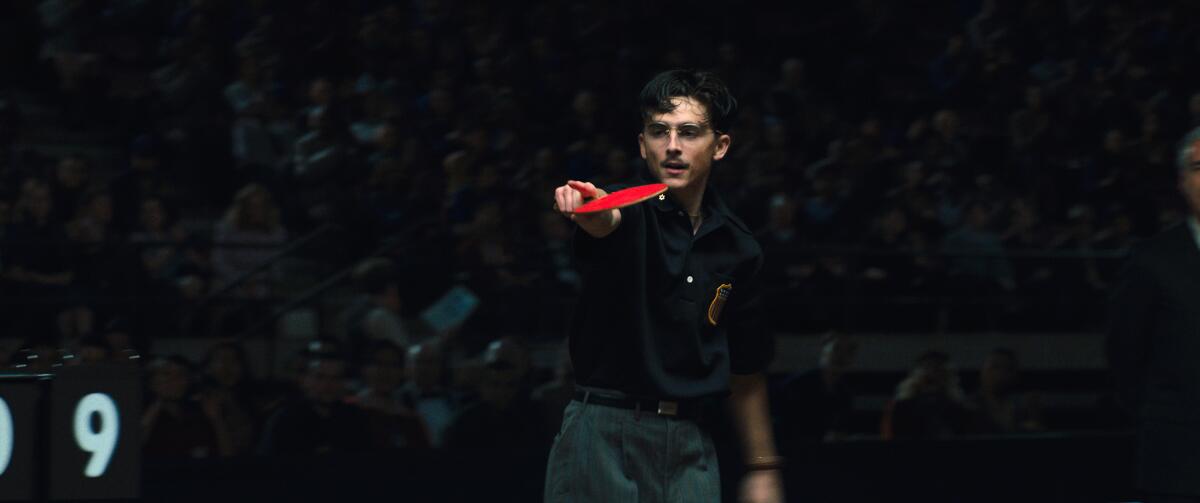
Timothée Chalamet dropped a third clue on movie sets all over the globe. To prepare for his role in the delightfully frenetic “Marty Supreme,” the two-time Oscar nominee traveled for years with a table in tow, training and presumably enjoying the sport at the center of the current holiday season hit.
Director Josh Safdie enlisted the husband-and-wife table-tennis teaching tandem of Diego Schaaf and Wei Wang — a former U.S. Olympian — to elevate Chalamet’s game as well as serve as technical advisors on set.
But Chalamet was already playing nearly well enough to emulate a world champion on screen. He’d taken lessons and done his homework — setting up a table in the living room of his New York apartment and playing throughout the pandemic.
“Everything I was working on, it was this secret,” Chalamet told the Hollywood Reporter. “I had a table in London while I was making ‘Wonka.’ On ‘Dune: Part Two,’ I had a table in Budapest [and] Jordan. I had a table in Abu Dhabi. I had a table at the Cannes Film Festival for ‘The French Dispatch.’”
It seems implausible that Chalamet was immersed in table tennis while also learning to sing and play guitar for the role of Bob Dylan in “A Complete Unknown.”
“If anyone thinks this is cap, as the kids say — if anyone thinks this is made up — this is all documented, and it’ll be put out,” he said. “These were the two spoiled projects where I got years to work on them. This is the truth. I was working on both these things concurrently.”
Wherever Chalamet found the time, Schaaf was impressed by the result.
“He was singularly dedicated to getting this to be the same quality as the rest of the movie,” Schaaf told the Hollywood Reporter.
Eschewing a stunt double for the table tennis scenes was a point of pride for Chalamet. The only concession to modern moviemaking was that several of the longer sequences during games were choreographed without a ball, which was added later via computer-generated imagery (CGI).
“We realized it had to be scripted to be able to film it,” Schaaf told the Washington Post. “And because it was scripted, we had to practice it first with a real ball. He had to understand the physical layout of the point: Where does he have to go? When does he have to go there? When you later on do [visual effects] and put the ball in there, it’s critical that the player goes to the right place.”
Schaaf said about 60 points were scripted.
“We needed a lot of rehearsal, and I was amazed,” he said. “Timothée wound up getting a better feel for it than most professional players because professional players take the cue from the ball. You take the ball away, they all were like ‘What is the timing?’
“Of course, they have a good sense of timing and then they learned it quickly. But Timothée was right there on top of it.”
The on-screen rival of Chalamet’s character, Marty Mauser, is Koto Endo, portrayed by real-life Japanese table tennis champion Koto Kawaguchi. Their dynamic approximated the real-life rivalry between 1950s U.S. champion Marty Reisman and Japan’s Hiroji Satoh.
In her review of “Marty Supreme,” Times film critic Amy Nicholson noted that well-struck pingpong balls travel up to 70 mph.
“Set in 1952 New York, this deranged caper races after a money-grubbing table tennis hustler (he prefers ‘professional athlete’) who argues like he plays, swatting away protests and annoying his adversaries to exhaustion,” she wrote.
Nicholson offers that Reisman would be pleased by the movie, “which time-travels audiences back seven decades to when American table tennis players were certain bright days were ahead.
“As an athlete, Chalamet seems to have lost muscle for the role. Yet as funny as it is to see a guy this scrawny carry himself like Hercules, he leaps and strikes with conviction.”
Nothing gives an actor — or an athlete — self-assurance like practice, repetitions and rehearsals. Chalamet’s paddle performance is proof.
A ping-pong ball at top speed travels over 70 miles an hour — so fast it could zip across Manhattan in less than two minutes. Director Josh Safdie’s hyperactive, head-spinning “Marty Supreme” keeps pace. Set in 1952 New York, this deranged caper races after a money-grubbing table tennis hustler (he prefers “professional athlete”) named Marty Mauser (Timothée Chalamet) who argues like he plays, swatting away protests and annoying his adversaries to exhaustion.
Hounding his shoe-store co-worker to give him $700 from the safe, Marty hammers the poor sap with every trick he’s got — emotional pressure, physical violence, bribery, humiliation, revenge — until he hits one that wins. The high-strung kid is pure nerve and he looks like one, too; he’s the embodiment of a twitch. But with a paddle in his hands, Marty turns into Gene Kelly in “Singin’ in the Rain.” He could win a match swinging an umbrella.
The character’s inspiration is Marty Reisman, one of the so-called “bad boys of ping-pong,” according to a U.S. Table Tennis Assn. official in 1972, explaining why the rascal wasn’t invited to the USA versus China exhibition games referred to as “ping-pong diplomacy.” You may remember those matches from “Forrest Gump,” but Tom Hanks’ guileless sweetheart would never use the sport to smuggle gold bars out of Hong Kong, as the real Reisman once did.
Share via
Reisman’s exploits, immortalized in his 1974 memoir “The Money Player,” are too outrageous to squeeze into one film, even for a chaos-feeding filmmaker such as Safdie, going solo after co-directing “Good Time” and “Uncut Gems” with his brother Benny. (A trilogy, maybe.) Reisman’s biography opened with him fleeing French-occupied Hanoi, Vietnam, the day before it fell to the Viet Minh and detoured to a meeting with the Pope in Rome before drunkenly landing a plane in Brazil. The book was optioned shortly after publication. He felt it should star Robert De Niro.
That movie never happened and Reisman died in 2012 at the age of 82, still insisting he deserved to bask in the spotlight. He’d be happy to see Safdie’s “Marty Supreme,” which time-travels audiences back seven decades to when American table tennis players were certain bright days were ahead.
As an athlete, Chalamet seems to have lost muscle for the role. Yet as funny as it is to see a guy this scrawny carry himself like Hercules, he leaps and strikes with conviction. His Marty yearns for prestige. Safdie even concocts a subplot in which he invents his signature orange ball solely so he can wear all-white like the posh jocks of Wimbledon. He starts the film desperate to fly to a tournament in London, in part to escape the walk-up apartment where he’s always squabbling with his mother (Fran Drescher) and uncle (Larry “Ratso” Sloman) and a nosy neighbor (Sandra Bernhard). Perilously, Marty’s secret lover (a simmering Odessa A’zion) lives with her jealous husband (Emory Cohen) in an apartment one floor below.
Marty and A’zion’s Rachel belong together, if only to quarantine their equally manipulative genes from the general population. Before the opening credits, the couple improvises a lie to get some privacy to mate. Cinematographer Darius Khondji sends the camera inside her body to see Marty’s most aggressive sperm wriggle to the finish line. Rachel’s egg becomes the moon; the moon becomes a ping-pong ball. Game on.
From this scene forward, Marty will dash around the city and the globe, chasing his dreams and out-running his parental responsibilities. Along the way, he trips over a gun-toting gangster named Ezra (Abel Ferrara), a faded movie star, Kay (Gwyneth Paltrow, sullen and aloof), and her callous husband Milton (“Shark Tank” investor Kevin O’Leary), the chief executive of a pen corporation who thinks Marty can make him a mint in ping-pong-crazed Asia. O’Leary, a first-time actor, easily embodies the face of capitalism.
Flaunting that he can turn anyone into an actor, Safdie crowds his New York with bit parts played by big personalities: magician Penn Jillette, fashion designer Isaac Mizrahi, basketball player George “The Iceman” Gervin, highwire artist Philippe Petit, playwright David Mamet, journalist Naomi Fry and grocery tycoon John Catsimatidis. The musician Tyler Okonma, better known as the Tyler, the Creator, is great in his feature film acting debut as Willy, Marty’s gambling wingman. He was previously seen onscreen getting electrocuted by a piano in “Jackass Forever.” Okonma brings that same energy here and it’s perfect.
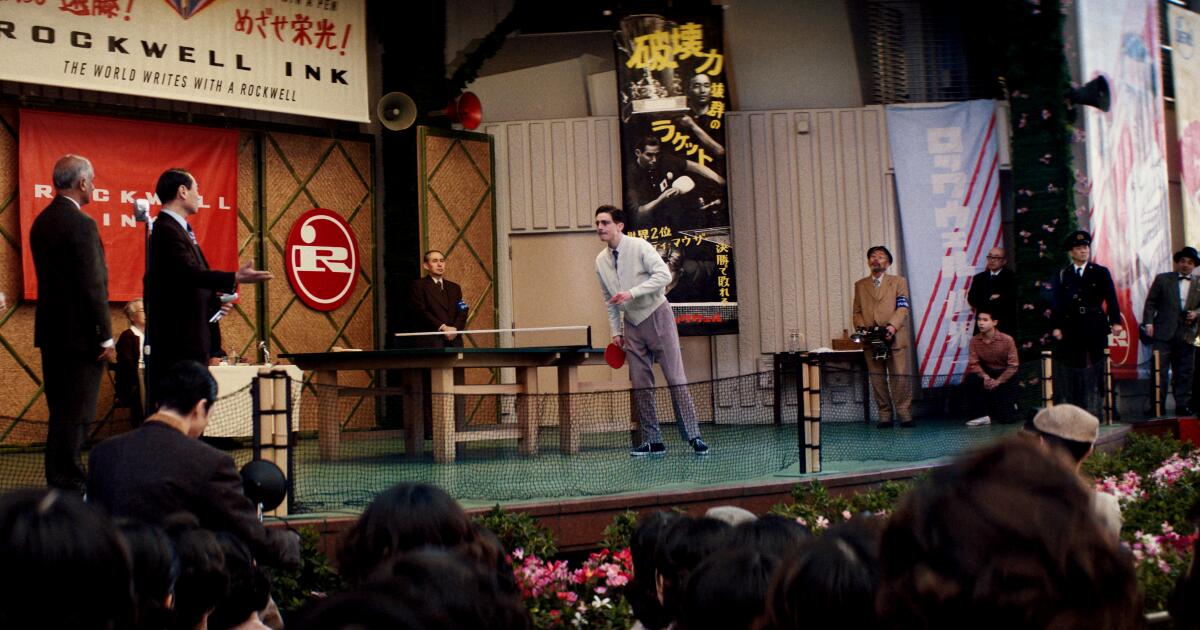
Marty’s main foe — and personality opposite — is a Japanese player named Koto Endo (Koto Kawaguchi) who lost his hearing in the Tokyo airstrikes that happened seven years before and uses a deadly quiet foam-backed paddle. Marty’s friendliest rival, Béla (Géza Röhrig), survived Auschwitz, and in a jaw-dropper of a scene, shares a story of endurance that actually happened to the Polish player Alex Ehrlich. Imprisoned in the camps shortly after winning silver at the World Championships in 1939, Ehrlich was renowned for a record-breaking competitive volley that lasted over two hours, a back-and-forth so relentless that the referee quit with a sore neck. The rhythm of it could be a metronome for this movie’s plot — it whips us around to the point of delighted collapse.
The soundtrack is an unexpected backbeat of synth hits by Tears for Fears and New Order that bleeds into a Tangerine Dream-esque score by Daniel Lopatin — a startling choice for an era where people act like World War II happened yesterday. But to our modern ears, the music has its own vintage: It’s the sound of the greed-is-good 1980s, when movies rooted for ruthless strivers such as “Risky Business’” Tom Cruise, who opened a brothel in his parents’ bedroom.
Safdie’s script, co-written by Ronald Bronstein, is even structured like an ’80s movie that builds up to the big showdown, be it a ski race, a car-washing competition or a frat house decathlon à la “Revenge of the Nerds.” The catch is that Marty — not Endo — may be the bully who deserves to lose. How loudly are we willing to cheer for a callow guy who thinks of WWII as an opportunity for trash talk, boasting he’ll “drop a third bomb” on Endo’s fans? (In fairness, Tokyo promotes their rematch with a poster of Marty that looks uncomfortably close to antisemitic Nazi propaganda, a pointed choice by Safdie and the production designer Jack Fisk.)
Marty is convinced he’s a self-made success who doesn’t need anyone’s help; the people we see him squeeze and squash would disagree. He’s similar to Adam Sandler’s rapacious jeweler in “Uncut Gems,” except that scoundrel contained his damage to the Diamond District and people as shady as him. Safdie sends Marty out to bedevil the world, shipping him to Paris where he gets snippy with a maître d’ who doesn’t speak English and then to Cairo where he steals a chunk of the Great Pyramids.
Listening to a Japanese newsreel describe him as a villain referred to only as “the American,” you realize that “Marty Supreme” is more than a caricature of Reisman. It’s a biography of our national ego, with Marty brashly lecturing the British head of the International Table Tennis Assn. that a champion from the United States would boost the sport’s global reputation. After the commissioner makes this conceited Yank grovel, Marty simply replies: “It’s every man for himself where I come from.”
Like Marty, Chalamet was raised in New York City, and since he arrived on the scene, there’s never been a doubt he’ll win an Oscar. The only question is, when? To Chalamet’s credit, he’s doing it the hard way, avoiding sentimental pictures for pricklier roles about his own naked ambitions. For “A Complete Unknown,” he taught himself to play guitar like Bob Dylan while revealing that the bard was a rat, and in the even-better “Dune: Part Two,” played a naif radicalized into a galaxy-destroying messiah.
Here, Chalamet again fuses his personal drive into his performance, claiming that he spent seven years training to play ping-pong like Reisman, and unlike Tom Hanks in “Gump,” he’s doing his own stunts. Voters seem content to let the young talent dangle, trusting that he’ll continue flogging himself to make more great pictures like this.
The movie’s moxie makes it impossible not to get caught up in Marty’s crusade. We’re giddy even when he’s miserable. Performing with the Harlem Globetrotters in some of the most war-scarred, joy-desperate corners of the planet, his own shame prevents him from appreciating how much he’s entertaining the crowd. When you weigh his selfish desires against any other character’s needs, Marty is as hollow as a ping-pong ball. It really is all about his balls. Their embossing reads: “Marty Supreme — Made in America.”
‘Marty Supreme’
Rated: R, for language throughout, sexual content, some violent content/bloody images and nudity