The GOP is on a rescue mission in Kansas, where Dems haven’t won a Senate race in nearly a century
TOPEKA, Kan. — At 94 years, the Kansas GOP’s streak of one-party dominance in Senate races is the nation’s longest because even in the toughest years, disaffected Republican-leaning voters have reliably drifted back to the party’s fold before Election Day.
But Republicans fear this year could be different, setting the race between Republican Sen. Roger Marshall and Democrat Adam Hamilton on track to be the most expensive in state history.
Hamilton, founder and senior pastor of the nation’s largest United Methodist church, has raised significantly more money than Marshall, who is seeking his second term. Hamilton’s candidacy — and voters’ disapproval of President Trump’s handling of the economy — have upended GOP hopes of seeing Marshall coast to victory as the GOP tries to hold its Senate majority.
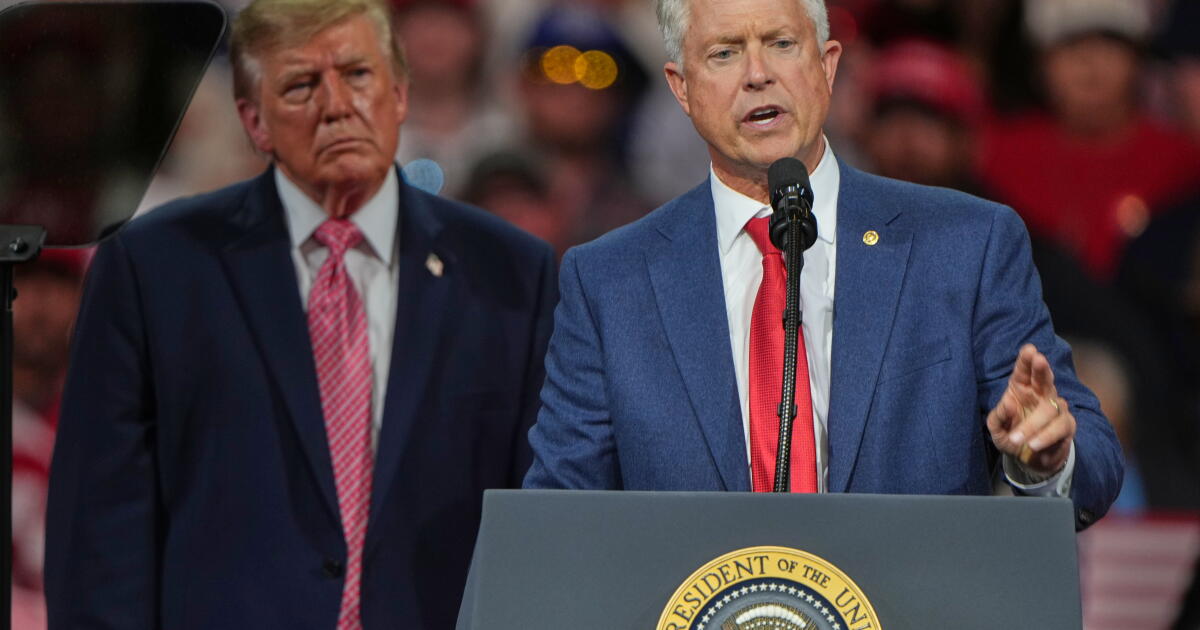
Kansas, which Trump carried in three presidential races, is an unlikely Senate battleground. Republicans redirected money from the North Carolina Senate race to help Marshall, and Trump flew to Kansas this week to hold a rally for him, calling Marshall “one of the greatest senators in our country”.
Stalwart GOP voters sensed a serious threat even before Trump announced his rally.
In Topeka, 81-year-old Julie Adamson has been praying about the election, but she’s also knocked on doors for Marshall, about 200 by her count. She said if Hamilton wins and Democrats control the Senate, “We’ll see, ‘impeach, impeach Trump.’”
“And nothing will get done for our country,” she added.
A formidable candidate emerged in a tough year for the GOP
Before entering the race, Hamilton already had a public profile in vote-rich suburbs through building his Kansas City-area Church of the Resurrection into a 25,000 member congregation. Churchgoing Protestants also knew him as the author of several dozen books, and he’s honed his speaking skills through weekly sermons.
Hamilton has positioned himself as a moderate and made rising prices, particularly for fuel, a key issue. During a debate Wednesday, both he and Marshall endorsed barring transgender girls and women from female sports teams. Hamilton called for local officials to make such decisions but suggested Marshall and other Republicans have been bullying transgender people by making the issue prominent in campaigns.
Marshall, a mostly retired doctor, portrays Hamilton as too liberal — radical, even — for a state where less than 26% of the 2 million registered voters are Democrats, while more than 44% are Republicans.
During Wednesday’s debate, Marshall repeatedly said a Hamilton victory would put Democrats in charge of the Senate and that Hamilton would vote with liberal Democrats.
“We need to remind everybody that control the Senate goes through Kansas,” he said.
There are signs that voter enthusiasm is with the Democrats as advance voting has surged across the U.S. compared to the last midterm. In Kansas, it has more than doubled for the same period.
Amanda Chavez Thomson, who is part owner of a small home-restoration business, said she believes change has been needed “for quite some time.”
“I think we finally have a candidate that can give us that energy and that surge that we need from people who may be on the fence or may not have voted in the past,” she said.
Fundraising emerges as a key concern for Republicans
Since the state’s August primary, Republican groups have committed to spending more than $26 million on television and digital advertising to boost Marshall, more than what they spent in his first race in 2020, according to the ad-tracking firm AdImpact. Including Marshall’s campaign, total GOP ad spending would exceed $32 million.
But Hamilton and Democratic groups together have committed to spending more than $38 million, according to AdImpact. Total ad spending — involving more than 40 groups outside the campaigns — would be about $71 million, a record for Kansas.
One of the reasons the GOP is pushing money towards Marshall may be that the incumbent has proven a lackluster fundraiser. Between the state’s August primary and Thursday, Hamilton has collected more than 10,000 contributions from Kansas residents, while raising $8 million from across the U.S., online campaign finance reports show. Marshall has about 200 contributions from Kansans while raising $905,000 total.
“People are crying out, saying, ‘Come on, Roger Marshall, speak up for us,’” Hamilton said during Wednesday night’s debate.
Marshall talking about liberal Democrats and ‘wokeness’
Marshall’s campaign and GOP groups have tried to knock any shine off Hamilton’s public image by attacking how he’s led his church and using snippets of his own sermons to portray him as too “woke.” During Trump’s rally, Marshall called Hamilton “the most radical liberal Democrat to ever get through a Senate primary in the history of Kansas.”
But such attacks aren’t resonating with at least a few disaffected Republicans. Don Hineman, a western Kansas rancher and former GOP state House majority leader, said he’s tired of “woke” being as an insult.
Hineman, who has signed on to the Republicans for Hamilton group, added that no one “was more ‘woke’ than Jesus Christ.”
Democrats have countered with television ads over Marshall’s pursuit of unpaid patient bills from the practice as an obstetrician that he gave up a decade ago. State court records online show that from 1996 through 2016, Marshall or his practice filed at least 700 debt-collection lawsuits, occasionally 10 or more a day.
The New York Times first reported the extent of the litigation. It said that in 81 cases, patients were arrested for missing court dates and quoted two experts who called Marshall’s tactics extreme. During Wednesday’s debate, Marshall said he’s faced a “gross mischaracterization” of his actions.
History and loyalty have been key assets for the Kansas GOP
Democrats can hold out hope for a Hamilton victory because the state has sizable blocs of moderate Republican and independent voters who’ve regularly swung elections to their candidates for governor and who protected abortion rights in a statewide vote in 2022.
Yet Republicans still have two key assets: Kansas’ political history and the loyalty that even unhappy Republican-leaning voters show to the party.
Not only have Democrats lost every Senate race in Kansas since 1932, no Democrat has come within 10 points of winning since 1974. In both 2014 and 2020, races considered tossups in mid-October fizzled, and Marshall’s predecessor, Republican Sen. Pat Roberts, won.
Leroy Towns, a former Roberts chief of staff, said many Republicans in 2014 who considered voting against Roberts “just couldn’t do it.” Towns — who switched parties because of Trump — is backing Hamilton.
Towns believes Hamilton will win, but added, “That Republican pull at the end of an election is really, really strong in this state.”
Hanna and Cappelletti write for the Associated Press. Cappelletti reported from Washington. AP writer Nicholas Ingram in Topeka, Kan., contributed to this report.