market

Chile stock market posts region’s best performance in 2025

Chile’s stock market ranked fourth globally, with returns totaling 56% in Chilean pesos.

Only Ghana’s stock market outperformed Chile, posting a gain of 79%, followed by South Korea and Zambia. File Photo by Claudio Reyes

Jan. 15 (UPI) — Chile’s stock market delivered its strongest performance in 32 years in 2025, emerging as the best-performing exchange in Latin America and ranking fourth globally, with returns totaling 56% in Chilean pesos.

Only Ghana’s stock market outperformed Chile, posting a gain of 79%, followed by South Korea and Zambia.

Santiago’s main benchmark, the Selective Stock Price Index, or IPSA, surpassed historic levels and closed the year at 10,481.47 points, marking its best annual performance since 1993.

Trading volumes also rose sharply, with the value of shares traded climbing 67.9% to a total of $50.87 billion.

Of the 30 companies listed on the index, 28 recorded positive returns in local currency, while all companies posted gains when measured in U.S. dollars.

The most valuable company and the one with the highest return was Sociedad Química y Minera de Chile, the world’s leading nonmetallic mining company in lithium and iodine production. The firm posted a return of 74.32%.

Economic analyst Jorge Berríos, academic director of the Finance Diploma Program at the Faculty of Economics and Business of the University of Chile, told UPI that the Chilean index posted an outstanding result consistent with the country’s macroeconomic normalization, which is projecting growth above 2%.

“Inflation has been trending downward and there have been cuts to the monetary policy rate, which ultimately makes investment portfolios more attractive,” Berríos said. “The banking sector is a key driver of the IPSA. The normalization of credit risks has made it particularly appealing. Banking continues to be a sector with a high rate of return compared to other markets.”

He also highlighted momentum in commodities, driven by elevated copper prices.

“There are expectations tied to advancing the energy transition. There is structural demand for electricity, which boosts mining activity and supports high commodity prices,” Berríos said.

Another factor cited by analysts was a reduction in political uncertainty.

Alex Fleiderman, head of Equity Sales at BTG Pactual, said the main driver of the market’s performance was strategic asset allocation ahead of the presidential election in November 2025.

“Polls consistently pointed to the arrival of a pro-market, pro-investment government,” Fleiderman said. “This scenario was confirmed in the December runoff with the election of right-wing candidate José Antonio Kast, whose economic policy expectations for the 2026-to-2030 period underpin market optimism.”

Fleiderman added that Chile’s economy proved resilient, exceeding initial GDP growth forecasts of 2.0% to reach between 2.3% and 2.4%.

“This upward revision was driven mainly by a recovery in investment during the second half of the fiscal year,” he said.

He also pointed to the approval of a tax reform aimed at increasing savings in the private pension system and a rise in business confidence.

“These factors combined strengthened corporate profitability,” Fleiderman said. “They shape a constructive outlook for 2026 and support a positive view of the market over the next four years under the Kast administration.”

Berríos agreed, noting that positive expectations are emerging in capital markets.

“There is a decline in country risk, greater stability and no visible changes that would affect the foundations of the country’s financial system,” he said. “That environment is encouraging stronger capital flows and increased investment.”

Together, he added, these conditions have helped produce “an exceptionally strong IPSA.”

Source link

Korea communications chief urges Kobaco overhaul as ad market shifts online

Kim Jong-cheol, new head of the Korea Media Communications Commission, speaks during a ceremony to mark his inauguration at the government complex in Gwacheon, South Korea, 19 December 2025. File. Photo by YONHAP / EPA

Jan. 12 (Asia Today) — Kim Jong-cheol, chairman of South Korea’s broadcasting media and communications regulator, urged the Korea Broadcasting Advertising Corporation, known as Kobako to pursue budget efficiency and business restructuring as broadcast advertising continues to weaken and spending shifts to online platforms.

Kim made the comments Monday during a public business report at the Gwacheon government complex covering affiliated institutions, including Kobaco and the Viewers’ Media Foundation.

“The decline in the broadcast advertising market is a global phenomenon,” Kim told Kobaco President Min Young-sam, adding that Kobaco’s challenges appear heavier than those facing other institutions.

A 2025 survey on broadcast and telecommunications advertising spending released by the regulator and Kobaco showed online advertising spending reached 10.1011 trillion won (about $7.8 billion) in 2024, accounting for 59% of total ad spending.

Online advertising has climbed steadily since topping 10 trillion won for the first time in 2023, with 2025 sales estimated at 10.7204 trillion won (about $8.2 billion), according to the survey.

Broadcast advertising continued to decline, falling more than 15% to 3.3898 trillion won (about $2.6 billion) in 2023 from 4.0212 trillion won (about $3.1 billion) in 2022. It slipped another 5% to 3.2191 trillion won (about $2.5 billion) in 2024, or 18.8% of total ad spending, the survey said.

Kim said Kobaco’s management performance evaluation has worsened for three consecutive years and called for introspection. He said Kobaco’s performance has fallen about 3 percentage points faster than overall broadcast advertising revenue, adding that the result is “painful” given the generally strong broadcasters Kobaco works with.

Min said deregulation is needed to help Kobaco expand into new markets, calling for legislative passage of a proposed amendment to the advertising sales agency law. He said Kobaco faces limits on entering parts of the digital advertising market and said “cross-media agencies” should be introduced so firms selling broadcast ads can also handle online and mobile advertising.

Kim said structural responses are needed but urged the corporation to focus on measures it can take on its own, including restructuring, to use this year’s budget more efficiently.

— Reported by Asia Today; translated by UPI

© Asia Today. Unauthorized reproduction or redistribution prohibited.

Source link

‘I’ve been to dozens of market towns — there’s 1 I keep returning to again and again’

It’s somewhere I keep returning to and never get tired of – in fact, I think it’s one of the loveliest market towns

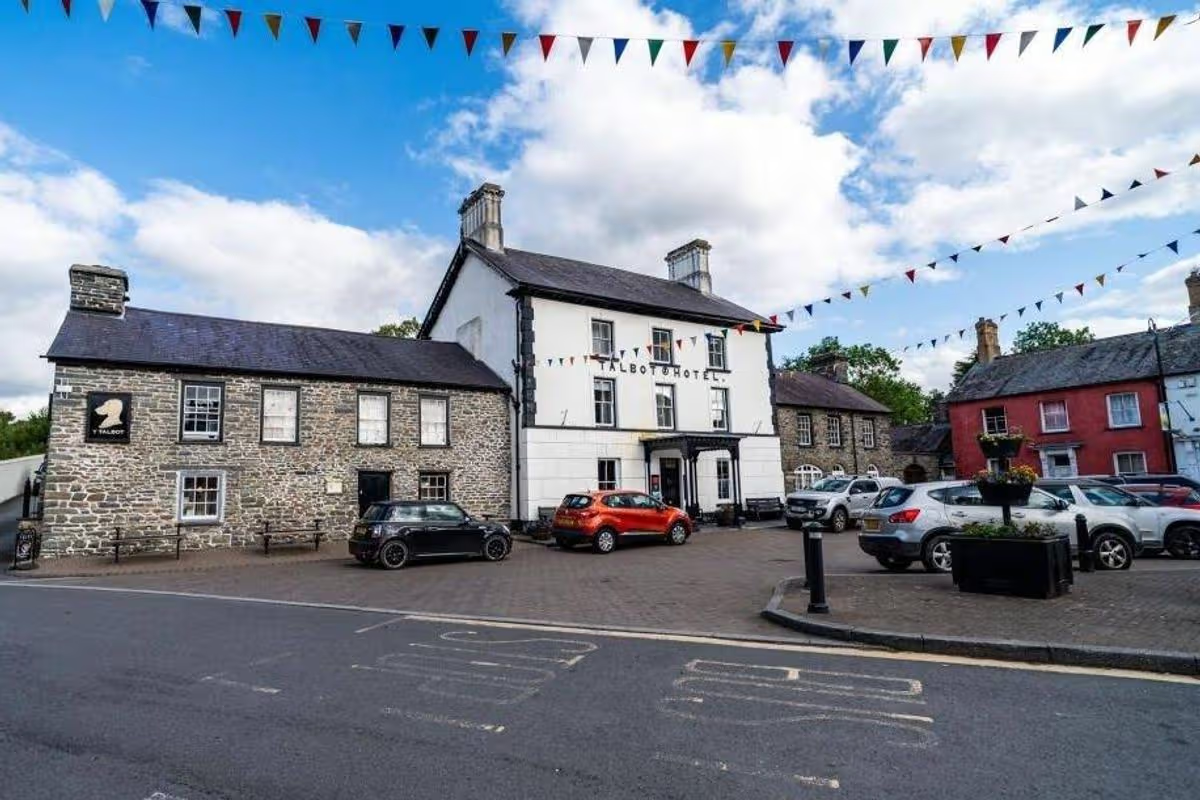
Regular readers of journalist Portia Jones will be well aware of her unabashed affection for Welsh market towns. A mix of authentic pubs, independent retailers, and eccentric cafes offering local fare and quality coffee is Portia’s idea of bliss.

However, one stands out above the rest and she has finally settled on her favourite. Portia explains why…

I’ve visited a considerable number of market towns throughout Wales, and I’m often asked which one tops my list. It’s a tough question given the country is practically brimming with charm, but after much contemplation, mostly undertaken in pubs, I have an answer.

Rhayader. Always Rhayader. The place I find myself returning to time and again, and the one I rave about to anyone unfortunate enough to ask for recommendations. I could talk about it for hours!

Situated at the crossroads in mid-Wales, this is a vastly underappreciated gem that, despite its wealth of attractions, doesn’t receive the recognition it deserves, reports Wales Online.

Boasting the stunning dams and reservoirs of the Elan and Claerwen Valleys, I believe Rhayader ranks among the finest market towns in Wales and merits a lengthy visit when journeying along the A470.

This community-centric market town serves as an ideal base for biking, hiking, wildlife spotting, or simply unwinding with friends in traditional pubs.

Rhayader has long functioned as a mid-Wales hub for weary travellers, acting as a stopover for drovers and those journeying the lengthy route from London to Aberystwyth.

Today, it’s recognised as the entrance to the Elan Valley and is situated just outside the expansive estate. It serves as a handy base with numerous independent shops, cafes, and pubs, also branding itself as the ‘outdoors capital of Wales’.

In terms of pubs, you’ll be spoilt for choice in Rhayader, boasting an impressive number of quality establishments for a relatively small town, which is one of the many reasons it tops my list of market towns.

For a hearty Sunday lunch, make your way to The Crown for generous helpings of meat, vegetables, and Yorkshire pudding. It’s a Sunday roast just like mum used to make – no-nonsense, satisfying, and drenched in gravy.

You certainly won’t leave feeling peckish. The Historic Triangle, a beautiful 16th-century drover’s inn located a brief walk away in Cwmdauddwr, offers a cosy fire, real cask ales on tap, and homemade food featuring several pub favourites.

The Lamb and Flag is another great spot for ales, traditional bar meals, and Sunday carveries, while the vibrant green Elan Hotel’s bar boasts a decent selection of beverages.

Pop into The Lost Arc for lunch and coffee at this quirky community cafe. Be sure to try my favourite – a delicious Welsh rarebit consisting of toasted bread covered in warm mature cheddar, Welsh ale, and a touch of laverbread and mustard.

It’s truly divine, and I challenge you to find a better one in Wales. If you do, let me know – I’m always on the hunt for a top-notch rarebit. In addition to a god-tier Welsh classic, they also offer coffee, cakes, light lunches, and a variety of vegan options.

By evening, this trendy spot morphs into a live music venue, featuring up-and-coming acts and hosting popular pizza nights.

The Old Swan Tea Rooms is a charming, family-run tea room and cake shop that provides a delightful setting for homemade pasties, cakes, and lunches. Don’t miss their irresistibly tasty chicken curry, made from a family recipe.

For a top-notch caffeine hit in Rhayader, make a beeline for Narrative Coffee, the fresh face on the high street, already causing a stir and garnering glowing reviews.

This chic little place recently reached the finals of the UK Coffee Masters in London, an impressive achievement, and the team is thrilled to be acknowledged as one of Wales’ premier spots for speciality coffee.

Rhayader is not only home to pubs but also a lovely destination for shopping at independent and boutique stores. Along the main thoroughfare, you’ll discover a compact shopping area where you can peruse a range of antiques, local crafts, prints, pottery, upcycled clothing, and local souvenirs.

One of the more unique shopping experiences here is Hafod Hardware – a vintage, family-run hardware store that has been serving customers since 1895.

In addition to the usual DIY items and kitchenware, you can also snag vintage-style tourism prints of Wales, specially-crafted Elan Valley mugs, and chocolate bars that make perfect gifts.

Quillies is a must-visit for its splendid locally-produced crafts including pottery, textiles, jewellery, and fused glass. Get your shopping fix at the family-owned No8 Clothing where you’ll find clothing, accessories, and gifts for men, women, and children.

The two-storey shop stocks popular brands such as Joules, Brakeburn, Seasalt, Soya Concept, Mistral, Joe Browns, Wrangler, Pachamama, Jellycat, and Powder.

River Wood stands out as the UK’s only gallery-bookshop dedicated solely to wildlife and wild places, brimming with original paintings, prints, cards, and books. The upper floor houses a working artist’s studio and space for creative workshops.

For quality outdoor gear, Hill Walking offers a good selection of clothing, boots, and accessories from brands like Urban Road, Game, Regatta, Trespass, and Craghoppers. These brands are all well-suited to handle Wales’ wildly unpredictable weather conditions.

Beyond the town, there’s a wealth of activities and outdoor adventures to keep you entertained. Rhayader serves as the gateway to the stunning Elan Valley, home to the estate’s Victorian dams nestled among the rolling green hills.

Constructed over a century ago to provide water to a heavily urbanised Birmingham, these distinctive gravity dams attract photographers who flock to capture the cascading waters.

The tale of the Elan Valley originates in the late 19th century, during a time when Birmingham, a bustling city at the peak of the Industrial Revolution, was expanding rapidly.

In need of a dependable and clean water source, engineers turned their attention to the remote Elan Valley after extensive searching. The valley, with its high rainfall and steep, narrow terrain, was an ideal site for a series of reservoirs.

In 1892, one of the era’s most ambitious water supply projects commenced. Over 3,000 workers were enlisted to construct dams, reservoirs, and aqueducts manually, aided by steam-powered machinery.

By the project’s completion in 1904, the Elan Valley had undergone a significant transformation. Four primary dams were built – Caban Coch, Garreg Ddu, Pen y Garreg, and Craig Goch. Each dam is a marvel of engineering, constructed from local stone and designed to blend seamlessly into the landscape.

For instance, the Caban Coch Dam, viewed from afar, resembles a natural cliff face, but up close, its immense size and the sound of water cascading over its edge are truly breathtaking.

The reservoirs themselves, large and deep bodies of water, mirror the surrounding hills and sky, creating a picture-perfect scene. Maps of the estate can be obtained from the Elan Valley Visitor Centre, where staff are also on hand to recommend scenic routes to view the dams.

The ideal time for a leisurely drive around the estate is after a heavy downpour (a common occurrence in Wales), when reservoir water cascades over the steep ‘Birmingham Baroque’-style structures.

Fancy a guided tour by a local expert? You can arrange a customised tour of the Elan Valley and the Cambrian Mountains area with Cambrian Safaris, discovering all the hidden gems with a knowledgeable guide.

One of the top ways to explore Elan Valley is by walking or cycling along the Elan Valley Trail. This 13-mile (21km) path traces the old railway line that transported materials to the valley during the dam’s construction.

Today, a well-kept trail meanders through some of the valley’s most picturesque spots. Beginning in the quaint village of Cwmdeuddwr, just west of Rhayader, you’ll follow the old Birmingham Corporation Railway line, perfectly situated to showcase Elan’s finest Victorian dams.

The linear trail is mostly level, with a few slopes and tarmacked sections, making it suitable for cyclists of all skill levels, including older children. And if you fancy a bit of extra assistance, you can always hire an E-bike in Rhayader – who says you can’t traverse the valley in style?

If you’re not bringing your own bike, you can hire a push bike or an E-bike from either Neil’s Wheels or Clive Powell Mountain Bikes. The trail should take around three hours, so renting a bike for half a day should provide ample time for photo opportunities and coffee breaks.

The path ascends 165ft from the Elan Valley Visitor Centre, passing by the striking Caban Coch and Garreg Ddu reservoirs. When filled to capacity, millions of gallons of water tumble over the historic 120ft-high dam walls of Cabin Coch.

Dŵr Cymru Welsh Water is the owner of the nearby Elan Estate, though a significant portion is vested in the Elan Valley Trust. While its primary function is to provide clean water, the estate also serves as a meticulously managed beauty spot for intrigued visitors.

Over 80% of the valley is recognised as a site of special scientific interest (SSSI), teeming with wildlife and extraordinary landscapes. Owing to its varied habitats and careful stewardship, the Elan Valley is a sanctuary for a broad spectrum of wildlife. The valley’s woodlands, moorlands, and wetlands offer habitats for a diverse array of species including birds, mammals, insects, and plants.

The expansive moorland acts as a hunting ground for birds of prey, with red kites, buzzards, and occasionally peregrine falcons soaring high above.

For a closer view of the resident red kites, head to Gigrin Farm, renowned for its red kite feeding. Situated half a mile from Rhayader, hundreds of red kites feed here, making it the best spot in the UK to see and photograph hundreds of wild red kites, including the rare leucistic red kites.

Small-scale cattle farming is a vital aspect of Elan Valley’s agricultural scene, with only a few farms still maintaining this tradition. Keep your eyes peeled and you’ll spot cattle leisurely grazing on the open hills and within some enclosed habitats.

The flora of Elan Valley is equally captivating. Dense forests house ancient oaks while the moorlands are blanketed in a lush layer of heather, bilberry, and mosses.

Come spring and summer, the valley’s meadows come alive with wildflowers, adding vibrant hues to the landscape. Did you know that Rhayader and the Elan Valley boast some of the world’s darkest, clearest, and least polluted skies?

With its 45,000 acres of safeguarded land, Elan Valley has been at the forefront of this movement since it was awarded International Dark Sky Park status in 2015, making it the first privately owned, publicly accessible park in the world to achieve this.

This prestigious status now protects the Elan Valley from light pollution, providing a haven for the rich wildlife and nature that call the estate home.

Since earning its dark-sky designation, Elan Valley has gained recognition as one of the premier stargazing destinations globally, featuring in numerous stargazing guides, talks, and books.

But what does this mean for astronomy enthusiasts? Simply put, it means minimal light pollution and crystal-clear skies where you can observe the Milky Way, meteor showers, and even the faint glow of neighbouring galaxies with the naked eye.

The valley’s secluded setting and dedicated conservation efforts make it a top choice for those yearning for a profound connection with the universe.

This location boasts several prime spots for stargazing. Remember to bring a red-light torch to maintain your night vision, and give your eyes 20 minutes to adapt to the darkness for the full celestial experience.

For a more engaging encounter, keep an eye out for organised stargazing events in the area to connect with the cosmos or try your hand at astrophotography.

The Elan Valley Trust and Dark Sky Wales frequently organise guided tours and workshops that provide expert knowledge and telescope access. For dark sky events, check the Elan Valley’s What’s On webpage, Facebook (ElanValley), and Instagram (@elanvalley).

Where to stay

Mid Wales Holiday Lets

These affordable holiday lets can accommodate up to 44 people, with Glandwr House, Afonwy House, The Old Drapers, The Bakehouse, and The Cwtch all available.

The attractive red-brick converted townhouses are ideal for groups of friends or families visiting the Elan Valley area. They also cater well to cyclists, offering secure bike storage to safeguard your equipment. After a long day exploring, you can relax in the outdoor hot tub, perfect for easing those tired muscles.

Ty Morgans

For a stay in the heart of Rhayader, Ty Morgans is a historic townhouse that seamlessly blends traditional charm with a contemporary feel. This charming, reasonably priced boutique hotel is nestled at the heart of Rhayader, making it an ideal base for exploring both the town and the Elan Valley.

The snug rooms retain original features such as oak beams and stone fireplaces, whilst providing all the contemporary comforts you’d anticipate, including en suite bathrooms. Ty Morgans also boasts an on-site bar and restaurant where guests can savour a range of meals from hearty Welsh breakfasts to evening dinners. Its central location means local shops, pubs and the Riverside Walk are just a short amble away.

Elan Valley Hotel

Just a brief drive from the Elan Valley, the Elan Valley Hotel is a top pick for those seeking a blend of comfort and convenience in a boutique hotel setting. Here, you’ll discover well-furnished rooms with stunning views of the surrounding countryside. Each room is designed with relaxation in mind, featuring plush beds and modern amenities.

The hotel’s restaurant is famed for its outstanding menu, which uses locally-sourced ingredients to deliver a truly authentic taste of Wales. It’s the perfect spot for easy access to the Elan Valley’s numerous trails and reservoirs, all while enjoying a dash of luxury.

Getting to Rhayader

Rhayader, the gateway to the Elan Valley, is easily reachable from various parts of Wales and England.

By car

If you’re hitting the road, Rhayader is conveniently accessible via the A470 and A44, offering a picturesque drive from cities like Cardiff (roughly 2.5 hours), Birmingham (just over two hours), or Shrewsbury (about 90 minutes). The roads leading into mid Wales meander through charming countryside, so do factor in some extra time for leisurely rural routes and photo opportunities.

Public transport

You can also opt to travel by train and bus, although services are somewhat limited in this rural region. The closest train station is in Llandrindod Wells, approximately 12 miles away, with connections provided by Transport for Wales. From there, a local bus service can take you to Rhayader. For more details and timetables, consult Traveline Cymru or use transport apps to assist in planning your journey.

Source link

Louisiana shrimper praises Trump tariffs as industry lifeline

For nearly 50 years, James Blanchard has made his living in the Gulf of Mexico, pulling shrimp from the sea.

It’s all he ever wanted to do, since he was around 12 years old and accompanied his father, a mailman and part-time shrimper, as he spent weekends trawling the marshy waters off Louisiana. Blanchard loved the adventure and splendid isolation.

He made a good living, even as the industry collapsed around him. He and his wife, Cheri, bought a comfortable home in a tidy subdivision here in the heart of Bayou Country. They helped put three kids through college.

But eventually Blanchard began to contemplate his forced retirement, selling his 63-foot boat and hanging up his wall of big green fishing nets once he turns 65 in February.

“The amount of shrimp was not a problem,” said Blanchard, a fourth-generation shrimper who routinely hauls in north of 30,000 flash-frozen pounds on a two-week trip. “It’s making a profit, because the prices were so low.”

Then came President Trump, his tariffs and famously itchy trigger finger.

Shrimper James Blanchard sits in the cabin of his fishing boat.

Blanchard is a lifelong Republican, but wasn’t initially a big Trump fan.

In April, Trump slapped a 10% fee on shrimp imports, which grew to 50% for India, America’s largest overseas source of shrimp. Further levies were imposed on Ecuador, Vietnam and Indonesia, which are other major U.S. suppliers.

Views of the 47th president, from the ground up

Tariffs may slow economic growth, discombobulate markets and boost inflation. Trump’s single-handed approach to tax-and-trade policy has landed him before the Supreme Court, which is expected to rule by summer on a major test case of presidential power.

A hand holding a bag of dried shrimp.

Blanchard snacks on a bag of dried shrimp.

But for Blanchard, those tariffs have been a lifeline. He’s seen a significant uptick in prices, from as low as 87 cents a pound for wild-caught shrimp to $1.50 or more. That’s nowhere near the $4.50 a pound, adjusted for inflation, that U.S shrimpers earned back in the roaring 1980s, when shrimp was less common in home kitchens and something of a luxury item.

It’s enough, however, for Blanchard to shelve his retirement plans and for that — and Trump — he’s appreciative.

“Writing all the bills in the world is great,” he said of efforts by congressional lawmakers to prop up the country’s dwindling shrimp fishermen. “But it don’t get nothing done.”

Trump, Blanchard said, has delivered.

::

Shrimp is America’s most popular seafood, but that hasn’t buoyed the U.S. shrimp industry.

Wild-caught domestic shrimp make up less than 10% of the market. It’s not a matter of quality, or overfishing. A flood of imports — farmed on a mass scale, lightly regulated by developing countries and thus cheaper to produce — has decimated the market for American shrimpers.

In the Gulf and South Atlantic, warm water shrimp landings — the term the industry uses — had an average annual value of more than $460 million between 1975 and 2022, according to the Southern Shrimp Alliance, a trade group. (Those numbers are not adjusted for inflation.)

A boat moves up a canal in Chauvin, La.

A boat moves up a canal in Chauvin, La.

Over the last two years, the value of the commercial shrimp fishery has fallen to $269 million in 2023 and $256 million in 2024.

As the country’s leading shrimp producer, Louisiana has been particularly hard hit. “It’s getting to the point that we are on our knees,” Acy Cooper, president of the Louisiana Shrimp Assn., recently told New Orleans television station WVUE.

In the 1980s, there were more than 6,000 licensed shrimpers working in Louisiana. Today, there are fewer than 1,500.

Blanchard can see the ripple effects in Houma — in the shuttered businesses, the depleted job market and the high incidence of drug overdoses.

Latrevien Moultrie, 14, fishes in Houma, La.

Latrevien Moultrie, 14, fishes in Houma, La.

“It’s affected everybody,” he said. “It’s not only the boats, the infrastructure, the packing plants. It’s the hardware stores. The fuel docks. The grocery stores.”

Two of the Blanchardses’ three children have moved away, seeking opportunity elsewhere. One daughter is a university law professor. Their son works in logistics for a trucking company in Georgia. Their other daughter, who lives near the couple, applies her advanced degree in school psychology as a stay-at-home mother of five.

(Cheri Blanchard, 64 and retired from the state labor department, keeps the books for her husband.)

It turns out the federal government is at least partly responsible for the shrinking of the domestic shrimp industry. In recent years, U.S. taxpayers have subsidized overseas shrimp farming to the tune of at least $195 million in development aid.

Seated at their dining room table, near a Christmas tree and other remnants of the holidays, Blanchard read from a set of scribbled notes — a Bible close at hand — as he and his wife decried the lax safety standards, labor abuses and environmental degradation associated with overseas shrimp farming.

James Blanchard and his wife, Cheri, like Trump's policies. His personality is another thing.

James Blanchard and his wife, Cheri, like Trump’s policies. His personality is another thing.

The fact their taxes help support those practices is particularly galling.

“A slap in the face,” Blanchard called it.

::

Donald Trump grew slowly on the Blanchards.

The two are lifelong Republicans, but they voted for Trump in 2016 only because they considered him less bad than Hillary Clinton.

Once he took office, they were pleasantly surprised.

They had more money in their pockets. Inflation wasn’t an issue. Washington seemed less heavy-handed and intrusive. By the time Trump ran for reelection, the couple were fully on board and they happily voted for him again in 2024.

Republican National Committee reading material sits on the counter of James Blanchard's kitchen.

Republican National Committee reading material sits on the counter of James Blanchard’s kitchen.

Still, there are things that irk Blanchard. He doesn’t much care for Trump’s brash persona and can’t stand all the childish name-calling. For a long time, he couldn’t bear listening to Trump’s speeches.

“You didn’t ever really listen to many of Obama’s speeches,” Cheri interjected, and James allowed as how that was true.

“I liked his personality,” Blanchard said of the former Democratic president. “I liked his character. But I didn’t like his policies.”

It’s the opposite with Trump.

Unlike most politicians, Blanchard said, when Trump says he’ll do something he generally follows through.

Such as tightening border security.

“I have no issue at all with immigrants,” he said, as his wife nodded alongside. “I have an issue with illegal immigrants.” (She echoed Trump in blaming Renee Good for her death last week at the hands of an ICE agent.)

“I have sympathy for them as families,” Blanchard went on, but crossing the border doesn’t make someone a U.S. citizen. “If I go down the highway 70 miles an hour in that 30-mile-an-hour zone, guess what? I’m getting a ticket. … Or if I get in that car and I’m drinking, guess what? They’re bringing me to jail. So what’s the difference?”

Between the two there isn’t much — apart from Trump’s “trolling,” as Cheri called it — they find fault with.

Blanchard hailed the lightning-strike capture and arrest of Venezuelan President Nicolás Maduro as another example of Trump doing and meaning exactly what he says.

“When Biden was in office, they had a $25-million bounty on [Maduro’s] head,” Blanchard said. “But apparently it was done knowing that it was never going to be enforced.”

More empty talk, he suggested.

Just like all those years of unfulfilled promises from politicians vowing to rein in foreign competition and revive America’s suffering shrimping industry.

James Blanchard aboard his boat, which he docks in Bayou Little Caillou.

James Blanchard aboard his boat, which he docks in Bayou Little Caillou.

Trump and his tariffs have given Blanchard back his livelihood and for that alone he’s grateful.

There’s maintenance and repair work to be done on his boat — named Waymaker, to honor the Lord — before Blanchard musters his two-man crew and sets out from Bayou Little Caillou.

He can hardly wait.

Source link

I live in desirable market town packed with indepedent shops and UK’s oldest pub

The beautiful market town in Buckinghamshire is one of the most expensive places to live in the county, with celebrity residents and historic charm

Beaconsfield, a market town in Buckinghamshire, is conveniently located near the M40 and approximately 23 miles from central London. It boasts an old town high street brimming with charming, independent businesses, alongside a vibrant new town high street featuring well-known brands.

The town’s first documented reference dates back to 1185, believed to be of Saxon origin, and it also bears traces of two Roman roads.

The town is steeped in history, with many original structures, such as churches and rectories, still standing. It’s not only a fantastic place to reside but also one of the priciest in Buckinghamshire.

Having lived in and around Beaconsfield my whole life, I can easily understand its appeal to celebrities and tourists alike.

Famous residents include Vernon Kay and Tess Daly, as well as former residents like Ricky Gervais and James Corden, according to the Express.

The high street is home to a wide array of independent shops, restaurants, and pubs, including Melody Mint Cafe, Royal Saracens Head, and The Old Tea House, to name just a few.

Brasserie Blanc by Raymond Blanc ranks among my favourite eateries in the old town, along with Giggling Squid and homePizza.

The town also houses the Crazy Bear Hotel, one of the oldest recorded buildings in Beaconsfield, originally a 15th-century coaching inn.

Today, this stunning hotel is lavishly adorned, providing a luxurious setting and serving delectable food.

In the new town, particular favourites of mine include Fego, known for its scrumptious breakfast, as well as The Beech House and Prime Steak House.

A stone’s throw away is the Royal Standard of England, a historic pub boasting the title of Britain’s oldest.

Its charm lies in its carved oak panels, weathered flagstones, twisted timbers and a mouth-watering menu.

The town has also served as a cinematic canvas for numerous films and TV series, including The Theory of Everything, Hot Fuzz and Midsomer Murders.

Nearby picturesque towns such as Amersham, Gerrards Cross, and Marlow add to Buckinghamshire’s allure as a desirable residential location.

However, living here comes with a hefty price tag, with the average property price over the past year hitting a staggering £1,039,083, according to Rightmove.

While there’s no shortage of properties on the market in the town, very few fall below the £500,000 threshold, making it a tough market for first-time buyers.

At present, there are 208 homes up for grabs in the town, with the priciest one fetching a cool £6,750,000.

Source link

Picturesque market town with cosy pubs and incredible walk

It’s also the perfect base for tackling the Cheviot Hills walking trails in Northumberland National Park

Hidden away in Northumberland lies a treasured town, providing the perfect stopping point for those tackling this beloved UK walking route.

Wooler is positioned right on the edge of Northumberland’s stunning National Park, consequently welcoming numerous visitors seeking essential rest between their outdoor pursuits. This market town boasts various traditional shops, pubs and cafés providing ideal sanctuary for walkers, whilst still maintaining that immersive countryside atmosphere. The structures forming this charming town originate from the 1700s and 1800s, lending it that warm, distinctly English character. These include historic establishments such as The Black Bull Inn, The Anchor Inn and The Angel Inn, all earning excellent customer feedback.

One TripAdvisor reviewer declared the Black Bull as “the place to stay” in Wooler, whilst another said: “A great place to stay, a friendly locals’ pub. Excellent food and drink, and the rooms are clean. All the staff are very friendly. Lots to see in the area.” Part of its appeal stems from the region’s commitment to preserving its heritage and traditions, demonstrated through their yearly Glendale Show, an occasion that has occurred for the past 130 years.

Featuring fairground attractions, live entertainment, regional cuisine and numerous activities, the community genuinely unites to create an enjoyable, welcoming day out for families. What makes the town so handy is its brilliant position, nestled right next to the dramatic Cheviot Hills, which draws walkers and cyclists from far and wide.

The route features babbling brooks and deep gorges that provide breathtaking panoramas of Northumberland, including massive cascading waterfalls. The Cheviot rises majestically as the loftiest peak across the entire Northumberland National Park, reaching 815 metres, and presents quite a demanding climb.

On clear days, it’s believed you can gaze out towards vistas stretching as far as the Lake District, with some even claiming Edinburgh comes into view. One walker shared their experience, writing “Wooler provides wonderful views of, and open access to, the Cheviot Hills. Overlapping the border between England and Scotland, you are provided with mile upon mile of open moorland together with the general ability to roam across the countryside. Truly, the Cheviots are made for walking, and boy, we did.”

Another said it was “perhaps England’s loveliest place”. They added: “There are plenty of beautiful places in our country, but the Cheviots have something special. On a walk up the hills or along the valleys, you can find yourselves alone for much of the day to enjoy the fabulous, peaceful scenery. It’s a place to lose yourself and take in the sweetest of air.”

Adding to its appeal for your adventures, Wooler is connected to the links of Morpeth and Coldstream along the Scottish Borders via the A697. It can take a mere 25 minutes to travel from the town over to Scotland.

Source link

The beautiful UK town that’s like a ‘mini Oxford’ with independent shops and weekly market

The gorgeous town is home to approximately 170 independent shops, from family-owned gems to chic fashion boutiques and quirky antiques stores

The UK is home to a wealth of picturesque towns brimming with historic architecture and rich heritage. Yet, not all are teeming with unique independent shops and mouth-watering eateries.

In today’s world, finding a town bustling with independent retailers that hasn’t been swallowed up by chain cafes and large supermarkets can be quite the task. Last year, independent shops across the UK faced significant hurdles, leading to closures primarily driven by high inflation, escalating costs, and dwindling customer spending – a trend predicted to continue in 2026.

However, one town that’s positively overflowing with independent shops is the charming Stamford in Lincolnshire. This town, with a population of 20,000, is home to around 170 independent shops and boasts the highest number of listed buildings for a town of its size.

In 2024, Stamford clinched the title of the UK’s top high street for independent shops in a study conducted by AmEx and retail experts GlobalData.

Stamford’s vibrant St Mary’s Street bagged the coveted top spot, outshining competitors like Gloucester Road in Bristol and Stoke Newington Church Street in Hackney, London, reports the Express.

From quaint family-run treasures to sleek fashion boutiques and eccentric antiques stores, there’s a shop for every taste. Some of the town’s most celebrated independent retailers include Iris & Violet, a fashion and lifestyle boutique boasting a range of unique brands; Stamford Botanics, a specialist plant and garden store; Fairfax & Favor, a luxury clothing, footwear and accessories retailer; and Hoptroff & Lee Antiques, a delightful antiques shop nestled on Cheyne Lane.

Every Friday, Broad Street and Ironmonger Street morph into a vibrant market brimming with over 70 stalls, offering everything from fresh produce to flowers. On weekends, Red Lions Square hosts additional stalls and a farmers’ market.

It appears that visitors can’t get enough of the town’s shopping scene. Reddit user MarianLoxlee expressed their adoration for Stamford on the platform, stating they “absolutely love” the town.

They added: “I live in South Notts, but Stamford is always my day trip of choice when I want to see something pretty and bougie. The town is stunning, [with] cute shops (fashion and furniture), love the frontage along the river, great antique stores and charity shops with well-heeled donors.”

Another Reddit user also raved about the town’s shops and architecture, affectionately referring to the town as a “mini Oxford”.

Adventurous_Jump8897 said: “Stamford is gorgeous – one of the UK’s best preserved stone towns. Kind of like a mini Oxford. I can’t talk to culture as I have only done weekend breaks there, but for independent shopping, and eating and drinking, it is very good.”

The town’s stone structures are built from locally-sourced limestone, lending them their distinctive golden hue. Architecture ranges from Georgian to medieval, with many original features intact, creating a truly distinctive aesthetic.

Things to do in Stamford

Stamford Corn Exchange Theatre

This cosy, intimate performance space accommodates up to 400 guests with a diverse programme including tribute acts, adult pantomime, theatrical productions, dance performances and more.

Stamford Arts Centre

As the region’s premier arts destination, featuring a theatre, cinema, Georgian ballroom and art gallery alongside a cafe and bar, Stamford Arts Centre is ideal for a wintry day out. The stunning building has heritage dating to 1833, when it originally served as a marketplace.

Browne’s Hospital and Museum

Browne’s Hospital is a medieval almshouse constructed in 1475. It was subsequently established by wool trader William Browne in 1485, who transformed it into accommodation and a place of worship for 10 impoverished men and two impoverished women.

Guests can explore some of the original chambers and the chapel, which retains its original stained glass.

Barn Hill

Located in Stamford town centre is Barn Hill, a compact, historic street featuring stunning period buildings. One TripAdvisor reviewer commented: “There have been various TV/ films made in this tiny little historic street. It may be only 100 metres in length, but it is packed full of attractive old buildings with a stunning church at the base of the hill.”

Source link

‘Like hitting a lotto ticket.’ Why memorabilia collectors pursue chase cards

Trading sports cards is a game of negotiation for Greg Petikyan. Within seconds, he talked to multiple vendors at Frank and Son Collectible Show last month offering the same card: a 2025 Panini Donruss Saquon Barkley Downtown.

The first deal consisted of a 3-for-1 exchange, with an additional couple of hundred dollars to sweeten the deal or a straight purchase for $460. As the vendor looked through his phone for the value of the cards he asked for, Petikyan told him he’ll circle back.

Instead, the entrepreneur offered it to Eric Mitchel, another booth owner, across the aisle and sold it. A rectangular cardboard collectible with the Super Bowl-winning running back in front of the Philadelphia skyline sold for $300.

What about the other deal?

“Too late,” Petikyan said. “I’ll still buy those cards I asked for.”

Customers browse and shop for cards at vendor Eric Mitchel's booth at Frank and Son Collectible Show.

Customers browse and shop for cards at vendor Eric Mitchel’s booth at Frank and Son Collectible Show.

(Ronaldo Bolanos / Los Angeles Times)

Nothing personal, just business.

Trading and collecting cards, an industry valued at $14.9 billion in 2024, is estimated to reach $52.1 billion within the next decade, according to Market Decipher report. The sports memorabilia business, as a whole, is estimated to reach a value of $271.2 billion by 2034.

E-commerce platforms like Fanatics Live and Whatnot have turned business transactions involving the cards of sports legends into entertainment and helped grow the market. Heritage Auctions sold the most expensive card in August. The collectible known as the “holy grail” by basketball collectors was a 2007-08 Upper Deck Exquisite Collection Dual Logoman Autographs Michael Jordan and Kobe Bryant card.

The one-of-one sold for $12.932 million, a sum that topped a Mickey Mantle card that went for $12.6 million in August 2022. The Jordan-Bryant card is the second-most expensive sports collectible of all time, trailing Babe Ruth’s 1932 World Series Jersey, which he wore when he called his shot, that cost $24.12 million.

Last Friday, Heritage Auctions set a sales record for the year by crossing the $2 billion mark. The cards sold that day included a 2003 Upper Deck Exquisite Collection Dual Logoman Jordan-Bryant card for $3,172,000 — this one was not autographed.

The trading card business has grown so much, the ecosystem has created specialized markets within it. Collectors can chase a specific team; stick to vintage cards; complete a set of prints with mistakes; chase specific relics of their favorite team; or even just buy cards to resell them for the sole purpose of buying more to flip.

“I know for a fact, a lot of men like to show off their collection,” Adam Campbell, sports cards specialist with Heritage Auction, said. “People love to have good, cool collections,” he added.

The type of chase can change the direction of a business transaction, said George Peña, 53, another booth owner at Frank and Son, an old Sam’s Club that now houses more than 200 vendors selling and showcasing collectible merchandise three days a week.

Kids go into his booth and negotiate with him. Most of the time he doesn’t necessarily need a card from them but engages with them to give them the experience.

“Family members get all excited for them,” Peña said.

But when dealing with people like Petikyan, the stakes change.

“Negotiations are a little different with those kinds of people because they want to make money and we want to make money,” he said as he quipped with Petikyan.

Some collectors have turned into investors because the value of cards is so volatile. It changes in real time — it’s fast, unpredictable and relentless. The moment Dodgers designated hitter and pitcher Shohei Ohtani hit three home runs and struck out 10 batters in Game 4 of the 2025 NLCS, the value of his cards went up. But it cuts both ways — the moment Cleveland Guardians pitcher Emmanuel Clase was indicted on federal charges for wire fraud conspiracy and bribery, the value of his cards dipped.

“The value of cards is not based on anything else, whatsoever, except for hype and buzz” Campbell said. “[It’s] entirely arbitrary.”

Vendor Marion Owens completes a transaction at Frank and Son Collectible Show last month.

Vendor Marion Owens completes a transaction at Frank and Son Collectible Show last month. Owens has been selling cards since 1992.

(Ronaldo Bolanos / Los Angeles Times)

Collecting trading cards has been a part of the culture since Goodwin Tobacco Company released the first set of individual players’ baseball cards in 1886. The N167 Old Judge sets were inserted into tiny cigarette boxes to increase sales and to make sure the cards were not damaged in transit.

Since the tobacco industry started the trade, sports cards have endured changes through generations, each defined by specific characteristics.

The vintage era, before the 1980s, ushered in simpler designs, lower print runs and sets featuring the legends of all the sports. Then came the junk wax period, marked by mass overproduction that devalued the product. The current ultra modern era evolved the market into investments, scarcity, and digitized the business with websites like Arena Club, which repackages pre-graded cards as slab packs.

No matter the changes, there remains a common thread within collectors throughout the years: opening packages and feeling a bump of euphoria when a chase card, a sought-after item, appears.

“It’s the best feeling ever, imagine getting a $1,000 card for like 20, 30 bucks?” Petikyan said. “It’s like hitting a lotto ticket, but better, because it could go up in value depending on the player.”

Petikyan, 27 from Montebello, runs a page called Strictly Pullz on the shopping app Whatnot where he opens boxes and auctions the items within them. Any card pulled from a team that’s purchased by the individual will be shipped to them. On occasion, he inserts a card with higher value to hype a specific set.

To some, the business is intertwined with collecting.

“I’ll use some of the money that I am able to make on the business side, to add to my personal collection,” Mitchel said. “Finding items for the personal collection, I wouldn’t find if I wasn’t out for the business part of it.”

Regardless of motivation, pulling a card worth more than the price paid for will remain priceless.

“I just bought a pack and I pulled a card worth $1,000,” Campbell said, speaking as a collector. “It can change your whole day, and maybe your whole week, maybe a whole month or even a whole year every time you open a pack.”

But, collecting cards is more than just the value of each, Campbell said.

“Do this because you like sports, do this because you love collecting.”


Source link

Prague Christmas market named Europe’s cheapest with £2 pints and fairytale setting

Prague has been crowned the cheapest Christmas market destination in Europe with £2 pints and £74 hotels, and it’s also one of the most photographed festive spots on the continent

If you’re on the hunt for the ultimate Christmas market to explore this December, then you’re in luck. Hoppa has done the legwork for you and identified the most affordable destination to soak up the festive atmosphere.

The airport transfer experts have scrutinised dozens of European winter holiday spots, considering factors such as average accommodation costs, Tripadvisor reviews, and even the price of a pint.

And the European location that offers the best value for money this Yuletide is…Prague!

I agree with them after visiting the scenic city of Prague two years ago during the Christmas period. The Old Town Square has an iconic Gothic Church, a 20-Metre Christmas tree and is the most festive place I’ve ever experienced.

READ MORE: Charming UK town with vibrant Christmas market where you might even bump into a celebrity

It truly comes alive in December when the Christmas lights sparkle, locals sing traditional Czech carols and chalets sell everything from Trdelník (chimney cake) to hand-painted Czech Marionettes and puppets.

In addition to a visually stunning Christmas market, you’ll find an impressive 4,811 attractions to keep you entertained. With a score of 7.5 out of 10, the average cost of a 3-star hotel in Prague is a mere £74, and a pint will set you back just £2.17, according to secretldn.com.

The square is lined with eateries where you can sit back, enjoy reasonably priced food and drink, and indulge in some people-watching. Dinner with drinks typically costs between 250-400 CZK (roughly £8 to £14), with street food being even more affordable.

You can enjoy traditional dishes like Goulash, Svíčková (beef in cream sauce) or Vepřo knedlo zelo (pork, dumplings, sauerkraut) washed down with mulled wine, beer or Tatratea : A popular tea-based spirit.

In fact, the Christmas market is so picturesque that it’s been dubbed the most photographed Christmas market in Europe by various media outlets and Prague City Tourism.

There’s still ample time to visit – the market operates annually from late November until early January, transforming the square into a magical scene dominated by the towering Gothic spires of Týn Church and the Astronomical Clock.

One of the best aspects is that despite being only a two-hour flight from the UK, once you set foot in the Old Town Square, it feels as though you’ve travelled back in time. And you can get there for as little as £27 return (if you book well in advance), leaving plenty of spare change for a few £2 pints of beer.

The 10 most budget-friendly European winter getaway destinations:

Prague, Czech Republic.

Bansko, Bulgaria.

Sofia, Bulgaria.

Budapest, Hungary.

Tallinn, Estonia.

Kraków, Poland.

Tirana, Albania.

Belgrade, Serbia.

Bratislava, Slovakia.

Vilnius, Lithuania.

Source link

Charming UK market town with gorgeous streets that feels like stepping back in time

This gorgeous market town has Tudor buildings, and royal polo heritage.

If you’re dreaming of a getaway to a quintessentially British market town, complete with cobbled streets and Tudor architecture, then Midhurst in West Sussex is the place for you. Often hailed as a gem in West Sussex’s crown, it’s no wonder Midhurst has been voted one of the best places to live in the UK.

This charming, friendly town centres around a market square and boasts an abundance of historic architecture, giving it a traditional feel. It’s a magnet for the rich, famous, and even royalty, thanks to its status as the home of British polo – making it the perfect spot to try your hand at a new skill.

Notable figures such as King Charles, Prince Harry, and Prince William have all competed here, with Lady Diana Spencer making an appearance in July 1981, just days before her wedding to the then Prince of Wales.

Just a mile away from the town centre is the world-famous Cowdray Park Polo Club, host of the Gold Cup, considered one of the most significant events on the British social calendar, reports the Express.

Situated within the South Downs National Park, life in Midhurst unfolds against a backdrop of stunning landscapes, offering a tranquil atmosphere.

No visit would be complete without exploring the national park, which boasts beautiful walking trails, making it the ideal base to take in more of Midhurst’s picturesque surroundings.

Located on the River Rother, Midhurst is 20 miles inland from the English Channel and 12 miles north of Chichester.

Why not pop into The Spread Eagle? It’s one of England’s oldest coaching inns, dating back to 1430, and it’s brimming with character and charm at every turn.

A “wealth” of independent shops awaits you on West Street, Red Lion Street, Church Hill, Knockhundred Row and North Street.

Midhurst truly embodies the enchantment of Christmas, as the town is transformed into a festive wonderland adorned with twinkling lights.

Each year, the season begins with a Christmas street party, where the town’s tree and stunning lights are ceremoniously switched on. To celebrate the occasion, its numerous boutiques extend their opening hours, offering the perfect opportunity to find unique gifts.

Source link

‘I went to most overrated Christmas market and one thing left me baffled’

While I continue on my journey to achieve Christmas nirvana by exploring the plethora of festive markets around Great Britain, there’s one beloved Christmas market that I’m just not a fan of.

Going to Christmas markets is like an Olympic sport, and I, for one, am a self-proclaimed gold medallist.

I tend to find myself coming alive in the last two months of the year, as my hot chocolate-addled brain looks for its next fix complemented by Christmas lights and cheesy music. As Christmas chaos tightens its vice-like grip around unsuspecting UK residents, scores of us find ourselves Googling the million-dollar question: ‘Best Christmas markets in the UK?’

While I continue on my journey to achieve Christmas nirvana by exploring the plethora of festive markets around Great Britain, there’s one beloved Christmas market that I’m just not a fan of. Let’s just say — I’ve never met a Christmas market I didn’t like. Till I met the Southbank Christmas Market, that is.

While ‘absolutely hated’ is a strong phrase, ‘generally disappointed’ is not. And that’s how I felt about London’s Southbank Centre Winter Market. After hearing loads of complimentary things about it from my friends (and the internet) for ages, I decided to bundle up one fine Thursday evening and head on over to the ‘magical Christmas market on the River Thames’.

When I say the market ended before it started, I am not exaggerating. Southbank’s famed Christmas market had some seven odd stalls when I last visited (okay yes, I am exaggerating — it’s called a creative licence, look it up). And no, I refuse to add the scores of restaurants down the road — which earnestly dress themselves up in festive cheer and provide a jolly good time to visitors — to the count. I’m talking about the actual Southbank Christmas market, which actually is really quite tiny. I visited the market for the first (and last) time with my partner and our friend — all of us popping our Southbank Christmas Market cherry at the same time — and, as it goes with every ‘first-time’ virginity-losing story, we were all left wondering: is this it?

Having made the (never-ending) trek from East London, upon arriving, we felt like we were being Punk’d. Where were the rows of food and drink stalls? The gamut of overpriced souvenirs designed to entrap the unsuspecting tourist? The tat passing off as ‘must-haves’ this fashion cycle? It felt like someone clocked all the happiness Christmas markets brought to seasonally depressed individuals — and decided to suck every drop of joy straight out of them.

Because what’s the point of setting up a Christmas market if you can’t cause customers utter confusion over which bratwurst stall to go for? Why couldn’t I get four different shops selling the exact same patterned ceramic bowl and evil eye hangings at grossly varying price points? What is the point of this life, if I don’t buy mulled wine from 5 different stalls for a thousand million pounds each, as I happily hand them over all of my life’s savings?

There’s no point. And that’s why you won’t see me returning to the Southbank Christmas Market anytime soon. Except this Friday, because a spirited discussion with my colleagues before writing this article has already convinced me that I need to give it another shot (of overpriced Baileys, woohoo).

Source link