Radiation markers found in 44% of North Korean defectors tested

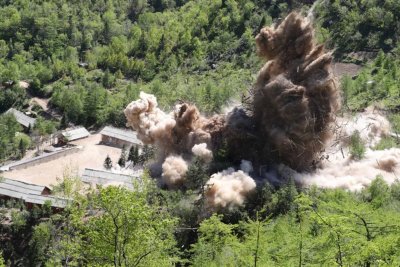
Earth is displaced during an explosion on the first day of dismantling at North Korea’s Punggye-ri nuclear test site in Punggye-ri, North Korea, 24 May 2018. On 24 May North Korea started to demolish its Punggye-ri nuclear test facility, in the country’s northeast. Photo by NEWS 1 KOREA / EPA
July 31 (Asia Today) — Nearly half of the North Korean defectors tested last year after living near the Punggye-ri nuclear test site showed chromosomal changes above a minimum detection threshold, South Korea’s Unification Ministry said Friday.
The ministry cautioned, however, that the findings did not establish a connection between the individuals’ radiation exposure and North Korea’s nuclear tests.
The Korea Institute of Radiological and Medical Sciences conducted biological radiation tests on 59 defectors from eight cities and counties near Punggye-ri in North Hamgyong Province.
The group included former residents of Kilju, Hwadae, Kimchaek, Myonggan, Myongchon, Orang, Tanchon and Paekam.
Tests found stable chromosomal abnormalities above the minimum detection level in 26 people, or 44.1% of those examined.
Stable chromosomal abnormalities can reflect radiation accumulated from birth until the date of testing. The measurement can include exposure from natural sources, medical procedures and work environments.
The institute said the test cannot determine when the exposure occurred or identify its source.
Age, smoking, alcohol use, heavy metals and other factors can also affect the results, it said.
Researchers conducted an additional test for unstable chromosomal abnormalities among the 26 people whose initial readings exceeded the detection threshold.
That second test, which is more useful for identifying relatively recent radiation exposure, produced above-threshold results in six people.
Older age complicates findings
The average age of the 26 people with elevated results was 52.8, or 13.2 years older than the average age of the 33 participants whose results remained within the normal range.
The group with elevated readings had also spent less time near Punggye-ri than the group with normal results.
Researchers found differences in drinking-water sources as well. Piped water was more common among participants with elevated readings, while a greater share of the normal group reported using water from mountain streams.
The findings did not demonstrate that the 26 participants were exposed to radiation from underground nuclear explosions, the institute said.
“There are limitations to interpreting the stable chromosome-aberration test results as exposure caused by past nuclear tests,” the institute said.
It said the participants with elevated readings were older on average and had several possible contributing factors, including medical radiation exposure.
The institute recommended continued health examinations and long-term monitoring for participants whose biological dose assessments exceeded the minimum detection level.
It said the results should be interpreted carefully because of possible confounding variables.
More environmental information would be needed to conduct a reliable assessment, including radiation measurements around former residential areas, drinking-water tests and radioactivity measurements from local food, the institute said.
No cancer cases identified
The Unification Ministry also provided detailed medical examinations to five defectors whose radiation tests conducted from 2017 through 2024 had produced readings above the detection threshold.
The ministry said no confirmed or suspected cancer cases were identified among the people examined during the latest program.
South Korea conducted similar examinations of defectors from areas near Punggye-ri in 2017, 2018, 2023 and 2024 after concerns were raised about possible radiation leakage from the test site.
Across tests conducted since 2017, researchers have identified chromosomal abnormalities in some former residents of the region, but they have not established that North Korea’s nuclear tests caused them.
North Korea carried out six underground nuclear tests at Punggye-ri between 2006 and 2017.
The country has not allowed international nuclear inspectors to conduct an independent environmental assessment at the site.
North Korea has maintained that its nuclear tests were conducted safely and did not release radioactive material into surrounding communities.
— Reported by Asia Today; translated by UPI
© Asia Today. Unauthorized reproduction or redistribution prohibited.
Original Korean report: https://www.asiatoday.co.kr/kn/view.php?key=20260731010011734