CNN Chairman and Chief Executive Mark Thompson could remain in his role at the news network after Paramount completes its deal to acquire the news network’s parent company, Warner Bros. Discovery.
Thompson, 69, is said to be in early stages of a discussions with Paramount Skydance Chief Executive David Ellison about continuing in the job he has held since April 2023, according to two people familiar with the matter who were not authorized to discuss it publicly.
The Wall Street Journal was first to report Thursday that Thompson has been approached by Ellison about staying with the network. A representative for Paramount declined to comment.
Retaining Thompson in his role would provide short-term relief to CNN staffers who are concerned about the change in ownership. As Paramount pursued its $111-million deal to acquire Warner Bros. Discovery — which is moving forward following a judge’s decision to settle an antitrust suit filed by state attorneys general who wanted to block the deal — the Ellison family have reportedly had discussions with President Trump about altering the network’s coverage, which he has often deemed as unfair.
As part of the settlement, Paramount agreed to the formation of an editorial oversight board that will monitor adherence to editorial independence from its owners and shareholders. The editorial board is part of an agreement to end the states’ antitrust fight that threatened to delay the completion of the deal for months.
Keeping Thompson at CNN raises questions of how CBS News Editor-in-chief Bari Weiss will be integrated into the new company.
Weiss, who joined the storied news division after Paramount acquired her contrarian digital news site the Free Press last year, has made major changes at “CBS Evening News” and the top rated newsmagazine “60 Minutes,” with no audience gains to show for it.
CNN insiders have been skeptical over how Weiss could take over the vastly larger and more profitable news organization based on her CBS track record so far.
CNN and CBS News are expected to consolidate some of their operations, such as its overseas bureaus. But there are obstacles to a rapid consolidation, as many CBS News employees work under union contracts. Most of CNN is not unionized.
But if Thompson remains, its likely he we will have the task of reducing costs, as the traditional TV audience that provides the bulk of revenues for both CNN and CBS News continues to shrink.
Thompson has been behind a major effort to generate more revenue from CNN’s digital operations, which now include a subscription streaming service that makes the channel available without a cable or satellite TV package. He oversaw the New York Times’ successful transformation into a dominant digital news product during his run as president and chief executive from 2012 to 2020.
The Paramount-Warner deal will close soon after a judge signed a settlement that ended the antitrust lawsuit brought by Calif. Atty. General Rob Bonta and 11 other attorneys general. The detente , however, has not cooled tensions between CNN and the White House.
CNN was scheduled to provide press pool coverage of Trump’s trip to Texas and Oklahoma on Thursday. But the White House removed the network from the pool, despite a judge’s order last week to block the administration’s attempt to ban access for some media outlets.
Last week, CNN, MS NOW and Politico were banned from White House grounds. Trump cited the outlets’ ongoing negative coverage of him as the reason for the ban. The administration later tried to argue in court that their coverage was a threat to national security.
THEY are marking 25 years with a record-breaking anniversary tour.
But despite celebrating a quarter of a century together, Westlife say they have never felt younger — thanks to fans still throwing their bras onto the stage.
Kian Egan, Shane Filan and Nicky Byrne have been inundated with fans throwing their undergarments on to the stage during their gigs at Dublin’s 3ArenaCredit: SuppliedThe band with Sun’s EmilyCredit: supplied
Speaking to Biz on Sunday’s Emily backstage on Friday night, Kian said: “We have a B-stage where we get quite close to the audience. One bra got thrown up, and before we knew [it], it started growing to ten, 14 . . . It is a bit of fun, and nostalgic.”
Sign up for the Showbiz newsletter
Thank you!
Shane added: “We aren’t leaning into it too much or the stage would be covered!”
The Irish hitmakers are on track to surpass 150 dates on their 25th Anniversary World Tour and completed a record-breaking 13-show residency at the 3Arena last night.
They head to Aberdeen on Tuesday before playing dates across England, Wales and Scotland for their diehard fans.
Shane said: “We have 150 dates and it is growing. We don’t know how many it is going to be, but it is going to be more than 150 for sure.
“You keep yourself fit, you go to the gym, go for a run or surf — you just want to be in good shape for it. It is a very physical show.
“We aren’t out drinking every night, but we still get to enjoy it. We came off stage on the first night with a few pints of Guinness together. It was a lovely moment.”
The boys were fresh-faced twenty-somethings when they embarked on their first tour, East Meets Westlife, in 2000.
Asked if they feel fitter now, Shane said: “Without a doubt. We are getting older but we feel the same on stage.”
Now on their 15th tour, the band have made sure their hits World Of Our Own and Flying Without Wings still form part of their two-hour set.
“All these people have been with us since day one and now they get to relive these 25 years in one show for two hours,” Shane said.
Kian said: “It has never been discussed, but you never know.”
Niall, over to you . . .
SET LIST
World Of Our Own Uptown Girl Bop Bop Baby What About Now When You’re Looking Like That (includes a Sweet Child O’ Mine guitar solo) What Makes A Man I Have A Dream I Lay My Love On You Starlight Queen Of My Heart Chariot Fool Again If I Let You Go My Love Unbreakable Mandy Flying Without Wings Hello My Love You Raise Me Up Swear It Again
Westlife, The 3Arena, Dublin *****
WESTLIFE were the life and soul of Dublin for their 25th Anniversary World Tour concert on Friday night.
Shane Filan, Kian Egan and Nicky Byrne weaved through two hours of hits including World Of Our Own and Flying Without Wings for their adoring fans at the 3Arena.
Despite being the penultimate night of their 13-date residency in the Irish capital, the boys made sure every member of the audience had the time of their life.
The mesmerising drone show during You Raise Me Up and pitch-perfect vocals proved they were still the masters of a good ballad.
Their 1999 debut single Swear It Again got the crowd gushing like teenagers over their boyband heartthrobs.
The astonishing number of dates on this tour is a credit to the love Westlife have for performing.
The energy is infectious and I defy anyone to leave without a smile.
NEW LOOK IS A CARDI BY GUCCI
Cardi B looked ready for winter in her furry white jacket at Milan Fashion Week on FridayCredit: GettyThe American rapper was spotted out in the Italian city, where she proved she’s quite the fashion queen herselfCredit: Getty
CARDI B looked ready for winter in her furry white jacket at Milan Fashion Week on Friday.
The American rapper was spotted out in the Italian city, where she proved she’s quite the fashion queen herself.
Cardi teamed the Gucci coat with tights from the same Italian luxury fashion house.
And she shared snaps of her look to her 160million online followers, captioning them: “Lord that new Gucci collection.
“So clean, sickening, sexy and detailed.
“Go ahead, just take my whole wallet.”
If I had Cardi’s money, I’d do the same.
ENGLAND rugby legend James Haskell would love to follow ex-footballer Vinnie Jones into acting in a gangster drama, like Guy Ritchie’s hit Netflix series The Gentlemen.
He told me: “I met Guy once. We didn’t talk about roles but if there was ever the opportunity, I’d 100 per cent do it.”
SINGER TALIA MAR has released her video for track Pyscho On A Couch.
The Stay The Night hitmaker stars in the video as herself and a therapist as she explains her troubles.
Fans can catch Talia at Koko in London on October 6.
If this video is anything to go by, Talia will certainly put on a show.
PALOMA HAS FAITH IN VOICE
Paloma Faith is ready to teach contestants on The Voice how to make their own kind of musicCredit: Getty
PALOMA FAITH is ready to teach contestants on The Voice how to make their own kind of music.
The singer will join Sir Tom Jones as one of the guest mentors as the ITV show’s Battles – in which teammates duet – kick off on October 10.
Delta Goodrem joins Kelly Rowland’s group; Cheryl Tweedy works with WILL.I.AM’s team; and McFly’s Dougie Poynter and Harry Judd assist bandmates Danny Jones and Tom Fletcher.
Next Saturday, viewers get a glimpse of the guests at London’s Alexandra Palace, discussing which acts should make the semi-finals.
A source said: “Watching Cheryl’s return to TV and a glimpse of her role as a coach next series will give fans plenty to look forward to.
“Alongside the experience brought by Paloma, Delta, Dougie and Harry, the Battles will be a series highlight.”
Every footballer has a story, but not many are quite as trippy as the one Luis Binks tells while sitting among the palm trees of La Manga, Scotland’s training headquarters for a few days this week.
At 25, the Brondby centre-half and captain is pushing hard for a Scotland debut against Slovenia on Saturday, a spot in the heart of Sebastien Pocognoli’s defence having opened up since Grant Hanley and John Souttar were jettisoned once the Belgian took over from Steve Clarke.
Binks, with a grandparent from Dunbar, is among the eight uncapped players in the new manager’s squad.
That’s a lot of new faces and a lot of new stories.
Binks talks about the early weeks of his time at Montreal Impact in the MLS; February to March, 2020. He was 18 and recalls: “I’d been at Tottenham since I was very young, but I just wanted to go and play first-team football.
“That was my biggest thing, to not get caught up in the whole youth system. I feel that if you get caught in that, it’s not real football. I wanted to test myself.”
Which brought him to Montreal where his manager was the great Thierry Henry.
“I’d signed in February and then we went into Covid lockdown in March,” Binks explains. “I hadn’t yet found an apartment. I was in one hotel and Thierry was in another. The one I was in was then shut down.
“He was staying at the Ritz on his own. They wanted to move me to a hotel by the airport and I didn’t want to go because there was nothing there. It felt like prison, almost. One day I get a call from him, saying: ‘Do you want to move to where I am? You can go on the other floor’.”
The Ritz-Carlton is a five-star retreat with 129 rooms. Henry and Binks were the only residents.
“I’d go for runs in the morning and he’d be sat in the reception on his own. When I’d get back from the run, he’d still be sat there. I’d spend a few hours with him, just trying to pick his brains.
“I remember one night I was sat in my room just playing PlayStation and he rings me and goes, ‘do you want to get a pizza?’. There’s me and him driving around Montreal looking for a pizza. It’s a bit surreal, but that was how it was.
“I’m saying it now like it’s just anybody, but there’s a big aura around him. I was nervous at the time, but I asked him who’s the best defender he’s played with and against and why and it was a good time.
“It’s a bit of a blur now, but I always remember him talking about Sol Campbell and just saying what made him great and how I could improve as a defender.
“I owe a lot to him because he gave me my first chance in senior football.”
That much was clear Saturday at the Lucas Museum of Narrative Art’s opening-night soiree, where the guest list was as celebrity-heavy as any Academy Awards after-party. As the festivities kicked off around sunset in the courtyard under the museum’s towering elliptical oculus, Oprah Winfrey hugged Robert De Niro, and Harrison Ford and Calista Flockhart skipped the red carpet after chatting with Spike Lee. Laura Dern and Greta Gerwig laughed together by the entrance while Samuel L. Jackson plopped down on a curved bench, joking, “Hey, look what I did!”
For the record:
1:22 p.m. Sept. 20, 2026A previous version of this article said James Cameron was photographed along with a large group of directors at the Lucas Museum of Narrative Art. He was not.
He didn’t sit for long because Cynthia Erivo and Andy Garcia showed up and there were more hugs and handshakes and hellos. Owen Wilson, Leonardo DiCaprio, Kim Kardashian, Meg Ryan, Jack Quaid, Gov. Gavin Newsom, Rep. Nancy Pelosi, Justin Trudeau, Mark Hamill and Magic Johnson were there too, and that was just the beginning.
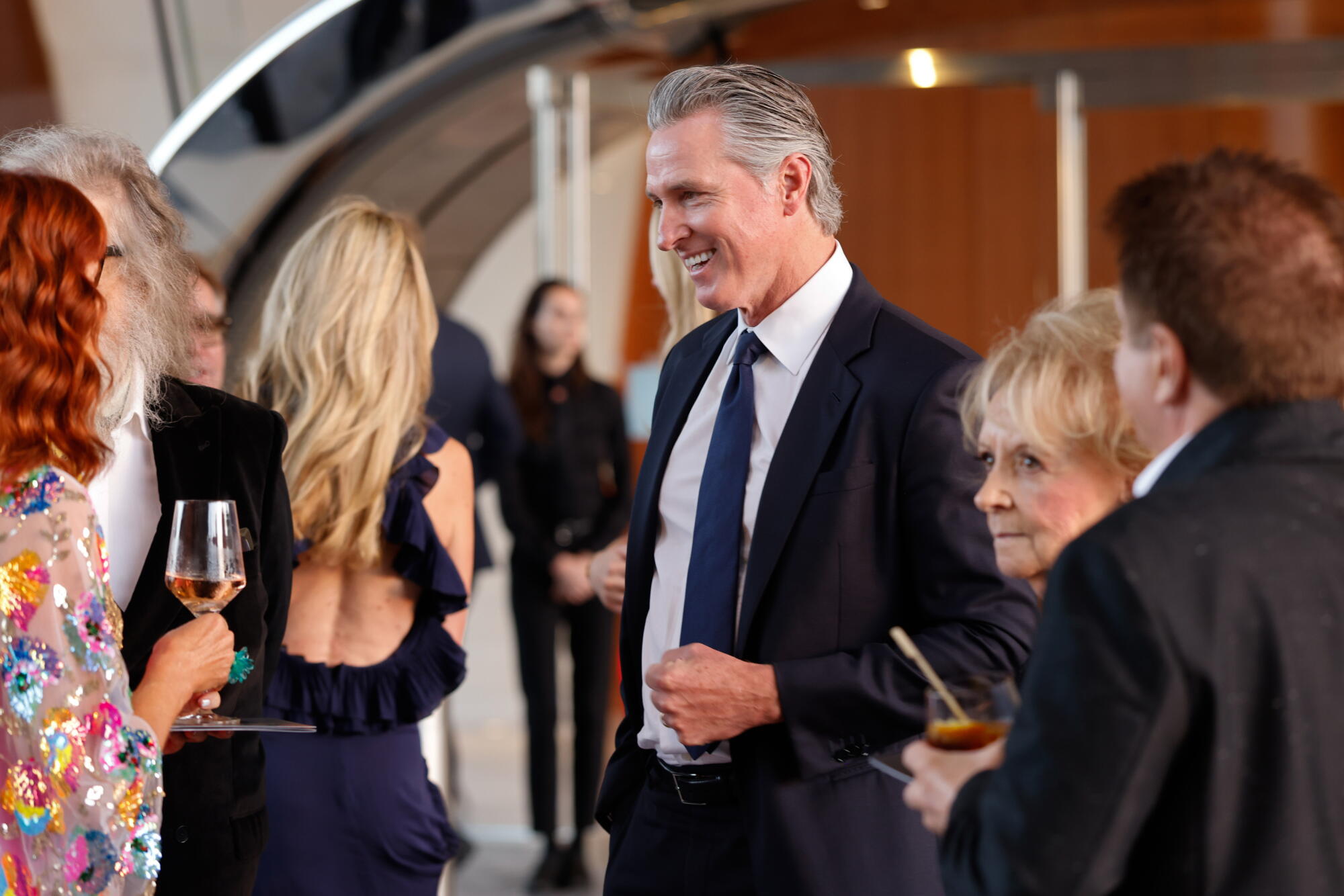
Gov. Gavin Newsom attended the opening-night party for the Lucas Museum of Narrative Art alongside a host of other notable guests and celebrities.
(Carlin Stiehl / For The Times)
After a rousing performance by a white-robe-clad vocal collective called Voices of Fire, co-founded by Pharrell Williams, Lucas’ wife Mellody Hobson noted that, “George kept saying, ‘Will this person come? Do you think this person will come?’”
“I said, ‘They will all come,’” Hobson said as the crowd laughed during opening remarks on a raised platform in the museum’s grand lobby.
And so they did. There was even a banner moment inside the posh fifth-floor Skywalker Grill where a group of directors gathered to be photographed in what could very well become a seminal photo of Hollywood influence in the 21st century. The shot included Lucas, Jon M. Chu, Chris Columbus, Francis Ford Coppola, Lee Daniels, Guillermo del Toro, Jon Favreau, Bryce Dallas Howard, Ron Howard, Peter Jackson, Chris Meledandri, Denis Villeneuve, Christopher Nolan, Spike Lee, Tyler Perry, Steven Spielberg, Frank Miller, Robert Rodriguez, Nathan Fielder and David Benioff.
Organizers were scrambling to find Gerwig, but she had dashed off somewhere else.
“Star Wars” legendMark Hamill and his wife, Marilou York, were guests at the Lucas Museum of Narrative Art opening party.
(Carlin Stiehl / For The Times)
There were artists in attendance too, of course, but not as many. Jeff Koons, Refik Anadol, Judy Baca and Takashi Murakami strolled through the crowd, as did museum directors including the Broad’s Joanne Heyler and Los Angeles County Museum of Art’s Michael Govan, who was relieved to be attending someone else’s party after hosting so many of his own in April and May when the new Geffen Galleries opened.
Lucas and Hobson went to great lengths to explain why the Lucas Museum matters and why it is different from other museums. Their comments, in many ways, sought to address the criticism that has been lobbed at the museum since it held its press preview a few weeks back.
Though it has received a number of rave reviews, critics have called narrative art a false conceit and argued that the juxtaposition of masterworks with pop culture ephemera does not work. Much of the criticism has been focused on a perceived lack of context since there is almost no wall text clarifying why certain curatorial choices were made.
George Lucas and his wife Mellody Hobson hosted an extravagant opening party at the Lucas Museum of Narrative Art.
(Carlin Stiehl / For The Times)
“When I started it, everybody said, ‘You’re crazy. You shouldn’t do it. It’s not going to work. People are going to come after you,’” Lucas said of his plans for the museum. “I said, ‘People have come after me all my life, especially in the movies.’”
Lucas also addressed why he curated the museum’s 100,000 square feet of gallery space on his own, noting that at a certain point plans were “getting off the rails.”
“I’m going to have to take this over because people don’t understand what I’m doing,” Lucas recalled thinking. “The idea that illustration is an art form and illustrators are artists was just too much for somebody who had been taught otherwise by the art schools that they went to and the universities that they went to.”
People with PhDs often can’t see the big picture, Lucas said, “You can’t say ‘This is art. This is not art.’ Art is in the eye of the beholder. If it is emotional to you, then it’s art. And, of course, I’ve been criticized up and down and sideways for that. But I believe it wholeheartedly — that you get to decide what art is.”
Members of the Virginia Beach vocal collective Voices of Fire, co-founded by Bishop Ezekiel Williams and Pharrell Williams perform at the Lucas Museum.
(Carlin Stiehl / For The Times)
Lucas noted that throughout his career he has worked with many illustrators, “and I will tell you, they are as talented as any artist I’ve ever met. This is the way of giving back to them something that they’ve all wanted … inevitably, all of the illustrators say the same thing — everybody from R. Crumb to Rockwell — they all say, ‘I wish I could be in a museum,’ but they can’t. There isn’t a major museum in the world that’ll have this kind of art in it. I’m hoping this will change that.”
Lucas’ comments came after his friend and co-host Queen Latifah noted to the cheering crowd that, “Paris has the Louvre, New York has the Met and now L.A. has the artistic equal.”
Guests mingle at the Lucas Museum of Narrative Art opening party.
(Carlin Stiehl/For The Times)
It took more than a decade for the Lucas Museum to land in L.A. after a search that included Chicago and San Francisco as well as lots of civic pushback and lawsuits over the use of public parkland.
“We did not realize how hard it would be to give a city a museum,” Hobson said during her remarks, later joking: “If your husband or spouse comes home and says they want to build a museum, I suggest your response is a hard no.”
Laura Dern, left, and Greta Gerwig spent the early part of the night chatting and laughing.
(Carlin Stiehl / For The Times)
Hobson went on to extol Lucas’ vision and his ability to never waver from his dream for the museum.
“He was driven to create a space that would showcase the brilliant illustrators that he thought were too often overlooked and ignored,” Hobson said. “And if critics say that a museum of narrative art is too much like a popcorn movie and not enough like an art film, well, we love popcorn movies in our family.”
Like a popcorn movie, the evening ended happily with a drone show in the night sky narrated by Winfrey and Jackson, and featuring images from the museum’s collection including the Cave of Altamira, N.C. Wyeth’s “The Storybook,” Julie Bell’s “The Huntress,” Banksy’s “Girl With Balloon,” the “Star Wars” Millennium Falcon and Maxfield Parrish’s “Ecstasy.”
Afterward the party moved inside from the rooftop terrace for a performance by the Black Eyed Peas.
MIAMI — Dodgers owner Mark Walter and multiple insurance companies he owns have been sued, alleging they failed to disclose an ongoing federal probe to customers while directing policyholders’ money into Walter’s other companies.
The lawsuit lists Walter, Delaware Life Insurance Co., Clear Spring Life and Annuity, TWG Global Holdings and Walter’s Guggenheim Partners investment firm as defendants.
Ira Rosner, a 67-year-old Florida man, brought the class-action lawsuit in U.S. District Court in Miami on Wednesday. He purchased a policy from Delaware Life in April and he had until late May to withdraw his money without penalty. However, the company did not disclose the investigation to him until June,
Rosner is seeking a jury trial in the lawsuit that seeks damages for negligent misrepresentation, breach of contract and aiding and abetting fraud.
TWG Global didn’t immediately respond to a request for comment on the lawsuit.
Walter has been under investigation since last year by the U.S. Attorney’s Office in Manhattan and the Securities and Exchange Commission following a whistleblower complaint regarding alleged misrepresented loans made between companies within his business portfolio.
TWG Global Holdings is the holding company through which Walter controls Delaware Life, Clear Spring Life and Annuity Co. and his stake in Guggenheim Partners. TWG Global denied any wrongdoing involving the probe in a statement last month.
Walter and co-owner Todd Boehly sold their stakes in English Premier League club Chelsea this week. Last month, Walter agreed to sell the Lakers in a surprise move less than a year after buying the NBA franchise from the Buss family. The deal is under review by the league.
The Dodgers have been adamant that Walter has no plans to sell the baseball team.
LONDON — Todd Boehly and fellow co-owner Mark Walter have sold their stakes in Chelsea, handing full control to Clearlake Capital, the English Premier League club said on Wednesday.
“Chelsea Football Club today announced affiliates of Clearlake Capital Group will acquire the ownership interest of Todd Boehly,” it said in a statement.
“As part of the transition, Clearlake will also acquire Mark Walter’s ownership interest and therefore acquire full control of the club.”
Boehly, Walter and Swiss investor Hansjorg Wyss all purchased a 12.8% share alongside the private equity company Clearlake, which had owned 61.5% ahead of Wednesday’s announcement. The Financial Times reported that Walter and Boehly will receive £950 million ($1.3 billion) for their combined stake in a deal that values the club at £5 billion ($6.7 billion) including debt.
Walter’s companies are the subject of multiple investigations that center on how much life insurance companies he owns were invested in the Dodgers and Lakers and why the investments weren’t accurately disclosed. Walter sold his majority share of the Lakers last month for a record $12.5 billion valuation, but Walter’s TWG Global said the decision to sell was not forced by the investigation. People with knowledge of company operations but not authorized to speak publicly told The Times Walter was open to selling his Chelsea share for the right price, but he has no intention of selling the Dodgers and other sports investments.
Boehly has worked with Walter at Guggenheim Partners since 2001 and played a significant role in the purchase of the Dodgers and Lakers, among other Walter owned properties.
In 2022, Clearlake and Boehly combined to take over the club from Roman Abramovich when the Russian billionaire was forced to sell the club after being sanctioned by the U.K. for his connection to Russian President Vladimir Putin following Moscow’s full-scale invasion of Ukraine.
Boehly now stands down in his role as Chelsea chairman. Fans protested Boehly’s tenure as the club struggled to keep pace in the Premier League title chase amid erratic leadership, unusual player acquisitions and chaotic relationships with managers.
“It has been an honor to serve as chairman of Chelsea Football Club,” Boehly said. “I would like to thank the many who helped secure a bright future for the club, including the English Premier League, the coaches and players, the talented leadership and staff at Chelsea, and the legions of dedicated fans.
“I have valued my partnership with Clearlake and the wider ownership group, and the collective decisions and investment we have made to support the immediate and long-term success of the club. I am confident that Chelsea is well positioned for continued success under Clearlake’s leadership.”
“Todd has been an important partner throughout our ownership of Chelsea, and we thank him for his time and contribution as chairman,” Eghbali and Feliciano said. “He will always be a part of the Chelsea story and family.
“Clearlake has served as Chelsea’s majority owner since 2022, and as we move to full control our focus is to continue investing in the club’s infrastructure, sporting performance, player development and delivering long-term success for Chelsea and the club’s supporters.”
The statement also said Wyss would “remain an important stakeholder and partner in the ownership group”, and that there would be “no changes to the day-to-day operations, leadership or strategy at the club.”
Chelsea, which is sixth in the Premier League standings, next faces London rival Brentford on Friday.
Chelsea chairman Todd Boehly and director Mark Walter have sold their stakes in the club to majority owner Clearlake Capital.
Swiss billionaire Hansjorg Wyss has also sold his stake, meaning Clearlake – led by co-founders Behdad Eghbali and Jose E. Feliciano – have now acquired full control of the club.
Boehly, Walter and Wyss each had a 12.8% stake, with Clearlake previously owning 61.5% of the Blues.
American Boehly will leave his role as chairman, a position he has held since 2022, when the consortium bought the club for £2.3bn from Roman Abramovich, who was sanctioned by the UK government in March 2022 over alleged links to Russian president Vladimir Putin – something he has denied.
Multiple sources said talks started within Chelsea‘s ownership group after a rift, first apparent in 2024, led both sides to explore buying each other out.
Boehly, who is a co-owner of baseball franchise the Los Angeles Dodgers, said it had been an “honour” to serve as Chelsea chairman.
“I would like to thank the many who helped secure a bright future for the club, including the English Premier League, the coaches and players, the talented leadership and staff at Chelsea, and the legions of dedicated fans,” he added.
“I have valued my partnership with Clearlake and the wider ownership group, and the collective decisions and investment we have made to support the immediate and long-term success of the club. I am confident that Chelsea is well positioned for continued success under Clearlake’s leadership.”
MARK Wright was caught red-handed by wife Michelle Keegan after telling porkies about his whereabouts while she was at work.
The TV star told his actress wife he would be at home looking after their daughter Palma, 1, – confident he wouldn’t be rumbled.
Michelle Keegan caught husband Mark Wright out after he lied about going golfingCredit: Instagram/thisisheartA flustered Mark admitted their daughter Palma was spending the day with his mumCredit: Instagram/thisisheart
But Mark, 39, was actually out playing golf and was spectacularly exposed when Michelle FaceTimed him live on air.
The hilarious incident unfolded on Heart Breakfast when Michelle appeared as a guest to promote her new drama The Blame.
Sign up for the Showbiz newsletter
Thank you!
“Shock, he’s at golf,” Michelle, 39, remarked as the star popped up on the video call before demanding: “I’ve got a question – where’s the baby?”
A flustered Mark responded: “She’s with my mum. She’s seeing her nanny today.”
Mark joked that the radio presenters had landed him “in the doghouse”Credit: Instagram/thisisheartThe couple welcomed their first child, daughter Palma, in March 2025Credit: PA
Michelle then clapped back: “You told me you weren’t golfing today. You’re in trouble!”
Mark told the other presenters: “This is what I mean, guys. You’ve got me in the doghouse!”
The couple welcomed their first child, Palma, in March 2025 after nearly ten years of marriage.
Michelle is now gearing up for the release of six-part ITVcrime drama The Blame, adapted from Charlotte Langley’s debut novel of the same name.
Mark is a doting dad to 18-month-old daughter PalmaCredit: instagramMichelle recently pulled out of another ITV project to spend more time with PalmaCredit: Instagram
She plays DI Emma Crane, who investigates the murder of a young figure skater while confronting corruption and misogyny within the police force.
The series marks Michelle’s first acting role since giving birth to Palma.
She said earlier this year: “Coming back to work after having a baby is quite daunting.
“But the production were so supportive and I was so looked after. It was like working with family.”
However, the actress recently pulled out of another major ITV drama amid concerns its demanding filming schedule would keep her away from Palma for too long.
Michelle had been due to play a working-class barrister but withdrew several months before filming began, with former Doctor Who star Jodie Whittaker, 44, stepping into the role.
Although Michelle had committed to the project and filming dates had been agreed, she reportedly walked away before signing a contract.
Byron Sher, a Stanford law professor-turned California legislator who wrote some of the state’s most far-reaching environmental laws, died Saturday. He was 98.
Cerebral and soft-spoken, Sher was the antithesis of politicians nowadays. He rarely issued press releases, didn’t convene news conferences, and disliked raising campaign money.
But he left an indelible mark on the environment, authoring legislation offering incentives to recycle, limiting advertisers’ inflated claims about products’ environmental benefits and combating water and air pollution.
He helped lead the effort to preserve ancient redwoods in Headwaters Forest in Humboldt County in 1999, pushing the state and federal government to buy it from Texas financier Charles Hurwitz, who owned Pacific Lumber Co. and was preparing to log it.
A decade earlier, in 1988, Sher authored legislation requiring that California take stock of the sources of greenhouse gases. It was the first time the legislature in California — or any other state — embedded the term “global warming” into a state law, and became the foundation for bills in later decades to combat climate change.
“The heat is on,’’ Sher said presciently, as quoted by the Sacramento Bee on May 5, 1989. “The state can either ignore what science is telling us, or we can respond to this challenge in a responsible way.’’
Because of his legislation, manufacturers today sell more products in spray bottles rather than aerosol cans, people can more easily dispose of televisions and other electronic waste, and underground gasoline storage tanks rarely leak and foul groundwater.
“Byron Sher built the legal and research foundation for California’s climate change regime and by extension helped shape how the world has tried to handle climate change,” said Joe Mathews, a Berggruen Institute fellow who is working on a book about the state’s legislative efforts to confront global warming.
Today, Sher’s 1989 legislation creating state wild and scenic rivers is a barrier to President Trump’s proposal to raise Shasta Dam north of Redding to increase water storage, an idea backed by Central Valley farming interests. His legislation protects the McCloud River, which feeds Shasta Reservoir. Raising the dam would inundate habitat along the McCloud.
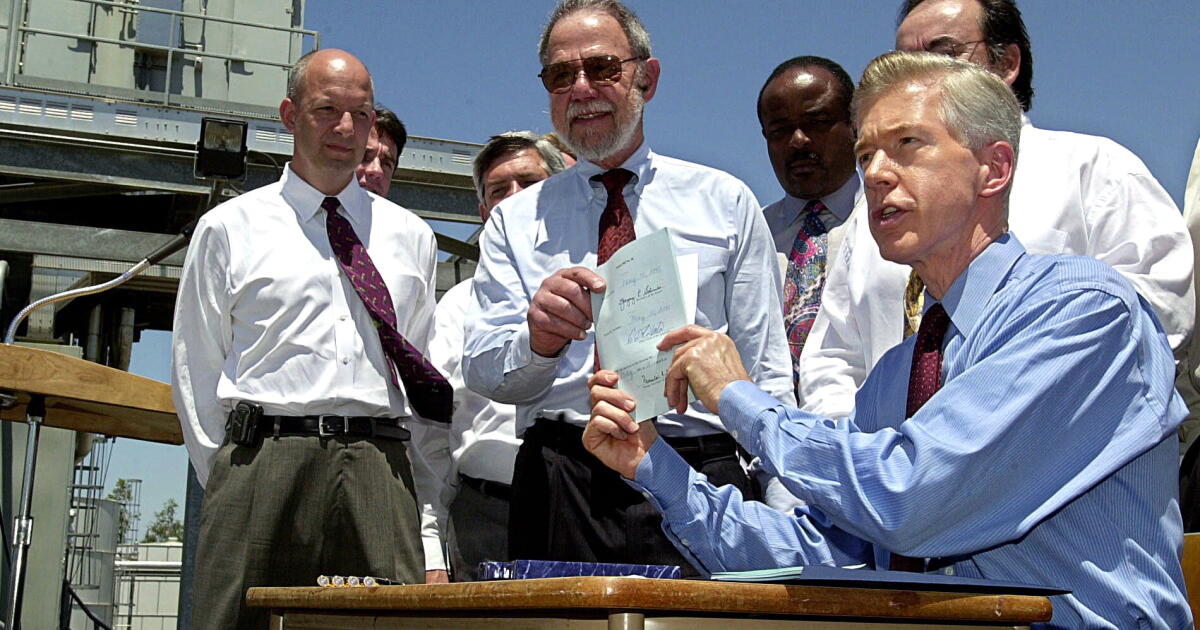
That Sher placed such ideas into law reflected his ability to persuade and compromise. Gov. George Deukmejian, a Republican, signed the wild rivers legislation, and Sher’s Clean Air Act, which helped shape federal clean air legislation signed in 1990 by President George H.W. Bush.
Their partisan differences aside, Deukmejian viewed Sher as having “great personal integrity,” said Steve Merksamer, who was Deukmejian’s chief of staff.
“When Byron Sher wanted to come into the office and had the bill, would he get in? Absolutely. Would the governor listen to him? Yes,” Merksamer said.
Sher did fall short of convincing Deukmejian to sign one of his bills — a whimsical measure inspired by a Camp Fire girls and boys troop to proclaim the banana slug to be the official state mollusk. Deukmejian vetoed the bill, though Gov. Gavin Newsom signed legislation in 2024 designating the slimy yellow creature as the official state slug.
Sher was born in St. Louis in 1928, graduated from Harvard Law School in 1952, and joined the Stanford Law School faculty in 1957. He served on the Palo Alto City Council in the 1960s, got recalled in 1967 over his opposition to development and won back his seat in the 1970s. Sher was Palo Alto mayor in 1980 when he won an Assembly seat. He remained in the Assembly until 1996 when he was elected to the state Senate, serving until 2004 when term limits forced him to step aside.
Among the students who passed through his Stanford classrooms was Newsom’s father, William Newsom, who became a state court of appeals justice.
Sher and his aide and friend Kip Lipper attended a 2010 banquet in San Francisco at which the California League of Conservation Voters honored Justice Newsom with the Byron Sher Lifetime Achievement Award. In his acceptance speech, Newsom recalled that Sher was the only Sanford professor who gave him a C. When Lipper asked whether the story was true, Sher deadpanned, “He deserved it.”
“There aren’t a lot of tales to tell about Byron Sher,” said Bill Lockyer, who was Senate leader when Sher won a state seat in 1996. “He went home at night and tended not to get into the Capitol gossip.”
In 1996, Lockyer entrusted Sher to serve on a joint Assembly-Senate conference committee that produced landmark legislation that sought to deregulate California’s electricity system.
Sher added provisions expanding requirements that the state use renewable sources of electricity and called the legislation “an extraordinary result” given the issue’s complexity. Lockyer said Sher’s additions, while important, were “the cherry on top of the toxic sundae.”
The legislation was blamed for California’s electricity crisis in 2000 and 2001 when swashbuckling energy traders manipulated the markets, causing prices to spike, resulting in rolling blackouts, and fueling the 2003 recall of Gov. Gray Davis.
Sher was notable for measures he refused to support. With a few other liberal Democrats, nicknamed the Grizzlies, Sher would pick through turgid language of legislation looking for provisions that reflected the undue influence of special interests.
Sher voted against 1986 legislation that purported to open the way for a shrimp processing facility in West Sacramento. The bill turned out to be part of an elaborate FBI sting that resulted in 14 legislators, lobbyists and others being sent to prison.
“He wasn’t a comfortable politician,” said San Mateo County Supervisor Jackie Speier, a former Democratic congresswoman who served in the Legislature with Sher. “He didn’t speak up a lot. So, when he did, people listened.”
He displayed partisan side in 1994 when Republicans took a 41-seat majority in the 80-seat Assembly, and Republican Assemblyman Jim Brulte was in line to be elected speaker. But Democratic Speaker Willie Brown had a Republican supporter, Paul Horcher, who voted to retain Brown as speaker, plunging the two parties into a yearlong fight for control.
To wrest control from Republicans, Brown asked the professorial Sher to challenge one Republican’s right to remain in the Assembly. That Republican, Richard Mountjoy of the San Gabriel Valley, won two elections that November — one to the Assembly and the other in a special state Senate election to fill the seat vacated when the incumbent, Frank Hill, was sentenced to prison in the corruption scandal.
Sher reasoned that Mountjoy had to make up his mind — stay in the Assembly or move to the Senate. Facing term limits in the Assembly, Mountjoy joined the Senate in January 1995. The partisan battle went on all that year.
Brulte, who never did become speaker, was elected to the Senate in 1996, as was Sher. On Sunday, he called Sher “a wonderful man.”
“Everything in politics today is personal. It wasn’t personal,” Brulte said of Sher’s role in the speakership battle. “Somebody may have taken it personally, but I certainly didn’t.”
Sher retired to a pear orchard in the Sierra Nevada foothills and served on Tahoe Regional Planning Agency and Sierra Nevada Conservancy.
His wife of 62 years, Linda Bowser Sher, died in 2014. He is survived by three children, five grandchildren and a great-granddaughter.
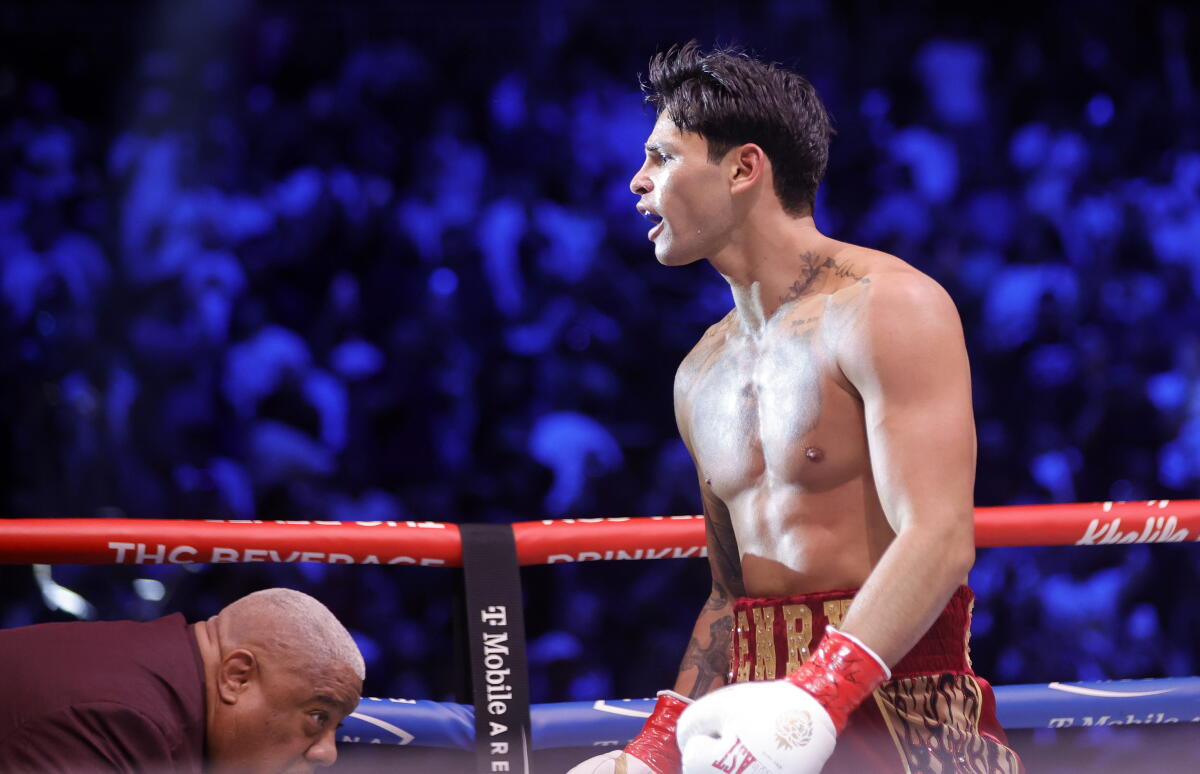
LAS VEGAS — After taking 10 years to win his first world championship, Ryan Garcia needed only 4 minutes and 25 seconds to finish off Conor Benn on Saturday night in the first defense of his WBC welterweight title.
“I kind of figured he would just come at me crazy,” Garcia said. “Second round, I said I’m tired of him coming forward; I’m gonna stand my ground a little bit … and then he got caught with a hellacious one.”
Garcia’s sharp right hand to the jaw put Benn on the canvas early in the second round. Moments later, with the Englishman on the ropes, Garcia (26-2, 21 KOs) served a flurry of punches that prompted referee Thomas Taylor to step in and end the contest at the 1:25 mark and send the announced sold-out crowd of 18,855 into a frenzy.
”He’s exactly what I thought he was; he went in and tried to fight me. I think he needs to be a little bit more patient,” Garcia said. “I don’t think he has enough experience. I think he will be back. I have a new level of respect for him.”
Garcia closed -300 at BetMGM, meaning bettors would have had to put down $300 to win $100.
WBC welterweight champion Ryan Garcia celebrates after defeating Conor Benn in the second round Saturday.
(Steve Marcus / Getty Images)
The bout was more than another high-profile main event, as it marked a career-defining crossroads for both fighters.
For Garcia, he solidified himself in the 147-pound weight class as a durable, legitimate titleholder rather than a gifted attraction whose career has often been defined by controversy, inconsistency and unrealized potential.
The convincing victory positioned Garcia for a lucrative welterweight fight against the division’s other leading names, including Teofimo Lopez, who was ringside, or another major showdown with Devin Haney, who was also in attendance.
For the 29-year-old Benn (25-2), it’s likely back to the middleweight division after failing in his first world-title opportunity and a chance to escape the considerable shadow of his father, former two-division champion Nigel Benn.
Benn was transported to a hospital after the fight for observation.
In the co-main event, Jai Opetaia (31-0, 24 KOs) patiently weathered several cagey rounds before stopping Noel Mikaelian in the ninth round of their scheduled 12-round lineal cruiserweight championship fight.
Opetaia stunned Mikaelian (28-4) with a multi-punch combination and two crushing hooks, then sent him backward into the ropes with a powerful right hand. Referee Harvey Dock administered a standing eight-count before determining Mikaelian could not continue, ending the competitive fight by TKO at 1:30.
Da’Mazion Vanhouter (13-0, 10 KOs) wasted no time in his scheduled eight-round heavyweight bout, delivering a crushing right hand at the 1:58 mark of the first round for a knockout of Raphael Akpejiori (19-4).
In the 10-round lightweight bout that opened the main card, Andres Cortes (26-0) retained his belt with a unanimous decision over Mark Magsayo (29-3), with all three judges scoring the fight 97-93.
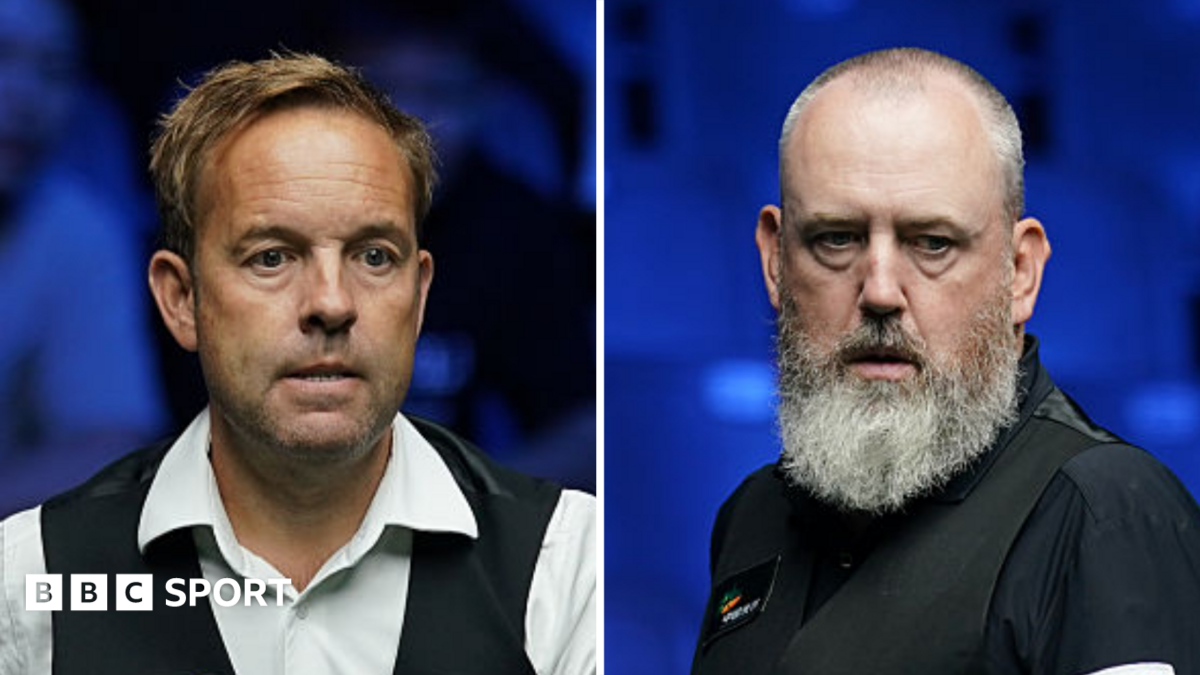
But this time it was the world number seven who was denied as Welshman Williams claimed five straight frames to snatch a 6-5 win.
Murphy looked set to clinch victory in the 10th frame with a break of 51 but handed Williams a lifeline and the world number nine took full advantage.
The 51-year-old made 65 to level things up and again prevailed in the decider, with a break of 69 completing the three-time world champion’s remarkable comeback.
Williams and Carter will now battle it out for their first English Open title at the Brentwood Centre in Essex.
In the first semi-final, Carter reeled off five frames in a row to claim a 6-2 win over China’s Ding Junhui, producing a highest break of 119.
The 47-year-old from Essex started the week 25th in the world rankings and will return to the elite top 16 if he beats Williams.
“To get in the top 16 at my ripe old age of 47 wouldn’t be too bad,” said Carter.
“There is a lot to play for tomorrow, but I’m going to be in there fighting.
“I’m still competing with the best players in the world and it is a feather in my cap.”
World champion Wu Yize fell in the third round of the English Open as Liam Davies scored an eye-catching 4-1 victory in Brentwood.
Welsh prospect Davies, 20, opened up a 3-0 lead on his way to the first ranking event quarter-final of his career, helped by a break of 105 in the second frame, then completed his victory as China’s Wu struggled to find his dynamic best form.
Tantalisingly, Davies will face compatriot Mark Williams, the three-time world champion, in the last eight on Friday evening.
Williams, still a major force on the baize at the age of 51, had breaks of 76, 103 and 63 in a late-night 4-1 victory over England’s Barry Hawkins.
Mark Selby, who was runner-up at last week’s British Open and won the China Open in August, had his hopes of reaching another final ended by a 4-3 defeat against fellow former world champion Kyren Wilson.
Selby led 2-0 in the all-English tussle after an early break of 112 but then lost the next three frames. He dragged himself level, but Wilson trebled in the yellow to effectively make sure of victory in the decider.
England’s Judd Trump, newly deposed as world number one, edged a tense decider against Scot Anthony McGill to take a 4-3 victory.
Trump will face a quarter-final against Shaun Murphy who was taken the distance after midnight by Pang Junxu before racing through the deciding frame with a 103 break.
Ali Carter had a highest break of 75 as he completed a 4-2 win over Gong Chenzhi, Zhou Yuelong made a 141 in his 4-2 victory over Chinese compatriot Yuan Sijun, and Ding Junhui beat Joe O’Connor 4-1.
A few months after Mark Walter became the chairman and majority owner of the Dodgers, he was told a fan in one of Dodger Stadium’s upper decks was upset about a mix-up with his tickets.
On most days, that would be an issue for an usher to handle. Not on this day.
Walter and team president Stan Kasten decided to address the problem, climbing the narrow stairwell to the top level where they found the fan and listened to his complaint.
“Obviously the guy was floored just to see me, let alone to see Mark,” Kasten said. “Mark, he’s incredibly comfortable around people. Not just his peers, but average fans. Because he considers himself an average fan.”
The Dodgers’ billionaire owner, hardly an average fan, is under intense scrutiny these days, following the sale of his controlling interest in the Lakers and a federal investigation into his business dealings. The drama has come as a surprise to some who know Walter, who has earned respect for his financial acumen and, despite his purchases of high-profile sports teams, has tended to dodge publicity.
He put together the ownership group that bought the Dodgers in 2012. Since the purchase, the team has played in five World Series, winning three, and finished first in the National League West 12 times in 14 seasons. It’s the greatest sustained run of excellence in baseball in more than a generation.
Walter waves to the crowd during the Dodgers’ ring ceremony in March.
(Jessie Alcheh/MLB Photos via Getty Images)
If the Dodgers win a third straight World Series this fall, they will become the first team to three-peat this century. And much of the credit for that would go to Walter, who has funded a front office that consistently has outspent the rest of Major League Baseball, signing seven players to contracts worth more than $2 billion combined in the last six years alone.
Now Walter faces questions about his future owning the Dodgers. Last month, his companies became the focus of two federal inquiries and a Delaware insurance regulatory review.
He is helping pay off some of his companies’ loans and sold the Lakers at a record valuation of $12.5 billion, a deal Walter’s holding company, TWG Global, says was not forced by the inquiries. Still, the sale raised questions about whether he will sell his ownership stakes in other sports properties, including English soccer club Chelsea, the Cadillac Formula One racing team, the WNBA’s Sparks and the Professional Women’s Hockey League.
Walter declined to comment for this article.
Kasten insists Walter has no plans to divest from the Dodgers. “The sports portfolio is going to remain intact,” Kasten said. “It’s important to Mark. I can’t tell you how important the Dodgers are to him.”
Still, Kasten acknowledges the decision to sell the Lakers to former Disney chief executive Bob Iger and venture capitalist Joshua Kushner just 14 months after agreeing to buy the team “was not a planned thing,” either.
Walter hoists the World Series trophy next to MLB Commissioner Rob Manfred last November.
(Rob Tringali/MLB Photos via Getty Images)
Like most of the middle-class kids in the class of 1978 at Jefferson High in Cedar Rapids, Iowa, Walter worked in high school.
“He pumped gas and he played golf,” recalled Cathy Boland Polito, Walter’s date for the senior prom who is now a retired medical technologist living in Oro Valley, Ariz.
Walter hardly stood out in his graduating class of about 350 students. He was athletic but not a stud. He was a good student, especially in math, but not a nerd.
“He was friendly. He was nice,” Polito said. “Everybody sort of knew him.”
Walter talks with Dodgers president Stan Kasten during the playoffs last year. “I can’t tell you how important the Dodgers are to him,” Kasten says.
(Michael Reaves / Getty Images)
Walter went to Creighton University , where he studied accounting and business while playing intramural sports and participating in the philosophy society. Three years later, he earned a law degree from Northwestern.
Walter met his wife, Kimbra, in Chicago, where they raised their daughter, Samantha.
After a decade split between a Chicago law firm and First Chicago Capital Markets, a financial services and securities brokerage, Walter founded an investment firm, Liberty Hampshire Co., in 1996. While there he met J. Todd Morley, who connected him with the Guggenheim family fortune. The introduction quickly led to the formation of Guggenheim Partners, an investment and advisory financial services firm that works with insurance services, among other assets, and one that has a Wall Street reputation for being low-key but aggressive.
Before the COVID-19 pandemic closed Guggenheim’s offices, the lobby of the firm’s Chicago headquarters on the 49th floor of the AT&T Center boasted one of Monet’s “Water Lilies” paintings, which hung behind the receptionist’s desk inside a glass case with an alarm. A Picasso brightened another office upstairs.
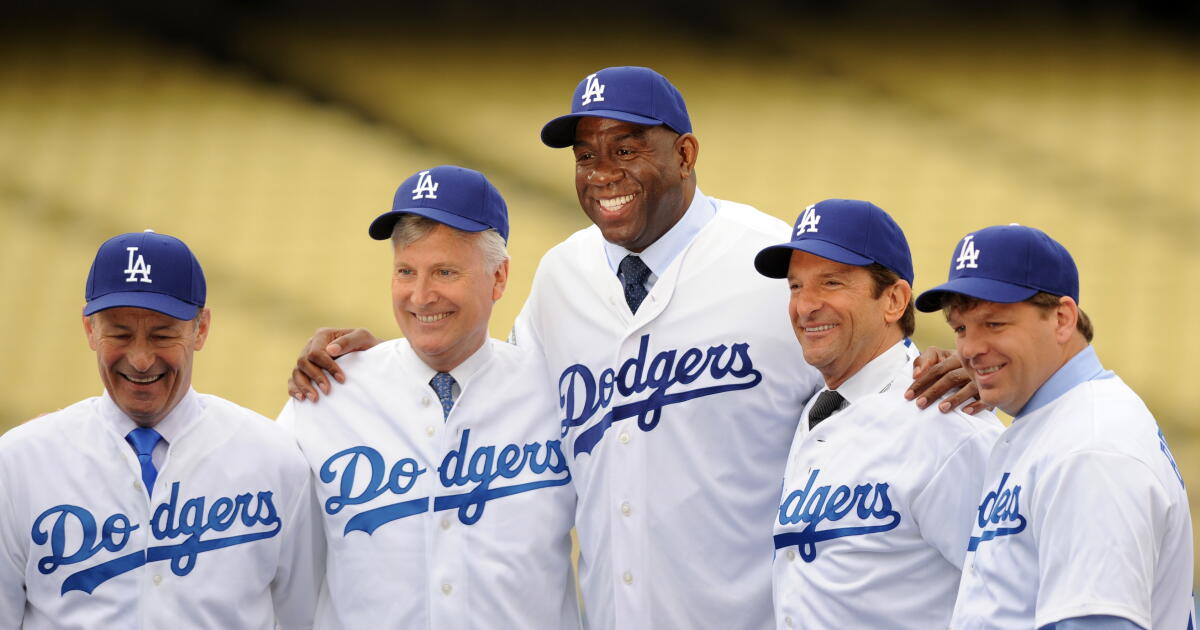
Walter with Guggenheim Baseball Management partners Peter Guber, left, Stan Kasten and Magic Johnson at Dodger Stadium in 2012 after the group bought the Dodgers for $2 billion.
(Damian Dovarganes / Associated Press)
A company insider not authorized to speak publicly told The Times in 2012 that Walter was a disciplined, focused and careful investor.
“He is a guy with one of the great financial minds of our time,” the person said.
For Walter, 66, who grew up playing youth baseball about 50 miles from the Iowa cornfield that became Kevin Costner’s “Field of Dreams,” that financial success was all well and good. But the longtime Chicago Cubs season-ticket holder really was a die-hard baseball fan whose dream was to own a sports franchise.
Walter first explored a purchase of the Houston Astros, who eventually were sold to Houston businessman Jim Crane for $615 million ahead of the 2012 season. So Walter pivoted and formed Guggenheim Baseball Management, a group that included Kasten, Lakers Hall of Famer Magic Johnson, movie producer Peter Guber and investors Bobby Patton and Todd Boehly, to buy the Dodgers for $2.15 billion, a record at the time, in March 2012. Part of the money Walter invested in the deal came from the insurers he controlled, although that deal was vetted by state insurance regulators.
MLB engineered the sale of the Dodgers after previous owner Frank McCourt filed for bankruptcy.
“The market drove the price,” Walter told The Times after the sale closed, calling the investment “a multigenerational thing my daughter’s granddaughters will own.” Walter’s daughter, who grew up joining family trips to Los Angeles for Dodgers games, is a marketing manager at TWG Global.
1
2
1.WASHINGTON, DC – JULY 02: U.S. President Joe Biden (C) holds the jersey given to him by Los Angeles Dodgers Chairman Mark Walter during an event with the 2020 World Series champions in the East Room of the White House on July 02, 2021 in Washington, DC. The Dodgers defeated the Tampa Bay Rays to win the championship series at the end of an abbreviated season due to the coronavirus. (Photo by Chip Somodevilla/Getty Images)(Chip Somodevilla / Getty Images)2.WASHINGTON, DC – APRIL 07: (L-R) Los Angeles Dodgers pitcher Clayton Kershaw, U.S. President Donald Trump, and Los Angeles Dodgers Owner and Chairman Mark Walter pose with a jersey presented to Trump as he hosts the 2024 World Series champions in the East Room of the White House on April 07, 2025 in Washington, DC. The Los Angeles Dodgers defeated the New York Yankees with a 7-6 victory in Game 5. (Photo by Kevin Dietsch/Getty Images)(Kevin Dietsch / Getty Images)
Today, the team is the most lucrative in the sport and is on pace to become just the second this century to draw more than 4 million fans in consecutive seasons. The Dodgers could be sold for a valuation of $10 billion to $13 billion — at the higher end, three times as much as the record sale price for a major league team — an industry source told The Times on the condition of anonymity.
Through it all, Walter mostly has shunned attention. The exception is participating in on-field championship celebrations and joining the team for trips to the White House during the Trump and Biden administrations.
His smooth run was interrupted during the Dodgers’ run to the 2024 World Series when Walter suffered a stroke that kept him from the victory celebration. His recovery reportedly was arduous; Walter struggled to speak clearly for months and didn’t return to public view until the Dodgers’ season-opening series in Japan the following spring.
Walter didn’t publicly step down from any roles after the stroke, holding on to control of a vast portfolio. Since buying the Dodgers, he has invested in European soccer, women’s hockey and basketball, squash and auto racing. He also bought several historic buildings in the resort town of Crested Butte, Colo., where he and his philanthropist wife own a home. In 2013, the couple purchased the Wild Oak Plantation, a 17,000-acre wildlife preserve in northeast Florida, where the Walters now spend most of their time.
Kimbra has served on the boards of Chicago’s Lincoln Park Zoo, OneGoal nonprofit and Goodman Theatre and is active in the family’s charitable organization, TWF Causes, which focuses on social impact and conservation work, including owning or supporting several major conservation and private reserve properties in Africa.
The family has a limited political footprint, with Walter donating to the Democratic National Committee and the campaigns of then-presidential candidate Barack Obama and then-Chicago mayoral candidate Rahm Emanuel. The majority of their donations, however, run through their family foundation and the Dodgers Foundation.
“For us, my wife and I, and all of my partners believe that corporations have to be corporate citizens, and individuals who benefit from them, or who have built them, need to give back,” Walter told ESPN soon after buying the Dodgers. “You can’t take it with you, and you ought to do something philanthropic with it.”
But while he’s put money into charitable projects, he’s invested his heart and soul in the Dodgers, Kasten said.
“He cares deeply about it,” the Dodgers president said. “He’s living through every play, every out, every at-bat.”
However much longer Walter remains invested in the Dodgers — financially, at least — could come down to math.
Justice Department prosecutors, the Securities and Exchange Commission and a Delaware insurance regulator are investigating whether Walter funneled as much as $21 billion from the portfolios of two insurance companies he owns into private credit for loans to other companies he also controls while reporting just a fraction of the loans’ value. The Wall Street Journal and the Athletic reported Walter used billions of dollars of those insurance premiums to buy sports teams.
Such “related party transactions” are legal, within limits, but are required to be reported to guard against conflicts of interest and to protect clients.
In Walter’s case, the related-party loans f initially were reported at between $1 billion and $1.4 billion when the true total actually was between $16 billion and $21 billion. The reclassification meant the affiliated investments jumped from 2% of one insurer’s portfolio to about 40%, according to Fitch Ratings.
No formal charges have been filed, and TWG Global, the multinational holding company led by Walter, is cooperating in the investigation. Walter has declined to be interviewed or to respond to written questions about the investigation, but his representatives have strongly denied any improper behavior, describing reports of the probe as “substantial speculation and misinformation” advanced by “unnamed sources and self-serving interests.”
“It does not inspire confidence to know that this kind of wild understatement happened,” said Andrew Granato, a law professor at the University of Texas at Austin who specializes in corporate finance and insurance. “It also doesn’t inspire very much confidence in the system of insurance regulation we have, that there could be this big of a mess that was not caught for years.”
Walter hired veteran Goldman Sachs lawyer David Markowitz to be his chief legal officer and reportedly is exploring the sale of his 12.8% stake in the Chelsea soccer club to Clearlake Capital, a Santa Monica-based private-equity firm whose Puerto Rican-born co-founder, José E. Feliciano, recently bought the San Diego Padres.
A source close to Walter not authorized to discuss it publicly told The Times he has an interest in selling Chelsea if the terms are right but insisted there is no desire to sell the Sparks, the PWHL, his investment in professional squash or, more prominently, his stake in the Dodgers.
While Kasten and TWG Global officials insist the Dodgers aren’t for sale, uncertainty likely will linger at least until all investigations are completed.
Times staff writer Mirjam Swanson contributed to this report.
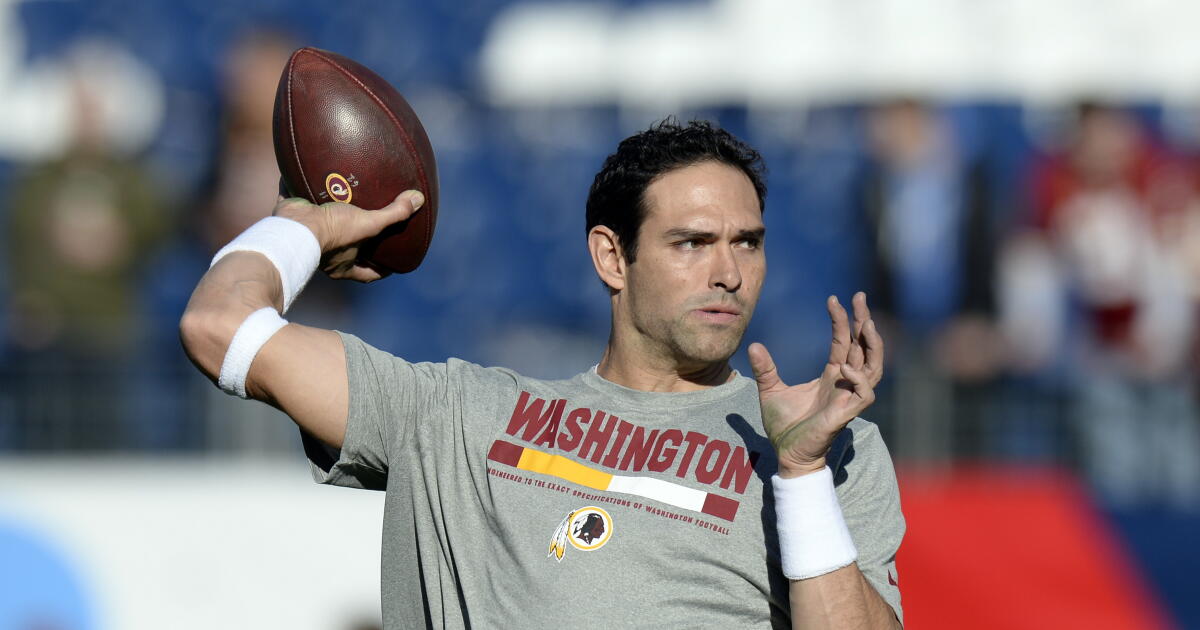
Former USC and NFL quarterback Mark Sanchez plans to enter a guilty plea in connection with his physical altercation with a 69-year-old truck driver in Indianapolis last October, according to online court records.
Attorneys for both sides entered a joint motion Thursday requesting that the judge “set this matter for a guilty plea and sentencing hearing,” according to WTHR-TV in Indianapolis, which has viewed the filing.
A jury trial had been scheduled to start Tuesday. The filing asks instead for a sentencing trial to be scheduled for November.
“The parties have reached a resolution that will obviate the need for the jury trial,” the document reads.
Sanchez was in town during the first weekend of October to cover a Colts game for Fox Sports. According to a police affidavit, Sanchez accosted Perry Tole after the Indiana resident had backed his truck into the loading docks of a downtown Indianapolis hotel.
Sanchez was charged with a level five felony of battery involving serious bodily injury, as well as the misdemeanors of battery resulting in injury, unauthorized entry of a motor vehicle and public intoxication. It is not clear the charges to which Sanchez will be pleading guilty.
In a civil suit against Sanchez, Tole alleged that he suffered “severe permanent disfigurement, loss of function, other physical injuries, emotional distress, and other damages.” Sanchez was hospitalized with stab wounds to his upper right torso following the incident.
“This is a positive development. We are finalizing an agreement with the prosecutor’s office that provides a path toward resolving the state’s case,” Nick Sanchez Jr., the former quarterback’s brother and legal advisor, said Thursday in a statement obtained by multiple media outlets. “We’re also encouraged by the constructive conversations taking place regarding the related civil matter. There is real momentum toward bringing this entire chapter to a close.”
Tole’s attorney, Matt Golitko, said Thursday in a statement: “We are pleased with the constructive and professional conversations we’ve had with Mr. Sanchez’s team. Our discussions have been productive and we’re on a positive path toward an agreement that will allow the parties to move forward. Mr. Tole appreciates the progress we have achieved and looks forward to an amicable resolution.”
Sanchez played for the New York Jets, Philadelphia, Dallas and Washington during his eight-year NFL career. Fox Sports confirmed in November that Sanchez is no longer employed by the network.
The US dollar broke above 2.1 million Iranian rials on Tehran’s free market on Wednesday, setting a new record as the rial lost around 60% of its value against the dollar since the start of the Iranian calendar year in March — when the dollar traded at approximately 1.35 million rials.
ADVERTISEMENT
ADVERTISEMENT
The rial’s slide has accelerated since the US reimposed a naval blockade on Iranian ports in July, following the collapse of a short-lived ceasefire.
The euro hit an unprecedented 2.55 million rials, and the UK pound reached 2,976,000 rials.
The UAE dirham, which serves as the benchmark for pricing the rial on regional markets, reached 600,000 rials for the first time.
One gram of 18-carat gold climbed above 225.7 million rials, and the Imami gold coin — a standard unit of value in Iran — changed hands at 2.26 billion rials.
Iran operates a dual exchange rate system. The official rate, set by the Central Bank and used for state transactions and subsidised imports of essential goods, is significantly stronger than the free market rate available to ordinary Iranians and businesses.
The gap between the two has widened sharply since the war began, with the free market rate now more than double the official rate.
The rial has been in freefall since the US-Israeli strikes against Iran on 28 February launched the ongoing war, now in its seventh month, and has accelerated as Washington has tightened its economic pressure campaign.
The US Treasury has cut off Iran’s access to regional banks, severing one of the Islamic Republic’s main channels for accessing foreign currency and clearing import payments.
The naval blockade of Iranian ports has compounded the pressure by restricting trade routes and reducing Iran’s oil export revenues.
Abdolnaser Hemmati, governor of the Central Bank of Iran, said the bank was ready to inject $2 billion into the foreign exchange market to stabilise the rial. He attributed the latest slide primarily to psychological factors rather than fundamental economic ones.
“The dust created in the foreign exchange market will settle, and the recent increase in exchange rates is driven more by psychological factors than by real economic factors,” he said.
Hemmati acknowledged that inflation had placed heavy pressure on households.
“Although inflation and rising prices have placed heavy pressure on people’s livelihoods and daily lives, and these difficulties are tangible, the Central Bank has been able to control the accelerating pace of inflation by using monetary, supervisory and prudential tools,” he said.
He rejected US claims that Tehran lacked access to financial reserves.
“These claims are completely baseless. The reserves have not been frozen, and the Central Bank has access to stable resources as well as multiple oil and non-oil revenues,” he said, claiming that more than $18 billion in foreign currency had been provided for imports of essential goods, medicines, animal feed and raw materials since March.
He provided no further details to support the figure.
The rial’s collapse is feeding directly into consumer prices. Iran was already experiencing high inflation before the war, while the currency’s further depreciation has raised the cost of all imported goods, raw materials and energy inputs.
Iranians who hold savings in rials have seen their purchasing power roughly halved in less than six months. Gold and hard currency have become the primary store of value for those who can access them.
Iran’s official currency is the rial, although most Iranians conduct everyday transactions in tomans — a colloquial unit equal to 10 rials that is so deeply embedded in daily use that shops, restaurants and property listings quote prices almost exclusively in tomans.
At Wednesday’s free-market rate, the US dollar traded at about 220,000 tomans. The government announced plans in 2020 to formally replace the rial with the toman and remove four zeros from the currency, a redenomination that has not yet been fully implemented.