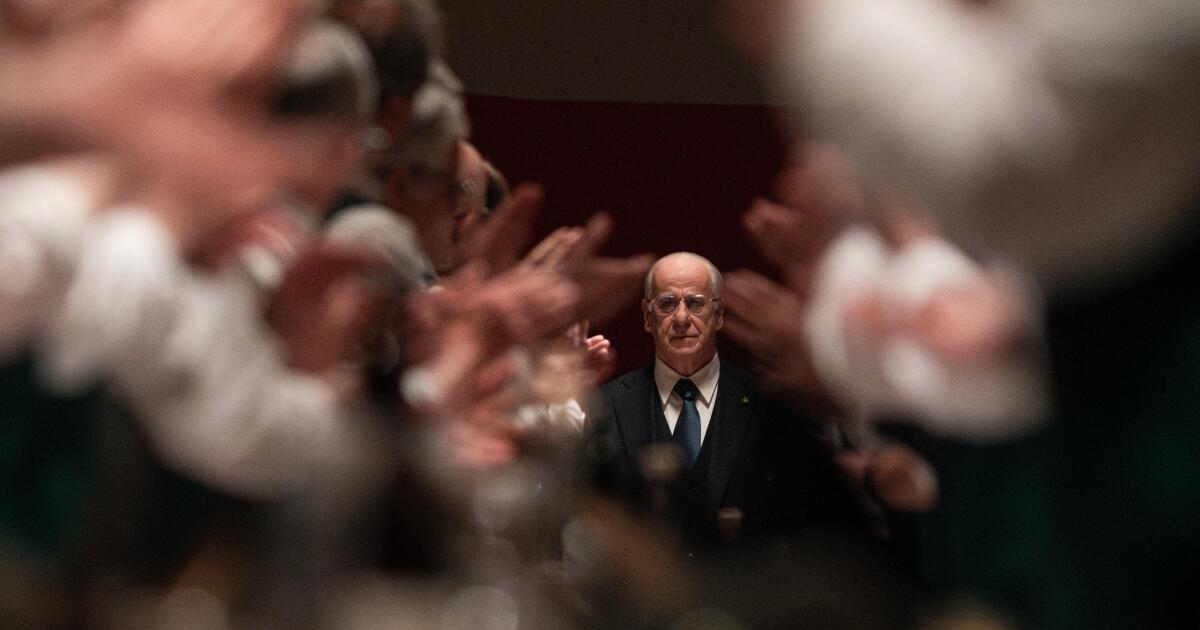
‘La Grazia’ review: Sorrentino, Servillo take on a president’s final months
We should be grateful for filmmakers who have a special artistic relationship with an actor: Akira Kurosawa with Toshiro Mifune, Martin Scorsese with Robert De Niro and, by all indications, Yorgos Lanthimos and Emma Stone. Count the Italian duo of Paolo Sorrentino and star Toni Servillo among them, a fertile partnership that began nearly 25 years ago with the director’s first film (“One Man Up”) and continues with their seventh together, the political drama “La Grazia” (“Grace”).
The wielding of power seems to be a frequent backdrop for these two, with “La Grazia” — about an Italian president facing tough decisions as he ends his term of office — marking the third time Sorrentino has asked his favorite leading man to be a head of state, following their breakthrough 2008 collaboration “Il Divo” (about Prime Minister Giulio Andreotti) and 2018’s romp about Silvio Berlusconi, “Loro.”
The difference this time is that, while the other two films centered controversial real-life figures, Servillo’s character in “La Grazia” is fictional, yet pressured to deal with contentious issues. The result is a much more somber, ruminative exploration of morality in governmental authority than the stylish violence of “Il Divo” and exploitative raunch of “Loro.”
A decade after his lush Oscar-winning bacchanal “The Great Beauty” (starring an especially great you-know-who), Sorrentino is no less drawn to pictorial beauty or arresting visuals. But there’s a grayer, graver tone to the long shadows of “La Grazia,” as if the natural, appealing gravitas of Servillo playing an important man fighting a planned obsolescence was the only palette Sorrentino and cinematographer Daria D’Antonio needed.
Servillo’s Mariano De Santis has mere months left — as a leader, that is. But besides being pushed to eat healthier and stop smoking cigarettes by his daughter Dorotea (a wonderful Anna Ferzetti), the idea of ending things isn’t entirely figurative as this austere jurist-turned-president wanders the halls of his official Roman residence, the grand Palazzo del Quirinale, wryly contemplating retirement.
He’s a widower, for one thing, whose love for his deceased wife is still deep enough to keep him jealous regarding her early infidelity with a mystery man he’s eager to identify, even as his old friend, art curator Coco (a vibrant Milvia Marigliano), stays tight-lipped about what she knows. He’s also being pushed by Dorotea, a treasured advisor who is herself a legal scholar, to consider two cases of clemency for convicted spousal killers, both with circumstances that would test any arbiter of sound legal judgment. And finally, though De Santis is a devoted Catholic, on good terms with the pope (Rufin Doh Zeyenouin), he’s grappling with signing right-to-euthanasia legislation.
You wouldn’t think a movie with such heavy topics would count as escapism. But when you consider current headlines, a thoughtful leader engaging with thorny issues from a place of psychological honesty, social integrity and fatherly love could almost count as fantasy. And Sorrentino, a dedicated sensualist, does allow himself some lighter touches, including, toward the end, a fanciful visual metaphor for a burdened man’s spirit that maybe only he could get away with.
Most assuredly, though, this is a duo of director and star once more moving in concert together, maybe not as confidently as with some previous efforts, but with a knowing intelligence. Servillo is no less than magnificent, conveying a buttoned-up statesman’s management of earned wisdom and inconvenient emotion (and, at one point, an interest in rap lyrics) with enough lessons in actorly craft to fill one of his character’s treasured law tomes. The title doesn’t just describe what’s sometimes elusive in governance. “La Grazia” is Servillo in every scene.
‘La Grazia’
In Italian, with subtitles
Rated: R, for some language
Running time: 2 hours, 13 minnutes
Playing: In limited release Friday, Dec. 12