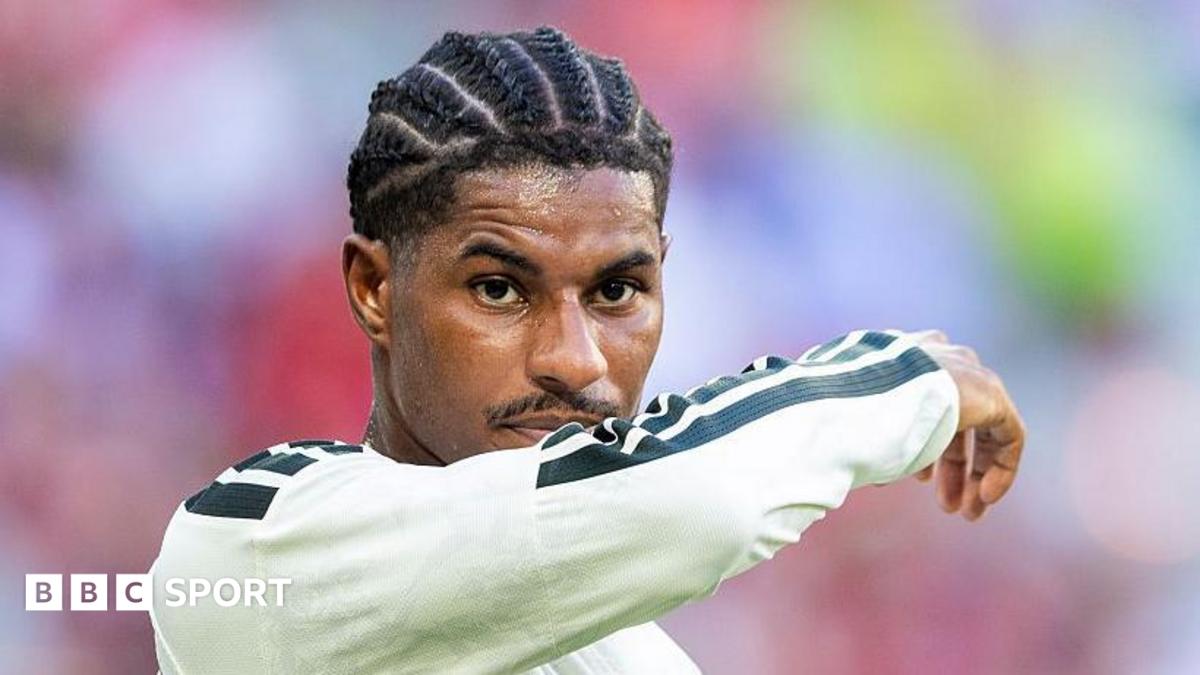
Rashford is a Manchester United player. He has a contract that runs to 30 June 2028. When Casemiro’s contract expires on 30 June this year, he will be the club’s highest earner, with his salary benefiting from the restoration of the 25% that had been taken off because of last season’s failure to qualify for the Champions League.
His loan deal with Barcelona includes an option to make the transfer permanent for €30m (£25.94m) if it is triggered by 15 June.
That is the easy bit. From there it starts to get complicated.
On the face of it, making the deal permanent makes sense for all parties.
Rashford has done pretty well; 14 goals and 14 assists in 47 appearances. It was enough to earn him an England recall from Thomas Tuchel and, in all probability, a spot in the final 26-man World Cup squad.
He enjoys playing for Barcelona and would like to stay.
While Barca have other targets this summer, they would be signing a player for well under market value. Manchester United meanwhile would be washing their hands of someone who was in Ruben Amorim’s ‘bomb squad’ last summer.
However, Barcelona are apparently unwilling to execute the transfer and are trying to renegotiate, potentially to sign Rashford next season on another loan deal. United have indicated they are not prepared to do that.
It is an understandable position for United, who know they could get more for Rashford from other clubs.
Yet United’s stance has risk.
Last month, head coach Michael Carrick said ‘nothing has been decided’ on Rashford and indicated he would be willing to work with the 28-year-old if he returned to Old Trafford next season and he was confirmed as the new boss.
However, United are determined to drive wage costs down and minority owner Sir Jim Ratcliffe has previously spoken about trying to ensure the highest earners are ‘on the pitch’.
Given the club are approaching a summer in which they will be attempting to sign at least two central midfield players and almost certainly at least two more players in other areas of the pitch, and also need to talk to skipper Bruno Fernandes about his contractual situation, it does not help them in negotiating terms for someone on Rashford’s salary to still be at the club.
Welcome back to the Lakers newsletter, where, against all odds, we’re still kicking.
The Lakers defied expectations by winning their first-round series against the Houston Rockets. Most didn’t give them any chance. It felt dicey after a deflating Game 5 loss at home. But the Lakers pulled it off with a headlining performance from their 22-time All-Star and award-worthy supporting performances from the ensemble cast.
Against the league-leading Oklahoma City Thunder, even fewer people are giving the Lakers a chance for an encore performance. But as Kevin Garnett once said: “Anything is possible!”
All things Lakers, all the time.
Get all the Lakers news you need in Thuc Nhi Nguyen’s weekly newsletter.
By continuing, you agree to our Terms of Service, which include arbitration and a class action waiver. You agree that we and our third-party vendors may collect and use your information, including through cookies, pixels and similar technologies, for the purposes set forth in our Privacy Policy such as personalizing your experience and ads.
Set the tone
Marcus Smart rotated over to the baseline. He came face to face with Houston’s Tari Eason as the 6-foot-8 Rockets forward leapt toward the basket. The 6-3 guard jumped right along with him.
Smart is used to taking on big challenges.
The Lakers brought Smart in for this moment. It’s not just the defensive tenacity to block a forward five inches taller and eight years younger than him, but when the postseason inevitably challenged the Lakers in unforeseen ways, they needed Smart’s leadership. He proves it every time he steps up to take a charge, gets a deflection or just pulls a teammate aside for a quick word.
“Marcus is a true leader,” center Deandre Ayton said. “Besides [Le]Bron [James], Luka [Doncic] and AR [Austin Reaves], Marcus is the other guy with the grit where [if you feel] discombobulated, he tries to be that guy that puts his arm around you and some of the younger guys. Whether it’s coming down to his competitiveness, keeping that same, consistent edge, Marcus tries to keep that level of intensity pretty high and it’s contagious, too.”
With Doncic (hamstring) still sidelined to begin the Western Conference semifinals against the top-seeded Thunder, the Lakers are counting on their supporting players for major performances. Smart’s role will be one of the most taxing; he’ll be the top defender for a team trying to slow down the NBA’s reigning most valuable player.
On his long list of elite matchups, Smart ranked Shai Gilgeous-Alexander at the top.
“I think we all know that, right?” the former defensive player of the year said. “He does a really good job of getting to the free-throw line. He’s mastered it. … It’s tough, but it can be done, it’s just going to take a lot of effort from everybody and we gotta stay together.”
Gilgeous-Alexander is a front-runner for his second consecutive most valuable player and led the Thunder to a sweep over the Phoenix Suns in the first round. The Thunder easily carved up Phoenix’s ninth-ranked defense, scoring 126.9 points per 100 possessions. Their offensive efficiency was five points better than the next best team in the first round.
The Lakers are coming off their own defensive masterpiece against Houston, holding the Rockets to less than 100 points in four of the six first-round games. Their 78 points allowed in the series-clinching Game 6 were the fewest in a playoff game by a Lakers opponent since May 16, 2012.
The anchors of the defensive performance are two major offseason additions acquired to help the Lakers bounce back from their disappointing first-round series loss to Minnesota last year. Smart and Ayton are quietly starring this postseason.
Ayton’s 11 points per game didn’t accurately reflect the influence he made against the Rockets. His 10.8 rebounds per game, including four games in which he had 10 or more rebounds despite being ejected in the third quarter of Game 4, were even more impressive against a team that dominated the rebounding battle at a historic rate.
A strong performance from Ayton lifts the ceiling on the team more than anyone else, Lakers coach JJ Redick said. An underrated and unexpected part of Smart’s value is his ability to unlock the team’s most important piece.
“I’m just somebody who he respects,” Smart said. “He sees [me] go out there and not only preaching, I’m actually doing what I’m preaching.”
Smart and Ayton barely knew each other before this season. But their paths are parallel: Former postseason mainstays who, in Ayton’s words, “disappeared.” The center who helped Phoenix to the NBA Finals trudged through Portland for two seasons; Smart, the former Boston Celtics stalwart, bounced between Memphis and Washington.
They’re now soaking up the spotlight in L.A.
“We’re both here, we’re both trying to get our names back into the good graces of the basketball gods,” Smart said, “and just show what we still can do.”
Priority No. 1
The Lakers had two keys for their first-round series against the Rockets: boxing out and taking care of the ball.
Now against what Redick estimated was “one of the greatest teams ever in NBA history,” that list has narrowed to one big thing.
Turnovers.
The Lakers, who got swept in the four-game regular-season series by an average of 29.3 points per game, averaged 17.5 turnovers per game against the Thunder during the regular season, three more than their regular-season average. Turnovers nearly undid the Lakers’ first-round series: they averaged 17.7 against the Rockets and gave up 19 points off turnovers per game.
The Thunder are an especially dangerous matchup for a team that can’t take care of the ball; Oklahoma City led the league in points off turnovers with 22 per game during the regular season.
“Whatever moments we felt Houston pressuring, like the maximum amount of pressure they put on us, that’s OKC’s baseline,” Redick said.
The Thunder, even playing without star two-way wing Jalen Williams for much of the season, were the NBA’s most disruptive defense. They’re league-leading defensive rating came with the third-most steals (9.7), sixth-most blocks (5.5) and the second-most turnovers forced (16.7) per game.
“They somehow do all of that without fouling,” Redick said with a hint of sarcasm in his voice, “which is one of the most remarkable things, I think, in NBA history.”
The Lakers, who attempted the second-most free throws in the league behind Doncic’s top-ranked 10.1 attempts, committed fewer fouls than the Thunder this season: 18.5 fouls per game compared to Oklahoma City’s 19.
On tap
Tuesday at Oklahoma City, 5:30 p.m. PDT (Game 1)
Two of the Lakers’ worst losses of the year were in Oklahoma City. If November’s 29-point loss wasn’t painful enough, the injury-plagued disaster on April 2 could be enough for the Lakers to want to sage the whole arena.
Thursday at Oklahoma City, 6:30 p.m. PDT (Game 2)
The Thunder have had the league’s best home record for each of the last two seasons, including a 34-7 mark this season, but still had two home playoff losses last year. Oklahoma City dropped Game 1 of the Western Conference semifinals and the NBA Finals last year, needing to win both series in seven games en route to the championship.
Saturday vs. Oklahoma City, 5:30 p.m. (Game 3)
The Thunder lost Game 3 in three of their four playoff series last year. The only exception was their first-round sweep over Memphis.
Monday vs. Oklahoma City, 7:30 p.m. (Game 4)
Could this be the final Lakers game of the year?
Status report
Luka Doncic (left hamstring)
After missing the first round, the Lakers’ superstar guard is still sidelined with a Grade 2 hamstring strain. He is not expected to return for the start of the series and has yet to progress to live on-court workouts.
Jalen Williams (left hamstring)
The Thunder’s All-NBA wing will miss at least Game 1 after he suffered a Grade 1 left hamstring strain on April 22, which kept him out of the Thunder’s last two games. After last year’s breakout season, Williams was plagued by injuries to his wrist and right hamstring that limited him to just 33 regular-season games.
(Second) favorite thing I ate this week
Because I did not take a picture of it, the only evidence I have from my No. 1 meal from Houston is a lingering sweet and spicy tang on my tongue from Rodeo Goat’s Billy F Gibbons burger. It was delicious: candied bacon, caramelized onions, gouda, mango pico, cream cheese and habanero sauce.
Street taco plate from Luchi & Joey’s in Houston.
(Thuc Nhi Nguyen / Los Angeles Times)
A close second was the street taco plate from Luchi & Joey’s, a food stall in downtown Houston’s underground tunnels. The five-taco spread hit the spot while I was hiding from the heavy storm moving through Houston on the day of Game 6. The six-mile tunnel system is lined with restaurants and shops that came in handy during torrential rain. I was safe from the elements while I hunted for lunch then only had to make a one-block scramble through the rain back to my hotel.
Marcus Smart knows what it feels like to be on the other side. The last time the Lakers guard was in the playoffs, he was helping the Boston Celtics storm back from a three-game deficit in the Eastern Conference finals to force a near-historic Game 7.
Now he’s watched the Lakers’ seemingly insurmountable three-games-to-none series lead dwindle to 3-2 after a 99-93 loss to the Houston Rockets on Wednesday at Crypto.com Arena. Smart isn’t flinching.
Whether defending a three-game lead or coming back from one, Smart knows the mindset is the same.
“We really got to literally go out there and be ready to die,” Smart said Wednesday after the Lakers failed to close out the Rockets for the second consecutive game. “… When I was on the other end, that was our motto: be willing to run through a wall and sacrifice your body for the betterment of the team. And that’s what we’re going to do now.”
Lakers guard Marcus Smart knocks the ball away from Rockets guard Amen Thompson during Game 5 at Crypto.Com Arena on Wednesday.
(Robert Gauthier/Los Angeles Times)
NBA teams are 159-0 with a 3-0 lead in a best-of-seven playoff series. Only four have even pushed it to the decisive Game 7. Smart’s 2023 Boston Celtics, when they clawed back against the Miami Heat in the Eastern Conference Finals, lost Game 7 at home after star Jayson Tatum turned his ankle on the first play of the game.
Hoping to avoid joining the historic list, the Lakers get a third try at vanquishing the Rockets for good in Game 6 on Friday at 6:30 p.m. PDT at Houston’s Toyota Center.
“Once we get on that plane and head down to Houston, we got to forget about it and understand what we are going for,” said LeBron James, who had 25 points and seven assists Friday. “It’s going to be even harder. Every game is hard. It’s so hard to close out a team in the postseason, to win a series, and this is our first time doing it as a unit.”
The Lakers built a three-game lead in the series despite playing without leading scorers Luka Doncic (hamstring) and Austin Reaves in the first four games. Reaves returned from a Grade 2 left oblique muscle strain Friday, scoring 22 points on four-of-16 shooting with six assists, but his presence couldn’t stop the gradual decline of the Lakers offense.
The Lakers have failed to reach 100 points in each of the last two games. From shooting 53.9% from the field and 51.7% from three in the first 10 quarters of the series, they have shot just 44.6% from the field and 29.2% from three in the last 10, excluding overtime of Game 3.
Luke Kennard, a flamethrower who scored 50 points in the first two games, has scored just eight in the last two. He was scoreless from the field Wednesday, including two missed three-pointers. A 91.2% free-throw shooter, Kennard even missed a free throw.
On the other hand, Houston has found its rhythm. The Rockets made 38.7% of their shots in the first 10 quarters — Games 1 and 2 and the first half of Game 3 — and have shot 46.3% in the 10 quarters since, excluding the Game 3 overtime period. Their three-point shooting has jumped from 30.9% to 34.1%.
“We just got to make shots,” Smart said of the offense’s struggles. “… And we’re not giving ourselves a chance by turning the ball over, which we can’t get a shot up on the rim because of that.”
The Lakers had 15 turnovers that resulted in 18 Rockets points Wednesday. The game started slipping away in the second quarter when they had five turnovers with the Rockets scoring nine points off the miscues. The Lakers let their 11-point first-quarter lead turn into a four-point halftime deficit.
Smart, who was asked to handle more ball-handling responsibilities while Doncic and Reaves were injured, had six turnovers and just two assists Friday. He called them “unacceptable.”
Rockets center Alperen Sengun yells out for the ball while Lakers guard Marcus Smart pressures the ball hander during Game 5 at Crypto.com Arena on Wednesday.
(Robert Gauthier/Los Angeles Times)
“The turnovers come in all shapes and sizes, and it’s about limiting them,” Lakers coach JJ Redick said. “And you certainly have to give your guys freedom to make basketball plays. I would say in general though, turnovers of aggression are OK; turnovers of passivity are not.”
The Rockets only averaged 8.5 steals per game during the regular season, but had two players in the NBA’s top 10 in total steals with guards Reed Sheppard (sixth, 122 total steals) and Amen Thompson (eighth, 119). They had three and four steals, respectively, in Game 5.
A defensive play from Sheppard stifled the Lakers’ late comeback. The Lakers trimmed a 13-point lead to three in less than three minutes. The cheer from the sold-out crowd at Crypto.com Arena was deafening when James kissed a left handed layup off the glass to pull the Lakers to within one possession with 2:59 left.
Sheppard immediately responded with a midrange jumper then picked James’ pocket on the next Lakers possession, going coast-to-coast for a two-handed dunk that pushed the lead back to seven with 2:20 remaining.
The crowd went silent.
The Lakers had that same stunning effect on a road crowd already this series when they stormed back from a six-point deficit in less than 30 seconds in Game 3. The prospect of doing it again with even larger stakes brought an excited smirk to Smart’s face.
“We knew this was going to be a tough series,” Smart said. “I think everybody knew that, and it’s turning out to be exactly what we expected. And now the fun begins.”