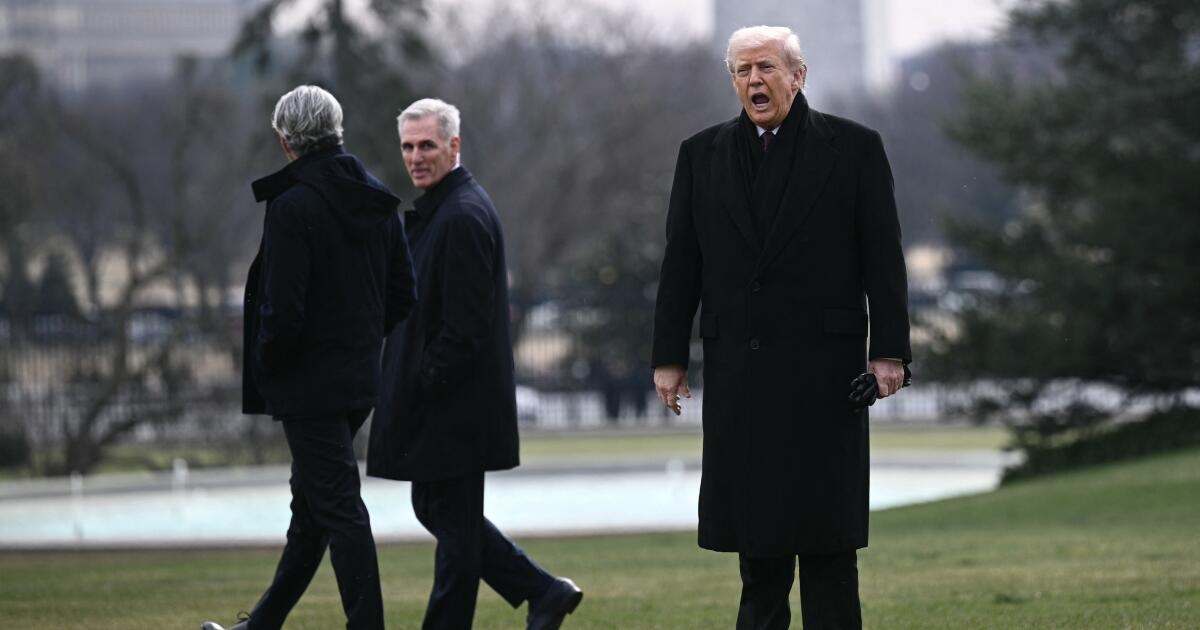
MEXICO CITY — President Trump has ordered a partial blockade on oil tankers going to and from Venezuela, potentially crippling the nation’s already battered economy, and accused Caracas of stealing “oil, land other assets” from the United States — a significant escalation of Washington’s unrelenting campaign against the government of President Nicolás Maduro.
Asked about Venezuela on Wednesday, Trump said the United States will be “getting land, oil rights and whatever we had.”
“We want it back,” Trump said without further elaboration. It was unclear if Trump planned to say more about Venezuela in a televised address to the nation late Wednesday night.
The blockade, which aims to cripple the key component of Venezuela’s faltering, oil-dependent economy, comes as the Trump administration has bolstered military forces in the Caribbean, blown up more than two dozen boats allegedly ferrying illicit drugs in both the Caribbean and the Pacific, and threatened military strikes on Venezuela and neighboring Colombia.
“Venezuela is completely surrounded by the largest Armada ever assembled in the History of South America,” Trump said in a rambling post Tuesday night on his Truth Social site. “It will only get bigger, and the shock to them will be like nothing they have ever seen before.”
Not long after Trump announced the blockade Tuesday night, the government of Venezuela denounced the move and other Trump efforts as an attempt to “rob the riches that belong to our people.”
Leaders of other Latin American nations called for calm and United Nations Secretary-General Antonio Guterres, after a phone call with Maduro, called on U.N. members to “exert restraint and de-escalate tensions to preserve regional stability.”
Also Wednesday, Trump received rare pushback from the Republican-dominated Congress, where some lawmakers are pressuring the administration to disclose more information about its deadly attacks on alleged drug boats.
The Senate gave final approval to a $900-billion defense policy package that, among other things, would require the administration to disclose to lawmakers specific orders behind the boat strikes along with unedited videos of the deadly attacks. If the administration does not comply, the bill would withhold a quarter of Defense Secretary Pete Hegseth’s travel budget.
The bill’s passage came a day after Hegseth and Secretary Marco Rubio came to Capitol Hill to brief lawmakers on the U.S. military campaign. The briefings left lawmakers with mixed reaction, largely with Republicans backing the campaign and Democrats expressing concern about it.
The White House has said its military campaign in Venezuela is meant to curb drug trafficking, but the U.S. Drug Enforcement Administration data shows that Venezuela is a relatively minor player in the U.S.-bound drug trade.
Trump also declared that the South American country had been designated a “foreign terrorist organization.” That would apparently make Venezuela the first nation ever slapped with a classification normally reserved for armed groups deemed hostile to the United States or its allies. The consequences remain unclear for Venezuela.
Regional responses to the Trump threats highlight the new ideological fault lines in Latin America, where right-wing governments in recent years have won elections in Chile, Argentina and Ecuador.
The leftist leaders of the region’s two most populous nations — Brazil and Mexico — have called for restraint in Venezuela.
“Whatever one thinks about the Venezuelan government or the presidency of Maduro, the position of Mexico should always be: No to intervention, no to foreign meddling,” Mexican President Claudia Sheinbaum said Wednesday, calling on the United Nations to look for a peaceful solution and avoid any bloodshed.
Brazilian President Luiz Inácio Lula da Silva has also urged Trump to pull back from confrontation. “The power of the word can outweigh the power of the gun,” Lula said he told Trump recently, offering to facilitate talks with the Maduro government.
But Chile’s right-wing president-elect, José Antonio Kast, said he supports regime-change in Venezuela, asserting that it would reduce migration from Venezuela to other nations in the region.
“If someone is going to do it, let’s be clear that it solves a gigantic problem for us and all of Latin America, all of South America, and even for countries in Europe,” Kast said, referring to Venezuelan immigration.
In his Tuesday post, Trump said he had ordered a “complete blockade of all sanctioned oil tankers going into, and out of, Venezuela.” While potentially devastating to Venezuela’s economy, the fact that the blockade will only affect tankers already sanctioned by U.S. authorities does give Venezuela some breathing room, at least for now.
Experts estimated that only between one-third and one-half of tankers transporting crude to and from Venezuela are likely part of the so-called “dark fleet” of sanctioned tankers. The ships typically ferry crude from Venezuela and Iran, two nations under heavy U.S. trade and economic bans.
However, experts said that even a partial blockade will be a major hit for Venezuela’s feeble economy, reeling under more than a decade of of U.S. penalties. And Washington can continue adding to the list of sanctioned tankers.
“The United States can keep sanctioning more tankers, and that would leave Venezuela with almost no income,” said David A. Smilde, a Venezuela expert at Tulane University. “That would probably cause a famine in the country.”
The growing pressure, analysts said, will likely mean the diminishing number of firms willing to take the risk of transporting Venezuelan crude will up their prices, putting more pressure on Caracas. Purchasers in China and elsewhere will also likely demand price cuts to buy Venezuelan oil.
Trump has said that Maduro must go because he is a “narco-terrorist” and heads the “Cartel de los Soles,” which the While House calls is a drug-trafficking syndicate. Trump has put a $50 million bounty on Maduro’s head. Experts say that Cartel de los Soles is not a functioning cartel, but a short-hand term for Venezuelan military officers who have been involved in the drug trade for decades, long before Maduro or his predecessor and mentor, the late Hugo Chávez, took office.
In his comments on Tuesday, Trump denounced the nationalization of the Venezuelan oil industry, a process that began in the 1970s, when Caracas was a strong ally of Washington.
Echoing Trump’s point that Venezuela “stole” U.S. assets was Stephen Miller, Trump’s homeland security advisor, who declared on X: “American sweat, ingenuity and toil created the oil industry in Venezuela. Its tyrannical expropriation was the largest recorded theft of American wealth and property.”
Among those believed to be driving Trump’s efforts to oust Maduro is Secretary of State Maro Rubio, the son of Cuban immigrants to Florida. Rubio has long been an outspoken opponent of the communist governments in Havana and Caracas. Venezuelan oil has helped the economies of left-wing governments in both Cuba and Nicaragua.
Christopher Sabatini, a senior fellow for Latin America at Chatham House, said Rubio has been on a long-time campaign to remove Maduro.”He has his own political project,” Sabatini said. “He wants to get rid of the dictators in Venezuela and Cuba.”
Staff writers McDonnell and Linthicum reported from Mexico City and Ceballos from Washington. Contributing was special correspondent Mery Mogollón in Caracas.