Before the Coachella Valley Music and Arts Festival became a world-famous event, it started as a much more modest music festival in Southern California’s desert in 1999.
As the festival kicks off its 25th year, we combed through The Times’ extensive archives to take a trip down Coachella’s memory lane. Scroll through and you’ll see those epic moments from Daft Punk, Beyoncé, Prince and Madonna, but also the iconic large art installations at the festival and just how much the event has grown and changed over the years.
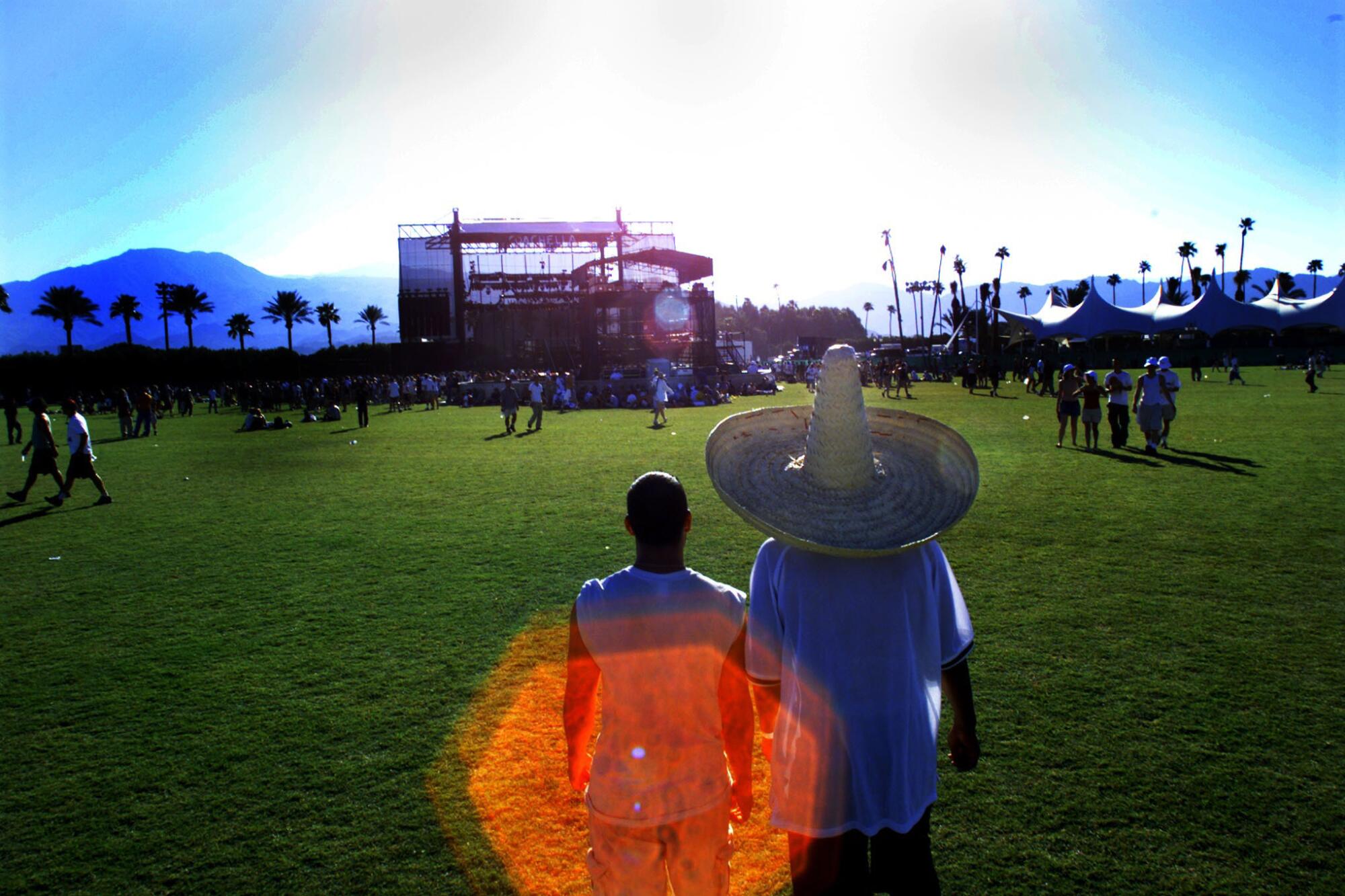
Dennis Carrillo wears a sombrero as a shield against the blistering sun as he and friend Dario Soto, both of Los Angeles, walk toward the stage at the inaugural Coachella Valley Music and Arts Festival in Indio in October 1999, where the temperature hit triple digits.
(Luis Sinco / Los Angeles Times)
Beck was one of the headliners of the original Coachella in October 1999.
(Luis Sinco / Los Angeles Times)
Thousands of music fans wait at the main stage area at the inaugural Coachella in 1999.
(Gina Ferazzi / Los Angeles Times)
Rage Against the Machine was one of the headliners of the inaugural Coachella Valley Music and Arts Festival in 1999.
(Gina Ferazzi / Los Angeles Times)
2001
Due to the financial losses, Coachella skipped a year and returned in April 2001 as a one-day event with a headlining set by Jane’s Addiction and a bill featuring artists such as Weezer and Paul Oakenfold. It drew more than 32,000 people to the desert.
When Coachella returned as a one-day event in 2001, Jane’s Addiction headlined the show.
(Lori Shepler / Los Angeles Times)
Even in its early years, Coachella made art part of the vibe. In 2001, people on stilts roamed the field in front of the main stage.
(Lori Shepler / Los Angeles Times)
Thousands of fans hang out on the main field at Coachella in 2001.
(Lori Shepler / Los Angeles Times)
Paul Oakenfold’s first time playing Coachella was in 2001.
(Lori Shepler / Los Angeles Times)
2002
Coachella went back to being a two-day event in 2002, headlined by Bjork and Oasis. One of the emerging acts on the bill that year was a rock combo out of New York called The Strokes.
Oasis, with guitarist Noel Gallagher, headlined the second day of Coachella 2002.
(Kevin P. Casey / Los Angeles Times)
When The Strokes first played Coachella in 2002, the New York band was just emerging in the rock scene. Singer Julian Casablancas and the group will perform again in 2026.
(Kevin P. Casey / Los Angeles Times)
The first time Bjork headlined Coachella was the 2002 edition of the festival.
(Kevin P. Casey / Los Angeles Times)
Fans watch arm in arm as Oasis closes out Coachella 2002.
(Kevin P. Casey / Los Angeles Times)
2003
The Beastie Boys and Red Hot Chili Peppers headlined Coachella 2003, but the lineup also included The White Stripes, Iggy and The Stooges, Underworld and the Blue Man Group.
Coachella attracted about 35,000 fans per day in 2003.
(Myung J. Chun / Los Angeles Times)
The White Stripes were one of the standout acts at Coachella 2003.
(Myung J. Chun / Los Angeles Times)
The Sahara Tent has always been the heartbeat of Coachella’s dance scene, but in 2003 it was much smaller than the airplane hangar-sized stage it is today.
(Myung J. Chun / Los Angeles Times)
The Blue Man Group performed at the 2003 Coachella Valley Music and Arts Festival.
(Myung J. Chun / Los Angeles Times)
2004
In 2004, the Flaming Lips created an iconic Coachella moment when singer Wayne Coyne traveled over the crowd in a giant inflatable ball. Headlined by Radiohead and The Cure, the festival also included a reunion of the Pixies. It also marked Coachella’s first sellout, with 60,000 attendees per day.
The Flaming Lips’ Wayne Coyne travels over the Coachella 2004 crowd in an inflated plastic bubble.
(Robert Gauthier / Los Angeles Times)
Syd Klinge’s “Cauac” Tesla coil was one of Coachella’s firstart pieces. It made its debut in 2004.
(Robert Gauthier / Los Angeles Times)
Coachella 2004 featured a highly-regarded reunion of the Pixies.
(Robert Gauthier / Los Angeles Times)
Fans brave sweltering heat as they wait for the Pixies to perform at Coachella 2004.
(Robert Gauthier / Los Angeles Times)
2005
Coldplay and Nine Inch Nails headlined Coachella in 2005. Weezer, The Chemical Brothers and Wilco were some of the other notable acts on the bill. Among the memorable moments was the reunion of Bauhaus and singer Peter Murphy performing “Bela Lugosi’s Dead” while hanging upside down like a bat.
Wilco performs before a crowd of tens of thousands at dusk at the 2005 Coachella Valley Music and Arts Festival.
(Myung J. Chun / Los Angeles Times)
Trent Reznor and Nine Inch Nails headlined Coachella in 2005. Reznor will return to the festival in 2026 with German music producer Boys Noize to perform as Nine Inch Noize.
(Myung J. Chun / Los Angeles Times)
Music fans break a sweat dancing in the Sahara Tent during the 2005 Coachella Valley Music and Arts Festival.
(Myung J. Chun / Los Angeles Times)
Allen Writhen, of Santa Maria, takes a spin on a bicycle at the Cyclecide arena at Coachella 2005. Cyclecide, a San Francisco–based bicycle rodeo group, brought bike-centric art installations to Coachella for multiple years.
Prince headlined Saturday night of Coachella 2008, performing a memorable cover of Radiohead’s “Creep.”
(Spencer Weiner / Los Angeles Times)
Kestrin Pantera dances while Marc Goldstein DJs aboard a special Amtrak charter, the Coachella Express, which traveled from Los Angeles to Indio in 2008. The free train service provided transportation to Coachella Valley Music and Arts Festival attendees.
(Spencer Weiner / Los Angeles Times)
Roger Waters performed Pink Floyd’s “Dark Side of the Moon” during the final day of Coachella 2008. His set also included a giant inflatable pig that was let loose into the Indio night.
(Spencer Weiner / Los Angeles Times)
A dance circle develops inside the Do Lab at the 2008 Coachella Valley Music and Arts Festival.
(Jay L. Clendenin / Los Angeles Times)
2009
Coachella 2009 marked the final year the general public could buy single-day tickets to the festival. Paul McCartney headlined opening night and played 50-plus minutes after curfew. When The Cure tried the same thing to close down Sunday, the sound was cut earlier. Sandwiched in between was a headlining set from The Killers. Other notable performers included M.I.A., who stepped in after Amy Winehouse dropped off the lineup, Morrissey, who complained about the smell of burning flesh, and Leonard Cohen.
Paul McCartney headlined the main stage at Coachella 2009 in a career-spanning set that went nearly an hour past the 1 a.m. curfew.
(Spencer Weiner / Los Angeles Times)
Festivalgoers find shade in the Do Lab at Coachella 2009.
(Jay L. Clendenin / Los Angeles Times)
M.I.A. stepped in to perform at Coachella 2009 after Amy Winehouse dropped off the lineup.
(Jay L. Clendenin / Los Angeles Times)
“Bamboo Starscraper” was a 90-foot-tall bamboo tower by Gerard Minakawa that was part of the art at the festival in 2009.
(Jay L. Clendenin / Los Angeles Times)
2010
This year was the first time the festival only offered three-day passes and Coachella drew a record 75,000 people per day, up nearly 15,000 from the previous year. It was also the year Coachella had its first rap headliner with Jay-Z, who brought out wife Beyoncé to perform “Young Forever.” The other headliners in 2010 were Muse and Gorillaz. The eruption of an Icelandic volcano kept some artists from getting to the festival, including The Cribs and Frightened Rabbit. Then there was Sly Stone’s oft-delayed set that ended with him ranting about his former manager and led to a slander lawsuit. The full festival was also livestreamed for the first time.
In 2010, Jay-Z became the first rapper to headline Coachella. He brought out wife Beyoncé as a surprise guest.
(Luis Sinco / Los Angeles Times)
Members of the Old Crow Medicine Show jam in the VIP area of the Coachella Valley Music and Arts Festival at the Empire Polo Club in Indio in 2010.
(Luis Sinco / Los Angeles Times)
DJ Lance Rock and the creatures of “Yo Gabba Gabba!” performed at Coachella in 2010.
(Luis Sinco / Los Angeles Times)
The crowd reacts during Benny Benassi’s DJ set in the Sahara Tent at Coachella 2010.
Snoop Dogg performs with a hologram of Tupac Shakur near the end of the Snoop Dogg and Dr. Dre’s headlining set at Coachella 2012.
(Jay L. Clendenin / Los Angeles Times)
Laura Newton, left, Lucy Holme and Louise Watkins from Britain attended their first Coachella in 2012 and protected themselves from the rain that swept in on opening day with garbage bags.
(Luis Sinco / Los Angeles Times)
David Guetta brought lots of lasers to his performance in the Sahara Tent at Coachella 2012.
(Jay L. Clendenin/Los Angeles Times)
An aerial view of the 2012 Coachella Valley Music and Arts Festival.
“Helix Poeticus,” created by Poetic Kinetics makes its way, slowly, across the polo field at Coachella 2013.
(Jay L. Clendenin / Los Angeles Times)
Flea of the Red Hot Chili Peppers headlined Sunday night at the 2013 Coachella Valley Music and Arts Festival.
(Brian van der Brug / Los Angeles Times)
The Yuma Tent made its debut at Coachella 2013 with air conditioning, a hardwood floor and comfy chairs.
(Luis Sinco / Los Angeles Times)
Tesla coils by artist Syd Klinge go off along with the “Coachella Power Station,” left, by artists Vanessa Bonet, Derek Doublin and Chris Waggoner at Coachella 2013.
(Jay L. Clendenin / Los Angeles Times)
2014
A reunited Outkast, Muse and Arcade Fire headlined Coachella 2014, but one of the most memorable performances was Pharrell Williams’ star-studded set on the Outdoor Theatre. We also saw the debut of Poetic Kinetics’ “Escape Velocity,” a.k.a. the Coachella astronaut, and the mirrored “Reflection Fields” by Phillip K. Smith among the festival’s major art installations.
A nearly 40-foot tall astronaut, “Escape Velocity” by L.A. art collective Poetic Kinetics, is reflected in “Reflection Fields” by Phillip K. Smith at the 2014 Coachella Valley Music and Arts Festival.
(Brian van der Brug / Los Angeles Times)
Andre 3000 of Outkast performs inside a screen box opening day of the 2014 festival. Andre 3000 and Big Boi reunited for the festival.
(Bethany Mollenkof / Los Angeles Times)
Fans pack the Sahara Tent for the performance of Showtek at Coachella 2014.
(Jay L. Clendenin / Los Angeles Times)
Pharell Williams performs at the second weekend of the 2014 Coachella Valley Music and Arts Festival.
Angus Young duck walked in his traditional schoolboy uniform during AC/DC’s Coachella 2015 headlining performance.
(Luis Sinco / Los Angeles Times)
Music fans flock to “Desiderium Eruca,” Poetic Kinetics’ large butterfly sculpture that replaced the “Papilio Merraculous” caterpillar sculpture at Coachella 2015.
(Marcus Yam / Los Angeles Times)
Florence + The Machine was one of the memorable performances at Coachella 2015. Singer Florence Welch broke her foot when she leaped from the stage during Weekend 1.
(Marcus Yam / Los Angeles Times)
Aerial performers spin above the crowd at the Do Lab at Coachella 2015.
After breaking his foot the week before Coachella 2016 during Guns N’ Roses’ Troubadour warm-up show, Axl Rose performed on stage at Coachella atop the motorized throne Dave Grohl previously used on tour after breaking his leg.
(Brian van der Brug / Los Angeles Times)
Alejandro Murcia and Wanda Quintero take a photo in front of R&R Studios’ “Besame Mucho” installation at Coachella 2016. The typographic sign was covered in silk flowers and is among the more memorable art pieces from the year. Today, the installation lives on at Miami International Airport.
(Jay L. Clendenin / Los Angeles Times)
Ice Cube’s performance at Coachella in 2016 led to an on-stage reunion with the surviving members of N.W.A, featuring MC Ren and DJ Yella Weekend 1 with Dr. Dre joining them on Weekend 2.
(Jay L. Clendenin / Los Angeles Times)
Brian Sneed and Claudia Jerez jump as a friend takes their photo in front of the “Katrina Chairs” art installation at Coachella 2016.
The first time Lady Gaga headlined Coachella was in 2017 and it was because she stepped in after Beyoncé had to postpone due to her pregnancy.
(Brian van der Brug / Los Angeles Times)
Crowds of people take photos of Gustavo Prado’s art piece “Lamp Beside the Golden Door”at Coachella 2017. The sculpture featured more than 2,100 mirrors.
(Luis Sinco / Los Angeles Times)
Kendrick Lamar released “Damn.” the Friday of Coachella 2017 Weekend 1, two days before his headlining performance that included ninjas.
(Brian van der Brug / Los Angeles Times)
Olalekan Jeyifous’ 50-foot-tall “Crown Ether” treehouse art installation provided a backdrop for photos at Coachella 2017.
(Brian van der Brug / Los Angeles Times)
2018
Coachella was already regarded globally as a music festival. Then Beyoncé turned Coachella into the pop culture moment of the year. Coachella became Beychella and her Homecoming performance was nothing short of epic, even becoming its own Netflix special. Beyond Beyoncé, Eminem and The Weeknd headlined, but one of the other standouts was Cardi B’s TLC-inspired performance on the main stage. On the grounds, 2018 was the year “Spectra,” the cylindrical rainbow tower, became part of the festival’s landscape.
Beyoncé’s stunning headlining performance at Coachella 2018 celebrated America’s historically Black colleges and universities. Her set also featured cameos from husband Jay-Z, sister Solange and a Destiny’s Child reunion.
(Luis Sinco / Los Angeles Times)
The rainbow-colored cylindrical tower “Spectra” made its debut at Coachella in 2018.
(Christina House / Los Angeles Times)
Cardi B performed a set inspired by TLC at Coachella in 2018.
(Kent Nishimura / Los Angeles Times)
Festival goers walk in front of Edoardo Tresoldi’s “Etherea” wire mesh cathedral structures and Randy Polumbo’s “Lodestar,” which was made with the fuselage of a military jet, at Coachella 2018.
(Maria Alejandra Cardona / Los Angeles Times)
2019
Ariana Grande, Childish Gambino and Tame Impala headlined Coachella in 2019, but the big memories from that year were the rise of artists like Bad Bunny and Billie Eilish as they were becoming bona fide superstars. Arguably the most memorable performance of the year wasn’t even during normal festival hours — it was when Kanye West held a Sunday Service in the campgrounds on Easter Sunday during Weekend 2. Meanwhile, to mark Coachella’s 20th year, Poetic Kinetics brought back the famous roving Coachella astronaut in a new form as “Overview Effect.”
Bad Bunny’s set at Coachella 2019 included a guest spot from J Balvin.
(Mariah Tauger / Los Angeles Times)
Kanye West’s Easter Sunday Service happened outside of the main festival grounds during Weekend 2 of the Coachella 2019.
(Kent Nishimura / Los Angeles Times)
“Overview Effect,” a roaming astronaut sculpture made by Poetic Kinetics, roams around the 2019 Coachella Valley Music and Arts Festival at the Empire Polo Club grounds in Indio.
(Brian van der Brug / Los Angeles Times)
Fans go wild as confetti drops during Tame Impala’s headlining performance at Coachella 2019.
Billie Eilish’s 2022 Coachella headlining turn included a guest spot from Damon Albarn to join her for “Getting Older” and “Feel Good Inc.”
(Dania Maxwell / Los Angeles Times)
Wearing the signature blue wigs of Karol G, music fans cheered the star as she arrived on the main stage at Coachella 2022.
(Gina Ferazzi / Los Angeles Times)
Swedish House Mafia x The Weeknd became a last-minute headliner replacement for Kanye West at Coachella 2022.
(Christina House / Los Angeles Times)
One of the largest art installations at Coachella 2022 was Cristopher Cichocki’s “Circular Dimensions x Microscape,” which was made with more than 25,000 feet of PVC tubes and was five stories tall. At night, images were projected on the piece.
Bad Bunny performs at Coachella Weekend 1 in 2023.
(Christina House / Los Angeles Times)
People walk by Güvenç Özel’s sculpture “Holoflux” at Coachella 2023.
(Christina House / Los Angeles Times)
Doechii performs at Coachella 2023.
(Dania Maxwell / Los Angeles Times)
A reunited Blink-182 joined the Coachella 2023 lineup days before the festival. The band played in the Sahara Tent during Weekend 1 before moving to the main stage Weekend 2 to help fill the gap left by headliner Frank Ocean dropping off the bill.
(Dania Maxwell / Los Angeles Times)
2024
Lana del Rey, Tyler, the Creator and Doja Cat headlined the festival in 2024, but one of the big draws was the reunion of No Doubt, who brought out Olivia Rodrigo. Sabrina Carpenter, who is headlining the 2026 festival, also performed on the main stage during the day. The big changes in 2024 were that the main festival grounds expanded with a larger Sahara Tent on the southern end of the site and the addition of the Quasar Stage.
Tyler, the Creator’s headlining set at Coachella 2024 featured the rapper dressed as a park ranger and an elaborate national park-like stage set.
(Dania Maxwell / Los Angeles Times)
Gwen Stefani of No Doubt performs at Coachella 2024. The band reunited for the festival and brought out Olivia Rodrigo as a guest.
(Christina House / Los Angeles Times)
Doja Cat was the Sunday night headliner at Coachella 2024 and her performance included dancers dressed like yetis.
(Dania Maxwell / Los Angeles Times)
Chappell Roan was one of the breakout stars at Coachella 2024.
ATLANTA — The Georgia General Assembly ended its annual session early Friday without a plan for new equipment to overhaul the state’s voting system by a July deadline, plunging into doubt the future of elections in the political battleground.
The lawmakers’ failure to offer a solution after months of debate raises uncertainty about how Georgians will vote in November and leaves confusion that could end in the courts or a special legislative session.
“They’ve abdicated their responsibility,” Democratic state Rep. Saira Draper said of inaction by Republicans who control the legislature.
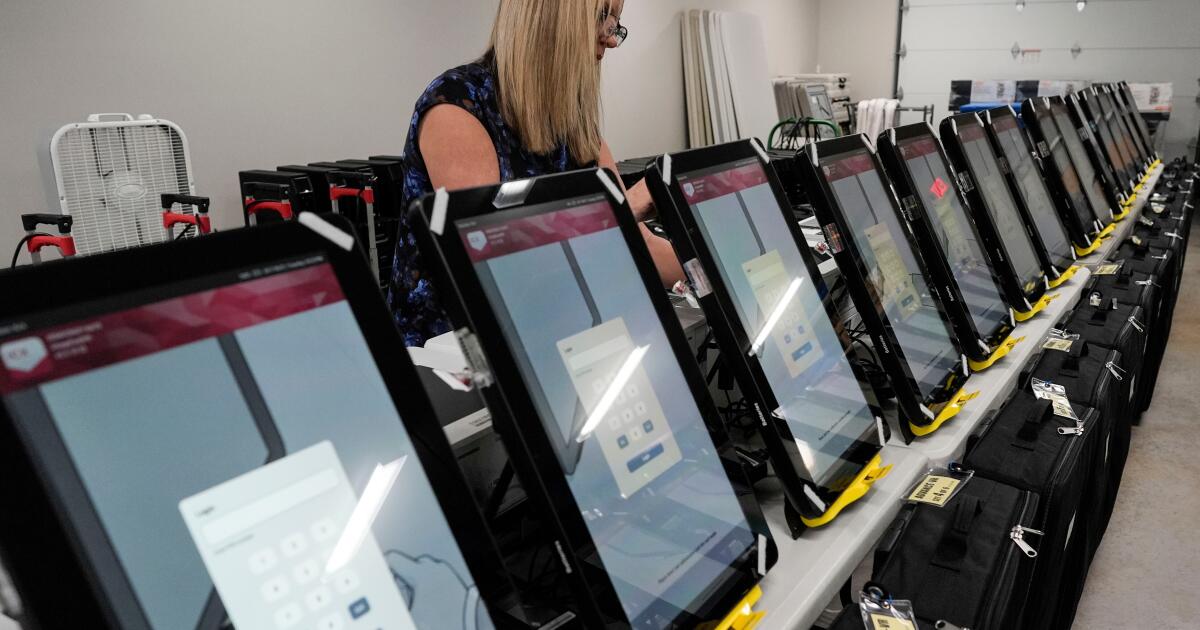
Currently, voters make their choices on Dominion Voting machines, which then print ballots with a QR code that scanners read to tally votes. Those machines have been repeatedly targeted by President Trump following his 2020 election loss, and Trump’s Georgia supporters responded by enacting a law in 2024 that bans using barcodes to count votes.
But state law still requires counties to use the machines. No money has been allocated to reprogram them, and lawmakers failed to agree on a replacement.
“We’ll have an unresolvable statutory conflict come July 1,” said House Governmental Affairs Committee Chairman Victor Anderson, a Cornelia Republican who backed a proposal to keep using the machines in 2026 that Senate Republicans declined to consider.
House Republicans and Democrats backed Anderson’s plan, which would have required that Georgia choose a voting process that didn’t use QR codes by 2028. Election officials preferred that solution.
“The Senate has shown that they’re not responsible actors,” Draper said. She added that Lt. Gov. Burt Jones, a Trump-endorsed Republican running for governor, seemed more interested in keeping Trump’s backing than “doing right by Georgia voters.”
A spokesperson for Jones didn’t immediately respond to a request for comment early Friday.
Joseph Kirk, Bartow County election supervisor and president of the Georgia Association of Voter Registration and Election Officials, said he’ll look to the secretary of state for guidance and assumes a judge will rule to instruct election officials how to proceed.
“This is uncharted territory,” he said.
Robert Sinners, a spokesperson for Republican Secretary of State Brad Raffensperger, who is also running for governor, said officials are “ready to follow the law and follow the Constitution.”
Republican House Speaker Jon Burns told reporters that his chamber was seeking to minimize changes this year.
“You can’t change horses in the middle of the stream,” Burns said.
Burns said he would meet with Gov. Brian Kemp and “take his temperature” on the possibility of a special session. A spokesperson for Kemp didn’t answer questions about what the outgoing Republican governor would do.
Anderson said without action, the state could be required to use hand-marked and hand-counted paper ballots in November.
Election officials say switching to a new system within just a few months, as advocated by some Republicans, would be nearly impossible.
“They made no way for this to happen except putting a deadline on it,” Cherokee County elections director Anne Dover said of the switch away from barcodes. Dover said one problem under some plans is that a very large number of ballots would have to be printed.
Lawmakers seemed more concerned about scoring political points than making practical plans, Paulding County Election Supervisor Deidre Holden said.
“If anyone is resilient and can get the job done, it’s all of us election officials, but the legislators need to work with us, and they need to understand what we do before they go making laws that are basically unachievable for us,” Holden said.
Supporters of hand-marked paper ballots say voters are more likely to trust in an accurate count if they can see what gets read by the scanner.
Right-wing election activists lobbied lawmakers for an immediate switch to hand-marked paper ballots, but the House turned away from a Senate proposal to do so.
Anderson said he wasn’t sure if a special session could escape those political crosswinds, but said Georgia lawmakers must fix the problem.
“This is a legislative problem,” Anderson said. “It’s a legislative solution that has to happen.”
AI is coming. AI is here. AI is a bubble. AI is the future we want. AI is the end. AI is the path to a better us (at least the ones who survive it).
A big topic, this artificial intelligence, with a lot of different ways to think about it. To grapple with AI is a worthy endeavor for any filmmaker. (And by grapple, I don’t mean asking AI to make the film for you.)
Daniel Roher, the man behind the Oscar-winning “Navalny,” has, along with co-director Charlie Tyrell, attempted a nonfiction primer of sorts on the biggest technological, societal and existential challenge of our time with “The AI Doc: Or How I Became an Apocaloptimist,” a title boasting a hybrid coinage Roher picks up from one of his interviewed experts — one of too many, it turns out. “The AI Doc” is a well-intentioned but aggravating soup of information and opinion that wants to move at the speed of machine thought.
Roher’s approach is understandable for a mainstream doc. He assumes many of us are tech-competent, anxious and confused as to what AI even is to begin with. In his pursuit of answers, Roher employs a cloying framework: his loving wife occasionally narrating as if this were a storybook and Roher the protagonist of a scary adventure. The fable construct extends to a frenetic visual scheme of handmade art and animation that interrupts our absorption process as if we were kids needing stimulation between all the talking heads.
As for the AI itself, the experts — a mix of tech founders (such as Sam Altman and Anthropic’s Amodei siblings), historians, scientists and assorted champions and skeptics — come to Roher’s home, because he wants to foreground a key question as an expectant father: Should he be bringing a child into this world?
Perhaps more urgently, should Roher have made an AI doc that treats us like children? First, he parades all the safety doomers, seeming to believe their warnings that an unfeeling superintelligence is upon us and we can’t trust it. Then, sufficiently disturbed, he hauls in the AI cheerleaders, a suspiciously positive gang who can envision only medical miracles and grindless lives in which we’re all full-time artists.
Only then, after this simplistic setup where platitudes reign, do we get the section in which the subject is treated like the brave (and grave) new world it is: geopolitically fraught, economically tenuous and a playground for billionaires.
Why couldn’t the complexity have been the dialogue from the beginning, instead of the play-dumb cartoon “The AI Doc” feels like for so long? Maybe Roher believes this is what our increasingly gullible, truth-challenged citizenry needs from an explanatory doc: a flashy, kindhearted reminder that we’re the change we need to be.
But if you thirst for a sober-minded investigation into this ominous tool — one with an approach that treats you like the intelligent being you are — you’ll have to wait for AI doc 2.0.
‘The AI Doc: Or How I Became an Apocaloptimist’
Rated: PG-13 for language
Running time: 1 hour, 44 minutes
Playing: Opens Friday, March 27 in limited release
Lavenham in Suffolk is home to over 300 preserved Tudor houses and charming timber-framed buildings – and was used as the filming location for Godric’s Hollow in Harry Potter and the Deathly Hallows
It was once of the wealthiest areas in the country(Image: Getty)
Tucked away in Suffolk lies a remarkably well-preserved village, famed for its collection of over 300 Tudor houses, instantly recognisable by their timber-framed design.
During England’s Tudor period, this very village was among the country’s most affluent areas, but today it serves as a living museum for history enthusiasts and tourists seeking a glimpse into the past.
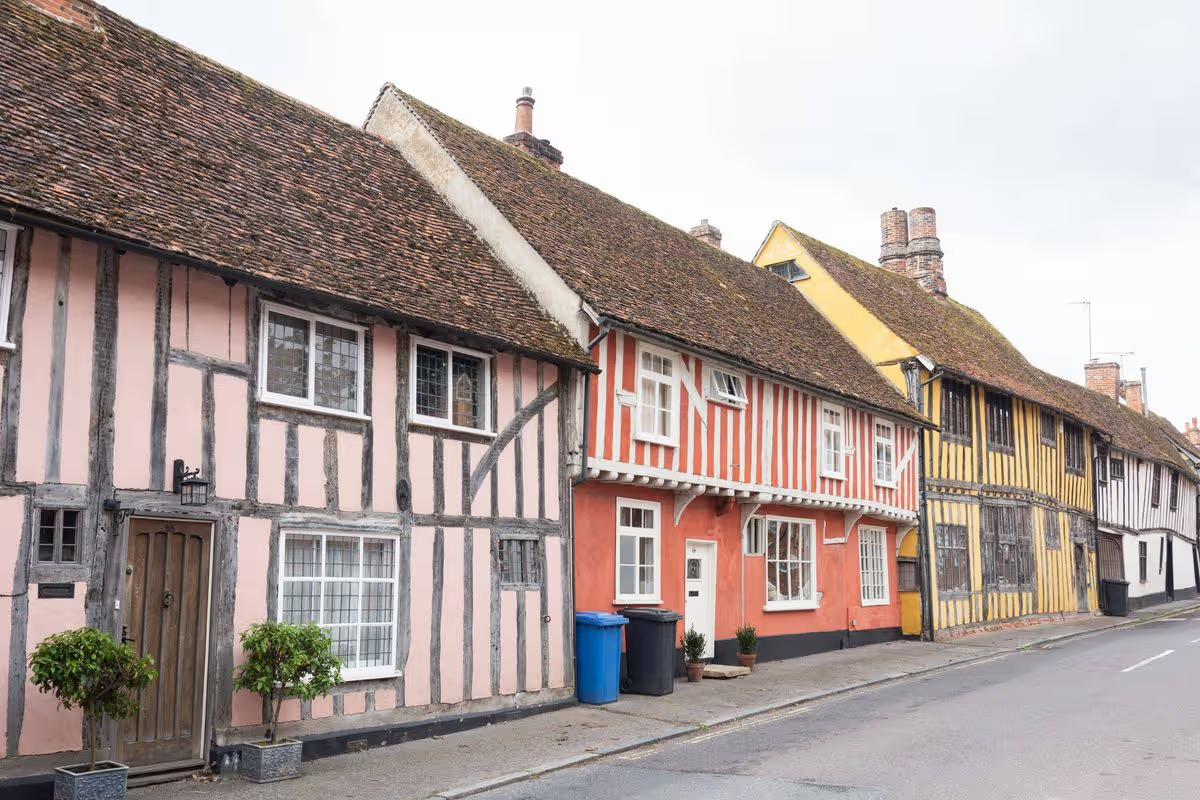
Lavenham is the quintessential ‘higgledy-piggledy village’, boasting a variety of architectural styles, but it’s the Tudor buildings that truly set it apart.
So much so, that hundreds of its structures are listed and thus protected to maintain their original appearance, whilst the National Trust owns some of its most significant sites, renowned for their historical importance within the village.
Best UK holiday cottage deals
This article contains affiliate links, we will receive a commission on any sales we generate from it. Learn more
Sykes Cottages offers a wide range of handpicked holiday homes across the UK and Ireland, from cosy countryside retreats to stunning coastal escapes. Prices start from £27 per night
The area’s grandiose atmosphere is rooted in the village’s wool trade history, as it gained fame for producing high-quality lavender blue broadcloth.
However, when the trade declined in the 17th century, there were no attempts to rebuild; instead, efforts were focused on preserving what already existed.
Historic Buildings
Among these stunning structures stands a 15th-century Tudor building located on Main Street, known as the Crooked House.
This particular spot inspired the well-known nursery rhyme There Was A Crooked Man, and much like the Leaning Tower of Pisa, its upper section exhibits a noticeable tilt.
Dating back to 1395, this stunning edifice, now adorned in a vibrant orange hue, is owned by two ‘crooked men’, husbands Alex and Oli.
Visitors are invited to explore the interior and receive a warm greeting from its owners, complete with a guided tour of its captivating rooms.
In addition, the village is home to the Lavenham Guildhall, currently under the stewardship of the National Trust, and serves as a showcase for local history.
This bewitching structure sits at the very heart of the village and has functioned as a community hub throughout its 500-year existence, assuming new roles and changing hands over time.
A recent guest shared on TripAdvisor: “Was very impressed with our visit to this NT property. Instead of being stuffed with display cases full of historic relics, the approach here is to set up the Guildhall how it would have been used through its history and have minimal information boards and artefacts that support and demonstrate that approach.
“But the real stars here are the volunteer guides, and all three who were working the different rooms at the time we visited had fantastic knowledge that could bring the building to life.”
Harry Potter
Already famous in its own right, Lavenham elevated its status when it featured on the silver screen as the filming location for Godric’s Hollow in Harry Potter and the Deathly Hallows Part 1.
The idyllic setting portrayed the location of Harry’s parents’ graves in the film. In a poignant and memorable scene in the movie, he and Hermione visit the village on Christmas Eve.
De Vere House served as the exterior of the Potters’ ruined home, which was later modified for the screen using computer-generated imagery. The Guildhall was also utilised, depicted as the abandoned house sitting in the backdrop of the village.
The already serene village gained an added sense of tranquillity when it was blanketed by a thin layer of snow as the two characters strolled down its Main Street.
However, it is widely understood that the Hollywood actors themselves did not actually set foot in Lavenham and were instead superimposed onto the village’s backdrop after filming in a studio.
Billy Porter says a poorly treated urinary infection nearly killed him.
On Wednesday, the 56-year-old Broadway icon appeared on “Today” to promote his new children’s book, “Songbird in the Light,” and discussed a recent health scare that’s given the actor a new outlook on life.
“I am on the road to complete recovery,” he said, tearing up. “It is a gift to be alive. It’s still emotional to talk about it.”
Last year, Porter crossed the pond and made his West End debut starring as the Emcee in the musical “Cabaret,” which ran Jan. 28 through May 24 at London’s Playhouse Theatre. The Tony-winning actor said he was having a ball and living his purpose, but then he got a urinary infection.
“The medicine in the U.K. is trash,” he told “Outlaws” podcast host TS Madison earlier this month. “Four rounds of antibiotics and 10 to 12 weeks later, it’s a kidney infection with kidney stones.”
Porter eventually thought the infection had cleared up and returned to New York, where last fall he was gearing up for a Broadway revival of the musical starring as the production’s first Black Emcee, but his history-making run was cut short.
“I go into rehearsals for ‘Cabaret’ on Broadway … and everything seems fine, and a month in, the kidney stone pain comes back,” he told Madison.
On a Tuesday in September, Porter checked himself into the hospital due to debilitating pain, and then the “Pose” star subsequently fell into a coma and woke up days later on a Saturday evening.
“They went in to do a routine check. They saw that the kidney stone was trapped in my urethra, and they went in to put a stent in, redirect the urine, blast me with real antibiotics — not U.K. antibiotics — and blow up the kidney stones. When they got in there, there was so much pus and bile and infection behind the stone, it bubbled up and I went uroseptic in minutes.”
“I was dead for three days,” Porter said.
Porter said he was placed on an ECMO (extracorporeal membrane oxygenation) machine, which, according to Mayo Clinic, pumps blood outside of the body to a heart-lung machine, removes carbon dioxide from the blood and sends oxygen-rich blood back to the body. It’s essentially a life-support system.
While Porter was in a coma, he said, one of his legs went into compartment syndrome, which happens when there’s too much pressure around your muscles, causing reduced blood and oxygen flow and possibly leading to necrosis. “They had to cut me open on either side of my leg while I was in a coma, from my knee to my hip, and leave it open for two days so they could save my leg,” he told Madison, visibly choked up over the ordeal.
Porter told “Today” that the experience was mind-altering yet also inspiring. “My work here on this earth is not done, and that gives me hope.”
His new children’s book, “Songbird in the Light,” which follows a young boy who grapples with bullying while learning to embrace his talent and love himself, hit bookshop shelves this week.