WASHINGTON — As President Trump zigzags across the country in the final weeks before the midterm elections, he has made California his favorite foil as he tries to fire up his base.
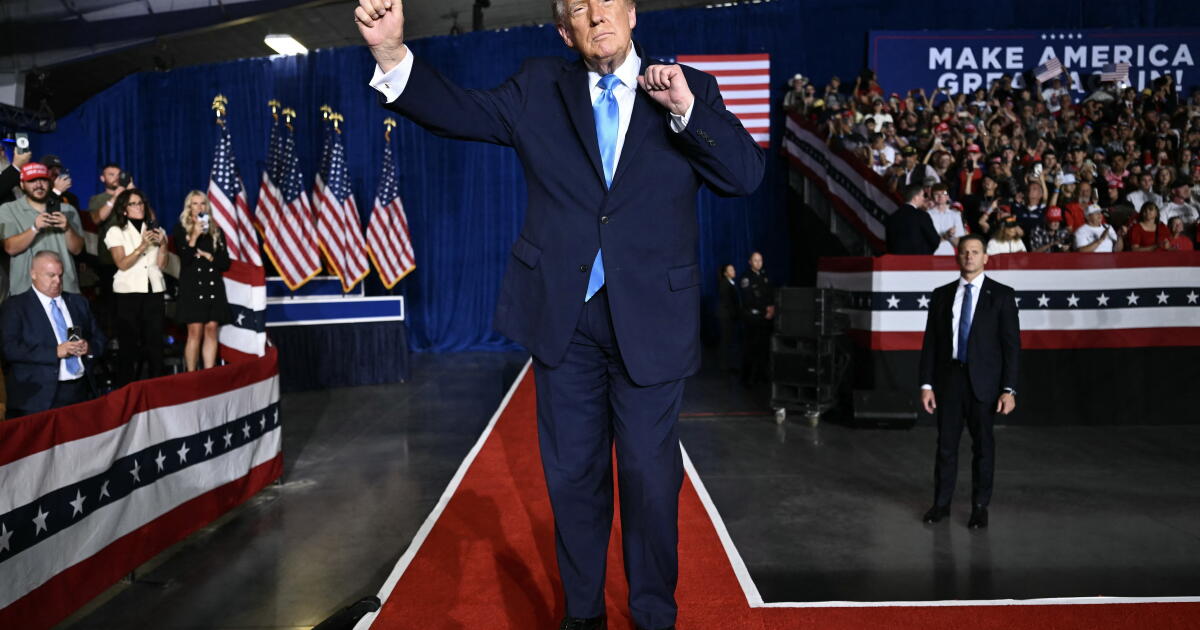
On Monday, he blamed the Golden State for the rising cost of gas prices, claimed without evidence that its elections are rigged, and at a Nebraska rally suggested Iran could “take out” Los Angeles and San Diego.
“It’s a small price to pay for keeping the world safe, keeping our country safe,” Trump said. “They can take out a city, let them take out Los Angeles, let them take out San Diego. This is a very small price to pay.”
The president’s team on Tuesday said his remarks were misunderstood, arguing the president “clearly” stated that U.S. cities would have been threatened “if a nuclear Iran hadn’t been stopped.” Trump declined to clarify what he meant by his statements when asked by a reporter Tuesday.
But by then, Trump’s remarks had already drawn fierce condemnation from California leaders, including Republican Jim Desmond, a Navy veteran running in a highly competitive race that is key to helping Republicans retain control of the House.
“I vehemently disagree with President Trump’s comments,” Desmond wrote on social media. “America must stand up to Iran and defend our interests, but the first responsibility of our Commander in Chief is to protect the American people and our homeland.”
The backlash exposed the risk of Trump’s closing midterm strategy. Bashing California is a reliable applause line in red states like Nebraska, Alabama, Texas and Oklahoma, where the president has been holding rallies trying to ensure his supporters get out to vote. But in this modern era, an incendiary comment can travel fast online and leave Republicans running in competitive districts in awkward spots, trying to distance themselves from Trump.
Overall, political observers see the episode as an example of how the president’s political strategy can be unpredictable at a time when Republicans are trying to control the message the most.
“Whether you like Trump or not, he is good at getting his message out and coming up with a message that can resonate and catch fire,” said Mindy Romero, founder and director of the nonpartisan Center for Inclusive Democracy. “I think the question now is: Is he starting to fail himself when it comes to his messaging?”
California Democrats were quick to use Trump’s remarks as a line of attack against him. Gov. Gavin Newsom called him “deranged and dangerous” and opened the state emergency operations center to assess potential threats. San Diego Mayor Todd Gloria told Trump to “keep our city out of your reckless war talk.” And Los Angeles Mayor Karen Bass said his comments could “potentially compromise our safety.”
Trump’s remarks about the California cities on Monday were the most striking example yet of the president using California as a foil to rally a base in GOP strongholds.
In Nebraska and other red states in recent days, Trump has repeatedly cast California as a political boogeyman as a means to motivate voters to cast their ballots for the GOP candidates.
At an Oklahoma rally last week, Trump told the crowd that Republicans need to keep the party in control of Congress so that his administration can continue the work of combating fraud in blue states, like California. The administration’s efforts, led by Vice President JD Vance, have sometimes been overestimated or nebulous.
But Trump tells supporters that in places like California, the administration is seeing “billions and billions of dollars of fraud.”
In a social media post Monday, Trump began blaming the cost of fuel — a defining issue for voters this election cycle — on states like California.
“What’s driving up Gasoline is no longer the Strait of Hormuz,” Trump wrote. The issue, he said, is refineries being “closed up in Blue States, like California, by the Dumocrats.”
Hours later, while rallying in Nebraska, Trump seemed to contradict himself as he promised the crowd that fuel costs would go down once the war in Iran was over.
“That will end very quickly, one way or the other, very soon, maybe a little after the election, maybe a little before, but it is going to end very soon,” Trump said. “When that happens, the oil will come tumbling down.”
Trump’s messaging underscores how the war with Iran, which has gas prices topping $6 a gallon, has emerged as a potential liability for Republicans that the president is trying to address in subtle ways.
Polling on Trump’s handling of the economy has remained low, even among Republicans. A University of Massachusetts Amherst poll last month found that only 22% of Americans perceive the economy in a good or fair state.
In California, a poll by the UC Berkeley Institute of Governmental Studies, co-sponsored by The Times, found that 70% of California voters disapprove of Trump’s decision to go to war in Iran, including 1 in 5 Republicans.
The softening of Trump’s approval even among those who still support his performance could translate into lower GOP turnout in the state’s few competitive races, the poll’s director, Mark DiCamillo, said.
Trump’s strategy in the final stretch before the midterms has largely focused on rallying the base in hopes that they will turn out to vote. Part of that strategy includes using California as a punching bag.
One particular line of attack has been disparaging the state’s voting systems. He suggested Monday that Democrat-led cities are trying to cheat in November as he touted the fast count of ballots in foreign countries.
“In Detroit, Philadelphia, California and numerous other U.S. Cities and States, the results, with much smaller numbers, will often take weeks to Rig, I mean, calculate,” Trump wrote on Monday. “Voting in America is CORRUPT!!!”
In another social media post, he said: “California: Took 38 days with 16.1 million ballots in 2024.”’
Trump using California as a foil for any given issue could be a risky strategy, Romero said.
“He’s expanding the types of things that he’s blaming California for, like the gas crisis,” she said, arguing that such statements could “start to lose credibility with those people that he has credibility with.”
For Republican voters in California, the ploy may be even riskier, especially when Trump suggests Iran could “take out” their cities.
“I don’t think that message necessarily plays well here because Californians are Californians,” DiCamillo said. “There is a certain pride in being a Californian, certainly not held by everybody … but I would think that the mainstream would be defending the state.”