loses

SK Broadband turns to AI data centers as pay TV loses subscribers

A graphic shows SK Broadband’s declining pay TV subscribers and rising AI data center revenue, alongside an overview of the planned Ulsan AI data center equipped with about 60,000 GPUs and a first phase of 40 megawatts scheduled for 2027. Graphic by Asia Today and translated by UPI

March 5 (Asia Today) — South Korea’s pay television industry is struggling to maintain growth as streaming services reshape the media landscape, pushing operators to seek new revenue sources such as artificial intelligence data centers.

SK Broadband, one of the country’s largest pay TV providers, lost about 150,000 subscribers last year as consumers increasingly shift to over-the-top streaming platforms.

The company has responded by pursuing a two-track strategy of industry cooperation and expansion into new technology businesses.

Earlier this year SK Broadband joined rivals KT and LG Uplus to establish a 40 billion won ($30 million) IPTV strategy fund as part of the government’s K-content media investment initiative.

The fund will support production of film and television content while helping secure programming for pay TV platforms and boost video-on-demand sales, a key revenue source for operators.

SK Broadband generated 4.53 trillion won ($3.4 billion) in total revenue last year, with pay TV accounting for more than 40% of the total.

However the industry has been hit by accelerating “cord cutting,” a trend in which viewers cancel traditional television services in favor of online streaming platforms.

The company reported 9.45 million pay TV subscribers last year, including 6.72 million IPTV users and 2.73 million cable TV subscribers. That represented a decline of roughly 158,000 customers from the previous year.

Pay TV revenue also fell by about 15 billion won ($11 million).

To strengthen cooperation within the industry, the three telecom companies also plan to launch VOD gift certificates that can be used across platforms regardless of service provider.

The initiative is intended to improve consumer access to pay TV services and expand distribution channels to corporate clients.

SK Broadband has also integrated the artificial intelligence agent A.dot into its IPTV platform B tv to provide personalized content recommendations. The company said the service has recorded more than 100 million uses.

At the same time SK Broadband is expanding its business-to-business services through data centers.

The company operates nine data centers nationwide and generated more than 1.4 trillion won ($1.05 billion) in related B2B revenue last year.

It is also building a large-scale AI data center in Ulsan with its parent company SK Telecom. The first phase is expected to begin operations next year.

By 2030 the company expects AI data centers alone to generate about 1 trillion won ($750 million) in annual revenue.

Last year revenue from AI data center operations rose 35% to 519.9 billion won ($390 million).

SK Broadband and SK Telecom have pledged to invest 3.4 trillion won ($2.55 billion) in AI data centers through 2028.

Industry officials say the company’s push into higher-margin technology businesses could help offset declining pay TV subscriptions.

— Reported by Asia Today; translated by UPI

© Asia Today. Unauthorized reproduction or redistribution prohibited.

Original Korean report: https://www.asiatoday.co.kr/kn/view.php?key=20260305010001413

Source link

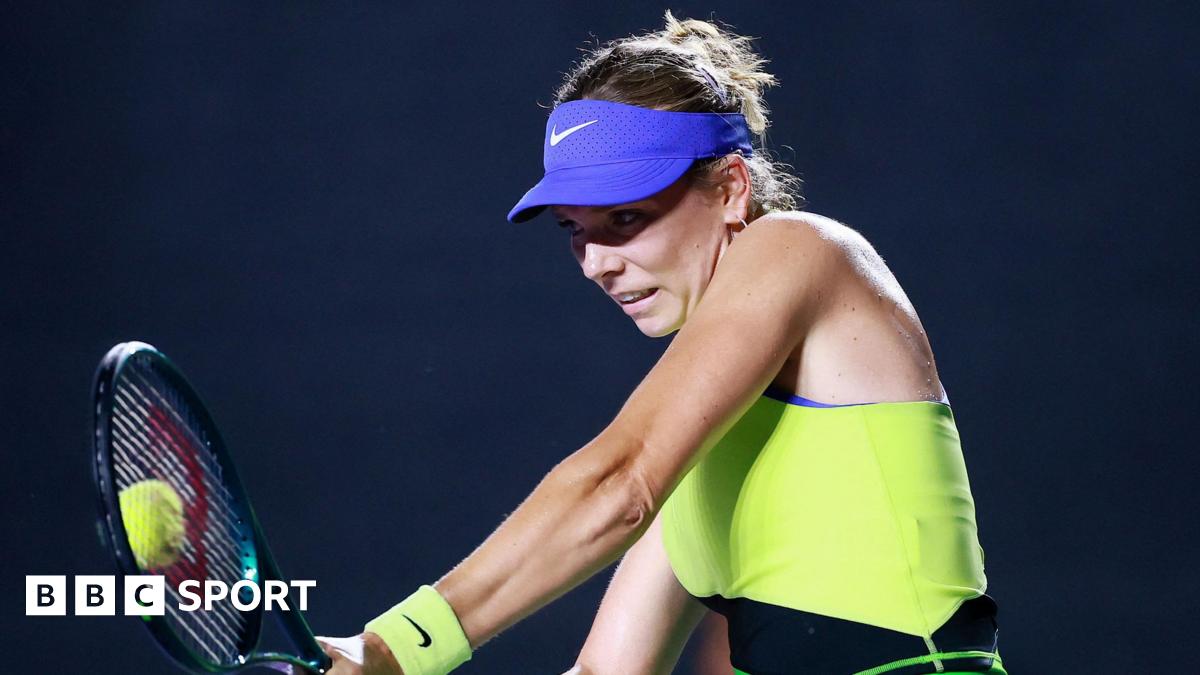
Merida Open: Katie Boulter loses to Jasmine Paolini in last eight

Britain’s Katie Boulter was unable to build on a superb start as she lost to Italian top seed Jasmine Paolini in the last eight of the Merida Open.

Against the world number seven in Mexico, Boulter won the first set in 28 minutes without dropping a game.

But errors started to creep in as Paolini went on to win 0-6 6-3 6-3.

Having won only three points on her serve in the opening set, Paolini started the second set strongly, holding for the first time and then breaking to go 3-1 up.

Boulter, who came into the contest on the back of a seven-match winning run, including claiming the Ostrava Open title, broke straight back to love but neither player could hold serve in the next three games.

It was Paolini who held her nerve to take the second set and level the contest.

The 2024 Wimbledon and French Open finalist raced into a 2-0 lead in the decider and, although Boulter broke back and held serve to lead 3-2, the Italian’s confidence grew as she won four games in a row to claim a semi-final spot.

“It was a really tough one – Katie, the first set she was smashing every ball and hitting a winner everywhere,” Paolini told Sky Sports.

“I was telling myself to play more deep in the court and hit the ball harder because I had to raise the level to try and win the match and in the end it worked out.

“I was trying to be calm, to think what I had to do. I think when you’re nervous you can’t find the solutions.”

Source link

Ukrainian Olympian loses appeal over helmet honoring war dead

Ukrainian skeleton athlete Vladyslav Heraskevych took his case to sport’s highest court Friday, detailing the reasons why he wanted to race at the Milan-Cortina Olympics in a helmet that paid tribute to his country’s war dead.

The arbitrator was moved by his story but ruled against him anyway, denying him his last chance for a win of any kind at this year’s Winter Olympics.

The Court of Arbitration for Sport denied Heraskevych’s appeal of his disqualification from the men’s skeleton race, agreeing with the International Olympic Committee and the sliding sport’s federation that his plan to wear a helmet showing the faces of more than 20 Ukrainian coaches and athletes killed since Russia invaded their country four years ago would violate Olympic rules.

“The court sided with the IOC and upheld the decision that an athlete could be disqualified from the Olympic Games without actual misconduct, without a technical or safety threat, and before the start,” wrote Yevhen Pronin, Heraskevych’s attorney.

The Court of Arbitration for Sport said the sole arbitrator who heard the case sided with IOC policy about what athletes at an Olympics can say on a field of play — and that the “memory helmet” Heraskevych brought to the Milan-Cortina Games would not align with the rules.

The arbitrator, the court said, “found these limitations reasonable and proportionate,” especially since Heraskevych could show his helmet away from the racing surface, such as in interview areas and on social media. Heraskevych also wore the helmet in training runs.

The court added that the arbitrator “is fully sympathetic to Mr. Heraskevych’s commemoration and to his attempt to raise awareness for the grief and devastation suffered by the Ukrainian people, and Ukrainian athletes because of the war.”

The appeal, which Heraskevych believed he would win, was largely moot anyway. He was disqualified from the competition 45 minutes before its start on Thursday, and whatever the Court of Arbitration for Sport said Friday wouldn’t have changed that.

“Looks like this train has left,” Heraskevych said after Friday’s hearing, knowing there was no way he could race. He left Cortina d’Ampezzo’s Olympic village on Thursday night with no plans to return.

He was blocked from racing by the IOC and the International Bobsled and Skeleton Federation on Thursday after the slider and his father emerged from a last-minute, last-ditch meeting with IOC President Kirsty Coventry — who was unable to get Heraskevych to change his mind.

Coventry reiterated Friday that she believed the disqualification was justified. The IOC made its decision based on the guidelines for athlete expression at the Olympics, he said.

They say, in part, “the focus on the field of play during competitions and official ceremonies must be on celebrating athletes’ performances.” Heraskevych never made it to the field of play — not in competition, anyway.

“I think that he in some ways understood that but was very committed to his beliefs, which I can respect,” Coventry said. “But sadly, it doesn’t change the rules.”

The IOC contends that the rule is in place for multiple reasons, including protecting the athletes from pressure from their own countries or others about using Olympic platforms to make statements.

“I never expected it to be such a big scandal,” Heraskevych said.

He also said he found it puzzling that his accreditation for the Games was taken away, then returned in short order Thursday in what seemed like a goodwill gesture.

“A mockery,” he said.

The Court of Arbitration for Sport did agree that Heraskevych should keep his accreditation.

Heraskevych said he felt his disqualification fed into Russian propaganda, noting that he and other Ukrainian athletes have seen Russian flags at events at these Games — even though they are not allowed by Olympic rule. He has previously spoken out against the IOC’s decision to allow Russians and Belarusians to compete at Milan-Cortina as “neutral” athletes and said the IOC empowered Russia by awarding it the 2014 Sochi Games.

He also wondered why other tributes from these Olympics, such as U.S. figure skater Maxim Naumov displaying a photo of his late parents — killed in a plane crash last year — have been permitted without penalty.

Italian snowboard competitor Roland Fischnaller had a small Russian flag image on the back of his helmet during these Games, and Israeli skeleton athlete Jared Firestone wore a kippah with the names of the 11 athletes and coaches who were killed representing that country during the 1972 Munich Olympics.

Pronin wrote that IOC representatives at Friday’s hearing said that “they were not punished because they did not declare this in advance, but did it after the fact, so there was no point in disqualifying them.”

The IOC said those cases were not in violation of any rules. Naumov showed his photo in the kiss-and-cry area and not while he was actually on the ice; Fischnaller’s helmet was a tribute to all the past Olympic sites he competed at, with Sochi included; and Firestone’s kippah “was covered by a beanie,” IOC spokesman Mark Adams said.

The IOC offered Heraskevych the chance to compete with a different helmet and bring the tribute helmet through the interview area after his runs. He also could have worn a black armband, which the IOC typically bans. It just didn’t want him making a statement by competing in the helmet.

“I think it’s the wrong side of history for the IOC,” Heraskevych said.

Reynolds writes for the Associated Press. AP journalists Annie Risemberg and Stefanie Dazio in Milan and Vasilisa Stepanenko in Warsaw contributed to this report.

Source link