Why Justin Herbert isn’t questioning Chargers’ leadership
Justin Herbert is prioritizing on-field execution as the Chargers seek their first win.
That’s why the seventh-year quarterback cut off a reporter’s question about whether the team’s locker room needs heightened vocal leadership as the Chargers carry an 0-2 record into Sunday’s road game against the unbeaten Buffalo Bills.
“I think I’m going to stop you right there,” Herbert said. “We’ve got great leadership on this team. I trust those guys in that locker room, so I don’t think anyone has panicked or worried because that’s not going to do us any good.
“It’s [about] moving on to the next play and understanding we’re close, we made mistakes, how do we fix it and how do we move on?”
Herbert’s intense messaging was surprising. The quarterback usually speaks in emotionless platitudes during news conferences.
But that response, or leadership — a trait teammates and coaches see far more from Herbert than the public — is one of several reasons why the Chargers are supporting their quarterback despite the offense’s sloppy start to the season.
“Ain’t anybody giving up on anything,” wide receiver Tre’ Harris said. “Everybody’s still on the same page. Everybody has extreme belief in 10 — I know I do — and extreme belief in [offensive coordinator Mike McDaniel] as well. We’ll go out there and do what we need to do.”
The Chargers are averaging just 14 points per game, above only the winless Miami Dolphins (13) and the 1-1 Pittsburgh Steelers (11.5).
And Herbert is partially responsible.
He ranks 27th in completion percentage (59.3%) through two weeks and is 23rd in passing yards (401) with the second-most interceptions (3).
“By default, Justin blames himself,” McDaniel said.

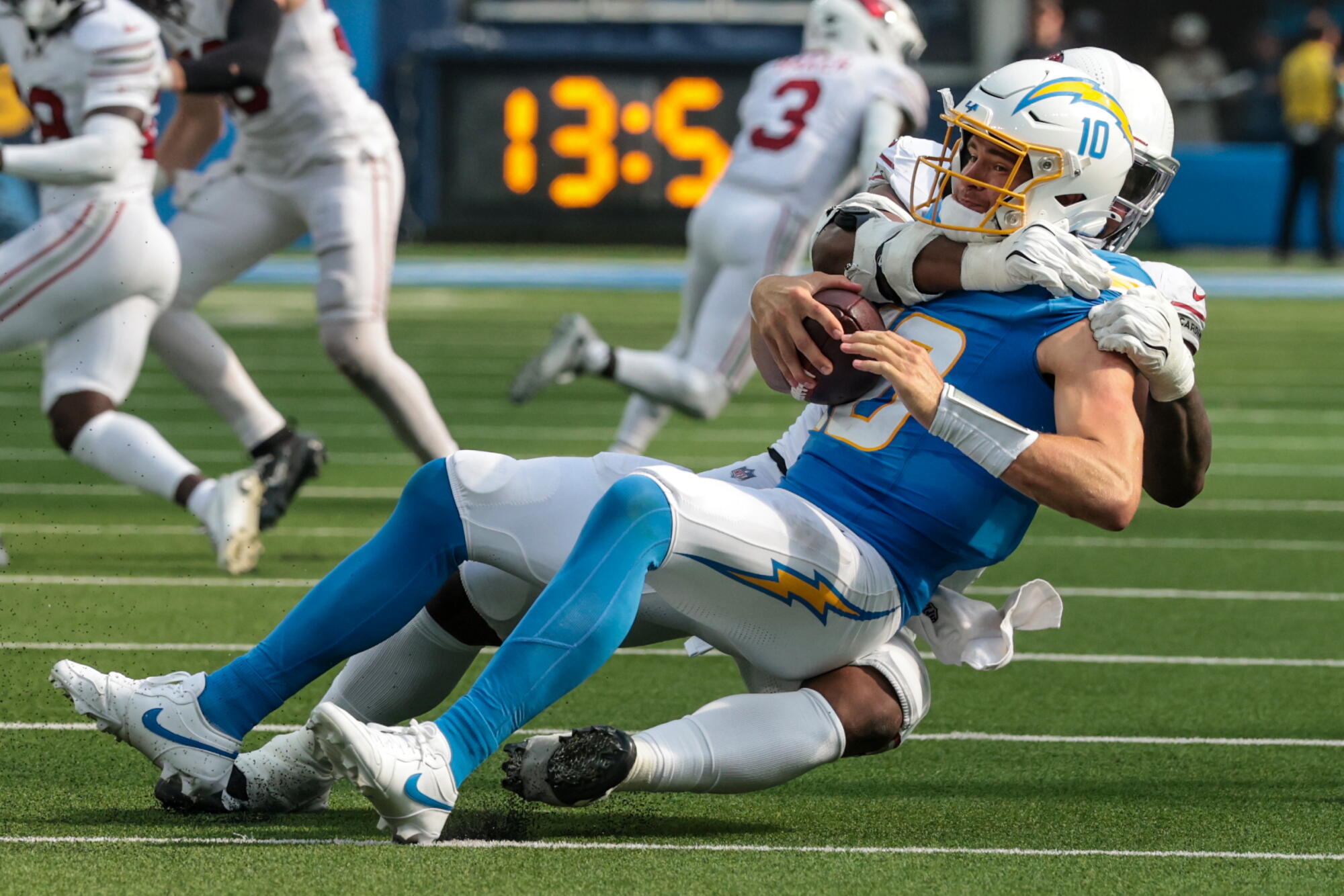
Chargers quarterback Justin Herbert is sacked by Arizona Cardinals linebacker Jordan Burch on Sept. 13.
(Robert Gauthier / Los Angeles Times)
Herbert just hasn’t looked comfortable in yet another new scheme. But, as usual with him, context is key.
With a revolving door at left guard and rookie Jake Slaughter starting at center, the Chargers have allowed the league’s second-highest pressure rate (45.5%), according to Pro Football Focus.
Herbert’s pass-catchers have been inconsistent, too, struggling with pre-snap communication, frustrating — sometimes comical — drops and, of course, injuries.
The offense overall is having too many fumbles (7), penalties (15 for 109 yards) and other self-inflicted wounds. So while Herbert’s stats aren’t pretty, the Chargers’ woes go beyond his performances.
They have Herbert’s back, though, as they collectively sort things out.
“He’s been locked in [and] dialed in, man,” safety Derwin James Jr. said. “He’s working hard in the weight room [and] making all his throws out there. So, I can’t wait to try to get him some stops on Sunday.”
Then, there’s the McDaniel factor.
He admitted that he thought the Chargers would score more than 28 points thus far. As a result, he is considering “everything” moving forward, including shrinking the playbook.
McDaniel added that he and Herbert are “much closer” than they were two weeks ago as they work through the offensive struggles.
“It can be a lonely world as a starting quarterback — that’s a franchise quarterback — when you have successive losses,” McDaniel said. “It can be lonely as a playcaller [or] offensive coordinator. And the only way to approach it is that you’re not alone.”
The Chargers and their turbulent offense are on the verge of starting 0-3 for the first time since 2017.
Many outsiders are looking to Herbert to save the franchise from an abysmal season not many projected.
But to those in the building? They just want Herbert to be Herbert.
“One thing that separates him from a lot of other leaders … he’s the same person, each and every day, consistently great at everything he does,” said reserve quarterback DJ Uiagalelei.
After all, when Herbert’s comfortable, he’s arguably among the league’s top signal-callers.
“Since I’ve been with Justin, there’s not a thing I’d change about Justin,” coach Jim Harbaugh said.