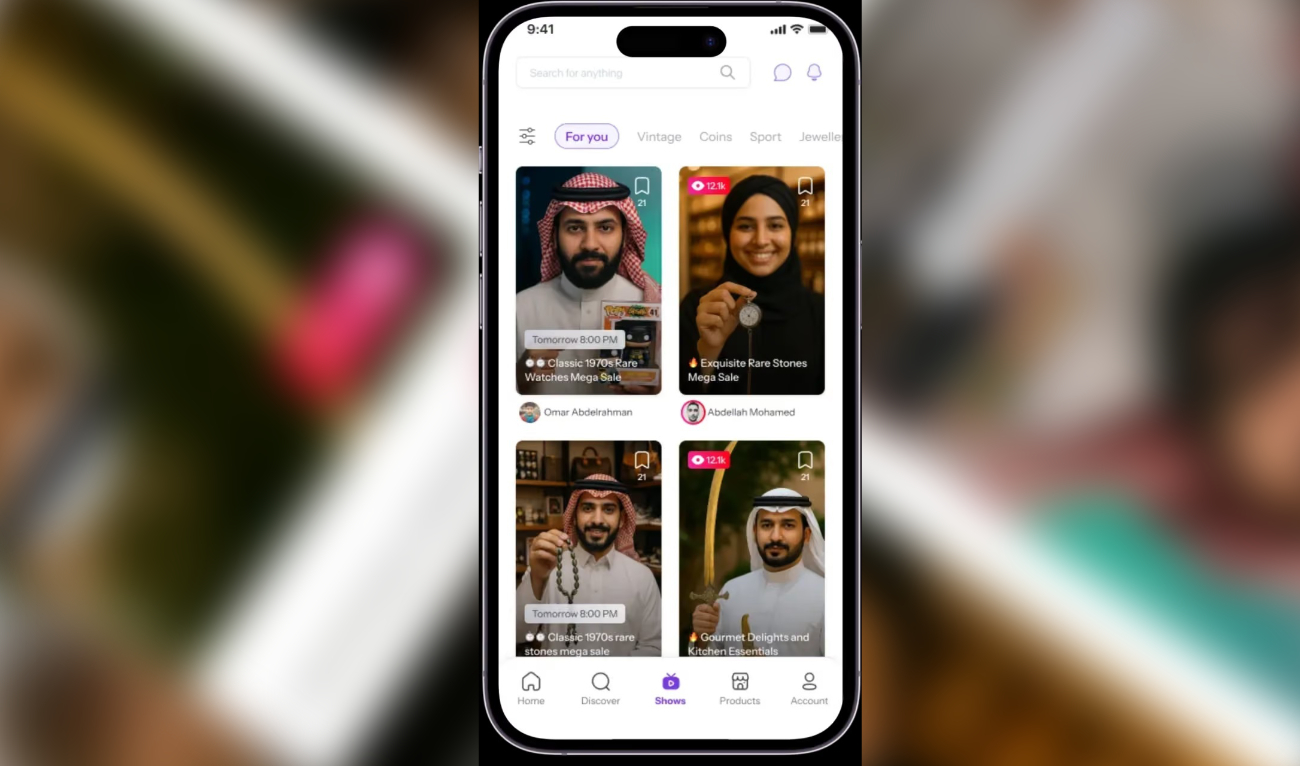
JEDDAH: While the COVID-19 pandemic forced millions of people around the world to move their lives online, one young Saudi technology entrepreneur was watching more closely.
He was not just looking at how people were adapting to a new digital reality, he was watching what was happening elsewhere — particularly in China, where livestream shopping was rapidly becoming a mainstream way to buy.
For Taher Alblowe, the idea was simple but powerful — and he decided to build a live Saudi social shopping and auction marketplace.
“It is called Rwaj; we built it so a seller can go live, sell at a fixed price or by auction, get paid and ship without leaving the app, and a buyer can purchase or bid knowing their money is protected until the item is in their hands,” he explained to Arab News. “This lets us reach many more sellers and buyers in the region and beyond.”
Before founding Rwaj, Alblowe founded and served as CEO of Geeks Valley, an education and digital fabrication company that grew to more than SAR23 million in cumulative revenue and worked with government entities, leading universities, and international companies.
“Live selling in our region did not need to be invented. It needed to be made safe, and made native,” he said.
He sees Rwaj as being more than another shopping application; it is an attempt to anticipate how commerce could evolve and to build that future.
“When I saw the same model start to take hold in the US and then in Europe, I was convinced the timing was right to build it for the Middle East, from the ground up and in Arabic,” he said.
Today, through Rwaj, Alblowe is focused on building a new generation of commerce for Saudi Arabia and the wider Gulf Cooperation Council, combining livestream shopping, real-time auctions, entertainment, and direct interaction between buyers and sellers into a more engaging and trusted shopping experience.
A technologist at heart, he and his team had to build not only the technology that allows sellers to broadcast live, but also the systems behind every transaction — from seller verification and payments to escrow and logistics.
On Rwaj, sellers must go through a verification process before they can sell, while payments are held in escrow and released only after the buyer receives an item and confirms it is as described. For Alblowe, building that layer of trust from the beginning was part of the promise he wanted to make to users.
Asked what makes Rwaj different from existing e-commerce and social-commerce platforms, he replied: “Three things. First, trust and safety are built into the product, not bolted on — every seller is verified and every purchase, fixed price or auction, runs through escrow. Second, the format itself — a seller can sell instantly at a fixed price and run timed live auctions in the same stream, so buyers get both convenience and the excitement of bidding. Third, it is built for this region — Arabic-first and fully bilingual.”
The journey has gone through many challenges, but he kept going. “Every startup faces challenges, especially in the early days,” he said, pointing to logistics and the complexity of building a reliable trust system before reaching significant scale.
Yet none of those issues changed his conviction that live commerce has a future in Saudi Arabia and the wider region.
Alblowe, who has been recognized by Forbes Middle East, believes Saudi Arabia has many of the ingredients needed for that future — a young and digitally connected population, widespread use of smartphones and social media, fast mobile networks and increasingly sophisticated digital payments.
But perhaps his biggest ambition is to make live selling accessible beyond major brands and influencers.
Rwaj, founded in 2025, recently closed a $1.2 million (SR4.5 million) pre-seed funding round, which the company plans to use to accelerate growth and product development across the region.
For the founder, however, the funding appears to be less an end point and more another step in a much longer journey. He already sees Rwaj beyond Saudi Arabia and the Gulf: “I want Rwaj to be serving the world,” he said.
The ambition may sound big for a company still in its early stages, but it reflects the same mindset that led him to start the business in the first place: looking at where people’s behavior is heading and trying to build for tomorrow rather than today.
His vision is of a future in which livestream selling becomes as normal as walking into a store, where every shopping district could have people whose job is to sell live to customers who may never physically enter.
“Rwaj is building the infrastructure for that: the streaming, the payments, the trust layer, and the logistics,” he said.