liberty

Cameron Brink injured as Sparks fall to Liberty despite late surge

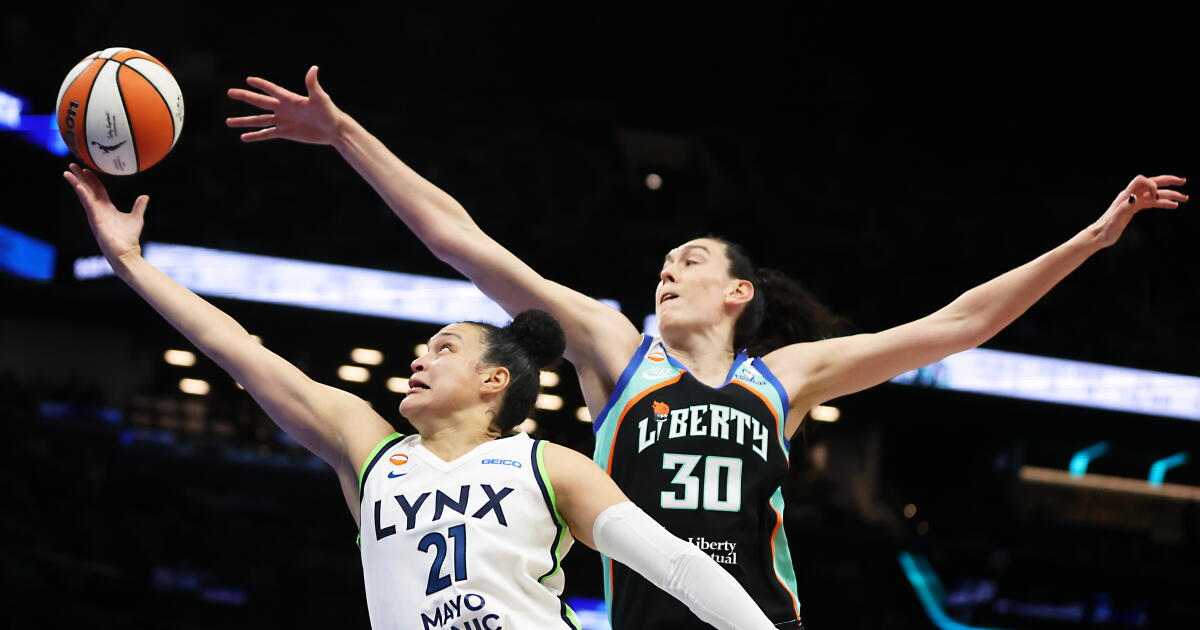
Sabrina Ionescu scored 20 points and the New York Liberty avoided one of the biggest collapses in WNBA history, holding off the Sparks 85-81 on Thursday night.

New York (21-14) led 69-41 early in the fourth quarter and looked poised to cruise to an easy victory when the Sparks scored 21 straight points to get within striking distance.

The Sparks (12-21) only trailed 82-79 with 26.6 seconds left and were in position to match the Chicago Sky for the biggest comeback in league history. The Sky rallied from 28-down to beat Las Vegas in 2022. Rae Burrell got the Sparks within one on a reverse layup with 22 seconds left. Ionescu hit two free throws with 14.8 remaining to restore the three-point advantage.

The Sparks had one last chance, but Ariel Atkins missed a three-pointer from the wing with seven seconds left and Ionescu hit a free throw with 3.2 seconds left to seal the win.

The Sparks also lost Cameron Brink earlier in the fourth quarter. She helped key the game-changing run, drawing an offensive foul on Breanna Stewart. Brink was down on the floor for a few minutes before being helped to the locker room with a towel over her head. She took a shot to the stomach area from Stewart to get the offensive foul called. A few minutes earlier Brink and Burrell banged heads.

Sparks coach Lynne Roberts said Brink was being evaluated by doctors after a “brutal hit to the ribs”, but didn’t have an update other than that.

Cameron Brink controls the ball during the first half against New York on Thursday.

Cameron Brink controls the ball during the first half against New York on Thursday.

(Elsa Garrison / Getty Images)

Burrell finished with a career-high 28 points.

New York got a scare in the third when Ionescu left the game. She went down awkwardly after playing defense and quickly grabbed her right foot. She subbed out soon after and jogged up the tunnel back to the locker room area. She returned about four minutes later on the game clock to a nice ovation from the crowd.

Jonquel Jones was a big reason the Liberty built a 49-32 lead at the half with 10 points and 12 rebounds. New York extended the advantage to 26 after three quarters and 69-41 before the Sparks rallied.

New York was still playing without Leonie Fiebich and Satou Sabally. Coach Chris DeMarco said that there’s no timetable on Fiebich’s return and that Sabally, who has been sidelined for over a month with a concussion, was away from the team.

Up next for the Sparks: at Washington on Saturday.

Source link

Justice Kennedy reflects on his time deciding the Constitution’s promise of liberty and equality

Justice Anthony M. Kennedy, the Supreme Court’s most influential member prior to his retirement, has watched quietly for eight years as a new conservative majority took charge.

He was troubled by partisan gerrymandering, but a year after he stepped down, a 5-4 ruling closed the federal courts to challenges to state voting maps that allow one party to rig the elections in its favor.

Though he believed abortion was a moral wrong, he cast the crucial vote in 1992 to uphold Roe vs. Wade and the principle that a woman, not the government, had the right to decide on ending an early pregnancy.

Four years ago, that decision was overturned on a 5-4 vote.

While Kennedy has refrained from commenting on the current court or President Trump, he has written a memoir that tells his life story and explains the reasoning behind the major decisions of his era.

It has become common for the justices to write books, but they steer clear of writing about the work of the court. Kennedy’s book, “Life, Law & Liberty,” is, like the justice, the exception to that rule.

An Irish Catholic from Sacramento and a Reagan Republican, Kennedy had a generally conservative voting record over 30 years on the high court. But he had a distinct view of liberty and justice.

“The nature of injustice is that we may not always see it in our own times,” he wrote in 2015.

Kennedy rejected the “rigid” view that the Constitution’s promises of liberty and equal protection of the law, as well as the protection against cruel and unusual punishment, were limited to their “original” meaning in the Bill of Rights of 1791 or the 14th Amendment of 1868.

After all, slavery and segregation were legal for much of American history, and women were not protected from discrimination by the promise of “equal protection” in the 14th Amendment.

Kennedy remained open to new rights and liberties. The goal, he wrote, was “a decent society in which the Constitution and the rule of law treat all with dignity and equality.”

He was the justice who made the difference in several areas of law, none more significant than in LGBTQ+ rights.

He wrote the court’s four major rulings rejecting discrimination based on sexual orientation. In 2015, he spoke for the 5-4 majority to uphold same-sex marriages nationwide.

“No union is more profound than marriage, for it embodies the highest ideals of love, fidelity, devotion, sacrifice, and family,” he wrote. “Many same-sex couples provide loving and nurturing homes to their children, whether biological or adopted. And hundreds of thousands of children are presently being raised by such couples.”

They “ask for equal dignity in the eyes of the law. The Constitution grants them that right,” he concluded in Obergefell vs. Hodges.

He also believed that teenagers who commit crimes are not as culpable as adults. He wrote a court opinion in 2005 ending executions for murderers who were under age 18 at the time of their crime.

Five years later, he wrote the court’s opinion holding it was cruel and unusual punishment for judges to impose a sentence of life in prison with no chance for parole for a teenager’s crime that did not involve homicide. In the case before the court, a Florida teen was given a life term for committing an armed robbery and a home burglary prior to his 18th birthday.

Kennedy marked his 90th birthday on Thursday and says his favorite topic of conversation is not the nine justices but his nine grandchildren. He still goes to the court some days and says he is worried by the tone in Washington and around the country.

“It is too partisan and confrontational,” he said in a recent interview with The Times. “I’m concerned that the divisiveness may be reflected at the court.”

Democracy requires “reasoned and respectful debate,” he said, not personal attacks and name calling.

Kennedy may be the last justice of his kind, said Washington University law professor Daniel Epps, a former Kennedy clerk.

“I don’t think we’ll see another justice who is so ideologically unpredictable and who votes against his party of appointment in some of the hugest cases in our lifetimes,” he said. Kennedy emerged from “an appointments process that was less polarized, where there were conservative Democrats and liberal Republicans and a Senate filibuster, which all made it possible for moderates to be appointed.”

While Kennedy describes himself at times as a small-town lawyer from Sacramento, he knew the two California governors, both Republicans, who reshaped the Supreme Court.

Kennedy’s father was a friend of Gov. Earl Warren, and young Tony played with Warren’s children. He also worked as a young page in the state Capitol when Warren was governor.

He was a high school senior in 1954 when Warren, the new chief justice, spoke for a unanimous court to strike down racial segregation in the case of Brown vs. Board of Education.

He and his father agreed the ruling was long overdue. It also provided an early lesson in how justices can uphold the fundamental principles of the Constitution despite intense opposition in much of the nation.

He said he later learned a second lesson. The Brown decision was “a historic step forward” but it “just a beginning” in the fight against entrenched racial injustice.

In writing the same-sex marriage case, Kennedy cited Warren’s opinion in the 1967 case of Loving vs. Virginia which struck down the bans on interracial marriages in 16 states.

As as young lawyer, Kennedy worked on special projects for Gov. Ronald Reagan and admired him greatly. He was just 38 years old when, at Reagan’s behest, he was appointed to the U.S. 9th Circuit Court of Appeals.

As president a decade later, Reagan had appointed Justices Sandra Day O’Connor and Antonin Scalia to the Supreme Court and elevated William Rehnquist to be the chief justice. But his third nominee — Judge Robert Bork — was voted down as too conservative by the Senate.

Reagan invited Kennedy to the White House and offered him the nomination. Kennedy recalled telling Reagan that he and his wife Mary were happy in Sacramento where all their friends and family lived. We don’t know anyone in Washington, he said.

President Reagan gestures toward Judge Anthony M. Kennedy's family after nominating Kennedy to the Supreme Court in 1987.

President Reagan gestures toward Judge Anthony M. Kennedy’s family after nominating Kennedy to the Supreme Court in 1987.

(Dennis Cook / Associated Press)

In his best imitation of Reagan’s voice, he recounted the president’s response: “You know me. And you know Nancy.”

Kennedy accepted the nomination and was confirmed in February 1988 by a 97-0 vote, the last justice to win unanimous approval from the Senate.

His three decades on the court were shaped in part by his relationship with Scalia.

Kennedy and his wife bought a house in the same northern Virginia neighborhood where Scalia lived. In their early years on the court, they appeared to be friends and allies.

They broadly supported freedom of speech. To the surprise of many, they cast the deciding votes in 1989 to rule that the 1st Amendment protects the right to burn an American flag in protest.

A year later, Kennedy and Scalia dissented vehemently when the court ruled the Michigan Chamber of Commerce and its corporate supporters could be barred from advertising their support for state candidates.

The decision triggered a decades-long dispute that ended with the Citizens United ruling in 2010. Kennedy spoke for a 5-4 conservative majority to rule that corporations, unions and other groups were free to spend money independently to oppose or support candidates.

But when the court was closely split in major cases, Kennedy was likely to be in majority while Scalia wrote scathing and increasingly personal dissents.

“I would hide my head in a bag,” Scalia wrote in dissent in the same-sex marriage case, rather than join an opinion “couched in a style that is as pretentious as its content is egotistic.”

Kennedy was put off by a different jab. Scalia said the justices do not represent the full country. For example, the court lacks a “genuine Westerner (California does not count),” he wrote.

Since Scalia’s death, his influence has grown especially with the younger generation of conservatives.

Two of Trump’s appointees — Justices Neil M. Gorsuch and Brett M. Kavanaugh — were clerks for Kennedy in 1993, but they are far more likely to cite Scalia and his views on interpreting laws or the Constitution. Justice Amy Coney Barrett, Trump’s third appointee, was a clerk for Scalia.

While Kennedy did not respond to Scalia’s harsh dissents, they hung over their last year together on the court.

One day in early February of 2016, Scalia stopped by Kennedy’s office to talk.

“Nino said he had come to regret deeply the tone of his Obergefell dissent and its personal references. He apologized for being intemperate,” Kennedy wrote. “Neither of us is big on hugging, but we hugged, both of us smiling.”

They agreed to get together for dinner with their wives when he returned from a hunting trip to Texas.

A week later, Scalia’s wife Maureen called to tell them of his death.

“Nino and I spent 28 years on the court together,” Kennedy wrote. “We sometimes agreed and sometimes disagreed, but I respected him and miss him very much.”

Source link

Liberty Global targets $2B year-end corporate cash while advancing Ziggo Group spin to mid-’27 (NASDAQ:LBTYA)

Earnings Call Insights: Liberty Global (LBTYA) Q2 2026

Management View

  • “Number one, it was a strong quarter commercially, and particularly in the Netherlands, where VodafoneZiggo continues to execute brilliantly… This was our best consumer broadband performance in 6 years… And as Charlie will outline, we’re confirming

Seeking Alpha’s Disclaimer: This article was automatically generated by an AI tool based on content available on the Seeking Alpha website, and has not been curated or reviewed by humans. Due to inherent limitations in using AI-based tools, the accuracy, completeness, or timeliness of such articles cannot be guaranteed. This article is intended for informational purposes only. Seeking Alpha does not take account of your objectives or your financial situation and does not offer any personalized investment advice. Seeking Alpha is not a licensed securities dealer, broker or US investment adviser or investment bank.

Source link

Column: The Founding Fathers pledged their fortunes to the cause of liberty. Trump enriches himself

Could the Declaration of Independence be signed today by this crop of political leaders, particularly the one who occupies and defaces the White House?

Not just sign, but sincerely mean it.

Especially the guy who bangs a wrecking ball against the historic East Wing to make room for an incongruous ballroom monstrosity, who mars the sacred Oval Office with gold glitter and paves over the lovely Rose Garden.

But never mind these displays of egotism and tackiness that currently blemish landmarks throughout the nation’s capital, including the National Mall, traditional site of the annual July Fourth fireworks.

Back to my central question: Would there be enough patriots today to affix their John Hancocks to a rebellious document that bravely concludes:

“For the support of this Declaration, with a firm reliance on the protection of Divine Providence, we mutually pledge to each other our Lives, our Fortunes and our sacred Honor.”

Political leaders would very likely sign the more famous preamble that includes this passage, widely regarded as the most important sentence in American history:

“We hold these truths to be self-evident, that all men are created equal, that they are endowed by their Creator with certain unalienable Rights, that among these are Life, Liberty and the pursuit of Happiness.”

Those words probably would poll well and make salable talking points in local town halls. Even if the notion that all people are created equal would be recognized, as it was 250 years ago, as merely a lofty, hypocritical pie-in-the-sky goal. After all, the eloquent document’s principal author, Thomas Jefferson, owned 600 slaves.

You’re reading the L.A. Times Politics newsletter

George Skelton and Michael Wilner cover the insights, legislation, players and politics you need to know. In your inbox Monday and Thursday mornings.

We’ve made a world of progress since then on equality. But clearly President Trump and much of America today don’t agree that all people are created equal and guaranteed the same right, for example, of due process in court. People such as undocumented immigrants — the tired, the poor and the “huddled masses yearning to breathe free.”

But that’s a heated and politicized 250-year-old debate that will continue indefinitely.

For me, the most striking and sincere sentence in the Declaration of Independence is the last one, in which 56 delegates to the Second Continental Congress in Philadelphia on July 4, 1776, unanimously pledged “our Lives, our Fortunes, and our Sacred Honor.”

“It was not a throwaway line,” notes UC Berkeley Law School Dean Erwin Chemerinsky, a constitutional scholar. “It was an acknowledgment that they were committing treason. It showed how deeply committed they were.”

The nation’s founders understood that in British King George III’s view, they were traitors. And if their rebellion failed, they’d be targets for execution.

“We must indeed all hang together or most assuredly we shall all hang separately,” Benjamin Franklin supposedly told delegates.

In fact, nine of the signers died during the Revolutionary War from disease, prison hardships or combat wounds.

An estimated 6,800 U.S. soldiers died in combat and more than 8,500 were wounded. An additional 17,000 Americans perished.

Several signers sacrificed their fortunes, some to help pay for the war.

Gen. George Washington — an immensely rich Virginia planter — refused to accept a salary as commander in chief of the Continental Army. He bought much of the ammunition and fighting gear himself, then was reimbursed after the war.

Sacred honor? That meant what it said back then. The revolutionary leaders proved their character with sacrifice and bravery.

The nation’s first president, Washington, could not tell a lie, according to myth. Of course, he routinely lied during the war to deceive the British. But our 47th president, Donald Trump, is a pathological liar who seems to prevaricate daily.

Would Trump pledge his fortune to the cause of liberty?

That’s hard to imagine of a president who uses the office to promote and prosper from his own brand name. And whose income ballooned to $2.2 billion in 2025, his first year back in the White House after being booted by voters in 2020, a humiliation he still doesn’t have the integrity to acknowledge.

“President Trump is using the office to enrich himself and his family in ways we’ve never seen before,” Chemerinsky asserts.

Pledge his life? Please!

This is a man who once faked bone spurs to avoid the military draft. OK, he wasn’t the only young fellow who dodged combat in the unnecessary Vietnam War, which claimed the lives of 58,000 Americans.

But Trump has called America’s war dead “suckers” and “losers,” according to former aides. He denies it.

There’s no question he expressed contempt for the late Sen. John McCain, who spent more than five years as a North Vietnamese prisoner. “He’s not a war hero,” Trump said. “I like people who weren’t captured.”

The Declaration of Independence was about severing the chains of a British monarchy and creating a government powered by the people with checks and balances.

Trump has attempted — often successfully — to govern as a monarch, ignoring the checks and balances of Congress and the judiciary. He has gotten away with it because bullied Republican congressional leaders have mostly rolled over like lapdogs.

But we may be seeing the early signs of a mild revolt against the king as Trump sinks further in the polls and we draw closer to the November elections.

That’s sort of what the founders had in mind: a government deriving its power “from the consent of the governed.” And when citizens are subjected to “absolute Despotism, it is their right, it is their duty, to throw off such Government.”

So could the Declaration be signed today? Hard to say. There’s no King George hovering over us. Only a wannabe king.

But, yes, I suspect there’d be a signing. Independence is a dominant gene in America’s DNA.

What else you should be reading

The must-read: What you should know about the $351.7-billion state budget Newsom just signed
Go your own way: Facing setbacks and resistance, Trump presses bid to reshape elections on multiple fronts
The L.A. Times Special: More money and patience could help California’s vote count

Until next week,
George Skelton


Was this newsletter forwarded to you? Sign up here to get it in your inbox.

Source link

Evacuation ordered at National Mall as storms gather ahead of Trump’s America 250 speech

President Trump’s plans to commemorate America’s 250th anniversary of independence with a rally on the National Mall were complicated on Saturday by severe storms that gathered near Washington, forcing event organizers to order an evacuation.

“Freedom 250 will share updates on programming and doors reopening,” Freedom 250 spokesperson Danielle Alvarez said in a statement that encouraged participants to seek shelter at museums and federal buildings near the National Mall. Washington’s metro system also said several of its underground stations were available for shelter.

Plans for fireworks were still moving forward in other cities including Chicago and New York, where tall ships passed the Statue of Liberty earlier in the day, recalling the fanfare around America’s 200th anniversary in 1976.

Anticipation for the milestone holiday has been building for much of the year, serving as an opportunity for Americans to reflect on their complicated history as onetime colonists of an empire who became a superpower of their own. Organizers of celebrations months in the making had to adjust or cancel activities entirely as much of the East Coast sweltered under heat that approached and in many cases surpassed triple digits.

Heat is defining the big weekend in many places

The disruption was particularly acute in Washington, where signs at the Great American State Fair posted an alert shortly after 7 p.m. ET encouraging participants to leave the area. As the order to evacuate was played over loudspeakers on the National Mall, some people appeared to be standing in place, talking with those around them and not exiting the area, while others were walking toward exits. National Guard troops told people to leave.

The U.S. Secret Service announced it had temporarily closed checkpoints to screen attendees ahead of Trump’s speech, which was scheduled to begin around 10 p.m. ET.

Crowds were building in the area several hours before Trump’s speech. Tina Hale, 58, of Cohoes, New York, watched three of her grandchildren children dip their hands into a pool of water near a museum. Hale pointed toward the sky and urged them to look up as three military jets roared above the crowd.

“If that doesn’t make you proud to be an American,” she said.

David Koshko, 42, and his wife, Jennifer Koskho, of Harrisburg, Pennsylvania, came to Washington for a baseball game but planned to stay for the city’s fireworks show. After baking in the heat for hours during the Pittsburgh Pirates’ win over the Washington Nationals, they took a break in the shade of an overpass near the National Mall to plot their next stop.

“Just to be a part of the 250 years (anniversary) is an amazing thing,” said David Koshko, a commercial driver and veteran of the Marine Corps reserves.

In Philadelphia, fireworks began to crack as early as midday in the birthplace of the nation near the site where the Declaration of Independence was adopted by delegates to the Second Continental Congress. Hundreds of visitors were gathering at Independence Hall in the sweltering heat to await the celebrations coinciding with the France-Paraguay World Cup knockout game at Philadelphia Stadium, which began with commemorations of the holiday.

“It’s one big party in here,” Carlos Alban, who traveled to Philadelphia from Chicago to watch the match, said as he arrived at the stadium, adding that he spotted a fan in the parking lot dressed as one of the Founding Fathers.

About 45 minutes before another World Cup match in Houston, a message from astronauts aboard the International Space Station noting the holiday was beamed into the stadium.

In New York, tall ships, with their masts, rigging and white sails outlined against a blue sky, made a procession around the Statue of Liberty and up the Hudson River.

The 43 ships were followed by a display of aerial might with a stealth bomber and the Navy’s Blue Angels. Patrouille de France, the French Air Force’s acrobatic teams, flew over New York Harbor with their red, white and blue trails, evoking images of the American flag.

“We got up early and just rode our bikes about a mile down here to come see the scene,” said Oona Moore, a Jersey City, New Jersey, resident who took in the New York festivities. “We saw the tall ships and we saw the planes, you know, all different manner of military aircraft. I’ve never seen it so close and in the sky at the same time.”

At George Washington’s Mount Vernon, people took the Oath of Allegiance to become U.S. citizens. They stood with eyes closed and hands over hearts for the national anthem.

An uneasy nation gets ready to celebrate

Trump spoke Saturday with world leaders including Russian President Vladimir Putin and Ukrainian President Volodymyr Zelenskyy, who both congratulated the U.S. as they engage in a war. The president has also heard from Britain’s King Charles III and Israeli Prime Minister Benjamin Netanyahu in recent days.

Inside the U.S., The celebrations are unfolding against the backdrop of a deep divide this election year that has been expanding for years, visible in everything from political expression to cultural norms to age-old questions over race, class and immigration.

At Mount Rushmore on Friday, Trump spoke of communism as a “mortal threat to American liberty” with the Republican president saying it was more dangerous than either World War or 9/11.

Without naming Trump, New York City Mayor Zohran Mamdani, a Democrat who is also a democratic socialist and recently backed several successful congressional candidates in their primaries, appeared to reference Trump during a speech Friday.

“Those ideals upon which our nation was built — they are strong enough to endure any authoritarian regime, but only if we reach for them,” he said.

Vice President JD Vance said small but loud voices would speak on America’s birthday about its imperfections instead of its greatness.

“They will tell you that America is just another country, where the weak struggle against the strong,” Vance said speaking aboard the USS Kearsarge in New York Harbor.

Sloan writes for the Associated Press. Associated Press writers Emily Wang in New York, Luis Andres Henao in Philadelphia, Kristie Rieken in Houston, Sarah Rankin in Richmond, Va., Jeffrey Collins in Columbia, S.C., Safiyah Riddle in Los Angeles and Jesse Bedayn, Anna Johnson, Will Weissert and Michael Kunzelman contributed to this report.

Source link

Thanks to the World Cup, I’m finally learning the words to the Mexican national anthem

I rose from my living room couch before Mexico’s World Cup match against Czechia when the Telemundo announcer stated it was time for the Mexican national anthem.

The public address system at Azteca Stadium in Mexico City played a short string intro. My back straightened. I pressed my right hand against my chest horizontally in the traditional gesture that accompanies the tune. And then I recited the opening lyrics to a song I’ve heard all my life but that I only began committing to memory this month:

Mexicanos al grito de guerra/El acero aprestad y bridón/Y retiemble en sus centros la tierra/Al sonoro rugir del cañon

Those florid 19th century words — “Mexicans, at the cry of war/Ready the steel and the bridle/and may the Earth tremble to its core/at the cannon’s resounding roar” — make “The Star-Spangled Banner” seem as anti-war as “Give Peace a Chance.” My kumbaya heart nevertheless jumped as the anthem continued.

Goosebumps blossomed on my skin as Mexico’s head coach Javier Aguirre, he of a stern face and gray haircut worthy of a drill sergeant, beamed while singing. My eyes watered as the camera panned over his arm-in-arm players as they shouted the line, “Think, o beloved homeland! That heaven/gave you a soldier in each son.”

Millions of Mexican Americans like myself have stumbled through the himno nacional during this World Cup, whereas in previous years, we might have just hummed some bars or stayed silent. It’s a boisterous way to connect with one half of our hyphenated lives and get in the right mindset to root for El Tri, but otherwise something we don’t really have to know all the way through given we’re in the U.S.

Yet seeing stadiums and bars packed with Latinos wearing the jerseys of their ancestral homes and warbling their national anthems during this World Cup has been a jolt of inspiration I wasn’t expecting. Those few minutes before each match have become a reminder of what we’re up against at this moment in the Western Hemisphere, as President Trump thirsts to smash Latin America into submission while persecuting too many of us stateside.

In downtown Santa Ana earlier this week, Alicia Rojas quietly recited Colombia’s national anthem word for word before a game against the Democratic Republic of the Congo, even though she was just one of a handful of Colombian fans at Chapter One: The Modern Bistro.

“It reconnects me to my roots, my family and the memories of home,” said Rojas, who was born in Bogotá and moved to the U.S. at age 12. The artist has helped to organize against federal immigration raids in Orange County and volunteers for local political races. “Those few minutes remind me that beyond our differences, we share a history, a culture and a love for the land that made us who we are.”

Latinos are a famously divided bunch, to the point that we don’t even like a catch-all label for “us.” A 2024 Pew Research Center survey found that 52% of Latinos prefer to refer to themselves by their family’s country of origin, while only 30% identify as Hispanic or Latino and just 17% use plain ol’ American.

One thing that can unite us all — and all lovers of liberty, for that matter — is those Latin American national anthems. Many were written in the aftermath of wars for independence. Most are bright, rousing listens, even if you don’t understand Spanish, because their chords reflect the Romantic classical music popular at the time of their composition in the 19th century. All call for their countrymen to fight against tyranny.

Fans cheer after Lionel Messi scores a goal

Fans cheer after Lionel Messi scores a goal against Algeria during a World Cup watch party at Mercado Buenos Aires on Tuesday, June 16 in Van Nuys.

(Ronaldo Bolaños/Los Angeles Times)

Cue up this soundtrack for your summer:

Paraguay’s national anthem starts by stating that the people of the Americas were “oppressed for three centuries” until they rebelled. Ecuador’s recalls how its founding fathers “cried out a holy voice to the heavens/that noble voice of a unbreakable pledge/to defeat that [Spanish] monster of blood.” Colombia’s similarly doesn’t shy away from how violent its fight for independence was, but takes solace that “in furrows of pain/good now germinates.”

On and on, these songs stir the soul. Argentina: “Hear the sound of broken chains/See noble equality enthroned.” Uruguay: “Tyrants: Tremble!/We shall cry out ‘Liberty’ in battle!” — a boast backed by flutes and violins that make it sound like a Rossini overture. I especially like how Panama’s national anthem concludes by urging “shovel and pick/to work without delay” — a reminder that the job of creating a better society is never done.

Conservatives have, unsurprisingly, long railed at the very idea of singing the national anthems of other countries on American soil. But that just reinforces Samuel Johnson’s adage that patriotism is the last refuge of a scoundrel.

There’s nothing wrong with taking inspiration from the clarion calls of other countries. “O Canada” is as soaring as “God Save the King,” while revolutionaries across the world have chanted “La Marseillaise” for centuries. And yes: I sing “The Star-Spangled Banner” with all my heart as well — and I definitely know the words to it.

But the message of the U.S. national anthem isn’t enough for Latinos right now. Hailing survival against an invading force is important, but it’s a mindset too many of us have resigned ourselves to under Trump.

The theme of Latin America’s national anthems is the demand that we stand against despotism and push for a better world through sacrifice and valor. They should be a wake-up call, especially for Latinos, to lead the electoral charge against Trump this November. We helped put him in the Oval Office in 2024, and we have the power to take Congress away from his GOP vassals.

Alas, all those paeans to freedom have played out better in song than in real life. Latin America is swinging rightward again, electing presidents who promise to channel the strongmen of yore and rule the region through might, not right.

On the same night that Rojas was cheering on Colombia, she was bemoaning that her homeland had elected Abelardo de la Espriella, a millionaire criminal defense lawyer and political novice who earned Trump’s endorsement for his “tremendous accomplishments in life” — which include claiming that female voters would pick him because of the supposed size of his genitals.

We must channel the hopes and dreams of Simón Bolívar, Emiliano, Zapata, José Martí and other heroes of the Americas who fought for freedom for their countrymen, sought to cast off the long reach of colonialism and imperialism and urged pan-American alliances over forever wars.

Nothing like the World Cup’s unofficial pre-game soundtrack to reinforce this eternal, universal message.

Mexico dominated Czechia 3-0 and finished first in its group. When El Tri plays again on Tuesday in the first round of the knockout stage, I will stand at a packed Chapter One with other fans and so many more across the U.S. and sing again Mexico’s national anthem.

I will hope to have it all memorized by then instead of reading off my smartphone — the thing is hard! The Spanish is archaic, the intonations are complicated, and the words tumble over themselves like a hard charge toward the goal posts.

But I will do it — a little victory in the long battle for freedom that never ends.

Source link

Nneka Ogwumike’s buzzer-beater gives Sparks a big win over Liberty

Nneka Ogwumike called game.

The 10-time WNBA All-Star and Sparks forward hit a buzzer-beating three-point shot to give the Sparks an electric 98-97 come-from-behind win over the New York Liberty on Sunday at Crypto.com Arena.

In a rematch of the WNBA’s first-ever game from June 21, 1997, the Sparks overcame a 17-point Liberty lead, all while celebrating the inaugural matchup — and iconic alumni — that changed women’s sports forever.

Ogwumike led the way with a game-high 24 points on 11 of 18 shooting while the rest of the starting lineup — Dearica Hamby, Erica Wheeler, Kelsey Plum and Ariel Atkins — all finished in double figures. Guard Rae Burrell also scored 19 off the bench.

Sparks head coach Lynne Roberts spoke highly of her team’s locker room pregame, even as L.A. entered riding a two-game losing streak. But the Sparks continued to fight, as Roberts expected, ultimately beating the No. 2 team in the Eastern Conference.

“I think it’s good,” Roberts said. “I wish we were fully healthy. Not having [Cameron Brink] is a big loss, or an impactful absence. But we got [Kelsey Plum]. And obviously, as you guys know, she’s the head of the snake. So that gives us, the whole group, a little more confidence … a little swagger, maybe that’s the right word.

“But the mood is good. We’ve had some great wins and some tough losses … it’s the process. You have to stay present and not freak out or panic … We’ve got great people in that locker room.”

Without Brink, who remains out after suffering an ankle sprain against Golden State, the Sparks were glad to have Plum back. L.A. entered with a 6-0 record in games in which Plum recorded six-plus assists, and the four-time WNBA All-Star, in her return from a one-game absence due to a leg injury, finished with seven to go with 12 points.

New York led for most of the night despite a cold game from guard Sabrina Ionescu, who finished with a quiet two points. The rest of the Liberty’s starting five — Breanna Stewart, Satou Sabally, Leonie Fiebich and Jonquel Jones — delivered, though, with a combined 63 points.

“Well, they’re big,” Roberts said pregame of the Liberty. “I think the unique thing is New York is huge all the way across, and so that enables them to do some things that are unique. I think the other thing they’re doing is putting [Jones] and Stewie in kind of lead guard positions. … They’ve got Hall of Famers over there. It’s a talented roster, which presents problems in and of itself, but they’re a good team.”

However, after a halftime break honoring Sparks and Liberty legends like Lisa Leslie and Teresa Weatherspoon, among many others at half court, L.A. was rejuvenated for the final 20 minutes. And after rapper Warren G performed after the third quarter, the Sparks — and their crowd — had all the momentum in the world. Ogwumike just delivered the icing on the cake.

Sunday, before anything else, was a celebration of the WNBA’s existence and the pioneers who fought to bring the game to its current standing.

“Just know that we never took a day for granted,” Leslie said at halftime. “We appreciate every moment, every day, every moment that you guys supported the WNBA from New York to L.A. and everywhere in between.”

But after Ogwumike’s game winner? WNBA fans exited Sunday’s game spoiled.

Source link