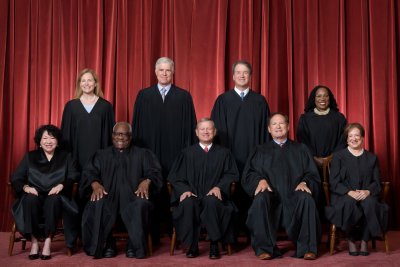
WASHINGTON, March 4 (UPI) — The Supreme Court on Wednesday considered whether the brokers who connect shippers with trucking companies can be held liable for irresponsible drivers.
The case, Montgomery vs. Caribe Transport II LLC, stems from a 2017 incident in which Shawn Montgomery, the petitioner, suffered significant injuries after a tractor-trailer hit his parked truck on the side of an Illinois highway.
A key part of the case is the interpretation of part of the Federal Aviation Administration Authorization Act of 1994. It prevents state laws “related to a price, route or service” of trucking companies or brokers that connect them to shippers.
However, the statute also provides an exception, stating that it will “not restrict the safety regulatory authority of a state with respect to motor vehicles.”
The outcome could redefine liability standards for freight brokers and impact the broader transportation industry and interstate commerce landscape.
The driver of the tractor-trailer, Yosniel Varela-Mojena, had been involved in a crash months earlier, but was still employed by Caribe Transport II, an interstate trucking company. Freight broker C.H. Robinson recruited Caribe II to deliver a cross-country shipment. After the crash, Montgomery sued the broker for negligent hiring under Illinois state laws.
During the arguments, the two sides disagreed about whether the phrase “with respect to motor vehicles” includes brokers.
“We do believe that ‘with respect to motor vehicles’ is the crucial question here,” said Theodore Boutrous Jr., Caribe II’s counsel. He argued Congress did not intend for brokers to be included.
The attorney for the United States agreed that the two different sections of the law being discussed should, in context, be taken altogether to mean that brokers are not included in the realm of “motor vehicles.”
“Paragraph one uses the phrase ‘with respect to the transportation of property,’ [and] paragraph two [says] ‘with respect to motor vehicles,'” said Sopan Joshi, assistant to the U.S. solicitor general. “That seems like a conscious choice that Congress made to parallel the language, but change the noun to a much narrower noun.”
Associate Justice Brett Kavanaugh questioned Paul Clement, Montgomery’s counsel, on how brokers would address safety concerns if the court were to rule in favor of Montgomery and say that brokers are liable for consequences of negligent hiring.
For instance, Kavanaugh suggested drivers should be proficient in English to ensure safety. In April 2025, President Donald Trump signed an executive order to enforce English-language requirements for commercial motor vehicle drivers.
“If you’re hiring drivers who can’t read the signs, that seems like a safety issue,” Kavanaugh said.
Clement said brokers could work with larger trucking companies with deeper pockets and check that they have adequate programs in place to test drivers for drug use, check on prior accidents and address other potential concerns.
“One of the reasons, I think, that you do want [brokers] to have some duty of care in these circumstances is this is a margin business,” Clement said. “If they don’t have any sort of incentive to internalize any of the cost of not asking the question, they really have no good reason to ask the question. They want the cheapest carrier.”
Associate Justice Ketanji Brown Jackson asked Joshi to explain why he thought Congress did not think brokers should share responsibility for safety given the language in the 1994 law.
“The problem, I think, with the argument in the way that you’ve set it up is that you are assuming away any responsibility that a broker might have for safety,” Jackson said.
Joshi argued that Congress did not intend for brokers to have responsibility regarding safety and could have worded the law differently if it did.
“Congress has an entire chapter, several chapters, of the U.S. Code in Title 49 that deal with safety addressing carriers, safety of motor vehicles, driver qualifications, and they’re all addressed at carriers,” Joshi said. “Not a single one is addressed at brokers.”
Joshi acknowledged that the Federal Motor Carrier Safety Administration is “understaffed,” “overworked” and unable to review all of the federally registered carriers. However, he said Congress has provided ways of bringing consequences against carriers who violate federal requirements and regulations.
In his closing rebuttal, Clement told the court that 94% of registered carriers on the road do not have meaningful federal safety inspections — a number derived from 2021 Federal Motor Carrier Safety Administration data.
He said state tort law could provide a “backstop to the federal system.”
“This case doesn’t have to be that hard. The thing that triggers state tort liability is an 80,000-pound motor vehicle. That’s what devastatingly injured my client,” Clement said.
The court is expected to issue a ruling by summer.