Lestat

Dying to be a rock star? How Lestat sunk his teeth into rock stardom

In early June, hundreds of fans dressed to the nines were in attendance at a rock star’s sold-out show at New York’s Beacon Theatre. There was lace everywhere and leather too. Chains dangled from belt loops and wrists. Some attendees arrived with dyed crimson hair, others with orange or pink.

Sheer black outfits that looked pulled from the pages of a gothic romance novel were draped on bodies. If “The Rocky Horror Picture Show” had collided with a modern concert, it might have looked something like this.

Then a man took the stage. Was it Lestat de Lioncourt, the immortal vampire-cum-rock star, or was it actor Sam Reid?

Moments earlier, attendees had watched the first episode of AMC’s “The Vampire Lestat,” the rebranded third season of “Interview With the Vampire” that premiered earlier this month. This season adapts Anne Rice’s novel of the same name, which is told from the perspective of Lestat, played by Reid, and transforms him into a touring musician.

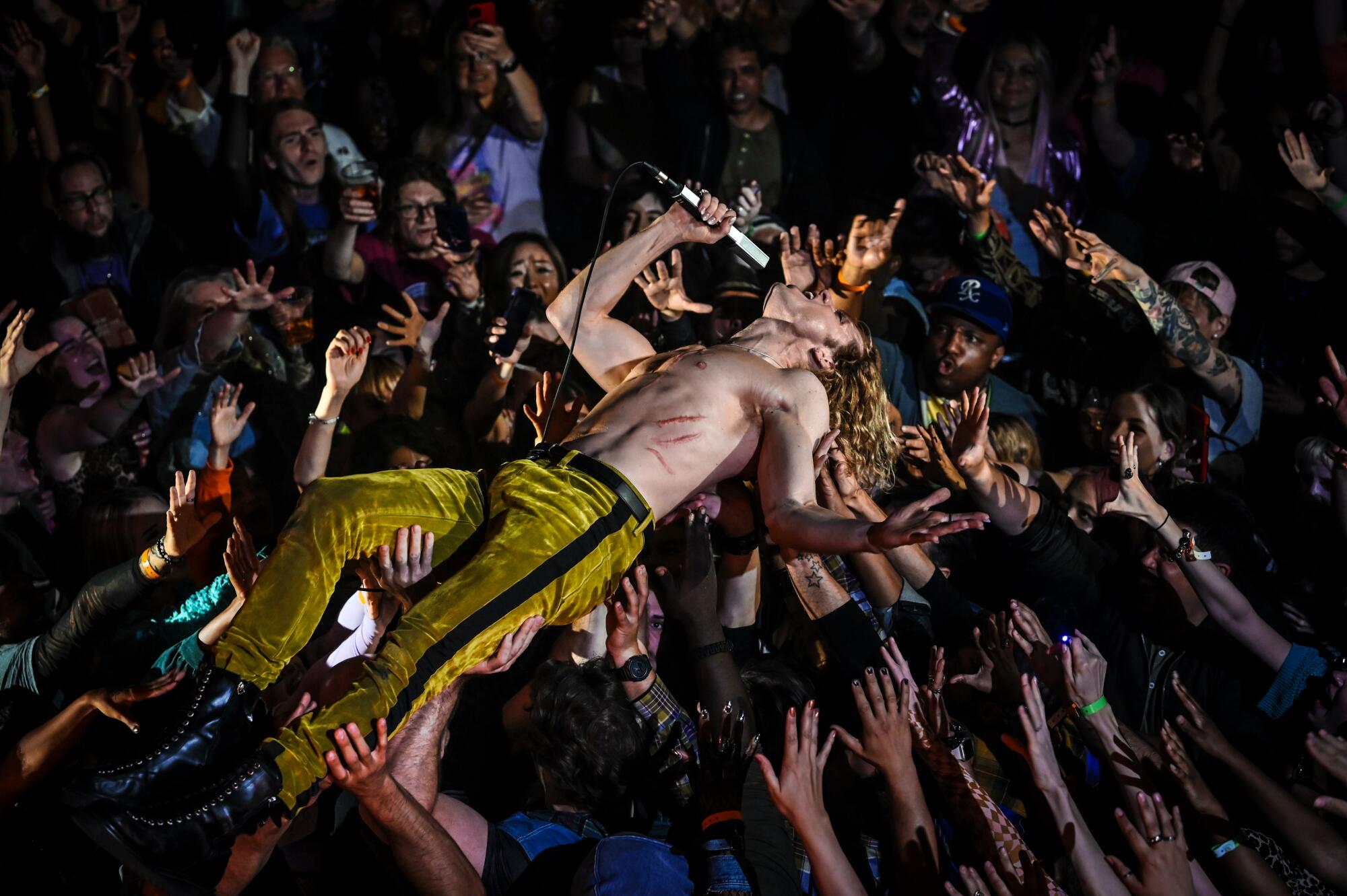
Now Reid, dressed in black with his chest partially exposed beneath an open jacket revealing a scar, stepped on stage and into the role of Lestat in front of the audience. As he moved across the stage, phones shot into the air. Fans screamed. People sang along to a slew of songs, and for a moment, the line between actor and character seemed to disappear.

At first glance, the assignment to turn Lestat into a rock star seemed straightforward. The vampire at the center of Rice’s beloved novels has flirted with music before. In 2002’s “Queen of the Damned,” he emerged as a leather-clad nu-metal frontman capable of commanding massive crowds. But bringing Lestat into the present introduced a different challenge. Rock music no longer occupies the same place in popular culture. Fame is fragmented. Audiences are skeptical of celebrity. Social media can build a star overnight and tear them down just as quickly.

Yet “The Vampire Lestat” asks viewers to believe something as audacious as a centuries-old vampire still being able to captivate people, launch a music career and inspire a movement. Reid thinks part of what drives the character is something surprisingly modern.

“Nobody cares that I exist, nobody cares that I’m not relevant,” Reid said of Lestat’s mindset entering the season. “It’s really fun to see him struggle with that and see him try to find his place in the world and not immediately get world domination.”

Making that fantasy feel believable required far more than putting Lestat in leather and handing him a microphone. To pull it off, the show’s creative team had to build a rock star from the ground up, crafting a visual identity, creating music that could stand on its own outside the series, and transforming Reid into a performer capable of owning a crowd rather than simply acting in front of one.

Sam Reid's Lestat de Lioncourt crowd-surfs in "The Vampire Lestat."

Sam Reid’s Lestat de Lioncourt crowd-surfs in “The Vampire Lestat.”

(Sophie Giraud / AMC)

“Dropping Lestat down into 2025 and making the decision for him to play rock ‘n’ roll was a really great dramatic switch because while there are many great rock bands that are alive and kicking right now, their hold of the cultural landscape is quite small,” showrunner Rolin Jones said. “You couldn’t think of a worse way to get your message out than going to be a rock star right now.”

That challenge became the foundation of the season.

Step 1: Making the music

A polished aesthetic, marketing and, in Lestat’s case, book buzz can only take a musician so far. It’s the music that had to make diehard fans believe he’s an artistic genius, or at least a star in the making.

That challenge landed with composer Daniel Hart long before a single script was finished. In an unusual twist, many of the songs that would eventually appear throughout the season were written before the writers’ room fully mapped out the story.

“There were so many unknowns when we started,” Hart said. To find a way in, Hart and Jones started with their familiar reference point: David Bowie.

“We settled, I think sort of obviously, on David Bowie as the launch pad for our Lestat,” Hart said. “The way that Bowie was so mercurial, and he was a chameleon. He reinvented himself throughout his career.”

Hart also looked to artists as varied as Kurt Cobain and Chappell Roan, while drawing inspiration from classical music, blues and the old-world sound Lestat would have absorbed over his long life. One early writers’ room exercise even involved breaking down the influences embedded within “Long Face,” the Bowie-coded first single released from Lestat’s fictional album.

“‘Long Face’ feels like a Bowie rip-off to Daniel Molloy [played by Eric Bogosian], and so then Lestat breaks the song down for him and goes into all the other influences that are in there,” Hart said. “ ‘Long Face,’ you could say, was in some way influenced by Bach, and then [he] talked about Willie Dixon, and how the blues had influenced Lestat when he was around the … 1920s and ‘30s.”

“He’s been alive for 250 years,” Hart continued. “He’s seen and heard a lot of music.”

The creative team never set out to replicate the hard-rock sound that defined “Queen of the Damned.” If anything, Jones felt trying to outdo that soundtrack would have been a losing battle.

A rock star playing a violin during a live rock concert

In “The Vampire Lestat,” Sam Reid sings every song himself, including “Long Face,” “Butterscotch Bitch,” “Your Biggest Fan,” “All Fall Down” and “Black Licorice.”

(Sophie Giraud / AMC)

“I mean, that soundtrack is deservedly very famous,” Jones said. “And I think if we decided to out-Korn Korn, we were going to be in trouble.”

Instead, their Lestat was a musician still searching for his voice. Jones says the season begins in a more performative glam-rock space before gradually evolving into something more personal.

“We thought ‘70s Bowie is where we would start, and that we would musically make a journey with him as we went deeper and deeper,” he said. “He would put his band on one tour, what a normal band would do, over four albums. The music just keeps changing. And as he gets more and more vulnerable, the songs begin to change. They get more raw. They get more exposure, and the music style evolves.”

Reid sang every song himself, including “Long Face,” “Butterscotch Bitch,” “Your Biggest Fan,” “All Fall Down” and “Black Licorice.”

“The more bombastic, the more over-the-top songs — he doesn’t seem to like them by the end of this season,” Hart said. “The more introspective songs that come later on are more in his new wheelhouse.”

That journey also shaped how Reid approached the material. While audiences will ultimately see the songs unfold within the context of the show, Reid encountered many of them before he fully understood where Lestat’s story was heading.

“I think in the beginning, he’s coming from an artificial kind of construct,” Reid says. “As the show goes on, the music becomes more personal, and he becomes less interested in actually finding love through his audience and more about finding who he is as an individual and as an artist.”

When Jones first began adapting “The Vampire Lestat,” he briefly considered making the character the sort of arena-filling superstar audiences might expect, like a Beyoncé or Taylor Swift. But the more the writers discussed it, the less interesting that version felt.

“If we were gonna start chipping away at all the armor that Lestat had, one of the great repetitive ways of a tour is you just can’t seem to break a ceiling,” Jones said. “He’s a niche star. And I think that is part of the gas that fuels this little journey.”

Hart also had the impression that Lestat would be a massive star.

“But it became more apparent that [he might] not exactly have the kind of success that he wanted and desperately felt like he needed — that was a more interesting story to tell,” he said.

Step 2: Getting the rock star look

While the audience has to believe Lestat is a rock star, they also have to believe he’s someone with the look — and worth staring at.

Lex Wood, the show’s costume designer, said that the challenge began long before cameras rolled on Season 3. Jones first floated the idea of rock star Lestat while the team filmed Season 2 in Prague in 2023, giving Wood time to begin imagining what a nearly 300-year-old vampire might wear while reinventing himself as a singer. During a production trip to Paris, she started sourcing pieces and collecting references that would eventually make their way into this season years later.

A rock star with sunglasses stands in a loose-fitting suit

“The main aim of building costumes for Lestat was to maintain an element of the unachievable,” says show costumer designer Lex Wood. “To emphasize that Lestat is untouchable.”

(Sophie Giraud / AMC)

Being fashionable wasn’t the only goal.

“The main aim of building costumes for Lestat was to maintain an element of the unachievable,” Wood said. “To emphasize that Lestat is untouchable. Hence, building specific costume build shapes and patterns that we adapted throughout the season.”

That idea guided nearly every aspect of the wardrobe. While the first two seasons often presented Lestat through structured tailoring and muted palettes, Season 3 arrives in a much louder world.

“A big thing really was that we wanted to push more color into the season in general,” Wood said.

Wood said the choice reflected where Lestat finds himself emotionally. No longer confined to drawing rooms and period silhouettes, he’s navigating celebrity, performance and self-reinvention. Leather remains. Black remains. But so do bursts of color, softer fabrics and strange patterns.

“We wanted to break Lestat free of the suiting,” Wood said. “Though we wanted to remain true to his roots in the 18th century, we also wanted Lestat’s pieces to feel slightly otherworldly at times.”

That meant weaving in elements of garments from the 18th century and making them feel contemporary. This could look like a very specific cut of a sleeve of a shirt that nods to that time.

Wood also studied the backstage photography of Mick Rock, pulling references of Bowie, Iggy Pop and Freddie Mercury. She blended that with punk-inspired designs from Vivienne Westwood and Jean Paul Gaultier. Goth icon Siouxsie Sioux also became an influence, particularly in the use of layering, texture and attitude.

Wood said the scattered references reflect a character actively trying to figure out who he wants to be.

“He’s investigating social media himself,” she said. “As he’s discovering his presence as a rock star. He’s investigating what it means to be a rock star.”

“He’s finding his persona,” she continued. “And trying on different personas.”

That idea extends all the way down to accessories, with Lestat’s jewelry blending old and new — a custom necklace created by a U.K. silversmith recalls one worn by Mercury during Queen’s early years, while rings featuring sculpted teeth serve as subtle reminders of his vampiric nature.

“We purposefully wanted some of his wardrobe to not be recognizable to any particular brand — at other times, we wanted to celebrate high-end fashion, to explore his playfulness and unpredictable character through his clothing,” Wood said.

Even the shoes became part of the transformation. One of Wood’s earliest conversations with Reid centered on abandoning the heeled footwear that helped define earlier versions of the character. This Lestat needed something heavier for a performer who could pace a stage.

“He wanted something that felt more grounded,” Wood said. “Something he could bounce around more in.”

Wood said the redesigned footwear altered Reid’s posture and movement, helping create a version of Lestat that she noted feels more volatile and more comfortable captivating a crowd than charming one.

Step 3: Becoming the rock star

For all the work that went into the costumes, music and scripts, none of it mattered unless the watchers believed the actor tying it all together.

Reid had already spent two seasons playing Lestat through other characters’ memories and perspectives. This time around required him to carry the character’s story through his own reflections. More importantly, he had to answer a deceptively difficult question: Why would anyone follow Lestat in the first place?

A long-haired rock star on stage arches his back and looks skyward

“It’s not fame that he’s after,” says Reid of his character in “The Vampire Lestat.” “Fame is totally temporary for a creature that lives forever.”

(Sophie Giraud / AMC)

The surface answer might be fame. The character launches a music career, records songs and steps into the spotlight. But Reid doesn’t think that’s what drives him.

“It’s not fame that he’s after,” Reid said. “Fame is totally temporary for a creature that lives forever.”

Reid sees Lestat as someone searching for validation.

“Not for the vampire that he is, but for the human being that he was,” he said. “He’s been pretty heavily rejected. From Louis through the book, and then his mother knows exactly how to string him along, when to give him love and when to take it away. So he’s really looking for validation and going into an audience space is where he first experienced that.”

While developing the season, Reid says he became increasingly interested in the gap between the public version of Lestat and the person underneath it.

“His whole life has been performance,” Reid said. “His whole life has been a lot of adversity, and the way that he kind of climbs out of that is to build a construct that he can perform and operate in. It makes a lot of sense for him to do this rock star persona. Through this season you start to see him realize that the music and the art can allow him to access himself as opposed to it just being a performance.”

“He’s trying to discover his sound as a musician,” Reid continued. “But he’s also trying to discover who he is.”

Throughout the season, viewers see a musician struggling to connect.

“Why can’t I sell out 5,000 seats?” Jones says, describing the character’s mindset. “I used to be able to walk into a room and everyone would love me.”

For Jones, that’s ultimately what makes Lestat feel like a contemporary artist. Sure, he may be an immortal vampire, but he’s navigating the same questions that confront plenty of artists: How much of yourself to reveal? How much should one perform? Can admiration ever substitute for genuine connection?

By the time the season reaches its conclusion, Lestat is still larger than life. But he’s also a more complicated performer forced to reckon with the distance between being seen and understood. Jones said none of this would be possible without Reid in the role.

“I think his performance in Season 3 is one of the 10 greatest American TV performances of all time,” Jones says. “I’d put him right next to Carroll O’Connor, Walter White [played by Bryan Cranston] and James Gandolfini.”

“And I’d look at all of them and say, ‘You guys didn’t sing.’ ”
Source link

‘The Vampire Lestat’ boss discusses bringing a glam rock edge to the AMC saga

Some people are still processing “Euphoria’s” evolution away from its roots as a gritty drama that explored highly mature and dark teenage experiences to, in its final season, a fever dream-esque look at adulthood that played like a full-blown neo-noir crime thriller. But another show’s creative transformation has taken the stage now.

The third season of AMC’s adaptation of Anne Rice’s “Interview With the Vampire” brings a reset to the captivating world of bloodsuckers. While the first two seasons adapt the original 1976 novel, relying heavily on the recollection of Louis de Pointe du Lac (Jacob Anderson) as he recounts his centuries-long life and romance with Lestat de Lioncourt (Sam Reid) to a journalist, the new season shifts narrative focus and perspective over to Lestat, who transforms into a charismatic frontman of a glam-rock band to publicly set the record straight. As such, the series has been retitled “The Vampire Lestat,” which is the name of Rice’s second novel. For this week’s Guest Spot, I spoke with showrunner Rolin Jones about the show’s rebranding and Reid’s commitment to the musical challenge.

You are reading Screen Gab newsletter

Sign up to get recommendations for the TV shows and streaming movies you can’t miss, plus exclusive interviews with the talent behind your favorite titles, in your inbox every Friday

Also in this week’s Screen Gab, TV critic Robert Lloyd steers us away from the usual streaming options to recommend a man’s video journal that documents his quest to travel the world by foot, while culture critic Mary McNamara suggests a new British comedy about codependent BFFs navigating the sort of tricky development that would end most friendships.

Speaking of endings to relationships, it was announced this week that “Doctor Who” showrunner Russell T Davies is exiting the series (again) seven months after Disney+ decided not to continue its partnership with the BBC to distribute the long-running sci-fi series. BBC also announced it will not air the show’s previously announced Christmas special this year. Lloyd, a longtime Whoverse follower, is a voice of calm through it all. He shares his thoughts on why the new questions swirling around the franchise don’t necessarily have to be cause for alarm — evolution is part of the show’s essence, he reminds us. Elsewhere in current events, if you’ve been curious (… sure, that’s the right word!) about the UFC Freedom 250 live event that will unfold in an oversize cage on the White House South Lawn in celebration of Trump’s 80th birthday and the country’s 250th anniversary — and will be streamed live on Paramount+ — check out our explainer about the controversy — and lawsuit — it has sparked.

Now if you’ll excuse me, I have another Matthew Rhys story to read so I can maintain my executive membership in the fan club. See you next week!

— Yvonne Villarreal

Turn on

Recommendations from the film and TV experts at The Times

@AlexanderCampbellOfficial (YouTube)

In February 2023, Alexander Campbell, then 27, set out from Sydney to walk west around the world. Currently he is somewhere around Albania, having traversed, among other places, Bangladesh, Nepal, Pakistan, Kazakhstan, Turkey and Bulgaria. He’s been documenting his progress on camera all along the way, but it wasn’t until Day 938, in Georgia, that he began posting the longer, “uneventful” videos that make his channel such a singular, meditative, even hypnotic, form of vicarious travel. Walking alone to the sound of his own footsteps, through sun, rain, sleet, snow and dark of night, over mountains and deserts, through forests and fields, he becomes a character in a peripatetic, nearly one-man show. The occasionally encountered friendly local will warn him about wolves or bears or the hunters who might mistake him for one, though he meets more dogs than people. (He calls them all “Buddy,” warily.) Titles include “I Slept in a Barn Full of Stray Dogs,” “I Got Caught in a Snowstorm With Nowhere to Sleep” and “Something Was Out There in the Forest.”) — Robert Lloyd

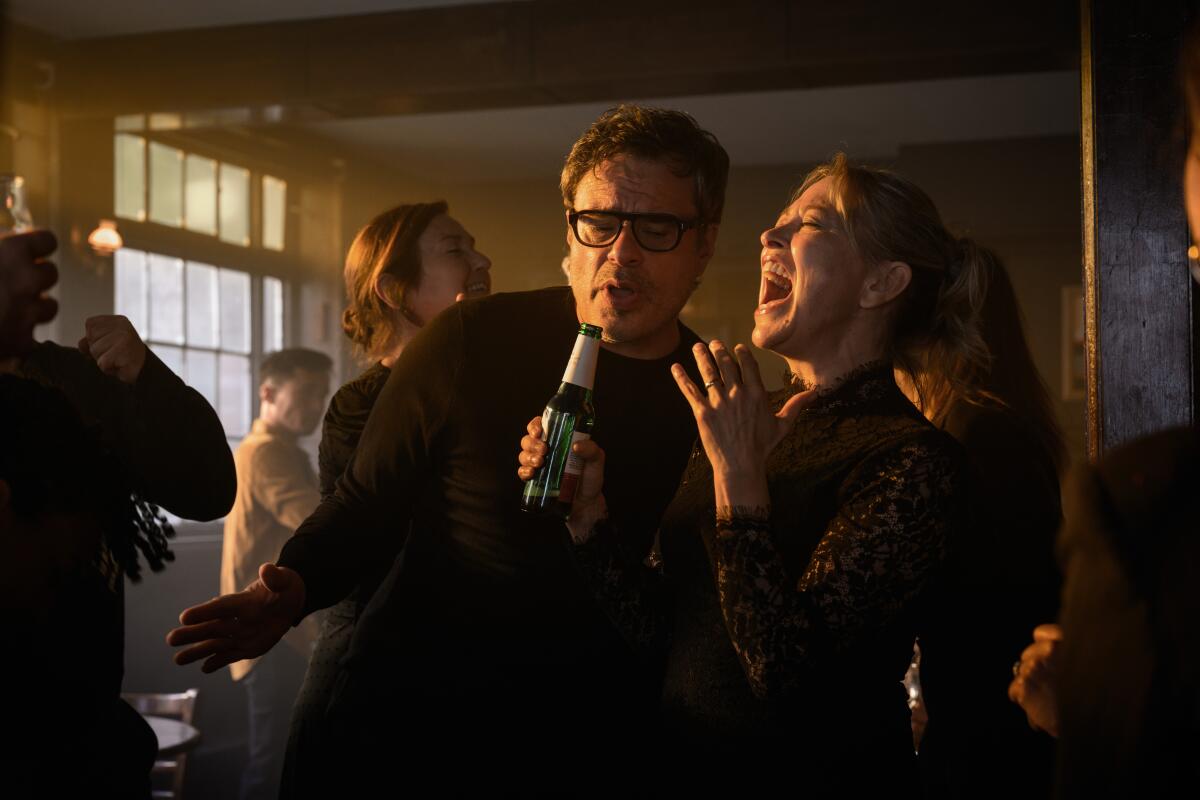
A man and a woman singing into a beer bottle.

Jemaine Clement, left, and Nicola Walker in “Alice and Steve.”

(Lara Cornell / Hulu)

“Alice and Steve” (Hulu, Disney+)

What would you do if your ex-turned-longtime bestie slept with your 26-year-old daughter? Well, Alice (“The Split’s” Nicola Walker) 100% loses her mind. Sure, during a drunken convo at a bar, she did tell Steve (“Flight of the Conchords’” Jemaine Clement) that he could have any woman he wanted, but she most certainly wasn’t talking about Izzy (Yali Topol Margalith). Having just returned home after breaking up with her boyfriend, Izzy decides that Steve, now bunking down on the sofa, is “strangely hot” enough for a little rebound sex and then a romantic relationship. And Steve, though initially regretful and more than a little shell-shocked, decides this is what he wants too. “I really like her,” he says by way of sheepish explanation. It leaves Alice no choice but to hilariously alternate between screaming and scheming as she tries to put a stop to the proceedings even at the expense of her marriage, her career, her friendship with Steve and her self-respect.

Clement’s sad-sack charm successfully boosts the leap of faith required to keep Steve from becoming an oblivious creep, but the show belongs to Walker. Her Alice becomes a blazing embodiment of the emotional maelstrom inside every woman who is expected to somehow put on a supportive, understanding face no matter how outrageous or impossible the situation. The laughs she elicits are exhalations of shock, recognition and relief. We can’t all ditch the high road for pure, luxurious fury, but it’s mighty fun to watch someone who does. — Mary McNamara

Guest spot

A weekly chat with actors, writers, directors and more about what they’re working on — and what they’re watching

A shirtless man with long blond hair holds up a black and red sheet draped behind him

Sam Reid as Lestat De Lioncourt in “The Vampire Lestat.”

(Sophie Giraud / AMC)

If you thought posting cryptic digs about an ex on your social media accounts as a way to cope with unresolved emotions was petty, this TV vampire may have you beat. The wild new, music-infused season of “The Vampire Lestat” (formerly “Interview With the Vampire”) revolves around Lestat de Lioncourt (Reid) on an elaborate mission to tell his side of the story after his ex-lover, Louis de Pointe du Lac (Anderson) published a scandalous memoir — with the help of journalist — that detailed their turbulent romance. In his bid to control the narrative, Lestat becomes an immortal glam rocker who launches a music tour and enlists the same journalist — newly turned into a vampire — to direct and film a music documentary about his life. The result is a flamboyant seven-episode season that blends rock-opera style performances (the season will feature 20 original songs) with personal reflections from its flashy frontman. As it enters its second week of release on AMC and AMC+, creator and showrunner Rolin Jones spoke over video call recently to discuss the show’s creative pivot and more. — Y.V.

To kick off the new season, there was an immersive premiere concert event at the historic Beacon Theatre in New York City earlier this month. Was that a surreal experience? Did you feel like a music manager?

I have a hard time talking about the work — the selling of the work, all that kind of stuff. I want to finish my edit, and then I want to like disappear at the Arctic. I knew we were doing this and I knew that there were like fans from all over the world flying in for it — some who didn’t have tickets. I knew there were people who had worked on the show from Seasons 1, 2, and 3 who got on a plane, asked for a ticket, and made a pilgrimage there. I was really moved by it. It was about as good as these things can ever be. It felt really beautiful. It felt like Vampire Church. It was pretty cool. And Sam — “surprising” is not the word because I’ve worked with him for a long time — was way better than he should have been. It’s incredible.

In this TV landscape, taking a show and giving it a new title as it enters its third season is a daring move. The series moves focus to the second book in Rice’s oeuvre. And while it continues the story of these characters, at the same time, it feels like a new show. What made you nervous about carrying out that kind of creative transformation? And what was thrilling about it?

We could start with a thrilling part because the idea to be able to go to the people who worked really hard and say, “Hey, let’s rebuild it” — that’s exciting. That part’s cool. The executing part about it is where the terror begins because most worthwhile art — you can call TV art — invariably has to have risk and danger involved in it, otherwise you’re probably performing a magic trick. No offense to magicians. But you want something that when you turn off the TV, you’re not immediately forgetting. The more risk you do, in terms of form, in terms of all that, you want to be able to feel like you can pull it off because, otherwise, they [the audience] have nothing to grasp onto. [And they say,] “You just destroyed this thing we love, how dare you!” But generally speaking, everybody — from the top of the network down to the actors who are doing it — was down for it. Mostly because, if you listen to our fandom, I think they demand it. They’re out there on a limb telling everybody “it’s the greatest TV show, and blah blah blah” and you have to deliver that for them so that they can continually confidently bombard all their friends and neighbors and say, “Watch the show.” There’s nobody who didn’t give everything [to this season]. It was a real collective leap together.

Sam undergoes quite the transformation to make this rock star vampire persona believable. What struck you about how he approached embodying Lestat this season?

I gained 20 pounds in Toronto, and that’s because I kept stuffing my face with bread, and about every three or four times I would have this big sloth of butter on bread, I’d go, “Poor Sam” because I know Sam had not touched a piece of bread. Let’s start there — 0% body fat, the dimensions on the waist. The level of dedication. He was living and breathing every second about the role and about the demands of it — sing songs, and not only sing songs, but go learn to be a musician, and go train with people who have been doing it their whole life so you can fake it. I feel very confident saying this: Anybody who watches this season and Sam’s performance will feel like, at the end, they saw one of the 10 greatest performances in the history of our medium. I think he absolutely disappeared. James Gandolfini did not sing songs, Swearengen [the “Deadwood” character played by Ian McShane] did not sing songs. Mr. White [the “Breaking Bad character played by Bryan Cranston] did not sing songs. I’ll put him [Sam] up against all of them. He’s incredible.

What if he wants to go off and be a rock star now?

He could do it.

A bloodied man holds a piece of paper with his right hand

Jacob Anderson as Louis De Pointe Du Lac in Season 3 of “The Vampire Lestat.”

(Sophie Giraud / AMC)

You have a rock band posing as vampires fronted by an actual vampire who is the focus of a documentary being directed by a vampire passing as a human. And for all this to work, the band has to be good. What was the challenge of making this fictional band’s stardom believable — the charisma, the presence on stage, the discography? It’s a tall order, in addition to making a compelling TV show.

Anytime you have seen these things, following a band, there’s so many ways it can fall flat. You can do three or four of the things you need to do, and if one of them falls apart, you’re still stuck there, going, “Eh.” We all, who are working on it, love music. We’ve all been in clubs. The first thing we did was remove the stardom for budget reasons, but also for singular storytelling — he decided to do rock ’n’ roll in the year 2025. Some basic building blocks, we need songs. So with [composer and songwriter] Daniel Hart, we bring him into the [writers’] room because it’s not only writing songs, but writing the context about when and where he’s [Reid] singing them. He has to be aware of what we’re doing in the room. We also have to be able to pivot when he has pure inspiration; he can come in with something we’ve never talked about, and go “Boom!” And it’s OK, now what do we do with this song? And quite often this year we restructured episodes because the song was beating our episode. [We had to] hire actors who can play or musicians that can act — and that’s not everybody, so that shrinks that down. Make sure when you’re in the club, or whether you’re singing the song in rehearsal, let us uglify it, embrace the mistake, make it a little dirty. We have a song this year that has some of the most beautiful orchestrations, but because of where it landed in the season and what it talked about, we ended up going with the most stripped down, bare version of it. Don’t worry, you’ll get to hear these beautiful orchestrations [at some point]. [It’s also thinking about] how do you carve out the time you need to shoot it and the playback elements of it, and what sacrifices you have to make on other set pieces that you would normally put in is a lot. But everything from the beginning was with one thing in mind: Do not suck. How can we suck less? Let’s not suck. And we just kept going over and over again with that.

At the end of the first episode we see Lestat reunited with his undead mom, Gabriella, who he has, I think it’s fair to say, an oddly intimate relationship with —

Multifaceted.

And obviously the Louis-Lestat romance is far from being over. What are you interested in exploring within those two dynamics, in particular, moving forward since they’re so central to Lestat?

It becomes immediately about him going, “Let me try to explain this … I might have just repelled 80% of you.” I’m really interested in the viewers who are really off-put by it. I want to see where they’re at by the end of Episode 7, if they trust us. And see what they’re feeling. I guess [some people feel], “Oh, you’re not allowed to do this in the TV world unless you got f— dragons and s—, but all the things that you would have thought [that the network might say], “Don’t do this,” we didn’t really have a lot of those obstacles. There was a lot of trust. The thing with the Lestat character is like it’s probably harder to cuddle up to him like you could Louis. Louis is a Faustian tale; here it’s like a Faustian tale but Elton John’s at the center of it. There’s a series of questions like “Why do you keep doing this to yourself? Why do you keep get trapped into these things?” It’s like going on odyssey, or as Jacob called it, an idiocy, with a character that is exotic and eccentric and contradictory. For us going forward, as we wrote it, every time we fell into the something that felt well-made or cool on a twist or turn level, we found we were very suspicious of it, and we were trying to make alien TV as best we could. So, what do I want? It’s less about exploring those two dynamics, although they’re richly part of this fabric. It was, how can you take them on a magic carpet ride, a very difficult one? The idea is to actually have, by the end, every single person recognize that part of themselves in him. And how can you normalize him over seven episodes? How can you deliver that to an audience?

I know you’ve been superbusy, but what’s the last thing you watched that you found yourself recommending to everyone or something that you were obsessed with right now?

A TV show I’m watching, one that I’m enjoying right now, is “Widow’s Bay” [Apple TV]— that has been very enjoyable. It’s so much fun.

Matthew Rhys’ facial expressions are so good.

Oh, he’s great, and that show just really knows what it is, and is joyfully silly, and has a great atmosphere. It’s one of the most beautifully shot things I’ve seen in a while. I’m not finished yet.

OK, before I let you go, I hope we get a concert out in L.A. at some point.

Wouldn’t that be nice? Where would you put it up? Echoplex?

Maybe the Troubadour.

What about the Greek? That would be nice.

ICYMI

Must-read stories you might have missed

Source link