Los Angeles clashes with the state over ‘Zone Zero’ regulations
As the state continues multiyear marathon discussions on rules for what residents in wildfire hazard zones must do to make the first five feet from their houses — an area dubbed “Zone Zero” — ember-resistant, the Los Angeles City Council voted Tuesday to start creating its own version of the regulations that is more lenient than most proposals currently favored in Sacramento.
Critics of Zone Zero, who are worried about the financial burden and labor required to comply as well as the detrimental impacts to urban ecosystems, have been particularly vocal in Los Angeles. However, wildfire safety advocates worry the measures endorsed by L.A.’s City Council will do little to prevent homes from burning.
“My motion is to get advice from local experts, from the Fire Department, to actually put something in place that makes sense, that’s rooted in science,” said City Councilmember John Lee, who put forth the motion. “Sacramento, unfortunately, doesn’t consult with the largest city in the state — the largest area that deals with wildfires — and so, this is our way of sending a message.”
Tony Andersen — executive officer of the state’s Board of Forestry and Fire Protection, which is in charge of creating the regulations — has repeatedly stressed the board’s commitment to incorporating L.A.’s feedback. Over the last year, the board hosted a contentious public meeting in Pasadena, walking tours with L.A. residents and numerous virtual workshops and hearings.

-
Share via
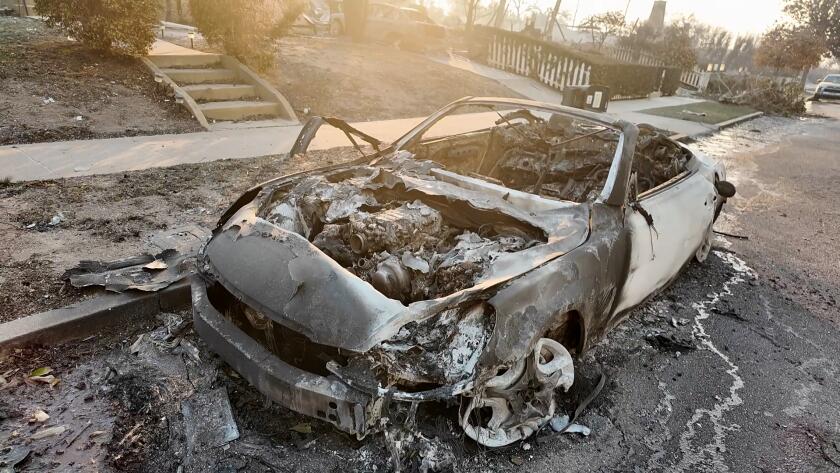
Some L.A. residents are championing a proposed fire-safety rule, referred to as “Zone Zero,” requiring the clearance of flammable material within the first five feet of homes. Others are skeptical of its value.
With the state long past its original Jan. 1, 2023, deadline to complete the regulations, several cities around the state have taken the matter into their own hands and adopted regulations ahead of the state, including Berkeley and San Diego.
“With the lack of guidance from the State Board of Forestry and Fire Protection, the City is left in a precarious position as it strives to protect residents, property, and the landscape that creates the City of Los Angeles,” the L.A. City Council motion states.
However, unlike San Diego and Berkeley, whose regulations more or less match the strictest options the state Board of Forestry is considering, Los Angeles is pushing for a more lenient approach.
The statewide regulations, once adopted, are expected to override any local versions that are significantly more lenient.
The Zone Zero regulations apply only to rural areas where the California Department of Forestry and Fire Protection responds to fires and urban areas that Cal Fire has determined have “very high” fire hazard. In L.A., that includes significant portions of Silver Lake, Echo Park, Brentwood and Pacific Palisades.
Fire experts and L.A. residents are generally fine with many of the measures within the state’s Zone Zero draft regulations, such as the requirement that there be no wooden or combustible fences or outbuildings within the first five feet of a home. Then there are some measures already required under previous wildfire regulations — such as removing dead vegetation like twigs and leaves, from the ground, roof and gutters — that are not under debate.
However, other new measures introduced by the state have generated controversy, especially in Los Angeles. The disputes have mainly centered around what to do about trees and other living vegetation, like shrubs and grass.
The state is considering two options for trees: One would require residents to trim branches within five feet of a house’s walls and roof; the other does not. Both require keeping trees well-maintained and at least 10 feet from chimneys.
On vegetation, the state is considering options for Zone Zero ranging from banning virtually all vegetation beyond small potted plants to just maintaining the regulations already on the books, which allow nearly all healthy vegetation.
Lee’s motion instructs the Los Angeles Fire Department to create regulations in line with the most lenient options that allow healthy vegetation and do not require the removal of tree limbs within five feet of a house. It is unclear whether LAFD will complete the process before the Board of Forestry considers finalized statewide regulations, which it expects to do midyear.
The motion follows a pointed report from LAFD and the city’s Community Forest Advisory Committee that argued the Board of Forestry’s draft regulations stepped beyond the intentions of the 2020 law creating Zone Zero, would undermine the city’s biodiversity goals and could result in the loss of up to 18% of the urban tree canopy in some neighborhoods.
The board has not decided which approach it will adopt statewide, but fire safety advocates worry that the lenient options championed by L.A. do little to protect vulnerable homes from wildfire.
Recent studies into fire mechanics have generally found that the intense heat from wildfire can quickly dry out these plants, making them susceptible to ignition from embers, flames and radiant heat. And anything next to a house that can burn risks taking the house with it.
Another recent study that looked at five major wildfires in California from the last decade, not including the 2025 Eaton and Palisades fires, found that 20% of homes with significant vegetation in Zone Zero survived, compared to 37% of homes that had cleared the vegetation.