When Zoe Kazan learned she was going to adapt “East of Eden,” she knew it meant she’d be destroying a copy of John Steinbeck’s 1952 novel with scribbled notes in different colors, highlights and earmarked edges. So she ordered a used one from Powell’s Books — it has somebody else’s last name written on it, she points out.
“It’s a treasure to me,” she said during a recent video call from London.
Steinbeck’s Cain and Abel-inspired novel follows two families across decades as a way to explore good and evil, legacy, free will and what makes a person. Driving many of the biblical parallels are two sets of siblings — half-brothers, Charles and Adam Trask, and later, Adam’s fraternal twin sons Cal and Aron — each competing for their father’s attention and love. Disrupting their lives is an enigmatic woman named Cathy Ames, who Adam marries and who gives birth to Cal and Aron.
The book-to-screen adaptation has been Kazan’s passion project. And for a tale of familial legacy, she had her own to confront — in 1955, her grandfather Elia Kazan directed a film version that starred James Dean and covered the last third of the book, which focused on Cal and Aron. Zoe Kazan’s interest in the story took shape decades later when, as a teenager, she discovered the book.
She found herself drawn to Cathy, its famous antagonist.
“I felt repelled by her, attracted by her, curious about her. I felt empathy. I felt hared. I felt love. I felt all these things,” Kazan said. “I had never read anybody like her. I just remember, every few pages, wanting to stop and read aloud to someone the things that she was doing or [the things] that someone was saying about her.”
She also felt the pull of the story’s examination of intergenerational cycles and familial legacy.
“It feels a little bit like a chicken-and-egg situation. Which came first: Was I drawn to this book because of its intergenerational aspects or did this book teach me to think about intergenerational aspects?”
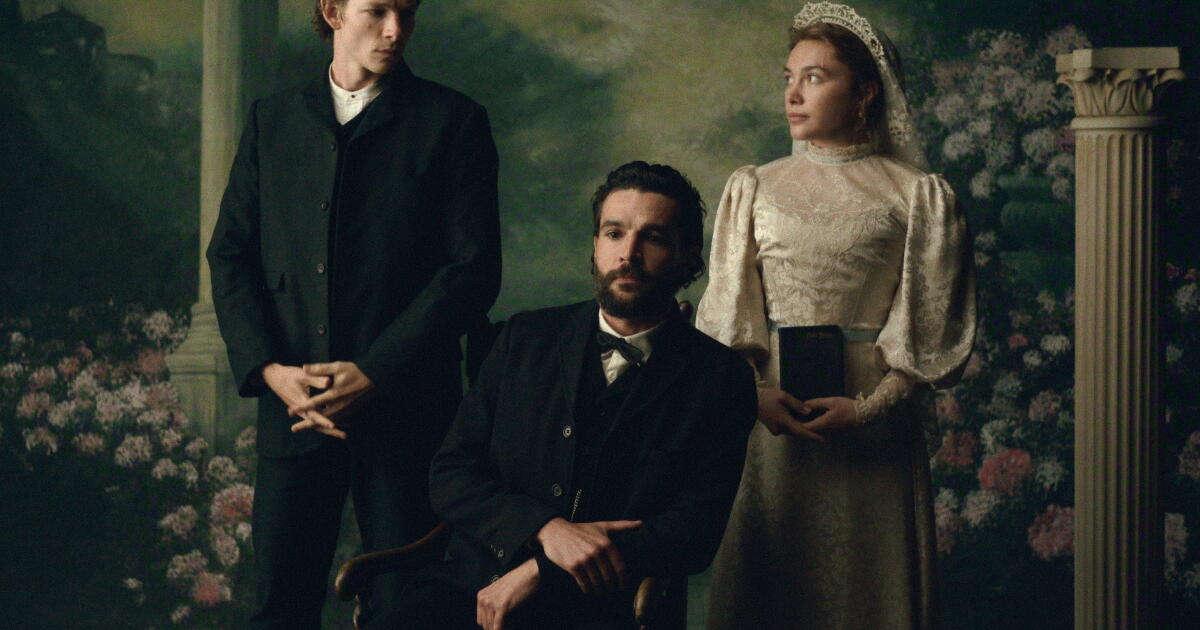
Now streaming on Netflix, the seven-part adaptation Kazan shepherded — alongside co-showrunner Jeb Stuart — covers more ground of the multigenerational saga than her grandfather’s film. This new version also centers Cathy.
Blue’s Lee Ryan has announced his wife Verity is pregnant with his SEVENTH babyCredit: Instagram/leeryanofficialThe All Rise hitmaker uploaded a sweet clip to social mediaCredit: Instagram/leeryanofficial
Lee’s new social media video showed him donning a black hat as he danced around with his family.
Verity, sporting her own nude headgear and a brightly-patterned dress, was seen proudly holding a sonogram scan of their unborn tot.
Sign up for the Showbiz newsletter
Thank you!
The happy couple shared a kiss before the rest of their family joined them to celebrate.
In his caption, penned alongside a family day out, he wrote: “I am blessed by God for the family I have”.
He said at the time: “I met someone finally who loves and supports me in everything I do.
“Verity is a beautiful, strong and loving woman who I treasure.
“And I’m a lucky man to have such a wonderful mother for my child, and now wife, in her.
“I’ve never been more calm and grounded and I have Verity to thank for that.
“I’m the happiest I’ve ever been in my life because of the wonderful family life I now have.”
Stunning Verity is a talented singer who appeared on X Factor in 2009 – and even turned her talent into a career when she worked as an Ariana lookalike and impersonator.
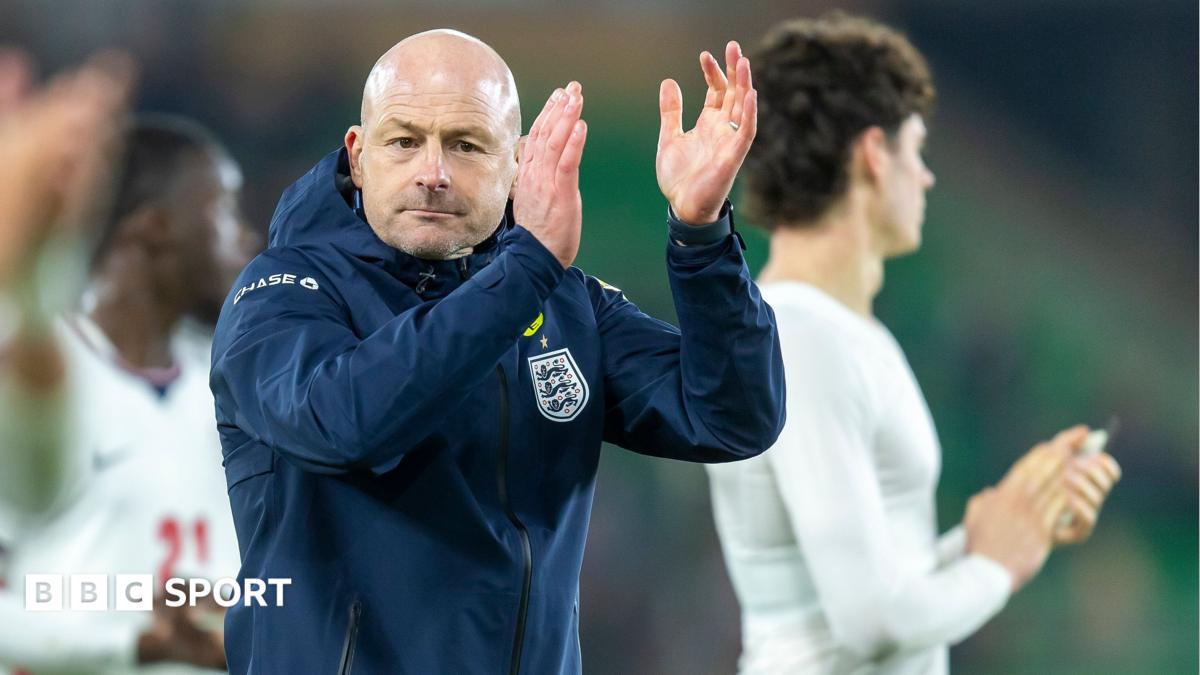
England lifted successive trophies in 1982 and 1984 but then had to wait 39 years until Carsley’s men won in Georgia and Romania in 2023, beating Spain in the final.
Winning the tournament three times in a row has only ever been done once before, by Italy in the 1990s, although never in the competition’s current guise of 16 teams.
Carsley is aware of the challenge ahead – but also the lasting impact more success could have.
“The older you get, you want to leave a legacy, don’t you?” He said, with England top of Group D and three points clear of Slovakia.
“There would have been an easy move, after the first win, to go and do club management and go and accept a few of the offers.
“But I enjoy the job I’m doing and I enjoy that I’m part of a bigger quest to win a major tournament. I want to be part of the FA when we do that.”
Carsley also says he welcomes the pressure of attempting to do something no Young Lions team has done before.
“I think we have to embrace that,” said the former Everton and Derby midfielder. “They come to play for the under-21s, you’re back-to-back champions. There’s a bullseye that goes with that. We have to be aware of that and go for it.
“The expectancy, we’ll just get through the group and then we’ll win the quarters, we’ll win the semis and then we’ll just win the final… it’s very difficult.
“My priority is definitely qualifying and then that’s something I’ll think about.”
Actor D’Arcy Carden stopped by early, beating the cadre of guests crowding the main plaza beneath the now-famous oculus of the 300,000-square-foot Ma Yansong-designed building. A Stormtrooper drove by on a flatbed truck, shortly before R2-D2 greeted visitors in the courtyard, wearing an official staff badge. (The line for a selfie with the droll droid stretched as far as the eye could see.) Museum leaders have long said that “Star Wars” artifacts account for about 7% of the 100,000 square feet of gallery space, but one worker quipped 90% of opening-day attendees likely had a vested interest in the franchise.
This proved true, for the most part: Many visitors clearly knew and loved “Star Wars,” and Princess Leia buns and Yoda ears abounded. (Two Padmé Amidalas ran into each other, and according to a restaurant worker, one brave soul showed up in “Star Trek” gear.)
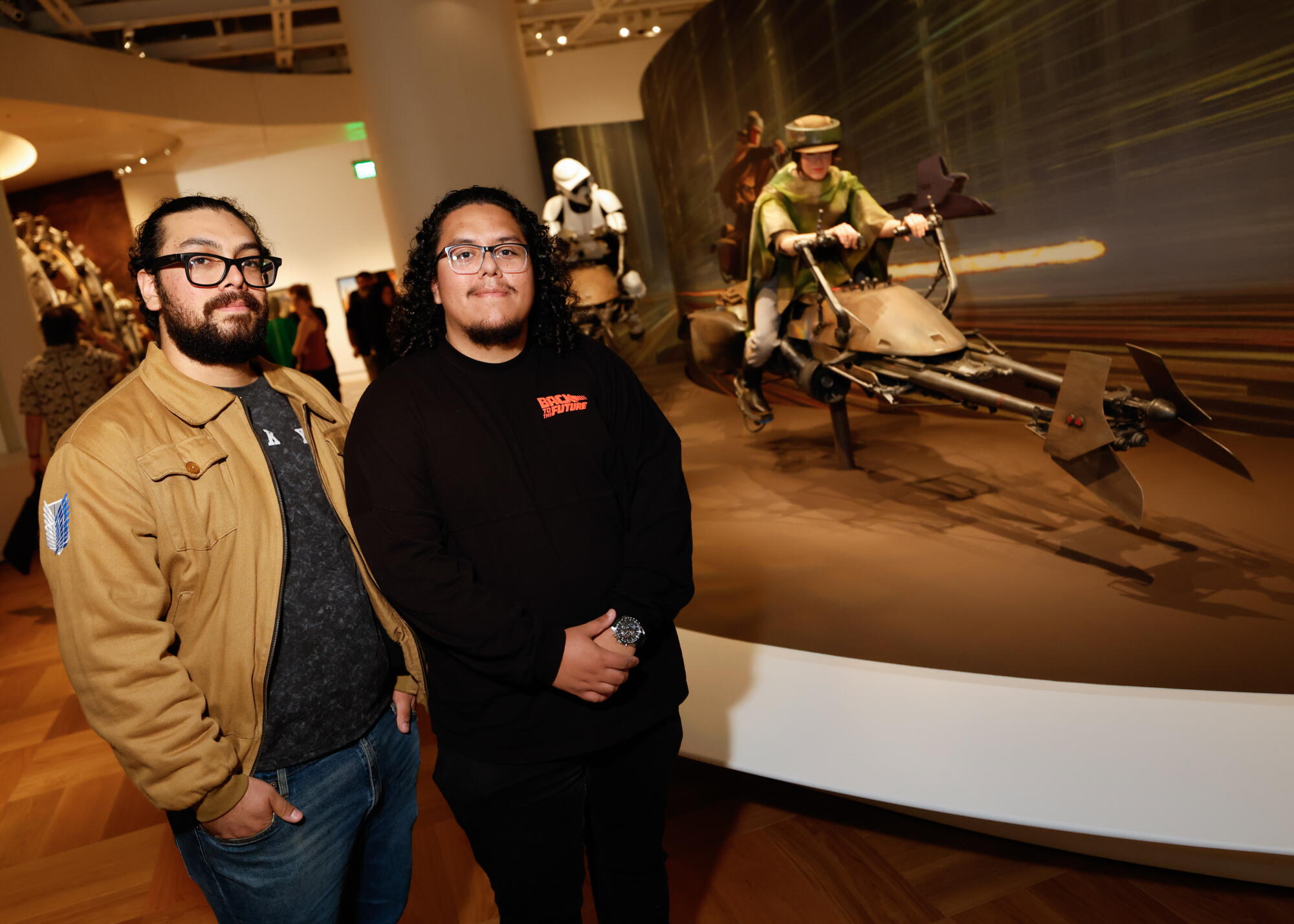
David Perez, 27, (right) donned his “Back to the Future” gear, hoping to see art from the movie. But he and his brother Carlos Perez, 28, (left) were quite pleased with the “Star Wars” artifacts in the Cinema section.
(Carlin Stiehl / For The Times)
Still, the museum, as its famous co-founder George Lucas has repeatedly said, is about more than just one story, however beloved. That sentiment cropped up repeatedly in interviews, too: Early guests seemed to believe the museum’s brochure, which notes that the galleries are about the “narrative art” of illustrating stories.
Co-founders Lucas and businesswoman Mellody Hobson (also Lucas’ wife) gave remarks early Tuesday to the first 100 visitors, consisting of students from USC, Los Angeles Technology Center, Otis College of Art and Design and Los Angeles City College, who were all handed free tickets.
A yellow Naboo N-1 Starfighter hangs above the education lobby, across from the main plaza, guarding the research library.
(Carlin Stiehl / For The Times)
“I’ve spent more than 50 years collecting the work of artists who don’t always get their due — illustrators, cartoonists, muralists, painters — because I believe their images are as vital as any other art form,” Lucas said. “They deserve to be in a museum.”
“This is a museum of the ‘people’s art’ — the images are illustrations of the beliefs we live with every day,” said Hobson, “and for that reason, this art belongs to everyone.”
Later that day, The Times asked visitors to share their impressions of a museum that, until now, has lived largely in the imaginations of fans and in abundant social media posts online. The museum has drawn loads of applause but also plenty of criticism, mostly for its lack of context via wall text, and for displaying art that not everyone agrees should be elevated.
Do the people love the “people’s art”?
Responses have been edited for length and clarity.
Alden Chang and his wife flew 6,800 miles from Taiwan to thank George Lucas for creating the “Star Wars” films and franchise. Chang told The Times that he also wrote an academic paper examining “Star Wars” fan culture in Taiwan.
(Carlin Stiehl / For The Times)
Alden Chang, 32, green product engineer from Taiwan
You flew all the way from Taiwan, just for this?
Chang: Yeah, halfway across the world to meet George Lucas and Miss [Mellody] Hobson.
Did you get to meet them?
Chang: Yeah, I just shook hands with them this morning. It’s like a dream come true.
How long ago did you and your wife get here,and how long are you staying?
Chang: For eight days. We came here on Sept. 18.
Is this the highlight of the trip?
Chang: Sure. [Laughs.] It’s my main mission and my main goal.
(Later, in an email, Chang told The Times that he also wrote an academic paper examining “Star Wars” fan culture in Taiwan.)
Friends Robert Meier, left, and Marc Downing used to work as ushers at the Music Center together. Growing up, Marc rode his bike where the Lucas Museum now stands.
(Carlin Stiehl / For The Times)
Marc Downing, 71, retired, from Exposition Park and Robert Meier, 70, educator, from Highland Park
Downing: I go to all the museums. This was the newest museum, so I had to come and see this.
How does this compare to the other L.A. museums?
Downing: This is ultra modern, ultra space-future. I’m glad the museum is here; highly recommend it. And I’m proud that it’s in my city, and I’m glad that it’s in the neighborhood that I grew up with.
What made you want to be a member of the museum, Robert?
Meier: It’s giving to the neighborhood. I’ve admired George Lucas — I used to have a relative in Marin County, and growing up, we’d go to lunch, and I’d see George Lucas and his family. We’d be at the same restaurant together.
Downing: Well, speaking of this neighborhood: This used to be a parking lot. I remember it very well. And I used to come here and ride my bike in this neighborhood as a kid.
C.S. Lee sits on a bench at the south viewpoint of the museum, gazing out onto the sculpture garden below. “This is why you live in Southern California. This is why you live in L.A.: for days like these.”
(Carlin Stiehl / For The Times)
C.S. Lee, 54, actor, from Koreatown
Lee: “Star Wars” was the very first movie I ever saw in my life as a 4-year-old when I immigrated here from Korea. We landed in Hawaii, in Waikiki Beach. Our family friends took us to a drive-in movie cinema place, and they said, “You want to come see a movie?” And it was “Star Wars” and “King Kong,” double billing. And my mom said when I saw the screen, my eyes popped out of my head because I’d never seen a movie before.
How do you think “Star Wars” impacted how you saw narrative and story?
Lee: I think I carried that all through my life: the story of “Star Wars.” I was like, “Oh, the good guys won!” And it was such an uplifting thing for me to hold on [to] all these years.
What did you think about the rest of the museum?
Lee: It’s so beautifully done: all the curves, all the light. You got the wind coming through the trees that they planted. I mean, honestly, I was just looking out, thinking to myself, “Wow, this is why you live in Southern California. This is why you live in L.A.: for days like these.”
The view of the sculpture garden and grounds beyond that C.S. Lee was contemplating from the south viewpoint.
(Carlin Stiehl / For The Times)
What about the building itself?
Lee: We rarely get to see architecture like this. But I think it’s good for people to see the artistry and the imagination of what people can build.
Janet Jacobs, 62, architect and Hanjin Jacobs, 25, audio equipment manufacturer technician, mother and son on a family trip from Portland (pictured at the top of the story)
I see you’re wearing a “Star Wars” T-shirt.
Janet: Yes, I am — actually from 1977.
Wow, really?
Janet: Yeah, I’ve had it for that long [laughs].
What was your overall takeaway from the museum?
Janet: I know George Lucas wanted to create this museum in a different way, like he didn’t have a sequence of events or a roadmap, he just wanted people to experience it the way they wanted to, so that’s all great. We do wish some of the things were explained a little more. Like, I know who Ralph McQuarrie is; [my kids] do not. So that would’ve been nice. Like in a typical museum, you do have a little blurb.
[My son] brought up a really good point: how ironic it is that it’s about storytelling, but yet there seems to be no storyline.
Andrew Liu, left, and Matthew Haak hang loose in front of a KAWS sculpture. They actually didn’t know it was opening day, but were happy to be there anyway.
(Carlin Stiehl / For The Times)
Matthew Haak, 26, architectural designer, and Andrew Liu, 26, behavioral therapy assistant, both from University Park
Haak: We are not “Star Wars” fans. I haven’t watched a single “Star Wars” movie. I’ve somehow evaded them my entire life.
So, if not for “Star Wars,” why did you come out today?
Haak: I’ve been watching this building being constructed for the past two years. I’m just geeking out over the organic curvilinear forms. Not a single hallway has been straight. And they even have real expensive details, like light coves on the base [of the wall]. All of these things really stand out to me. Also, curved walls like this are so expensive; architects never get a budget to do stuff like that.
I was just surprised: It’s not just “Star Wars” stuff. There’s so much art; it’s so cool.
Nicole Garcia — dressed as Padmé Amidala in her lakeside gown — poses in front of a statue of Princess Leia.
(Carlin Stiehl / For The Times)
Nicole Garcia, 24, cosplayer/costumer from Corona and Veronica Antonucci, 40, administrative assistant from Orange County
So, this might be an obvious question [given their fun outfits], but what brought you guys out today?
Antonucci: This little thing called “Star Wars”!
Garcia: Growing up with “Star Wars,” I always loved all the pieces, knowing that, for example, there’s miniature pieces that look just huge on-screen, and seeing them in-person is just, like, I want to shrink myself down and just be there.
Antonucci: It’s also amazing that it’s not just “Star Wars,” and it’s also so much more that everyone should come out and see.
Is there anything else you were particularly excited to see?
Antonucci: I was really excited to see the Frida [Kahlo]. I didn’t know she was gonna be here, so I think when I saw her, I gasped.
Is there anything else you’d like to add?
Garcia: I just hope the future generations of kids come back to see this, growing up with museums more often, and just learning how to make art — like, physically make art — and be inspired.
Antonucci: Actually, we talked about feeling jealous of all the kids who are going to be here on their school field trips, because we didn’t get to experience this.
Nikki Foster, left, loves a good field trip. She texted her group chat to visit the museum, and her bestie, Shalonda Dean, responded, so they both cleared their calendars for the visit.
(Carlin Stiehl/For The Times)
Shalonda Dean, 47, consulting business founder and president, and Nikki Foster, 45, live event production executive, both from Beverly Hills
Dean: Being a Black woman, I can identify with this little Black girl. Even in 2026, I think this painting depicts a lot of what Black women are going through today, whether it be in the workplace, navigating motherhood, navigating life. And I think this is an example of the barriers that we’re constantly breaking through every day, even today.
Foster: I’ve never seen it in person until now. So when we saw it, we were like, “It’s here, it’s here!” Just to be able to lay our eyes on it, and not have to go to another country, another state — here in Los Angeles. This is divine. It’s a divine day.
“I love meeting people,” Vincent Zabierowski said. “People are my main inspiration. I’m very lucky I get to be in a place where people want to be, and people want to soak up all that creative energy and just experience art.”
(Carlin Stiehl / For The Times)
Vincent Zabierowski, 23, host at the Skywalker Grill and freelance illustrator, lives near Downtown L.A.
As an artist yourself, what are your favorite pieces in the museum?
Zabierowski: I love a lot of the things that are in the graphic novel collection, like the Jack Kirby, the Garfields. My favorite is the Art Nouveau artist Alphonse Mucha. The Diego Rivera mural, that one was really amazing — and just the history here, having it be in L.A.
How does your work as an illustrator inform how you see these pieces?
Zabierowski: When I was going through it with some of my co-workers, I would [ask] “Do you know why they use a blue pencil?” And it’s because, when you take a photograph or a scan, that blue pencil disappears. So it was just really cool to see the behind-the-scenes and understand.
So seeing those blue pencil marks tells you that a piece is real?
Zabierowski: A person made it! I feel like a lot of people see artwork in textbooks, or they see artwork on their phones, or they see artworks on posters, and it takes a lot of skill and intelligence and training to be able to do those pieces of artwork.
LAS VEGAS — Susan Gonzalez plans to pay off her credit card now that she no longer needs to pay taxes on the dollar bills that she stashes away at the end of long shifts pouring beers and mixing cocktails in a smoky sports bar.
Thanks to President Trump, “there’s more money in our pockets,” the registered Republican said. The Iran war might have spiked gas prices, but Gonzalez is still confident that the U.S. economy is getting stronger.
The Jackpot Bar & Grill, located about 4 miles from the Las Vegas Strip, is in the heart of Nevada’s 3rd Congressional District, where Democratic Rep. Susie Lee is trying to fend off a challenge from Republican candidate Marty O’Donnell. The state has the highest concentration of tipped workers in the country because its economy is driven by the hospitality and tourism industries, making Trump’s “no tax on tips” policy a critical part of his party’s midterm pitch here.
The question for Nevada voters is whether they’re seeing more benefit from lower taxes or more pain from the country’s economic troubles, such as energy costs and declining tourism.
Lee’s district is a top target for the Republican Party in its fight to maintain control of the House. With a mix of working-class and high-income neighborhoods, it’s the most competitive of Nevada’s four congressional seats. In 2024, both Lee and Trump won the district.
Lee has held the seat since 2019, campaigning as a moderate and highlighting her bipartisan record. O’Donnell, a composer known for his work on the “Halo” video game series, became his party’s nominee this year with help from Trump and a $3 million personal loan.
The race has caught the attention of Trump-aligned super PACs. Safety and Affordability, an offshoot of MAGA Inc., committed this month to spending almost $3.2 million on advertising to help O’Donnell, according to the ad-tracking firm AdImpact. The total effectively matches the $3.1 million O’Donnell’s campaign has already spent on advertising reservations through November.
The heavy commitment puts pro-O’Donnell forces ahead by more than $1 million in the ad spending race in the district, where Lee’s campaign has spent $2.9 million and the Democratic House leadership super PAC House Majority Fund has put in $2.3 million.
Nevada is the birthplace of ‘no tax on tips’
Trump first announced his policy proposal at a June 2024 campaign event in Nevada, and he has repeatedly said that he was inspired by a Las Vegas server who suggested the idea.
“So we’re eating, and this beautiful young lady walks over, and I said, ‘How are you doing, everything good?’” Trump said in August. “‘Sir, they’re taxing me to death.’ I said, ‘Really? What are they taxing?’ ‘They’re taxing my tips. Sir, they should have no tax on tips.’”
The proposal was included in a sweeping package of tax breaks, social-services cuts and immigration enforcement that Trump signed into law last year.
O’Donnell has centered his attack against Lee for her vote against that bill.
“When she had an opportunity to vote for things that would actually help the people of the district, she said no,” O’Donnell told The Associated Press.
Lee attributed her vote to what she says were harmful and unpopular policies in the package. She also noted that the “no tax on tips” part of the legislation expires at the end of 2028.
“More importantly, they came at the cost of cutting Medicaid and SNAP and healthcare,” Lee told the AP at a recent canvassing launch in Las Vegas.
She and other Nevada Democrats support a separate proposal that would make permanent “no tax on tips” while also fixing what they say are issues with the current policy.
Slump in tourism lessens ‘no tax on tips’ impact
Lee said the tax cut isn’t helping because tourism is falling off.
“When people are feeling the pinch at home all across this country, the first thing they cut is their trip to Vegas,” Lee said.
Nevada’s tourism fell 7.5% from 2024 to 2025, according to Las Vegas Convention and Visitors Authority CEO and President Steve Hill. Las Vegas hosted the Super Bowl and the second annual Formula 1 Grand Prix in 2024.
At a recent economic forum, Hill said high rollers are continuing to visit the city but lower-income visitors are not. The number of international visitors has also dropped significantly, especially Canadians who watched Trump feud with their country over trade and other issues.
O’Donnell said Las Vegas tourism is on the “comeback.” He said Trump’s tariffs served as a necessary way to negotiate with countries “that have been absolutely ripping us off.”
The composer blames the high cost of living on Democrats. He recently told a crowd at the Republican midterm convention in Dallas that one good job used to be enough to raise a family, buy a house and “live a comfortable, fulfilling life while getting ahead.”
“Somewhere along the way, that deal got broken,” he said. “Now many need two incomes just to tread water, and we’re still digging our way out of Biden’s inflation crisis.”
Nevada’s powerful labor unions are backing Lee
While O’Donnell has help from Republicans’ national war chest, Lee has the support of the political powerhouse that is the Culinary Workers Union, representing 60,000 hospitality workers in Nevada.
Secretary-Treasurer Ted Pappageorge said the current “no tax on tips” policy brings some relief but is “deeply flawed.” A married couple filing jointly can deduct only up to $25,000 of their tipped income, Pappageorge said. The policy also does not apply to automatic gratuities that are charged to large parties, he said. Lee and other Nevada Democrats want to fix that, he said.
“There’s a history of our Democrats here fighting for fair taxation,” Pappageorge said.
On a recent weekend in Lee’s district about 50 days before the election, members from the Culinary Union, the American Federation of Labor and the Congress of Industrial Organizations knocked on voters’ doors, hoping to sway those still undecided.
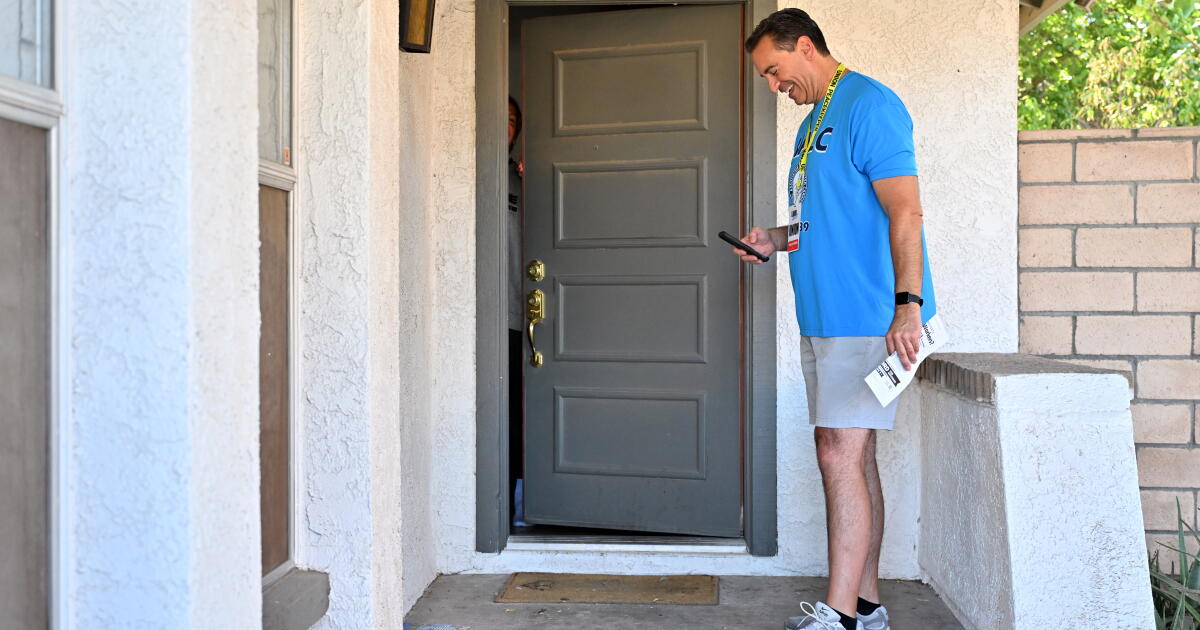
Paul Peterman, president of the local chapter of the National Association of Letter Carriers, wearing a blue union T-shirt, a lanyard and shorts, walked to union households, carrying flyers supporting Lee and other Democrats. He asked a resident who he planned to vote for. “All Republican,” said the man, hidden behind his screen door. Peterman asked if he could leave a non-Republican flyer, and the man said, “No.”
“Sorry to bother you,” Peterman said as the door closed.
At the next door, the voter identified as an independent but said he’d vote for Lee. A voter at another house said who he plans to vote for was private. Nobody answered at the next few doors.
Peterman has been canvassing these neighborhoods for years, describing it as important union work.
“It sends a message that we’re all united, and you also need every hand on deck, too, to be successful in what you want to achieve,” Peterman said.
What happened to the future we were promised? The vision that grew out of the 1990s techno-utopianism, when the internet was still a place of freedom and experimentation. Where are the infinite possibilities the early years of the millennium afforded, when social media meant AOL Instant Messenger and GeoCities, when our cellphones were not yet smart, and when personal tech evoked whimsy and excitement rather than anxiety and dread?
On a recent night in L.A., that digital optimism still existed. Here, at a clothing store on La Brea Avenue in the Fairfax District, something that felt lost was rediscovered. People were huddling around to play 1999’s “Crazy Taxi” on a Sega Dreamcast, or 2005’s “Tekken 5” on a PlayStation 2. They were surfing a perfectly re-created Y2K-era internet, and navigating an early version of Apple’s Photo Booth to snap selfies with a first-generation iSight webcam.
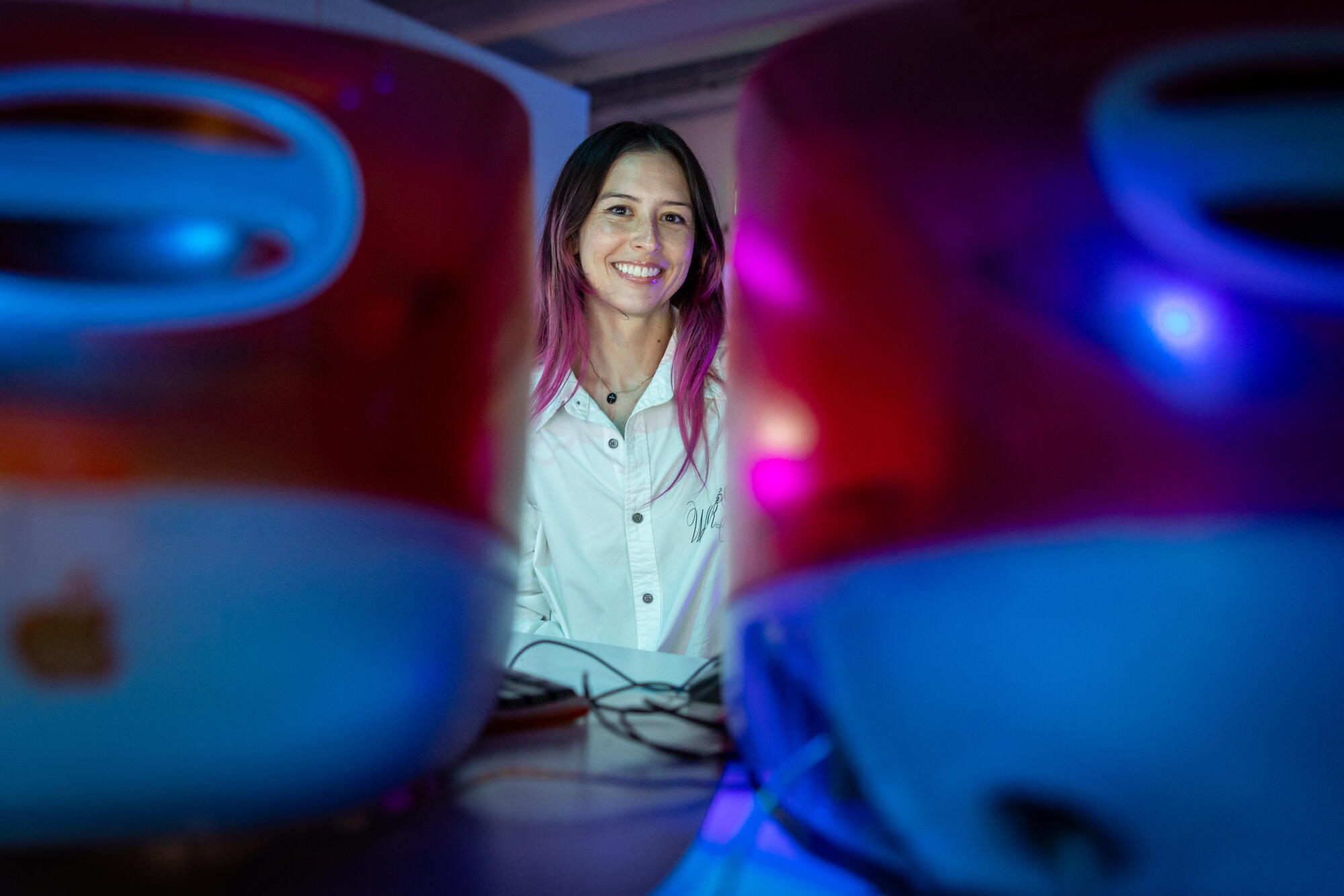
Paizley Lee created Dead Internet Theory to bring guests back to an era when tech evoked excitement rather than dread.
(Jason Armond / Los Angeles Times)
Yes, almost everyone was staring at screens, but almost no one was looking at their phone. Instead, the room felt alive and buzzing with energy. Technology was creating human connection rather than isolation.
Welcome to Dead Internet Theory, an event hosted by game designer Paizley Lee that’s both a celebration of vintage tech and a place to build community. The name is a tongue-in-cheek reference to the theory that the internet today is mostly bots, AI slop and corporate algorithms, while the human element is quickly disappearing from the web.
Lee started the event earlier this year after seeing how her friends reveled in hacking old hardware but had nowhere to show off their reimagined contraptions. She said Dead Internet Theory is a space to highlight “artists who don’t see the light of day,” a cyberpunk show-and-tell of sorts. “There’s a world of knowledge that comes from that person that can share and collaborate with another artist, and that’s really the future that we were promised, right then and there,” Lee said. “It’s the ‘Hey, look at what I made, look at what I’m interested in, and let’s share that.’ ”
Benjamin Palmer shows his project called Pan and Scan.
(Jason Armond / Los Angeles Times)
One of those artists sharing his work was Dan Ruth. Atop a low credenza, he displayed a black, leather suitcase that housed inside of it an old laptop attached to an external zip drive. On the laptop’s screen was a menu of various banned books — the Unabomber’s manifesto and “The Anarchist Cookbook” among them. Ruth had recently bought the trademark rights to the digital storage systems iOmega, Zip and Jaz. “They were what we all used in the ‘90s to transfer larger files,” he explained of the era before online storage and transfer infrastructure like Google Drive.
With his setup at the event, participants could choose whatever banned book they wanted and write it to a physical Zip disk (about the size of a saltine cracker) to keep forever. If Ruth’s installation is a bit provocative, his message is less controversial. At a time when servers are being shut down, physical media is being digitized out of existence, and the subscription model is supplanting personal ownership, Ruth believes this is a way to have data autonomy.
Guests play retro video games.
(Jason Armond / Los Angeles Times)
Lee’s own contribution to the evening is the full rainbow of Apple’s iMac G3 computers — those bubbly, teardrop-shaped desktops that debuted in 1998 to the famous “iCandy” ads displaying their colorful shells, and TV commercials scored to the Rolling Stones’ “She’s Like a Rainbow.” Over several months and multiple trips, Lee drove across the country collecting the G3s in their core five colors. And it wasn’t easy. She recalled sleeping in her car in the parking lot of a Cracker Barrel for a few nights because she had spent all her money on acquiring the computers.
It was the people Lee met in the months of gathering the G3s, however, that made it worth it: a single dad who collected vintage iMacs to bond with his son, an elementary school teacher who held onto the old computers because the school was going to destroy them.
“I met these really witchy, cool, queer programmers from MIT in Medford, Massachusetts, who invited me back for MIT Swap Fest, where I found Indigo,” said Lee, referring to another G3 color not part of the core five. “I met a guy who used to work in broadcast, and his wife just died of cancer. His mom moved in, and she has been trying to support him in getting rid of old things and not holding on to them too much.” Human moments made possible almost by the accident of holding onto a computer longer than most.
Lee’s pursuit of old tech hardware has always been, at its root, a means to meeting new people, hearing their stories and creating a relationship with them. “I care about people a lot,” she said. “I think every single person that touches any of my projects knows that I really care about people feeling good.”
Paizley Lee spent months collecting the full rainbow of iMac G3s.
(Jason Armond / Los Angeles Times)
With a mouse, Jaimie Wan clicks into the past.
(Jason Armond / Los Angeles Times)
When Lee finally acquired all five original colors (blueberry, strawberry, lime, tangerine and grape), plus all the additional colors (ruby, indigo, snow, graphite, sage and three limited edition colors), she began booting up the G3s computers to make sure they still worked. In the process, she discovered the forgotten digital detritus left on their hard drives: old resumes, photo albums, Word documents.
“It’s somebody’s life,” she said. “It feels weird to do anything with it, but it also feels weird to alter it.” In the end, she kept the old files and built a replica of the early ‘00s internet to live beside them on the computers. At Dead Internet Theory events, participants are given free reign to the G3s and slowly find clues Lee has left on their desktops that lead into a mystery game she created.
Back at the event, people flocked to the bank of iMac G3 computers. They clicked around, laughing, their eyes lighted up. “It’s really a trip seeing the old MacBooks,” said Shannon Stack after navigating one of the relics. “I remember having those in my elementary school classroom. Now, these are archival pieces. It’s freaky!”
Lee herself hovered around the computer bank, watching people interact with them and discovering the random documents left behind or playing one of Apple’s preset games. She asked a couple who had been tinkering around for over half-an-hour if they wanted a hint to her mystery. “No!” they respond excitedly.
While Dead Internet Theory has only been held in Los Angeles, Lee’s dream is to take it on the road. “I’ve got kids in Seattle, in Nashville, in Dallas that are emailing me and going, please bring it here,” she explained. The only thing stopping her was money, but that changed recently. A few weeks after the event on La Brea, she was approached by a sponsor. Now she’s making a tour happen, first with a pop-up event in New York City on Wednesday.
The event has become a place to gather and build community.
(Jason Armond / Los Angeles Times)
Recently, as Lee began driving across the country to set up, she stopped at a bed and breakfast near Red Lodge, Mont. When she learned the innkeeper had an old blueberry iMac G3 in her basement, she asked to take a look.
“I spent an hour getting her back on,” Lee said of rebooting the machine to give the innkeeper access. “And the face she made when it came back to life — literally priceless.”
The woman browsed through old photos of her daughters, their old school projects and other files forgotten over time. Afterward, the innkeeper gave Lee the computer, telling her it deserves a second life.
KATIE Price has revealed why she’s still wearing her engagement ring from conman ex-husband Lee Andrews despite their split – and if she’s spoken to him since her bombshell Good Morning Britain appearance this week.
Katie revealed she’s still wearing her engagement ring but on the other handCredit: YouTube/The Katie Price ShowThis week Lee insisted ‘there’s been no wool pulled over anyone’s eyes’ despite all of his liesCredit: mistraesthetics/Instagram
On the latest episode of her podcast The Katie Price Show, Katie held up her hand to sister Sophie, 36, and said: “I’m still wearing my ring but on the other hand because I love the ring.
“I’ve taken Lee out of [my Instagram] bio now. Enough is enough now, it gets to a point where you can tolerate so much…
Sign up for the Showbiz newsletter
Thank you!
“I did what I had to do. It doesn’t matter what people say about whoever I’m with. I have to do what I need to do.
“If there are things that I question, that’s for me to find out myself to make my decision. Things haven’t added up and I’m not happy about them. He is still in prison and I haven’t spoken to him.”
This week Katie rolled her eyes as a voice note from Lee was played on Good Morning BritainCredit: UnknownBut Katie confessed she still loves Lee and believes he loves her tooCredit: Unknown
“I love the man I met. I can’t take it. I was stupid to fall for him. It’s really sad.”
Katie also admitted she believes her ex loves her too, saying: “I do believe he did.
“I think he’s got himself in such a situation… where he copy and pastes what he says to women… I do believe he’s fallen for me.”
Katie then revealed the signs that finally made her open her eyes.
She said: “For example, one of the rings he bought me he said was worth £72,000. So I thought I’d better get it insured.
“So I took it into a shop and got it cleaned to get it insured. When they gave it back to me I said, ‘How nice are the diamonds?’
“They said, ‘They’re really good lab diamonds. They were grown in a lab. The ring is probably only worth about five grand’. Do you know how embarrassed I was?”
VENICE, Italy — “My actual personality is not very friendly, I’m afraid,” claims Korean actor Jeon Do-yeon. “Myself and actor Sul Kyung-gu, we can be a little bit brusque. We don’t really have the talent to make the set fun.”
As she says it, though, Jeon and co-star Cho Yeo-jeong are laughing — making the assertion rather harder to believe when it arrives in English from Korean via an interpreter. Throughout our conversation, in fact, the pair chuckles, nods along to each other’s answers, interjects sounds of assent. Enough for me to understand that their chemistry comes naturally, whatever Jeon’s protestations.
“In the film I play a character that chases [Jeon’s character] and it really suited me, almost to the point where I didn’t really need to try and act this role,” as Cho puts it. “I was almost like a sunflower, constantly facing and chasing actor Jeon.”
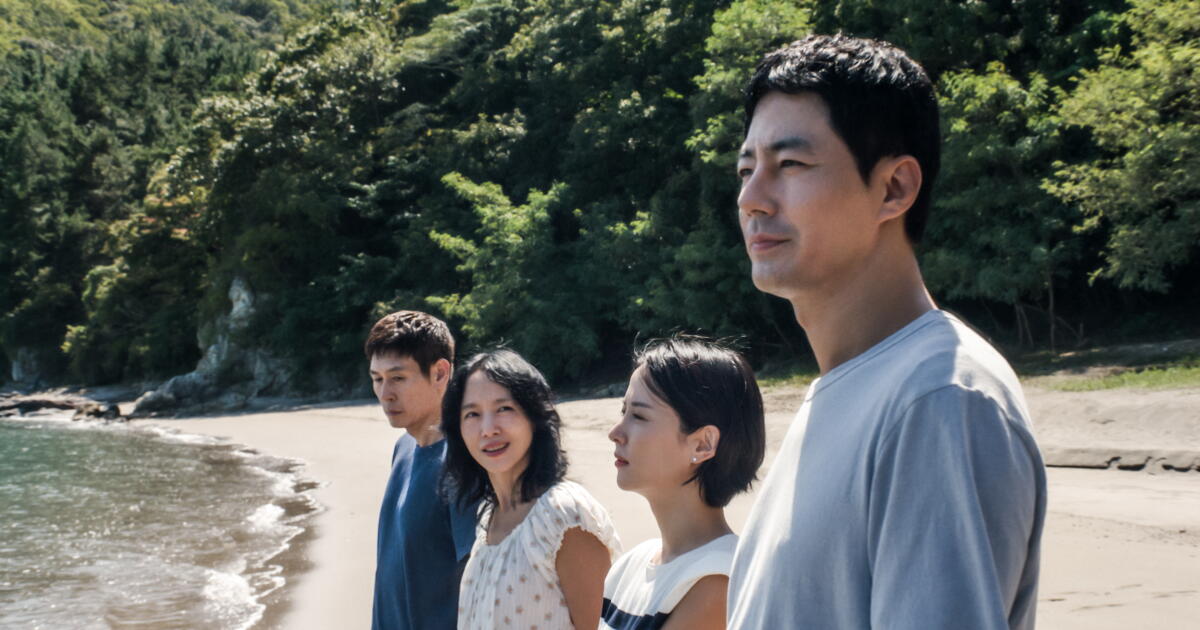
The actors needed every ounce of the sublime chemistry they forged to portray the magnetic but fatally flawed relationship at the heart of auteur Lee Chang-dong’s first film in eight years, “Possible Love,” which premiered Sunday at the Venice Film Festival. South Korea’s international feature submission for the 2027 Oscars, the Netflix film sees Ye-ji (Cho), a documentarian married to a wealthy businessman (Zo In-sung), cozy up to Mi-ok (Jeon), whose husband (Sul) has been seriously injured in a brutal crackdown on striking factory workers, in order to secure an interview with him — only for divisions of class and professional ambition to expose the fault lines in their relationship, and in turn their marriages.
“It seems like they want to be friends with each other, but then there seems to be a line that just cannot be crossed between them,” says Lee, also through an interpreter, of the actors’ accomplished double act, referring to a scene in which Ye-ji bristles at Mi-ok’s suggestion that her high-end clothes are out of place interviewing unemployed laborers. “[Jeon and Cho] knew of that and they went into shooting that scene knowing that it was quite challenging to express. There were, of course, some things that were up to the camera in bringing that about, but I think that was a scene where the two were able to express just how nuanced and quite strange the relationship can be.”
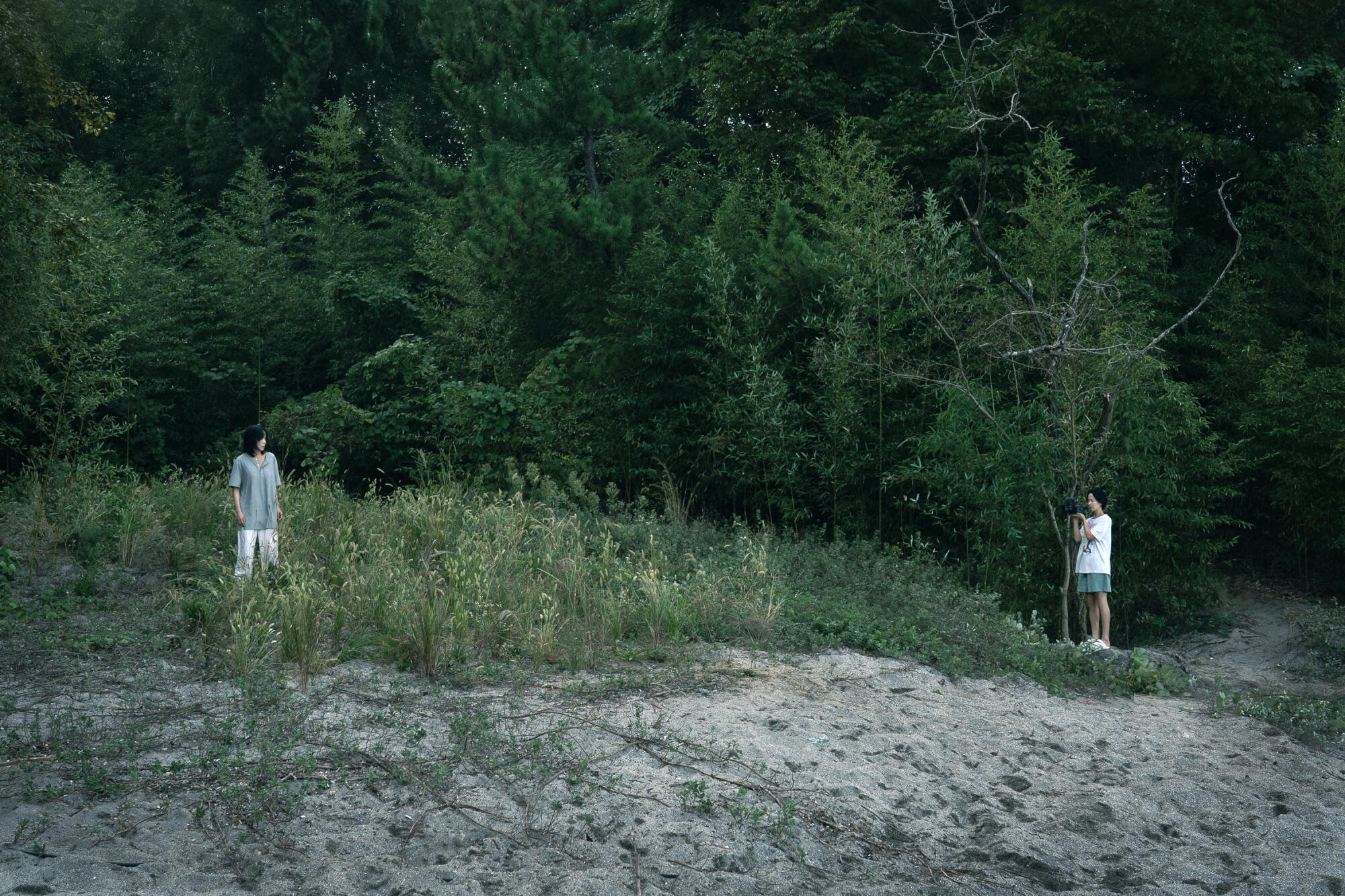
The film itself is just as slippery and multi-layered, down to Lee’s heady admixture of documentary and dramatic aesthetics. Inspired by real-life labor conflict in South Korea, “Possible Love” uses Ye-ji’s nonfiction study of laid-off workers as a window into the lives of ordinary people swept up in large-scale social change, against the backdrop of which the two women’s competing priorities are thrown into stark relief. Can a filmmaker who totes a $4,000 Lora Piana backpack, however well-intentioned, truly understand the plight of the working class? Is a subject eager to publicize a political struggle prepared for the risk that her personal privacy will be invaded in the process?
To choreograph the film within the film — so compelling that I almost missed seeing its conclusion when “Possible Love” shifts the focus to interpersonal fireworks in the third hour — Lee cast a real-life documentary director and cinematographer as Ye-ji’s crew, lending what Cho calls their “natural energy” to the movements of the camera. Cho herself prepared by consulting the late master of the form, Frederick Wiseman, who was unabashed about the tension between documentary filmaking’s often radical politics and the privilege required to turn it into a profession.
“[Wiseman] was posed the question by some students studying film and documentary: ‘How can I pursue this work in reality?’” she recalls. “And he replied with the immortal words, ‘Marry a rich man.’ And you know, I was preparing for the role of Ye-ji, so it was such an apt response for her situation.”
Jeon, left, and Cho in “Possible Love.”
(Joo Jae-bum/Netflix)
The potential for conflict bursts into the open at a seaside home that has been in Ye-ji’s husband’s family for years, where the group has decamped for a supposedly restorative holiday. Reminded of the setting by the location of our conversation — a set of green-curtained, pink-carpeted suites at the Hotel Excelsior, overlooking the northern shores of the Adriatic — I ask the actors what’s going through their characters’ minds when Mi-ok and Ye-ji’s promising connection ultimately severs.
Mi-ok “doesn’t really want to reveal to anyone else what’s going on in the family … She only wants to show the good side that they are trying to live their best life and trying to improve and move forward with hopefulness,” Jeon says, citing an early scene in which Mi-ok asks the crew not to film her son’s awkward taekwondo at a school field day. When the camera’s prying eye becomes more intrusive, though, she “feels a great sense of betrayal, that her family is being used and exploited.”
For Cho, who says Ye-ji is “constantly balancing the ethical dilemma” between documenting the truth and treating her subjects with care, the break was always inevitable, and no amount of Ye-ji’s remorse or guilt can repair the damage.
Against this microcosm of the class war Lee sets the emergence of artificial intelligence, which threatens to further destabilize labor across a range of industries — including his own. Although he’s uncertain if, when or how AI will “intrude” on the “entirely creative” filmmaking process, the “Poetry” and “Burning” director is already using it for everyday tasks.
“Before going to see the doctor, I like to ask AI all the symptoms that I have, ask what’s wrong with me. Or I would ask, you know, ‘What’s the weather like in Venice?’” he says. “AI gives us instant answers, and it goes even beyond that to where it gives you advice these days. And in that sense, AI has indeed really gotten deeply intertwined in my daily life.”
Similarly, Jeon is open to using AI for more “trivial” matters, such as simultaneous translation from English to Korean and vice versa. But she admits to more “extreme thoughts” than Lee about the technology’s role in the future of screen acting.
“I’m going to be starring in a [Korean-language adaptation] of Anton Chekov’s “The Cherry Orchard” upcoming in New York. And I was wondering, actually, is the stage the last place that cannot be conquered by AI, and will not be replaced by AI?”
Perhaps. But the scene in “Possible Love” that best captures the finely honed chemistry of its female leads, in which Mi-ok and Ye-ji drunkenly bond over soju and Korean barbecue as their bemused husbands look on, seems to me beyond the capabilities of AI — it’s too warm, too meticulously rendered to be anything other than fully human, the sort of acting one hopes the Venice jury will remember when it hands out the Volpi Cup for best actress on Saturday.
“It is quite difficult technically and practically — it was a scene that we shot all night long,” Cho says. “But I remember shooting it with a lot of pleasure.”