lauer

Dodgers drop sixth straight game, also lose Dalton Rushing to UCL tear

The Dodgers ended up with an acute need at the trade deadline after all.

Catcher Dalton Rushing’s elbow injury was diagnosed as a partial tear of his ulnar collateral ligament, as manager Dave Roberts first told AM 570’s David Vassegh.

“It’s a bummer because he has made a lot of strides,” Roberts said before the Dodgers’ 7-6 loss to the Cubs on Wednesday, which extended the Dodgers’ season-high losing streak to six games. “Even just this right here, you’re talking about over 125 plate appearances that you’re missing out on, and also opportunities to catch major league innings. So I feel for Dalton.”

He’ll be shut down from throwing for four to six weeks, Roberts said. But the plan is for him to resume hitting before then. Asked if Rushing could catch again this season, Roberts said he believed there was a “very small” chance.

“I hope I’m wrong,” Roberts said. “He’s a tough kid, and so for him to go through this speaks a lot. So I think that would be great if he can. Certainly a possibility with the time, but we’re certainly trying to keep the bat alive, for sure.”

Even if Rushing doesn’t return behind the plate, his left-handed bat off the bench could be valuable for the Dodgers down the stretch and even into the postseason. As constructed, the Dodgers don’t have an equivalent for pinch-hitting situations.

Next, Rushing, in conversation with the team and medical staff, will have to decide whether he needs to undergo surgery to repair the ligament. He did not make the trip to Chicago, so he was not available to comment on the situation.

“Over the next couple weeks, I think that we’ll have a better idea of how he’s responding with time,” Roberts said. “I do think that there’s really not much cost, outside of two weeks or whatever, to kind of wait and see how he responds to some treatment and some kind of stuff that they decide to do.”

Depending on the severity of a partial UCL tear, rehab and strengthening the muscles around the elbow can sometimes at least put off surgery. If that’s not a viable option, there are a range of operations to address UCL injuries — from reinforcement with an internal brace, to full reconstruction (Tommy John surgery).

Elbow surgeries tend to come with a lengthy recovery timeline. So, even if surgery becomes inevitable, as long as Rushing can hit and the Dodgers think he can contribute off the bench into the postseason, holding off any operation until the offseason could make sense.

Rushing’s injury will impact not only the catching corps but also the offense, necessitating a shift to defense-first catchers.

Taking on starting catcher duties for nearly two months with Will Smith (neck) on the injured list, Rushing had an .809 OPS when the Dodgers scratched him from the game Sunday with what they initially called minor arm irritation.

“I think that it was something that was there, and then it just showed itself Sunday,” Roberts said.

Though Smith has been at least hitting in the batting cages, he’s had a back-and-forth recovery from an injury the Dodgers initially hoped wouldn’t need an IL stint.

“Everything keeps moving forward, which is a good thing,” Roberts said. “There’s no timeline as far as when he faces pitching, let alone when he goes out on a [minor-leauge rehab assignment]. Then we’ll have more clarity on a projected date of return, but right now I don’t know.”

So, the Dodgers acquired an entirely new catching tandem before the trade deadline Monday. On Tuesday, they activated Ben Rortvedt and Hunter Feduccia, both catchers who have played for the Dodgers in recent years. They optioned Eliezer Alfonzo and designated Chuckie Robonson for assignment.

Rortvedt, who Roberts said could get the “taking a lion’s share for the foreseeable future,” caught two-time Cy Young winner Tarik Skubal in his Dodgers debut Tuesday. Feduccia caught Lauer on Wednesday.

Lauer gave up six runs and 11 hits to the Cubs and lasted just four innings, in his worst appearance as a Dodger. Wednesday marked the Dodgers’ first loss with Lauer on the mound, snapping a streak of nine games.

The Cubs completed a three-game sweep, during which the Dodgers were outscored 22-12. They’ve been swept for two straight series, also dropping all three home games to the Red Sox last weekend. The Dodgers were last swept in consecutive series last year, getting swept by the Houston Astros and Milwaukee Brewers July 4-9.

MVP standoff between Ohtani, Crow-Armstrong

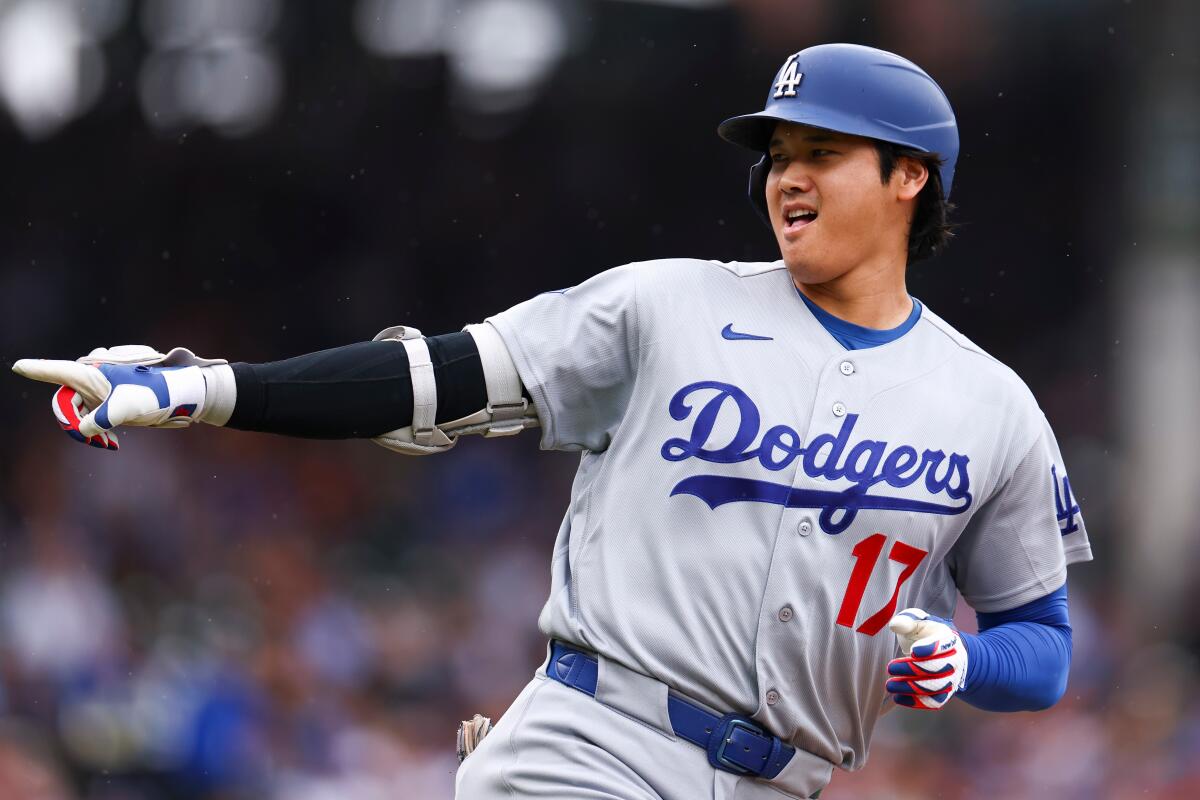
Dodgers designated hitter Shohei Ohtani gestures towards the dugout after hitting a home run to lead off Wednesday's game.

Dodgers designated hitter Shohei Ohtani gestures towards the dugout after hitting a home run to lead off Wednesday’s game.

(Jessie Alcheh / Associated Press)

The frontrunners in the National League MVP race traded leadoff home runs at Wrigley Field Wednesday.

First was Dodgers two-way superstar Shohei Ohtani, who notched the 32nd leadoff homer of his career and 29th as a Dodger, breaking a tie with Davey Lopes for the second-most in franchise history, behind Mookie Betts (32). And he made it his first multi-homer game of the season in the eighth inning, with a two-run shot that trimmed the Cubs’ lead to 7-6.

Cubs star center fielder Pete Crow-Armstrong matched him with a tying blast in the bottom of the first inning. In the fourth, he mashed a two-run blast off the right-field scoreboard for his third multi-homer game of the season.

Roberts irked Cubs fans a week and a half ago when, asked to evaluate Ohtani’s season overall, he said he’ll still be the NL MVP.

“I haven’t followed the race,” Roberts said. “I have followed what Pete’s doing, and he’s figured some things out with the bat. “He’s having a heck of a year. And he has rightfully made it a lot closer than most people expected. He’s had a tremendous season.”

Ohtani was considered the runaway MVP favorite early in the year, while his pitching performance also put him in the Cy Young conversation. But his extended absence from the mound (left knee issue) and Crow-Armstrong’s contributions on offense and defense have made the race more interesting.

Crow-Armstrong entered Wednesday leading the majors in fWAR (7.5), followed by Ohtani (6.4).

Ohtani is expected to begin playing catch in the near future, but Roberts didn’t have a specific day circled for catch play or his return to the mound.

The Dodgers’ rotation depth means he doesn’t necessarily need to build up to a full starter’s workload by the end of the year.

“Any innings we get from him are bonuses, given he’s a two-way player,” Roberts said. “Whether it’s one inning, two innings, three innings, I’m not too concerned about the timeline. … I certainly see him as a starter, but how much he could give us, to then have somebody [piggybacking] behind him, that we don’t know yet.”

Source link

Why an MLB salary cap wouldn’t stop the Dodgers from winning

The Dodgers won the World Series last year, and the year before that. Their lead is the largest in any division this year. That success, and the money that nourishes it, has battalions of fans beyond Los Angeles all but marching outside ballparks with picket signs reading “SALARY CAP NOW.”

It’s a reasonable thought: The Dodgers can’t possibly keep winning if they can’t keep outspending the competition.

Or can they?

“There are a lot of little things that happen behind the scenes that people don’t see,” pitcher Will Klein said. “I understand where people are coming from. It’s easy to be a fan of a smaller team and get mad at other teams outspending you.

“But I think there’s a level of care here, and wanting to win, that exceeds other groups.”

The obvious disclaimer: Any team would be better with Shohei Ohtani and Freddie Freeman and Mookie Betts and Yoshinobu Yamamoto, at a combined price of $1.6 billion. The counter argument: The Angels had Ohtani and Mike Trout and, well, you know.

It takes a roster. In Klein and pitcher Eric Lauer, the Dodgers have done something they do well besides spend: develop valuable contributors out of players discarded by other teams.

The Dodgers grabbed Lauer last month, desperate to fill a hole in their starting rotation. The Toronto Blue Jays had cut him, and he would be joining his seventh major league organization. The logical thought: The Dodgers had found a healthy arm to eat up some innings until they could find someone better.

That still might happen. But Lauer, who is set to pitch Monday, has put up a 3.22 earned-run average in four starts with the Dodgers. Four starts is a small sample size, but in that time, Lauer is a career league-average pitcher performing 28% above league average.

“They got me immediately,” Lauer said. “They figured me out right away, and they knew exactly what was going to help me.”

For Lauer, the changes affected his delivery, but the specifics were not as important as finding a kindred spirit in Connor McGuiness, the Dodgers’ assistant pitching coach.

“I’ve always had a really hard time explaining myself and what I do, because I think a little differently,” Lauer said.

“When I was with the Brewers, it was running joke that it was ‘the language of Lauer,’ because I would describe things so differently and feel things so differently that, if you weren’t close to me and you didn’t know how I operate, it was very hard to understand what I was trying to do.

“Connor just immediately got it. It was like he’s been speaking it forever.”

At one point in his career, Lauer said, he struggled to explain the sensation of catching his heel on the mound as he completed his delivery toward home plate.

“I would describe it as, ‘I was falling backwards and I would catch myself,’ and it’s a really weird concept to think somebody was falling backwards when it doesn’t look like you’re falling at all,” he said. “It looks like you’re just moving forward.

“So they were like, ‘That’s not what you’re doing’ and I was like, ‘That’s what I’m feeling.’ We have to make the connection between the feel and the real so that we can understand each other.”

“I have a hard time saying anybody has done a better or faster job of helping me than the Dodgers.”

— Eric Lauer, Dodgers pitcher, on his development with the team

Klein, who joined his fourth organization when the Dodgers acquired him in a minor league trade last June, is in his first full major league season. He has a 2.37 ERA, and his 0.7 wins above replacement is better than any Dodgers reliever besides veteran closer Tanner Scott.

Klein said other teams had made suggestions on how to improve his game, and with the Dodgers, he has added a sweeper and dumped a slider. But what he needed to do most was throw more strikes, trusting that his lively fastball and curve were good enough to beat the best players in the world.

In the minors, Klein issued 6.9 walks per nine innings. This season, he has issued 3.6 walks per nine innings.

The credit, he said, should be shared with the Dodgers’ mental skills coaches.

“It’s easy to see the guys in the batter’s box — especially when you come up watching baseball and being fans of these guys, it’s easy to see them being above yourself,” Klein said.

“But you’re on the mound with them, so you have to see that too. There’s a lot on the mental side that’s helped me here.”

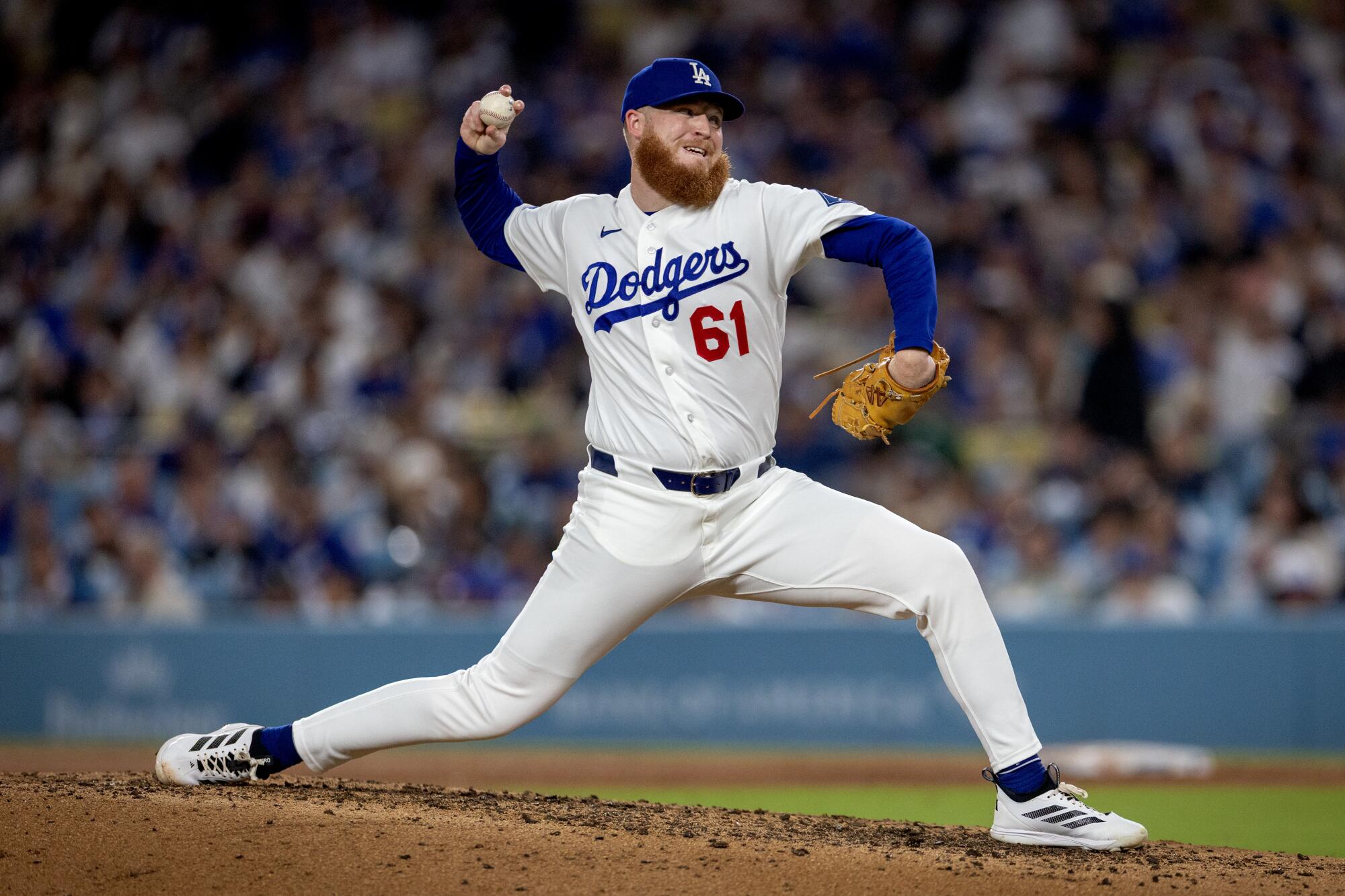
Dodgers pitcher Will Klein delivers against the Tampa Bay Rays at Dodger Stadium on June 16.

Dodgers pitcher Will Klein delivers against the Tampa Bay Rays at Dodger Stadium on June 16.

(Eric Thayer / Los Angeles Times)

The Dodgers did not include Klein on their postseason roster for the first three rounds last year, but he said coaches at all levels — in the majors, at triple-A and at the Arizona training complex — never stopped checking in on him, during the season and throughout October.

“When you’re down there, they don’t forget about you up here,” he said. “That kind of commitment and care was levels above what I had experienced.”

When the Dodgers added him to the World Series roster, Klein saved the season, with four scoreless innings to close out an 18-inning victory in Game 3.

Lauer called the communication in the Dodgers’ organization “miles ahead” of any other organization in which he has played.

“The training room, the weight room, the coaching staff, the players to each other,” he said. “Every form of communication is so seamless. Everybody knows what’s going on all the time. There’s no gray area.

“It’s all: ‘This is the plan, this is what we want to happen, this is how we’re going to make it happen,’ instead of: ‘This is the plan, this is what we want to happen, figure out a way to make it happen.’”

Klein raved about how the Dodgers treat player families, and about a high-tech pitching machine so lifelike that he could see what it would be like to bat against him. Lauer reflected on his experience as a first-round pick turned journeyman who went to South Korea to revive his career.

“I have a hard time saying anybody has done a better or faster job of helping me than the Dodgers,” Lauer said.

What Lauer and Klein say substantially echoes what Dodgers president of baseball operations Andrew Friedman said at last year’s World Series about turning the team into a preferred destination for players, and not just because the team wins and spends.

“Communication, being honest, having a really strong player development group in place at the major-league level, and how you treat families and treat the players,” Friedman said then, “I think matters a lot in that.”

To be clear: There is no indication the players’ union is willing to consider, let alone approve, a salary cap.

But, if that were to happen, Klein believes the Dodgers would be just fine.

“Our owners want to win, so they want to get the best product on the field, so they go and spend money,” he said, “and then everyone is mad that they want to win.

“I think they’ll find ways to win more if they can’t spend as much money. Friedman was with the Rays when they weren’t spending as much money and still had success there.

“I think they’re just better at wanting to win than some other people.”

Source link

Miguel Rojas’ homer propels Dodgers to series-opening win over Rays

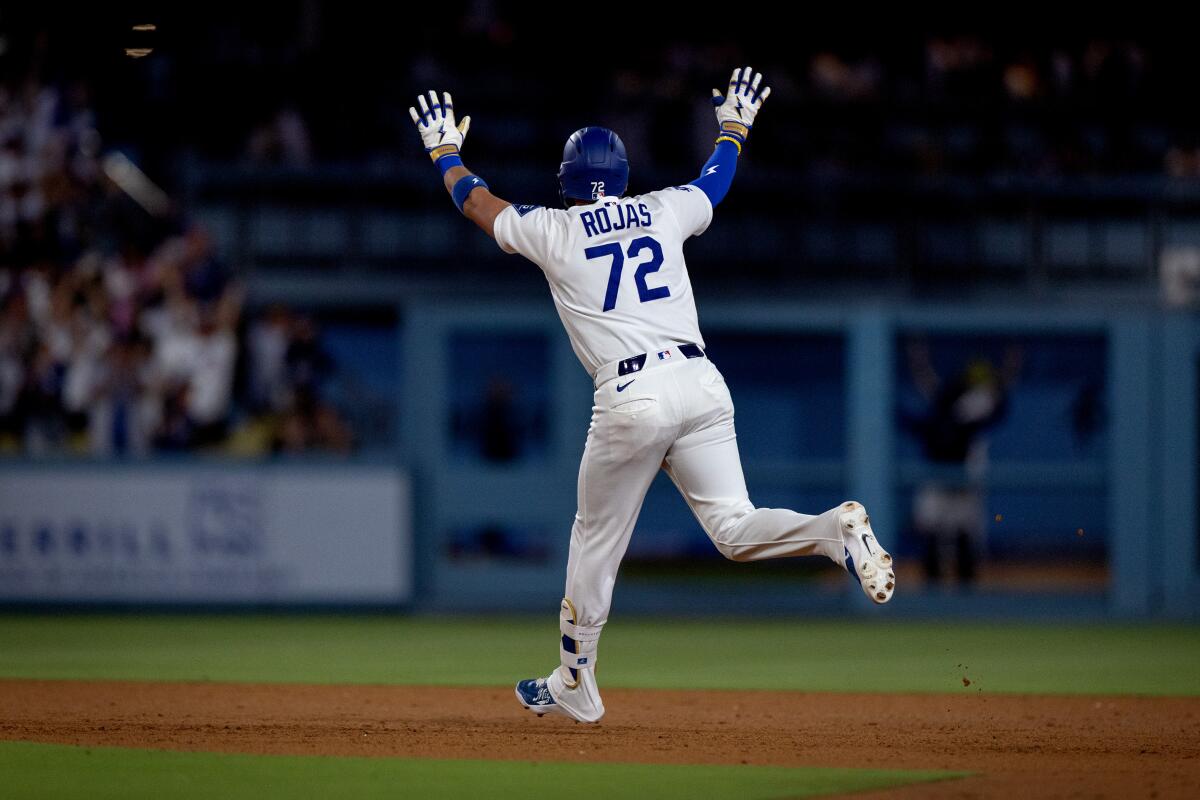
Miguel Rojas had practiced his dance moves in the Dodgers dugout Monday, long before he hit the go-ahead home run. Before the game, he strutted around, at one point even grabbing Dalton Rushing, decked in full catcher’s gear, to get hyped.

Rojas, who pinch-hit for Alex Freeland in the bottom of the seventh and homered to center, was more measured as he crossed the plate without any antics. His veteran steadiness never indicated that he‘d hit a pinch-hit home run only one other time in his career.

The Dodgers’ 4-3 win over Tampa Bay rid them of their middling road performance. The team split a six-game trip, capped by a Sunday loss to the Chicago White Sox, before returning home.

No one found more immediate success than Kyle Tucker, who temporarily put his .227 batting average on the trip in the rearview mirror. For how long remains a question. Tucker’s season so far has looked more like a teenager testing out their driver’s license: stopping and starting and stopping again. Yet everything seemed to be working when the Dodgers (46-27) beat the Rays (41-28).

Of the five Dodgers who’ve played at least 60 games, Tucker has the lowest batting average (.238). Still, he battled in an eight-pitch duel in the second inning before taking a changeup 384 feet over the wall in right-center. His home run tied the score at three apiece, and Tucker wasn’t finished.

The next inning, the Rays’ Ben Williamson hit a two-out single to Tucker in right field, and Tampa’s Jonathan Aranda darted around third toward home. Tucker lasered a ball to Rushing, who tagged Aranda out on the slide.

Miguel Rojas acknowledges the bullpen after homering in the seventh inning.

Miguel Rojas acknowledges the bullpen after homering in the seventh inning.

(Eric Thayer / Los Angeles Times)

The defensive play helped buoy an otherwise precarious start by pitcher Eric Lauer. The left-hander had been undefeated in three starts with the Dodgers, a large departure from the 1-5 record he had with the Toronto Blue Jays. After starting his year with a 6.69 ERA, Lauer had dropped it to 2.76 with the Dodgers.

But inconsistencies plagued Lauer’s start, ranging from the three earned runs he gave up in the first two innings to a pitch clock violation in the fourth. While Lauer eventually settled, the command of his fastball remained absent. He normally crosses the strike zone with 53.7% accuracy on his fastball, getting batters to chase about 37% of the time. In the series opener, Lauer threw his four-seamer in the zone only 42% of the time, cutting his chase rate to 23%.

In other words, the best pitch in Lauer’s arsenal became one of his worst, and the Rays took advantage. Junior Caminero doubled in the first inning, and Ryan Vilade followed with a home run on a cutter, silencing a sold-out Dodger Stadium before the game could even heat up. The Rays tacked on another run on a safety squeeze, taking the lead until Tucker’s home run. Lauer finished after six innings, giving up the three earned runs on six hits and three walks, striking out four.

Tampa Bay starter Nick Martinez fared about as well. The right-hander lasted 5-1/3 innings of three-run baseball, striking out six and walking one.

While there was movement on the bases for both starters, the game lulled until the seventh. A couple of feet separated Rushing’s foul ball from a home run. Reliever Steven Matz didn’t get so lucky with Rojas, who delivered his first homer since April 20.

Source link

Tanner Scott bounces back to save Dodgers’ win over Diamondbacks

The Dodgers had managed to cling to their lead over the Diamondbacks despite the comeback attempt the home team had mounted in the late innings.

Now it was up to left-hander Tanner Scott, coming off his first blown save of the season, to finish the job.

With the would-be tying run standing on first base and one out, Scott crashed hard on Geraldo Perdomo’s sacrifice bunt and zipped a throw across the diamond just in time for the out.

Then to tie a bow on the outing, Scott got Pavin Smith to lunge after an outside slider and ground into the final out of the game.

“It was good to see,” manager Dave Roberts said after the Dodgers’ 6-5 win Tuesday. I thought from pitch one he was pitching with a purpose. Obviously there was no margin with a one-run lead. I just liked the way he was going after those guys.”

Though the Dodgers led for the game from Freddie Freeman’s first-inning homer on, it was a nail-biter. The Diamondbacks rallied against a Dodgers bullpen that had been practically flawless for weeks. Roberts made five pitching changes. But with an offensive bounce-back and strong pitching performances on the front and back end, the Dodgers evened the series at Chase Field.

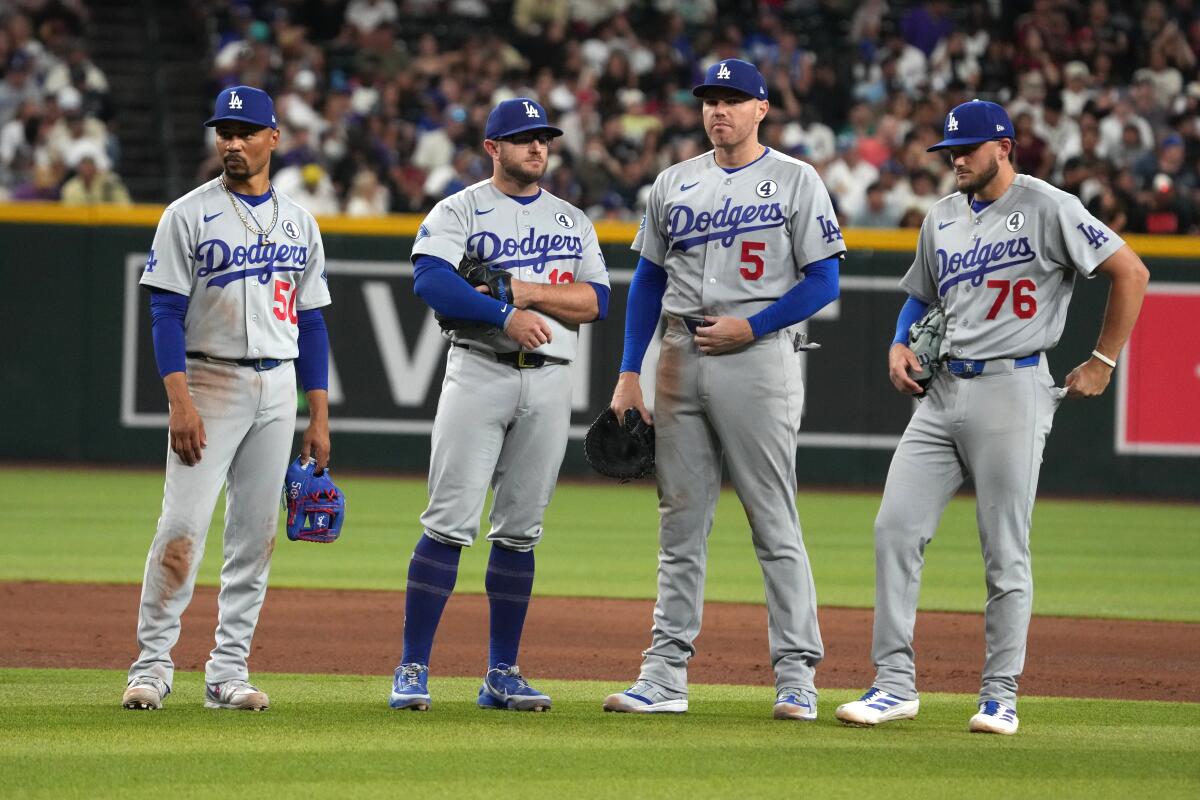
Mookie Betts, from left, Max Muncy, Freddie Freeman and Alex Freeland await the pitcher.

Mookie Betts, from left, Max Muncy, Freddie Freeman and Alex Freeland await the pitcher.

(Rick Scuteri / Associated Press)

“It’s nice after only scoring one [Monday] to get out and get some runs early on the board,” said Freeman, who led the team with three hits. “Four runs in the first couple innings, you would hope you keep going. But two in the middle innings there was good enough. Pitching was good again. Got a little hairy at the end, but luckily pulled it off.”

Freeman and Ohtani teamed up to give the Dodgers that four-run lead against Diamondbacks starter Michael Soroka in the first two innings.

A double from Ohtani preceded Freeman’s first-inning blast. Then the next inning, Dalton Rushing and Alex Freeland’s back-to-back singles set up Ohtani to score them both when he lined a triple into the right-field corner.

Dodgers starter Eric Lauer, making his second start since the trade that brought him over from the Blue Jays, tossed two scoreless frames to maintain that lead.

In the third, however, Diamondbacks star Corbin Carroll sent a cutter the other way, and it bounced off the top of the left-field wall into the home bullpen for Arizona’s first run of the night.

Lauer relied on soft contact to throw a scoreless fourth inning, but he ran into some trouble in the fifth, with back-to-back singles, a sacrifice fly, a disengagement violation and PitchCom issues.

In a two-run game, Roberts pulled the plug before Lauer could face right-handed No. 3 hitter Gabriel Moreno for a third time, even though Lauer had set him down twice. Lauer’s pitch count was only up to 70, after giving up five hits in 4 ⅔ innings.

“I thought I could have tried to convince him on the mound [to let me stay in], but he kind of stuck his hand out right away, so I didn’t have a huge chance there,” Lauer said. “But afterwards, we talked, and he explained his thought process to me and just reiterated his thoughts, and I agreed. And I think that’s huge, just to be able to have that conversation.”

Lauer did have an inkling, however, that he wasn’t going to be in the game too much longer with Nolan Arenado on deck. Arenado entered Tuesday with eight hits off Lauer in 27 at-bats (.296 batting average). Half of them were homers.

“We’re still learning each other, so it’s just making sure that [he knows] I do believe in him,” Roberts said of their conversation. “If I’m not going to let him go through Arenado right there, I felt it would give Blake the best chance to get us out of that inning in a tight ball game.

“I don’t want him looking over his shoulder. I pushed him in his first start, didn’t push him this start, because he was really good for us. And I just don’t want anything lost in translation or the assumption game. So I just wanted to kind of be forthright.”

Shohei Ohtani reacts after scoring on a single by Mookie Betts in the seventh inning,

Shohei Ohtani reacts after scoring on a single by Mookie Betts in the seventh inning,

(Rick Scuteri / AP)

Roberts turned to right-handed reliever Blake Treinen, who walked Moreno but got out of the inning by inducing Arenado to fly out to left field. Rookie Ryan Ward, in his fourth major league game, made the sliding catch.

The Dodgers (39-22) added insurance in the seventh, manufacturing the first with a double from Dalton Rushing, sacrifice bunt from Alex Freeland, an intentional walk to Ohtani, and sacrifice fly from Andy Pages. Back-to-back singles from Freedman and Betts pushed across a second run.

The Diamondbacks countered. And for the first time, the Dodgers’ lead looked like it was in danger.

Dodgers reliever Kyle Hurt’s command was shaky from the start. And his two walks with less than two out in the seventh came back to haunt him, as both baserunners scored on Arenado’s double off the wall. Ward bobbled the ball as he picked it up for the relay home and a close play at the plate for the second run.

Hurt issued a third walk, a season high, before fellow right-hander Will Klein replaced him.

Pinch-hitter Geraldo Perdomo shot a line-drive single off Klein into shallow left field, loading the bases. Klein walked in a run, which trimmed the Dodgers’ lead to 6-5.

A broken-bat grounder to the right side of the infield, hunted down by Freeman ranging to his backhand side from first base, ended the inning.

Infield defense again got Klein out of a jam in the eighth, turning a double play after back-to-back singles to maintain the lead.

“They’re not going to be clean every time out there,” Roberts said of Hurt and Klein, two relievers he’s trusted in high-leverage situations this year. “They’ve both been very good for us. You’ve got to give those guys credit today, the Diamondbacks. They spoiled some pitches. They hit to the opposite field. They battled tonight.”

Scott (2.10 ERA) took over in the ninth, in his first appearance since Saturday, when he broke a streak of 12 appearances without giving up a run. His wife Maddie posted screenshots of the death threats their family received via social media in the aftermath.

On Tuesday, Scott retired three of the four batters he faced, with only a well-placed single through the right side of the field — a “soft-serve hit, as Roberts put it” — marring the outing.

Said Roberts: “Outside of that, he was really sharp tonight.”

Source link