
last

‘Jackass: Best and Last’ review: The old men and a sea of pain

The best weapon in the “Jackass’” arsenal isn’t the taser, the beehive or the booby-trapped latrine. It’s the explosion of relief when a prank ends, often in humiliation, always with hoots and claps. The first film, 2002’s “Jackass: The Movie” was slow to discover that carnage without camaraderie is painful; several injuries limped off-screen in horrified silence. Laughter heals, except for the brain hemorrhage that Johnny Knoxville suffered in 2022’s “Jackass Forever” when, dissatisfied by the clobbering he took from a bull, requested a second ramming that knocked him out cold.

Hence “Jackass: Best and Last,” the goon squad’s alleged final film, is underwhelmingly tame. Shot quickly by stalwart director Jeff Tremaine this spring, half of it is a clip reel of past hits, like the time fan favorite Steve-O slingshotted into the sky in a port-a-potty. The rest is scraps of hastily assembled chaos, the most elaborate of which is a puppet show in which veterans Ehren McGhehey, Dave England and Jason “Wee Man” Acuña dangle helplessly from strings, trying to recite cue cards while being pummeled by tropical fruit. “A pineapple!” Wee Man moans.

I’m no sadist. They’ve suffered plenty for our amusement. Still, it’s a shame that for the first time in two and a half decades of cringe comedy, the guffaws feel forced.

Acknowledging the Jackasses’ age, if not maturity, are a couple skits about prostate and rectal checkups. (The gnarliest involves clear pants, colonoscopy prep liquid and a game of Twister.) Modern technology enters the arena with a nimble-fingered robot. If the team had invested any actual energy into brainstorming this entry, they’d have played paintball with a sniper drone. At least for the sake of torch-passing, someone should have thought of something for the newish members introduced in “Jackass Forever” to do besides stand around and applaud.

These fresher faces — Jasper Dolphin, Rachel Wolfson, Zach Holmes — prove brave and resilient when allowed to participate. Only one of them, Sean “Poopies” McInerney, a surf bro so gullible that I’m not sure he’s capable of informed legal consent, fits into “Best and Last” like a well-worn punching bag. (When Poopies yelps that “my mind is getting to me” while wearing a shock collar around a sensitive area, people snort because, as sweet as he seems, the only thing rattling inside his cranium is a moth.) Early on, Poopies gets swollen lip injections that, someone claims, will last the whole movie. You expect his trophy wife pout to be a running sight gag. But his disfigurement never even gets another closeup.

“Jackass” started with a bang. In January of 1998, Knoxville, then a 26-year-old aspiring actor, strapped on a cheap bulletproof vest padded with a stack of “Hustler” magazines and fired a gun point-blank into his chest. His dumb derring-do went viral on VHS tapes, earning him an MTV show and five feature films. Watching that Rosetta Stone-cold stupid footage here, you’re struck not only by his audacity, but by the scene’s excruciating comic pacing. As there’s only one bullet in the pistol, empty chambers click multiple times before the bullet finally fires. Logically, you know Knoxville will live long enough for his hair to turn fright-wig white. Yet the lizard brain making you gawk is shrieking.

Do not attempt any of the stunts you’re about to see, the prefatory caution blares. Absolutely. The thing is, no one else could. “Best and Last’s” flashbacks are a walloping reminder that Knoxville is inimitable: a telegenic and extroverted entertainer with a charisma he wields like a skunk aims its stink. Upset him at your own risk. Like Buster Keaton before him, Knoxville has an uncanny awareness of how his death-defying escapades appear on camera. Even in that near-suicidal early segment, note how Knoxville stays on his feet, enduring agony with a magician’s “Ta-da!” He might have given himself a bruise the size of a baseball but he’s focused on the audience’s delight.

Over the years, the visuals dramatically improve, from snuff film aesthetics to confidently silly splendor. “Jackass Number Two,” released in 2006, expended major energy on a musical homage to Old Hollywood that nodded to Keaton and bathing beauty Esther Williams who, in MGM’s “Million Dollar Mermaid,” plunged 50 feet into a pool and broke her neck. By 2010’s “Jackass 3D,” which riffed on classic cartoons with Knoxville strapping himself onto an Acme-style red rocket, one could admit they went to see a Jackass movie for the cinematography with even more sincerity than if Knoxville claimed he bought “Hustler” for its life-saving properties.

The new movie doesn’t have any artistic ambition. The charitable excuse for its reliance on old material is that the gang wanted one more film that summed up their entire legacy — from the impact of seeing them age to the opportunity to include departed colleagues Ryan Dunn, who died in 2011, and Bam Margera, fired in 2020. The other explanation is it’s a cash grab made for pennies. Still, Steve-O strives for memorable moments, gathering the gang in a generic office building corridor to watch him take off his pants and pop out a ping-pong ball. There’s a lot of nudity but the setting feels half-assed.

“Best and Last’s” intro splat-tacular, typically a highlight of each film, hinges on the posse standing still on a moving floor. But the monochrome staging — white walls, white ground — looks almost like CGI, the antithesis of their appeal, and it takes us a minute to understand what’s actually going on. Worst, it lacks both suspense and surprise, that no-they-aren’toh-god-they-are drama that once elevated the franchise to the peak of pure cinema.

There is — and I mean this — existentialism in witnessing a person embrace shame and terror. Actors have won Oscars without achieving the transcendence of, say, misery glutton McGhehey in “Jackass Forever,” bound to a chair and coated in salmon and honey, realizing that his friends have released a bear into the room. Meryl Streep could never do that (and wouldn’t have to). McGhehey’s sole path to stardom is that he did.

Not everything in a “Jackass” movie needs to be that sublime. One of my few genuine howls in “Best and Last” came in a three-second rehash of someone stepping on a rake; another was the percussion Chris Pontius makes with his swinging nethers before attempting a naked Fosbury flop. There’s a great accidental gag in a cut bit from the original MTV pilot when a deputy pulls up to arrest Knoxville and forgets to put her car in park. Yet the snippet I keep thinking about is a throwaway beat in a new skit when McGhehey willingly gets into the wrong chair again and, once freed, attacks Knoxville who coolly knees him in the nuts. Everyone chuckles.

Once, in anthropology class, my professor lectured on an insular island tribe that cackled whenever someone got hurt. Schadenfreude was the community’s way to vent tension. I thought of that village throughout “Best and Last,” especially during Knoxville’s nonchalant disarmament of his pal. Team Jackass has stayed united even while at each other’s throats. In bad times, they’ve borne each other’s struggles with sobriety and mental health. In good, they’ve seen the inequality of success that’s left Knoxville in a better financial position to retire than the rest.

While “Best and Last” is a whiff, I can forgive this band of bozos’ urge to make it. No one seems happy to still be zapping themselves with electrodes. They just want to rally together for the final time to choke out one last laugh.

‘Jackass: Best and Last’

Rated: R, for extremely dangerous stunts and crude material throughout, graphic nudity, pervasive language and sexual material

Running time: 1 hour, 32 minutes

Playing: Opening Friday, June 26 in wide release
Source link

FIFA World Cup: Climate change could create ‘dangerous’ situations

A few hours after Lionel Messi and the Argentine World Cup team checked into their training base in Kansas City, a series of thunderstorms pounded the area, knocking out power, felling trees and bringing flood and tornado warnings.

Hardly ideal conditions for the world’s biggest soccer tournament. Yet that’s likely just the opening salvo of a disruptive weather system that could affect the 38-day competition, which kicks off next week with games in Mexico, Canada and the U.S.

“It’s pretty safe to say climate change is going to have a mark on this World Cup,” said Kaitlyn Trudeau, a senior research associate of climate science for Sacramento-based Climate Central. “With climate change we know it’s not just going to be hotter, but it’s also going to increase the humidity as well.”

And that could make this summer’s World Cup one of the last of its kind. Tournament soccer in June and July has been a tradition dating to the first World Cup in 1930, but since then global temperatures in June have warmed by 1.89 degrees, according to the U.S. National Oceanic and Atmospheric Administration. That may not sound like a lot, but it takes many days and nights of extreme heat to move the needle that much.

“It can be a very dangerous situation,” Trudeau said.

As a result, FIFA President Gianni Infantino has already begun discussions on moving the start of the tournament from June to March or October after 2030. In the meantime, early kickoffs, cooling breaks, air-conditioned stadiums and regular weather-related delays will necessarily become common features of the tournament, according to “Pitches in Peril,” a detailed report on the impact of climate change on global soccer, released in the run-up to the World Cup.

“Football’s all of a sudden starting to reckon with the new climate realities,” said Elliot Arthur-Worsop, founding director of Football For Future, a pioneering U.K. nonprofit and co-publisher of “Pitches in Peril.”

“Extreme weather events are becoming more unpredictable,” he said. “The players, the spectators and the officials, they’re all at risk here, especially when it comes to extreme heat. How can we future-proof the game?

“Adaptation looks like moving the entire tournament to another time of year to deal with the extreme weather. Short term it could be moving the kickoff times, it could be introducing more drink breaks, having more heat protocols and safety regulations.”

Some climatologists fear summer events like the World Cup and Olympic Games are just one heatwave away from a major weather-related tragedy. In fact, Arthur-Worsop said his group’s study found that this men’s World Cup, the first held in North America in 32 years, will likely be the last played here.

“By the time the cycle of awarding the hosting rights would possibly come back, our climate projections show that the tournament in its current form would be unplayable due to extreme weather events,” he said. “Not only heat, but other compounding threats such as extreme wind and flooding and wildfires.”

Trudeau worries that whatever adaptations are eventually adopted won’t keep pace with a rapidly warming planet.

“We are basically pushing ourselves to a limit,” she said. “I’m not saying we’re going to absolutely lose the World Cup. But we are making it so much harder to find time to safely enjoy these kinds of events.

“This is not a safe environment and we should not be putting people’s lives at risk just to watch a game.”

FIFA did move the 2022 World Cup, pushing the start of the tournament in Qatar from June to November. Even then the games had to be played in air-conditioned stadiums, though. Three of the 16 venues to be used this summer — in Atlanta, Houston and Arlington, Texas — are domed and climate-controlled.

But the next World Cup, to be held in 2030, will be played mostly in Spain, Portugal and Morocco, where June and July temperatures frequently top 95 degrees. And just one of the likely venues is climate-controlled.

As for this summer’s tournament, a 2025 study published in the International Journal of Biometeorology found that conditions in 14 of the 16 World Cup host cities are likely to exceed the extreme Wet Bulb Globe Temperature (WBGT) threshold, an advanced index used to measure how the human body experiences heat stress.

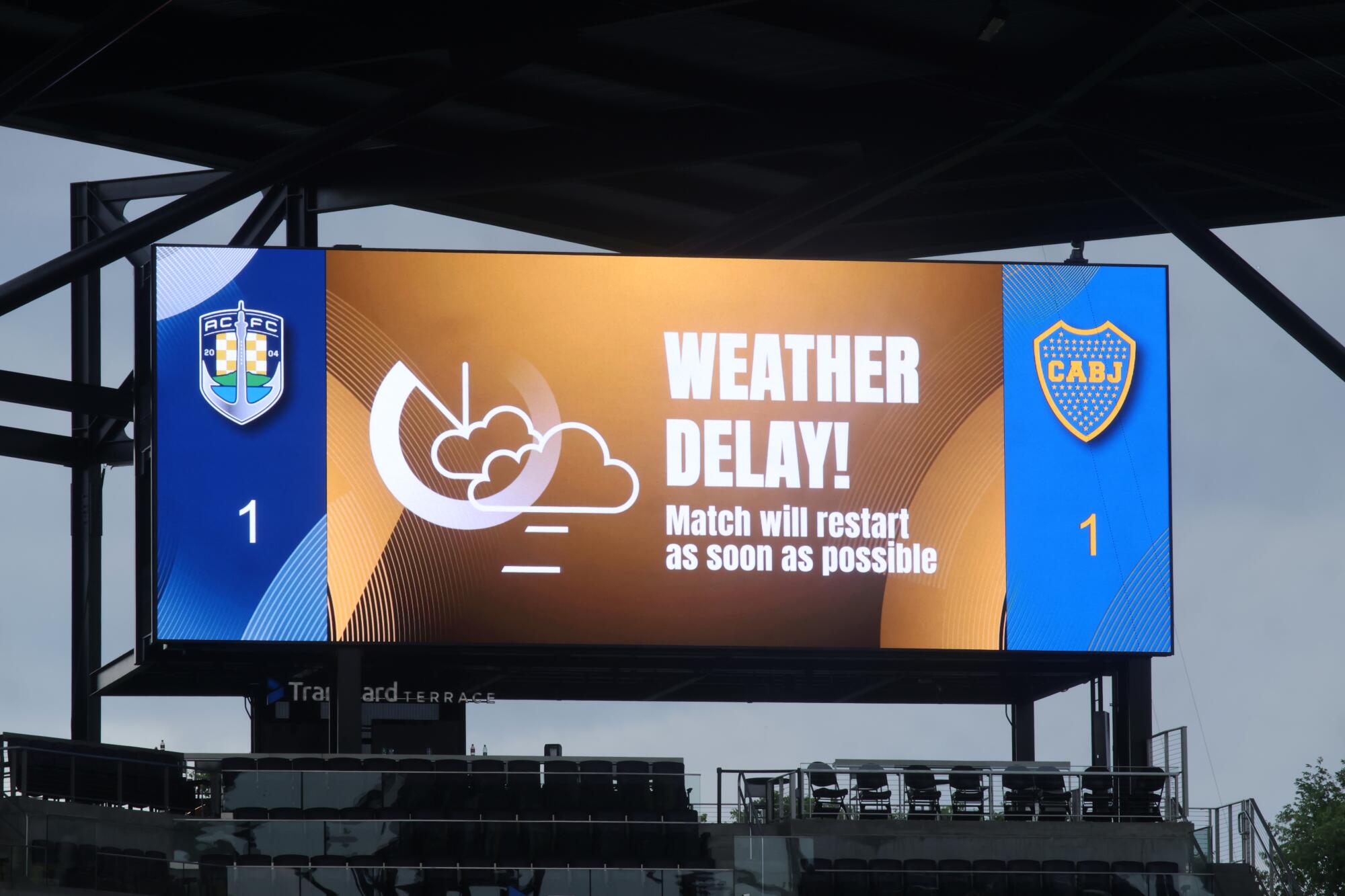
A weather delay interrupts a Club World Cup match between Auckland City FC and Boca Juniors in Nashville in June 2025.

A weather delay interrupts a Club World Cup match between Auckland City FC and Boca Juniors in Nashville in June 2025.

(Alex Grimm / Getty Images)

But you don’t have to do complicated math to know it’s hot because there’s also the “feels like” index, which registers how your body feels the heat. That can be vastly different from the reading on a thermometer. In Miami, for example, where seven World Cup games will be played, humidity will make an air temperature of 90 degrees “feel like” 109 degrees.

Under those conditions, it becomes more difficult for the body to cool itself.

“We talk about temperatures all the time, but that is only one part of the equation. It’s not including the amount of heat that you might feel from humidity,” Trudeau said. “It’s so important because once it gets too humid, then our body’s main cooling mechanism, sweating, is no longer possible.

“These are the kinds of situations where you have to be really careful. Not just players, but also people who maybe work at the stadiums, people who are watching the matches. It can be a very dangerous situation.”

Playing games in the cooler evening hours could alleviate that but FIFA, in a nod to TV viewers in Europe, scheduled 40 of the tournament’s 104 games, including the majority of games in the knockout rounds, to kick off at 3 p.m. or earlier local time. And though mandatory three-minute hydration breaks midway through each half have been added, Trudeau questions their impact.

“That’s kind of silly to be like, ‘Oh, we’re going to give an extra water break. But we’re going to be doing it at the hottest time of the day,’” she said. “It kind of sends mixed messages, right? What is the main priority of FIFA here? Is it to get the most views and the most revenue and the most whatever? Or is it to actually protect these players?

“We should not be having these in the hottest parts of the world at the hottest times of day,” she continued. “It’s just common sense.”

Chelsea's Benoit Badiashile puts water on his face before at Club World Cup match against Esperance de Tunis.

Chelsea’s Benoit Badiashile puts water on his face before a Club World Cup match against Esperance de Tunis in Philadelphia in June 2025.

(Francois Nel / Getty Images)

FIFA defended the schedule, saying in a statement that climate-related risks are assessed as part of overall tournament planning and managed in close coordination with the host cities, stadium authorities and national agencies.

“Building on experience from recent tournaments, a tiered heat-mitigation model will apply,” the statement continued. “When forecasts indicate elevated temperatures, venues will activate additional cooling capacity, including shaded areas, misting systems, cooling buses and expanded water distribution. Work-rest cycles for staff and volunteers are adapted accordingly, and first-aid readiness is reinforced with clear triage and escalation pathways for suspected heat illness. These measures scale dynamically based on real-time conditions before and during each event.”

Last summer’s FIFA Club World Cup, a 63-game tournament played in the U.S. as a kind of dress rehearsal for this year’s event, gives an indication of the problems ahead. That tournament was plagued not just by high heat and humidity, but also by thunderstorms and lightning that paused or delayed a half-dozen matches in Orlando, Fla.; Nashville; Cincinnati; Charlotte, N.C.; and East Rutherford, N.J.

“The heat is incredible,” said Argentine midfielder Enzo Fernandez, who played in last summer’s tournament with Chelsea. “I got a bit dizzy during a play. I had to lie down on the ground because I was really dizzy.

“Playing in this temperature is very dangerous.”

But if health risks are the primary concern of summer sporting events on a warming planet, they aren’t the only ones. The weather also affects the quality of play, said Norwegian defender Julian Ryerson, who played for Borussia Dortmund in last summer’s club tournament.

“Football is different when you play in this humidity and heat,” he said. “It is really tough. You take some precautions. That’s the only way to go about it.”

As the planet continues to bake, there are also increasingly fewer ways of going about staging a World Cup. You can play it nontraditional times and in nontraditional places. You can play it indoors in air-conditioned stadiums.

Or you can not play it at all.

“We’re running out of options,” Trudeau said. “We have to understand that unless we are going to address human-caused climate change, you’re going to start losing these things that are culturally important to us or economically important.

“We cannot keep doing these things at the rate we’re doing them and the times that we’re doing them in the ways that we’re doing them while we also continue to warm the planet.”

Source link