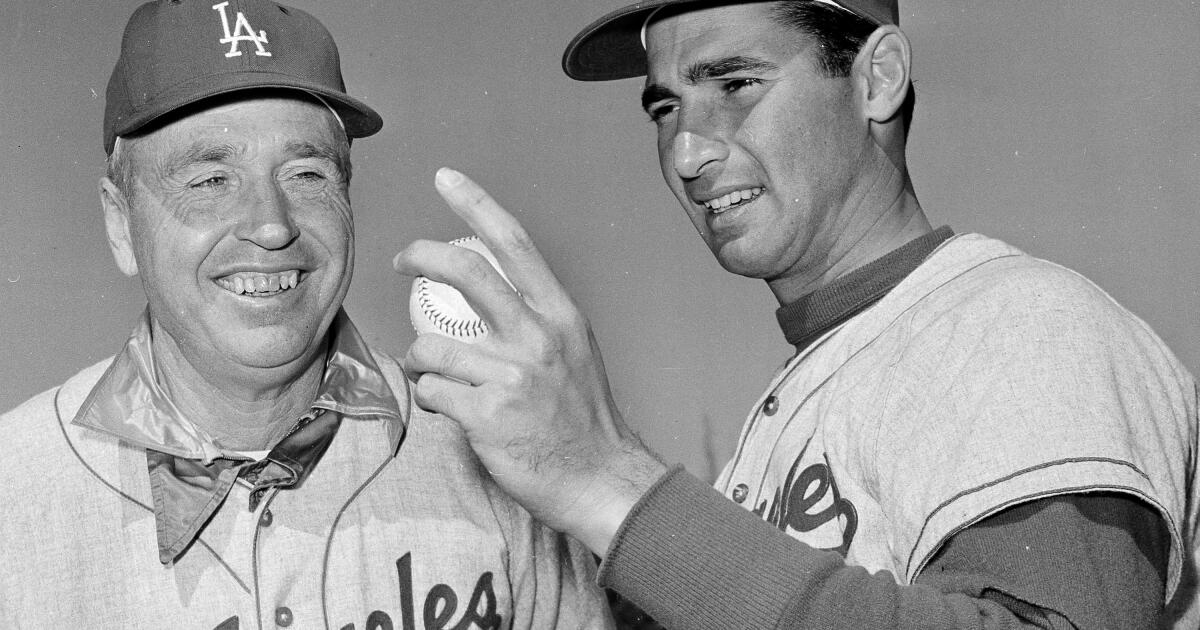
Dave Roberts has surpassed Tommy Lasorda among greatest managers
Hi, and welcome to another edition of Dodgers Dugout. My name is Houston Mitchell. Finally, we are concluding the greatest Dodgers at each position series with managers.
Before we get a to the manager’s countdown, let’s catch up a bit. Not much has happened since the Dodgers signed reliever Edwin Díaz, which was covered in the last newsletter.
The Dodgers avoided arbitration with all four players who were eligible:
Left-handed reliever Anthony Banda was given a raise to $1.625 million compared to the $1 million he got last season; outfielder Alex Call will get $1.6 million, a nice jump from the $769,000 he made last season; Brusdar Graterol will get $2.8 million next season, the same he made last season, which he missed because of injury; and reliever Brock Stewart will get $1.3 million compared to the $870,000 he got in 2025.
In other news, outfielder Justin Dean, who was claimed by the Giants when the Dodgers removed him from the 40-man roster, has subsequently been put on waivers by the Giants, so it’s possible he could return to L.A.
And for those of you still emailing, worried about the Dodgers re-signing Kiké Hernández, remember he had surgery on his elbow and won’t be able to play until the All-Star break. The best guess here is the Dodgers will not re-sign him until they can put him on the 60-day IL (which begins in spring training). That way he won’t count against the 40-man roster. In fact, they might wait until he’s ready to start baseball activities again. In short, it seems if he does come back next year it will be as a Dodger, unless some other team decides to throw a lot of money at him, which seems unlikely.
In the next newsletter later this week, we will look at the remaining free agents out there, including Cody Bellinger, who is apparently at an impasse in re-signing with the Yankees, mainly over the length of the contract.
Top 5 managers
Here are my picks for the top five managers in Dodgers history, followed by how all of you voted. Numbers listed are with the Dodgers only. Click on the manager’s name to be taken to the baseball-reference.com page with all their stats.
1. Walter Alston (1954-76, 2,040-1,613, .558 winning percentage, seven NL pennants, four World Series titles)
Alston began managing the Dodgers in 1954 when they still were in Brooklyn and remained manager until 1976, winning seven NL pennants (1955, 1956, 1959, 1963, 1965, 1966, 1974) and four World Series, (1955, 1959, 1963, 1965), three of them in Los Angeles.
Alston was named NL manager of the year six times. He had his number (24) retired by the team in 1977 and was elected to the Baseball Hall of Fame in 1983. When he got his 2,000th win in the 1976 season, he became only the fifth manager to reach that milestone. There are only 12 now. He is one of five managers to win at least four World Series. The others: Joe McCarthy, Casey Stengel, Connie Mack and Joe Torre.
Alston died at age 72 on Oct. 1, 1984.
A great Alston story, recounted in many books on the Dodgers, comes from the time when teams still traveled by bus. One time, the bus the Dodgers were using was old and had no air conditioning. Several players spent the trip yelling and getting on Lee Scott, the club’s traveling secretary, for getting them such a rickety bus.
Alston, sitting in the front, stood up and said: “I don’t want to hear another word about this bus. And if anyone has something more to say about it, he can step off right now and we’ll settle it right here.” No one said a word after that.
Legendary Times columnist Jim Murray wrote the following when Alston retired:
“I don’t know whether you’re Republican or Democrat or Catholic or Protestant, and I’ve known you for 18 years,” Murray wrote of Alston. “You were as Middle-Western as a pitchfork. Black players who have a sure instinct for the closet bigot recognized immediately you didn’t know what prejudice was. There was no ‘side’ to Walter Alston. What you saw was what you got.”
You can read more about the life of Alston in this article.
2. Dave Roberts (2016-current, 944-575, .621, five NL pennants, three World Series titles)
The question isn’t whether Roberts deserves to be ranked ahead of Tommy Lasorda, the question is if he should be ranked ahead of Alston. Right now, Alston has him beat on longevity, but Roberts is gaining fast.
Roberts has the best winning percentage of any manager in history, minimum 1,000 games. He is 368 games above .500, which is 10th all time. The nine guys ahead of him are all in the Hall of Fame and all managed at least 600 more games than Roberts. He is one of only 11 managers with at least three World Series titles. All are in the Hall of Fame except Bruce Bochy, who will be. He is one of only 12 managers with at least five pennants. All are in the Hall except for Bochy and Vic Harris, a Negro Leagues manager.
Does he have his weaknesses? Sure. Every manager does, though. Is he helped by the fact the Dodgers pay a lot for players? Sure. But there have been managers throughout history who have led powerful teams nowhere.
The fact is, managing now is different than managing when Alston or even Lasorda was in charge. Analytics play a much bigger role now. Most front offices don’t favor such things as sacrifices or steals. The biggest responsibility now is probably keeping all 26 players satisfied with their role on the team. And, Roberts has gotten much better at managing a pitching staff the last couple of seasons.
I’m sure there will be those who will say “Roberts is a bum!” whenever the Dodgers lose a few games in a row next season. Those people are wrong and shouldn’t be listened to. There’s a reason many players are clamoring to play in L.A. One of those reasons is Roberts.
3. Tommy Lasorda (1976-96, 1,599-1,439, .526, four NL pennants, two World Series titles)
Can you imagine if social media existed in 1985? What would the reaction had been online after Lasorda let Tom Niedenfuer pitch to Jack Clark? And what would Lasorda’s reaction to that have been? The mind shudders at the thought.
Lasorda began his pro career in 1945 as a left-handed pitcher in the minors for the Philadelphia Phillies. After spending two years in the Army, he pitched one more season in the minors for the Phillies before the Dodgers drafted him in 1949. That began a long association with the Dodgers, with only a brief interruption to pitch for the Kansas City A’s in 1956 and as a minor leaguer with the New York Yankees in 1956 and 1957 before being reacquired by the Dodgers in 1957.
Lasorda pitched in four regular-season games for the 1955 World Series champion Dodgers and has a ring to show for it. He started against the St. Louis Cardinals on May 5 and had an interesting first inning. He walked Wally Moon, who took second on a wild pitch. Then he walked Bill Virdon. Another wild pitch put Virdon and Moon on second and third with Stan Musial at the plate. Musial struck out swinging. With Rip Repulski at the plate, Lasorda unleashed another wild pitch, and while Moon was sliding into home to score, he accidentally spiked Lasorda in the knee, opening up a gash deep enough to see bone. Lasorda, having waited years for this moment, covered up the injury, struck out Repulski and got Red Schoendienst to pop to first. When he limped to the dugout, manager Walter Alston saw his knee and took him out of the game. It was Lasorda’s only start for the Dodgers.
The Dodgers sent Lasorda back to the minors June 8 to make room for a bonus baby they had signed: Sandy Koufax.
But Lasorda is not on this list because of his pitching; he’s here because of his managing and the fact there may not have been a more colorful character in Dodgers history.
After retiring as a player in 1960, Lasorda became a scout for the Dodgers from 1961 to 1965. In 1966, he became a minor league manager and led the Ogden Dodgers to three league championships. He became manager of triple-A Spokane in 1969 and remained the manager when the team moved to Albuquerque in 1972. In 1973, he became the third-base coach for the Dodgers, who still were being managed by Alston.
Most figured Lasorda was the heir apparent to Alston, and Lasorda must have believed that too, because he turned down opportunities to interview for managing positions with the Montreal Expos and the Yankees.
Alston announced his retirement with four games remaining in the 1976 season and let Lasorda manage those final games. The Dodgers considered naming either Lasorda or first-base coach Jim Gilliam as the new manager but settled on Lasorda, who kept Gilliam as the first-base coach.
The rest, as they say, is history. It’s hard to write a good summary for someone who has led such a public life as Lasorda. We all know he managed the team to the NL pennant in his first two seasons, losing to the Yankees in the World Series both times. He managed the Dodgers to World Series titles in 1981 and 1988.
Some people think Lasorda was all flash and no substance, considering him to be an overrated manager. But Lasorda did a very smart thing in 1981. The season had been split into two halves by a strike, and Major League Baseball decided that the teams in first place when the strike began automatically would qualify for the postseason, playing the second-half winner of their division. Lasorda, realizing he had a playoff spot sewn up, started giving his bench guys, such as Jay Johnstone, Steve Yeager and Steve Sax, more playing time, getting them ready for the postseason. And who helped the Dodgers finally defeat the Yankees in the 1981 World Series? Guys such as Yeager and Johnstone, who had key hits in the six-game victory.
Lasorda’s final game as Dodgers manager was June 23, 1996, a 4-3 victory over the Houston Astros. He went to the hospital the next morning because of stomach pains. It turned out he had a heart attack. After taking time to recover, Lasorda announced his retirement on July 29. He finished with 1,599 victories, good for 23rd on the all-time list.
Lasorda died at 93 on Jan. 7, 2021. One of his final public appearances was during the 2020 World Series, when he watched the Dodgers win the title for the first time since his 1988 team.
He was quite the talker in his prime, so what better way to end this than with some Lasorda quotes:
“There are three types of baseball players: those who make it happen, those who watch it happen and those who wonder, ‘What happened?’”
“When you’re not playing up to your capability, you gotta try everything, to motivate, to get them going. All of them have to be on the same end of the rope to pull together. It’s playing for the name on the front of the shirt, not the back. Individualism gets you trophies and plaques. Play for the front, that wins championships. I try to remind them of that.”
“I walk into the clubhouse today and it’s like walking into the Mayo Clinic. We have four doctors, three therapists and five trainers. Back when I broke in, we had one trainer who carried a bottle of rubbing alcohol, and by the seventh inning he’d already drunk it.”
“When you say you’re a Padre, people ask when did you become a parent. When you say you’re a Cardinal, they tell you to work hard because the next step is Pope. But when you say you’re a Dodger, everybody knows you’re in the major leagues.”
“I don’t like the pitch count! How are you gonna develop your arm? If you’re a track man, you don’t say, ‘Hey, you can’t run too much.’ Or if you’re a boxer, you don’t say, ‘Hey, you can only box three rounds.’ It’s not right!”
“Listen, if you start worrying about what the people in the stands think of your decisions, before too long you’re up in the stands with them.”
4. Leo Durocher (1939-1946, 1948, 738-565, .566, one NL pennant)
Durocher was a fiery presence, always willing to pick a fight to spur his team to action. In 1947, some Dodgers players circulated a petition asking management not to put Jackie Robinson on the team. The team was training in Cuba when Durocher found out about the petition around midnight. He immediately called a team meeting and told the players what they could do with their petition. “I don’t care if the guy is yellow or black, or if he has stripes like a … zebra. I’m the manager of this team, and I say he plays. What’s more, I say he can make all of us rich. And if any of you can’t use the money, I will see that you are traded.”
5. Wilbert Robinson (1914-31, 1,375-1,341, .506, two NL pennants)
Robinson managed the Dodgers to two NL pennants and the team was so identified with him at the time that they were called the Brooklyn Robins for a while in his honor. In 1915, famous aviator Ruth Law was near the team’s spring training camp in Daytona Beach, Fla., and getting a lot of publicity for dropping golf balls from her plane on a nearby golf course. The Dodgers saw a chance to get in on this publicity and asked her if she would drop a baseball from her plane to a player down below, who would catch the ball. She said sure, but no player would volunteer to do it. Robinson, wanting to show his players they need to be tougher, said he’d do it. When the time came, Law realized she forgot to bring the baseball with her, but she did have a grapefruit (don’t ask me why). So, she dropped that instead. Robinson got the grapefruit, which exploded the moment it hit his mitt. Robinson was convinced the pulp covering him was his innards and that he was seriously injured. He called for help. Players rushed to his side, and once everyone figured out what had happened, he never lived it down. Robinson died in 1934 after falling in a bathroom and striking his head on the bathtub. He was 70.
The readers’ top five
There were 2,098 ballots sent in. First place received 12 points, second place nine, third place eight, fourth place seven and fifth place six points. For those of you who were wondering, I make my choices before I tally your results. Here are your choices:
1. Walter Alston, 1,420 first-place votes, 23,498 points
2. Tommy Lasorda, 501 first-place votes, 20,770 points
3. Dave Roberts, 163 first-place votes, 17,204 points
4. Leo Durocher, 7 first-place votes, 13,007 points
5. Joe Torre, 9,842 points
The next five: Wilbert Robinson, Burt Shotton, Chuck Dressen, Don Mattingly, Jim Tracy.
Scheduling note
We will be back at a more regular schedule now since, hold on to your hats, the first spring training game is just 40 days away.
And finally
Some special messages to Clayton Kershaw from members of the 2025 Dodgers. Watch and listen here.
Until next time…
Have a comment or something you’d like to see in a future Dodgers newsletter? Email me at houston.mitchell@latimes.com. To get this newsletter in your inbox, click here.