California’s insurance crisis existed long before the L.A. wildfires. Why wasn’t it fixed?
California’s property insurance market was unraveling fast in mid-2023 when the state’s insurance commissioner, Ricardo Lara, landed in Bermuda for four days of elbow-rubbing with industry figures.
The state’s largest carriers were dumping customers by the tens of thousands and refusing to write new policies across large swaths of the state. Insurers cited inflation, soaring reinsurance costs and inadequate rate hikes, with one national insurer threatening to leave California altogether if Lara didn’t make things right.
Lara was in Bermuda to speak on two panels about climate risk, but he spent the majority of his stay navigating an itinerary offered by Bermuda’s billion-dollar reinsurance houses: invitations to dinners, a rum tasting, cocktail cruise, island excursions, and a casual LGBTQ+ lawn party at which Lara was the special guest, called “Pride and Prosecco.”
Lara’s island hosts held a big stake in what the regulator of the nation’s largest insurance market might do next. Reinsurers — who sell catastrophe insurance to other carriers — were doubling rates and reaping record profits, causing duress for the struggling property insurers back home. And Lara faced enormous pressure from those California carriers to let them pass the charges on to consumers.
It was an industry agenda Lara had previously opposed, but the faltering California market had backed him into a corner.
Weeks after returning from Bermuda, in closed-door sessions arranged by Gov. Gavin Newsom, Lara would concede. He agreed to placate the insurance industry with a series of measures, including swifter and larger rate hikes, to curb the power of consumer advocates and limit what insurers have to pay in market bailouts. In return, carriers would commit to insuring homes in high-risk regions — a guarantee critics say contains caveats that allow insurers to skirt their obligations to extend coverage where it is needed most.
Despite Lara’s declarations that his strategy is working, six of the first nine rate hikes sought under the new rules in fact add no new policies in fire-prone areas.
Lara’s delays in addressing California’s broken insurance market and the actions he would eventually take to address it exacerbated what is now a crisis of affordable property insurance for many consumers, according to a Times examination of insurance company filings, state agency communications and data, and interviews with industry experts and consumer advocates.

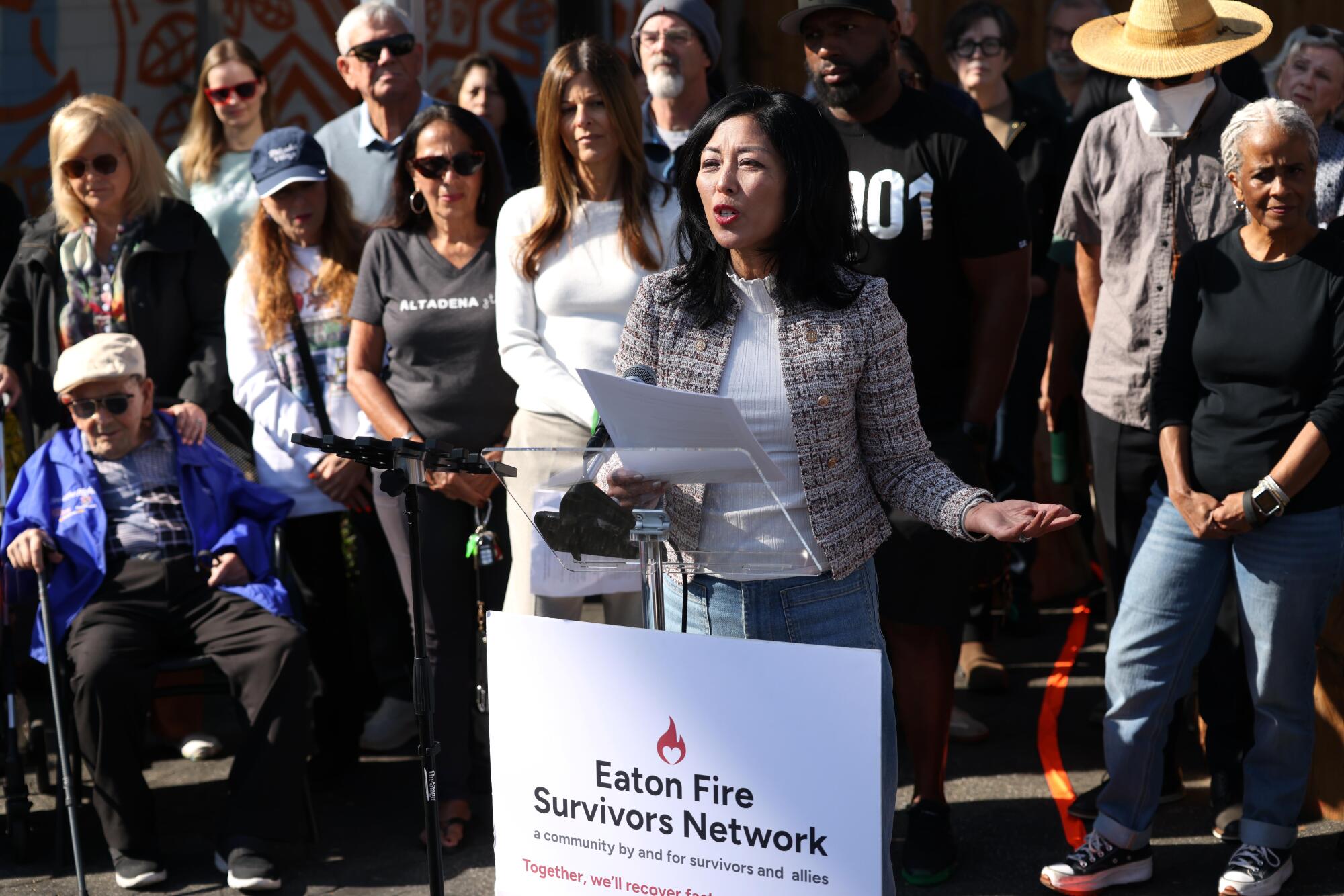
Joy Chen, center, executive director of the Eaton Fire Survivors Network, along with Eaton and Palisades fire survivors, urges Gov. Gavin Newsom to call for the resignation of Insurance Commissioner Ricardo Lara during a news conference in Altadena on Nov. 6.
(Genaro Molina / Los Angeles Times)
During Lara’s six-year tenure as regulator, the state’s insurer of last resort, which covers those shunned by the traditional market, ballooned. The California FAIR Plan, which provides minimal coverage, held 123,657 policies at the start of 2019. It now has more than 645,000.

The number of insurance policies sold in California shrank, even as continued development meant more homes in need of coverage.
The insurance pullback came into sharp relief in January, when devastating wildfires in Los Angeles destroyed or heavily damaged nearly 13,000 homes and other residential units and killed 31 people in two communities hit hard by insurance industry pullouts.
Thousands of fire victims covered by the FAIR Plan were left with inadequate payouts to rebuild. Fire victims whose homes survived with smoke damage also battled insurers, who denied thousands of claims.
Consumer advocates and victims criticized Lara for later allowing rate hikes without first insisting that insurers pay wildfire claims and for attempting to block fire victims from taking part in rate hike negotiations.
In addition, Lara ordered that most insured homeowners statewide will have to cover half of the $1 billion needed for the FAIR Plan to pay its L.A. claims.
Last month dozens of Altadena and Pacific Palisades fire victims called on Lara to step down.
“We take no joy in calling for anyone’s resignation, but as survivors, we are living firsthand in the depths of California’s insurance crisis,” said Joy Chen, executive director of the Eaton Fire Survivors Network.
“Look, no matter who the commissioner was, it was going to be hard,” said regulator-turned-advocate Robert Herrell, a deputy insurance commissioner to Lara’s predecessor and now executive director of the California Consumer Federation. But, he said, under Lara the industry is “getting everything they want, and then some.”
Lara framed the state’s insurance problems around climate change and the decisions of others.
In an interview and emails, he argued that because of inaction by his predecessors he had “inherited a department unprepared for climate impacts and lacking the tools to address this unprecedented insurance crisis.”
Lara said he needed to give insurers a financial incentive to resume writing new policies — critical to helping homeowners recover from catastrophic wildfires and keeping the state’s housing market afloat. The coming rate increases, he said, will eventually translate into increased competition and lower premiums.
Because of his embrace of “transformational change,” Lara said, he is now under personal attack. “I wonder if I ruffled too many feathers at once or if I took on too many adversaries too quickly to withstand all the attacks and inquiries.”
Lara is currently the subject of twin investigations by the Fair Political Practices Commission into his acceptance of travel gifts and his campaign expenses. Over five years, Lara took 30 trips abroad, spending more than 163 days on official trips, often without reporting funding sources or providing receipts as required of elected officials, The Times found.
Lara denies wrongdoing, saying attending international insurance meetings is a necessary part of his job.
“Real change attracts unprecedented scrutiny, skepticism, and criticism from entrenched interests, the industry, the media, and so-called consumer groups that have profited from a broken system at the expense of consumers,” he said.
Origins of a crisis
When Lara took office in January 2019, California’s insurance market was already challenged.
In 2017, the development of high-resolution computer models gave rise to new predictions of low-probability but catastrophic wildfires, resulting in a startling 55% increase in predicted annual wildfire losses.
Two major disasters — the 2017 Tubbs fire and the Camp fire in 2018 that destroyed Paradise — underscored the magnitude of the risks.
Carriers used the models to reevaluate their portfolios, identify risk and decide how much reinsurance they needed.
At that same time, the reinsurance industry was doubling its rates and limiting availability.
The upshot: California insurers struggled to afford, or even find, sufficient reinsurance to cover their portfolios, insurance department emails show. Their options were limited: seek rate hikes or cut risk by dropping customers, decisions also driven by the new models.
“The home insurance market in California is not in crisis yet,” warned a 2019 governor’s commission report as insurance nonrenewal rates climbed, but “we are marching toward a future where home insurance will be increasingly unavailable and/or unaffordable.”
Lara responded with one-year prohibitions on insurers dropping policyholders in burn areas, which temporarily slowed the contraction. He championed legislation to require carriers to insure consumers who take steps to reduce the risk of fire damage to their homes. When that didn’t pass, he required premium discounts for customers who hardened their homes against wildfire.
He focused mainly on the long-term threat of climate change, creating a database of “climate smart” insurance companies and partnering with climate action groups to measure extreme heat events and to survey insurers on their climate policies. Climate change, he argued, was making insurance harder to find and more costly.

Homes burn near Altadena and New York drives in Altadena in the Eaton fire on Jan. 7.
(KTLA)
None of those measures addressed the roots of the industry’s financial crisis.
Exacerbating problems was the California Department of Insurance’s increasingly slow handling of rate hike requests, delays especially burdensome for small insurers. Decisions that took six months when Lara took office by 2022 required nearly a year, according to a study by the Milliman insurance services firm.
Stacey Jackson, executive director of the Pacific Assn. of Domestic Insurance Companies, said two member companies stopped insuring homes due to “over-regulation.” One pulled out of California entirely.
“We’re just stuck with this system that is unworkable in large part,” Jackson said.
Lara took the position that no changes were needed in the state’s regulatory system. He accused insurance companies of “having gamed” California regulations by seeking rate hikes just below the 7 % threshold at which consumer advocates could demand public hearings, even when their ledgers showed more money was needed.
If insurers needed to charge more, he told the Legislature in 2020, all they had to do was ask.
Allstate delays
One insurer took Lara at his word: Allstate.
The “good hands” company, once the state’s third-largest home insurer, had stopped writing new policies in 2007 in response to a rate hike denial, resumed in a fraction of the state in 2016 and then in early 2021 opened up to every ZIP code in California. A company executive told regulators it would potentially quadruple its policy count, potentially bringing tens of thousands of policies back into the shriveling market.
In return, Allstate sought a 4.6% rate hike. Emails show Allstate expected speedy approval, but the filing instead bogged down in bureaucracy, including 10 months of back-and-forth questioning by a state actuary.
Allstate Chief Executive Thomas Wilson complained on a quarterly earnings call that “We’ve been waiting to get a rate increase that was agreed to with the State of California over a year ago … and that has yet to come through.”
Allstate froze business across half of California in August 2022 and soon stopped writing new home policies statewide.
Rex Frazier, head of the Personal Insurance Federation of California, which represents the carrier, characterized Allstate’s retraction as “disillusionment” with California regulation.
Lara said he had no indication Allstate’s freeze was a sign of trouble ahead. He said the department was hopeful that other carriers “would fill the gap, as they had in the past.”
Without public announcement of the Allstate freeze, Lara celebrated his reelection as insurance commissioner six days later before embarking on a two-month run of international travel, including stops in Santiago, Chile; Egypt; Paris, and a 10-day legislative trade delegation in New Zealand and Australia.
A sit-down with Allstate did not appear on Lara’s calendar until February 2023 — three months after the company froze home policies in California.
Three months after that, State Farm announced its own hiatus. Only then was the Allstate freeze widely reported.

California Insurance Commissioner Ricardo Lara speaks during a news conference in Sacramento in September 2023. Lara announced a plan aimed at keeping insurance companies from leaving the wildfire-prone state.
(Adam Beam / Associated Press)
Despite those setbacks, Lara publicly remained upbeat, insisting California’s insurance market was healthy. In a recorded Zoom call with Woodside homeowners two months after State Farm’s freeze, he said the state had more than 115 companies writing policies and called nonrenewals “normal,” suggesting they were part of his efforts to ensure insurers could meet their obligations to pay claims.

“When we, as a department, see a company is overexposed,” he said, “then we have to work with them to pause their products.”
Lara explained that it was part of his job to balance “consumer protection and the solvency of the largest insurance market in the country, fourth in the world.”
In an October email to The Times, Lara said he did not intend to give the impression the insurance department was encouraging policy nonrenewals.
“I have never said that, and it has never been part of our strategy,” he wrote.
Despite his rosy assessments, office calendars and meeting notes show the commissioner was being confronted by a large market meltdown.
Staff from the division responsible for financial oversight of insurers joined Lara’s talks with Farmers Insurance, months before Moody’s warned the company of a ratings downgrade. Liberty Mutual told the commissioner’s office it was closing down its dwelling fire program, affecting 17,000 policyholders. And Lara engaged in secret conversations with his counterpart regulator in Illinois to discuss the solvency of State Farm, California’s largest home insurer, which had perilously drained its capital.
From 2019, when Lara took office, to 2023, entire counties in the Sierra Nevada — Tuolumne, Mariposa, Nevada, Calaveras, Alpine, Amador and El Dorado — lost more than a fourth of their private market home insurance.
In hindsight, Lara said he didn’t believe his own optimistic rhetoric.
“We had this Top 10 Tips [for finding insurance] and I would always cringe when I would say that, because people couldn’t find insurance,” Lara said. “They would tell me, like, ‘Have you been out here? We can’t find insurance… it doesn’t matter what I do.’”
Lara said he was at home in August 2023, reviewing talking points for a town hall in Laguna Niguel, when he decided he would have to “level” with consumers.
“I told them, ‘this is the status of the market: Whether you like it or not, the top 10, 12 insurance companies have been losing money.’”
As he delivered that message, reporting shows, Lara was already brokering a plan to give the insurance industry much of what it wanted, at the instigation of Gov. Newsom’s office.
‘Take a bow’
Early in 2023, Dan Dunmoyer, head of the California Building Industry Assn, warned Newsom that major housing projects were being stalled by developers’ inability to secure commercial risk wildfire insurance. He called it “an existential threat for California’s future.”
Newsom’s office arranged a series of closed-door talks among the governor’s staff, legislative leaders, Lara’s department and industry trade groups in mid-2023. The resulting “market stabilization plan” was welcomed by the industry. “Up until then, the department really was not engaging on these issues,” said Frazier, head of the Personal Insurance Federation of California.
Consumer advocates caught wind of the talks, but details of the meetings in the Capitol “swing space” shared by the governor and Legislature were so elusive that one advocate likened it to “chasing a ghost.”
Consumer Watchdog President Jamie Court, while on a plane to Sacramento to meet with Newsom’s legal affairs secretary about the negotiations, overheard a lobbyist discussing “trying to jam” an insurance fix through the waning days of the legislative session. Court said Newsom’s staff insisted that the governor only “set the table” for stakeholders to hash out a solution, with one staff member complaining: “I don’t know why the commissioner can’t just do this.”
A few days later, Chief Deputy Insurance Commissioner Michael Martinez emailed a 16-page draft of the plan to industry groups, governor’s staff and legislative aides.
The plan allowed insurers to bill consumers for their reinsurance costs, required speedy reviews of rate hikes and allowed them to be based on predictive computer models. It also contemplated orders by Lara to require consumers to pay part of a bailout if the industry-managed FAIR Plan ran out of money.
Carriers that elected to take full advantage of these higher rates would have to agree to write policies in “distressed areas” equivalent to 85% of their statewide market share. The deal gave Lara’s office the power to decide what qualified as distressed and included a loophole that allowed insurers to be excused “on a case-by-case” basis.
The outline mirrored legislation Lara had helped kill three years earlier because he said it was “written by the industry.”
This time, however, the plan failed to secure a legislative sponsor.
Three weeks after Martinez’s email, Lara rolled it out as his own “Sustainable Insurance Strategy.”
“Great work Michael,” an Allstate lobbyist wrote to Martinez upon learning the news.
“Take a bow.”
Lara told The Times that the plan represents the greatest “modernization” of insurance in California since 1988, when voters created the elected insurance commissioner position.

Harvey Rosenfield, the founder of the Consumer Watchdog group, speaks at a news conference in February 2024 in Los Angeles.
(Jason Armond / Los Angeles Times)
Lara’s promised regulations did little to stem the continued acceleration of policy cancellations.
For those living in the path of the Palisades and Eaton fire disasters, enrollment in the FAIR Plan shot up last year a combined 47%, to 28,440 homes, The Times has reported.
Two consumer advocacy groups and fire victims say Lara’s “modernization” is a giveaway to the insurance industry.
The solvency of the FAIR Plan previously was the responsibility of insurance companies. Lara’s changes shifted half of the burden of bailouts onto most insured homeowners, giving insurers incentive to drop yet more policies and move ratepayers into the high-cost plan.
Insurers that agree to insure homes in high-risk areas can now elect to base rates on proprietary predictive computer models. State reviews of the software were done under confidentiality agreements and do not address large variations in the programs. The Times found loss estimates for the same insurance portfolio differed by model vendor as much as 58%. These divergent predictions can now form the basis for rate hikes.

Consumer advocates also single out loopholes in the coverage requirement.
To meet the 85% market share threshold, for example, insurers must offer coverage in 662 ZIP codes that overlap state fire hazard zones and have large FAIR Plan enrollment or unaffordable premiums. Companies are free to cherry pick low-risk properties within those expansive regions while they jettison those in need, and can stretch their required growth across many years.
“The regulation he wrote to enforce that commitment is Swiss cheese, so full of loopholes that no insurance company is really going to be obligated to move back into risky areas,” said Carmen Balber, executive director of Consumer Watchdog. “And so the commissioner has got nothing for selling Californians down the river.”
The new regulations also allow insurers to collect a surcharge to reflect the cost of reinsurance — amounts that current filings show can range from an average of $230 to $727 per policy. The underlying data Lara’s agency used to calculate the amount are secret.
Lara consulted with reinsurers on passing these costs to California consumers, discussing how to structure the charges, according to communications between his office and reinsurers.
. He met with the reinsurance lobby while in Seattle and Sacramento, and during two return trips to Bermuda that included private industry dinners.
In an interview, Lara acknowledged alternatives to the profit-driven private reinsurance market, such as a state-run public fund to sell protection to California carriers. Proponents argue a public reinsurer would mean cheaper prices, citing Florida’s hurricane safety net.

-
Share via
Although national insurance fund proposals periodically surface in Congress, including the “INSURE Act” introduced in July by California Democrats Sen. Adam Schiff and Rep. Sydney Kamlager-Dove, “I chose other options,” Lara said, without elaboration.
Lara also has proposed regulations to increase scrutiny of who may challenge rate hikes.
Over the years, the number of consumer groups seeking to intervene in rate filings has dwindled, leaving primarily just Consumer Watchdog. Lara accuses the organization of duplicating the work of state actuaries, but using confidential settlement records in more than two dozen cases since 2023, The Times found that 4 times out of 5, Consumer Watchdog negotiated lower rates than what state actuaries were prepared to approve.
By November, insurers filed for nine rate hikes under the new regulations. Though Lara’s agency has yet to rule on the filings, both he and Newsom have proclaimed that the filings show a commitment to California’s market.
The Times, however, found that in return for proposed rate hikes, six of the nine filings promise no new insurance policies at all in high-risk areas of the state. One insurer would continue to reduce coverage. The three carriers committing to expand agreed to add only a fraction of the 81,556 policies needed to meet the 85% standard. For $341 million in combined annual hikes, the state would gain 8,111 policies over three years.
Lara is unfazed. He acknowledges that there will be “hiccups” and some insurers will take advantage of the new rules. He says the commissioner’s office will be vigilant.
Market forces continue to put pressure on California insurers, buffeted by inflation, a 2024 catastrophe model update that further increases predicted wildfire losses, climbing 50 % in Northern California, and unchecked reinsurance costs.
Reinsurance rates nationwide this year began to fall, but not so in California or for RenaissanceRe, the company that hosted Lara’s “Pride and Prosecco” reception.
In a July earnings call, RenRe’s chief underwriting officer said the reinsurer was securing rate increases from fire-struck California insurers of 50% or higher. Despite losses from the L.A. fires, the company posted $600 million in underwriting profit for the year to date.
“We continue to like the California market,” CEO Kevin O’Donnell told investors last month. “We’re setting our own rate and our own terms.”