lachman fire

LAFD records show no sign of ‘cold trailing’ again at Lachman fire, as interim chief had claimed

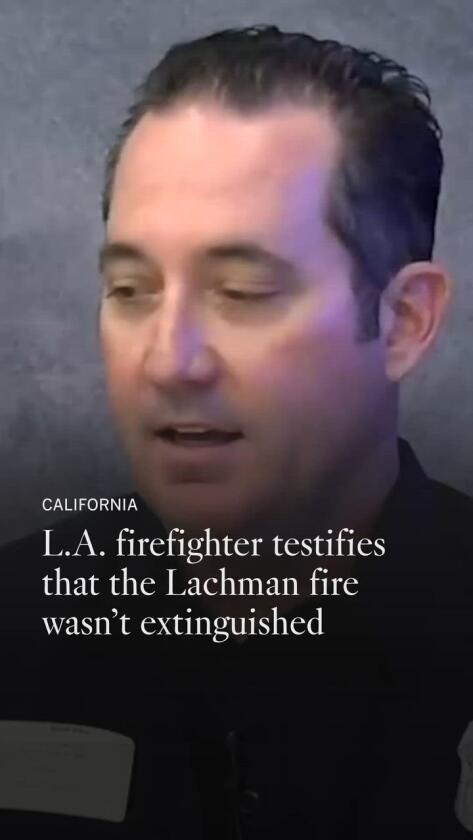
In the weeks since federal investigators announced that the devastating Palisades fire was caused by a reignition of a smaller blaze, top Los Angeles Fire Department officials have insisted that they did everything they could to put out the earlier fire.

But The Times has obtained records that call into question the agency’s statements about how thoroughly firefighters mopped up the Jan. 1 Lachman fire in the days before it reignited.

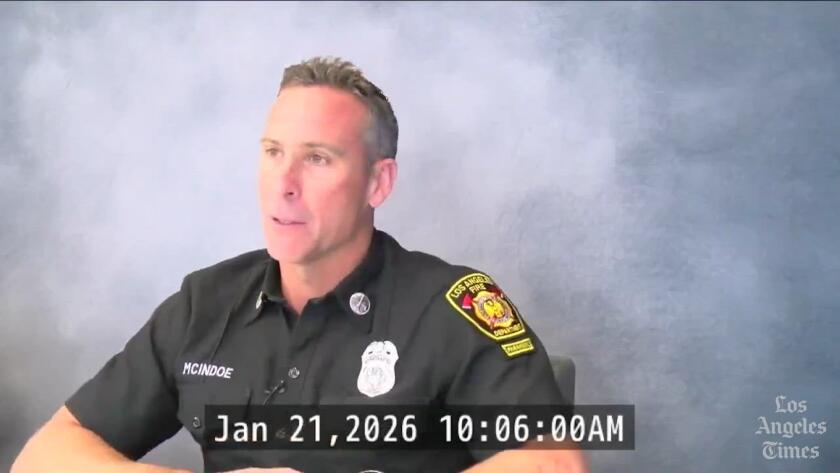
In an interview last month, then-Interim Fire Chief Ronnie Villanueva said that firefighters returned to the burn area on Jan. 3 — due to a report of smoke — and “cold-trailed” an additional time, meaning they used their hands to feel for heat and dug out hot spots.

“We went back over there again. We dug it all out again. We put ladders on it. We did everything that we could do — cold-trail again,” Villanueva told The Times on Oct. 8. “We did all of that.”

A dispatch log obtained by The Times, however, shows that firefighters arrived at the scene that day and quickly reported seeing no smoke. They then canceled the dispatch for another engine that was on the way, clearing the call within 34 minutes. The log does not mention cold trailing. It’s unclear if crews took any other actions during the call, because the LAFD has not answered questions about it.

The Times has made multiple requests for comment to LAFD spokesperson Capt. Erik Scott by email, text and in person, but the agency has refused to explain the discrepancy. Villanueva also did not respond to an emailed request for comment and an interview request.

The conflict between the LAFD’s statements and its own records is likely to intensify frustration and anger among Palisades fire victims over contradictory and incomplete information about what was done to protect their community. With the first anniversary approaching, gaps remain in what the LAFD has told the public about what it did to prepare for and respond to the fire, which killed 12 people and destroyed thousands of homes.

The LAFD’s after-action report on the Palisades fire makes only a cursory reference to the Lachman blaze. Missing from the 70-page document, released last month, are the report of smoke in the area on Jan. 3 and a battalion chief’s decision to pull firefighters out of the scene the day before, even though they warned him that there were signs of remaining hot spots.

The head of the board that oversees the LAFD has maintained that information about the firefighter warnings — or any examination of the Lachman fire — did not belong in the after-action report.

“The after-action review that was presented to the commission is exactly what we asked for,” Genethia Hudley Hayes, president of the Board of Fire Commissioners, said at the board’s meeting on Tuesday. She said the review was only supposed to cover the first 72 hours after the Palisades fire erupted.

“It is not an investigation,” she said. “It should not include things that the newspaper seems to feel like should be included.”

The after-action report detailed missteps in fire officials’ response to the Palisades fire, including major failures in deployment and communications, and made recommendations to prevent the issues from happening again.

Two former LAFD chief officers said the report also should have provided an examination of what might have gone wrong in the mop-up of the Lachman blaze, which investigators believe was deliberately set, as part of its “lessons learned” section.

“A good after-action report documents what happened before the incident,” said former LAFD Battalion Chief Rick Crawford, who retired from the agency last year and is now emergency and crisis management coordinator for the U.S. Capitol. “The after-action report should have gone back all the way to Dec. 31.”

Patrick Butler, a former assistant chief for the LAFD who has worked on several after-action teams, including for the federal government, agreed.

“If you limit an after-action to an artificial timeline, you’re not going to uncover everything you need to learn from,” said Butler, who is the Redondo Beach fire chief.

He noted that the reports shape training and operational improvements for the Fire Department.

“To exclude the Lachman fire from the report gives the appearance of a coverup of foundational facts,” Butler added. “It’s not a harmless oversight. The consequences can be significant and far-reaching.”

The Jan. 3 report of smoke at the Lachman burn area came in shortly before noon, according to a dispatch log of the incident. Firefighters from Fire Station 23 — one of two stations in the Palisades — arrived on the scene about 10 minutes after they were dispatched.

A couple minutes later, they reported “N/S,” or nothing showing, according to the log. A few minutes after that, they canceled the dispatch for an engine from Fire Station 69, the other Palisades station.

The last entry in the log was from 12:20 p.m., indicating that an L.A. County crew was working in the area.

The L.A. County Fire Department said in a statement that the crew was at the scene for less than 30 minutes conducting an “informal ‘lessons learned’ discussion of their actions from the night of the fire.”

“They did not gear up or perform any work while there and they did not see anything of note,” the statement said.

The L.A. County crew left the scene about 12:40 p.m.

The Times previously reported that firefighters were ordered to roll up their hoses and leave the burn area of the Lachman fire on Jan. 2, even though they had complained that the ground was still smoldering and rocks remained hot to the touch. The paper reviewed text messages among three firefighters and a third party, sent in the weeks and months after the fire, in which they discussed the handling of the blaze.

LAFD officials also opted not to use thermal imaging technology to detect lingering hot spots. Despite warnings of extreme winds leading up to Jan. 7, they failed to pre-deploy any engines or firefighters to the burn area — or anywhere in the Palisades.

At least one battalion chief assigned to the LAFD’s risk management section has known for months that crews had complained about hot spots after the Lachman fire. But the department kept that information hidden from the public.

At the Tuesday fire commission meeting, newly appointed Fire Chief Jaime Moore — in an apparent reference to The Times reporting — slammed what he called media efforts to “smear” firefighters who battled the worst fire in city history.

“Something that’s been very frustrating for me as fire chief, and through this process, is to watch my friends in the media smear our name and the work that our firefighters did to combat one of the most intense fires, the Palisades, the wind-driven monstrosity that it was,” Moore, a 30-year LAFD veteran, said on his second day on the job.

He added: “The audacity for people to make comments and say that there’s text messages out there that say that we did not put the fire out, that we did not extinguish the fire. Yet I have yet to see any of those text messages.”

Moore made those remarks despite having been tasked by Mayor Karen Bass with conducting an investigation into The Times report about the LAFD’s response to the Lachman fire.

Bass had requested that Villanueva investigate, saying that “a full understanding … is essential to an accurate accounting of what occurred during the January wildfires.”

Critics have said it would be improper for the LAFD to investigate itself and called for an independent review.

Before the City Council confirmed his appointment as chief, Moore also had called for an outside organization to conduct the inquiry, describing the reports of the firefighters’ warnings on Jan. 2 as alarming.

On Tuesday, he said he would review the LAFD’s response to the Lachman fire.

“I will do as Mayor [Karen] Bass asked, and I will look into the Lachman fire, and we will look at how that was handled, and we will learn from it, and we’ll be better from it,” he said.

A Bass spokesperson said Wednesday that the mayor “has made clear to Chief Moore” that the investigation into the Lachman fire should be conducted by an independent entity.

The LAFD has not responded to a question about who will conduct the probe.

Source link

New LAFD chief slams media ‘smear’ of firefighters who battled Palisades fire

On his second day as chief of the Los Angeles Fire Department, Jaime Moore criticized what he called media efforts to “smear” firefighters who responded to the worst wildfire in city history.

Moore’s comments Tuesday appeared to be in reference to a Times report that a battalion chief ordered firefighters to roll up their hoses and leave the burn area of the Jan. 1 Lachman fire, which days later reignited into the deadly Palisades fire, even though they had complained that the ground was still smoldering.

The Times reviewed text messages between firefighters and a third party, sent in the weeks and months after the Palisades fire, indicating that crews had expressed concerns that the Lachman fire would reignite if left unprotected.

“The audacity for people to make comments and say that there’s text messages out there that say that we did not put the fire out, that we did not extinguish the fire,” Moore told the Board of Fire Commissioners. “Yet I have yet to see any of those text messages.”

Moore’s statements represented a dramatic shift from his comments last week, when he told the L.A. City Council’s public safety committee — two days before the full council approved his appointment as chief — that the reports had generated an “understandable mistrust” of the fire department.

“The most alarming thing to me is … our members were not listened to, or they were not heard,” he said last Wednesday.

In response to Mayor Karen Bass’ request that he investigate the department’s missteps during the Lachman fire, Moore had called for an outside organization to conduct the probe.

On Tuesday, he said he would review LAFD’s response to the Lachman fire, though he did not specify who would conduct the investigation.

“I will do as Mayor Bass asked, and I will look into the Lachman fire, and we will look at how that was handled, and we will learn from it, and we’ll be better from it,” he said.

In one text message reviewed by The Times, a firefighter who was at the Lachman scene Jan. 2 wrote that the battalion chief in charge had been told it was a “bad idea” to leave because of visible signs of smoldering terrain.

A second firefighter was told that tree stumps were still hot at the location when the crew packed up and left, according to the texts. And another firefighter said in more recent texts that crew members were upset when directed to leave the scene, but that they could not ignore orders.

The firefighters’ accounts line up with a video recorded by a hiker above Skull Rock Trailhead late in the morning Jan. 2 — almost 36 hours after the Lachman fire started — that shows smoke rising from the dirt. “It’s still smoldering,” the hiker says from behind the camera.

At least one battalion chief assigned to LAFD’s risk management section knew about the complaints for months, The Times found. But the department did not include that finding, or any detailed examination of the reignition, in its after-action report on the Jan. 7 Palisades fire — or otherwise make the information public — despite victims demanding answers for months about how the blaze started and whether more could have been done to prevent it.

Moore, a 30-year LAFD veteran, told the City Council on Friday that one of his top priorities is raising morale in a department that has come under heavy criticism for its handling of the Palisades fire, which killed 12 people and destroyed thousands of homes.

In January, The Times reported that LAFD officials decided not to pre-deploy any engines or firefighters to the Palisades — as they had done in the past — despite being warned that some of the most dangerous winds in recent years were headed for the region.

The LAFD after-action report released last month described fire officials’ chaotic response, which was plagued by major staffing and communication issues, as the massive blaze overwhelmed them.

After Bass ousted Fire Chief Kristin Crowley over her handling of the Palisades fire, the department was led by interim Chief Ronnie Villanueva until Moore took over Monday.

Genethia Hudley Hayes, president of the Board of Fire Commissioners, which provides civilian oversight for the fire department, said at Tuesday’s meeting that she had not seen the text messages quoted in The Times. Because she hadn’t seen them, she said, the messages have “no bearing on the work of the fire commission.”

She also said that the commission supported the fire department’s after-action report, noting that that the report was not about the rekindling of the Lachman fire, but about the first 72 hours of the department’s response to the Palisades fire.

“It has nothing to do and should not have had anything to do with the Lachman fire, because that is not what we asked for,” Hudley Hayes said.

Source link

LAFD insider named chief amid lingering questions about Palisades fire

As Jaime Moore prepares to take the helm of the Los Angeles Fire Department, he said he plans to commission an outside investigation into missteps by fire officials during the mop-up of a small brush fire that reignited days later into the destructive Palisades fire.

Mayor Karen Bass had requested a probe late last month in response to reporting by The Times that firefighters were ordered to roll up their hoses and leave the burn area, even though they had complained that the ground was still smoldering.

Moore — a 30-year department veteran whose appointment was confirmed Friday by the Los Angeles City Council — said the reports have generated “understandable mistrust” in the agency.

The Times found that at least one chief assigned to LAFD’s risk management section knew about the complaints for months, but that the department kept that information hidden despite Palisades fire victims pleading for answers about whether more could have been done to protect their community.

On Wednesday, Moore told the council’s public safety committee that bringing in an outside organization to investigate the LAFD’s handling of the Jan. 1 Lachman fire would be one of his first moves as chief.

“Transparency and accountability are vital to ensure that we learn from every incident and is essential if we are to restore confidence in our Fire Department,” Moore said. “As fire chief, I will focus on rebuilding trust, not just with the public, but within the LAFD itself.”

Federal investigators say the Lachman fire was deliberately set on New Years’ Day and burned underground in a canyon root system until it was rekindled by high winds on Jan. 7. LAFD officials have said they believed the earlier fire was fully extinguished.

Moore said one of his top priorities is raising morale in a department that has come under heavy criticism for its handling of the worst wildfire in city history, which killed 12 people and destroyed thousands of homes.

In the days after the Jan. 7 Palisades fire, The Times reported that LAFD decided not to pre-deploy any engines or firefighters to the Palisades — as they had done in the past — despite being warned that some of the most dangerous winds in recent years were headed for the region.

An LAFD after-action report released last month described fire officials’ chaotic response, which included major staffing and communication issues.

Moore — who has the backing of the United Firefighters of Los Angeles City, the union that represents firefighters — said his other priorities include better preparation for major disasters, with a focus on pre-deployment and staffing, as well as for the 2026 World Cup and the 2028 Olympics.

“I’ve got skin in the game,” he said, adding that his son is an LAFD firefighter. “We need to address the amount of calls they’re going on, and make sure that they’re going on the right calls with the right resources, and if that means us having to change our department model, so be it. I have the courage to do that.”

He also said he wants to expand the LAFD’s technological capabilities and better deploy the equipment it already has, like the thermal imaging cameras and heat-detecting drones that officials did not deploy during the Lachman fire mop-up.

“We are now requiring them to be used, and we’re not picking up any type of hose until we know that we’ve been able to identify through the use of the drone, thermal imaging cameras to ensure that those surface hot spots are all taken care of,” he said.

“I wish it didn’t take this for us to have to learn the lesson about using the tools we already have,” Councilmember Traci Park replied.

Park grilled Moore on reporting by The Times that firefighters warned a battalion chief about the Lachman fire not being fully extinguished.

“We know now that our own firefighters on the ground were offering warnings that it was still too hot, that it was still too smoldering,” Park said. “For Palisades residents and Angelenos across the city who have questions and concerns, what would you say to them at this point?”

Moore referred back to independent investigation he plans to launch.

“I want to know why it happened, how it happened, and take the necessary steps to ensure that never happens again,” he said.

The Times reviewed text messages among firefighters and a third party that indicated crews had expressed concerns that the Lachman fire would reignite if left unprotected. The exchanges occurred in the weeks and months after the Palisades fire.

In one text message, a firefighter who was at the Lachman scene Jan. 2 wrote that the battalion chief in charge had been told it was a “bad idea” to leave because of visible signs of smoldering terrain, which crews feared could start a new fire.

A second firefighter was told that tree stumps were still hot at the location when the crew packed up and left, according to the texts. And another said in texts last month that crew members were upset when directed to leave the scene, but that they could not ignore orders.

The firefighters’ accounts line up with a video recorded by a hiker above Skull Rock Trailhead late in the morning on Jan. 2 — almost 36 hours after the Lachman fire started — that shows smoke rising from the dirt. “It’s still smoldering,” the hiker says from behind the camera.

A federal grand jury subpoena was served on the LAFD for firefighters’ communications, including text messages, about smoke or hot spots in the area of the Lachman fire, according to an LAFD memo. It is unclear if the subpoena is directly related to the arson case against Jonathan Rinderknecht, who is accused of setting the Jan. 1 fire and has pleaded not guilty.

Complaints that the city and state failed to properly prepare for and respond to the Palisades fire are the subject of numerous lawsuits and a Republican-led inquiry by a U.S. Senate committee.

In addition to the pre-deployment issue, the LAFD’s after-action report found other problems during the Jan. 7 fire fight. The initial dispatch called for only seven engine companies, when the weather conditions required 27. Confusion over which radio channel to use hampered communication. At one point in the first hour, three L.A. County engines showed up requesting an assignment, and received no reply. Another four LAFD engines assembled, but waited 20 minutes without an assignment. In the early afternoon that day, the staging area — where engines were checking in — was overrun by fire.

Moore said he is closely evaluating the 42 recommendations in the report to make sure they are properly implemented.

Bass announced Moore’s selection last month after conducting a nationwide search that included interviews with fire chiefs of other cities. She had ousted Kristen Crowley, who was chief during the Palisades fire, citing deployment decisions ahead of the extreme weather, and appointed interim Fire Chief Ronnie Villanueva in February.

Moore — who said he grew up in the Mar Vista and Venice area — joined the LAFD as a firefighter in 1995, working his way up the ranks in various assignments throughout the city, including supervising arson investigations and serving as a spokesperson for the agency, according to his resume. He most recently was deputy chief of Operations Valley Bureau, directing the response to emergencies across 39 fire stations.

Source link

Federal prosecutors subpoena L.A. firefighter text messages

A federal grand jury subpoena has been served on the Los Angeles Fire Department for firefighters’ text messages and other communications about smoke or hot spots in the area of the Jan. 1 Lachman brushfire, which reignited six days later into the massive Palisades fire, according to an internal department memo.

The Times reported last week that a battalion chief ordered firefighters to pack up their hoses and leave the burn area the day after the Lachman fire, even though they complained that the ground was still smoldering and rocks were hot to the touch. In the memo, the department notified its employees of the subpoena, which it said was issued by the U.S. attorney’s office in Los Angeles.

“The subpoena seeks any and all communications, including text messages, related to reports of fire, smoke, or hotspots received between” 10 p.m. on New Year’s Eve and 10 a.m. on Jan. 7, said the memo, which was dated Tuesday.

A spokesperson with the U.S. attorney’s office declined to confirm that a subpoena was issued and otherwise did not comment. The memo did not include a copy of the subpoena.

The memo said the subpoena was issued in connection with an “ongoing criminal investigation” conducted by the Bureau of Alcohol, Tobacco, Firearms and Explosives.

Last month, an ATF investigation led to the arrest of former Pacific Palisades resident Jonathan Rinderknecht, who was charged with deliberately setting the Jan. 1 fire shortly after midnight near a trailhead.

It is unclear from the memo whether the subpoena is directly related to the case against Rinderknecht, who has pleaded not guilty.

During the Rinderknecht investigation, ATF agents concluded that the fire smoldered and burned for days underground “within the root structure of dense vegetation,” until heavy winds caused it to spark the Palisades inferno, according to an affidavit attached to the criminal complaint against Rinderknecht.

The Palisades fire, the most destructive in the city’s history, killed 12 people and destroyed thousands of homes, businesses and other structures.

Last week, The Times cited text messages among firefighters in reporting that crews mopping up the Lachman fire had warned the battalion chief that remnants of the blaze were still smoldering.

The battalion chief listed as being on duty the day firefighters were ordered to leave the Lachman fire, Mario Garcia, has not responded to requests for comment.

In one text message, a firefighter who was at the scene on Jan. 2 wrote that the battalion chief had been told it was a “bad idea” to leave because of the visible signs of smoking terrain, which crews feared could start a new fire if left unprotected.

“And the rest is history,” the firefighter wrote in recent weeks.

A second firefighter was told that tree stumps were still hot at the location when the crew packed up and left, according to the texts. And a third firefighter said this month that crew members were upset when told to pack up and leave but that they could not ignore orders, according to the texts. The third firefighter also wrote that he and his colleagues knew immediately that the Palisades fire was a rekindle of the Jan. 1 blaze.

The Fire Department has not answered questions about the firefighter accounts in the text messages but has previously said that officials did everything they could to ensure that the Lachman fire was fully extinguished. The department has not provided dispatch records of all firefighting and mop-up activity before Jan. 7.

After The Times published the story, Mayor Karen Bass directed interim Fire Chief Ronnie Villanueva to launch an investigation into the matter, while critics of her administration have asked for an independent inquiry.

Source link