Lachman

LAFD testimony details missed chances to fully put out Lachman fire

Jacob Ulibarri spent about six hours on New Year’s Day last year squashing hot spots where the Lachman fire had burned.

The rookie Los Angeles firefighter arrived sometime after 7 a.m., when the smoky areas were all over and easy to see. By the time the next crew swapped with his that afternoon, they were scarcer: “One every 30 minutes, roughly,” Ulibarri recalled.

At that point, Battalion Chief Martin Mullen, who was running the mop-up operation, had walked three laps around the perimeter of the fire. He recalled one hot spot he saw at about 10 a.m., which crews hit with water. Later in the afternoon, Mullen did his fourth and last loop and left the area for good.

He decided to leave the hoses out overnight, just in case.

Over the next two days, a series of communication failures and questionable decisions led crews to leave the area prematurely, with embers from the small Jan. 1 fire later reigniting into the devastating Palisades fire. A firefighter picking up hoses on Jan. 2 found crackling, red-hot coals in the dirt and warned colleagues that a more thorough mop-up was needed. Also that morning, a captain cautioned his chief that it was too soon to pick up the hoses. In yet another missed opportunity, crews apparently did not walk the entire perimeter of the burn scar after a caller reported smoke in the area on Jan. 3.

Because of the holiday, some were filling in for others outside of their normal assignments. Firefighters said they adhered to the LAFD’s strict chain of command and did not question higher-ups, while those in charge had fuzzy memories or shifted responsibility to others.

The revelations, contained in the sworn testimony of a dozen firefighters earlier this year as part of a lawsuit filed by Palisades fire victims, corroborate previous reporting by The Times and call into question the LAFD’s repeated claims that commanders left the fire “dead out.” More than a year later, with much of the Palisades still in ruins, LAFD leaders have refused to explain how or why the breakdowns occurred.

The LAFD employees mentioned in this story either could not be reached or declined to comment.

In a statement Monday, LAFD spokesperson Stephanie Bishop pointed to the alleged arsonist charged by federal prosecutors with deliberately setting the earlier fire. “The Lachman and Palisades Fire incidents would not be matters of discussion had this individual not allegedly initiated the original fire,” she said.

“It is important to allow the legal process to proceed without external influence or speculation. Offering running commentary on depositions outside of the courtroom risks compromising witness testimony, affecting the integrity of evidence review, and impacting ongoing judicial proceedings. We stand by the investigation conducted by the ATF,” Bishop added, referring to the Bureau of Alcohol, Tobacco, Firearms and Explosives.

Around 6 a.m. on Jan. 2, 2025

At the end of his 24-hour overtime shift, Mullen handed the reins to Battalion Chief Mario Garcia, recommending that the incoming chief scope out the fire perimeter.

“I told him I left him hose lines in place overnight. You need to walk that and make sure there’s nothing going up on there,” said Mullen, whose regular job is managing the LAFD’s 106 fire stations and 30 or so other buildings.

Before Garcia set foot on the burn scar, he put word out to station captains about the plan for the morning: Pick up hoses.

At Fire Station 19 in Brentwood, Capt. Alexander Gonzalez got a text from the chief’s aide, directing him to bring a “plug buggy” — a pickup truck used to carry equipment — “to help pick up hose.”

The plan reached Capt. David Sander at Fire Station 23 in the Palisades and Capt. Michael McIndoe at Fire Station 69.

McIndoe had reservations.

He told the chief’s aide that he thought the hoses should stay out longer. He had seen the forecast that day — a National Weather Service alert had warned of weather conducive to wildfires — and handling any lingering hot spots would be easier with hoses in place. The aide told him to take it up with the chief.

So McIndoe shared his concerns with Garcia over the phone.

Garcia “said something along the lines of, ‘OK. Let me go check it out, and then I’ll get back to you,’” McIndoe testified.

But the orders for the morning never changed.

8:30 a.m. on Jan. 2, 2025

After a briefing at Fire Station 23, Scott Pike and his partner took their ambulance to a cul-de-sac near the burn area. They spotted some hose dangling over a retaining wall covered in ivy.

An engine crew threw a 20-foot ladder to get over the wall. Soon, Pike said, they got another call and left.

“We were kind of making jokes, like, ‘It’s on us,’’’ recalled Pike, a firefighter normally assigned to a station in Sunland.

He grabbed his brush jacket, helmet and gloves and climbed over. He decided to hike to the end of the hose line — he was feeling good and thought he’d get a workout in.

Pike followed the main line — called the trunk line — which had hoses branching off in other directions. About 100 feet in, he saw where grass had burned. He navigated through culverts and climbed a steep hill of about 300 feet before hitting a hiking trail.

When he got to the end of the line, at about 8:45 a.m., he noticed a handful of smoky areas in heavier brush, and a hand line that wasn’t cut properly.

One ash pit was so hot he didn’t want to touch it, even with gloves. So he kicked it with his boot, exposing red-hot coals. He heard crackling and smelled smoke. He looked around, and there were no other firefighters.

We shouldn’t be picking up hoses, he thought to himself. Instead, we should be filling the hoses with water to do a more thorough mop-up.

He pinched the hose, directing any residual water to the ash pit. It steamed and crackled. He felt defeated when he only got a couple of gallons out, which wasn’t enough.

He slowed down, in case the pickup plan were to change because of his observations, and was relieved when more crews began hiking over.

“Hey, guys, are you seeing what I’m seeing?” Pike told a couple of firefighters. He was working an overtime shift away from his usual fire station, so he didn’t know them. “Like, maybe we should be charging these lines instead of picking them up.”

Since they were already there, he figured, some extra mop-up could save them work down the line if the fire were to reignite.

The firefighters shrugged him off and seemed eager to finish the assignment.

“They were like, ‘Yeah, I see what you’re saying,’ And then it was like, ‘We’ll tell one of the skippers. We’ll tell one of the captains.’ But, like, in the meantime, people were just very much like, just get the hose picked up,” Pike testified.

Shortly after, he saw a captain and raised the same concerns.

“That’s how I approached him, is like, ‘Hey, Cap … We have hot spots in general. We have some ash pits,’” Pike said. “That’s an alert to double-check the whole area and maybe we need to switch our tactics.”

Pike testified that it was not his job “to overstep and tell him what to do. He earned that rank.”

The captain suggested possibly bringing hand tools or a backpack filled with water up the hill to extinguish any hot spots.

Pike went back to picking up the hose while awaiting new orders, which never came.

The LAFD has declined to say whether the captain has been identified. Pike believed the captain was from Engine 69, which would have been McIndoe. But McIndoe told The Times he did not speak with Pike that day.

McIndoe said he also came across a smoldering ash pit during the couple of hours he was on the hill.

He retrieved a backpack with water from his engine, sprayed into the ground with a couple of gallons of water and dug up the dirt with his hand tool until he was satisfied it was cool.

At one point, he saw Garcia, the battalion chief, and brought up their earlier conversation.

“I just went up to him, and I said, ‘Hey, I hope you don’t think I’m just trying to get out of work,’” McIndoe said. “And he said, ‘No, that’s — that’s fine.’ Something along those lines, and that that’s all I can really recall.”

He said he was trying to tell Garcia that he believed “that the hose should stay up a little bit longer.”

By the time Gonzalez, who was backfilling that day at the Brentwood station, got to the scene, the operation was well underway, with half the hose already down the hillside.

“When I got there, it was just, it’s like a big daisy chain of hands pulling hose off and getting it down to the street. And rolling it, hosing it off and loading it into the plug buggy,” he testified.

He did not see smoldering that day. He testified that he went about 200 to 300 feet up, to where piles of hose were being dropped. “The next person brings it back down and that was it,” he said.

Some firefighters on hose pickup duty that day have not been deposed in the lawsuit. Aside from McIndoe and Pike, the four other firefighters who testified that they were at the burn scar on Jan. 2 said they did not see smoldering.

Garcia testified that at the burn scar, no one raised any concerns with him about the hose pickup. Nor did he see any need to leave the hoses at the site.

At 1:35 p.m. on Jan. 2, Garcia texted two higher-ups: “All hose and equipment has been picked up.”

Around 4:30 p.m., Garcia walked the area again with his aide to see if they had left any equipment behind. He saw no issues.

“We both walked the whole area,” Garcia said. “We went separate directions, but covered the whole area, and there was nothing that would bring any concern.”

11:51 a.m. on Jan. 3, 2025

Shortly before noon, someone called the LAFD about a grass fire in the burn area.

Engineer Edward Rincon, who had been on Engine 23 retrieving hoses the day before, pulled up to the same cul-de-sac. Once again, his crew threw the 20-foot ladder over the retaining wall. As on the previous day, he never entered the burn scar. He stayed with the engine while the captain and two firefighters went to scope out the area. He set the volume high on his radio to hear if they needed anything.

On the other side of the wall, Capt. Cesar Garcia walked for what he said was more than a couple of football fields, while the two firefighters went to different peaks to look around for smoke or fire.

“Everything is completely burned. I don’t smell anything. I don’t see any smoke. I don’t see any fire,” he testified.

He canceled another engine that was assigned to the call.

Firefighter Michael Contreras said he also didn’t see smoke. He said he could not see the entirety of the burn scar from his vantage point. He also said he did not suggest to his captain, Cesar Garcia, that they walk the whole perimeter.

“Is there a reason you did not?” a plaintiffs’ attorney asked.

“Again, would not be my lane to tell him that, you know,” he said.

Battalion Chief Mario Garcia was on duty again that day. Like Rincon, he stayed with his vehicle. Cesar Garcia said the chief pulled up a live feed on an iPad from two cameras on the mountain, which showed no smoke or fire.

An incident report shows they spent about 34 minutes on the call.

On the morning of Jan. 7, LAFD records show, a captain on duty in the Palisades called Fire Station 23 and told colleagues: The Lachman fire had started up again.
Source link

Who made the call to leave the Lachman fire? In sworn testimony, LAFD officials pass the buck

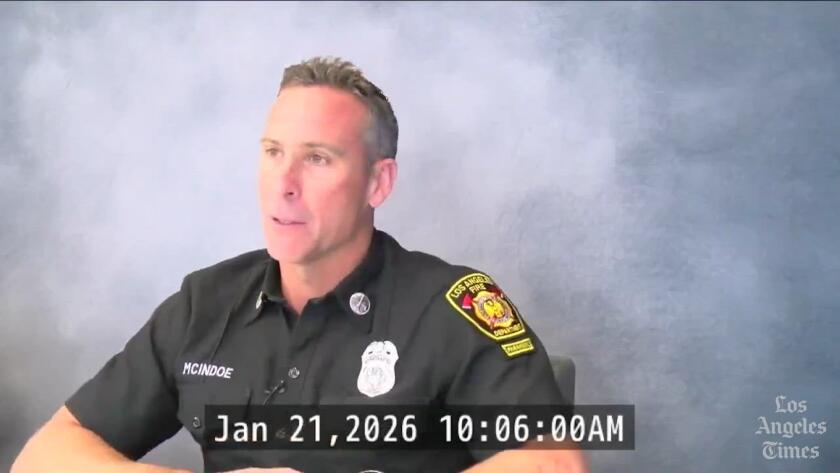
Early in Michael McIndoe’s shift on Jan. 2, 2025, his crew got their marching orders: Pick up hoses left overnight at the scene of the Lachman fire.

McIndoe, a captain at Fire Station 69 in Pacific Palisades, didn’t think the plan was a good idea, he said in sworn testimony obtained by The Times. He had read the National Weather Service’s forecast for the day — temperatures were expected to be warmer — and handling any lingering hot spots would be easier with hoses in place.

While he was still at the station, he said, he relayed his concerns by phone to Battalion Chief Mario Garcia, who was in charge of the operation.

Garcia “said something along the lines of, ‘OK. Let me go check it out, and then I’ll get back to you,’ ” McIndoe testified last month.

Despite the warning, Garcia’s orders never changed, and McIndoe spent a couple hours or so that morning rolling up hose lines.

At one point, McIndoe said, he came across a smoldering ash pit. He retrieved a backpack with water from his engine, sprayed into the ground with a couple gallons of water and dug up the dirt with his hand tool until he was satisfied it was cool.

Days later, amid high winds, embers from the Lachman fire ignited into the Palisades fire, which killed 12 people and destroyed thousands of homes.

McIndoe was one of a dozen Los Angeles firefighters deposed in January in a lawsuit filed by Palisades fire victims against the city and the state. Transcripts and videos of the testimony were released Thursday and Friday, backing up earlier reporting by The Times that crews were ordered to pack up their hoses despite signs that the Lachman fire was not completely out.

One firefighter, Scott Pike, testified that he informed a captain of hot spots and ash pits in the area but that he never received orders to take care of the hazards.

Garcia testified that no one informed him of any concerns about picking up the hoses and that he believed the decision was made before his shift.

The testimony raises questions about why LAFD officials did not address concerns expressed to them about weather conditions and potentially dangerous hot spots that could flare up into another fire. With Pike and McIndoe saying they were following directions from above, and Garcia and the battalion chief from the prior shift appearing to pass the buck to others, it is unclear who made the decision to leave the Lachman fire.

LAFD spokesperson Stephanie Bishop declined to answer the question of who decided to pull the hoses, citing an ongoing investigation. She also would not answer whether officials had identified the captain whom Pike spoke with or determined what the captain did with his concerns.

Pike said he did not know the captain’s name but believed the captain was from Engine 69.

McIndoe testified that he was the captain on Engine 69 that day. In an email Saturday, McIndoe said he was not authorized to speak with the media but wanted to correct the record: “I did not speak to, nor do I recall seeing, Firefighter Pike the day that we picked up hose at the Lachman fire.”

Garcia did not immediately respond to a request for comment. Pike did not respond to a request for comment.

That day, McIndoe testified, he saw Garcia on the hill picking up hoses and brought up their earlier conversation.

“I just went up to him, and I said, ‘Hey, I hope you don’t think I’m just trying to get out of work,’ ” McIndoe said. “And he said, no, that’s — that’s fine. Something along those lines, and that that’s all I can really recall.”

He said he was trying to clarify with Garcia that he believed “that the hose should stay up a little bit longer.”

Garcia testified that when he got to the burn scar, no one raised any concerns about the hose pickup, nor did he see any need to leave the equipment at the site.

He said he thought the decision to pick up the hoses was made before his shift — though he was “not 100 percent sure” — and that it was a “collaborative decision, based off all the information that was received.”

By the time he got up to the burn area, Garcia testified, half the hose had already been picked up. He walked the perimeter to ensure there was a line cut around it and that it was cold, and did not see any smoke or any sign that the fire was not fully extinguished.

“Came across several members,” he said. “Nobody mentioned anything about there being any concerns of any sort.”

Battalion Chief Martin Mullen, who was on duty before Garcia, testified that he walked the perimeter four times and left the hose lines in place overnight as a precaution, keeping two assistant chiefs, Vinny Alvarado and Joseph Everett, in the loop. Mullen said they informed another top chief, Phillip Fligiel.

The hoses could be hooked up again quickly “if something were to happen,” Mullen testified.

Mullen testified that he also notified Garcia: “I told him I left him hose lines in place overnight, you need to walk that and make sure there’s nothing going on up there.”

Mullen, who said he was not involved in deciding when to pick up the hoses, did not immediately respond to a request for comment.

In an email Sunday, Everett said: “I was not present or assigned to that incident. As a result I made no command decisions nor do I have information as to anyones testimony.”

Text messages obtained by The Times through a public records request in December show that Fligiel, Alvarado and Everett were making plans to remove the equipment on Jan. 1. The Lachman fire, which federal prosecutors believe was deliberately set, flared up shortly after midnight on Jan. 1, 2025. A few hours later, at 4:46 a.m., the LAFD announced that it was fully contained at eight acres.

“I imagine it might take all day to get that hose off the hill,” Fligiel said in a group chat early the morning of Jan. 1. “Make sure that plan is coordinated.”

At 1:35 p.m. on Jan. 2, Garcia texted Fligiel and Everett: “All hose and equipment has been picked up.”

Earlier that day, Pike was making troubling observations that led him to think that the entire area needed to be re-investigated. He saw about five smoky areas and ash pits, including one he remembered vividly that was too hot to touch with his gloved hand.

“So I just kicked it with my boot to kind of expose it, and there was, like red hot, like, coals,” he testified. “And I even heard crackling.”

Pike, a 23-year LAFD veteran based at a station in Sunland, was working an overtime shift at Fire Station 23, the LAFD’s second outpost in the Palisades, that day. He relayed his observations to a captain and two firefighters.

“That’s how I approached him, is like, ‘Hey, Cap … We have hot spots in general. We have some ash pits,’ ” Pike testified about his conversation with the captain. “That’s an alert to double-check the whole area and maybe we need to switch our tactics.”

Pike testified that it was not his job “to overstep and tell him what to do. He earned that rank.”

The captain, he said, suggested possibly bringing hand tools or a backpack filled with water up the hill to extinguish any hot spots. Pike went back to picking up the hose while awaiting new orders, which never came.

Pike testified that he felt his colleagues — the captain and two firefighters — blew him off.

“It kind of sits heavy with me that nobody listened to me,” he said.

In his deposition, McIndoe did not recall details about other conversations he had that day.

He was asked by a plaintiffs’ attorney: “Any dialogue with anyone else that you haven’t told me about concerning any of the work that was being done up there at the Lachman fire site, in terms of checking for smokers? Making sure that you got all the hose? Anything like that?”

McIndoe responded: “I don’t recall specific conversations. I think I may have had a conversation with one or two of the other captains that were on scene before we left.”

McIndoe testified that he told that captain — whom he said was from Fire Station 37 — that he thought it would be a good idea to leave the hose out because the warm weather could preheat the ground and bring up smokers, “and it would be nice to have the hose lines in place to address those.”

The Times reported in October that crews were ordered to leave the Lachman fire, even though the ground was still smoldering and rocks were hot to the touch.

In a text message reviewed by The Times, a firefighter who was at the scene wrote that Garcia had been told it was a “bad idea” to leave because of the visible signs of smoking terrain, which crews feared could start a new fire if left unprotected.

“And the rest is history,” the firefighter wrote.

Source link

L.A. firefighter testifies that Lachman fire was not fully put out when crews were ordered to leave

A Los Angeles firefighter said in sworn testimony that he sounded the alarm about the inadequate mop-up of the Lachman fire — and was blown off by a captain — days before the embers reignited into the deadly Palisades fire.

The firefighter, Scott Pike, testified last month in a lawsuit brought by Palisades fire victims against the city and the state.

Pike, a 23-year LAFD veteran normally assigned to a station in Sunland, was working an overtime shift on Jan. 2 when he was assigned to pick up the hoses from the Lachman fire. But he said he saw about five areas that were still smoking.

At one ash pit, he said, “I didn’t even want to use my gloved hand because it was hot. So I just kicked it with my boot to kind of expose it, and there was, like red hot, like, coals … that was still smoldering. And I even heard crackling.”

  • Share via

Pike’s dramatic retelling, which city attorneys initially blocked from release along with transcripts of deposition testimony from 11 other firefighters, corroborates previous reporting by The Times that a battalion chief ordered crews to pack up their hoses and leave, despite signs that the earlier fire was not completely extinguished.

Pike testified that when he reported his observations to other firefighters at the scene, “I felt like I kind of got blown off a little bit.”

Then he tried the captain.

“That’s how I approached him, is like, ‘Hey, Cap … We have hot spots in general. We have some ash pits,’” Pike said of the captain on the scene, whose name he did not know. “That’s an alert to double-check the whole area and maybe we need to switch our tactics.”

Pike testified that it was not his job “to overstep and tell him what to do. He earned that rank.”

The other firefighters, too, seemed eager to “just get this hose picked up,” Pike said, adding that he was working overtime the day after a holiday “because nobody else wanted to work it.”

“It kind of sits heavy with me that nobody listened to me,” he said.

LAFD commanders have insisted that the flames were completely out and barely mentioned the earlier fire in an after-action review report designed to examine mistakes and prevent them from happening again.

Pike said in his testimony that he was never interviewed for the after-action report.

After the firefighters testified over the course of three weeks, city attorneys invoked a general protective order that any party in the litigation can designate testimony as confidential for up to 30 days. A city attorney previously told The Times that this allowed them to review the testimony and determine which parts, if any, should stay confidential.

Days after the firefighters left the scene, high winds reignited the embers into the inferno that destroyed much of Pacific Palisades and killed 12 people.

Alex Robertson, an attorney representing the Palisades fire victims in the lawsuit, said the 11 other firefighters who were deposed testified that the fire was out and that they did not see hot spots or smoldering.

“Only one of the firefighters we deposed had the courage to tell the truth — that his fellow firefighters and captain ignored his warnings that the fire had not been fully extinguished,” Robertson said.

The fire victims allege that the state government, which owns Topanga State Park, failed in the week between the two fires to inspect the burn scar after firefighters left and make sure a “dangerous condition” did not exist on its property.

The LAFD was responsible for putting out the fire, but plaintiffs’ attorneys argue that the state should have done more to monitor the burn scar and ensure the area was safe.

Several California State Parks representatives also testified in the case. Their testimony and text messages show that their initial concern was whether the fire was on parkland and whether firefighting efforts and equipment would harm federally endangered plants and artifacts.

The Times report about crews being ordered to leave the earlier fire, published Oct. 30, described text messages from firefighters indicating that at the scene of the Lachman fire on Jan. 2, 2025, the ground was still smoldering and rocks were hot to the touch.

In one text message, a firefighter who was at the scene wrote that the battalion chief had been told it was a “bad idea” to leave because of the visible signs of smoking terrain, which crews feared could start a new fire if left unprotected.

“And the rest is history,” the firefighter wrote.

A second firefighter was told that tree stumps were still hot when the crew packed up and left, according to the texts. And a third firefighter said last month that crew members were upset when told to pack up and leave but that they could not ignore orders, according to the texts. The third firefighter also wrote that he and his colleagues knew immediately that the Palisades fire was a rekindle of the Jan. 1 blaze.

LAFD officials were emphatic early on that the Lachman fire, which federal prosecutors believe was deliberately set, was fully extinguished.

“We won’t leave a fire that has any hot spots,” Kristin Crowley, the fire chief at the time, said at a community meeting Jan. 16, 2025.

“That fire was dead out,” Chief Deputy Joe Everett said at the same meeting, adding that he was out of town but communicating with the incident commander. “If it is determined that was the cause, it would be a phenomenon.”

The Lachman fire broke out shortly after midnight on New Years Day. A few hours later, at 4:46 a.m., the LAFD announced that the blaze was fully contained at eight acres.

Top fire commanders soon made plans to finish mopping up the scene and to leave with their equipment, according to another set of text messages obtained by The Times through a state Public Records Act request.

“I imagine it might take all day to get that hose off the hill,” LAFD Chief Deputy Phillip Fligiel said in a group chat early the morning of Jan. 1. “Make sure that plan is coordinated.”

At 1:35 p.m. on Jan. 2, Battalion Chief Mario Garcia — whom firefighters said had received the observations about the smoldering ground and hot rocks, according to the private text messages The Times reviewed — texted Fligiel and Everett: “All hose and equipment has been picked up.”

Five days after that, on the morning of Jan. 7, an LAFD captain called Fire Station 23 to say that the Lachman fire had started up again.

In June, LAFD Battalion Chief Nick Ferrari had told a high-ranking fire official who works for a different agency in the L.A. region that LAFD officials knew about the firefighters’ complaints at the Lachman fire scene, The Times also reported.

After the Oct. 30 Times report, Bass directed Fire Chief Jaime Moore, who started the job in November, to commission an independent investigation into the LAFD’s handling of the Lachman fire.

In an interview last month, Moore said he opened an internal investigation into the Lachman fire through the LAFD’s Professional Standards Division, which probes complaints against department members. He said he requested the Fire Safety Research Institute, which is reviewing last January’s wildfires at the request of Gov. Gavin Newsom, to include the Lachman fire as part of its analysis, and the institute agreed. Moore also pointed to the L.A. City Council’s move to hire an outside firm to examine the Lachman and Palisades fires.

Even with the internal investigation underway, Moore said he spoke with the battalion chief who was on duty during the Lachman fire mop-up.

“He swears to me that nobody ever told him verbally or through a text message that there was any hot spots,” Moore said.

Source link