Koreans

Wu’er Kaixi warns South Koreans on North Korea

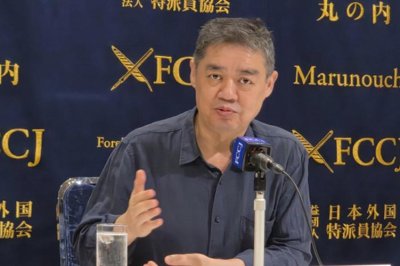
Wu’er Kaixi, a former student leader of the 1989 Tiananmen pro-democracy movement, speaks at a news conference at the Foreign Correspondents’ Club of Japan in Tokyo on Wednesday. Photo by Asia Today

June 3 (Asia Today) — Wu’er Kaixi, a former student leader of China’s 1989 Tiananmen pro-democracy movement, warned South Koreans on Wednesday not to view North Korea only as a country of the same ethnic people.

“North Koreans are certainly Koreans. They speak the same language and eat the same food,” Wu’er said at a news conference at the Foreign Correspondents’ Club of Japan in Tokyo, one day before the anniversary of the June 4 Tiananmen crackdown. “But they have been affected by the disease of communism, and that influence has seeped into their bones and DNA.”

Wu’er, also known as Uerkesh Davlet, was listed by the club as a former student leader of the 1989 Tiananmen movement for its Wednesday news conference, titled “Tiananmen 37 Years Later.”

Asia Today asked Wu’er about the future of China and what it could mean for the Korean Peninsula, noting China’s influence on the Korean War, the division of the peninsula and North Korea’s nuclear issue.

Wu’er responded by directly addressing North Korea.

“I understand that Koreans dream of unification,” he said. “But that is not simply a matter of meeting lost brothers and sisters again. It is the process of rebuilding half of a country that has been affected by communism.”

Wu’er expressed concern about what he described as a nationalist approach within parts of South Korean society.

“When I talk with friends in Seoul, I often sense conservative and nationalist sentiment,” he said. “I fully understand such feelings because South Korea has faced North Korea’s military threat directly.”

“But South Koreans who enjoy liberal democracy should have a mindset of using that freedom for the freedom of North Koreans,” he said.

Wu’er also warned against accepting North Korean propaganda at face value.

“North Korea’s military threats are calculated actions,” he said. “You should not be misled by the nationalist slogans they put forward.”

He said propaganda is used to control hungry citizens.

“North Koreans are still hungry, but they are ruled by regime propaganda,” Wu’er said.

“North Korea is no longer the North Korea we think of,” he said. “If one day South Koreans have the chance to embrace North Koreans, they will realize they are no longer the brothers and sisters they remember from the past.”

“They may be closer to Russians or Chinese,” he said. “You have to understand how a communist system changes human beings and society.”

Wu’er said South Korea’s government and people should understand the nature of the Chinese Communist Party system when considering North Korea.

During the news conference, Wu’er sharply criticized the Chinese Communist Party, saying many people mistakenly view China as a state driven by nationalism or communist ideology.

“The Chinese Communist Party is simply a criminal group,” he said. “They are not pursuing the interests of the state or the rejuvenation of the Chinese nation. They are only interested in maintaining their own power and wealth.”

He dismissed Chinese President Xi Jinping’s slogan of “the great rejuvenation of the Chinese nation” as propaganda meant to deceive the Chinese people.

“The Chinese Communist Party is driven more by interests than ideology,” Wu’er said. “Like a criminal organization seeking more profits, it endlessly tries to expand power and control.”

“To understand China, ask a criminologist rather than an international politics scholar,” he said. “If you approach it through the behavior of a criminal group, you can understand China’s foreign policy much more accurately.”

Wu’er said the Chinese Communist Party “is never satisfied” and urged liberal democracies to respond firmly as Beijing seeks to expand its control and influence.

— Reported by Asia Today; translated by UPI

© Asia Today. Unauthorized reproduction or redistribution prohibited.

Original Korean report: https://www.asiatoday.co.kr/kn/view.php?key=20260603010001047

Source link

2 S. Koreans seized on Gaza-bound aid vessels return home

Activists Kim Ah-hyun (L) and Kim Dong-hyeon speak to reporters at Incheon International Airport on Friday following their release after being captured by Israeli forces aboard Gaza-bound aid flotillas. Photo by Yonhap

Two South Korean activists returned home Friday after being released by Israeli forces that had captured them aboard aid vessels bound for the Gaza Strip.

Kim Ah-hyun was aboard an aid vessel seized by Israeli forces in waters off the Gaza Strip, while Kim Dong-hyeon’s ship was intercepted near Cyprus — both earlier this week.

They were released Wednesday and flew home together, arriving at Incheon International Airport, west of Seoul, at 6:24 a.m.

“Many people are dying not only from bombings, but also from starvation,” Kim Ah-hyun told reporters at the airport. “Because there are people there, I thought that I had to attempt the voyage again, no matter how dangerous the situation in the Middle East was.”

The activist had earlier attempted to enter the territory via an aid flotilla in October without authorization. She had been detained by Israeli forces during her first attempt and was later released.

Before her latest attempt, the South Korean government had revoked her passport.

The activist claimed she had been assaulted by Israeli forces in the face after her latest capture and that she couldn’t hear properly in her left ear.

Kim Dong-hyeon, the other activist, said Israeli forces had “tortured” the activists, claiming they had suffered “unendurable violence.”

Israel has faced criticism following the release of images of captured activists kneeling on the ground with their hands bound.

On Wednesday, President Lee Jae Myung criticized Israel’s seizure of the vessels, accusing the country of violating international rules as the ships were not in Israel’s territorial waters when they were seized.

Copyright (c) Yonhap News Agency prohibits its content from being redistributed or reprinted without consent, and forbids the content from being learned and used by artificial intelligence systems.

Source link

Most young South Koreans distrust election polls, survey finds

1 of 2 | Employees of the National Election Commission take part in a campaign in Ilsan, just outside of Seoul, South Korea, 26 April 2026, to encourage voter participation in the June 3 general election. Photo by YONHAP / EPA

May 19 (Asia Today) — More than 60% of young South Koreans and college students do not trust elections or political opinion polls, according to a survey released ahead of the June 3 local elections.

The Korean Law Consumers Federation, a legal advocacy group, released the results Monday after surveying 1,201 young people and college students from 119 universities nationwide. The respondents had an average age of 23.4.

The survey found that 60.37% of respondents said they do not trust elections or political opinion polls, while 38.80% said they do.

Despite the distrust, 59.95% said they would definitely vote in the local elections, and 35.89% said they would try to vote.

Asked whether one vote can have an important effect on election results, 75.27% agreed, while 24.56% disagreed.

On early voting, 53.54% said there is a possibility of election fraud, while 40.30% said such claims are completely false.

The survey also asked about possible constitutional revisions. A total of 62.28% supported including language related to the May 18 Gwangju Democratization Movement in the Constitution, while 35.97% opposed the idea.

However, 91.01% opposed removing the word “freedom” from the Constitution.

The survey included 53 questions and was conducted with the help of student volunteers. It had a margin of error of plus or minus 2.83 percentage points at a 95% confidence level.

— Reported by Asia Today; translated by UPI

© Asia Today. Unauthorized reproduction or redistribution prohibited.

Original Korean report: https://www.asiatoday.co.kr/kn/view.php?key=20260519010005434

Source link

Majority of S. Koreans back raising senior age to 70: poll

A majority of South Koreans support raising the country’s senior age threshold to 70 from the current 65, a survey showed Friday. In this file photo, attendees take part in a Senior Citizens’ Day ceremony in Seoul on October 2, 2025. File Photo by Yonhap

A majority of South Koreans support raising the country’s senior age threshold to 70 from the current 65, a survey by Gallup Korea showed Friday.

The survey, conducted from Tuesday to Thursday on 1,002 adults aged 18 and older, found that 59 percent of respondents favored raising the eligibility age for senior benefits.

Opposition stood at 30 percent, while 12 percent either declined to answer or said they were unsure.

In similar surveys conducted in 2015 and 2023, 46 percent and 60 percent of respondents, respectively, backed raising the threshold.

The poll also found 60 percent of respondents believe individuals should be primarily responsible for their own livelihood in old age.

By contrast, 29 percent said the government and society should take responsibility, while 4 percent said such responsibility fell on their offspring and 3 percent chose other options.

Across all age groups, more than half said individuals should take primary responsibility for their retirement.

Copyright (c) Yonhap News Agency prohibits its content from being redistributed or reprinted without consent, and forbids the content from being learned and used by artificial intelligence systems.

Source link

South Koreans split with experts on North Korea website access

A foreign journalist who covered North Korea’s Punggye-ri nuclear test site demolition reads the Rodong Sinmun, the official newspaper of the country’s Workers’ Party, on a North Korean chartered flight heading to Beijing, China. File. Photo by YONHAP / EPA

April 24 (Asia Today) — Nearly two-thirds of South Koreans oppose allowing access to North Korean websites, while most experts support the idea, the Presidential Advisory Council on Democratic and Peaceful Unification said Friday.

According to the council’s first-quarter public opinion survey on unification, 63.6% of respondents said they did not agree with a proposal to allow access to North Korean websites to help the public better understand North Korean society.

In contrast, 71.3% of 149 experts on unification and North Korea issues said they supported the proposal, showing a sharp gap between the general public and specialists.

The survey also found that 59.2% of respondents supported President Lee Jae-myung’s proposal, presented in a March 1 Independence Movement Day speech, to ease tensions between the two Koreas and work with relevant countries to transform the armistice system into a peace regime.

A separate 61.6% said they supported continuing the government’s policy of peaceful coexistence on the Korean Peninsula.

On the need for reunification, 65.9% said it was necessary, down 2.1 percentage points from the previous quarterly survey. Respondents cited eliminating the threat of war, at 29.2%, and economic development, at 26.3%, as the top reasons for reunification.

Views were mixed on North Korea’s “two hostile states” doctrine.

Among respondents, 27.7% said they do not recognize the North Korean regime but recognize inter-state relations with the North. Another 24.9% said they recognize both the North Korean regime and inter-state relations.

A separate 24% said they recognize neither the North Korean regime nor inter-state relations, while 16.7% said they recognize the regime but do not recognize inter-state relations.

The survey was conducted by Korea Research from March 27-29 on 1,200 adults nationwide. It had a confidence level of 95% and a margin of error of plus or minus 2.83 percentage points.

— Reported by Asia Today; translated by UPI

© Asia Today. Unauthorized reproduction or redistribution prohibited.

Original Korean report: https://www.asiatoday.co.kr/kn/view.php?key=20260424010007858

Source link