Dodgers Dugout: Another year, another division title; Farewell Ryan Ward, we hardly knew ye
Hi, and welcome to another edition of Dodgers Dugout. My name is Houston Mitchell. Thirteen division titles in 14 seasons, and in the year they didn’t win, they had 106 victories. We don’t have a lot to complain about.
Division titles and Ryan Ward
—The Dodgers won the division title again, clinching it Thursday with their win over the Reds. Remember the olden days of yesteryear when winning the division was a huge deal? Now it is blasé. Dodgers fans live in a time where they have an embarrassment of riches,
Let’s look at how many NL West titles each team has won since divisional play began in 1969:
Dodgers, 24
San Francisco, 9
Cincinnati, 7
Arizona, 5
Atlanta, 5
San Diego, 5
Houston, 2
There was no official winner in 1994, which was ended by a labor dispute.
I guess I’m feeling extra nostalgic today, but I remember growing up the Dodgers’ biggest divisional rival was the Cincinnati Reds, who moved to the Central division in 1994 and have since won a grand total of zero division titles.
If we narrow NL West titles since 2000, we get:
Dodgers, 16
San Francisco, 5
Arizona, 4
San Diego, 2
Poor Colorado.
—The Dodgers made room for pitcher Kris Bubic on the 40-man roster by designating outfielder Ryan Ward for assignment. Ward has been a favorite of newsletter readers for a couple of seasons now, but he really had no place on the team anymore. He’s too old (28) to really be a prospect and his best triple-A season came in his third season at that level. His numbers declined in triple-A this season (you can see his numbers here).
He’s not great defensively, and the team already has corner outfielders who aren’t great defensively. They passed him over for Josue De Paula when they needed someone to fill in for Shohei Ohtani, and there are several outfielders in the system who are considered better than Ward.
In all likelihood, another team will pick him up and give him more playing time in the majors, something he wasn’t going to get with the Dodgers. Hopefully we see him next season in the “There names seem familiar” section of this newsletter.
Evidence of Dave Roberts’ growth
One of the knocks on Dave Roberts has always been his poor postseason managing. But his postseason managing has dramatically improved the last few seasons, and I’m not just saying that because they won the last two World Series. His decisions appear to not always be guided by analytics, like they are during the regular season. And it appears Roberts has indeed learned some things during his tenure. He recently appeared on the 6-1-1 podcast, hosted by former major leaguers Ryan Howard and Jimmy Rollins, and had this to say:
“When you’re talking about winning 11 games in October, I couldn’t believe more that it’s about people, and players you can bet on,” Roberts said. “The heartbeat that the analytics doesn’t line up with. I think that early on, my mistake was I continued to use that same method of the regular season in the postseason….
He also had high praise for two of his players.
“Mookie has said to me, ‘Doc, we wouldn’t have won the World Series if it wasn’t for Shohei and Yamamoto. And his point was, the discipline that they had every single day, how they worked with intention every single day … it raised the level even higher for our guys.”
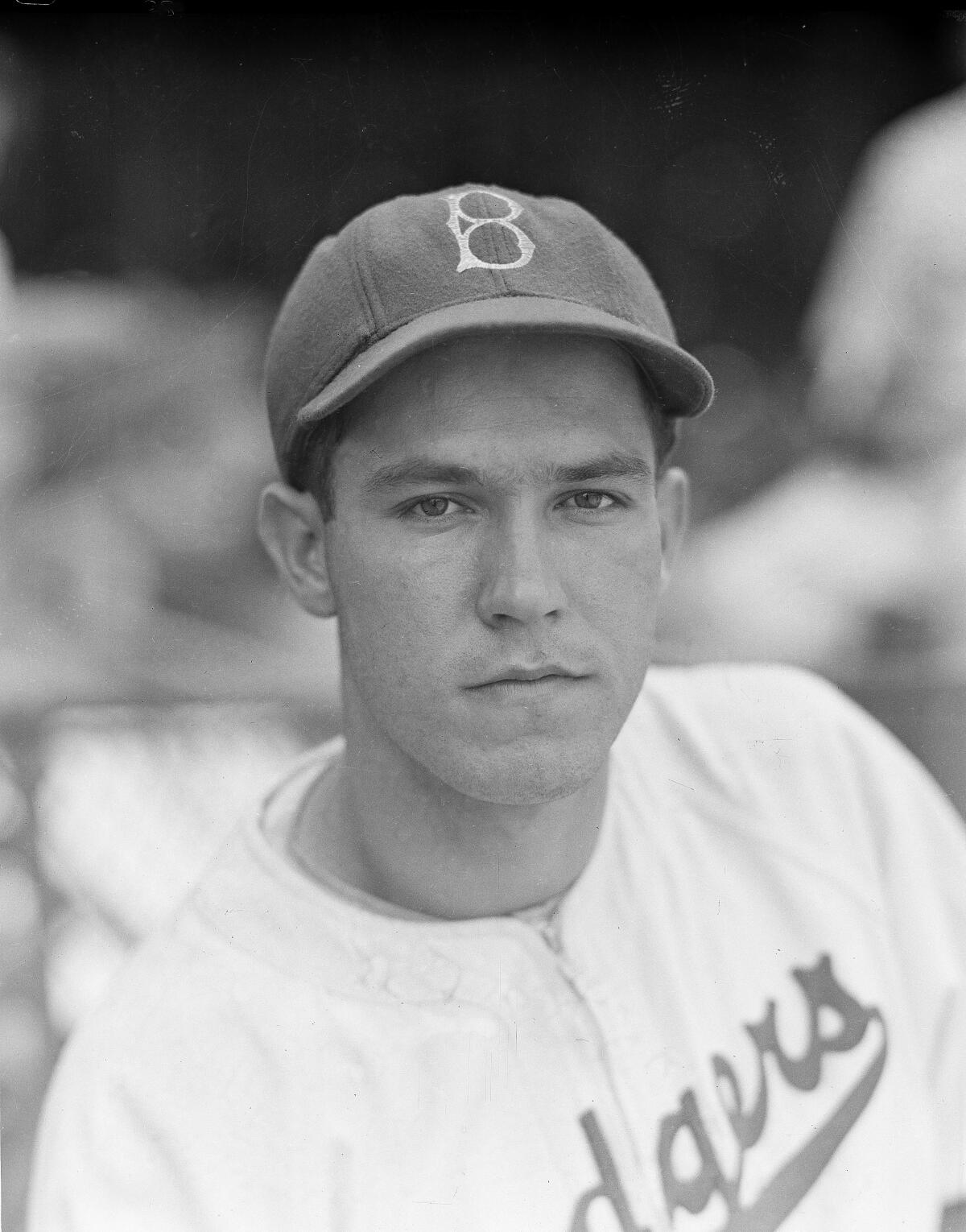
Forgotten Dodger: Pete Reiser

Pete Reiser in 1941.
(Associated Press)
Pete Reiser never met an outfield fence he didn’t like crashing into and it may have cost him a Hall of Fame career.
Harold Patrick Reiser was born on March 17, 1919, in St. Louis. He loved westerns and as a child often walked around wearing a cowboy hat and carrying toy guns, so people started calling him Pistol Pete, which stuck with him throughout his baseball career.
After playing in 58 games with the Dodgers in 1940, Reiser came into his own in 1941 when he hit a league-leading .343 to go with 117 runs, 39 doubles, 17 triples, 14 homers and 76 RBIs. He also played great defense in center. That got him second place in NL MVP voting behind teammate Dolph Camilli (Reiser should have won). Reiser led the league in nine categories.
He followed that by hitting .310 with 33 doubles and 10 homers in 1942, leading the league with 20 steals and making his second straight All-Star team. However, on July 18 of that year, he crashed full speed into the center-field fence, which was made of concrete, while chasing a fly ball. He ended up with a separated shoulder and fractured skull. In those days though, you didn’t let little things like a fractured skull slow you down. He returned to the lineup a week later, but he wasn’t the same. He hit .244 the rest of the season.
He then enlisted in the Army and spent three years there. In 1944, after a long march in below-zero weather, Reiser was diagnosed with pneumonia. The Army decided to put him in Fort Riley, Kan., so he could play for the camp’s baseball team. With Reiser on the team, they were virtually unbeatable and Reiser was given his own room and excused from all other duties.
Reiser returned to the majors in 1946 and broke his leg while stealing second. He crashed into the fence in St. Louis and missed some time. But he still led the league with 34 steals, though his batting average dropped to .277.
In 1947, he was chasing another fly ball when he crashed into the wall face first. This caused another fractured skull. He was given the Last Rites by a priest in the hospital before making a miraculous recovery. He ended up playing 110 games that season.
He was a bench player the following season, as he had put on a little weight and had been slowed tremendously by his numerous injuries. The Dodgers traded him to the Boston Braves after the season for Nanny Fernandez and Mike McCormick.
By unofficial count, Reiser’s injuries over the years included four fracture skulls, multiple dislocated shoulders, two broken ankles, torn ligaments in both knees and and two beanings. He was carried off the field on a stretcher eleven times—five times when he was unconscious.
He retired after the 1952 season and came back to the Dodger organization as a roving minor-league hitting instructor. He joined Walter Alston’s coaching staff in L.A. in 1960 and helped tutor Maury Wills on how to steal bases. In an interview with this newsletter a few years ago, Wills made sure to give praise to Reiser as being a big part of his 104-steal season.
Reiser had a heart attack in 1965, went on to coach for other teams. He smoked a pack of cigarettes a day throughout his adult life and died of emphysema in Palm Springs in 1981. He was only 62.
The postseason race
Here are the postseason seedings as of Thursday’s games. The three division winners get the top three seeds, followed by the three teams with the best records. The top two division winners get a first-round bye. Milwaukee and the Dodgers have clinched division titles.
Division leaders
1. Milwaukee, 95-58
2. Dodgers, 93-60, 2 GB
3. Atlanta, 89-64, 6 GB
Wild cards
1. Chicago, 85-68
2. Philadelphia, 85-68
3. San Diego, 84-69
4. Arizona, 80-73, 4 GB
Remember, there are no extra games to break ties anymore. It all comes down to tiebreakers. Atlanta and Milwaukee have the tiebreaker over the Dodgers. For the wild card, the Cubs have the advantage over the Phillies, having won six of seven games against each other. The Diamondbacks and Padres have split 10 games, but their final three games this season are against each other, so that very well could determine the final wild-card spot.
These names seem familiar
How notable players who were with the Dodgers the last couple of seasons are doing with their new teams (through Wednesday). Click on the player’s name to be taken to their full stats page:
Anthony Banda, Twins: 2-0, 4.46 ERA, 2 saves, 34.1 IP, 31 hits, 15 walks, 33 K’s, 95 ERA+, out for the season
Cody Bellinger, Yankees: .276/.351/.444, 533 PA’s, 25 doubles, 3 triples, 16 homers, 71 RBIs, 121 OPS+
Walker Buehler, Padres: 8-6, 4.58 ERA, 143.1 IP, 142 hits, 54 walks, 122 K’s, 88 ERA+
Mike Busch, Cubs: .238/.347/.393, 671 PA’s, 27 doubles, 2 triples, 19 homers, 76 RBIs, 104 OPS+
Michael Conforto, Cubs: .238/.336/.471, 286 PA’s, 15 doubles, 14 homers, 43 RBIs, 120 OPS+
Justin Dean, Cubs: .375/.500/.625, 10 PA’s, 1 triple, 3 RBIs, 209 OPS+, in the minors
Caleb Ferguson, Cardinals: 1-0, 5.18 ERA, 1 save, 33 IP, 37 hits, 19 walks, 31 K’s, 81 ERA+, released by Cardinals
Jack Flaherty, Tigers: 3-8, 4.59 ERA, 86.1 IP, 80 hits, 42 walks, 102 K’s, 92 ERA+, on the IL
Kenley Jansen, Tigers: 4-6, 3.43 ERA, 20 saves, 42 IP, 24 hits, 23 walks, 48 K’s, 123 ERA+
Craig Kimbrel, Royals: 1-5, 4.50 ERA, 1 save, 46 IP, 40 hits, 22 walks, 40 K’s, 94 ERA+
Gavin Lux, Rays: on the IL
Dustin May, Brewers: 7-9, 4.49 ERA, 138.1 IP, 132 hits, 46 walks, 133 K’s, 88 ERA+
Zach McKinstry, Tigers: .204/.289/.301, 411 PA’s, 15 doubles, 4 triples, 4 homers, 26 RBIs, 66 OPS+
James Outman, Tigers: .172/.235/.318, 157 PA’s, 4 doubles, 2 triples, 5 homers, 17 RBIs, 54 OPS+, in the minors
Joc Pederson, Rangers: .235/.329/.487, 432 PA’s, 12 doubles, 2 triples, 26 homers, 53 RBIs, 134 OPS+
Luke Raley, Mariners: .225/.284/.439, 287 PA’s, 9 doubles, 1 triple, 15 homers, 39 RBIs, 105 OPS+, on the IL
Corey Seager, Rangers: .234/.326/.436, 393 PA’s, 15 doubles, 18 homers, 46 RBIs, 120 OPS+
Justin Turner, Tijuana (Mexican League): .295/.395/.469, 263 PA’s, 21 doubles, 6 homers, 28 RBIs. Tijuana won the Mexican League title on Tuesday.
Trea Turner, Phillies: .240/.292/.382, 654 PA’s, 27 doubles, 1 triple, 19 homers, 57 RBIs, 79 OPS+
Miguel Vargas, White Sox: .249/.357/.473, 662 PA’s, 30 doubles, 1 triple, 31 homers, 84 RBIs, 131 OPS+
Kirby Yates, Pirates: 2-5, 3.40 ERA, 3 saves, 39.2 IP, 31 hits, 17 walks, 47 K’s, 125 ERA+, on the IL
Up next
Friday: San Francisco (*Cesar Perdomo, 0-1, 3.68 ERA) at Dodgers (Tyler Glasnow, 4-1, 3.50 ERA), 7:15 p.m., Apple TV, AM 570, KTNQ 1020
Saturday: San Francisco (TBD) at Dodgers (*Tarik Skubal, 10-7, 2.70 ERA [3-2, 2.52 ERA with Dodgers]), 6:10 p.m., SportsNet LA, AM 570, KTNQ 1020
Sunday: San Francisco (TBD) at Dodgers (TBD), 1:10 p.m., SportsNet LA, AM 570, KTNQ 1020
All times Pacific
*-left-handed
In case you missed it
Dodgers clinch 13th NL West division title in 14 years: ‘Something I know we can build on’
Plaschke: No more bubbly — NL West champion Dodgers appear headed for early fall
Dodgers co-owners Mark Walter, Todd Boehly sell Chelsea shares
Dodgers might be forced to leave Edwin Díaz off postseason roster
And finally
Vin Scully is amazed by Clayton Kershaw‘s curveball. Watch and listen here.
Until next time …
Have a comment or something you’d like to see in a future Dodgers newsletter? Email me at houston.mitchell@latimes.com. To get this newsletter in your inbox, click here.