KickedOff

Hunt For “AWACS Killer” Anti-Radiation Missile Kicked-Off By Navy

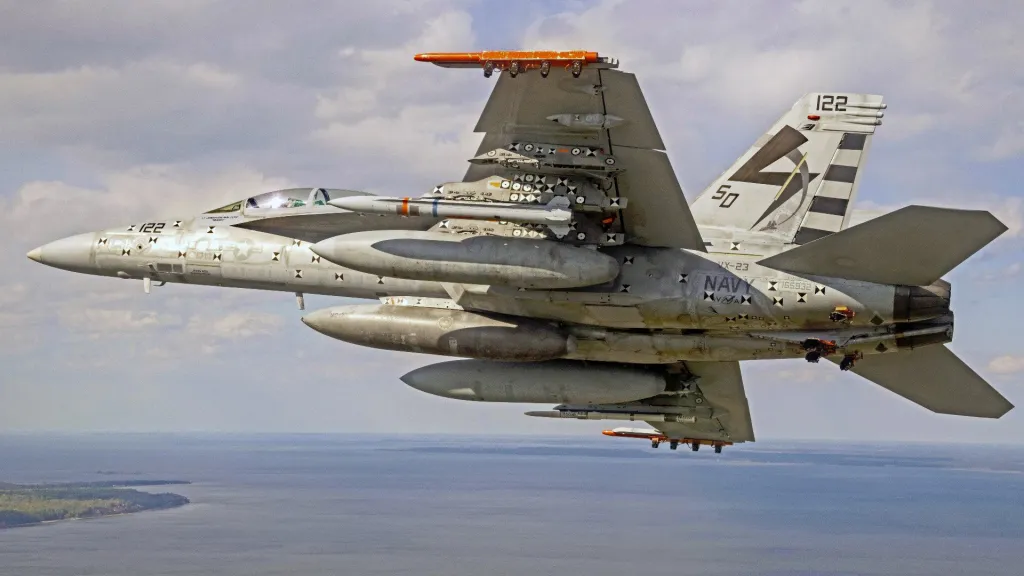
The U.S. Navy is exploring options for a new long-range anti-radiation missile designed to home in on radars to help neutralize enemy air defense networks. The capabilities the service wants for this Advanced Emission Suppression Missile (AESM) sound curiously similar to the ones it is already working to acquire through the AGM-88G Advanced Anti-Radiation Guided Missile-Extended Range (AARGM-ER). There is one crucial difference: the AESM needs to be able to engage targets in the air, as well as on the ground. This would give the Navy a single missile it could use to attack critical airborne early warning and control planes, as well as potentially other aerial targets, and air defenses down below.

Naval Air Systems Command’s (NAVAIR) Program Executive Office for Unmanned Aviation and Strike Weapons (PEO U&W) recently put out a contracting notice regarding the AESM.

A Super Hornet seen with an AGM-88G AARGM-ER under its left wing during a flight test. USN

NAVAIR is “conducting market research to identify potential sources capable of providing an advanced, anti-radiation guided missile weapon system, or key subsystems thereof, with a longer range than existing in the Navy’s current inventory, including associated engineering, manufacturing, testing, and logistics support,” the notice explains. “This All Up Round (AUR) must be compatible with existing launch platforms (e.g. F-18, F-35) and infrastructure currently supporting the Navy and Air Force’s existing inventory of anti-radiation guided missiles.”

The notice later elaborates that AESM needs to be compatible, at least, with the F/A-18E/F Super Hornet, EA-18G Growler, and F-35 Joint Strike Fighter. It is unclear whether “existing inventory of anti-radiation guided missiles” includes the AARGM-ER, which is a substantial new evolution of the AGM-88 design and is still under development. TWZ has reached out to NAVAIR for more information.

A NAVAIR graphic offering a very general comparison between the new AGM-88G AARGM-ER and the preceding AGM-88E AARGM. USN

“NAVAIR is seeking to enhance its capabilities to suppress and neutralize enemy air defenses in contested environments,” the AESM notice adds. “This effort aims to identify and potentially acquire a weapon system that provides similar or improved capabilities compared to its current weapons inventory, focusing on extended range, advanced targeting, counter-countermeasures, and integration with existing and future platforms.”

No specific range requirement is included in the notice beyond that AESM needs to be capable of “engaging targets at significant standoff distances.” The missile also needs to have an “advanced anti-radiation seeker with broad frequency coverage,” the “ability to target modern and advanced radar systems,” a “precision navigation and guidance system (e.g., GPS/INS with anti-jamming capabilities),” and the “potential for pre-emptive targeting capabilities.”

Much of this sounds, at least in broad strokes, like the requirements for the AGM-88G. “The AARGM-ER incorporates hardware and software modifications to improve AGM-88E AARGM capabilities to include extended range, survivability and effectiveness against future threats,” according to NAVAIR’s own website.

Another NAVAIR graphic with additional details about the AGM-88G AARGM-ER. USN

However, as noted, the requirements laid out in the AESM notice notably differ from those for AARGM-ER in one key respect: the explicit call for anti-air engagement capability. Prospective offers are required to “describe ability to engage air-to-air and air-to-ground targets.”

AESM also needs to have “robust ECCM [electronic counter-countermeasures] capabilities to defeat enemy countermeasures, including chaff, flares, jamming and anti-ARM [anti-radiation missile] techniques.” This might also point further to emphasis on the air-to-air role. Radar blinding chaff and infrared decoy flares are countermeasures typically associated with the air and naval domains.

U.S. military interest in very-long-range air-to-air capable anti-radiation missiles traces all the way back to the Cold War, primarily as a means for engaging enemy airborne early warning and control (AEW&C) planes. Anti-air weapons designed around this role are often colloquially referred to as ‘AWACS killers,’ a reference to the U.S. E-3 Sentry Airborne Warning and Control System (AWACS) aircraft. A very-long-range air-to-air missile could be used against other aerial targets, as well.

This is also not the first time the Navy, as well as the U.S. Air Force, has pursued an air-launched weapon that would blend together traditional anti-radiation and air-to-air capabilities. Starting in the mid-2000s, the two services worked together on a single missile to replace the AGM-88 and the AIM-120 Advanced Medium Range Air-to-Air Missile (AMRAAM) dubbed the Joint Dual-Role Air Dominance Missile (JDRADM), which then evolved into the Next Generation Missile (NGM). The NGM effort came to an end, at least publicly, in 2013, ostensibly over high costs. A more secretive parallel development effort, called the Triple Target Terminator (T-3), continued for at least some time afterward. A possible successor to T-3, called the Long Range Engagement Weapon (LREW), emerged in 2017. How far the LREW effort subsequently progressed, and what its current status might be, are unclear.

A rendering that has previously circulated in relation to the LREW program, showing an advanced air-to-air missile being launched from a US Air Force F-22 Raptor. Pentagon

All that being said, the value of an ‘AWACS killer’ missile is clear-cut. AEW&C are critical surveillance and battle management assets. Shooting them down deprives an opponent of those capabilities, inherently reducing their ability to effectively maneuver air assets and share important information, including with other nodes on the ground or at sea, as well as in the air. Knocking out these flying radar stations, which can be especially well-suited to spotting lower flying threats from their high perches, just hampers an enemy’s overall situational awareness.

The issue, of course, is that AEW&C planes typically orbit well behind the front edges of a conflict, creating additional challenges for targeting them. This is where something like AESM could come into play. A weapon of this type could engage other aerial targets by zeroing in on the radiofrequency emissions they pump out. This could include electronic warfare aircraft, and potentially other aerial targets. AESM might be able to take on a more general anti-air role with the addition of an active radar and/or imaging infrared seeker, as well as datalinks allowing for the use of networked targeting data. AARGM and AARGM-ER both feature an active millimeter-wave radar seeker to enable them to hit fleeing ground targets, but a similar concept could be adapted for air-to-air use.

AARGM F-18


For the Navy, as well as other branches of the U.S. military, this is all particularly relevant in the context of a potential future high-end fight with China, which has made major investments in its fleets of AEW&C and electronic warfare planes. The Chinese People’s Liberation Army (PLA) has also been pursuing ever-longer-ranged anti-air missiles, including types that could be used to target American AEW&C platforms, as well as other key support aircraft.

TWZ has previously highlighted much of this in a past feature discussing the use cases for the Navy’s new AIM-174B air-launched version of the Standard Missile 6 (SM-6), which was officially unveiled in 2024. Navy officials have previously hinted at further long-range air-to-air capabilities to come when talking about the AIM-174B.

How The Navy’s New Very Long-Range AIM-174 Will Pierce China’s Anti-Access Bubble


“Clearly we recognize that we’ve got to find opportunities to increase reach and range for our weapons,” Navy Rear Adm. Michael “Buzz” Donnelly, then director of the Air Warfare Division (N98) within the Office of the Chief of Naval Operations, said at the Navy League’s annual Sea Air Space symposium in April 2025. “We’re doing it in air-to-air. We just recently fielded the air-launched SM-6, or the AIM-174, that we’re capable of carrying off the F-18 Super Hornet. And we’ll look at increasing range and incrementing beyond that.”

“That’s [the AIM-174B] an operational capability. And, as you can see, that one being revealed and shown into the area, there are many more behind [it], things that we’re doing there, making sure that we are staying ahead of the conflict, making sure that we’re prepared for the fight that’s going on,” Navy Rear Adm. Keith Hash, head of NAVAIR’s Naval Air Warfare Center Weapons Division (NAWCWD), also said during a panel discussion at the WEST 2025 conference in January 2025. “And those activities and that development is active and strong.”

In addition, the Navy is now working together with the U.S. Air Force on the development of the AIM-260 Joint Advanced Tactical Missile. The AIM-260 is intended as a longer-range and otherwise more capable direct successor to the AIM-120 Advanced Medium Range Air-to-Air Missile (AMRAAM).

A 2025 briefing slide outlining the public portfolio of NAVAIR PEO U&W’s Air-to-Air Missile Office, or PMA-259, including the AIM-260 and AIM-174. USN

As described now, AESM would also offer air-to-surface capabilities in line with a traditional anti-radiation missile in the same package. Even in a future missile ecosystem that also includes the AGM-88G, AIM-174B, and AIM-260, having a single hybrid anti-air/anti-radiation missile would offer extremely useful additional flexibility, especially for addressing threats that might appear unexpectedly in the course of a mission.

One missile capable of being used in those disparate roles could also offer valuable magazine depth benefits, particularly if it has a form factor that allows it to be carried internally by various stealthy crewed aircraft, such as the F-35, and/or advanced combat drones. There had been some speculation that the aforementioned LREW effort, and possibly one or more of its predecessors, had been aiming for a missile that could serve in the anti-radiation and air-to-air roles, and fit inside F-22 and F-35 weapon bays. At the same time, a missile designed to be carried externally could help maximize range, which would be an important consideration for AESM. As an aside, scalable missile concepts have been raised in the past as a way to readily adapt a core design for internal or external carriage.

Altgoether, there is a possibility that AESM requirements could be met by a further variation on the AARGM-ER design. The U.S. Air Force is also already acquiring a more general high-speed strike derivative of that missile called the Stand-In Attack Weapon (SiAW). Prime contractor Northrop Grumman has also proposed a surface-to-surface version called the Advanced Reactive Strike Missile (AReS).

The first SiAW test missile delivered to the US Air Force. Northrop Grumman

The “market research” the Navy is doing now is intended to see what other options might be available. The AESM contracting also highlights the possibility of a weapon that could be further exported to allies and partners. Additional customers could help defray development and acquisition costs, and support production at scale.

Much is still to be learned about the Navy’s plans for AESM, but the Navy certainly seems to have kicked off a new hunt for an ‘AWACS killer’ type missile that could also be used against other targets in the air and on the surface.

Contact the author: joe@twz.com

Joseph has been a member of The War Zone team since early 2017. Prior to that, he was an Associate Editor at War Is Boring, and his byline has appeared in other publications, including Small Arms Review, Small Arms Defense Journal, Reuters, We Are the Mighty, and Task & Purpose.


Source link

Hunt For Container Launchers Packed With Drones Kicked-Off By Pentagon

The entire U.S. military is now pushing to acquire hundreds of thousands, if not millions, of new drones, especially smaller types, in the coming years, spurred on by new direction from the Pentagon. In turn, a demand for new containerized launchers capable of rapidly deploying and, if need be, recovering those uncrewed aerial systems has now emerged. On several occasions in the past, TWZ has called attention to the value of exactly these kinds of launch capabilities, for use on land and at sea, especially for employing fully networked swarms.

Earlier this week, the Pentagon’s Defense Innovation Unit (DIU) laid out broad requirements for what it referred to as a Containerized Autonomous Drone Delivery System (CADDS). DIU’s central focus is on leveraging new and improved commercial-off-the-shelf technologies to help meet U.S. military needs.

“The Department of War (DoW) faces a robotic mass challenge: current methods for deploying and sustaining unmanned aerial systems (UAS) rely on direct human interaction to launch, recover, and refit each system,” the CADDS notice explains. “This 1:1 operator-to-aircraft model limits deployment speed and scale while exposing operators to unnecessary risks.”

A sniper assigned to the Washington National Guard’s 81st Stryker Brigade Combat Team prepares to launch a quadcopter-type drone. US Army/Staff Sgt. Adeline Witherspoon

The “problem” to solve then is that “the DoW requires the ability to deploy large quantities of UAS rapidly, while minimizing the risk and burden to human operators executing kinetic and non-kinetic UAS operations in contested environments,” it adds.

To that end, “DOW seeks innovative solutions that enable the storage, rapid deployment, and management of multi-agent systems to provide either persistent UAS coverage over extended periods or massed effects within a single geographic region and time,” per DIU. It needs to be “employable from land and maritime platforms, in both day and night conditions, and during inclement weather.”

These have to be “designs [that] can be transported by military or commercial vehicles (land, sea, air)” and that “can be quickly positioned and made operational with minimal handling or setup.” They also have to be able to provide “automated functions for drone storage, launching, recovering, and refitting within the containerized platform; the intent is for the system to exist in a dormant state for a period of time and launch UAS upon command.”

DIU does not name any particular drones that the CADDS has to be able to accommodate or say how many UASs a single launcher should be able to hold. The notice does say the system will need to support “homogeneous and heterogeneous mixes of Government-directed UAS.”

The launch system also has to be capable of being set up and broken back down in a time frame measured in minutes and have a small operational footprint. “Ideally, the system should require a crew of no more than 2 personnel,” per DIU.

Another example of the “1:1 operator-to-aircraft model” that DIU says it wants to help get away from using CADDS. US Army

When it comes to the “autonomous” element of the launch system, DIU says it needs to support “both operator-on-the-loop and operator-in-the-loop decision-making processes.”

The market space for containerized launchers for various payloads, and for use on land and at sea, has been steadily growing globally in recent years. There has already been a further trend in the development of such systems for launching loitering munitions and other uncrewed aerial systems, or the adaptation of existing designs to be able to do so.

As one example, in the past year or so, Northrop Grumman has begun touting the ability of what it is currently calling the Modular Payload System (MPS) to launch drones, as seen in the computer-generated video below. TWZ was first to report on the development of that system all the way back in 2018, when it was being presented solely as a way to surface-launch variants of the AGM-88 anti-radiation missile. MPS is also now being pitched as a launcher for the Advanced Reactive Strike Missile (AReS), a surface-to-surface missile derived from the AGM-88G Advanced Anti-radiation Guided Missile-Extended Range (AARGM-ER) and its Stand-in Attack Weapon (SiAW) cousin.

Modular Payload System: Launching from Land or Sea


Last year, another concept for a containerized launcher capable of holding up to 48 drones at once also emerged from Mitsubishi Heavy Industries in Japan. Back in 2024, Germany’s Rheinmetall and UVision in Israel had also unveiled two very similar designs, specifically for launching members of the latter company’s Hero series of loitering munitions.

A rendering of UVision’s containerized launch system loaded on a truck. UVision

This is just a small selection of the designs that have been seen to date. Firms in China have been particularly active in this regard, and developments in that country have often also been tied to work on swarming capabilities.

中国电科陆空协同固定翼无人机“蜂群”系统


中国电科大规模无人机蜂群任务全流程试验


Container-like launchers for uncrewed aerial systems, often mounted on trucks, have already been in service in many countries for years. This includes Iran, where they are used to launch Shahed-type kamikaze drones, as can be seen in the video below.

Баражуючий іранський боєприпас «Shahed 136»


However, many of these systems are focused squarely on the launch aspect and lack the recovery and refit capabilities that DIU has outlined for CADDS. Chinese drone firm DJI and others in the commercial space are increasingly offering container-like ‘docks,’ but which are often designed to accommodate just one uncrewed aerial system at a time.

What is particularly interesting here is how many of the stated CADDS requirements actually sound very similar, at least in very broad strokes, to a containerized system capable of launching, recovering, and recharging thousands of small, electrically-powered quadcopter-type drones at the touch of a button that the Chinese company DAMODA rolled out last year. That launcher, dubbed the Automated Drone Swarm Container System, is for drone light shows for entertainment purposes rather than military use.

Behind the Scenes of DAMODA Automated Drone Swarm Container System.✨


China just dropped a new level of drone swarm tech | One-click auto-deploy of thousands | by DAMODA


Still, as we previously wrote:

It is worth reiterating that DAMODA’s Automated Drone Swarm Container System, at least as it exists now, is clearly designed for entertainment industry use first and foremost. Though the company’s drone light show routines are certainly visually impressive and often go viral on social media, they are pre-scripted and conducted in a very localized fashion. What the company is offering is not a drone swarm capable of performing various military-minded tasks in a highly autonomous manner at appreciable ranges from its launch point.

At the same time, large-scale drone light shows put on by DAMODA (and a growing number of other companies), do highlight, on a broad level, the already highly problematic threats posed by swarms. The new Automated Drone Swarm Container System underscores the additional danger of these same threats hiding in plain sight. The steady proliferation of advances in artificial intelligence and machine learning, especially when it comes to dynamic targeting, will only create additional challenges, as TWZ has explored in detail in this past feature.

This is not theoretical, either. As mentioned, in June [2025], Ukrainian forces launched multiple drone attacks on airbases across Russia with the help of covert launchers loaded on the back of unassuming civilian tractor-trailer trucks. This entire effort was dubbed Operation Spiderweb and took months of planning.

Even in an overt operational context, readily deployable containerized systems capable of acting as hubs for drone operations across a broad area with limited manpower requirements could offer a major boost in capability and capacity. Ships, trucks, and aircraft, which could themselves be uncrewed, could be used to bring them to and from forward locations, even in remote areas. If they can support a “heterogeneous mix” of uncrewed aerial systems, a single container could be used to support a wide array of mission requirements, including intelligence, surveillance, and reconnaissance, electronic warfare, kinetic strikes, and/or communications signal relay.

An inherent benefit of a drone swarm, in general, is that each individual component does not have to be configured to perform all of the desired tasks. This creates additional flexibility and resilience to threats, since the loss of any particular drone does not necessarily preclude the swarm from continuing its assigned missions. There are tangential design and cost benefits for the drones themselves, since they can be configured to carry only the systems required for their particular mission demands.

Army Aviation Launches Autonomous Pack Hunters


TWZ previously laid out a detailed case for the many benefits that could come along with loading containers packed with swarms of drones onto U.S. Navy ships. Many of those arguments are just as relevant when talking about systems designed to be employed on land. Containerized systems are often readily adaptable to both ground-based and maritime applications, to begin with.

Drone swarms are only set to become more capable as advancements in autonomy, especially automated target recognition, continue to progress, driven by parallel developments in artificial intelligence and machine learning, as you can read more about here. Future highly autonomous swarms will be able to execute various mission sets even more efficiently and in ways that compound challenges for defenders. Massed drone attacks with limited autonomy already have an inherent capacity to just overwhelm enemy defenses. In turn, electronic warfare systems and high-power microwave directed energy weapons have steadily emerged as some of the most capable options available to tackle swarms, but have their own limitations. Even powerful microwave systems have very short ranges and are directional in nature, and electronic warfare systems may simply not work at all against autonomous drones.

In terms of what DIU is now looking at for CADDS, the stated requirements are broad. It remains to be seen what options might be submitted, let alone considered for actual operational U.S. military use.

Still, DIU has laid out a real emerging capability gap amid the current push to field various tiers of drones to a degree never before seen across America’s armed forces, which counterinsurgency launch systems look well-positioned to fill.

Contact the author: joe@twz.com

Joseph has been a member of The War Zone team since early 2017. Prior to that, he was an Associate Editor at War Is Boring, and his byline has appeared in other publications, including Small Arms Review, Small Arms Defense Journal, Reuters, We Are the Mighty, and Task & Purpose.


Source link