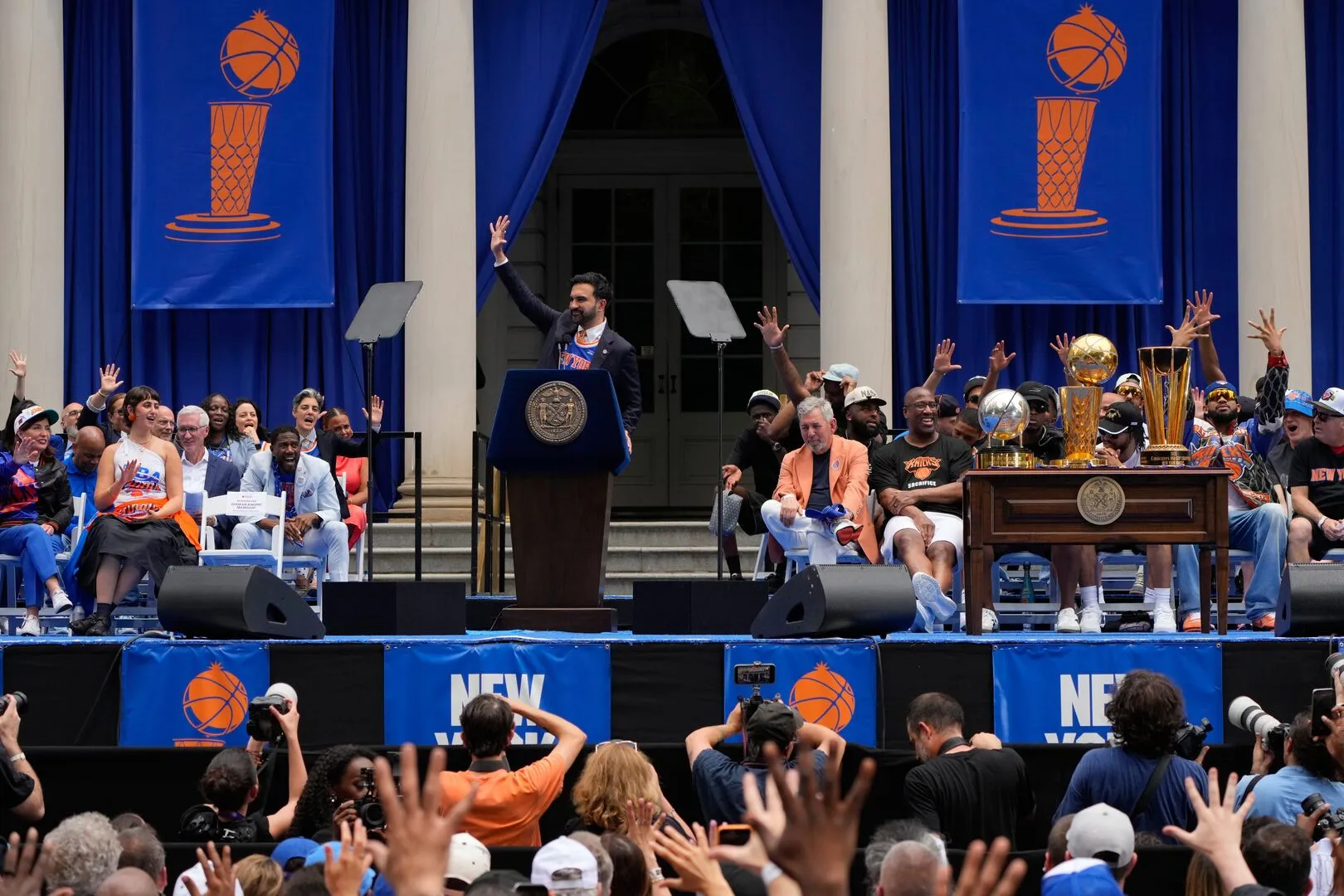
The New York Knicks celebrated their first NBA title in 53 years with a frenzied ticker-tape parade through Manhattan. The Knicks, along with finals MVP Jalen Brunson were awarded keys to the city by Mayor Zohran Mamdani in front of thousands of fans.
“Hell’s Kitchen,” the Alicia Keys musical that has landed at the Hollywood Pantages Theatre in a blaze of rousing sound, deploys the R&B star’s glorious treasure trove of work in the service of a semi-autobiographical version of her coming-of-age story in the Manhattan neighborhood that gives the show its title.
The Hell’s Kitchen of Alicia Keys’ story, set in the 1990s, isn’t the gang-ridden Hell’s Kitchen of West Side Story, set in the 1950s. Keys grew up in Manhattan Plaza, a federally subsidized residential complex that provides affordable housing for artists. But for a teenager in rebellion from her watchful mother, the vibrant, music-filled street life comes with its share of dangers.
Kennedy Caughell as Jersey and Maya Drake as Ali in the North American Tour of Alicia Keys’ “Hell’s Kitchen” at the Hollywood Pantages Theatre.
(Marc J. Franklin)
Ali (Maya Drake, who’s making her professional debut in this North American tour production) is a 17-year-old ready to break out of the cage her mother, Jersey (Kennedy Caughell), has placed her in. Jersey, a single mom, isn’t a tyrant. She just doesn’t want to see her daughter make the same mistakes that she did, namely get pregnant at a young age before she’s had a chance to realize her own dreams.
The book by playwright Kristoffer Diaz (“The Elaborate Entrance of Chad Deity”) is structured around a loving but combustible mother-daughter relationship amid the creative ferment of New York. This artistic neverland is crystallized in the apartment building that has music pouring out of every floor when Ali rides the elevator.
Maya Drake as Ali and the company of the North American Tour of Alicia Keys’ “Hell’s Kitchen” at the Hollywood Pantages Theatre.
(Marc J. Franklin)
The story isn’t the strong suit of “Hell’s Kitchen,” which is powered by Alicia Keys’ versatile catalog, which has been supplemented with original material. The hits — “You Don’t Know My Name,” “Girl on Fire,” “Fallin’,” “If I Ain’t Got You,” “Like You’ll Never See Me Again,” “No One” and “Empire State of Mind,” among them — reverberate inside the Pantages with a thrilling exuberance.
What’s most impressive, however, is the way these tracks have been arranged both musically and dramatically. Jukebox musicals are notorious for shoe-horning in beloved songs without regard for storytelling integrity. “Mamma Mia!,” which crammed in as many ABBA hits as possible, hardly even bothered to find pretext for their inclusion. The lucrative example paved the way for more than two decades of musical theater shamelessness.
The company of the North American Tour of Alicia Keys’ “Hell’s Kitchen” at the Hollywood Pantages Theatre.
(Marc J. Franklin)
“Hell’s Kitchen,” directed by Michael Greif, takes a more dignified approach, raiding Keys’ greatest hits in a way that doesn’t cause dramatic offense and better yet, adds a layer of surprise to music that is so well known.
The songs are allocated in unexpected ways. Numbers that you might think belong to Ali are divided among the company. Jersey is first in line, and Caughell makes the most of her opportunities. But sharing in the bounty are Davis (Desmond Sean Ellington), Ali’s mostly absent and chronically unreliable father; Knuck (Jonavery Worrell), Ali’s forbidden love interest; or Miss Liza Jane (Roz White), a pianist who lives in the building and becomes Ali’s formidable mentor.
There are other characters who offer luminous assistance, but these are the principals in a musical tale built around Ali’s central relationships. Keys’ origin story is more dynamic on an atmospheric than dramatic level. A mother having difficulty with her boy-crazy teenage daughter isn’t exactly breaking any ground, and Diaz avoids venturing into more turbulent territory. Ali’s divided identity, stemming in part from an all-too-present white mother and all-too-missing Black father, sets up issues that are touched on but never deeply engaged.
Desmond Sean Ellington as Davis and Kennedy Caughell as Jersey and the company of the North American Tour of Alicia Keys’ “Hell’s Kitchen” at the Hollywood Pantages Theatre.
(Marc J. Franklin)
Miss Liza Jane spots Ali’s musical gift right away and fills her with a sense of pride and responsibility in her Black heritage. But her character’s role is somewhat earnestly compartmentalized. Knuck recognizes that Ali’s fascination with him stems in part from the way she sees him, much as her mother does, as a “thug.” But their tentative affair is secondary to the complex bond between Ali and Jersey, whose troubled connection with Davis helps Ali understand why her mother is so paranoid about her romantic choices.
But these concerns fall away when the performers start singing. Drake has a beautiful voice, but her Ali is slighter than that of Maleah Joi Moon, who won a Tony for her Broadway debut performance. I didn’t mind that Davis sings “Fallin’,” as Ellington has a voice of luscious thunder. Worrell’s Knuck more than holds his own with his duets with Ali. (In fact, I was more taken by his velvety interpretation of “Like You’ll Never See Me Again” than Ali’s more straightforwardly pretty version.) White’s Miss Liza Jane takes the Pantages audience to church in her numbers. And when Caughell magnificently directs “No One” to Ali, I can’t imagine there’s a dry eye in the house.
Desmond Sean Ellington as Davis and Maya Drake as Ali in the North American Tour of Alicia Keys’ “Hell’s Kitchen” at the Hollywood Pantages Theatre.
(Marc J. Franklin)
This tour production isn’t crisp in all areas. The dancing isn’t always smooth, the costumes struck me as a road show idea of New York cool, and the acting didn’t do much to compensate for some of the book’s less subtle moments.
But the energy of the production is infectious. “Hell’s Kitchen,” a New York story of a wunderkind discovering her gift, helped me get over my allergy to the jukebox genre. The soaring quality of the orchestra and the delectable company of voices pay exhilarating homage to a singular artist, who seems right at home at the Pantages.
‘Hell’s Kitchen’
Where: Hollywood Pantages Theatre, 6233 Hollywood Blvd., Los Angeles
When: 7:30 p.m. Tuesdays-Thursdays, 8 p.m. Fridays, 2 and 8 p.m. Saturdays, 1 and 6:30 p.m. Sundays. (Check for exceptions.) Ends June 21
Tickets: Start at $57
Contact:BroadwayInHollywood.com or Ticketmaster.com
The US has leveraged threats to extract major concessions from Caracas, with Claver-Carone allegedly playing a key role. (Archive)
A mastermind of Trump’s hardline Latin American policies, Mauricio Claver-Carone no longer serves in the administration. But according to well-placed sources, he’s “picking who can operate” in Venezuela, controlling access to the government, and creating conflicts of interest.
Speaking with reporters on May 21, US Secretary of State Marco Rubio announced that Venezuelan President Delcy Rodriguez was on her way to New Delhi to discuss energy issues, and that he would be in India as well.
“This is an important trip, I’m glad we’re able to do it,” Rubio chirped after explaining the trio of nations would discuss how to increase Venezuelan oil sales to India.
His statement — and his announcement of Rodriguez’s trip before she had — perfectly illustrated Washington’s newfound dynamic with the Venezuelan government. Following over twenty years of hostile relations with Venezuela’s socialist-oriented leadership, the US Secretary of State was apparently so intimately involved with day to day affairs in Caracas that he was claiming responsibility for Rodriguez’s international itinerary.
In fact, according to an insider who enjoys close contacts within both the Venezuelan and US governments, Rubio’s influence over Rodriguez is said to be traced to one “gatekeeper”: former Trump Latin America envoy Mauricio Claver-Carone. “Mauricio [Claver-Carone] is picking who can operate and Delcy [Rodriguez] is taking instructions,” the source told The Grayzone.
A former senior US official with access to leadership in both Caracas and Washington offered the same assessment, remarking to The Grayzone, “Mauricio’s calling the shots on private sector economic positions, and if anyone wants in, they have to go to him.”
Hand-selected by former National Security Advisor John Bolton to serve as his Latin America charge during Trump’s first term, Claver-Carone no longer occupies an official governmental role. Instead, he has leveraged his legacy in the public sector to establish a Miami-based investment firm called the Lara Fund which could become a key player in the MAGA financial feeding frenzy in Caracas.
Described by the New York Times as the “architect of Trump’s tough Latin America policies,” Claver-Carone is a Cuban-American regime change zealot who once engaged in fisticuffs with Cuban diplomats as a young man. During Trump’s first term, he unleashed a financial “flamethrower” on Cuba, issuing scores of new sanctions that unraveled the Obama-era normalization policy and plunged the island back into economic misery.
Claver-Carone has similarly masterminded many of the policies that define Trump’s relationship with Venezuela, from its recognition of the previously unknown Juan Guaido as the country’s “interim president” to the deportation of hundreds of Venezuelan migrants from the US to El Salvador’s maximum security CECOT prison. Many of those migrants had been prompted to journey to the US by the economically crushing sanctions unleashed at Claver-Carone’s direction.
The Grayzone’s sources described the Trump veteran as the architect of the military invasion that saw Maduro spirited away to a federal penitentiary and installed Rodriguez as president following a stand-down by Venezuelan security forces.
“If he was in charge of implementing the kinetic side, maybe [Rodriguez] thinks she has to listen to him on finance,” the Venezuela insider said of Claver-Carone.
A report this January by investigative journalist Aram Roston described Claver-Carone as a “key backer” of Rodriguez following Maduro’s abduction, and cited sources who claimed he exercised decisive influence over Venezuela policy despite having left the administration.
Claver-Carone is now said to be at the heart of the most sensitive and consequential task Venezuela faces: the restructuring of its $170 billion in defaulted sovereign debt. Forced from several previous positions by corruption scandals and rancorous clashes, an operative with no official governmental position appears to be shaping the economic contours of Project Venezuela.
“He’s got a lock on everything”
This May, the US Treasury Department authorized Caracas to hire a financial advisor to assist with the herculean task of restructuring its debt. The Venezuelan government selected Centerview Partners, a top-drawer investment and financial advisory firm based in New York City.
According to the former US senior official, Claver-Carone’s romantic partner and business colleague, Jessica Bedoya, boarded a private jet to Caracas soon after the big announcement, arriving with a top advisor from Centerview. It was her second trip to the Venezuelan capital, they said, after visiting in February to discuss financial matters.
Claver-Carone did not respond to calls to his personal phone from The Grayzone, or to detailed questions sent by text and email.
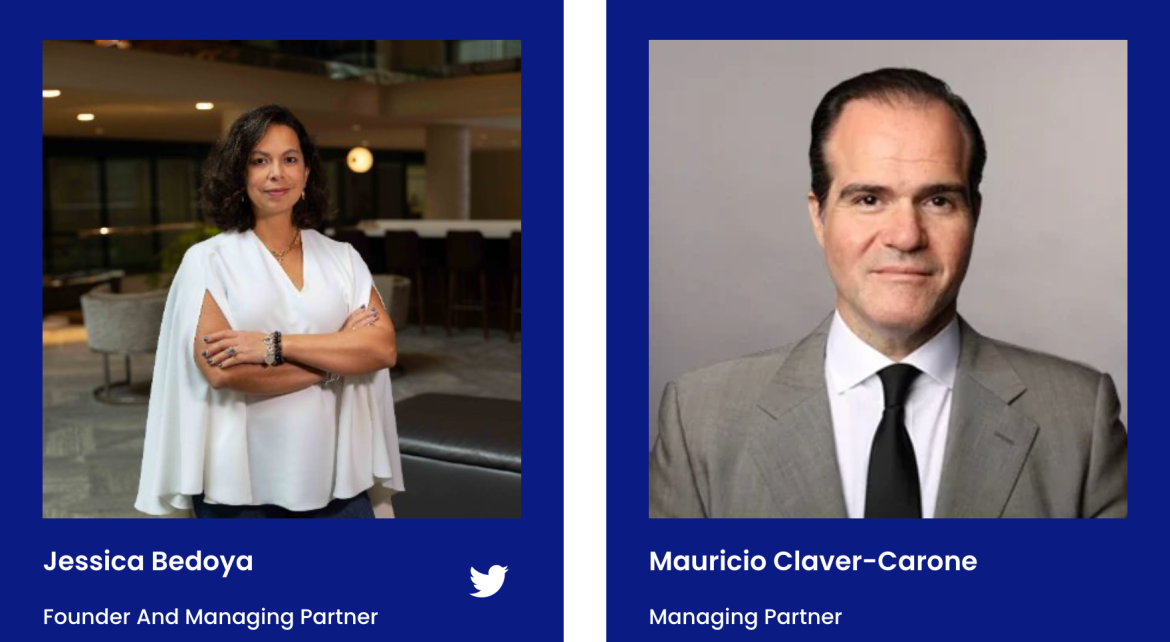
His partner, Bedoya, is the founder of the Lara Fund investment firm where he serves as managing partner. Her bio notes that she has also worked in the CIA and National Security Council.
Jessica Bedoya and Mauricio Claver-Carone’s headshots, as featured on Lara Fund’s webpage
Some insiders worry that her reported presence in the Venezuelan capital, together with Claver-Carone’s outsized influence, could represent a conflict of interest, allowing them to steer debt restructuring agreements to their own personal benefit.
“Now he’s got a lock on everything,” the Venezuela insider said of Claver-Carone. “He could say to anyone who wants to work in Venezuela, I’m the guy. I have the keys. If you want to play ball, invest with me.”
The former US official said Claver-Carone was raising capital for his Lara Fund while he served as a special government employee at the State Department. While Bedoya was running the firm, they said Claver-Carone was leveraging his position inside the Trump administration to pitch potential investors.
“Arbitrary and authoritarian actions that showed him to be a real thug”
When Trump appointed Claver-Carone to serve as the first American president of the Inter-American Development Bank (IDB) in 2020, he hired Bedoya as his chief-of-staff. The couple’s secret romance at the bank triggered an embarrassing ethics investigation after a hand-written contract was discovered showing they had agreed to pursue “absolute happiness,” and included a clause with punishments including “candle wax and a naughty box” if either party breached the deal.
An independent probe ordered by the IDB discovered that Claver-Carone had increased his paramour’s salary by 40% – a $133,000 reward in less than a year. Investigators also found that the couple had racked up expenses on an IDB credit card during romantic getaways.
Claver-Carone refused to participate in the investigation while accusing its authors of “fabrications.” In the end, IDB governors voted unanimously in favor of his firing. The US government endorsed their decision.
“President Claver-Carone’s refusal to fully cooperate with the investigation, and his creation of a climate of fear of retaliation among staff and borrowing countries, has forfeited the confidence of the bank’s staff and shareholders and necessitates a change in leadership,” they wrote.
The Argentine governor of IDB, Guillermo Francos, delivered a similarly harsh assessment of Claver-Carone’s tenure. “Claver was a disaster for several reasons,” Francos remarked in 2022. “For having an inappropriate relationship, for having disproportionately increased the salary of this inappropriate relationship, for having lied, and for these arbitrary and authoritarian actions that showed him to be a real thug.”
When Claver-Carone returned to the second Trump administration, it was not long before his proclivity for conflict jeopardized his position.
Throughout 2025, Claver-Carone’s spiteful attitude reportedly complicated Trump administration attempts to prop up a key right-wing ally in South America, Argentine President Javier Milei. Milei’s chief of staff happened to be Guillermo Francos – the former IDB governor whom Claver-Carone held personally responsible for outing his secret relationship with Bedoya. According to the Argentine paper Clarin, Claver-Carone attempted to retaliate by unsuccessfully pressuring Milei to fire Francos. He then attempted to undermine a major IMF loan package to Argentina by demanding the country first sever its credit line from China. This was met with an apparent rebuke from Treasury Secretary Scott Bessent, who visited Buenos Aires to express confidence in the IMF loan just weeks after Argentina’s central bank extended its credit line from Beijing.
The following month, in May 2025, Claver-Carone announced he was leaving the State Department to return to his Lara Fund. His departure gave the appearance that he had been forced out of his job. However, he maintained his clout through his direct line to Rubio.
The former US official told The Grayzone that Claver-Carone is now angling to become a Cuban American version of Jared Kushner, the Trump son-in-law who has leveraged his proximity to the president and role as Middle East negotiator to rake in billions from Israel and several Gulf monarchies despite having no official government title. To do so, he has allegedly inserted himself into the byzantine process of restructuring Venezuela’s debt.
When the Trump administration announced that Venezuela could hire a financial advisor to assist with its sovereign debt, Rodriguez initially planned a public bidding process for the coveted position. But then, according to the ex-US official, Claver-Carone issued support for Centerview, leading to the firm’s selection. (Opposition bloggers have speculated that Centerview was chosen because one of its partners, Matthieu Pigasse, is a self-described “pro-market socialist” who previously worked on deals with Maduro and Venezuela’s state owned PDVSA oil company.)
In recent weeks, according to sources, Claver-Carone has attempted to undermine financial advisors who had been working with the Venezuelan government to restructure its debt since 2014.
They said that when Claver-Carone’s partner, Bedoya, arrived in Caracas this month, allegedly on a private jet with Pigasse, she began pushing to remove the advisory mandate from David Syed, a seasoned French lawyer who had advised Caracas on debt-related issues for over a decade, and is considered incorruptible.
“The effort to push [Syed] out created a lot of tension,” remarked the Venezuela insider. “You can’t understand debt restructuring by parachuting in without his knowledge.”
Syed did not respond to The Grayzone’s request for comment. Hamouda Chekir, another Centerview partner who works on Venezuela’s debt, did not respond to calls and text messages sent to his personal phone.
Scandal-stained firms as vehicles for extracting profit from Venezuela
Just before leaving the State Department in May 2025, Claver-Carone convinced Rubio not to renew a sanctions waiver that allowed Chevron to sell Venezuelan oil in the US market. In doing so, he eliminated a mechanism which was explicitly designed to promote transparency and prevent local officials from skimming cash.
This January, after abducting Maduro, the Trump administration granted confidential licenses to a pair of notoriously corrupt trading houses, Vitol and Trafigura, to export Venezuelan oil. The deal came months after Trump’s re-election campaign received a whopping $6 million donation from a senior trader at Vitol.
Robert Bachmann, an analyst at the Swiss watchdog Public Eye, told the Washington Post at the time, “Trump is taking advantage of firms that know how to circumvent regulation.”
Both companies had been caught engaging in a series of elaborate bribery schemes across Latin America and Africa. In 2020, the Department of Justice (DOJ) forced Vitol to pay a $135 million penalty for bribing officials for licenses in Mexico, Ecuador and Brazil. Trafigura paid a similarly staggering fine in 2024 for a lucrative bribery scheme in Brazil. In the US, Vitol was rung up by the California Attorney General for manipulating spot market prices of oil.
But almost as soon as the Trump administration entered office, it neutered the DOJ corrupt foreign practices division charged with enforcing the judgments against Trafigura and Vitol on the grounds that it was “impeding America’s national security objectives.”
Now, the profits these scandal-stained firms generate through oil sales abroad – including to Israel – are channeled back into a US-run account with little public oversight. A percentage of sales is then delivered back to the Venezuelan government. Where the rest goes is anybody’s guess.
“The Venezuelans are the owners of the oil, and we know nothing. There is no transparency,” said José Guerra, an economist aligned with the Venezuelan opposition, complained to the Washington Post about the Trafigura and Vitol licensing agreements.
Trump, for his part, has essentially admitted Venezuelan oil profits are channeled into a slush fund for his international rampage. “We’ve taken out so much oil in Venezuela, we’ve paid for the cost of the war [with Iran] about 25 times over,” the president boasted during a May 23 campaign rally. While the president’s claim was absurd, as Venezuela is currently exporting only about one million barrels of oil a month – hardly enough to cover a full day of warfare – it revealed his avaricious attitude toward the entire operation.
Among certain Venezuelan opposition activists, Claver-Carone has become a figure of contempt who is partially blamed for Trump’s declaration that their de facto leader, the coup plotter and Nobel Peace Prize winner Maria Corina Machado, “doesn’t have the support within, or the respect within, the country.”
The Trump administration’s embrace of Delcy Rodriguez, and the Venezuelan president’s faithful compliance with Washington’s financial schemes, have prompted some top Democrats to adopt Machado as a partisan cudgel. This January, Chris Murphy, a ranking Democrat on the Senate Foreign Relations Committee, praised the opposition leader as “impressive” following a meeting on Capitol Hill, while taking a nasty swipe at Rodriguez. Machado “reminded us that Trump replaced Maduro with Maduro’s head of torture,” Murphy proclaimed.
We held a bipartisan meeting with Maria Corina Machado, the opposition leader in Venezuela.
Machado is impressive, and is walking a fine line – standing up for her country while trying to placate Trump. She reminded us that Trump replaced Maduro with Maduro’s head of torture. pic.twitter.com/WsamMv5eG7
If the Democrats take Congress after this year’s midterm elections, the Trump administration’s dealings in Venezuela will face intense scrutiny from the House Oversight Committee. Bipartisan pressure will then build for fresh elections to usher in a new government. “Delcy Rodríguez is a terrible person,” the regime change-obsessed Florida Republican Sen. Rick Scott told the Wall Street Journal this month. “We’ve got to have an election soon.”
In the meantime, a flock of MAGA-aligned financial vultures has swooped into Caracas to feast on the petro-state’s post-Maduro carcass. Donald Trump Jr. is said to be hunting for opportunities in the capital for his 1789 Capital fund, while a startup backed by pro-Trump tech oligarchs Peter Thiel and Palmer Luckey, Erebor Bank, just struck a lucrative deal to reconnect Venezuela’s central bank to the global economy. In the midst of this frenzy, a figure with no government title, Claver-Carone, appears to be establishing the new pecking order.
The views expressed in this article are the author’s own and do not necessarily reflect those of the Venezuelanalysis editorial staff.