‘Strip Law’ review: A crude courtroom comedy channeling Adult Swim
“Strip Law,” a new cartoon premiering Friday, finds Netflix in an Adult Swim state of mind, which is to say there was no thought of it being made for everybody. (Possibly including some of the people it was made for.) It’s rude, lewd, surreal in a banal sort of way, at times ridiculously violent — that is, the violence is ridiculous.
It was the cast that attracted me: Adam Scott, once more the schlemiel as leading man; Janelle James, sure of her own magnificence, not far from her character on “Abbott Elementary”; and Keith David, whose deep, sonorous voice is almost necessarily one of authority, turned to good or evil or in between as the script demands. James and David, especially, I could listen to for days.
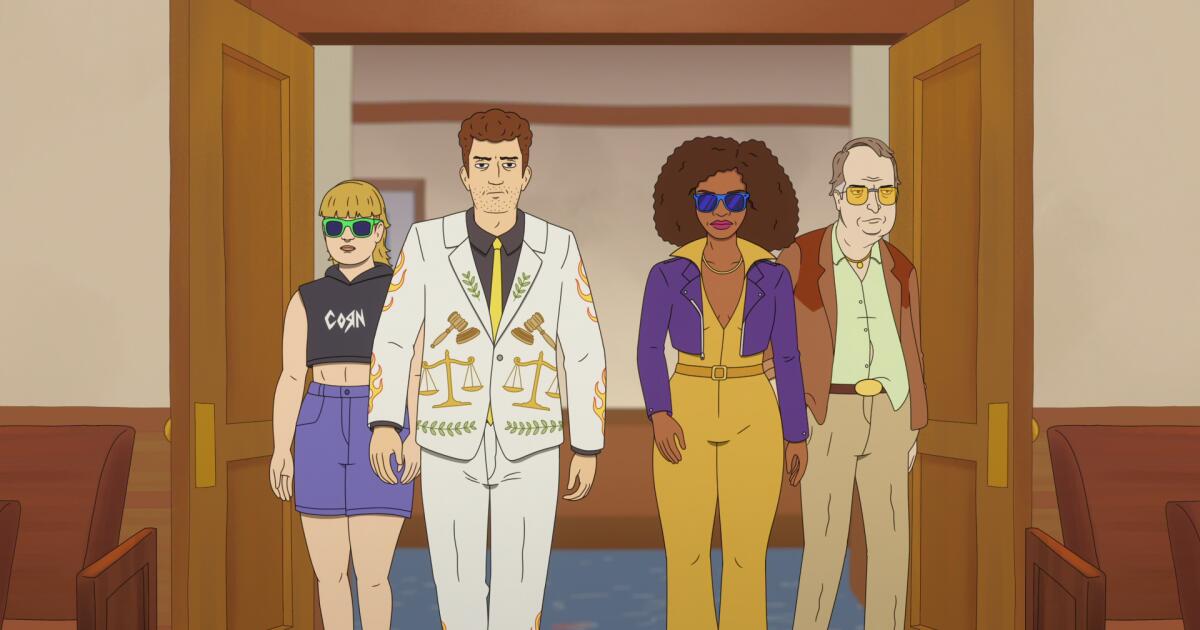
Created by Cullen Crawford, (“The Late Show With Stephen Colbert,” “Star Trek: Lower Decks”), the series is centered on a failing Las Vegas law firm, headed by Scott’s Lincoln Gumb, with James as Sheila Flambé, “a magician and three-year all-county sex champion” he hires as his “co-counsel in charge of spectacle.” Niece Irene (Shannon Gisela), an iron-pumping 16-year-old, works as his investigator; she wears a blindfold labeled “Underage” whenever she’s required to be in a bar. Stephen Root plays his disbarred (later undisbarred — rebarred?) lawyer uncle, Glem Blorchman, the strangest of them all — “It’s 115 degrees out so I put marshmallows in gin,” is something he says as they gather to watch Christmas movies. And David plays Lincoln’s nemesis, Stevie Nichols, the very successful former partner of Lincoln’s late mother, upon whom the son remains perversely fixated.
Much of it is the sort of thing that will work or not work depending on your mood, but generally I prefer the small throwaway jokes to the big gross ones. There are self-reflexive meta gags about “hard-working cartoon writers” and “reappropriating out-of-date catchphrases.” There are many nods to “The Simpsons,” including “frosty chocolate milkshakes” and James L. Brooks’ Gracie Films logo. The final episode, of 10, takes place within the finale of a “Suits”-like legal dramedy. (“It’s against their nature to let something be sweet and fun and airy,” that firm’s bromantic lawyers say of Lincoln’s team. “They have to make it dark and strange and crass.”) And there are left-field references to Cocteau Twins and Bikini Kill, whose “original bass player” Glem claims to be. (“I don’t know what Bikini Kill is,” says Irene. “Neither did I, according to Kathleen Hanna,” says Glem.)
There are various oddball judges (nothing remotely legal happens in a courtroom); “local character” Lunch Meat, who turns up in many roles; a barman, Mr. O’Raviolo, who switches between exaggerated Irish and Italian accents in mid-sentence. Comedian George Wallace plays himself as the mayor of Las Vegas. A Halloween Christmas episode parodies “Miracle on 34th Street”; another takes off on Colton Burpo, the “boy who saw Heaven,” which includes a live-action trailer for a faith-based film featuring Tim Heidecker as a coke-snorting atheistic Lincoln. A virtual reality HR seminar is hosted by “a computerized amalgamation of all five personalities of the Rat Pack,” an immersive Autoverse, in which actors create situations that somehow amount to a driving test. There are the “Nevada-grown” Hot Dates, a sexualized version of the California Raisins; riots occur when the characters are redesigned to be more respectable (“They’re walking away from years of established canon,” laments Lincoln.)
The series felt a little off-putting at first, as if it were straining for effect, but gathered steam as it went on, either because the later episodes are weirder or better written, or because one just gets used to being in that world with those people. There is just enough character in the comedy to create stakes in the narrative; its misfit energy has fueled the screen’s bands of outsiders throughout the years. (“Even when you’re a disaster, you’re a disaster for the right people,” Irene tells Lincoln.) As to the famous fine line between stupid and clever, the stupidity and the cleverness are all but inextricable, and to the point.
The credits declare that the series is “proudly made by real, non-computer human beings,” which is pleasant to know, and in 100 years will still have been the best way to make cartoons, even if by then they are only made by and, for all we know, for machines. The thin-lined drawing style is standard for more or less realistic 21st-century adult TV animation, with perhaps a hint of comics artist Daniel Clowes laid on. But the characters are expressive, and the medium is used to unreal ends, which is, after all, what cartoons are good for.