Going beyond the surface in the Karst plateau: exploring the new cross-border geopark in Italy and Slovenia | Slovenia holidays
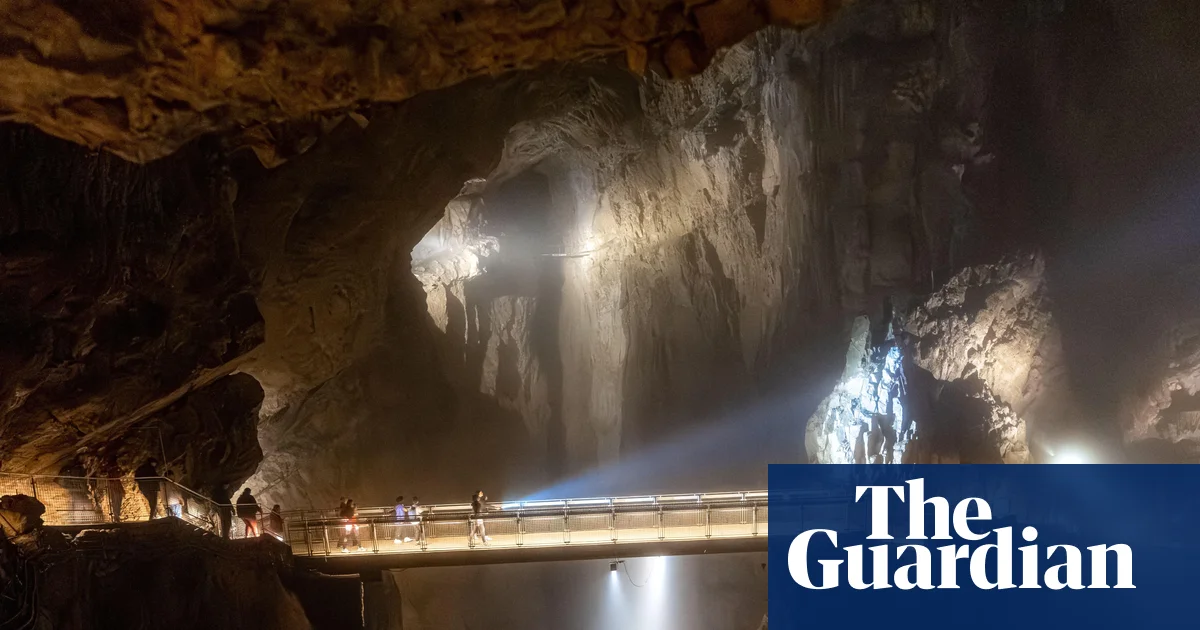
Our guide turns out the lights and suddenly there is nothing. Just total darkness, the sound of gentle dripping and a creeping feeling of unease. The switch is flicked back on and the shadowy world that lies deep beneath the Karst returns. I’m in Vilenica, thought to be the first cave in the world ever opened to tourists, with records of visitors dating back to 1633. It’s a magical sight: a grand antechamber sculpted through erosion, filled with soaring stalagmites and plunging stalactites streaked in shades of red, terracotta and orange by iron oxide, and dotted with shimmering crystals.
Vilenica is just one of a network of thousands of caves located in the Karst region of western Slovenia and eastern Italy, which is known for its porous, soluble limestone rock. Above ground, this creates a distinctive landscape, filled with rocks bearing lined striations and pockmarked by hollows known as dolines, where the limestone has collapsed underneath. But below ground is where it’s really special, with enormous caves, sinkholes and subterranean rivers. Later in the day, I visit the region’s other main visitor cave, Škocjan, where I’m amazed to see an underground river thunder through a chamber almost 150 metres high. It’s an almost surreal sensory experience, with the rush of the rapids echoing around the walls.
As my guide drives me through the Karst region, I watch the undulating hills of a comparatively untouched stretch of countryside go by, dotted with a patchwork of bilingual villages connecting eastern Italy and western Slovenia along a border that shifted several times over the 20th century. Increasingly, the area is viewing itself as one region spanning two countries, and is hoping to combat the overtourism plaguing Italy and Slovenia’s better-known destinations by attracting people in search of a slower, more authentic and local experience. To showcase its shared history, nature and culture, the region has established a new EU-funded cross-border geopark, known as GeoKarst, and is hoping to secure Unesco designation.
Winding around the region’s hills, I reach its highlight – Štanjel, a medieval village that wouldn’t look out of place in Provence, but without the crowds. Wandering around its cobbled streets feels like stepping back a millennium, or in some cases longer, given the village has prehistoric and Roman origins. The flint-grey buildings are made of sturdy local Karst stone, which has stayed more or less intact for hundreds of years. At sunset, I sit with a glass of crisp local vitovska wine in Bistro Grad, a prettily decorated restaurant garlanded with dried flowers, and take in sweeping views of the gilded valley beneath.
Leaving Slovenia, we venture over to the Karst’s Italian side, where it is flanked by Trieste, a vibrant university city that blends Italian culture with Viennese art nouveau architecture courtesy of its lengthy stint as the Austro-Hungarian empire’s sole port. Locals say the cultural blend has given it a uniquely open-minded and tolerant spirit. My guide, Beatriz Barovina, tells me that unlike elsewhere in Italy, you can eat, sip an espresso or drink a glass of wine alone without being judged for not having a big Italian family around you. She says there is still a strong attachment to Austria, especially among older generations, who cling to the refrain: “It was better under Austria.”
Locals tell me that as well as the buzzy cafe culture, they love Trieste for its easy access to nature. Heading out of the city centre for 15 minutes, we reach the 3-mile Via Napoleonica route, which offers panoramic views of Trieste’s bay, and connects the small towns of Opicina and Prosecco, birthplace of the eponymous sparkling wine.
It’s easy to eat well in the Karst region because most produce is sourced from local farmers. One unique experience is a visit to a local osmice, family-run farms and vineyards. At Cantina Parovel, the family serve homemade cheese, wine, prosciutto, honey and olive oil on picnic tables shaded by pines. The Parovel family is proud to boast its distinctively Karst pedigree to me: three generations of the family were born in the same village, yet their grandparents were born in the Austro-Hungarian empire, the parents in Italy, and the children in Slovenia.
Their osmice is located at the end of a spectacular 4-mile hike through the Rosandra valley, if you start in the village of Mihele and partly follow stage 36 of the Alpe Adria Trail, cutting through a landscape of wild cherry trees and roe deer. If you’re lucky you might even stumble upon one of the improvised “wine caves” – hollows in which people leave local wines and cheeses on an honesty-bar basis for hungry and thirsty travellers – with carved wooden seating overlooking the valley below.
It’s a uniquely Karst experience, and one that reflects the region’s two most distinctive features: its striking landscape and welcoming, communitarian spirit.
The trip was provided by Promo Turismo FVG, the tourist board of Friuli-Venezia Giulia, and Visit Kras in Slovenia. Doubles at Savoia Excelsior Palace in Trieste from £153. Doubles at Hotel Maestoso in Lipica from £122