In Niger Republic, The Junta’s Peace Is Not Everyone’s Peace
Aichatou often heard of insecurity for most of her life, but never experienced it herself. She had relatives who had either been killed or displaced in places like Bosso, a village close to Lake Chad that was ravaged by Boko Haram insurgency in 2015. But the violence that festered along the Sokoto and Kebbi flanks was not common where she lived in Dosso, a region in southwestern Niger.
Then came the coup. And with it, a promise that what had happened elsewhere would never reach her.
It did.
In 2024, terrorists stormed her town. They killed her brother and neighbours. And like many other survivors, she fled carrying nothing except the experience of something she had only once heard about – violence. It had finally reached her.
After Niger’s military rulers seized power in July 2023, they promised to do what the elected government could not: make the country safe. Nearly three years later, an analysis of conflict data, geospatial information, and interviews with people in the country shows that the military administration has failed to deliver on its promise.
While the junta has partly succeeded in shielding the capital city, Niamey, from attacks, more people are being killed across the country, and more people are being displaced from regions that were previously stable. The evidence shows that the generals have not ended the violence; they have simply relocated it.
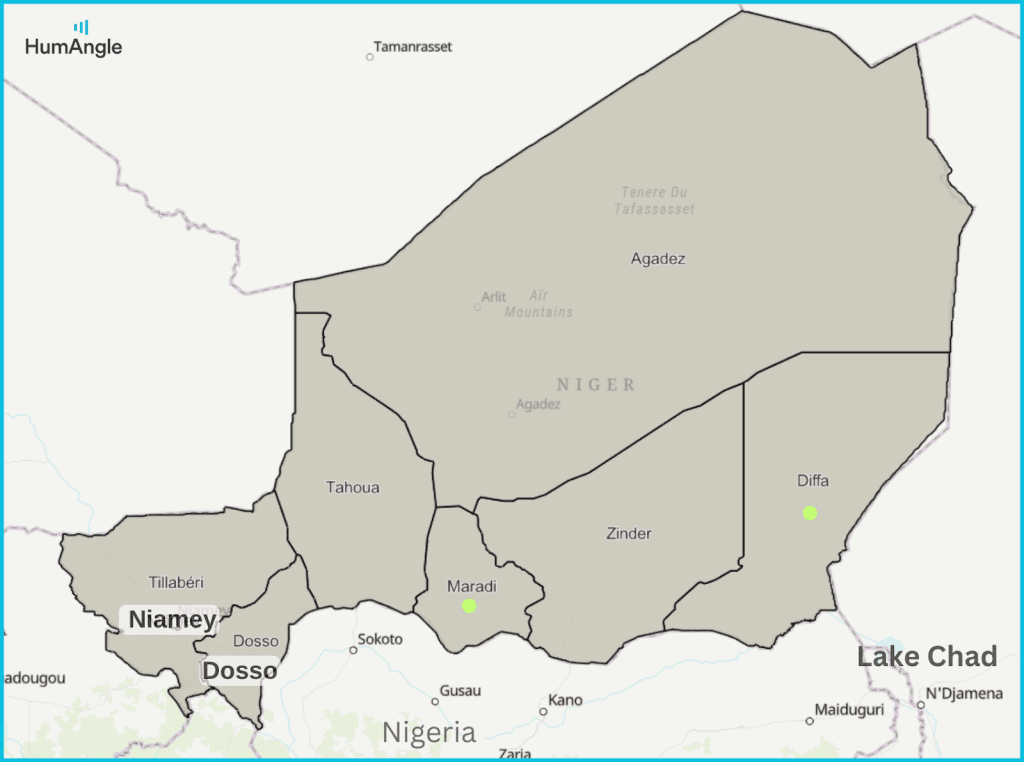
For this investigation, HumAngle analysed 62 months of conflict data, evenly divided between the period before and after the coup. We complemented this with interviews with Nigeriens in Maradi and Diffa, many of whom had fled from areas that had historically never been frontlines. They declined to speak on record, citing fear and arrest, and so their names have been changed to protect them.

Aichatou now lives in Maradi as a displaced person. She has not heard from her missing relatives and some of her neighbours. They were scattered when the attackers came. Everyone ran for safety, and it’s unclear who died and who survived. It’s a crisis of missing persons during a war.
“We don’t know where they are and don’t even have phone numbers to reach out,” she says.
The promise
When soldiers deposed President Mohamed Bazoum on the evening of July 26, 2023, the justification was that the civilian government had failed the people. Specifically, it had failed them on economy and security.
The coup leader, General Abdourahamane Tchiani, accused Bazoum of covering up the deteriorating security situation and cited what he described as both his predecessor’s “outstretched hand” policy toward armed groups and a fundamental failure to build a regionally coherent security architecture.
Two days after seizing power, Tchiani proclaimed himself head of state, saying he had deposed Bazoum to prevent what he described as “the gradual and inevitable demise of the country.” The new ruling body named itself the National Council for the Safeguard of the Homeland (CNSP) – a title that placed national security at the very centre of its identity and mandate.
The announcement landed on fertile ground. Niger had suffered genuine insecurity under the elected government. The Tillabéri region, squeezed between the borders of Mali and Burkina Faso in the volatile Liptako-Gourma tri-border zone, had been burning for years. Attacks by Islamic State affiliates and al-Qaeda-linked groups had claimed the lives of hundreds of soldiers and thousands of civilians. The insurgency had spread eastward into Tahoua, and southward into Dosso — regions that had once felt insulated.
Ordinary Nigeriens, particularly in rural and border areas, had every reason to want something different. The coup, for some, looked like that. What followed were celebrations.
Pro-junta crowds gathered in Niamey. Thousands marched. Russian and Nigerien flags flew alongside each other in the same streets where anti-French sentiment had been building for years. The generals had read the room correctly, at least in the capital.
Since assuming power, the junta in Niger has claimed some successes, especially in repelling some attacks, asserting sovereignty, and staging defences against the internal and perceived external threats. The military has, in 2025, also pursued general mobilisation decrees and created new partnerships, especially with Russian mercenaries. The mobilisation includes bolstering the military to 50,000 troops, increasing the retirement age for officers to 52, and mobilising youth to combat insecurity.
However, under the same military, in 2026 (data for 2025), Niger reached its worst-ever ranking on Global Terrorism Index (GTI) as the 3rd most terror-impacted country in the world. This was significantly higher than when it was under an elected government, in which it was ranked between 8th and 10th.

The silence
As the violence spreads under the junta, public criticism becomes more dangerous.
State-owned newspapers in Niger do not often report comprehensively on the security crisis. Most of what appears tends to highlight that a security meeting was held, or that some terrorists were killed, or it focuses on accusing France of being responsible for the country’s security problems. This narrative has gone as far as Abdourahamane Tchiani alleging that Nigeria is collaborating with France to launch an attack on Niger through terrorists deployed at the Nigeria/Niger border. The Nigerian government and independent fact-checkers denied that.
But when activists or independent journalists speak about insecurity, they get arrested.
Gazali Abdou Tasawa, a correspondent of DW Hausa, was arrested and jailed in January 2026 for reporting on displaced persons in Niger. He was not the first.
Human Rights Watch (HRW) has documented that in October 2025 six journalists were arrested in Niamey – Moussa Kaka and Abdoul Aziz of Saraounia TV; Ibro Chaibou and Souleymane Brah from the online publication Voice of the People; Youssouf Seriba of Les Échos du Niger; and Oumarou Kané, founder of the magazine Le Hérisson – over their alleged role in circulating a government press briefing invitation on social media criticizing the introduction of the mandatory payment for “Solidarity Fund for the Safeguarding of the Homeland”, a form of security levy in Niger to combat terrorism.
Moussa Ngom, Committee to Protect Journalists (CPJ)’s Francophone Africa representative, explained that “arrest and detention have become tools-of-choice for Nigerien authorities to try to control information they find undesirable.” For this investigation, HumAngle reached out to journalists in Niger to speak on insecurity. Three of them declined to speak and one promised to speak but never replied to our questions.
However, recently, a few activists have begun to speak out. A prominent Nigerien activist, Maikoul Zodi, recently called on the military junta to account for two years of broken promises on security – the central justification offered for seizing power on July 26, 2023.
Writing on his Facebook page, Zodi was blunt about what he sees as the junta’s failure. “Niger is still bleeding… the same villages are burning… the same families are burying their dead.” He asked directly what tangible improvements had been made on the ground since the coup.
His statement reflects a shift in civil society’s posture from solidarity with the transition to demands for results. “Compassion alone is no longer enough. There must be accountability,” he wrote, as violence continues spreading into regions that had previously been spared.
“I think the CNSP should present a transparent report of the security situation, with concrete figures and data,” reacted Tahirou Halidou, a concerned Nigerien.
One day after that Facebook post, Zodi was interrogated by the police because of the publication.
What the numbers buried
The junta’s promise of improving security has not become a reality.
To understand what changed, HumAngle analyzed conflict data from the Armed Conflict Location and Event Data (ACLED) project which maps political violence worldwide in real time, covering equal 31-month periods before and after the coup – from January 2021 to February 2026.
ACLED data does not necessarily give us a complete picture of the dire situation in Niger, given that most of its information relies on open-source reporting from NGOs and journalists who have been repressed by the junta, and so may not be able to accurately capture what is really happening on the ground.
While the ACLED number of recorded incidents for the period under review rose only modestly, the outcomes of insecurity became dramatically deadlier in Niger Republic. Worse, the violence is spreading toward communities that were never hotspots.
“Although we are aware of insecurity in some villages a few kilometres away from ours, we had never experienced violence before the military coup,” said Ousmane*, an IDP who left his village Gadori in Diffa and moved to Maradi in early 2025.
According to ACLED data, total recorded conflict events rose modestly after July 26, 2023 – from 1,879 to 2,221, an increase of 18.2 percent. Taken alone, that figure might suggest a country holding steady. But fatalities tell a radically different story: deaths surged from 2,983 before the coup to 4,855 afterwards, a 62.8 percent increase. The same rough number of incidents, but significantly more people dying in them. The deaths per incident climbed by 37.7 percent, meaning that even setting aside the raw count, each individual attack became deadlier on average.
One of the deadliest attacks recorded under the junta was on Dec. 10, 2024, when Jihadists affiliated with the Islamic State attacked Nigerien soldiers at a market in Chetoumane, Tillabéri region, killing at least 90 soldiers and over 50 civilians. The junta suspended BBC for reporting the attack.
The Junta Redistricted the Violence by IT HumAngle
The displacements
Before the coup, areas surrounding the Nigerien border with Nigeria were relatively safe, but not anymore. “In Dan Issa here, we had never experienced a situation when people were as afraid to go to villages as they are now,” one of the residents told HumAngle. “There is a silent displacement in the villages due to incessant cases of kidnappings.”
Dosso, Aichatou’s region, appeared in the ACLED displacement data for the first time, with six distinct locations recording forced civilian movement: Dogondoutchi, Banizoumbou Kobia, Boumba, Kassalama, Kontalangou, and Tounouga.
The entire Gaya corridor, the southern road connecting Niger to Nigeria and Benin, recorded zero displacement events in the 31 months before the coup. After it, the route became newly active, with JNIM and ISSP both documented operating along it. These are not places with histories of insurgent attack. They are places that were, until recently, buffers that absorbed refugees from further north without themselves being overrun. But that buffer has collapsed.
Tillabéri’s Abala district recorded nine distinct new displacement locations after the coup, compared to only two locations before the coup. A cluster triggered in a single week in October 2023 – Maimagare, Mandaba, Tamattey, Dangna, and Badak Toudou – marked the opening of that sub-region to what the data suggests was a systematic IS Sahel campaign of threats designed to clear villages.
By early 2026, even Niamey itself was no longer exempt: an Islamic State Sahel Province (ISSP) attack on Air Force Base 101 in January 2026 produced the capital’s first recorded displacement event.
Across the full dataset, 51 locations recorded displacement for the first time after the coup. Only four sites of chronic, pre-existing displacement persisted into the post-coup period. The coup expanded the footprint of violence into entirely new territory. Generally, according to the United Nations Refugee Council (UNHCR), as of 2026, Niger has recorded over one million displacements, more than half of whom are internally displaced (IDPs).

As the new wave of violence reached new places, more people fled their homes. Confirmed displacement events – i.e. ACLED incidents explicitly noting that people had fled or evacuated – rose by 83.3 percent, from 30 in the pre-coup period to 55 after. Abandoned settlement events declined, from 27 to 18, but that apparent drop carries a grim explanation: many of the communities that might have been abandoned had already been emptied. There were fewer inhabited places left to abandon.
The nature
The nature of the violence also transformed. Events recorded by ACLED explicitly as “violence against civilians” fell by nearly 31.7 percent. This decrease does not, however, reflect the full picture and reading it literally can be misleading.
ACLED records each conflict event under a single type based on its primary event: a gun battle is coded “Battles” even if the notes confirm civilians were killed; a roadside bomb is “Explosions/Remote violence” even when the target was a civilian vehicle. Only when deliberate civilian targeting is the defining characteristic, before they flag it as “Violence against civilians” and set the civilian targeting variable. However, three columns allow a closer accounting of civilian contributions to those increased overall fatality numbers: the “civilian_targeting” flag itself; the “interaction code”, which records the actor types involved; and the free-text “event notes”, which often documents civilian casualties in events coded under other categories.
Events that ACLED explicitly classifies as “Violence against civilians” did fall from 785 to 536 incidents. However, battles surged. The dominant interaction in battles by far was state forces against rebel groups, accounting for 182 clashes and 944 deaths before the coup and climbing to 382 clashes and 2,009 deaths afterwards. There have been clearly stated large combatant tolls in these events. But embedded in the ACLED event notes for those same battles are post-coup civilian-involved incidents, together contributing to 447 deaths when you count the fatality column of the rows’ note that explicitly records “civilian casualties”. This goes up from 23 battle events and 108 deaths before the coup to a more-than-threefold rise.
Most explosions and remote violence surges follow the same state-versus-rebel pattern: IED attacks on military convoys classified as “State forces-Rebel group” jumped from 46 to 155 events. Yet ACLED’s own civilian_targeting flag registers a 230 percent increase in civilian-linked explosion-related deaths (from 33 to 109).
Reviewing these columns in those months before and after the July 2026 coup gives a narrower picture than the overall event counts suggest.
More battles. Triple the bombs. Fewer labels, same bodies. by IT HumAngle
The increase in the death toll aligns with the assessments of other security monitoring bodies. The Africa Center for Strategic Studies noted that fatalities linked to extremist groups were projected to reach more than 1,600 in 2024 alone — a 60 percent increase from 2023. The Safeguarding Security Sector Stockpiles (S4) Initiative found that attacks on Niger’s own security forces in the first nine months of 2024 were more frequent than in any previous year. The CNSP had promised to protect its soldiers, but the opposite happened.
The HumAngle ACLED analysis also tracked attacks on state forces specifically: incidents targeting the military nearly doubled, rising from 198 to 366 – an 84.8 percent jump. Fatalities in those incidents climbed from 623 to 1,555, a 149.6 percent jump. By the post-coup period, state-force targeted deaths accounted for 32 percent of all fatalities recorded – up from 21 percent before the coup. The lethality of each individual attack on security forces also rose: from 3.2 deaths per event before the coup to 4.3 after.
“Those numbers reflect a simple reality that the security vacuum created by the rupture with Western partners has been exploited ruthlessly by non-state armed groups,” said Ikemesit Effiong, an analyst and a managing partner at SBM Intelligence, an African security intel firm based in Lagos, Nigeria. “A massive increase in violence metrics is more than a failure of policy; it is a failure of legitimacy,” he told HumAngle.
Jihadist groups, freed from the surveillance, intelligence-sharing, and operational pressure that Western and regional partnerships had provided, adapted their tactics. They hit less often but harder, and with dramatically more lethal results. JNIM, the al-Qaeda affiliate that had previously operated mostly in southwestern Tillabéri, expanded into southern Dosso. Islamic State Sahel Province consolidated control over the Abala sub-region and extended pressure southward toward Niamey.
Tera, in Tillabéri, became the single deadliest location shift in the dataset: event counts rose by only a third, but fatalities exploded from 198 to 991 – a 401 percent increase. Gaya, on the Nigerian border, went from near-silence to an active conflict zone. Dioundiou appeared in the data for the first time, with 49 events and 144 fatalities recorded where none had existed before. The geography of the war had moved.
The war moved south. by IT HumAngle
In January 2026, the Jihadists affiliated with the ISSP conducted an unprecedented daring attack on the Diori Hamani International Airport in Niamey. The attack included the first-time use of drones, which were reportedly engaged by the airport’s air defence systems. The attack sent a chilling message that the terrorists are getting bolder and ready to wage more sophisticated attacks on some of the state’s most protected infrastructure.
“The use of drones by ISSP shows a level of technical sophistication and intelligence gathering we haven’t seen this close to the capital before,” said Effiong, the security analyst. “For the military regime, if they cannot secure the perimeter of the country’s premier international gateway, they cannot claim to control the state.”
The protection bubble
What the full body of evidence suggests is that the junta in Niger built a bubble around Niamey and the corridors of power that connect it to key military installations. Inside that bubble, things are calmer. Attacks on urban centres remain relatively rare. The capital’s residents can move through their days with a reasonable sense that yesterday’s normal will resemble tomorrow’s.
“The distinction is now visible,” Effiong told HumAngle. “Regime security focuses on Niamey’s checkpoints and the presidential palace; peripheral areas are being sacrificed.”
Outside that bubble — in Dosso, in the new displacement clusters of Abala, in the villages whose names appear in ACLED event notes for the first time after July 2023 — the junta’s promise of peace has not arrived.
“This emboldens groups like ISSP and JNIM because it reveals a risk-reward calculation: the junta’s air power is limited, and their reaction times are slow,” Effiong said.
The Islamic State Sahel Province has moved closer to Niamey than at any point in the country’s history, with militants increasingly controlling key roads into the capital, effectively tightening a noose that the junta’s propaganda apparatus does not mention.
Aichatou knows this too well. She is in Maradi, far from everyone who once knew her, far from the brother whose body she could not bury, far from the relatives she could not trace, and far from the neighbours who once gave her a sense of community.
The promise of security reached Niamey.
It did not reach her.
This article was produced with support from the African Academy for Open Source Investigations (AAOSI) and the African Digital Democracy Observatory (ADDO) as part of an initiative by Code for Africa (CfA). Visit https://disinfo.africa/ for more information.