junior year

Mr. Patient: JJ Saffie is ready for Dodger Stadium moment

On the eve of the City Section championship baseball game at Dodger Stadium, let’s explore a sometimes forgotten character trait: Patience.

When JJ Saffie walks onto hallowed ground Saturday as a starting left fielder for 10-time City champion El Camino Real High in the Open Division championship game against Birmingham, he will be finishing a journey few want to travel these days.

He spent three years on the junior varsity team waiting and grinding before getting his chance to start on varsity this season.

“Very patient,” he said. “Freshman year, played frosh-soph, called up for a few JV games. Sophomore year, on and off starter on JVs. Junior year is when it started clicking for me. I found my bat, I found the style I like to play, I started hitting real good.”

He was part of an outstanding JV team his junior year, called up as a pinch runner for the playoffs. He developed power and a knack for hitting balls over El Camino Real’s left-field fence during batting practice.

“I’ve hit two windows and six cars,” said the 18-year-old, who likes to cause mayhem for insurance companies.

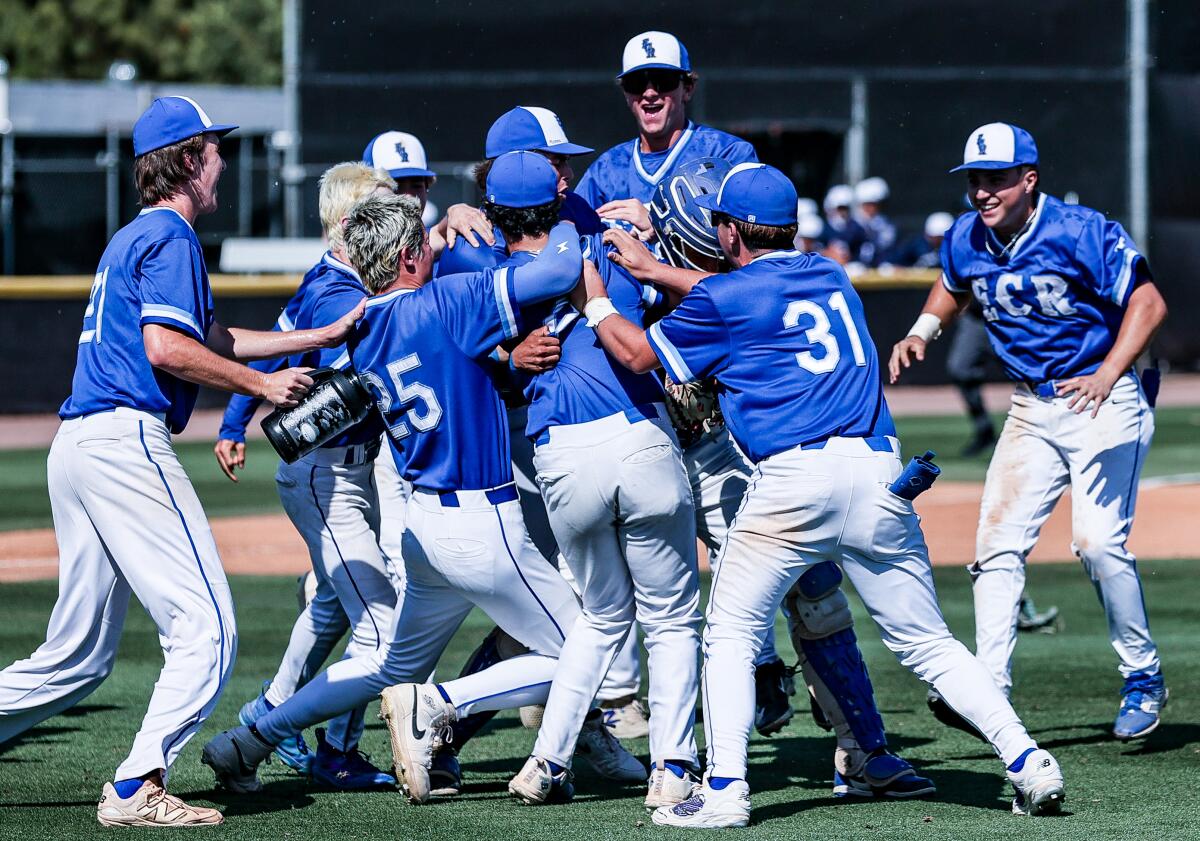
El Camino Real celebrates a 4-3 win over Granada Hills to earn a trip to Dodger Stadium on Saturday.

El Camino Real celebrates a 4-3 win over Granada Hills to earn a trip to Dodger Stadium on Saturday.

(Craig Weston)

He’s hit two home runs this season and become a key player for the Royals.

Now he gets to start at Dodger Stadium, a moment every high school baseball player in the City Section dreams of reaching.

“I’m a big believer in good things will come to those who are patient,” he said. “I knew I needed to be patient, work on my game and eventually success would come my way and I’d have my opportunities and here’s my opportunity. I’m trying to prove that Saturday.”

El Camino Real needed a two-run single by RJ De La Rosa in the bottom of the sixth inning on Wednesday to defeat Granada Hills 4-3 in the semifinals at Cal State Northridge.

“I saw my pitch,” De La Rosa said. “I wanted to take advantage. It was the bottom of the sixth. The team needed me most and I pulled through. It was an amazing moment. These boys are my brothers. I will fight for them. I will do everything for them. I can’t wait to make some memories at Dodger Stadium.”

For Saffie, staying and fighting to get better rather than running away from a challenge is a great lesson for others.

“I had a few people tell me to transfer,” he said. “But my sister came here, my dad. I want to prove myself at this school.”

Top-seeded Birmingham will have junior Nathan Soto starting on the mound in the 1 p.m. game. It’s a big assignment and he’ll be working on his mental part of the game.

“It’s just another game,” he said after the Patriots’ 4-1 semifinal win over Carson. “I think it’s everyone’s dream to pitch there, but you have to keep it as a normal game.”

Pitcher Carlos Acuna grinded out a complete game in Birmingham's 4-1 win over Carson to send the Patriots to Dodger Stadium.

Pitcher Carlos Acuna grinded out a complete game in Birmingham’s 4-1 win over Carson to send the Patriots to Dodger Stadium.

(Craig Weston)

Birmingham can thank Carlos Acuna for putting together a sophomore season to remember. His pitching season is done. He finished with an 11-0 record after a complete-game win against Carson.

“It’s an amazing season he’s having,” coach Matt Mowry said.

In six of the seven innings on Wednesday, Carson got the leadoff batter aboard, forcing Acuna to work extra hard while throwing 102 pitches.

“He was on the edge of coming out,” Mowry said.

Acuna wouldn’t let him.

“I love this team,” Acuna said. “I want to play one last game.”

He’ll start on Saturday at second or third base in a game matching two of the most successful programs in City baseball history. El Camino Real is seeking a record 11th title. Birmingham wants its ninth title.

The 10 a.m. game at Dodger Stadium has Verdugo Hills taking on Taft in the Division I final.

Fans will come for the sun, the hot dogs, the fun of cheering on someone they know or enjoying a moment of distraction at Los Angeles’ most sacred stadium.

Just remember those are teenagers out there who’ve sacrificed and spent years working toward this moment. There’s no losers when you get to play at Dodger Stadium as a high school kid.

For Saffie, it validates his belief in trusting the process and trusting himself. He didn’t run when the going got tough. He persevered and learned a valuable lesson: patience still pays off.
Source link

Would you trust former Dodger Ross Stripling to manage your money?

For Ross Stripling, baseball was something of an accidental career.

He walked onto the team at Texas A&M, majoring in business finance, planning to stick around campus long enough to earn a master’s degree. After his junior year, he turned down a six-figure bonus offered by the Colorado Rockies. After his senior year, he accepted a six-figure bonus to sign with the Dodgers, only to blow out his elbow after one season in the minor leagues.

He was 24. He was at peace. He called home.

“I think the right thing to do is to say I did this baseball thing and go start my life,” he told his father.

If you’re a Dodgers fan, you know the rest of his baseball story: In his major league debut, Stripling was five outs from a no-hitter when Dodgers manager Dave Roberts yanked him. In his nine years in the major leagues, including five with the Dodgers, he pitched in the All-Star Game and the World Series, and he once pitched with his “Chicken Strip” nickname on the back of his game jersey.

His father knew best. Instead of giving up on baseball when he needed Tommy John surgery, his father encouraged Stripling to use the yearlong rehabilitation process as a way to explore what a future without baseball might look like. His grandfather set him up with an internship at an investment firm.

Five years ago, Stripling and his mentor from that firm founded their own financial services company, called Skyward Financial. Now, 21 months after Stripling threw his last pitch in the major leagues, he is throwing a new one: Hey, young athletes coming into a lot of money, I’ve lived in that world, and I’ll show you how to protect your money and build toward generational wealth.

“It’s not me trying to become the next Wolf of Wall Street,” Stripling said. “This is genuine. I want to help kids and their families out in a space that has gotten out of hand in a hurry.”

Matthew Houston, the mentor, said Stripling blew away the brokers when he interviewed for that internship.

“He brings with him, like, a two-inch folder stuffed with handwritten stock reports he had written on minor league bus trips,” Houston said. “He handed us a couple of them, and they were legit Wall Street reports, him doing analysis of stocks. We were falling out of our chair.”

Stripling soon earned his broker’s license. Over the past decade, Houston estimated, he and Stripling might have traded messages about markets and clients “25 to 50 times a day.” One night, Houston watched Stripling pitch on television. Not long after the game ended, he heard the ping of a text message.

“I had just seen him on TV, and it’s like, ‘What do you think about Celgene and Gilead in the biotech sector?’” Houston said. “My mind was blown.”

You don’t need to have played in the major leagues to realize how much money athletes make. Major brokerages want a piece of that money. Some even use former athletes to recruit current ones.

Marc Isenberg, the former director of financial education for Morgan Stanley’s sports and entertainment group and author of the “Money Players” guide for young athletes, wished Stripling well but said he would face significant competition from firms with bigger names and greater resources.

“It’s oversaturated,” Isenberg said. “Almost every single Wall Street firm, to compete for athletes and entertainers, has a sports and entertainment group.”

And it’s not just the behemoths. Stripling checked with a basketball agent, who said he represents 24 college players that each have a different money manager.

There is nothing revolutionary about Stripling’s message: limit the flashy spending now in favor of prudent savings and investment, so you can grow your money through and beyond your career.

Stripling believes he can win by concentrating on young athletes, the ones suddenly showered in six- or seven-figure payments from draft bonuses, college revenue sharing payments, and name, image and likeness deals.

“I’ve seen the first-rounders come in and blow money on cars and houses and gambling,” Stripling said, “and I’ve seen the first-rounders like (former Dodgers shortstop Corey) Seager, who probably hasn’t spent a dime of his signing bonus.”

In a presentation for young athletes — and for the pro teams and college athletic departments that might invite him to speak — Stripling’s firm uses his story of a baseball prospect that got a $900,000 up-front payment and spent the $500,000 after taxes on a red Lamborghini. If the prospect had invested that $500,000 over 30 years into a fund that tracked the S&P 500, he would have made $8.6 million.

“That was the dumbest decision I’ve ever seen anyone make,” Stripling said.

“I have these stories from being in the locker room. I hope that, as a player, my story resonates more than a guy from Goldman Sachs saying, ‘Yeah, we’ve got a couple good ETFs.’”

Stripling would love the chance to speak at one of the Dodgers’ morning meetings in spring training, where players hear briefings about everything from safety and security to social media.

“I’d like to learn more about it, but I’d be open to putting him in front of the guys,” Roberts said. “I definitely trust him.”

In the meantime, Stripling has a federal record. All brokers do. One form requires brokers to list their employers and job descriptions over the last 10 years. Among all the wealth strategists and financial advisors and registered representatives, Stripling’s form is the one with the job history that starts with this line: “LA Dodgers, Pitcher.”

Source link