Venezuelan Gov’t, Opposition Faction Announce Judicial and Freedom of Speech Agreements
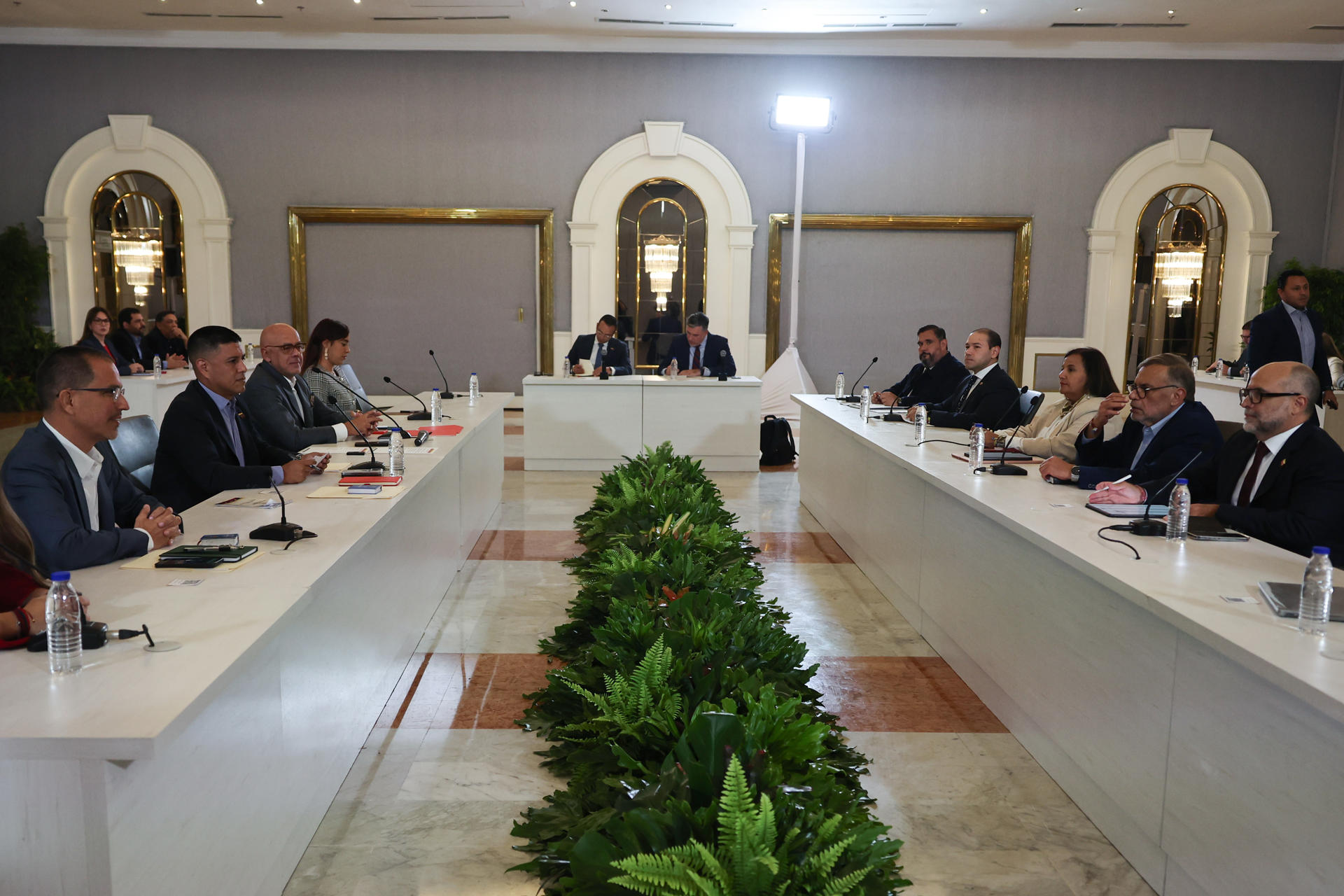
The Venezuelan government and opposition delegations met at the 5-star Meliá Hotel in Caracas. (National Assembly)
Caracas, September 28, 2026 (venezuelanalysis.com) – The Venezuelan government and delegates representing a defunct, opposition-majority parliament concluded, on September 25, a second round of US-backed talks focused on political and judicial reforms.
The negotiations produced preliminary agreements focused on judicial reform and loosening administrative restrictions on several opposition-aligned news outlets.
The primary advance in the negotiations centered on a comprehensive proposal to restructure Venezuela’s Supreme Court of Justice (TSJ).
According to official statements, both delegations established a seven-person committee to review the qualifications of Supreme Court justice candidates. The two parties also agreed to create a Judicial Nominations Committee within the National Assembly to oversee the selection process for new magistrates.
This committee will oversee applications from legal scholars, public sector workers, and civil society members, subjecting applicants to rigorous constitutional criteria before submitting a final list of recommended nominees for a plenary vote in the legislative body.
Speaking at the close of the talks at the Meliá Hotel in Caracas, National Assembly President and head of the government delegation, Jorge Rodríguez, highlighted the consensus achieved regarding judicial reform.
“We have reached concrete agreements to strengthen our democratic institutions, starting with a transparent process to evaluate and appoint magistrates to the Supreme Court,” Rodríguez stated to reporters. “This dialogue demonstrates that through constitutional channels and mutual respect, Venezuelans can resolve their differences without foreign interference.”
Representatives from the opposition delegation similarly acknowledged the priority of reforming the judicial branch.
Dinorah Figuera, president of the faction from the defunct National Assembly elected in 2025, claimed that the ongoing negotiations are aimed at “re-institutionalizing” the country.
“If the TSJ and the CNE move forward alongside political and civil guarantees, social issues and the health sector must also be linked to this process of re-institutionalization.”
The two sides launched a dialogue process in August, with a first round of talks launching the Supreme Court overhaul as well as a joint initiative to recover Venezuelan gold reserves frozen by the Bank of England. The 31 tons of gold, valued at around US $4 billion, will reportedly be transferred to the US before being used for earthquake reconstruction efforts with oversight from US authorities.
The Trump administration has endorsed the negotiations, with the State Department calling it a “unique opportunity” for a “political transition” in Venezuela. In a press conference last week, US Secretary of State Marco Rubio affirmed that the ongoing talks will “create the groundwork and rebuild the institutions necessary in order to have free and fair elections.”
In addition to the latest judicial reforms, both delegations agreed to lift long-standing administrative sanctions against select media organizations such as El Pitazo, Efecto Cocuyo, EFE Agency, among others.
Several outlets had been subjected to legal investigations or broadcast suspensions after being accused of endorsing or broadcasting content linked to past coup attempts and violent anti-government demonstrations.
The lifting of the administrative bans is intended to restore legal broadcast licenses and digital accessibility to several platforms. Government negotiators emphasized that while media outlets are expected to operate within the bounds of national laws regarding public safety, anti-hate regulations, and constitutional order, the agreement serves as a good-faith gesture to expand freedom of expression and media pluralism in the country.
As the closing of the second round of talks, both the Venezuelan government and opposition negotiators indicated that technical commissions will continue working in the coming weeks to finalize the nomination guidelines for the TSJ magistrates and monitor the administrative implementation of the media agreements. They will begin a third round of talks in October.
Washington’s backing for the 2015 National Assembly to take part in dialogue with the government has exposed rifts among the Venezuelan opposition, particularly with a far-right sector led by María Corina Machado.
A longtime endorser of international sanctions and aggressive regime-change strategies, Machado has reportedly attempted to return to Venezuela in recent weeks after a long hiatus abroad.
According to multiple sources, the attempts to enter Venezuelan territory have been frustrated by transportation-related technical issues; in both air and sea travel attempts, the companies involved cancelled the trips due to operational problems.
Despite a long absence from Venezuela, Machado has retained support in the US political establishment. The United States Senate has scheduled an urgent committee meeting to address the political situation in Venezuela, with lawmakers explicitly placing Machado’s return to Venezuela and her political eligibility at the top of the agenda.
Edited by Ricardo Vaz in Caracas.