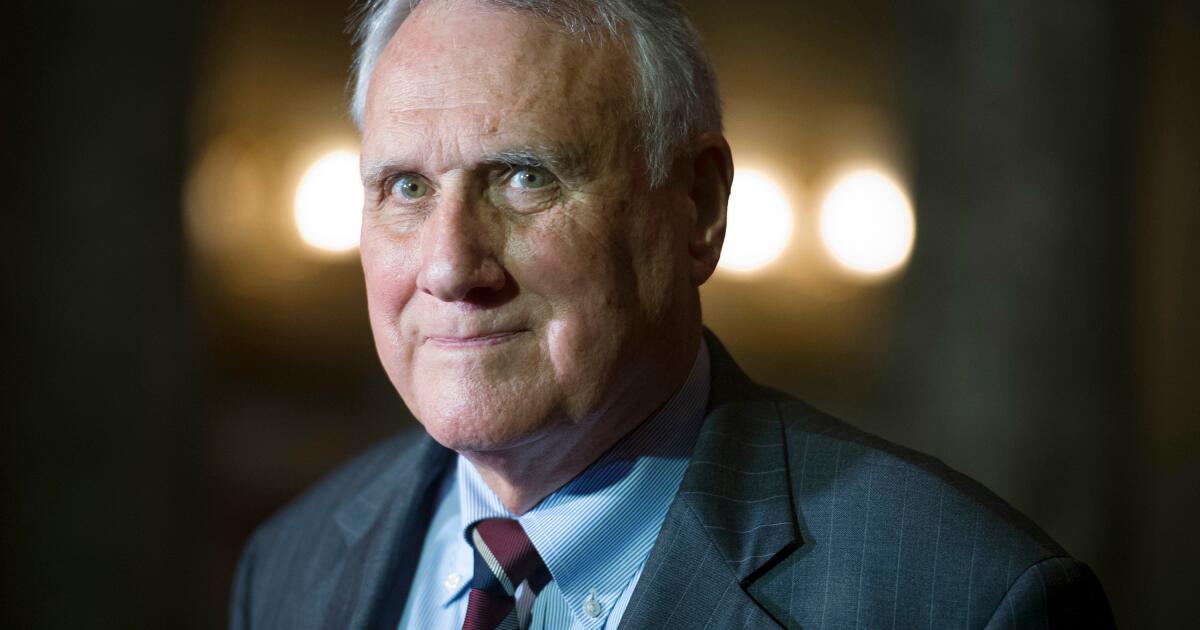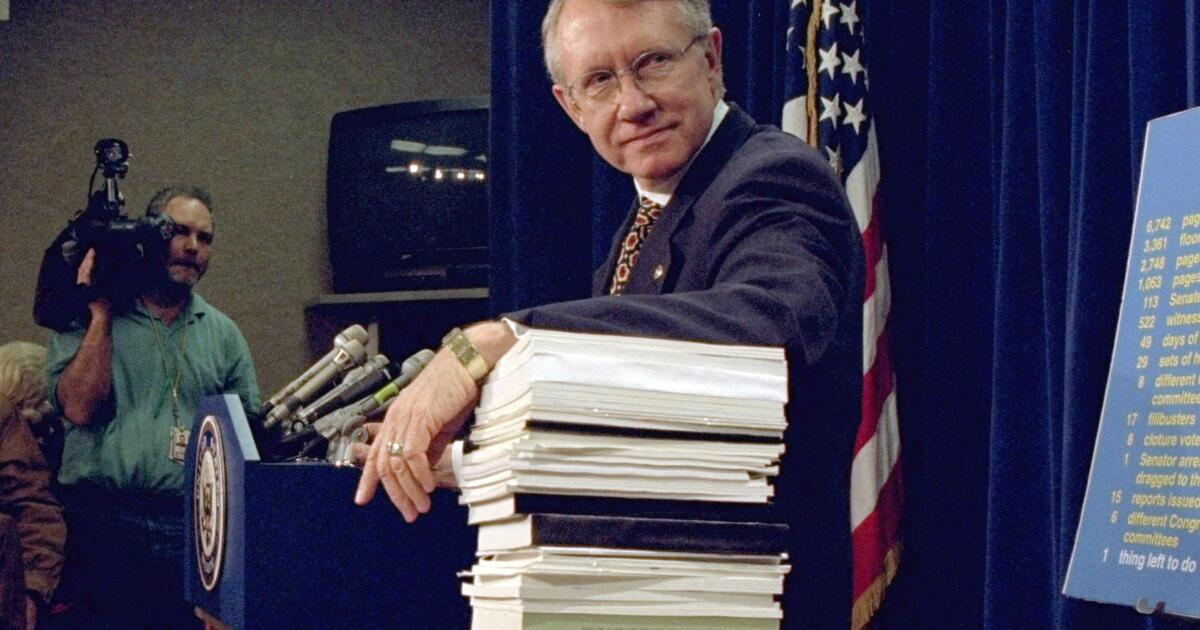
Harry Reid biographer Jon Ralston discusses his new book
To say Harry Reid and Jon Ralston had a fraught relationship is like suggesting Arabs and Israelis haven’t always been on the best of terms.
Or there’s a wee bit of tension between fans of the L.A. Dodgers and San Francisco Giants.
Reid, the former Senate majority leader and most powerful and important lawmaker ever to emerge from Nevada, went for long periods without speaking to Ralston, the state’s most prominent and highly regarded political journalist. Beyond that, Reid tried several times to get Ralston fired, finally succeeding when he was unceremoniously dumped by the TV stations that for years broadcast Ralston’s statewide public affairs program.
And yet when it came time to etch his name in history, Reid summoned Ralston and asked him to write his biography.
“He said, ‘Jon, you and I have something in common. We’re both survivors,’ ” Ralston recounted last week, laughing at the memory of their 2021 conversation.
“Which I thought was quite ironic, since he had tried to make sure I didn’t survive in my job several times. But he said, ‘You’re the only one who can do this book right. … I know I’m not going to like everything you write, but I want you to do the book.’ ”
The moment speaks to the quintessence of Reid, a flinty product of Nevada’s hardpan desert, who was famously unflinching and unsentimental in his pursuit and application of political power.
Reid, who died a little over four years ago, was a paradoxical mix of pugilism and self-effacement: cunning, ruthless and, at times, surprisingly tender-hearted. Beneath the bland exterior of a country parson, all soft-spoken solemnity, beat the heart of a bare-fisted brawler.
In short, he was an irresistible subject for a longtime student of politics like Ralston, whose book, “The Game Changer,” comes out Tuesday.
“I think there was a mutual respect there,” Ralson said of his parry-and-thrust relationship with Reid, who left the Senate in 2017 after more than 30 years on Capitol Hill. “Not to sound like an egoist, but he knew that I chronicled him in a way that nobody else did and recognized things about him that no one else did.”
Ralston took up the subject with no constraints.
Reid, who died about six months after asking Ralston to pen his biography, sat for two dozen interviews. He encouraged family, friends and former staffers to cooperate with Ralston. He granted unlimited access to his voluminous records — 12 million digital files and 100 boxes archived at the University of Nevada, Reno — including personal correspondence and internal emails. (Those include the senator and his chief of staff gleefully celebrating Ralston’s professional setbacks.)
The result is the definitive work — clear-eyed, evenhanded — on Reid and his legacy, which includes passage of the Affordable Care Act, or Obamacare, if you prefer; the survival of the Las Vegas Strip during the Great Recession, and, most controversially, the Senate’s abandonment of the filibuster for presidential nominees, which eventually led to today’s Trump-stacked Supreme Court.
(Full disclosure: Your friendly columnist read the book in galley form and provided a favorable blurb that appears on the back cover.)
The biography recounts standard Reid lore.
The hardscrabble upbringing in Searchlight, Nev., a pinpoint about an hour’s drive south of Las Vegas. His hitchhiking, 40-mile commute to attend high school in Henderson. His years as an amateur boxer — and scuffle with his future father in law — and work as a Capitol police officer while attending law school in Washington, D.C. The car-bomb attempt on Reid’s life, connected to his work on the Nevada Gaming Commission.
And, of course, his oft-stumbling climb through the ranks of Nevada politics, which included a failed bid for Las Vegas mayor, a U.S. Senate contest he lost by fewer than 700 votes and another Reid won by fewer than 500.
Ralston, of course, was well-versed in that history, having written much of it. (Today, he serves as chief executive of the Nevada Independent, a nonprofit, nonpartisan news and opinion website he founded in 2017.)
Even as the world’s foremost Reid-ologist, as Ralston jokingly calls himself, there were things that surprised him.
He was unaware of the length and depth of an FBI probe, conducted in the late 1970s and early 1980s, into Reid over purported mob ties and other alleged improprieties. “He was never indicted or charged or anything,” Ralston said, “but they clearly were after him.”
And he had no idea of Reid’s prolific penmanship.
“Hundreds, maybe thousands of [notes and letters] … to friends, to colleagues in the Senate, to journalists and others,” Ralston said. “That really is something that’s not known about Harry Reid, how he established personal connections with people, which helped him become the effective leader that he was in the U.S. Senate.”
Even after decades of covering Reid, and years devoted to researching his biography, Ralston won’t presume to say he knows exactly what made him tick — though he suggested Reid’s impoverished, trauma-filled childhood had a lasting impact.
“He was an incredibly driven person,” Ralson said, “who went right up the line and, some would say over it, in trying to achieve what he thought was best for himself, for his party, for his country, for his friends, for his family.”
Along with that determination, Reid had an industrial-strength capacity to relinquish hard feelings, forget old animosities and move on. So, too, does Ralston. Their clashes were “just business,” Ralston said, and nothing he took personally.
The result is an improbable collaboration that produced an insightful examination and worthy coda to a remarkable career.