White is the latest festival alum added to the bill for a surprise slot in recent years, joining the likes of Weezer and Ed Sheeran in 2025, Blink-182 in 2023 and Arcade Fire in 2022.
The sold-out festival is topped by Sabrina Carpenter on Friday, Justin Bieber on Saturday and Karol G on Sunday. Carpenter has the earliest headlining spot of the three, with a set scheduled for 9:05 to 10:35 p.m. Following Carpenter on opening night is electronic artist Anyma, who is debuting a production called “Æden” at midnight on the Coachella stage.
It’s free to see, but there’s a reservation system for a time slot. People who can’t make a reservation will be admitted on a first-come, first-served basis.
On the Coachella website, it describes the Bunker as being located near the Sahara Tent.
Having reached the Five-Timers Club, as addressed in an obligatory monologue sketch featuring Jonah Hill, Tina Fey, Candice Bergen and others, Black was a returning hero. He’s frequently cited as one of the favorite hosts among the cast. And while this time may not have reached the frenetic highs of last year’s manic and musical outing, it had some memorable moments.
Black paired up with Marcello Hernández to play martial arts instructors who teach unorthodox self-defense methods. It played to Black’s physical comedy chops, but something felt off about the execution, especially because of the hard-to-understand dialogue. Black played the last Spartan to be considered for inclusion in the group of 300 Greek fighters against Persia (spoiler: he doesn’t make it in). He played an intrusive Airbnb host with Melissa McCarthy, who was also on board for the Five-Timers sketch.
While the monologue was a blast of fresh chaos (or at least the sense of chaos) with Black jamming out with White, the rest of the show didn’t have the same kind of verve, falling back on familiar sketch formulas. That said, Black committed throughout and sang well when he had the opportunity.
Breaking a streak of cold opens featuring President Trump and/or members of his cabinet, this week’s opening sketch featured instead a March Madness NCAA post-game roundup featuring Ernie Johnson (James Austin Johnson), Kenny Smith (Kam Patterson), Charles Barkley (Kenan Thompson) and coach Bruce Pearl (Jeremy Culhane). The joke here was that Barkley, already known for being outspoken, has been getting kudos for speaking out in favor of immigrants on a CBS broadcast. On the show, he jokes that it’s “the first time I went viral without a prescription for Valtrex.” Emboldened, this version of Barkley keeps saying he’s going to be careful with his words, before weighing in on the Iran war, the Artemis II space mission (“A waste of money. They just flying around the moon.”) and the firing of former U.S. Atty. Gen. Pam Bondi. Bondi (Padilla) appeared to refute the comments, referring to “The final four… years of this country.” Barkley said he was going to choose his words carefully one more time before delivering, “Live from New York… It’s Saturday Night!”
For his induction to the Five-Timers Club, Black was joined by a jacket-clad Hill who revealed that there’s something wrong with the lounge where the Five Timers hang out. The room, indeed, appeared spooky and abandoned with cobwebs and Fey wearing a robe made out of Paddington, which she said she got after hosting “SNL UK” last month. Fey revealed the lounge has fallen apart after literally being run into the ground by too many Five-Timers Club sketches. The suave Hernández character Domingo appeared briefly but was conked on the noggin by White, who also achieved Five-Timers status, but as a musical guest. He left early to move his hearse: apparently musical Five Timers only get their parking validated for 15 minutes. Black chose to rock out to revive the lounge, launching into a version of White’s “Seven Nation Army” with the guitarist accompanying him. After a brief musical rockening, Black told the audience, “Stick around, we’ll be White Black!”
Best sketch of the night: If only we could remember why this song was so good
Beyond his spot-on Trump impression, Johnson has proven to be adept at musical impressions, and here he does a nice job launching into a country song, “Words to Live By,” about a man who hears his father’s dying words … and then forgets what the wisdom was that was imparted. Black takes over as a man who climbed a mountain in Tibet and spent 20 hours with a guru, only to forget what he learned while walking down the mountain and getting a text from his wife. That would have been plenty, but a third section features Andrew Dismukes as an annoyed father refusing to listen to his 6-year-old son’s words. “You don’t even know how to wipe your own butt,” he sings, “you maybe only know the names of like 30 weird Pokemon guys.” The three singers at least remember the name of the “Men in Black” device that erases your memory: The Neuralyzer.
Also good: There’ll be peace when you are done (watching this sketch)
What looked at first to be a repeat of a recent sketch about wine-drinking wives chatting in the kitchen and playing truth or dare instead pivoted to a scene about husbands stuck together in a den with nothing to talk about. That might have been premise enough for a piece about men having trouble making friends, but instead, a mumbled lyric for the Kansas song “Carry On Wayward Son” turned into a full-blown sing-along that peaks when the men jam out with ribbon sticks and strip their outerwear to reveal colorful jumpsuits. When you have a guest who can sing as well as Black, you’ve got to lean into that talent.
‘Weekend Update’ winner: A scandal that keeps ballooning
Patterson had some funny moments as the new Black version of Professor Snape slated to appear in the new “Harry Potter” series, but Sarah Sherman was tough to ignore as Kristi Noem’s husband Bryon, currently embroiled in a scandal over online chats. Sherman as Bryon Noem wore two giant balloons under a shirt, challenging “Update” co-host Michael Che and others to make fun of his kink. “I dare you to find one thing that’s funny about this whole situation,” Bryon said. The segment got more and more absurd as Bryon challenged the cue-card master Wally Ferensten, Lorne Michaels (shown having already left, leaving a spinning desk chair), Kristi Noem (Padilla) and even the dog she shot, shown in heaven with a halo. It was as distasteful a segment as you’d expect from “Update,” yet also somehow straddled the line between wallowing in the scandal and mining some genuine laughs out of it.
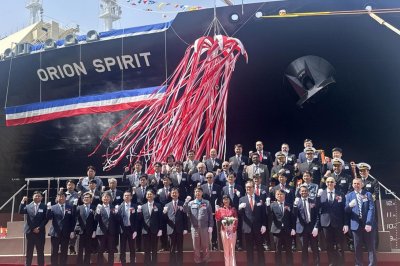
The christening ceremony of South Korea’s 500th liquid natural gas carrier for export at Samsung Heavy Industries Co. on the southeastern Geoje Island, South Korea. File. Photo by YONHAP / EPA
April 1 (Asia Today) — Samsung Heavy Industries has joined a U.S. Navy vessel development project, marking another step forward for South Korea’s shipbuilding industry in the American defense market following similar moves by Hanwha.
Samsung Heavy Industries said Wednesday it has begun conceptual design work for the Navy’s Next-Generation Logistics Support Ship program in partnership with U.S. shipbuilder General Dynamics NASSCO and Korean engineering firm DSEC. The project is scheduled to run through March 2027.
The program involves developing small, highly maneuverable vessels to support the Navy’s distributed maritime operations strategy, which emphasizes dispersed forces and flexible logistics. More than 13 ships are expected to be built under the initiative.
Samsung Heavy Industries will focus on hull design and technical support, using a 400-meter test tank at its research facility to improve efficiency and performance.
The announcement follows a move by Hanwha’s shipbuilding unit, which recently confirmed its participation in a separate U.S. Navy program. Industry analysts say a broader Korea-U.S. shipbuilding cooperation framework is beginning to take shape as major South Korean companies expand their presence in U.S. defense projects.
A company official said the NGLS program will serve as a foundation for expanding cooperation with the U.S. partner shipyard and accelerating efforts to secure tangible results in the American market.
In parallel with the design project, Samsung Heavy Industries is preparing to bid jointly with a U.S. shipyard for maintenance, repair and overhaul contracts. The company is also pursuing certification under the Navy’s ship repair agreement program, which would allow it to compete for future maintenance work.
The company is further strengthening collaboration in advanced manufacturing technologies, including artificial intelligence-based automation and robotics, through a research center established with San Diego State University. Plans include expanding cooperation to build a shipbuilding supply chain in the United States and train skilled workers.
The latest developments suggest South Korea’s shipbuilders are moving beyond commercial vessels into defense-related projects in the United States, broadening their global footprint and deepening bilateral industrial ties.
Weekly insights and analysis on the latest developments in military technology, strategy, and foreign policy.
Boeing Australia has teamed up with Rheinmetall, the largest arms manufacturer in Germany, to offer the MQ-28 Ghost Bat drone to the German military. The Ghost Bat collaborative combat aircraft (CCA) is the latest contender for a German requirement, and is likely to face competition from the XQ-58A Valkyrie drone and potentially the homegrown Airbus Wingman.
In a statement today, Rheinmetall said that the plan was to pitch the MQ-28 as “a mature solution for the Bundeswehr’s procurement of collaborative combat aircraft (CCA) into Germany by 2029.” Describing the Ghost Bat as “a world-leading, proven CCA,” Rheinmetall noted that the drone “can be modified to meet Germany’s sovereign requirements” — as we have discussed before, the highly modular nature of the MQ-28 is a key part of its design.
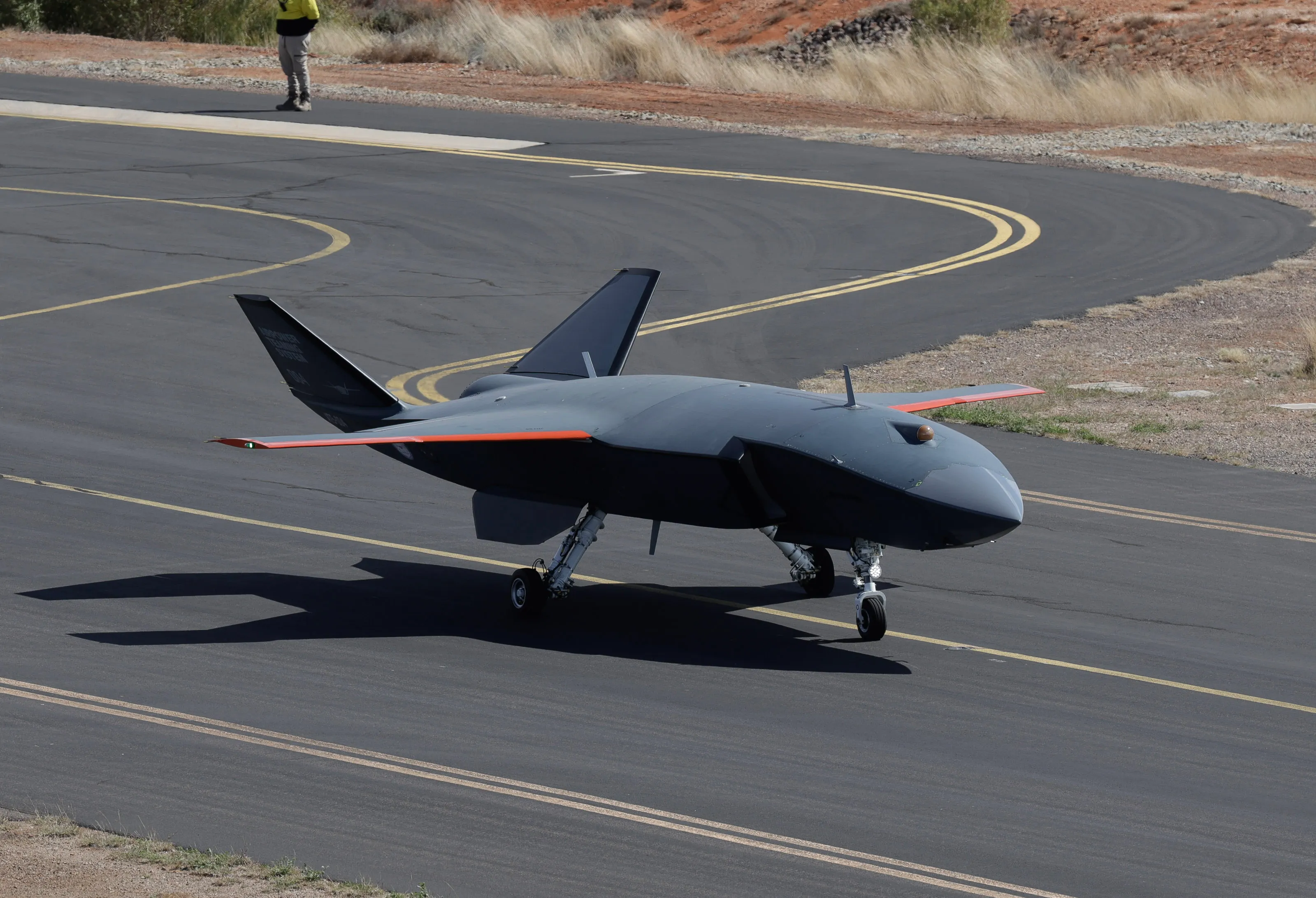
An MQ-28A Ghost Bat taxis prior to flight at Woomera, South Australia, in September 2025. Australian Department of Defense
Should Germany select the MQ-28 for its CCA requirement, Rheinmetall would serve as the system manager for the aircraft in Germany, overseeing system integration into the country’s existing and future command and weapon systems, and adaptation to national requirements. The company would also provide operational, maintenance, and logistical support. A major benefit of the platform is the fact that much of the development has already been paid for by Australia, and the resulting drone is more mature than anything else in Europe.
“With Boeing Defense Australia as a partner, we are laying the groundwork to optimally tailor the MQ-28 to the Bundeswehr’s requirements,” said Armin Papperger, CEO of Rheinmetall AG. “As a system integrator, we ensure that integration, operation, and further development come from a single source while simultaneously strengthening industrial value creation in the form of an industrial hub in Germany and Europe. We see revenue potential for Rheinmetall in the range of three-digit millions of euros.”
Australia has also contracted for the development of the enhanced Block 3 MQ-28, which will include an internal weapons bay. This will be scaled to accommodate one AMRAAM or two GBU-39/B Small Diameter Bombs (SDB) or equivalents, in terms of size. A pair of SDB IIs, also known as the GBU-53/B StormBreaker glide bomb, would be another option.
An AIM-120 AMRAAM loaded on an MQ-28A Ghost Bat. Australian Department of Defense
The next big milestones for the Royal Australian Air Force should come in 2028, with the planned service introduction of the Block 2 aircraft and the initial production of the Block 3 aircraft.
Interestingly, the Rheinmetall press release describes the MQ-28 being “ready to deliver air-to-ground capability to Germany by 2029.” It’s unclear at this point if this reflects Berlin’s requirement for an exclusive air-to-ground CCA platform, or if an air-to-air capability will be added at a later point.
A quartet of MQ-28s, the two in the middle having IRST sensors on top of their noses. Boeing
For Block 3, Boeing is working on three or four alternative sensor payloads, too. Integration of these would be facilitated by the fact that the entire nose can be swapped out to accommodate different payloads.
Speaking earlier this year to journalists, including from TWZ, Glen Ferguson, MQ-28 program director at Boeing, said he was unable to talk about any potential future customers other than Japan, but noted that the company was pursuing sales elsewhere in the Indo-Pacific region, specifically.
Meanwhile, in 2022, the Pentagon confirmed that it had acquired at least one MQ-28 to be used to support the U.S. Air Force’s advanced uncrewed aircraft and autonomy efforts. Meanwhile, the U.S. Navy has deployed a test and evaluation squadron to Australia to work on the aircraft, and an MQ-28 has also been operating out of Naval Air Station Point Mugu, California.
As we have discussed in the past, the MQ-28 seems uniquely suited for a cooperative production and operation program across multiple allied nations, and it’s perhaps not a coincidence that the Bundeswehr is increasingly looking at future operations in the Indo-Pacific region, something that has seen recent deployments of Luftwaffe Eurofighters, for example.
A Luftwaffe Eurofighter flies alongside an F/A-18F from the Royal Australian Air Force over Darwin, Australia, during the Pitch Black 2022 exercise. Bundeswehr/Christian Timmig
The Luftwaffe has long been seen as a candidate for a CCA-type drone. In the medium term, this would involve an uncrewed companion to work alongside the Eurofighter, which would be especially relevant for its forthcoming Eurofighter EK electronic warfare jets.
A rendering of a Typhoon EK for the German Air Force. Airbus
A drone of this kind could also be harnessed by other German Eurofighters, which undertake a range of air defense and air-to-ground missions, as well as the F-35A stealth fighters it also has on order. The F-35 is designed very much with CCAs in mind, with the combination of the stealth jet and complementary drones being a key part of the planned future U.S. Air Force force posture.
A CCA could be even more important for Germany depending on the fate of the pan-European Future Combat Air System (FCAS) program, at the heart of which will be the crewed New Generation Fighter (NGF). Both are expected to be in service by 2035, although that target is looking increasingly unlikely.
Concept artwork of the NGF fighter that is the centerpiece of the pan-European FCAS. Dassault Aviation
In fact, there is a good chance that rifts between France and Germany on the course that FCAS should take, especially when it comes to workshare, could see Germany walk away from the program entirely.
That would leave a significant gap in combat air ‘mass’ that a CCA could help mitigate.
With Germany in the market for a drone in this class, another partnership, announced last year, sees Airbus Defense and Space team up with Kratos Defense and Security Solutions to provide the stealthy XQ-58A to the German Luftwaffe.
Kratos says the new version of the Valkyrie would be “tuned” for the European mission, suggesting that it will feature specific modifications for operators in the region. New versions of the XQ-58 will be capable of runway launch, and the platform can be scaled to a degree, too.
A U.S. Marine Corps XQ-58A Valkyrie conducts a test flight with a U.S. Air Force F-16. U.S. Air Force photo
The same would likely apply to the MQ-28, which Rheinmetall could potentially offer to a range of other European nations, alongside Germany, potentially filling an emerging niche for ‘loyal wingman’-type drones, along with other roles, with several air forces. Again, depending on the fate of FCAS, that requirement could become even greater, and the new partnership gives the MQ-28 an anchor in Europe and an increasingly lucrative market.
Last year also saw the emergence of another possible contender for the Luftwaffe CCA, when German defense startup Helsing unveiled its CA-1 Europa. The company is targeting a first flight in 2027 for the drone, which looks very similar to the MQ-28.
CA-1 Europa: Autonomous Air Dominance
Meanwhile, in 2024, Airbus unveiled a stealthy CCA-like concept of its own, known as Wingman. At the time, the company said that the Luftwaffe had “expressed a clear need” for a drone that would be able to operate in conjunction with crewed fighters before the arrival in service of the FCAS. Airbus says the Wingman should provide a unit cost that’s equivalent to one-third that of a modern crewed fighter.
The Airbus Wingman concept aircraft at the Berlin Airshow in 2024. Thomas Newdick
Somewhat larger than the XQ-58A, the Wingman currently exists only as a concept aircraft, and its future is less certain now that Airbus is collaborating with Kratos on the Valkyrie.
Drones of the kind that are now referred to as CCAs are not entirely new territory for Germany.
Before the Wingman concept, Airbus worked on other advanced uncrewed aircraft programs, including the Barracuda, work on which began in 2003, initially as a ‘black program.’ The Barracuda was retired after six test campaigns. Experience and data from the drone have been fed into FCAS, which is also planned to include interaction of crewed and uncrewed aircraft, with “remote carrier” drones of different sizes being among the latter.
Ground crew working on the Barracuda technology demonstrator. Airbus
Whether Germany opts for the MQ-28 Ghost Bat or another rival solution, if current plans materialize, the Luftwaffe looks set to be operating some kind of advanced collaborative combat aircraft before the end of the decade.
Coupang interim CEO Harold Rogers takes part in an overnight to dawn delivery shift in Seongnam, South Korea. Courtesy of Coupang
March 20 (Asia Today) — Coupang interim CEO Harold Rogers joined an overnight to dawn delivery shift in Seongnam, south of Seoul, after accepting a lawmaker’s request at a National Assembly hearing to experience the job firsthand. Rogers worked from 8:30 p.m. Wednesday to 6:30 a.m. Thursday, taking part in the full process from loading to delivery, according to Coupang and local media reports.
The overnight shift followed a proposal made by Democratic Party lawmaker Yeom Tae-young during a parliamentary hearing in December, which Rogers agreed to at the time. Coupang said the experience was intended to deepen management’s understanding of field operations and strengthen trust by following through on that commitment.
Rogers and Yeom began at Coupang Logistics’ delivery camp in Yatap, where they completed safety training and helped load packages. They then rode with a directly employed Coupang delivery driver, known as a “Coupang Friend,” and delivered orders to apartments, villas and detached homes across Jungwon-gu.
Coupang said it would use the experience to accelerate workplace improvements and strengthen safety management by reflecting feedback from the field. Rogers said he was proud of all Coupang workers, including delivery staff, and pledged to continue building what he described as safe and advanced working conditions.
Separately, Coupang Fulfillment Services said it will begin holding job fairs Monday in Suwon, Daegu and other locations to recruit logistics workers as Rocket Fresh expands. The company said the events will use a one-stop hiring format covering consultation through interviews.
JUNIOR Andre has made his acting debut alongside his father Peter and an EastEnders star, just days after revealing his secret job.
The young lad, 20, played the role of Johnny in a new coming-of-age drama called Finding My Voice.
Sign up for the Showbiz newsletter
Thank you!
Junior has announced he’ll be starring in a filmCredit: Instagram/findingmyvoicemovieThe news comes only a matter of days after he revealed he secretly works at the London underground to make money to support his own musicCredit: Instagram/findingmyvoicemovie
Finding My Voice is about a girl called Mel who feels like she has nowhere to go after facing a series of tragedies.
Her family breaks up due to alcoholism following the death of her baby brother, plunging her into deep struggles.
Johnny is a friend who is always there for her when she needs someone to believe in her, which is truly heartwarming.
At the end of the month Finding My Voice will host its first screening as a part of Manchester‘s Film Festival.
Another Instagram post announced who Junior would be playing, which received a roaring reception from his friends and family.
The post shows a carousel of snaps of Junior featuring in the film, the first of which includes the name “Johnny” over his head in block lettering.
The caption says: “Junior Andre. Johnny is Mel’s school friend and one of the few people who’s always there when she needs someone to believe in her.
“Finding My Voice movie is out on 28th March at Manchester Film Festival. See you there!”
Junior’s character is very supportive in the filmCredit: Instagram/findingmyvoicemovieHis girlfriend Jasmine gushed with pride online about his film debutCredit: Splash
Right at the top of the post’s comments section is Peter, gushing: “Yea my son,” followed by three flame emojis.
Junior’s girlfriend Jasmine Orr added: “Can’t wait for this,” along with three hand emojis forming hearts.
Fans felt the same level of enthusiasm, saying “Wow” and that they “can’t wait to watch” the film.
Peter plays the role of Costas, who more details are yet to be released about.