
joining

Pakistan ready for multi-day US-Iran talks, but Tehran unsure about joining | US-Israel war on Iran News

Islamabad, Pakistan – Pakistan is gearing up to host the second round of talks between the United States and Iran aimed at ending their war, but rising tensions in recent hours have cast uncertainty over Tehran’s participation, as the deadline nears for the end of the two-week ceasefire.

Unlike the first round of talks held in Islamabad on April 11, the upcoming negotiations could last for multiple days until a temporary deal – mediators are calling it a memorandum of understanding – is signed, effectively extending the ceasefire, sources close to these efforts have told Al Jazeera. If the MoU is agreed, it would give negotiators a longer window – even up to 60 days – to secure a longer peace deal.

Recommended Stories

list of 4 itemsend of list

But all of that hinges on the participation of Iran, which – as of Monday morning – has not confirmed that it will be sending its negotiators to Islamabad. That follows a rapid escalation in tensions over the past 24 hours.

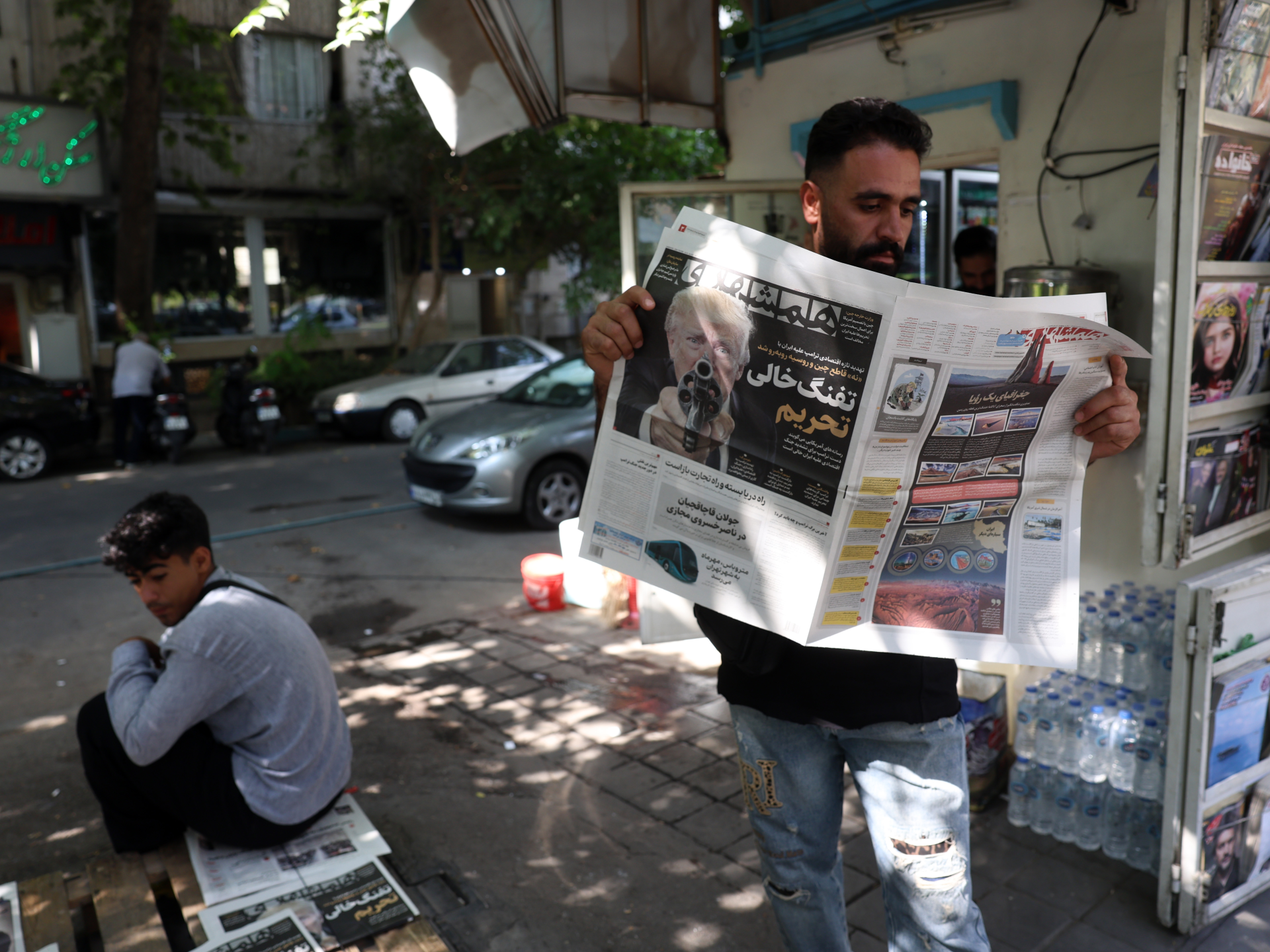
US President Donald Trump announced on Sunday that his representatives were heading to Pakistan for a second round of negotiations with Iran, as a fragile ceasefire, due to expire on Wednesday, edges towards its deadline.  But Trump accompanied his announcement with a revival of earlier pre-ceasefire threats to bomb Iran’s energy and power facilities.

“My Representatives are going to Islamabad, Pakistan. They will be there tomorrow evening, for Negotiations,” Trump wrote on Truth Social. He accused Iran of a “Total Violation of our Ceasefire Agreement” after Iranian gunboats fired on vessels in the Strait of Hormuz on Saturday, hitting ships including a French vessel and a British freighter.

“We’re offering a very fair and reasonable DEAL, and I hope they take it because, if they don’t, the United States is going to knock out every single Power Plant, and every single Bridge, in Iran,” Trump wrote. “NO MORE MR. NICE GUY!”

The tensions did not ease overnight. In the early hours of Monday, Trump announced on Truth Social that the US Navy guided missile destroyer USS Spruance had intercepted an Iranian-flagged cargo ship, the Touska, nearly 900 feet (274 metres) long, in the Gulf of Oman after its crew refused to heed warnings to stop.

“Our Navy ship stopped them right in their tracks by blowing a hole in the engine room,” Trump wrote. US Marines have now taken charge of the vessel, which Trump alleged was under US Treasury sanctions for prior illegal activity.

Iran has described the seizure of the ship as “piracy”.


epa12891925 The entrance of the Serena Hotel, which previously hosted Iran-US peace talks in Islamabad, Pakistan, 15 April 2026. Regional mediators continue efforts to extend the US-Iran ceasefire after talks in Islamabad ended without agreement on 11 April, while Pakistani Prime Minister Sharif begins visits to Saudi Arabia, Qatar, and Turkey as diplomatic discussions proceed. According to Iranian officials, members of the US and Iranian delegation could return to Pakistan to resume negotiations. EPA/SOHAIL SHAHZAD
The Serena Hotel is scheduled to host the anticipated next round of talks between the US and Iran. [Sohail Shahzad/EPA]

Pakistan’s preparations

Amid those military and social media exchanges between Iran and the United States, Pakistan has been busy getting ready to host talks that it – as the principal mediator between Washington and Tehran – hopes will yield a deal to end the war, now into its eighth week.

Islamabad’s Marriott Hotel asked guests to vacate by Sunday afternoon. The Serena Hotel, just a few kilometres away and the venue for the first round of talks a week earlier, soon issued the same order and stopped taking reservations.

Roads into the Red Zone, the capital’s most heavily fortified area, were sealed. The district houses key government buildings, including the National Assembly, foreign embassies and both five-star hotels. Thousands of additional police and paramilitary personnel arrived from across the country.

Barbed wire and barricades lined the streets, and most access routes were shut.

But even before Trump’s latest threat to blow up Iranian energy and power facilities, and the subsequent hijacking of the Iranian ship, Tehran was unclear about whether it would join the talks.

Minutes before Trump’s Truth Social message, Iran’s ambassador to Pakistan, Reza Amiri Moghadam wrote on his social media that violations of international law, the continuation of the US naval blockade of the Strait of Hormuz, threats of further strikes, and what he described as unreasonable demands could not be reconciled with a genuine pursuit of peace.

“As long as the naval blockade remains, faultlines remain,” he added.

The negotiators: The US and Iranian teams

Trump first said on Sunday that Vice President JD Vance, who had led the US team in the first round of Islamabad talks, would not visit the Pakistani capital this time around, because of security concerns.

But White House Press Secretary Karoline Leavitt later said that Vance would join the US delegation, alongside special envoy Steve Witkoff and Trump’s son-in-law, Jared Kushner, the same team that led the first round.

Flight tracking data showed at least four US government aircraft carrying communications equipment and motorcade support landed on Sunday at PAF Base Nur Khan in Rawalpindi, the primary VIP entry point for Islamabad.

However, by late night, sources close to mediators told Al Jazeera that it was once again unclear whether Vance would travel to Islamabad on Monday. They said that the US might now send Witkoff and Kushner to Islamabad first, and if the talks actually happen, Vance might join them.

Amid Iranian hesitation over whether to join the Islamabad talks, Pakistani Prime Minister Shehbaz Sharif spoke with Iranian President Masoud Pezeshkian. The call lasted about 45 minutes, the Pakistan PM’s office said.

Sharif briefed Pezeshkian on his recent visits to Saudi Arabia, Qatar and Turkiye, where he met with their leaders, describing those engagements as helpful in “building consensus in support of a sustained process of dialogue and diplomacy”.

But by early Monday morning, Trump’s revived threats and the capture of the Iranian cargo ship have left the prospects of talks in Islamabad even more on edge than before.

Iran pushes back

Tehran pushed back sharply against Trump’s flurry of social media posts on Sunday.

Iran’s state news agency IRNA said reports of a second round of talks in Islamabad were “not correct”, and blamed the lack of progress on what it described as American “greed”, unreasonable demands, shifting positions and “continuous contradictions”.

According to IRNA, the naval blockade – imposed by Trump last Monday, two days after the first round of Islamabad talks – violated the ceasefire understanding and had “so far prevented progress in negotiations”.

It added that “no clear prospect for productive negotiations is foreseen” under current conditions and dismissed US statements on talks as “a media game”, aimed at pressuring Iran through a “blame game”.

A satellite image shows the ship movement at the Strait of Hormuz on April 17, 2026, in Space. EUROPEAN UNION/COPERNICUS SENTINEL-2/Handout via REUTERS THIS IMAGE HAS BEEN SUPPLIED BY A THIRD PARTY MANDATORY CREDIT.
A satellite image shows shipping movement in the Strait of Hormuz on April 17, 2026, in Space. [Handout/ European Union/Copernicus Sentinel via Reuters]

In a post on X, foreign ministry spokesman Esmaeil Baghaei went further, describing the US naval blockade as “unlawful and criminal” and saying it amounted to “war crime and crime against humanity”.

Despite the public denials, Iranian sources earlier on Sunday indicated a delegation was expected in Pakistan on Tuesday. It could include Parliamentary Speaker Mohammad Bagher Ghalibaf, who led Tehran’s team in the first round, and Foreign Minister Abbas Araghchi, who had joined him then.

Pakistan’s foreign ministry said Araghchi and his Pakistani counterpart Ishaq Dar spoke by phone on Sunday and discussed “the need for continued dialogue and engagement as essential to resolving the current issues as soon as possible”.

Analysts say the gap between Iran’s public stance and private signalling reflects a deliberate strategy.

“This gap reflects a dual-track negotiation strategy,” Seyed Mojtaba Jalalzadeh, an international relations analyst based in Tehran, told Al Jazeera. “At the public level, Iran maintains a hardline position to preserve domestic legitimacy and increase its leverage; at the non-public level, by dispatching a team to Islamabad, it signals that it has not abandoned diplomacy but is instead testing its conditions.”

Fahd Humayun, an assistant professor of political science at Tufts University, agreed.

“When warring parties come to the table to negotiate, they come with the understanding that there is occasionally a gap between public posturing and private positions,” he told Al Jazeera. “My sense is that they will pick up from where they left off, rather than getting too caught up in the rhetoric that has emerged since”.

That divergence extends to the pace of negotiations.

Washington has pushed for a rapid resolution, with Trump repeatedly declaring the war “close to over” even as fighting continues. Tehran, by contrast, has shown little inclination to be rushed.

A diplomat in Islamabad, who has followed the talks closely, described the contrast.

“The previous round of talks is a great example. It appeared as if the Americans brought a stop-watch, whereas the Iranians came armed with a calendar,” the diplomat said on condition of anonymity.

What is achievable?

Officials do not expect a final deal this week.

The immediate goal is likely to be a ceasefire extension, with both sides in Islamabad working towards a limited understanding.

Pakistani officials expressed cautious optimism, saying the process was moving in a positive direction while stressing that a final agreement would require sustained engagement and compromise.

Unlike the first round, talks could run for several days, with the aim of agreeing on a framework for broader negotiations in the coming weeks and months.

Pakistan's Prime Minister Shehbaz Sharif meets with Iranian Parliament Speaker Mohammad Bagher Ghalibaf, as delegations from the United States and Iran are expected to hold peace talks, in Islamabad, Pakistan, April 11, 2026. Office of the Iranian Parliament Speaker/WANA (West Asia News Agency)/Handout via REUTERS ATTENTION EDITORS - THIS PICTURE WAS PROVIDED BY A THIRD PARTY. BEST QUALITY AVAILABLE.
Pakistan’s Prime Minister Shehbaz Sharif with Iranian Parliament Speaker Mohammad Bagher Ghalibaf before anticipated peace talks in Islamabad, April 11, 2026. [Handout/Office of the Iranian Parliament Speaker via Reuters]

Humayun cautioned against viewing the first round as a failure.

“I wouldn’t characterise the first round as having failed, that assumes expectations of resolving the most difficult issues early on, which is unlikely in talks of this nature where the issues are so complex,” he said.

For this round, a ceasefire extension would be “a meaningful outcome in itself”, while both sides would likely be “probing for any shifts or flexibility in positions since they last spoke”.

It is that movement, he added, that would allow both sides to “politically sanction an extension of the ceasefire”.

“A ceasefire extension could represent the most minimal form of agreement achievable in this round,” Jalalzadeh said, adding that the deal Washington seeks is “far broader in scope and is rooted in a history stretching back 47 years”.

Iran’s Deputy Foreign Minister Saeed Khatibzadeh, speaking on the sidelines of the Antalya Diplomacy Forum in Turkiye over the weekend, said “significant progress” had been made in the previous round but stressed that a framework must be agreed upon before talks could advance.

He described US demands on Iran’s nuclear programme as “maximalist”.

Ghalibaf was more direct. “There are many gaps and some fundamental points remain,” he said in televised remarks on Saturday night. “We are still far from the final discussion”.

The core sticking points, Iran’s nuclear programme and control of the Strait of Hormuz, remain unresolved since the first round, held on April 11, which lasted 21 hours and ended without agreement.

A separate Israel-Lebanon ceasefire is now in place, removing one of Tehran’s stated conditions for talks.

But Jalalzadeh said the ceasefire fell well short of satisfying Iran’s demands. “The current Israel-Lebanon ceasefire is temporary, fragile, and incomplete,” he told Al Jazeera, noting that Hezbollah – Tehran’s most powerful regional ally – was absent from the agreement, which the Lebanese government negotiated with Israel.

“This ceasefire is a tactical palliative, not a substitute for Iran’s strategic demand,” he said, adding that Tehran’s insistence on Lebanon being part of any broader deal, rather than handled through a separate arrangement, remained unchanged.

Humayun said Iran would want the Israel-Lebanon truce to hold and ideally include “some form of assurance against violations”.

U.S. Vice President JD Vance meets with Pakistan's Prime Minister Shehbaz Sharif for talks about Iran, in Islamabad, Pakistan, April 11, 2026. Jacquelyn Martin/Pool via REUTERS
US Vice President JD Vance with Pakistan’s Prime Minister Shehbaz Sharif for talks about Iran in Islamabad, April 11, 2026. [Jacquelyn Martin/Pool via Reuters]

The broader question, he said, is “whether Iran can secure at least some degree of US pressure on Israel to adhere to the ceasefire and to refrain from further escalation”.

The Sharif-Pezeshkian call capped an intensive week of Pakistani diplomacy.

Field Marshal Asim Munir travelled to Tehran last Wednesday, carrying what officials described as a new message from Washington.

Iranian Ambassador Reza Amiri Moghadam said last week in Islamabad that Tehran would “do talks in Pakistan and nowhere else, because we trust Pakistan”.

Analysts say Pakistan’s value as a mediator lies in the rare credibility it holds with both sides.

Humayun said that even if this round produces no breakthrough, it would not necessarily erode trust in Islamabad.

“All parties understand how difficult these issues are and that, without Pakistan’s facilitation, they may not have reached this point at all,” he said.

Jalalzadeh offered a more cautious assessment, saying Pakistan’s role ultimately depends on results.

“If this round also fails, its standing as an effective mediator will be weakened, even if it continues to function as a minimal communication channel,” he said.

Still, he noted, Islamabad has already distinguished itself among countries that have attempted mediation, filling a gap left by others and establishing itself as a credible host.

Trump, however, insisted a deal would come regardless.

“It will happen. One way or another. The nice way or the hard way,” he told ABC News. “You can quote me.”

Source link

What is driving the Houthis’ decision-making on joining the Iran war | US-Israel war on Iran

During the first month of the US-Israel war on Iran, the Houthis adopted a cautious approach, even though many expected them to move faster based on the nature of their close relationship with Tehran. This assessment is not wrong — the relationship is indeed strong — but what this view misses is that decision-making within the Yemeni group has increasingly become the product of an extended internal debate.

This debate goes back to the Houthis’ decision to launch military action in support of Gaza after Operation Al-Aqsa Flood on October 7, 2023. After the United States and Israel launched retaliatory strikes in March 2025, which lasted for two months, an agreement was brokered by Oman in May, bringing the fighting to a halt. This experience had a deep impact on the group.

Some Houthi leaders believe that the cost of that involvement over the past two years was high, not only in terms of military and leadership losses and civilian casualties, but also in terms of draining resources, damaging infrastructure and complicating the political track, especially with Saudi Arabia, which had put forward a roadmap for peace in Yemen in 2022.

This assessment did not remain at the level of abstract analysis; it became the basis for an internal discussion that produced two clear currents.

The first current leans towards caution. It seems that the previous experience proved that direct involvement does not yield strategic gains, but it does open costly fronts. This camp pushes for avoiding open confrontation, preserving existing understandings — especially with Saudi Arabia — and limiting action to political support or small, contained operations that do not drag the group into a large-scale escalation.

In contrast, there is another current that believes the present moment is crucial for the so-called “axis of resistance” created by Iran, and that absence or hesitation could cost the group its place in the post-war equation. For this current, this is a decisive moment to assert the Houthis’ presence, especially amid an expanding conflict and the likelihood of a reshuffling of the regional balance of power.

Two currents have shaped the Houthis’ decision-making over recent weeks. As a result, today the group has embraced neither full-scale engagement nor total absence. This was evident first in the escalation of political rhetoric during the first month of the war, then in the execution of limited, carefully calculated operations that began on March 27. There was a clear declaration of gradual intervention, close monitoring of developments, and a deliberate effort not to cross the red lines identified by the group’s military spokesperson, particularly those related to the Bab al-Mandeb Strait.

However, the balance between the two currents may become unstable at some point as the war escalates and widens regionally, and as Iranian and Houthi talk of a “unity of fronts” intensifies. The longer the conflict lasts, the less able the group will be to remain in this grey zone, and the stronger the pressure will be for deeper involvement.

With each new development on the ground, this internal debate may edge closer to a moment of decision: either entrenching caution as a long-term strategic choice, or shifting to broader involvement that may not be as gradual as was declared in Houthi statements.

What remains constant, however, is that the group has entered this phase with the accumulated experience of past years — a record that has taught it the cost of involvement and made it aware that entering a war is not merely a military decision, but an open-ended political, security, and economic trajectory. It has already paid that price in its previous confrontations with the US and Israel.

Thus, the question is no longer whether the Houthis will enter the war, but how they will enter and at what cost. Will they be able to set and maintain limits on their involvement? Will their calibrated entry avoid paying the full price? The answers to these questions will be made clear in the weeks to come.

The views expressed in this article are the author’s own and do not necessarily reflect Al Jazeera’s editorial stance.

Source link

India Joining One Of Europe’s Fighter Programs Is Anything But Easy

As part of its seemingly never-ending search for new fighters, the Indian Ministry of Defense says it wants to team up with one of the two rival European next-generation combat aircraft programs. Faced by the twin challenges of China and Pakistan’s modernizing air arms, Indian defense officials are now looking at sixth-generation fighters, although buying into either of these programs would be fraught with difficulties.

The development was revealed in a report on 2026 defense budget plans tabled in India’s parliament yesterday. Such a move would provide an alternative to India’s domestically developed next-generation fighter, the Advanced Medium Combat Aircraft (AMCA), which looks entirely unlikely to meet its timeline.

BREAKING ⚠️

India will join either the Tempest or FCAS 6th generation fighter programs, Indian MoD tells Parliamentary Standing Committee on Defence pic.twitter.com/EC9N4d8zSS

— Livefist (@livefist) March 18, 2026

The two European efforts identified by the IAF are the British-led Global Combat Air Program (GCAP), the centerpiece of which is the Tempest next-generation stealth fighter, and the pan-European Future Combat Air System (FCAS) program, at the heart of which will be the crewed New Generation Fighter (NGF). Both are expected to be in service by 2035, although that target is questionable in both cases.

As well as the United Kingdom, Italy, and Japan have joined the GCAP program, and other potential partners have been mentioned. Meanwhile, the pan-European FCAS program is led by France and Germany, with Belgium and Spain on board as junior partners. This may well change, however, with the program riddled by infighting.

The budget report states that the Indian Ministry of Defense has told the parliament’s Standing Committee on Defense that the Indian Air Force (IAF) wants to join one of these programs “right away.”

The result of such a partnership, the defense ministry contends, would help the IAF “ensure that they do not lag behind in achieving the target for advanced aircraft.”

First of all, it’s worth noting that the IAF badly needs new fighter equipment and has for some time. Multiple efforts to procure interim combat aircraft have either collapsed entirely or failed to deliver in terms of the required numbers.

As we described at the end of last year, the Indian government has said that the IAF needs at least 42 squadrons of combat aircraft. Currently, it has just 29, meaning the service is operating its smallest combat force since it went to war with China in 1962. This problem has been exacerbated by the retirement of the veteran MiG-21 Fishbed.

The upgraded MiG-21 Bison was the last version of the iconic Fishbed in Indian Air Force service. Indian Air Force

Meanwhile, the Tejas Light Combat Aircraft program, which should have provided a successor to the MiG-21, has been mired by delays.

An initial-production version of the Tejas Mk 1 during air combat maneuvers. Indian Ministry of Defense

In the background, India faces the dual threats of China and Pakistan.

On the one hand, China is ramping up its military development programs to a breathtaking degree, with combat aircraft at the forefront. Most spectacular has been the emergence of the tailless J-XDS and J-36 tactical jets, and ever sub-variations of them, as well as a navalized stealth fighter for its new carrier. Already well established are the J-20 stealth fighter, while development of the land-based J-35A continues.

Shenyang Aircraft Corporation’s (SAC) J-XDS, also referred to unofficially as the J-50. via X

The question of how the IAF shapes up against the Pakistan Air Force (PAF) has long underpinned its status and planning. After the brief conflict last year, both services claimed success with contradictory reports from official channels and rampant speculation across social media.

More importantly, the PAF continues to develop its homegrown JF-17 Thunder fighter and appears to be lining up more advanced Chinese-made combat aircraft, specifically the stealthy FC-31, alongside acquiring highly capable air-launched weapons from the same source.

Pakistani Air Force personnel stand guard in front of fourteen Dual-seat JF-17B multi-role aircraft rolled out at a ceremony which coincided with the launch of JF-17 Block-III aircraft at the Pakistan Aeronautical Complex in Kamra, west of the capital Islamabad on December 30, 2020. (Photo by Aamir QURESHI / AFP) (Photo by AAMIR QURESHI/AFP via Getty Images)
Pakistan Air Force personnel in front of 14 dual-seat JF-17B fighters rolled out at a ceremony which coincided with the launch of JF-17 Block III aircraft at the Pakistan Aeronautical Complex in Kamra, in December 2020. Photo by AAMIR QURESHI/AFP via Getty Images AAMIR QURESHI

All of this piles on the pressure to modernize the IAF’s aging combat fleet.

At one point, the IAF appeared set on a fifth-generation fighter.

The twin-engine AMCA is planned to feature low-observable characteristics and — in later versions — a supercruise capability, among other advanced features. Bearing in mind that construction is yet to begin, the possibility of putting this aircraft production by 2035, as has been suggested, seems entirely far-fetched. The saga of the Tejas program, in particular, must cast doubt on the future of the AMCA, at least in terms of meeting schedules.

A full-scale model of India's Advanced Medium Combat Aircraft (AMCA) aircraft is displayed during the 15th edition of Aero India 2025 at Yelahanka Air Force Station in Bengaluru on February 14, 2025. (Photo by Idrees MOHAMMED / AFP) (Photo by IDREES MOHAMMED/AFP via Getty Images)
A full-scale model of the Advanced Medium Combat Aircraft (AMCA) is displayed during the 15th edition of Aero India 2025 at Yelahanka Air Force Station in Bengaluru in February 2025. Photo by Idrees MOHAMMED / AFP IDREES MOHAMMED

In the meantime, both the United States and Russia have pitched alternative fifth-generation fighters to India.

Last year, in something of a surprise announcement, U.S. President Donald Trump offered the F-35 to India, while Russia has long sought India as a customer for its Su-57 Felon. As long ago as 2003, the Prospective Multirole Fighter (PMF) was planned as an India-specific version of the Su-57, before New Delhi exited the program, as you can read about here.

A Russian Sukhoi Su-57 (L) and U.S. Air Force's F-35 fifth-generation fighter aircrafts are pictured at the tarmac during Aero India 2025, a military aviation exhibition at the Yelahanka Air Force Station in Bengaluru on February 11, 2025. Air traffic is booming in India, even though only a tiny fraction of its people fly each year, and manufacturers are seeking lucrative deals at the flagship Aero India exhibition from February 10. (Photo by Arun SANKAR / AFP) (Photo by ARUN SANKAR/AFP via Getty Images)
A Russian Su-57 (left) and a U.S. Air Force F-35A during Aero India 2025, a military aviation exhibition at the Yelahanka Air Force Station in Bengaluru. Photo by Arun SANKAR / AFP ARUN SANKAR

The budget report indicates that the Indian Ministry of Defense would like to at least have the option of leapfrogging fifth-generation fighters like the AMCA, F-35, and Su-57, and move directly to the sixth generation.

In terms of keeping pace with China and Pakistan, that is an understandable aspiration.

On the other hand, joining either GCAP or the FCAS program would bring challenges of its own.

At this point, GCAP — involving the United Kingdom, Italy, and Japan — might look more promising. Compared to FCAS, the relationship between the three partners is relatively peaceful. There has been talk of Saudi Arabia possibly joining in some capacity, and, more recently, Poland has been reported as being interested in buying the aircraft, too.

But the possibility of India participating more directly in GCAP/Tempest is somewhat remote, since workshare arrangements have already been agreed between the three partners. The IAF would likely be forced to buy the aircraft off the shelf.

The latest concept configuration for the Tempest reveals a design tailored for long-range performance combined with a significant payload capacity. Leonardo

And that is if the British-led program survives the considerable challenges, both technical and political, that lie ahead.

After all, the process of creating an all-new fighter, especially one incorporating stealth technologies, brings very lengthy development times and high costs. The prospect of the Tempest entering service long after 2035 is likely, and the IAF needs new fighters sooner rather than later.

The same goes for the FCAS program, of course.

With FCAS, however, the chances of the program actually making it as far as operational hardware currently seem much slimmer.

For months now, there have been reports of significant rifts between France and Germany on the course that FCAS should take, especially when it comes to workshare, which has yet to be resolved.

French and German officials have repeatedly tried to get the program back on track, in the face of a bitter standoff between the two primes, France’s Dassault Aviation and Germany’s Airbus Defense and Space.

Concept artwork of the NGF fighter that is the centerpiece of the pan-European FCAS. Dassault Aviation

Most recently, it has been reported that France and Germany will have one more go at finding common ground on the program in April.

In the meantime, Germany has raised the possibility of taking its own path to developing a future combat aircraft, something it hasn’t done for decades, and which France has campaigned against.

Whatever happens next month, India’s joining FCAS would be a big risk. Some Indian media reports have suggested that, as a Dassault customer (for the Rafale multirole fighter), India might be able to take Germany’s place in the FCAS program, although it’s equally unclear whether it would be able to negotiate the kind of workshare deal it might want.

An Indian Air Force Rafale. Dassault Aviation

In the best-case scenario, it might be able to buy a much-delayed aircraft that is not necessarily tailored to its own requirements. In the worst case, the program may fall apart entirely and force the various partners to start again from scratch or look for alternatives.

If there is a way for India to enter GCAP or FCAS, that could bring a huge financial windfall for either program. This is what each program needs more than anything else, while increased production rates would mean lower unit costs, preventing the program from entering a death spiral should it mature.

Then there is the future of the AMCA to consider. If India genuinely wants to push ahead with a fifth-generation fighter, which can be developed according to its own particular needs, and over which it retains sovereignty, this program will need to be urgently kick-started. It seems unlikely that it would be possible if India had one foot in either the GCAP or FCAS camps.

There is also the wild card of how an advanced uncrewed aircraft could affect these developments. India is already starting to work on such programs, and drones could make up some of the Indian fighter shortfall. This is especially the case for high-end Collaborative Combat Aircraft (CCAs) and uncrewed combat aerial vehicles (UCAVs), to achieve a higher combat mass.

Finally, it needs to be acknowledged that it is the Indian Ministry of Defense — acting upon the IAF’s wishes — that wants to join GCAP or FCAS, not necessarily a reflection of what the government wants. As one long-standing Indian defense observer told TWZ, “the standing committee has no teeth.” Until the government signs off on it, the Indian Air Force joining an existing sixth-generation fighter program remains just an aspiration.

Contact the author: thomas@thewarzone.com

Thomas is a defense writer and editor with over 20 years of experience covering military aerospace topics and conflicts. He’s written a number of books, edited many more, and has contributed to many of the world’s leading aviation publications. Before joining The War Zone in 2020, he was the editor of AirForces Monthly.


Source link

Civic group urges reform over ex-police joining law firms

The logo of the National Police Agency is displayed in Seoul. Photo by Asia Today

March 18 (Asia Today) — A South Korean civic group on Wednesday called for changes to ethics laws after finding that dozens of former police officers took jobs at law firms shortly after retirement, raising concerns about potential conflicts of interest.

The People’s Solidarity for Participatory Democracy said 144 retired police officials joined law firms between January 2020 and February 2026, based on data from the government ethics oversight body.

Of 228 post-retirement employment reviews during that period, 63.2% were approved, allowing former officers to take positions at law firms, the group said.

Nearly half of those cases – 68 out of 144 – involved individuals who joined law firms within three months of leaving the police force.

The group said the trend raises concerns that former officers could still wield influence over active investigators, particularly because many held mid-level supervisory roles directly involved in criminal investigations.

Such overlap could undermine the neutrality and fairness of police work, it added.

The civic group also noted that the expanding role of police following recent criminal justice reforms has increased the need for stronger safeguards to ensure impartial investigations.

It called for revising the Public Officials Ethics Act, arguing that current rules do not sufficiently restrict employment at law firms for retired officials who hold legal qualifications.

The group urged lawmakers to amend the law to require stricter review of such employment and prevent potential conflicts of interest.

— Reported by Asia Today; translated by UPI

© Asia Today. Unauthorized reproduction or redistribution prohibited.

Original Korean report: https://www.asiatoday.co.kr/kn/view.php?key=20260318010005507

Source link