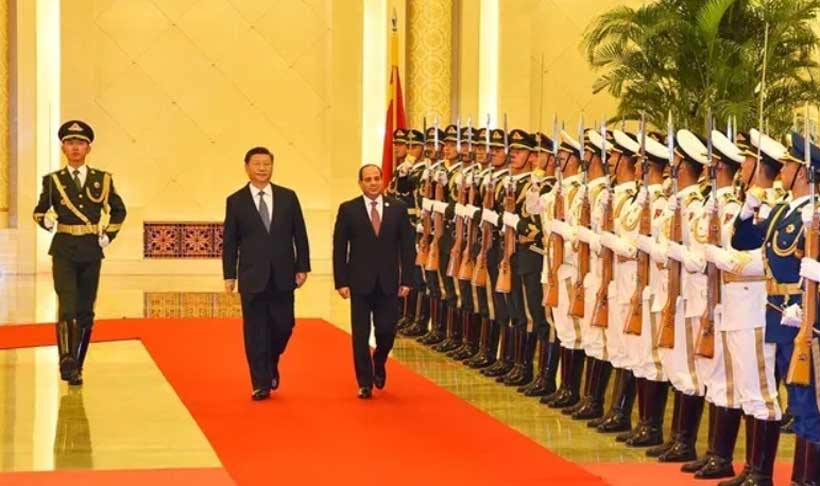
Xi Jinping’s Egypt Visit: How China Is Expanding Its Influence in the Middle East
The upcoming official visit of Chinese President Xi Jinping to Egypt, scheduled for August 30 to September 3, 2026, coincides with the Shanghai Cooperation Organisation (SCO) summit. The visit will address economic and technological cooperation, as well as regional and international issues, and marks the 70th anniversary of diplomatic relations between Egypt and China. The visit aims to strengthen the comprehensive strategic partnership between the two countries and expand Beijing’s economic and political influence in the Middle East amidst escalating regional and international tensions, while also bolstering China’s role in the Global South.
As an Egyptian academic specializing in Chinese politics and the policies of the ruling Communist Party of China, I can analyze and summarize the significance of President Xi Jinping’s visit to Cairo and his meeting with his Egyptian counterpart, President Abdel Fattah El-Sisi, and its importance to China’s influence in the Middle East and the Global South through the following points:
– First: What does China hope to achieve with Xi Jinping’s visit to Egypt at this particular time?
This visit of President Xi Jinping to Cairo (the first by a Chinese president to Cairo in nearly a decade) coincides with the 70th anniversary of the establishment of diplomatic relations between the two countries. It carries several key objectives, including political and international dimensions related to Chinese coordination with Egypt on Middle Eastern issues. The visit comes at a sensitive time, as the region is experiencing tensions linked to the conflict between Iran and the United States and its repercussions on maritime security in the Strait of Hormuz and global energy markets. Beijing also seeks to strengthen its strategic balance and reaffirm its diplomatic presence as an international power that supports diplomatic solutions and cooperates with pivotal countries like Egypt to achieve stability. This follows President Xi Jinping’s participation in the Shanghai Cooperation Organisation summit. President Xi Jinping’s visit to Cairo also carries several economic and trade dimensions, such as expanding the economic partnership and capitalizing on the significant increase in trade between the two countries to deepen cooperation. Furthermore, China will support infrastructure and energy projects in Egypt by boosting Chinese investments in Cairo, including renewable energy sectors such as wind turbine manufacturing plants, transportation deals, and electric trains, in addition to extending currency swap agreements between the two central banks.
Stay ahead of the geopolitical week.
MD Briefing delivers expert analysis across five global fronts — the Indo-Pacific, energy, geoeconomics, European security, and the Middle East — every Monday morning. Free.
The visit also aims to discuss the technological and artificial intelligence file in China’s relations with Cairo, particularly major technological offers, most notably the offer from the Chinese company Huawei to build data and artificial intelligence centers in Egypt. This project is viewed with apprehension by intelligence, military, political, and strategic circles in Washington, which are attempting to offer Cairo alternatives from major American technology companies such as Microsoft, Nvidia, and AMD.
– Second: Does the visit carry political messages that extend beyond bilateral relations, especially regarding the Middle East and Africa?
Yes, Chinese President Xi Jinping’s visit carries major strategic political messages that transcend the framework of bilateral cooperation. It aims to reshape the international order and build a multipolar world, starting with the Global South. The visit also carries messages that go beyond bilateral relations, pushing for a Global South leadership role. Beijing seeks to garner African and Arab support to assert its position as a major power, offering an alternative to Western and American competition and influence. China also aims to promote multilateralism by urging countries in the region to adopt common positions that support international stability and security, moving away from the unilateral polarization of the United States. Furthermore, President Xi Jinping’s visit signals China’s desire to secure its economic interests. Chinese actions are focused on ensuring the security of maritime routes and the stability of energy and trade markets within the framework of the Belt and Road Initiative. Here, President Xi’s visit to Cairo coincides with the launch of the second iteration of the massive joint air exercises, Eagles of Civilization, in August 2026 at Egyptian air bases. These exercises, which follow the first iteration in May 2025, will involve advanced fighter jets from both sides. This sends political and strategic messages to Washington and Tel Aviv about the new military partnership between Egypt and China, the diversification of arms sources, and the independence of Egyptian military and political decision-making in diversifying its partnerships.
Furthermore, the Chinese president’s visit to Cairo carries support for Egypt’s regional role in the Middle East and Africa, reaffirming the pivotal role of Egypt. Choosing Egypt as a starting point reflects Beijing’s understanding of its geopolitical importance as a key link between the Arab world and the African continent and its commitment to addressing regional repercussions. China is also demonstrating its readiness to cooperate with its African and Arab partners to contain the economic crises resulting from conflicts in the Middle East. In addition to China’s anticipated plan to expand alliances by strengthening the integration of Chinese development projects with major economic blocs such as BRICS, the Shanghai Cooperation Organisation (SCO), and the Asian Infrastructure Investment Bank, this visit also aims to coordinate common positions on de-escalation and maintaining peace and security in the Middle East and to discuss regional conflicts, particularly in the wake of the Gaza and Iran wars.
– Third: What economic files could witness new agreements or steps between Cairo and Beijing?
Economic relations between Cairo and Beijing are increasingly moving towards signing new agreements and taking new steps focused on strengthening joint investments and supporting financial stability. The most prominent joint economic and investment files between Egypt and China are based on supporting financial partnership and currency diversification. This involves renewing and strengthening local currency swap agreements between the Central Bank of Egypt and its Chinese counterpart to facilitate trade and support monetary stability, independent of international currencies. Economic cooperation and currency swaps will be among the top economic priorities of the visit through monitoring the surge in trade and extending the local currency swap agreement to enhance economic partnership within the BRICS framework.
Furthermore, there is a shared Chinese-Egyptian desire to localize industry and technology in Cairo by attracting substantial Chinese investments in electric vehicle manufacturing, new and renewable energy sectors, and advanced technology industries. With the expansion of Chinese projects in the Suez Canal Economic Zone, through the expansion of Chinese industrial and logistical projects within the Suez Canal Corridor, a major value-added production base is being established. China is also supporting Egypt in achieving food security and agricultural development by preparing joint Egyptian-Chinese alliances targeting large-scale agricultural land reclamation projects to enhance food security. This is happening concurrently with Chinese support for infrastructure and smart cities in Egypt through cooperation in urban development projects and modern smart cities.
– Fourth: Can China strengthen Egypt’s role as a key hub for its projects in the Middle East and Africa?
Yes, China is already strengthening Egypt’s role as a key and central hub for its strategic projects in the Middle East and Africa. The pillars of Chinese strategic cooperation with Egypt are based on China’s projects and investments within the Belt and Road Initiative. China considers Egypt a strategic gateway and a vital corridor for the maritime and land Silk Road, given the Suez Canal’s role as a global trade artery. With the diversification of Chinese partnerships and investments in the Suez Canal Economic Zone, given the concentration of major industrial projects by Chinese companies in the zone, such as the China-Egypt Economic and Trade Cooperation Zone (TEDA). China aims to access African markets through Egypt. Chinese companies utilize Egyptian land and ports as a joint manufacturing base and a launchpad for exporting products and services to markets across Africa and the Middle East. China also seeks to achieve developmental and security integration with Egypt, aligning its five-year development plans with Egypt’s Vision 2030. This is further evidenced by the development of joint military cooperation and air exercises between Egypt and China, such as the Eagles of Civilization exercises between the Egyptian and Chinese air forces, the first iteration of which took place in May 2025 and the second in August 2026.
Beijing also seeks to disseminate artificial intelligence and innovation technologies through Egypt to the African continent, the Middle East, and the Global South. Especially since Egypt hosts a number of Chinese companies across various sectors, particularly technology, such as Huawei, Xiaomi, Oppo, ZTE, Midea, and Haier. Furthermore, a $300 million investment fund has been established with Tsinghua University in China, focusing on artificial intelligence and semiconductor design.
– Fifth: To what extent can the Egyptian-Chinese partnership affect the balance of American influence in the region?
The Egyptian-Chinese partnership significantly impacts American influence in the Middle East by diversifying China’s economic and political alliances in the region. However, it does not eliminate the strategic alliances between the United States and several countries in the region, particularly the Gulf states. The partnership between Egypt and China is based on the economic and financial dimension, including major Chinese investments in Egypt. China is pouring billions of dollars into infrastructure projects and the Suez Canal region. China also supports Egypt’s bid to join the BRICS group, led by China and Russia, to reduce its dependence on the dollar and the Western and American financial system. Furthermore, China is keen to closely integrate its Belt and Road Initiative projects with the Egyptian economy. The partnership between Egypt and China also rests on the diplomatic and strategic dimension as well as the diversification of alliances. Egypt pursues a balanced foreign policy that is not limited to a single ally. Here, the partnership with China grants Egypt greater freedom of movement and a wider margin to maneuver, free from American political conditions and pressures, particularly in the areas of armament and military deals. This creates a delicate balance for Egypt, as it refuses to fully align itself with one power against another, maintaining its security partnership with Washington alongside its relationship with Beijing.
In this context, Beijing does not view Egypt merely as an economic partner, but rather as a strategic gateway and a pivotal pillar of its geopolitical influence in the Middle East and Africa, countering American penetration. This approach stems from China’s desire to fill the political and military vacuums resulting from the decline or fluctuation of the Western and American presence in the region. To this end, China leverages Cairo’s historical and political weight as a platform to expand its diplomatic influence and build partnerships with other countries in Africa and the Arab world. China’s support for Egypt’s membership in the BRICS bloc has provided Beijing with a strong regional ally, bolstering its vision for reshaping the global financial system into a multipolar order in the face of the United States’ unilateral hegemony in the region. This is especially significant given that Egypt represents a crucial land and sea crossroads for China’s Belt and Road Initiative via the Maritime Silk Road, considering the strategic and vital importance of the Suez Canal.
– Sixth: Does Beijing want Egypt merely as an economic partner, or does it see it as a strategic gateway for its influence in the Middle East and Africa?
Beijing views Egypt as a major strategic gateway for its influence, not just an ordinary economic partner. The relationship combines commercial interests with broad geopolitical ties. The economic dimension is based on the importance of the Suez Canal. China considers the Suez Canal a key artery for its trade with Europe and the rest of the world, and it is investing heavily to connect Egyptian ports and roads to its major commercial projects related to its Belt and Road Initiative. In addition to China’s role as a major logistics hub in the Suez Canal Economic Zone, numerous Chinese companies have established factories there to export goods. This is further compounded by Egypt’s strategic and political importance, as well as its sensitive geographical location, which is crucial to China’s interests. Egypt’s position at the crossroads of Africa, Asia, and Europe serves China’s regional influence. This coincided with China’s support for Egypt’s formal accession to the BRICS group, a move fully backed by China to bolster both countries’ political and economic weight globally.
Beijing also focuses on the growing security and military dimension of its relationship with Cairo to secure investments and international maritime routes. Chinese ambitions extend beyond simply selling goods; it seeks a greater role in protecting its interests and citizens by strengthening military cooperation with Cairo and diversifying defense partnerships with countries in the Middle East, Africa, and the Global South through Egypt. Beijing sees the growing military cooperation and arms sales to Egypt and the region as an opportunity to undermine Western and American military influence and to forge closer ties with the Egyptian army, one of the largest armies on the African continent. This is the true objective of China in transforming Egypt into a political and military hub that guarantees Beijing’s vital interests in the Middle East, Africa, and the Global South.
Accordingly, Chinese President Xi Jinping’s visit to Cairo comes at a time when Beijing seeks to strengthen its engagement in the Middle East and expand its relations with developing countries and the Global South, coinciding with escalating competition with the United States for economic and technological influence. Xi’s visit to Cairo also carries significance that transcends bilateral relations, given the ongoing repercussions of a potential US war with Iran and the instability in global energy markets. Therefore, China seeks to leverage Egypt’s pivotal role in achieving regional stability, mitigating crises, and protecting its interests in the Middle East and Africa.