Jim McGovern

House Republicans pull vote on Iran war powers measure

May 21 (UPI) — House Republicans abruptly pulled legislation to curb President Donald Trump‘s ability to continue the war with Iran on Thursday amid Democratic accusations that GOP leaders shelved the measure over fears it would pass.

House Concurrent Resolution 86 was listed on House Majority Leader Steve Scalise‘s schedule for possible consideration on Thursday but no vote was held before the House left Washington.

The resolution was delayed until after the lower chamber returns from recess on June 2, leaving Democrats fuming.

“Are we not voting on it because the American people are sick and tired of this illegal war that is costing tens of billions of dollars, gas prices are through the roof, people can’t afford their groceries? Is that why you’re pulling it?” Rep. Jim McGovern, D-Mass., asked on the House floor as cheers and boos erupted behind him.

“You guys don’t have the guts … to vote on this.”

The resolution, sponsored by Rep. Gregory Meeks, D-N.Y., directs Trump to remove U.S. forces from hostilities with Iran unless authorized by Congress.

Democrats put the measure forward amid a larger congressional push aimed at reining in Trump’s ability to go to war in the Middle East. Democrats in the Senate on Tuesday advanced similar legislation in the eighth vote they have forced on the matter since the war began Feb. 28.

While Democrats have said the war is illegal without congressional authorization, Trump and his Republican Party argue the effort is moot, claiming the war ended with a fragile cease-fire announced last month.

The Senate measure advanced with support from a handful of Republicans who have split from their party on the issue as the war has continued. In the House, where the GOP also holds a narrow majority, defections were anticipated. Republican Rep. Thomas Massie of Kentucky has supported previous similar measures.

“Let’s be clear: Republicans pulled this vote because they knew they were going to lose it,” Meeks, ranking member of the House Foreign Affairs Committee, said in a statement after the House recessed.

“They know this war is a political and strategic disaster. They know that as Americans head into Memorial Day weekend paying over [$]4.50 a gallon at the pump, they cannot go home and explain they voted to keep this war going. So, instead of casting that vote, they ran from it.”

Rep. Richard Neal, D-Mass., accused House Speaker Mike Johnson, R-La., and House Republicans of abdicating their responsibility by postponing the vote.

“This is a new low,” he said in a social media post.

“This is a disservice to the American people and the troops being put in harm’s way.”

House Minority Leader Hakeem Jeffries, D-N.Y., lambasted Trump for starting the war without articulating its objectives and exit strategy and without garnering public support or congressional approval for it.

“Even as we prepare to recognize our nation’s fallen heroes on Memorial Day, House Republicans refuse to show up and be accountable to the brave service members that have been recklessly put in harm’s way,” he said in a statement.

“The American people will remember in November.”

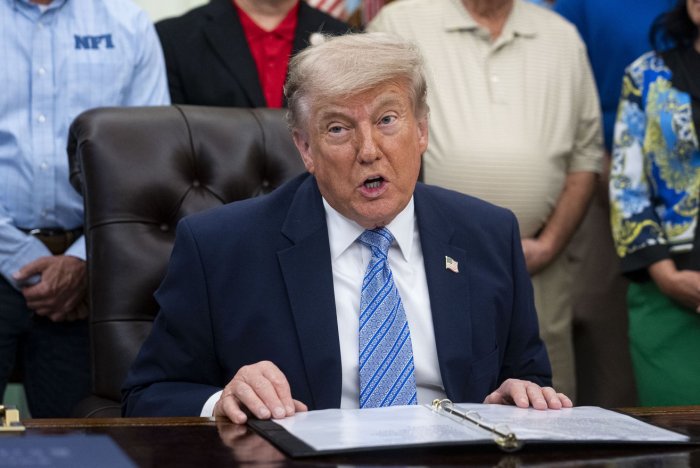
President Donald Trump speaks at an event with Environmental Protection Agency (EPA) Administrator Lee Zeldin in the Oval Office at the White House on Thursday. Photo by Al Drago/UPI | License Photo


Source link

Scientific report on ‘Golden Dome’ program counters Trump’s claims

WASHINGTON, May 19 (UPI) — President Donald Trump‘s move to build a national missile defense system would leave millions of Americans vulnerable to nuclear attack despite the program’s exorbitant cost, the author of a new scientific report said at a press conference Tuesday outside the U.S. Capitol.

The report simulated a “best case scenario” in which the Golden Dome system shot down 80% of incoming missiles, said Ira Helfand, the report’s main author and a co-founder of Physicians for Social Responsibility, an anti-nuclear weapons organization.

Under those circumstances, more than 300 warheads still would reach the United States, the report found, and that Russia would have a 95% chance of being able to destroy any one of 132 major population centers in which a combined 75 million Americans live.

“Let’s be clear what Golden Dome is: a vanity project of one person, Donald Trump,” said Rep. Jim McGovern, D-Mass., using Trump’s chosen moniker for the missile defense system. McGovern was one of two Massachusetts lawmakers who led the press event.

“We must suffer the Trump arch, the Trump ballroom, the Trump battleship and now Trump’s Golden Dome. Each are the egotistical fantasies of an aging man who needs psychiatric care,” McGovern said.

Soon after taking office in 2025, Trump directed the Defense Department to develop a homeland air and missile defense system. The order called for protecting the U.S. “against ballistic, hypersonic, advanced cruise missiles and other next-generation aerial attacks from peer, near-peer and rogue adversaries.”

This initiative, later named Golden Dome for America, echoes earlier missile defense efforts, such as President Ronald Reagan‘s Strategic Defense Initiative, commonly known as Star Wars. It was never fully build or deployed.

“Building an effective and reliable shield against any realistic attack by nuclear-armed ICBMs is technologically infeasible for the foreseeable future,” said Laura Grego, a physicist who specializes in nuclear security at the Union of Concerned Scientists.

“But also attempting to build one would be hugely expensive — wasting time and resources — and accelerate the nuclear arms race.”

The report was released by the Nobel Peace Prize-winning International Physicians for the Prevention of Nuclear War, Physicians for Social Responsibility and Back from the Brink, all advocates for abolishing nuclear weapons.

The press conference came after a Congressional Budget Office report released last week found that a missile defense system designed to counter a small-scale nuclear attack would cost $1.2 trillion.

A more robust system in line with Trump’s aspirations of “ending the missile threat to the American homeland,” would come with a $3.6 trillion price tag, according to a 2025 estimate by the American Enterprise Institute, a right-of-center think tank. Trump initially offered a price tag of $175 billion for the project.

“The Golden Dome is fool’s gold,” said Sen. Ed Markey, D-Mass. “It’s a gold-plated boondoggle that will enrich defense contractors and ignite a new nuclear arms race.”

Rep. Austin Scott, R-Ga., who sits on the House Armed Services Committee, told Medill News Service that he did not agree with the report’s conclusion that the Golden Dome would be too ineffective and costly to justify. On the contrary, Scott said, nuclear modernization efforts underway by U.S. rivals required a response.

“The weapons coming from China and Russia are faster and stronger,” Scott said. “And we have to be able to pick them up faster.”

Between 2014 and 2024, the estimated number of Chinese nuclear warheads doubled, from 250 to roughly 500, according to the China Power Project at the Center for Strategic and International Studies.

China, however, has maintained a no-first-use policy since it first detonated a nuclear weapon in 1964, which commits Beijing to only employ its nuclear weapons in response to a nuclear attack by another country.

When asked about claims made by Helfand and others at the press conference that the Golden Dome would spur a new global nuclear arms race, Scott disagreed again.

“It’s a defensive system,” he said, “not an offensive system.”

The planned outlays for the Golden Dome come in tandem with other Trump administration priorities that have raised eyebrows on Capitol Hill, including a $1.5 trillion defense spending package for 2027, $400 million for a new White House ballroom that will sit atop a bunker and $29 billion so far for the war in Iran.

At the same time, in its proposed budget, the White House moved to cut non-defense discretionary spending by 10%. The spending category comprises public health, scientific research and scores of other domestic programs.

At Tuesday’s press conference, Markey said the United States doesn’t have trillions of dollars to waste on a system that “is not going to protect the American people,” and he decried funding cuts to social programs that “actually do provide security for families in their own homes.”

Source link