Jim

Jim Whittaker, first American climber to scale Mt. Everest, dies at 97

For 20 minutes of his life, Jim Whittaker was on top of the world.

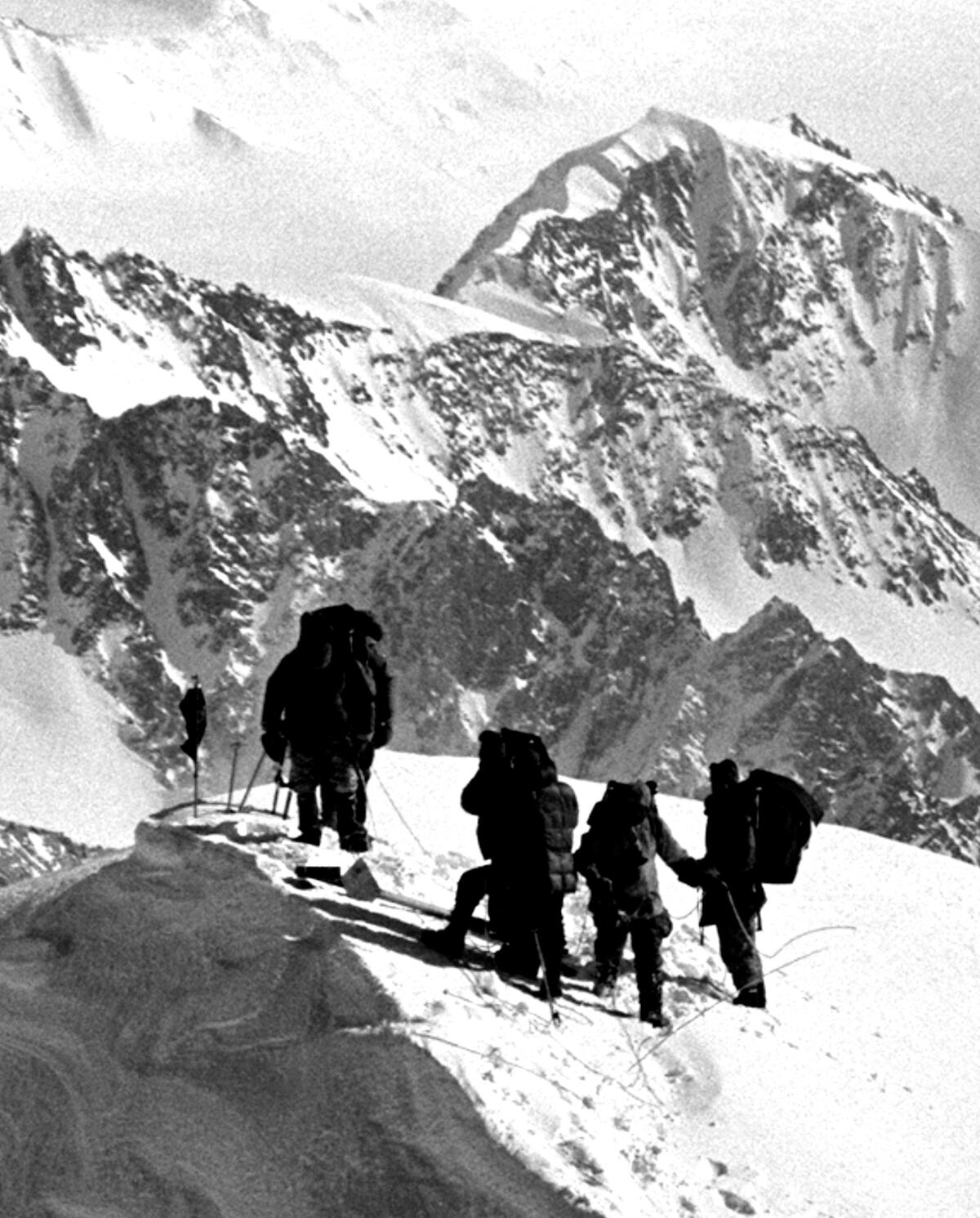
He was the first American to summit Mt. Everest, reaching the highest point on Earth on May 1, 1963, with Sherpa Nawang Gombu.

“We were standing in the jet stream, on the edge of space,” Whittaker wrote in his 1999 memoir, “A Life on the Edge.”

He returned home a hero, with his picture on the cover of Life magazine, a White House fete and unexpected celebrity. And though life off the mountain didn’t always go smoothly, he disdained regret.

“If you stick your neck out, whether it’s by climbing mountains or speaking up for something you believe in, your odds of winning are at least fifty-fifty,” he wrote. “On the other hand, if you never stick your neck out, your odds of losing are pretty close to 100%.”

An adventurer until the end, Whittaker died Tuesday at his home in Port Townsend, Wash., his son Leif confirmed to the New York Times. Whittaker was 97. .

Men on top of a mountain

On March 24, 1965, Robert F. Kennedy, left, stands atop Mt. Kennedy in Canada after placing a black flag in memorial to his late brother, President John F. Kennedy. With him were Jim Whittaker; William Allard, a National Geographic Society photographer; and George Senner, a ranger.

(Doug Wilson / Associated Press)

He was 34 when he scaled Everest, a feat that shaped much of the rest of his life. His Washington state license plate read 29028, the generally accepted height of Everest when he climbed it. (GPS surveys later put it at about 29,035 feet.)

He was chosen for the expedition by its leader, Swiss mountaineer Norman Dyhrenfurth, because of his experience in climbing under icy conditions, including numerous summits of Mt. Rainier near his Seattle-area home.

But Everest, first scaled in 1953 by New Zealander Edmund Hillary and Nepalese Sherpa Tenzing Norgay, was a far more formidable and dangerous beast. And even if the Dyhrenfurth expedition was successful, only a chosen few of its 19 team members would reach the top. Still, Whittaker thought his chances were good.

“I’d trained hard, put 60 pounds of bricks in my backpack,” he told National Geographic Adventure magazine in 2003. “I swam in Lake Sammamish in winter to build up to the cold we would encounter.

“I didn’t know anyone who was in better shape.”

On only the second day of the group’s climb from base camp, tragedy struck when a giant section of an icefall — a glacier formation resembling a frozen waterfall — shifted, crushing team member Jake Breitenbach.

“I had told everyone back home that Everest was not a difficult climb technically; the only problem was the lack of oxygen and the weather,” Whittaker wrote in “Life on the Edge.” “Now it had killed one of us, and we’d only just begun.”

Because the only way to get back to base camp was via that icefall, Whittaker chose to stay above it on the mountain for five steady weeks as more camps were established up Everest. He lost 25 pounds and a considerable amount of strength due to the thin air.

Still, he was in better condition than many of the other climbers, and Dyhrenfurth chose him for the final assault. He and Gombu left the last camp in the middle of a windstorm, with a scant supply of oxygen.

How hard was it to breathe? “Put a pillow on your face, run around the block, and try and suck oxygen through that pillow,” he said. It was so cold, one of his eyeballs froze, making it unusable.

Reaching the summit after several hours, they stayed only long enough to take pictures and plant flags as 50-mph winds whipped around them.

“When you are up there, you are not ecstatic, you are not afraid,” he told the Los Angeles Times in 2013. “You’re really not anything. But in the back of your mind, you know one thing: You gotta get off. Half of the climb is getting up, the other half is getting down.”

James Whittaker was born on Feb. 10, 1929, in Seattle, about 10 minutes before the birth of Louie, his twin brother. As the boys grew up, they took to rough-housing around the house, much to the chagrin of their mother.

“I believe that command to ‘Go outside and play’ is what started Louie and me on the path we have taken every since,” Whittaker wrote.

He was active in Boy Scouts and as a teenager joined a mountaineering club that sponsored climbs on the nearby Olympic and Cascade ranges. He tested himself on increasingly higher peaks, relishing moments such as breaking through cloud layers.

“I think nature is a great teacher,” he told the Seattle Times in 2013. “Being in nature that way is a good way to find out who the hell you are.”

After finishing West Seattle High School, Whittaker went on to Seattle University, graduating in 1952. He was promptly drafted into the Army, but his mountaineering experience led him to be assigned to the Mountain and Cold Weather Training Command in Colorado instead of combat duty in Korea.

In 1955, he became the first full-time employee of the Recreational Equipment Cooperative (later called REI) when it was housed in a 20-by-30-foot space above a Seattle restaurant. In his first year, he expanded the co-op’s offerings into ski equipment and introduced new concepts — such as opening on Saturday mornings so customers could pick up equipment for weekend trips — that boosted sales.

A man in front of climbing gear.

Whittaker, pictured on April 12, 1975, in Seattle, shows some of the gear he would be taking for an expedition to climb K2 on the China-Pakistan border.

(Associated Press)

Because of his connection to the co-op, he was appointed equipment coordinator of the Everest climb, and REI agreed to keep him on the payroll during the expedition.

In July 1963, he and other members of the Everest team, including Gombu, were presented the Hubbard Medal of the National Geographic Society — which partially sponsored the expedition — by President Kennedy, four months before the president was assassinated.

Two years later, Whittaker led a climb up Mt. Kennedy, a nearly 14,000-foot Canadian peak named for JFK, with Sen. Robert F. Kennedy in the climbing party. The two men forged a close friendship that extended to the wider Kennedy clan. In subsequent years, Whittaker went on ski vacations with the Kennedys, was a guest at the family compound in Hyannis Port, Mass., and hosted gatherings in Seattle that included mountain climbing.

Whittaker organized Robert Kennedy’s 1968 presidential campaign efforts in the Pacific Northwest and spoke to him by phone only minutes before the candidate was fatally shot in Los Angeles. Whittaker caught a flight to L.A. and was at the senator’s hospital bedside when he died and then served as a pallbearer at the funeral.

In mountaineering, Whittaker was closely involved in more high-profile ventures. He led a 1975 expedition up the world’s second-highest mountain, K2, that failed to reach the top. His return expedition in 1978 was successful, though he chose not to go to the summit himself.

That same year, he decided to quit REI, partly because of friction with the co-op’s board. He had been president and chief executive since 1971, and when he left, the co-op was a $46-million business with more than 700 employees.

Whittaker throws out the ceremonial first pitch before a baseball game between the Mariners and the Angels in 2013.

Whittaker throws out the ceremonial first pitch before a baseball game between the Mariners and the Angels in 2013.

(Elaine Thompson / Associated Press)

Income from an endorsement agreement helped keep him financially sound, but an investment in a new outdoor gear company proved to be a disaster. The financial irregularities of a partner, who was convicted of felony bank fraud, doomed the venture, and Whittaker was left holding the financial bag.

He was nearly wiped out but got back on his financial footing when a venture capitalist asked him in 1986 to be chairman of the board, with stock options, of a new company called Magellan. It was a pioneer in GPS consumer electronics and holds numerous patents in the field.

Appropriately, Whittaker called one of the chapters midway through his book “Roller Coaster.” But he finished it with “Life Well Lived.”

“If you aren’t living on the edge,” he wrote, “you’re taking up too much space.”

Whittaker is survived by his wife, Dianne Roberts, and children Bobby, Joss and Leif.

Colker is a former Times staff writer.

Source link

THE RESIGNATION OF JIM WRIGHT : Home District Mourns Loss of a Major Asset

In the city that Jim Wright represented for 34 years, the House Speaker’s resignation Wednesday prompted fear, sorrow and anger at Republicans.

“Anybody who knows anything of the American political process knows the loss of the speakership is a major loss for this area,” said Mayor Bob Bolen, whose city has long counted Wright as a major asset in attracting defense jobs.

Officials said it may be impossible to rebuild the political power or match the economic gain the region enjoyed from Wright’s 34-year tenure and his leadership in the Democratic Party.

“We just lost our right arm in Ft. Worth,” state Rep. Doyle Willis, who represents the city in the Texas House, said in Austin. “I think he got a dirty Republican deal. I think they were after him, and they finally got him.”

In Wright’s 12th Congressional District, people gathered around televisions in an electronics shop to watch his resignation speech.

“I think it’s horrible,” Lynn Bratcher said. “He’s the only one I could call on for help when I needed help. . . . He’s the only one that has ever really done anything for anyone for Texas.”

Source link

Jim Michaelian, Long Beach Grand Prix founder and president, dies at 83

Jim Michaelian, the race car driver who helped launch the annual Acura Grand Prix of Long Beach, has died. He was 83.

The Grand Prix Assn. of Long Beach confirmed his death on Saturday, just weeks before this year’s race, which is scheduled for April 17-19.

Michaelian joined the Grand Prix Assn. of Long Beach in 1975, a then-fledgling competitive race, and grew it into one of the most popular street racing events in the world. The annual three-day event draws thousands of race car enthusiasts and brings tens of millions of dollars into the city of Long Beach.

“Jim was a leader of a small, passionate group who believed in the concept of bringing elite open-wheel competition to Long Beach in the 1970s,” said Roger Penske, Penske Corporation chairman, in a statement. “His vision and energy surrounding this great event remained boundless for 50 years.”

Penske Entertainment acquired the Grand Prix Assn. of Long Beach in 2024.

Michaelian was a competitive sports car racer for more than 25 years, competing in endurance events at tracks including Le Mans, Daytona Beach, Nürburgring, Dubai and Sebring in Florida. He told The Times in 2019 that he was still racing sports cars at 76.

“As long as I can achieve some level of success, I’m going to continue doing it until they tell me I can’t anymore,” he said then.

A native of Monterey Park, Michaelian (pronounced meh-KAY-lee-un) graduated from UCLA with a bachelor’s degree in physics. But he turned his attention to business and went on to earn an MBA there. Driven by a love of motor racing, Michaelian eventually talked his way onto the staff of the Long Beach Grand Prix.

He served as the association’s controller and chief operating officer before being appointed president and chief executive in 2001. During his 51-year tenure, Michaelian transformed Long Beach into an iconic stop in the world of motor racing.

A variety of races are run during the three days on the city’s seaside streets, culminating with a big-league IndyCar Series race Sunday. The races feature different types of cars, and one is for trucks, to appeal to a broad audience.

But the Long Beach Grand Prix is more of a festival that’s been built up around the racing. There are concerts, a lifestyle expo, a kids’ zone with go-karts and other activities, along with an array of food and drink spots, all centered on the Long Beach Convention Center and Shoreline Drive.

Michaelian said he kept the pulse of the crowd by constantly walking the track to monitor how the grand prix’s fans were enjoying the activities. He would survey for problems that might need fixing or whether changes needed to be made for the following year.

“Many young people don’t want to sit in the seats now,” he told The Times in 2019. “They’re out taking selfies, they’re chronicling their experience at Long Beach, and the only way to do that is for them to get around.

“So, if they’re moving around, I’m moving around” by creating more places where they can gather, listen to music and having food options nearby, he said then.

Last year, Michaelian was inducted into the Long Beach Motorsports Walk of Fame.

“Jim was a racer’s racer and a dear friend to IMSA and the motorsports community at large,” John Doonan, president of International Motor Sports Assn., said in a statement. “We will sorely miss his presence at Long Beach and racetracks everywhere.”

The Grand Prix Assn. of Long Beach did not release his cause of death.

Michaelian is survived by his wife, Mary, and his sons, Bob and Mike.

Former Times staff writer James F. Peltz contributed to this report.

Source link

Long-serving Democrat Jim Clyburn of South Carolina will run for an 18th term in Congress

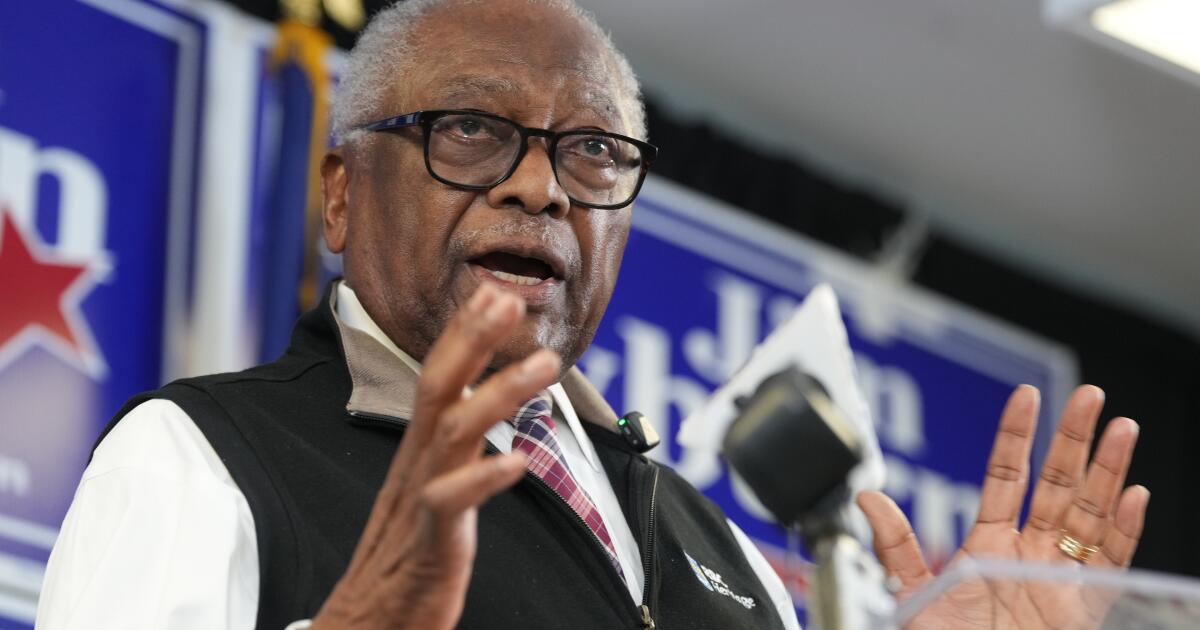
U.S. Rep. Jim Clyburn, the dean of South Carolina’s Democrats, said Thursday that he will run for an 18th House term, a move that could position him as an influential elder statesman in Congress if his party regains the majority in November.

The decision by the 85-year-old lawmaker cuts against calls for generational change within the party. Clyburn is one of several veteran Democrats running again instead of stepping aside for younger politicians whose frustration increased in the wake of President Biden’s failed reelection campaign.

“I’m here today to say I do believe that I’m very well equipped and healthy enough to move into the next term, trying to do the things that are necessary to continue that pursuit of perfection,” Clyburn said at state party headquarters in Columbia. “And so I will run a very vigorous campaign.”

Clyburn is among the oldest Democrats serving in Washington, and the only member of the last Democratic leadership team who is looking to stick around. Former Speaker Nancy Pelosi of California and former Majority Leader Steny Hoyer of Maryland both plan to retire at the end of their current terms.

Clyburn said that he sought counsel from his three daughters before making his announcement. One of them — Mignon Clyburn, a former member of the Federal Communications Commission — said she was concerned about the political vitriol that her father would face in Washington.

“Her interest was in her daddy and what she thought I might be subjected to,” Clyburn said. “When Mignon finally had decided that she could live with it, I’m here.”

Clyburn said he heard from another woman that “‘we don’t listen to them people up there, and you should not. You should listen to the people down here, and we don’t want you to leave.’ And so I’m responding to the people that are here.”

Clyburn served as majority whip and assistant Democratic leader. Remaining in Congress for another term could give him a chance to serve alongside the first Black speaker of the House as Rep. Hakeem Jeffries of New York is in line for the gavel should Democrats win control. Clyburn for many years was the highest-ranking Black lawmaker in the House.

On Thursday, asked about the prospect of being able to advise Jeffries, Clyburn said the two spoke recently about a possible working relationship in the next Congress.

“He expressed an interest in my being a part of his leadership, if we were to take the House back,” Clyburn said. “It made me feel necessary.”

Four years ago, when Clyburn announced his bid for a 16th term, he told the Associated Press that he intended to keep campaigning as long as his health and support from his family remained stalwart.

“I’ve told them, if you ever see that I need to go to the rocking chair or spend my spare time on the golf course, let me know,” he said describing his daughters’ counsel.

Clyburn won his 2024 reelection by more than 20 percentage points. First elected in 1992, he represents the district that sweeps from areas around the capital of Columbia through rural central and eastern counties down to Charleston.

Should he serve an 18th term, Clyburn would become the longest-serving South Carolinian ever in the U.S. House. Time horizons are longer for the state’s U.S. senators, two of whom — Republican Strom Thurmond and Democrat Fritz Hollings — served 48 years and nearly 39 years, respectively.

Filing for election in this year’s elections in South Carolina opens Monday and closes March 30. South Carolina’s primary elections will be held June 9.

Whenever Clyburn does leave office, the competition to be his successor will be fierce. He is the only Democrat representing his state in Washington.

As to whether his 18th term could be his last, Clyburn called that an “open question.”

“I’m looking forward to the day that I can spend more time reading, writing and playing golf, and so this could very well be to my last term,” he said. “And it could very well not be.”

Kinnard writes for the Associated Press.

Source link

Rep. Jim Clyburn, 85, to seek re-election

1 of 5 | Rep. James E. Clyburn, D-S.C., speaks at the 2024 Democratic National Convention in Chicago. Clyburn, 85, announced Thursday that he will run for re-election. File Photo by Tannen Maury/UPI | License Photo

March 12 (UPI) — Rep. Jim Clyburn, D-S.C., announced Thursday that he will run for his 18th term in the House of Representatives.

Clyburn, 85, said he is going to run a “very vigorous campaign.”

“Today I’m going to answer a question that’s always asked: What is there unfinished or what more do you need to do? Well, it’s in the preamble of our Constitution: We exist in pursuit of a more perfect union,” he said. “And I’m here today to say I do believe that I am very well-equipped — and healthy enough — to move into the next term, trying to do the things that are necessary to continue that pursuit of perfection.”

About his age, Clyburn said, “If I were not up to it, I would not do it. But in response to some extensive surveys, some intense consultations with my three daughters, they finally got to a unanimous opinion that I should be here today and make this announcement.”

Clyburn, who has served in the House for more than 30 years, was the No. 3 Democrat in the chamber until he stepped down as Democratic whip in 2023. He then became assistant Democratic leader to House Democratic leader Hakeem Jeffries, D-N.Y.

Reps. Nancy Pelosi, D-Calif., and Steny Hoyer, D-Md., recently announced their retirements from the House, leaving Clyburn as the only one left of that leadership trio from 2007-2023.

Clyburn joined the House in 1992 as the first Black congressman from South Carolina since Reconstruction.

Clyburn endorsed then-presidential candidate Joe Biden just before the South Carolina primary, which helped him win the state and boost his candidacy after struggling in other early primaries.

Antjuan Seawright, Clyburn’s longtime adviser, said he is still needed in Congress to “help shape the direction and future of our country.”

Seawright added that the party needs “a little hip-hop and R & B, Old Testament and the New Testament.”

South Carolina’s primary will be June 9.

President Donald Trump speaks to the members of the media on the South Lawn of the White House before boarding the Marine One helicopter to Hebron, Ky., on Wednesday. Photo by Yuri Gripas/UPI | License Photo

Source link