JF17

Why is Pakistan selling its JF-17 fighter jets to Bangladesh and others? | Military News

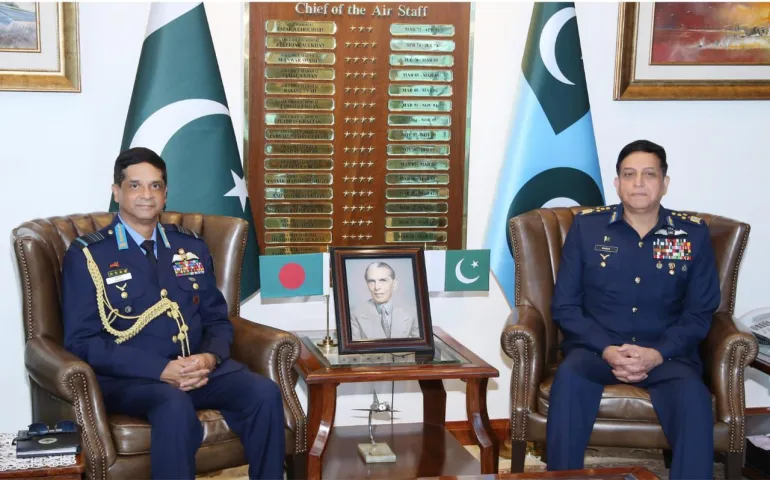
Islamabad, Pakistan – Less than a week into the new year, after a meeting between Pakistan’s Air Chief Marshal Zaheer Ahmed Babar Sidhu and his Bangladeshi counterpart Air Chief Marshal Hasan Mahmood Khan, the Pakistani military announced that a deal to sell its domestically produced JF-17 Thunder fighter jet could be imminent.

A statement by the Inter-Services Public Relations (ISPR), the military’s media wing, said Khan praised the Pakistan Air Force’s combat record and sought assistance to support the Bangladesh Air Force’s “ageing fleet and integration of air defence radar systems to enhance air surveillance”.

Recommended Stories

list of 4 itemsend of list

Alongside a promise of fast-tracked delivery of Super Mushshak trainer aircraft, the statement, issued on January 6, added that “detailed discussions were also held on potential procurement of JF-17 Thunder aircraft.”

The Super Mushshak is a light-weight, two-to-three seater, single-engine plane with fixed, non-retractable, tricycle landing gear. The plane is primarily used for training purposes. Besides Pakistan, more than 10 countries currently have deployed the plane in their fleet for pilot training, including Azerbaijan, Turkiye, Iran, Iraq and others.

Just a day later, it was reported by the Reuters news agency that Pakistan and Saudi Arabia were in talks to convert about $2bn of Saudi loans into a JF-17 fighter jet deal, further strengthening military cooperation between the two longtime allies. The discussions come only months after they signed a mutual defence pact in September last year.

Both developments followed reports in late December that Pakistan had reached a $4bn deal with a rebel faction in Libya, the self-styled Libyan National Army (LNA), including the sale of more than a dozen JF-17 Thunder jets.

While the Pakistani military has yet to formally confirm any agreement with Libya or Saudi Arabia, and Bangladesh has so far only expressed “interest” rather than signing a contract, analysts say events in 2025 have boosted the JF-17’s appeal.

However, the relatively cheap price of the plane, estimated at $25m-$30m, has meant that several countries in the last 10 years have shown interest in it, with Nigeria, Myanmar and Azerbaijan already having the jet in their fleets. And recent events have bolstered the reputation of Pakistan’s air fighting capabilities, say analysts.

In May, India and Pakistan fought an intense four-day air war, firing missiles and drones at each other’s territories, parts of Kashmir that they administer, and at military bases, after gunmen shot down 26 civilians in Indian-administered Kashmir. India blamed Pakistan, which denied any link to the attack.

Pakistan said it shot down several Indian fighter jets during the aerial combat, a claim Indian officials later acknowledged after initially denying any losses, but without specifying the number of jets downed.

“The PAF demonstrated superior performance against much more expensive Western and Russian systems, which has made these aircraft an attractive option for several air forces,” Adil Sultan, a former Pakistan Air Force air commodore, said.

The Indian Air Force (IAF) has traditionally relied on Russian Mirage-2000 and Su-30 jets, but in the 2025 fighting also used French Rafale jets.

Pakistan, for its part, relied on its recently imported Chinese J-10C Vigorous Dragon and the JF-17 Thunder as well as the United States’ F-16 Fighting Falcon jets, with 42 planes in the formation that took on 72 IAF planes, according to the PAF.

So what is the JF-17 Thunder, what can it do, and why are so many countries showing interest?

What is the JF-17 Thunder?

The JF-17 Thunder is a lightweight, all-weather, multi-role fighter aircraft jointly manufactured by the Pakistan Aeronautical Complex (PAC) and China’s Chengdu Aircraft Corporation (CAC).

Pakistan and China signed an agreement in the late 1990s to develop the aircraft, with work beginning in the early 2000s at the PAC in Kamra, situated in Pakistan’s Punjab province, just more than 80km (50 miles) away from the capital, Islamabad.

A retired Pakistan Air Force air commodore who worked closely on the programme said production is split between the two countries, with 58 percent carried out in Pakistan and 42 percent in China.

“We are manufacturing the front fuselage and vertical tail, whereas China makes the middle and rear fuselage of the plane, with a Russian engine being used, as well as British manufacturer Martin Baker’s seats are installed. However, the complete assembly of the plane is carried out in Pakistan,” he told Al Jazeera, speaking on condition of anonymity due to his involvement in the project.

He said the aircraft was first unveiled to the public in March 2007, with the induction of the first variant, Block 1, in 2009. The most advanced Block 3 variant entered service in 2020.

“The idea was to replace Pakistan’s ageing fleet, and subsequently, in the next decade or so, they made the bulk of our air force, with more than 150 combat jets part of the force,” he said.

Before the JF-17, Pakistan was primarily relying on French manufacturer Dassault’s Mirage III and Mirage 5, as well as Chinese J-7 fighter planes.

The Block 3 variant places JF-17 in the so-called 4.5 generation of fighter jets. It has air-to-air and air-to-surface combat capabilities, advanced avionics, an Active Electronically Scanned Array (AESA) radar, electronic warfare systems and the ability to fire beyond-visual-range missiles.

Their avionics and electronic capabilities are an upgrade from the fourth generation of fighter planes, such as the F-16 and Su-27, which were primarily built for speed and dogfighting.

The AESA radar gives these planes the capability to track multiple targets at once and provides more visibility at longer distances. However, unlike fifth-generation planes, they lack stealth capabilities.

The Pakistan Air Force says the jet offers high manoeuvrability at medium and low altitudes and combines firepower, agility and survivability, making it “a potent platform for any air force”.

A high-level defence delegation led by Air Chief Marshal Hasan Mahmood Khan, Chief of the Air Staff, Bangladesh Air Force called on Air Chief Marshal Zaheer Ahmed Baber Sidhu
Bangladesh Air Chief Marshal Hasan Mahmood Khan (left) met with the Pakistani Air Chief Marshal Zaheer Ahmed Babar Sidhu in Islamabad on January 6, during which a potential procurement of JF-17 was also discussed [Handout/Inter-Services Public Relations]

Who has bought the JF-17?

Myanmar was the first country to buy the JF-17, ordering at least 16 Block 2 aircraft in 2015. Seven have been delivered so far.

Nigeria became the second buyer, inducting three JF-17s into its air force in 2021.

Azerbaijan followed with an initial order of 16 jets in February 2024, worth more than $1.5bn. In November 2025, Azerbaijan unveiled five JF-17s during its Victory Day parade, formally making it the third foreign operator of the aircraft.

That same month, the Pakistani military announced it had signed a memorandum of understanding with a “friendly country” for procurement of the JF-17, describing it as a “noteworthy development” without naming the buyer.

Other countries, including Iraq, Sri Lanka and Saudi Arabia, have also explored the option of buying the JF-17 over the past decade, though those plans did not materialise.

While JF-17 makes the bulk of the PAF’s fighting squadron, the plane is not used by the Chinese air force, which is more reliant on its J-10, J-20 and J-35 fighter planes.

With the plane’s entire assembly carried out in Kamra, Pakistan is the primary seller of the JF-17 fighter plane, including its after-sales services.

How does the JF-17 compare to other fighter jets?

The most advanced fighters currently in service globally are fifth-generation jets such as the US F-22 and F-35, China’s J-20 and J-35, and Russia’s Su-57. These aircraft feature stealth technology – unlike all previous generations of jets.

The JF-17’s Block 3 variant, by contrast, belongs to the 4.5 generation, alongside jets such as Sweden’s Gripen, France’s Rafale, the Eurofighter Typhoon, India’s Tejas and China’s J-10, among others.

Still, while they don’t have stealth capabilities, 4.5 generation planes have specialised coating on them to reduce their radar signature, making them harder – though not impossible – to detect.

So, for instance, when a 4.5-generation jet enters the enemy’s radar zone, it can get detected, but it can also try to jam signals by using its electronic jamming capabilities, or use long-range missiles to attack the target, before turning back.

On the other hand, a fifth-generation plane remains entirely undetected by radars due to its physical design and weapons, which are stored internally.

While official pricing has not been disclosed, estimates put the JF-17’s unit cost at between $25m and $30m. By comparison, the Rafale costs more than $90m per aircraft, while the Gripen is priced at more than $100m.

An Islamabad-based regional security analyst who has closely monitored the development of the JF-17 planes said the jet’s appeal lies in its cost-effectiveness, lower maintenance requirements and combat record.

“The JF-17’s appeal is less about headline performance than the overall package, which includes lower price, flexible weapons integration, training, spares and generally fewer Western political strings,” he told Al Jazeera, requesting anonymity because of his involvement with the JF-17 project.

“In that sense, the JF-17 is a ‘good enough’ multirole jet optimised for accessibility. It can suit air forces modernising on tight budgets, but it is not a direct substitute for higher-end fighters like the J-10C or F-16V in range, payload, electronic warfare maturity and long-term upgrade headroom.”

Sultan, who is also dean of the Faculty of Aerospace and Strategic Studies at Islamabad’s Air University, said the JF-17’s performance against Indian aircraft in 2025 underscored its capabilities.

However, he cautioned that outcomes in air combat depend not only on the aircraft but on who is operating it.

“The jets’ integration with other systems such as ground and airborne radars, communication systems and the human skills mastered during training play the most vital role,” he said.

Interactive_JF17_Thunder_Jan8_2026
(Al Jazeera)

Why is the interest in JF-17s growing?

Pakistan’s air force again drew attention during the four-day conflict with India in May 2025, particularly on the night of May 7, when Indian aircraft struck targets inside Pakistani territory.

According to the PAF, Pakistani squadrons flying Chinese-made J-10C jets shot down at least six Indian aircraft. Indian officials initially denied losses but later acknowledged that “some” planes had been lost.

US President Donald Trump, who has claimed credit for brokering a ceasefire between the two countries, has repeatedly highlighted the performance of Pakistani jets, a claim India has strongly rejected.

Although the JF-17 was not involved in the reported shoot-downs, the PAF says it was part of the formations that engaged Indian aircraft.

Three days later, on May 10, the ISPR claimed a JF-17 was used to strike India’s Russian-made S-400 air defence system with a hypersonic missile. India has denied any damage to its defence system.

The Islamabad-based security analyst said Pakistan is using the May conflict to market the JF-17 as a combat-proven, affordable option for countries with limited defence budgets.

He added, however, that the possibility of a “potential procurement” should be treated cautiously.

“‘Expressions of interest’ should be treated cautiously as fighter jet procurements typically take years to translate from exploratory talks to signed contracts and deliveries,” he said, adding that “while PAF is continuing to market the JF-17 aggressively, the JF-17 for debt swap isn’t what PAF envisions.”

Other observers agree that Islamabad sees an opportunity to leverage its air force’s performance to secure defence exports and project itself as a rising middle power.

The retired air commodore involved in the JF-17 programme said combat performance remains the ultimate benchmark.

“Very few countries are making fighter jets, with most of the market dominated by Western developers who often attach many conditions to sales,” he said. “But everybody wants to diversify and avoid putting all their eggs in one basket, and that is where Pakistan comes in.”

On Bangladesh, he said Dhaka’s posture towards Pakistan has shifted sharply since a change of government in 2024.

“Such deals are not just about sale of a platform or a plane. It is a collaboration, an agreement at national level, showing strategic alignment between two countries,” he said.

Fighter jets, he added, are a long-term commitment, with service lives of three to four decades.

“If Bangladesh is getting a JF-17 or Super Mushshak trainers, you can be certain that they are in it for the long haul with training and after-sales services. They are also showing interest in Chinese J-10s, which means that strategically, they have decided who they want to align with in the future,” he said.
Source link

JF-17 Thunder Fighter To Be Offered To Saudi Arabia: Report

The Sino-Pakistani JF-17 Thunder has emerged as a surprise candidate for Saudi Arabia’s next fighter jet, according to a recent report. While a mutual defense pact signed with Pakistan would help open the door to the transfer of JF-17s to Saudi Arabia, the fighter faces very strong competition. Furthermore, it isn’t clear if the Saudis even would want a light fighter like this at all, especially considering it could cause a rift with the U.S. at a critical time. In the past months, the kingdom has been offered the U.S.-made F-35, as you can read about here, and has been linked with several other multirole fighters.

According to a report today from Reuters, talks are now underway between Saudi Arabia and Pakistan, with a view to the kingdom obtaining an undisclosed number of JF-17s. These would be paid for by converting some of the billions of dollars of Saudi loans taken out by Islamabad, a sign of the deepening relationship between the two countries, including at a military level. The report cites two different Pakistani sources, one of whom says the talks are limited to the JF-17, while the other claims that the jets are the “primary option,” but that different military equipment could also be made available.

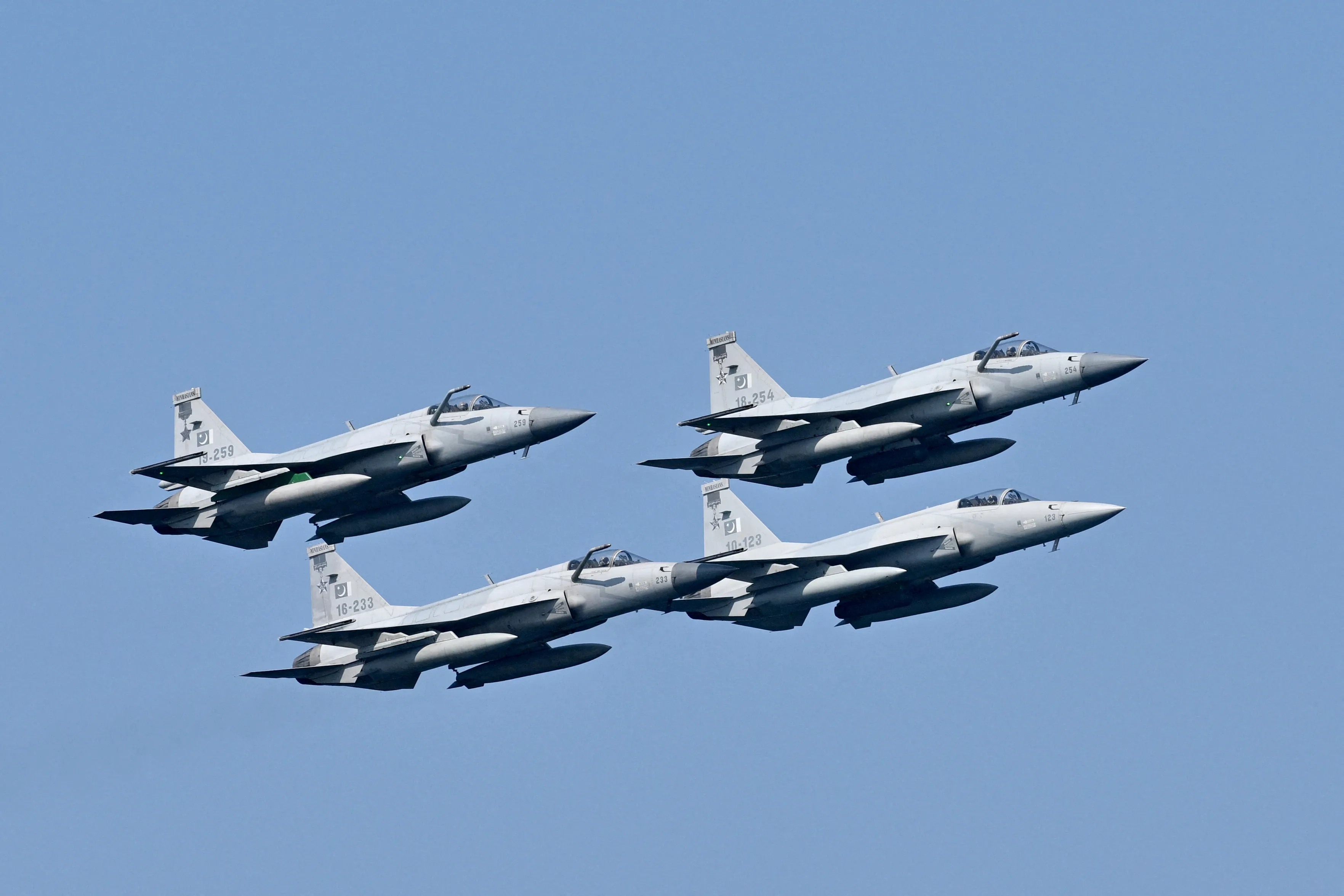
Pakistan's Air Force fighter JF-17 fighter jets fly past during the multinational naval exercise AMAN-25 in the Arabian Sea near Pakistan's port city of Karachi on February 10, 2025, as more than 50 countries participating with ships and observers. (Photo by Asif HASSAN / AFP) (Photo by ASIF HASSAN/AFP via Getty Images)
Pakistan Air Force JF-17 fighters during the multinational naval exercise AMAN-25 in the Arabian Sea near the port city of Karachi on February 10, 2025. Photo by Asif HASSAN / AFP ASIF HASSAN

Reportedly, the deal would be worth $4 billion in terms of offsetting the loan, while Saudi Arabia would also spend $2 billion on top of that.

This week, Pakistan’s Air Chief Zaheer Ahmed Baber Sidhu was in Saudi Arabia to discuss what the Pakistani military described as “bilateral defense cooperation, the regional security environment, and future avenues of collaboration” with his Saudi counterpart, Lieutenant General Turki bin Bander bin Abdulaziz.

The JF-17 was developed jointly by China’s Chengdu and the Pakistan Aeronautical Complex (PAC), and the first prototype took to the air in 2003. The aircraft is powered by a single Russian-designed RD-93 turbofan engine, an improved version of the RD-33 that is found in the twin-engined MiG-29 Fulcrum.

TOPSHOT - An undated file photo of the prototype of FC-1, also known as the JF-17 Thunder or the Super J-7, in Chengdu, southwestern China's Sichuan province. The Chinese air force is contemplating the purchase of a joint Sino-Pakistani fighter jet which could greatly boost the prospects for the FC-1 on the world market, after a publicly held test flight was made with great fanfare on Wednesday in southeastern Chengdu city, Sichuan province, with Pakistani Air Force Chief Kaleem Saadat attending the ceremony. (CHINA OUT) AFP PHOTO (Photo by KANWA NEWS / AFP) (Photo by STR/KANWA NEWS/AFP via Getty Images)
An undated file photo of the prototype of FC-1, which later became known as the JF-17 Thunder, in Chengdu, China. Photo by KANWA NEWS / AFP STR

The Thunder has been steadily improved since the first series-built JF-17s began to come off the PAC line at its Kamra facility in 2008. After the first 50 JF-17s were delivered to Pakistan, production switched to the enhanced JF-17 Block 2 version, with improved avionics, strengthened wing roots for additional stores carriage, and an in-flight refueling probe, among other changes.

The latest Block 3 version of the jet has an active electronically scanned array (AESA) radar, as well as an improved fly-by-wire flight-control system, infrared search and track system, helmet-mounted display, and a larger holographic wide-angle head-up display for the pilot.

Pakistan Air Force JF-17 participates in Virtual Air Tattoo 2021


In terms of performance and specifications, the Block 2 version has a maximum takeoff weight of a little over 27,000 pounds, a maximum speed of Mach 1.6, and an unrefueled range of 840 miles. It can carry 3,300 pounds of stores carried on seven external hardpoints. This puts it broadly in the same class as the Saab Gripen C/D.

The unclassified version of an annual Pentagon report to Congress on China’s military stated that, as of May 2024, the JF-17 had been sold to Azerbaijan, Burma, and Nigeria — as well as Pakistan. The report also says that, as of 2024, negotiations were underway regarding a possible JF-17 transfer to Iraq.

Azerbaijan unveils their newly purchased JF-17 from Pakistan.

It’s great that Pakistan is taking the initiative to export these planes, it’s a form of much needed industrial projects for Pakistan’s economy. pic.twitter.com/3thVFnj1wo

— Zhao DaShuai 东北进修🇨🇳 (@zhao_dashuai) November 13, 2025

That same story stressed heavily the growing presence of the JF-17, as well as other Chinese-made fighters, on the export market, as you can read more about here.

Last month, Pakistan reportedly struck a weapons deal worth more than $4 billion with the Libyan National Army, which is also said to include JF-17. Additionally, Pakistan has held talks with Bangladesh on the possible sale of the same jets.

As for Saudi Arabia, the claimed interest in the JF-17 comes after it signed a mutual defense pact with Pakistan last September. This is the latest development in a long-running security partnership between the two nations, which has seen extensive provision of defense equipment to the kingdom, as well as training.

“The agreement states that any aggression against either country shall be considered an aggression against both,” the office of the Pakistani prime minister said in a statement about the pact. This raised questions of whether the Pakistani nuclear umbrella might even be extended to protect Saudi Arabia, too.

A Pakistan's military vehicle carries a long-range ballistic missile Shaheen during the Pakistan Day parade in Islamabad on March 23, 2022. (Photo by Ghulam Rasool / AFP) (Photo by GHULAM RASOOL/AFP via Getty Images)
A Shaheen ballistic missile during the Pakistan Day parade in Islamabad on March 23, 2022. Photo by GHULAM RASOOL/AFP via Getty Images GHULAM RASOOL

For its part, Saudi Arabia has regularly provided Pakistan with economic support. In 2018, Riyadh agreed on a support package for its ally that included a loan worth $6 billion. Since then, it has allowed Islamabad to defer payments.

Were it to happen, a deal involving JF-17s and potentially other arms could help balance the books between the countries.

While the JF-17 is less advanced than other fighters that Saudi Arabia has been looking at buying, most notably the F-35, the Thunder’s status has been enhanced by claims of its performance during Pakistan’s clashes with India last year. Pakistan has long pitched the JF-17 as a cheaper and more sustainable fighter option, but now it is combat-proven too, although the results of its performance against the Indian Air Force are hard to verify.

Last month, it became clear that the Trump administration intended to sell up to 48 F-35s to Saudi Arabia, which marked a significant policy shift. Previously, Washington had been unwilling to export these jets to Arab states in the region, for fear of upsetting the strategic balance in relation to Israel — also an F-35 operator.

As we noted at the time:

Even without the F-35, the Royal Saudi Air Force (RSAF) operates an extremely modern and advanced fleet of fighters. It received 84 of the new-build F-15SA, which was the most advanced variant of the Strike Eagle family available until the appearance of the Qatari F-15QA and the U.S. Air Force’s F-15EX Eagle II. Meanwhile, the 68-strong fleet of earlier F-15S aircraft has been upgraded locally to a similar standard, known as F-15SR (for Saudi Retrofit).

The RSAF also received 72 Eurofighter Typhoons. Older, but still capable, are around 80 British-supplied Panavia Tornado IDS swing-wing strike aircraft, which continue in service in the strike role.

Four Royal Saudi Air Force F-15s fly in formation with U.S. Air Force F-15 Strike Eagles over the U.S. Central Command area of responsibility, Sept 10, 2020. AFCENT continues to build and strengthen our partners by training alongside one another, integrating capabilities and increasing interoperability, to project agile combat employment from established and austere locations throughout the U.S. Central Command area of responsibility. (U.S. Air Force photo by Staff Sgt. Justin Parsons)
Four Royal Saudi Air Force F-15s fly in formation with U.S. Air Force F-15 Strike Eagles over the U.S. Central Command area of responsibility, Sept 10, 2020. U.S. Air Force photo by Staff Sgt. Justin Parsons SSgt Justin Parsons

Other fighters have been linked with a sale to Saudi Arabia, as it seeks to further boost its fighter fleet.

For a long time, more Typhoons were seen as the most likely option, but a potential deal has been frustrated by Germany — which has a stake in Eurofighter via the German arm of Airbus — which has consistently blocked further sales of the jets to Saudi Arabia, citing human rights concerns.

Saudi Arabia also entered talks to buy 54 Dassault Rafale multirole fighters, as we reported back in 2023.

More recently, Boeing confirmed that it was offering the F-15EX Eagle II to Saudi Arabia.

The JF-17 is far less capable than these options, but it is not irrelevant, especially in its Block 3 version with AESA radar and Chinese-made PL-15 air-to-air missiles.

The wreckage of a Pakistani PL-15 air-to-air missile in the aftermath of clashes with India in May 2025. via X

At the same time, the Thunder would be a far less expensive option and could be acquired in greater numbers, creating a high-low force mix.

Still, the idea that Saudi Arabia would actually be interested in Pakistan’s proposal seems remote due to multiple factors.

Whether the JF-17 could be operated alongside the F-35 is highly questionable, on the grounds that its sensitive technologies might be exposed to Chinese intelligence. On the other hand, even without the JF-17, Saudi Arabia has long been a customer of Chinese-made defense equipment, including drones and ballistic missiles. But these are not fighter platforms with sensors that can give away critical capabilities, as well as weapon systems that need highly integrated tactics across a force in order to be effective. The very idea that a deal like this could even threaten the long-awaited acquisition of the F-35 seems to disqualify it on its face.

There is also the question of why Saudi Arabia would even want this aircraft when they have access to far more capable fighters that accommodate the weapons and networks their force already uses? A high-low mix may hold some relevance, but we have seen no indication that Saudi Arabia believes this to be the case.

It also comes at a time of extremely close ties between the kingdom and the U.S., with the Trump administration seeing Saudi Arabia as a top ally and economic partner. Risking that for a cheap fighter aircraft seems remote.

At the same time, Islamabad sees arms sales, including to non-traditional clients, as critical to helping address its economic troubles.

“Our aircraft have been tested, and we are receiving so many orders that Pakistan may not need the International Monetary Fund in six months,” Pakistani Minister of Defense Khawaja Asif recently told local media.

However, as has been the case in earlier Saudi procurements, the most important dimension in selecting a new fighter may well be the political one.

Contact the author: thomas@thewarzone.com

Thomas is a defense writer and editor with over 20 years of experience covering military aerospace topics and conflicts. He’s written a number of books, edited many more, and has contributed to many of the world’s leading aviation publications. Before joining The War Zone in 2020, he was the editor of AirForces Monthly.


Tyler’s passion is the study of military technology, strategy, and foreign policy and he has fostered a dominant voice on those topics in the defense media space. He was the creator of the hugely popular defense site Foxtrot Alpha before developing The War Zone.


Source link