Bass and Raman campaigns trade charges over Hasan Piker and Jewish heritage event
Hours before Nithya Raman took the stage at Jewish Federation L.A.’s mayoral forum this week, Mayor Karen Bass’ campaign blasted out a press release accusing the council member of skipping a City Council Jewish Heritage Month event to appear on Hasan Piker’s livestream.
The Raman camp’s response: “The Mayor is deliberately spreading misinformation that the public record directly contradicts,” said Liz Garcia, a campaign spokesperson.
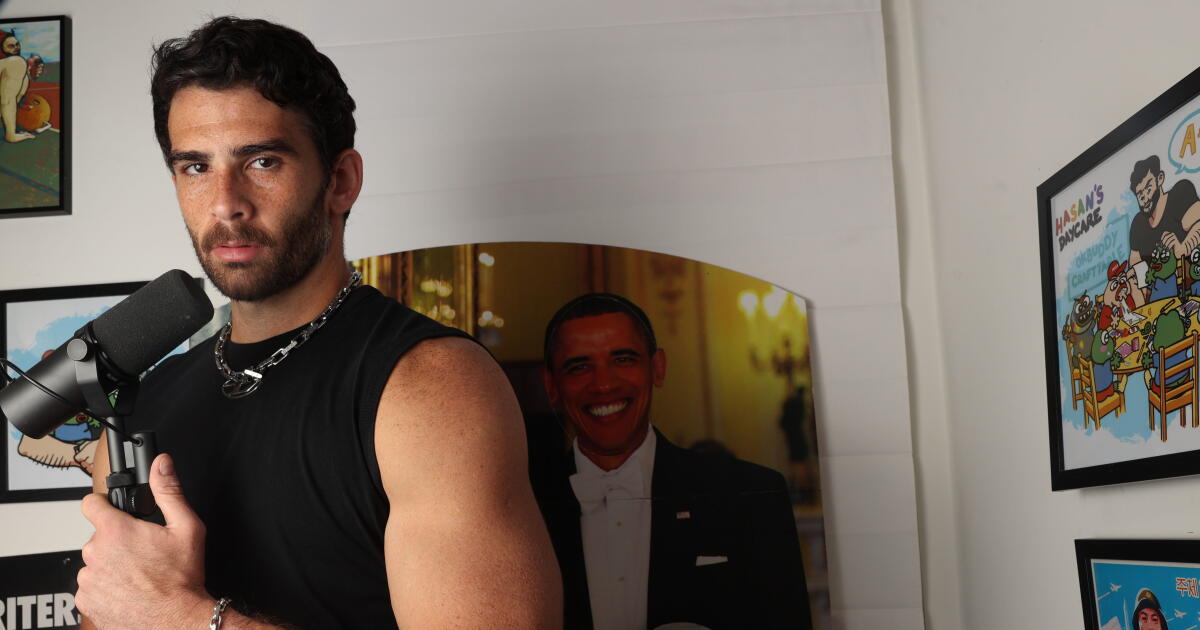
Piker is a left-wing streamer on the platform Twitch and a fierce critic of Israel. Raman appeared on his stream on May 15, where he asked her if she thought Israel was committing genocide in Palestine. She said she did.
That same day, Raman missed a Jewish Heritage Month event at City Hall. Debbie Paperman, who is on the executive board of Democrats for Israel Los Angeles, said Raman told her that she had not been feeling well.
The Bass campaign, citing the fact that Raman appeared on Piker’s stream the same day, fired off an email to reporters claiming the councilmember had lied about her reasons for missing the Jewish heritage event.
The Raman campaign said that Raman was, in fact, ill.
Video from the May 15 council meeting shows Raman was present at the start of the meeting, but no longer at her seat during the heritage event, in which Councilmember Bob Blumenfield celebrated Jewish athletes. More than an hour later, Raman was back in council to make a speech and introduce other speakers for Hapa Day, celebrating people of mixed Asian and Pacific Island heritage, during which she said she wasn’t feeling well.
Raman’s team said she was still at City Hall during the Jewish Heritage Month event, but that she left council chambers due to her illness.
She felt better later that afternoon, the Raman camp said, allowing her to appear on Piker’s show.
Paperman said she wasn’t convinced. “It happened that you were sick for the multiple hours this was going on and you happened to get better to go on this psycho’s stream?” said Paperman. “I don’t believe that.”
Piker, meanwhile, shot back at the mayor for using his name to try to dissuade voters from supporting Raman.
“Karen Bass is deploying the same nasty tactic that Donald Trump used recently at a press conference, wondering out loud why any Jewish person would vote for Democrats, due to my presence in the big tent,” he told The Times in a text message.
Piker said he will vote for Raman, though he supported Bass against billionaire Rick Caruso in 2022.
“I was also a fan of [her] past work in Cuba,” he told The Times. “Karen Bass used to be quite the radical.”
Bass swings up in new poll
Bass will need to rely on undecided Republican and conservative voters to propel her to a mayoral victory, a new poll paid for by a group supporting her found.
The incumbent mayor is trailing Raman by 4 percentage points, 39% to 35%, with a quarter of the electorate still undecided, according to the initial results from an FM3 Research poll that was commissioned by the Central City Assn.’s PAC, an independent expenditure group supporting the mayor.
When the pollsters gave likely voters additional, critical information about both candidates, Bass shot up by 5 points and took a narrow lead over Raman, 40% to 39%, with 21% undecided, according to FM3.
“The undecided voters — including many that say they will refuse to make a choice between Bass and Raman by Election Day — are disproportionately: Republicans, conservatives, 65+, homeowners, Democratic women over the age of 50 and those who do not hold a college degree,” wrote the research company in a polling memorandum.
The poll surveyed 809 likely L.A. voters from Sept. 21-28. It has a 3.5% margin of error.
“The mayoral race remains a statistical tie,” said Nella McOsker, the president of the Central City Assn. “Our poll demonstrates that some of the most reliable voting blocs swing to Bass once they fully learn both candidates’ records.”
A poll conducted between Sept. 15 and Sept. 20 by the UC Berkeley Institute of Governmental Studies, co-sponsored by The Times, found Raman was ahead 39% to 28%.
Raman allies engage in trash talk
A woman walks out of her home carrying a full garbage bag, then starts venting about the high cost of trash pickup.
“Karen Bass has nearly bankrupted L.A., so the city doubled my trash fees. Isn’t L.A. expensive enough?” the woman says angrily, before slamming the lid on a black trash bin.
That message is at the heart of a campaign video created by Streets For All, a transportation advocacy group now spending about $1.2 million to promote Raman and tear down Bass.
That ad is missing a key piece of information: Raman voted to hike those trash fees several times last year, even as two of her council colleagues spoke out against them.
“I was one of two no votes,” said City Councilmember Monica Rodriguez, who is supporting Bass’ reelection, in an interview. “She never once pushed back.”
Rodriguez called the ad misleading, saying it implies that Raman was an opponent of the fee hikes.
Michael Schneider, who runs the Streets For All campaign committee, defended the 14-second spot, saying council members hiked the trash fees to make up for bad budget decisions made by the mayor — including her support for a $2.6-billion upgrade of the Convention Center.
The council boosted the trash fee to $55.95 per month last year for small apartment buildings, up from $24.33. For single-family homes, the monthly fee was also hiked to $55.95, up from $36.32.
The city’s budget advisors said the increases were needed in large part because the monthly fees had not been increased in 17 years. As a result, L.A.’s residential trash customers were not being charged the full cost of garbage pickup, leaving the city budget to cover the difference.
“Kick it in the Park” gets Olympic makeover
L.A.’s summer of 2026 will be remembered for stifling heat, innumerable Dodgers injuries and, especially, World Cup watch parties.
Teams, corporate sponsors and the city of Los Angeles welcomed in the world, producing large crowds and kumbaya moments — with fans of opposing teams partying side-by-side in (relative) peace and harmony.
Mayor Karen Bass’ “Kick it in the Park” events drew a total of 45,000 fans over the length of the quadrennial soccer tournament. A survey of about 2,000 of them registered overwhelming support for the free shindigs.
Paul Krekorian, executive director of the mayor’s Office of Major Events, declared victory in a meeting with City Council members this week. He also said that substantial planning is already underway to bring the city even more viewing parties and “activations” during the 2028 Olympics.
While the city hosted a maximum of three viewing parties a day during the World Cup, it plans to stage as many as 15 a day when the Olympics come to town. A list has been drawn up of possible locations for the festivities — spread around every corner of the city and distant from Olympic venues to avoid overcrowding.
Among the possible viewing party locations: MacArthur Park, the Greek Theatre, Pan Pacific Park, Leimert Park Plaza, Koreatown, Penmar Recreation Center, Echo Park Lake, Angels Gate Park and the Watts Towers.
Given the welter of Olympic events, it will be a challenge to schedule the parties, whose centerpieces are usually big screen projections of the live events, with food and live performances often thrown in.
State of play
— SPLIT ON GAZA: Bass and Raman split on Tuesday over whether Israel has committed genocide in Gaza during the Israel Gaza war. The two candidates gave their opinions during a forum hosted by Jewish Federation Los Angeles. Raman said she agrees with the experts who use the term, while Bass said she would not use the term genocide to describe Israel’s counteroffensive in Gaza.
— WILDFIRE FAILURES: A long-awaited independent investigation commissioned by Gov. Gavin Newsom offered the most in-depth review of the Jan. 7, 2025, Palisades and Eaton fires, describing the chaos and poor communication that made firefighting, rescues and evacuations even more difficult. The 724-page report also cited the Los Angeles Fire Department’s failure to fully extinguish the Jan. 1 Lachman fire, which reignited days later, and Los Angeles County’s failure to provide timely evacuation alerts in Altadena.
— ESTAMOS CON WHOM?: Recent polling by the UC Berkeley Institute of Governmental Studies, co-sponsored by The Times, found that likely Latino voters favor Councilmember Raman over incumbent Bass by a wide margin — 45% to 21%, with 34% undecided. That’s an even bigger lead than Raman had over Bass with voters overall in the most recent Berkeley IGS/L.A. Times poll.
— VOTER GUIDES: The Times released its much-anticipated voter guides for the November election this week, including a mayoral guide and a guide to the Council District 9 race, among many others.
— OLYMPIC OBSCURA: The nonprofit organizer of the 2028 Summer Olympics, LA28, has provided less information in its annual reports than it agreed to in a 2021 contract with the city. The group has stopped reporting the contracts it signs over $1 million, leaving taxpayers with less information about the work going into the Games. LA28 says it has provided all necessary info.
The city also asked LA28 to take out a $650-million insurance policy, and agree to cover any potential losses above that amount, should the Games be canceled by a calamity.
— LAPD BLUES: Secret recordings documenting LAPD officers making racist comments have renewed questions about whether the force, which is now less than 50% white, has made forward progress on stamping out prejudice in its ranks.
— STORM’S BREWING: L.A.’s sanitation agency is bracing for the coming ‘Super’ El Niño, which could wreak havoc with the city’s Hyperion sewage treatment plant.
QUICK HITS
- Where is Inside Safe? The mayor’s signature program went to East Hollywood in Hugo Soto-Martínez’s district on Tuesday, where they moved 61 people indoors near Beverly Boulevard and Madison Avenue. On Thursday, Inside Safe moved 27 people indoors near Louvre Street and Ralston Avenue in Pacoima in Rodriguez’s district.
- On the docket next week: On Wednesday, the City Council’s transportation committee will be discussing an independent evaluation of the city’s Vision Zero Program.
Stay in touch
That’s it for this week! Send your questions, comments and gossip to LAontheRecord@latimes.com. Did a friend forward you this email? Sign up here to get it in your inbox every Saturday morning.