Street artist Barry McGee brings color and community to Jeffrey Deitch
San Francisco artist Barry McGee, 60, walked through Jeffrey Deitch’s Santa Monica Boulevard gallery on a recent Wednesday, while a small army of friends went about their business — some moving objects, others equipped with power tools. A few stood near a closet-size replica of a 99 Cents Only store, an homage to the weeklong art takeover McGee staged at the shuttered Wilshire Boulevard retailer in February.
Gallery visitors were careful not to step on the sprawling assemblage of photographs, drawings and artifacts scattered across the floor. Many were destined for the large installation McGee’s friends helped to assemble for “Another Round,” his recently opened exhibition, which runs through Jan. 30.
Like “99 CENT,” McGee’s aim is for the Deitch show to serve as a gathering place. A makeshift storefront houses an “anarchist bookstore” with activities organized by Matthew James-Wilson, who operates the Heavy Manners lending library and gallery in Echo Park. Events planned during the show’s three-month run include French beading and papier-mâché workshops, clothed figure drawing, and “music shows.”
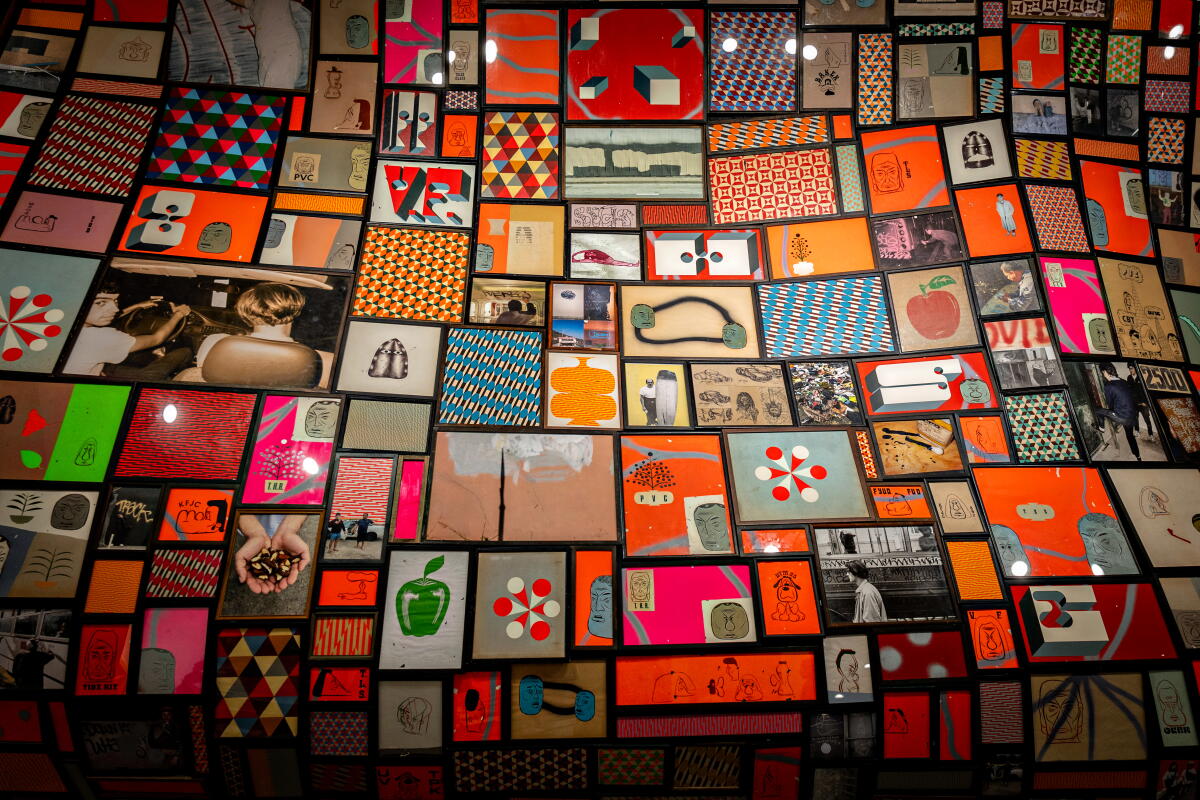
Adjacent to the bookstore, the untitled work bends and bulges on a plywood structure. It serves as a portal into McGee’s artistic life: Framed messages, photographs of friends, colorful, textile-inspired imagery and his father’s sketches of cars on napkins are grouped together in a bold display.

An untitled installation piece by Barry McGee at Jeffrey Deitch gallery. McGee is showing at the gallery for the first time in 20 years.
(Jason Armond / Los Angeles Times)
A related installation is in the collection of the San Francisco Museum of Modern Art and has also been shown at the Oakland Museum of California. “It feels like something entirely new this time and definitely unplanned,” McGee said of the work taking shape at the Deitch show.
The exhibition is billed as McGee’s first gallery exhibit with Deitch in more than 20 years, although the artist and dealer have collaborated on projects since the 1990s. McGee came up in San Francisco’s graffiti scene in the 1980s, developing a visual language under the moniker Twist that included faces, liquor bottles and stylized screws. Deitch traces McGee’s primary influences to the city’s punk, skate, surf and graffiti cultures, as well as its hand-painted signs. McGee has exhibited at the Hammer Museum, Fondazione Prada and the 2001 Venice Biennale.
When asked whether he was bringing street art inside for the Deitch show, McGee pushed back. “That’s not my goal at all,” he said.
McGee long ago achieved cult status and comes from a tradition of graffiti that he sees as separate from work made for a gallery. When he began tagging in the 1980s, he said, it wasn’t to create something for the market: “There’s no product at the end.” McGee’s connections across the graffiti scene and the gallery world attract artists and audiences alike for exuberant gatherings, sometimes with complications, as when he transformed the vacant 99 Cents Only Store into a pop-up resembling an indoor flea market during L.A.’s Art Week.

The tagger-turned-blue-chip artist Barry McGee reopened a former 99 Cents Only on Wilshire Boulevard for a one-week art fair event.
(Mariella Rudi)
McGee and Bay Area artist Tom Franco worked with Deitch and the Hole, a gallery that has since closed its Los Angeles location, to stage the exhibition. McGee’s devoted following came out in force: Deitch estimated that about 25,000 people visited. “L.A. really showed up for that,” McGee said.
The event also drew complaints. Several neighboring businesses and apartment buildings were tagged, though McGee said the graffiti was cleaned up. In July, L.A. Taco found that several participating artists had not been paid for work sold during the exhibition. Kathy Grayson, who runs the Hole in New York, wrote in an email that all artists and vendors have since been paid. “It was a gigantic undertaking,” she wrote of staging the exhibit, adding that she had stepped in to help McGee realize his “dream-come-true project.”

Barry McGee is a celebrated street artist who is equally comfortable in a blue-chip world. He brings both sensibilities to bear in his new show, “Another Round,” at Jeffrey Deitch.
(Jason Armond / Los Angeles Times)
While McGee has no plans to revive the concept, he has created a miniature replica of the 99 Cents Only Store at the gallery, complete with the store’s iconic blue-and-white floor. “The element of surprise is always the best thing,” he said.
Throughout the gallery, McGee’s paintings, drawings and found objects are displayed alongside work by what he estimates will be “around 200” like-minded artists, including C.R. Stecyk III, Chito K.K. and Chris Lux, who mounted two stained-glass works beneath the gallery’s skylights.
“When we do a show with Barry, we get the whole community,” Deitch said. “That’s one of the great things about it.”
Although the exhibition bears his name, McGee is wary of being the center of attention. “In this day and age, a solo anything seems ridiculous,” he said. “The ego of the artist is a tricky thing.” He prefers to bring together different generations and sensibilities: “Some young people, some older people, things that you wouldn’t imagine being next to each other.”

A surfboard installation by Barry McGee is part of his show, “Another Round,” at Jeffrey Deitch gallery on Santa Monica Blvd.
(Jason Armond / Los Angeles Times)
McGee’s own work is also in dialogue with itself: Geometric patterns, inspired in part by Islamic tile designs, share the canvas with his trademark male faces with drooping, melancholic eyes.
Deitch describes McGee as possessing “a unique kind of charisma.” Though shy, “he’s very accessible and reaches people.”
Franco agrees. He had wanted to meet McGee long before they encountered each other in a San Francisco thrift store last year, and he admires his support for less established artists.
“He nurtures young people,” Franco said. “It’s amazing to see. Somebody at his level, you can easily forget how famous he is, or how accomplished he is, because he’ll hug every single person who comes through the door.”
McGee sees the relationship as reciprocal. “They’re mentoring me also. It’s really mutual,” he said. “Their visual language is so rich.”
Working into the evenings after mornings spent surfing with his crew, McGee is allowing the exhibition to take shape as it goes. His connection to surfing is visible in the gallery, where surfboards are stacked like a wooden fan.
He contrasts his freedom to improvise at Deitch with museums’ lengthy planning schedules: “Their shows are seven years out, sometimes. So there’s no room for spontaneity.”
A week before the Deitch show opened, he was still anticipating what it might become. “I still don’t know what’s going to happen,” he said.