ISNT

State Controller May Freeze Payroll Until Budget Passes : Legislature: Official says some Medi-Cal payments could also stop if agreement isn’t reached by Saturday.

Attempting to force a state budget agreement, California Controller Kathleen Connell said Monday she is considering withholding lawmakers’ salaries, and cannot pay 35,000 state employees if the Legislature and Gov. Pete Wilson fail to approve a budget by Saturday’s constitutional deadline.

Without a budget, Connell said, she also will have no choice but to delay payments of some Medi-Cal bills, such as prescriptions, for elderly people–a step that would add pressure on lawmakers to approve a spending plan.

Under the state Constitution, California must have a new budget by the July 1 start of the 1995-1996 fiscal year. But Wilson and the Legislature remain far apart and seem to be in no rush to approve a budget.

In recent years, it has become common for the deadline to pass without a budget. In 1992, the state went more than 60 days without a budget, leading state government to pay its employees and vendors with IOUs.

Connell, who is in her first year in office and who issues the checks for the state, said California has the cash to pay its bills. However, without agreement on a budget measure authorizing state spending in the new fiscal year, Connell said she will have no choice but to delay paying vendors, some medical bills for the elderly, the blind and the disabled, and as many as 35,000 state employees, including management officials.

“I don’t think any taxpayer is going to be sympathetic to the idea that we have the cash but are not paying our bills,” said Connell, a Democrat.

Connell last week suggested that she would withhold lawmakers’ pay starting July 1 if they had not approved a budget by the deadline. But she softened her position after concluding that there may be a constitutional requirement that she issue their checks. However, Connell said she is still studying the question.

“I’m raising a moral issue here,” Connell said after a speech in Sacramento. “If there are [state] employees who are not going to be paid because we have partisan politics dominating the Legislature, then there has to be a question of who else should accept responsibility.”

In the Legislature, the Senate-Assembly budget conference committee met Monday afternoon. But Wilson and top legislative leaders have not scheduled budget talks to resolve differences.

Wilson has proposed a $56-billion budget that includes deep welfare cuts and requires 10% increases in state college and university tuition. Wilson also is pushing for a 15% income tax cut over three years–an idea opposed by many Democrats.

“We fully expect to have a budget in the month of July,” Wilson spokesman Paul Kranhold said. “We are hopeful that the Legislature will forward us a budget by Saturday, or soon afterward.”

The amount separating Democrats and Republicans is relatively small–$1.8 billion–compared to other years of the Wilson Administration, when the gap between Wilson’s proposals and what the Legislature proposed ranged from $5 billion to $14 billion. But rancor is so dividing the Assembly this year that partisans in the budget fight have yet to take the first steps toward a solution.

“It can happen by Saturday,” said Assembly Republican Leader Jim Brulte. “There is no reason that it couldn’t or shouldn’t happen by Saturday. But I don’t know if it will.”

Past court orders require that, even without a budget, the state pay to keep schools open and issue checks to welfare recipients. The state also will continue to meet its bond debt and pension payments, Connell said.

But starting Saturday, Connell said, the state will not pay vendors who perform various services for the state, or deliver goods to state prisons and state hospitals. Without a budget, she said, state agencies that lease space will be unable to pay rent and cannot pay utility bills. Payments for services such as nursing home care or food deliveries to prisons would be delayed until a budget is approved.

“The effect of having no budget begins immediately. It begins on July 1, and the damage will grow with each day,” Connell said.

If the state goes without a budget through July, the missed payments would total at least $360 million for Medi-Cal and state assistance to counties to operate trial courts. The total for employees was not known.

Unlike 1992, the last time there was a lengthy budget deadlock, the state cannot use IOUs to pay its workers who fall under the Fair Labor Standards Act.

A federal judge, acting on a lawsuit brought by state employees, ruled last year that the state acted illegally in 1992 by issuing the IOUs, and that roughly 120,000 workers covered by the Fair Labor Standards Act must be paid even if there is no budget.

But between 33,000 and 35,000 state workers are not covered by the act, raising the possibility that they will not be paid on time for work done after July 1.

The employees whose pay is in jeopardy include Wilson’s political appointees, and heads of departments and middle-level managers. Professionals such as deputy attorneys general and state physicians and dentists also may have their paychecks delayed. An aide to Connell said the controller’s office is reviewing the law to determine whether judges and other judicial officials can be paid.

The first state employees to miss a paycheck would be in the Department of Transportation, where 50 management employees would miss July 15 paychecks for work done after July 1.

Gov. Pete Wilson has criticized the commission’s findings, and Sens. Barbara Boxer (D-Calif.) and Feinstein have urged the President to throw out the panel’s work entirely. Rep. Vic Fazio (D-West Sacramento), whose district includes the threatened Air Force base, wants Clinton to send the report back and ask the commission to redraft it without the McClellan closure recommendation.

Source link

Why isn’t Casualty on tonight?

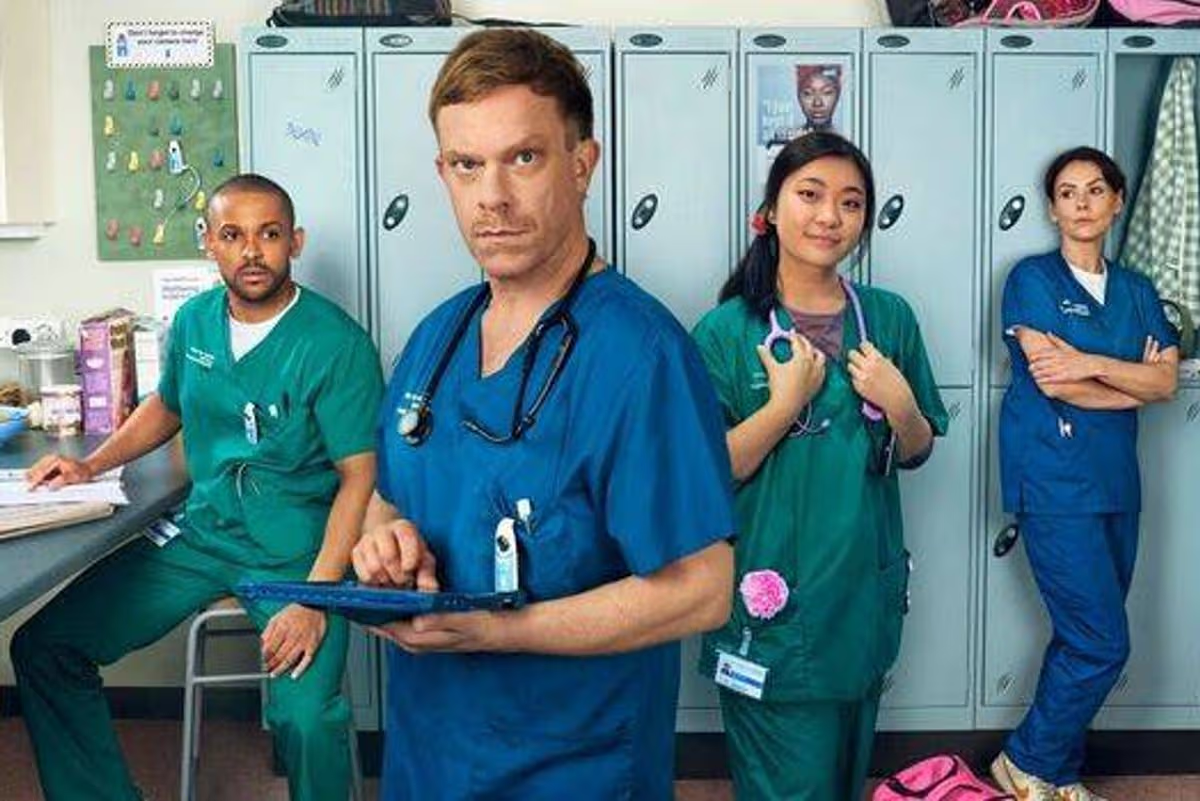
BBC fan-favourite medical drama Casualty has been off-air for a couple of weeks.

Casualty viewers have been left disappointed once again following a BBC schedule shake-up.

Fans of Casualty may have noticed a change to the BBC schedule tonight, April 4, as the much-loved medical drama has been taken off-air once again.

The series was pulled from the schedule last week, to make way for the The Big Night of Musicals, and fans hoped it would return to screens soon.

However, the drama continues to be absent from the Saturday evening schedule as another big event has taken precedent, leaving viewers disheartened.

In December 2025 it was announced BBC Studios had won the contract to continue to produce the next three seasons of the long-running show.

Yet fans have missed seeing their favourite Holby characters in action for two weeks in a row, and here is all you need to know about why the series will not be airing this week.

Why isn’t Casualty on tonight?

Casualty will not be airing on BBC One tonight as the channel is hosting coverage of The FA Cup for most of the evening.

Match of the Day Live will be on from 5pm until 10.05pm, with two separate games being shown, taking over Casualty’s usual slot.

The quarter-final coverage will see Chelsea and Port Vale go head to head first, followed by Southampton and Arsenal.

Fans will have to wait until Saturday, April 11, before Casualty returns to the BBC One schedule.

Casualty went off air in September 2025 and took a five month hiatus before returning in January this year.

Having first aired in 1986, Casualty is the longest running primetime medical drama in the world.

Fans took to X, formerly Twitter, to share their thoughts on the show’s absence, with one saying: “Settled down for Saturday night telly and just realised there is no #Casualty.”

Another fumed: “When the BBC f**** about with Saturday night schedules, why is #Casualty always the first, erm casualty?”

Towards the end of the year, the show will move to a new fictional hospital in Wales, with various Welsh characters set to be introduced.

Casualty returns to BBC One on Saturday, April 11 at 8.30pm

Source link

Trump isn’t immune from civil claims his Jan. 6 rally speech incited riot, judge says

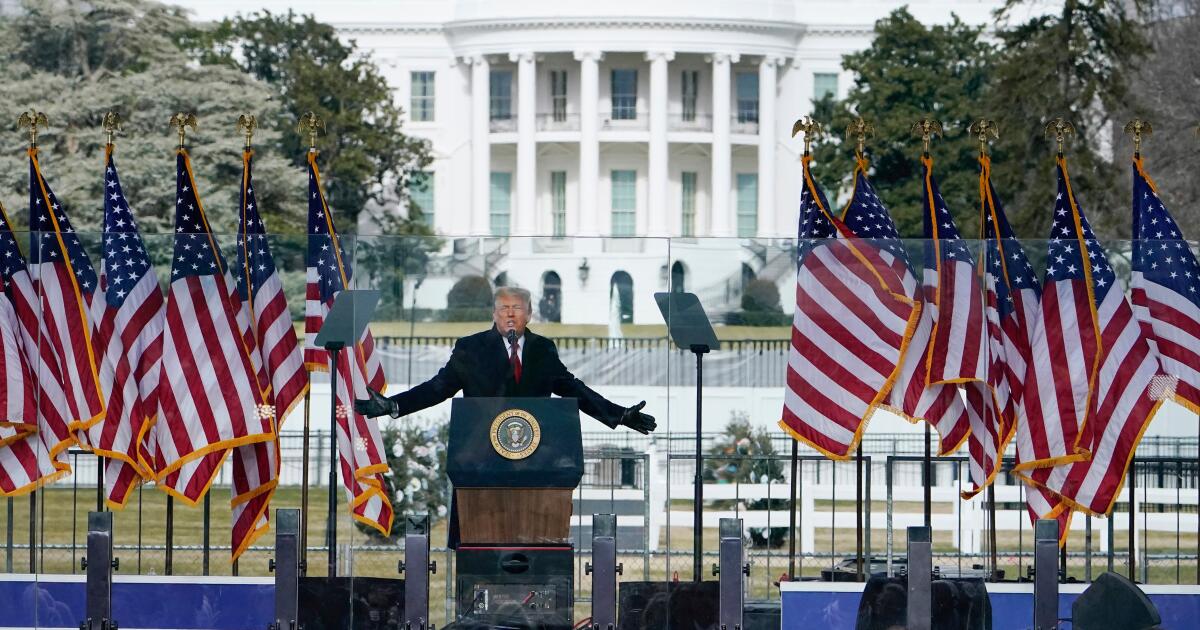
President Trump is not immune from civil claims that he incited a mob of his supporters to attack the Capitol on Jan. 6, 2021, a federal judge has ruled in one of the last unresolved legal cases stemming from the riot.

U.S. District Judge Amit Mehta ruled Tuesday that Trump’s remarks at his “Stop the Steal” rally, held on the Ellipse near the White House shortly before the siege began, “plausibly” were inciting words that are not protected by the 1st Amendment right to free speech.

The Republican president is not shielded from liability for much of his Jan. 6 conduct, including that speech and many of his social media posts that day, according to the judge. But Mehta said Trump cannot be held liable for his official acts that day, including his Rose Garden remarks during the riot and his interactions with Justice Department officials.

“President Trump has not shown that the Speech reasonably can be understood as falling within the outer perimeter of his Presidential duties,” Mehta wrote. “The content of the Ellipse Speech confirms that it is not covered by official-acts immunity.”

Not the first court ruling on presidential immunity

The decision is not the court’s first ruling that Trump can be held liable for the violence at the Capitol and it is unlikely to be the last given the near-certainty of an appeal. But the 79-page ruling sets the stage for a possible civil trial in the same courthouse where Trump was charged with crimes for his Jan. 6 conduct, before his 2024 election ended the prosecution.

Mehta previously refused to dismiss the claims against Trump in a February 2022 ruling that Trump was not entitled to presidential immunity from the claims brought by Democratic members of Congress and law enforcement officers who guarded the Capitol on Jan. 6. In that decision, Mehta also concluded that Trump’s words during his rally speech plausibly amounted to incitement and were not protected by the 1st Amendment.

The case returned to Mehta after an appeals court ruling upheld his 2022 decision. He said Tuesday’s ruling on immunity falls under a more “rigorous” legal standard at this later stage in the litigation.

Mehta, who was nominated by Democratic President Obama, said his latest decision is not a “final pronouncement on immunity for any particular act.”

“President Trump remains free to reassert official-acts immunity as a defense at trial. But the burden will remain his and will be subject to a higher standard of proof,” the judge wrote.

Official capacity vs. office-seeker

Trump spoke to a crowd of his supporters at the rally before the mob’s attack disrupted the joint session of Congress for certifying Democrat Joe Biden’s 2020 electoral victory over Trump. Trump closed out his speech by saying, “We fight. We fight like hell and if you don’t fight like hell, you’re not going to have a country anymore.”

Trump’s lawyers argued that Trump’s conduct on Jan. 6 meets the threshold for presidential immunity.

The plaintiffs contended that Trump cannot prove he was acting entirely in his official capacity rather than as an office-seeking private individual. They also said the Supreme Court has held that office-seeking conduct falls outside the scope of presidential immunity.

Rep. Bennie Thompson, D-Miss., who at that time led the House Homeland Security Committee, sued Trump, Trump’s personal attorney Rudolph Giuliani and members of the Proud Boys and Oath Keepers extremist groups over the Jan. 6 riot. Other Democratic members of Congress later joined the litigation, which was consolidated with the officers’ claims.

‘Victory for the rule of law’

The civil claims survived Trump’s sweeping act of clemency on the first day of his second term, when he pardoned, commuted prison sentences and ordered the dismissal of all 1,500-plus criminal cases stemming from the Capitol siege. More than 100 police officers were injured while defending the Capitol from rioters.

The plaintiffs’ legal team includes attorneys from the Lawyers’ Committee for Civil Rights Under Law. Damon Hewitt, the group’s president and executive director, praised the ruling as a “monumental victory for the rule of law, affirming that no one, including the president of the United States, is above it.”

“The court rightly recognizes that President Trump’s actions leading to the January 6 insurrection fell outside the scope of presidential duties,” Hewitt said in a statement. “This ruling is an important step toward accountability for the violent attack on the Capitol and our democracy.”

Kunzelman writes for the Associated Press.

Source link