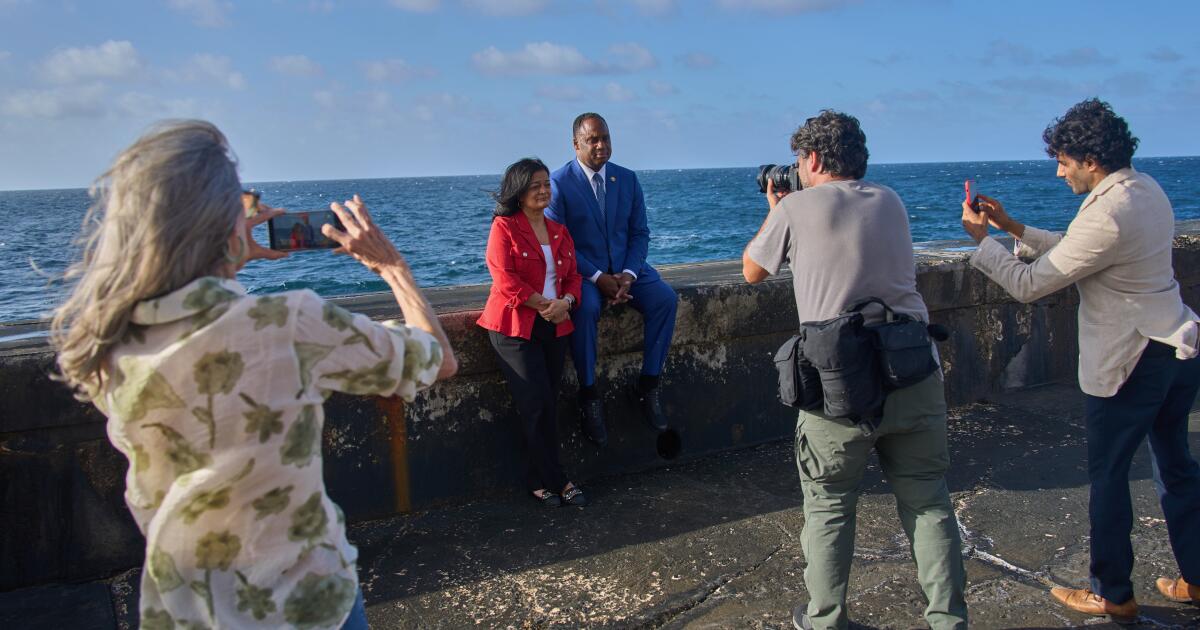
HAVANA — Two U.S lawmakers called for a permanent solution to Cuba’s crises after witnessing the effects of a U.S. energy blockade during an official visit to the island.
Democratic Reps. Pramila Jayapal of Washington and Jonathan Jackson of Illinois met with Cuban President Miguel Díaz-Canel, Foreign Minister Bruno Rodríguez and members of Parliament during a five-day trip that ended Sunday.
Díaz-Canel wrote on X Monday that upon meeting with Jayapal and Jackson, he “denounced the criminal damage caused by the #blockade, particularly the consequences of the energy embargo imposed by the current US administration and its threats of even more aggressive actions.”
Díaz-Canel added: “I reiterated our government’s willingness to engage in serious and responsible bilateral dialogue and find solutions to our existing differences.”
Both the U.S. and Cuba have acknowledged recently that talks are ongoing at the highest level, but no details have been disclosed.
Jayapal told reporters she believes that recent steps taken by Cuba, such as opening the economy to certain investments by Cuban Americans living abroad; the recent announcement that more than 2,000 prisoners would be pardoned; and the arrival of an FBI team to collaborate in the investigation of a fatal shooting involving a U.S.-flagged boat, “indicate that the moment is here for us to have a real negotiation between the two countries and to reverse the failed U.S. policy of decades, a Cold War remnant that no longer serves the American people or the Cuban people.”
Cuba’s government has released the pardoned prisoners who were accused of a variety of crimes, although none so far appear to be political prisoners.
In late January, President Trump threatened to impose tariffs on any country that would sell or provide oil to Cuba, although he made an exception for a Russian ship that reached the island last week with 730,000 barrels of crude oil. It was the first petroleum shipment in three months to dock in Cuba, which produces only 40% of the oil it needs.
“This is cruel collective punishment — effectively an economic bombing of the infrastructure of the country — that has produced permanent damage. It must stop immediately,” Jayapal and Jackson said in a statement released Sunday.
Critical oil shipments from Venezuela were halted after the U.S. attacked the South American country in early January and arrested its leader, Nicolas Maduro.
Cubans already suffering from five years of economic crisis have acutely felt the impact of the fuel shortage: national blackouts, gasoline shortages and rationing, lack of public transport, cuts in working hours, paralyzed hospitals and surgeries, and suspension of flights, among other things.
Russia has promised a second delivery of petroleum, although it’s not clear when it might arrive. Experts have said that the first shipment could produce about 180,000 barrels of diesel, enough to feed Cuba’s daily demand for nine or 10 days.
Jayapal said that while such shipments are critical, they are only temporary solutions: “We need a longer, permanent solution for the Cuban people and the American people.”
Meanwhile, Jackson compared the blocking of the Strait of Hormuz off Iran’s coast to the oil blockade in Cuba, adding that the island “is the most sanctioned part of Earth.”
“Our government is fighting to keep the Strait of Hormuz open so there is a free flow of oil around the world. We want, for humanitarian reasons, a free flow of oil, fuel, and energy in our own hemisphere,” he said.
Jackson and Jayapal said they would prepare a report and continue to work on initiatives proposed by fellow members of the U.S. House of Representatives to lift sanctions against Cuba to alleviate the ongoing humanitarian crisis.
Mesquita and Rodríguez write for the Associated Press.
OUR Spotlight On column gives you the lowdown on what to see and do in popular holiday spots and off-the-beaten-track destinations.
This week we’re taking a look at Ocho Rios, a serene resort town on Jamaica’s north coast that’s home to gushing waterfalls and turquoise waters.
Sign up for the Travel newsletter
Thank you!
Ocho Rios has been called a “true gem” in JamaicaCredit: GettyA popular attraction to visit is Dunn’s River FallsCredit: AlamyThe resort town is known for its bright blue waters and waterfallsCredit: Alamy
According to Jamaica Tourism, its a “true gem in the heart of Jamaica” and the island itself ha seen a boom in demand.
TUI’s UK&I Managing Director Neil Swanson said: “We’re seeing particularly strong demand for our direct long-haul flights to the Caribbean – especially the Dominican Republic and Jamaica – where point‑to‑point routes give customers added confidence and help them keep their holiday plans on track.”
Here are some of our top tips for visiting the resort town on the island of Jamaica.
MUST SEE/DO
Dunn’s River Falls is Jamaica’s most popular waterfall, cascading 600ft down a craggy rock.
The best way to view it in all its glory is with a Dunn’s River Falls Experience by Island Routes.
Guests are guided to the landmark, passing natural pools leading to the Caribbean Sea.
A two-hour experience costs from $62.73pp including transfer.
Guests staying at the Sandals resorts can add this onto their booking as part of their stay.
HIDDEN GEM
For a relaxed day, soaking up the delights of Jamaica away from the crowds, you can’t go wrong with Mahogany Beach.
It’s less popular than other nearby shores, but no less beautiful.
The laid back atmosphere, calm, clear waters and soft, white sands make this spot ideal for a fly-and-flop day.
Listen to chilled, live music while you paddle and don’t forget to check out the food stalls selling classic Jamaican dishes like jerk chicken and barbecued seafood.
BEST VIEW
It may feel like somewhat of a mission to reach the peak of Mystic Mountain, but once you do you’ll be rewarded with wondrous views of the resort town below.
Those who are up for a walk will be able to take advantage of beautiful flaura and fauna en route, but if you’re not able to or keen on a trek then catch the Sky Explorer chairlift which will carry you 700 feet above sea level.
Adrenaline junkies can take advantage of a zipline course through the treetops which offers equally impressive views.
The outdoor restaurant offers a laidback atmosphere with slap-up dinners that celebrate the island culture through classic flavours.
Dishes such as oxtail, curried goat and jerk chicken are paired with veggies, rice and peas (just as they should be).
Wash them back with a rum punch – the only cocktail you’ll want to drink out here.
BEST BAR
Within Sandals Dunn’s River resort, Ocarina Rooftop bar serves its tipples with a cracking view – best enjoyed at sunset when the sky is painted in hazy hues of pink and orange.
Sip on well-muddled cocktails or stick to beer and wine while you relax in the cool sea breeze. With the sound of the lapping ocean in front of you, it’s hear not to unwind here.
HOTEL PICK
The adults-only Sandals Dunn’s River has successfully injected Jamaican touches into the luxury space.
Water is sourced from the natural reserves of the nearby Dunn’s River Falls, hence the name of the resort. Lazy days will never get boring with a whopping 12 restaurants on site, including a swim-up bar.
There’s also complimentary water sports for all-inclusive guests, including up to two scuba dives per day for certified divers, as well as land sports and complimentary green fees at Upton Estate Golf & Country Club and access to the neighboring Sandals Ochi Beach Resort.
You are spoilt for choice with hotels along Ocho RiosCredit: Alamy
JUST off the coast of Portugal is a tiny archipelago that very few tourists visit, or even know about.
The little-known collection of Berlenga Islands consists of three islands – Berlenga Grande, Estelas and Farilhões-Forcado
Sign up for the Travel newsletter
Thank you!
The Portuguese archipelago is only open from March to OctoberCredit: AlamyBerlenga Grande has its own fort where you can camp in a cell overnightCredit: Alamy
Berlengas is primarily a nature reserve, home to lots of birds like the yellow-legged gull, guillemot, and sea life which you might spot while snorkelling.
Due to it being protected, and reasonably small, the islands have a daily limit of 550 visitors – and it can only be accessed between March and October.
With the weather this time between 18C and 25C, it’s the perfect time to visit and spend time on its beach – which is one of the prettiest in Europe.
This is Praia da Berlenga Grande, which is also the most famous beach on the island and ideal for relaxing on the golden sands.
It’s also a good spot for swimming with one visitor saying the clear waters reminded them ‘of the Caribbean‘.
Just be prepared for it to be chill, seeing as the islands are in the Atlantic Ocean.
National Geographic called it one of Portugal’s best beaches with ‘desert vibes’.
One visitor advised to visit in September as it was quieter and they had the beach all to themselves for an hour.
Another popular way to explore the island is by boat with plenty of tours throughout the day.
Bobbing around on the water means you can see the caves that have naturally formed into the cliffside.
One of Berlengas’ most famous rock formations is the Elephant’s Trunk – which literally looks like an elephant’s head and trunk which dips into the ocean.
Another is Dream Cave, or Cova do Donho, which is where fishermen used to spend the night because of its calmer waters.
Visitors can bring their own tent onto Berlengas IslandsCredit: AlamyOne popular boat trip is around ‘elephant cave’Credit: Alamy Stock Photo
Visitors can actually stay on the island if they wish and enjoy quieter evenings when the daytrippers leave.
There’s a hotel called Berlenga Bed & Breakfast which has just five rooms and sits on the clifftop so it has incredible views across the ocean.
You can check them out from the hotel’s pretty terrace bar and restaurant.
Anyone feeling brave and wants to sleep within nature can camp out at Forte São João Baptista.
The island’s fort has camping spots and is said to give an “immersive, authentic experience”.
Visitors can sleep in an old cell and have to bring their own sleeping bags or bedding.
There’s a campsite too where visitors can literally pitch up with their own tent with rates from €8 (£6.92) per night – pitches must be booked in advance with the tourist board.
As for how to get there, ferries go to the island three times from Peniche.
The journey between the mainland and the island takes around 30-minutes with tickets costing between £15 and £35.
Get Your Guide has tours on offer to explore the island, like a Cave Tour from €41 (£35.48).
There are also catamaran tours with snorkelling stops from €42 (£36.35) and round-trip boat tours of the islands from €29 (£25.10).
Peniche is a just over an hour’s drive from Lisbon which has direct UK flights for as little as £15.
EVEN more Brits will get to explore the delights of Montego Bay as Virgin Atlantic is upping its flight offerings.
Thousands more seats are being added to the airline’s schedule very soon making it much easier for holidaymakers to enjoy Jamaica’s sun and sea.
Sign up for the Travel newsletter
Thank you!
Montego Bay in Jamaica has beautiful beaches and highs of 30C year-roundCredit: AlamyVirgin Atlantic is upping its flights to Montego Bay to once a day from June 2026Credit: Alamy
Jamaica is one of the Caribbean‘s most popular islands welcoming around 2.5million visitors every year.
Thanks to its natural beauty and incredible weather – it’s a hit with Brits too.
Currently there are just four flights a week, but from June 1 there will be daily flights between the airports – meaning there will be over 15,000 more seats.
One-way tickets in June with Virgin Atlantic start from £444.
These daily flights which take on average 10 hours and 15-minutes will end on October 24, 2026.
Montego Bay on north-west coast of Jamaica is the capital of the parish of Saint James and is one of the most popular tourist spots on the island.
Of course Brits flock there for its great weather and beautiful bays like Doctor’s Cave Beach.
It’s considered one of the most beautiful in the country with white sand and bright turquoise waters.
Aside from sunbathing and paddling, snorkelling is popular too as swimmers are likely to spot parrotfish, turtles, and small sharks.
Other top-rated beaches in the area include Cornwall Beach, Walter Fletcher Beach and Dead End Beach.
For those who want to explore island life, head to the Hip Strip which is filled with local restaurants, bars, shops, and there’s plenty of nightlife too.
Check out some of our favourite Caribbean holidays…
*If you click on a link in this box, we will earn affiliate revenue…
Hotel Capriccio Mare, Dominican Republic
Facing the calm, crystal waters of the Caribbean Sea, Hotel Capriccio Mare looks like a bright white island villa. The hotel’s position on Bavaro’s coastline is perfect for exploring the popular resort town of Punta Cana. Whether it’s strolling the sands to grab a fresh coconut with a straw, or venturing out on a catamaran trip to Saona Island, this dreamy Caribbean resort is not one to miss.
This friendly, family-run hotel is a slice of Caribbean paradise. This hotel sits smack-bang on a sugar-white beach with warm turquoise waters. Enjoy both the beaches of Barbados and its plethora of rum bars – there are about 1,500 of them on the island.
Set on the quiet side of St Kitts’ Frigate Bay, the boutique Sugar Bay Club offers superb value and wonderful views of the Atlantic Ocean. Staff are on hand to assist with island tours, from catamaran cruises to scenic railway excursions.
Amazing Antigua has 365 beaches – one for every day of the year – as well as a fascinating history. This resort in Falmouth Harbour is perfect for exploring the beautiful local area, including Pigeon Point, Nelson’s Dockyard and English Harbour.
Other activities around Montego Bay include scenic bamboo rafting tours on the Martha Brae River which head through the rainforest.
Around an hour away from Montego Bay is Dolphin Cove where there are dolphin experiences and dolphin spotting in natural lagoons.
Back on land, the Rose Hall Great House is another attraction tourists flock to.
It’s a restored 18th-century Georgian mansion and former sugar plantation.
The historic house museum offers tours throughout the day to visitors wanting to learn more about the former owner, the White Witch of Rose Hall.
When it comes to Jamaica, the best months to visit are December through to April when it is at its warmest at around 30C.
During this time it’s mostly dry with low humidity.
You’ll be able to spot dolphins around Montego BayCredit: Alamy
Here’s another Caribbean island to visit with floating bars…
For more on the Caribbean, the islands of Turks and Caicos is rising in popularity due to the conflict in the Middle East – Deputy Travel Editor Kara Godfrey visited in 2024 and reveals more on the beautiful destination…
She said: “One of the main draws are the stunning beaches – so beautiful in fact they are often named some of the best in the world.
“I spent my jet-lagged mornings walking the length of Grace Bay, with powder soft sand and quiet sunrises. Even in the evening they were just as beautiful with pink sunsets ending the day. And there is not just one, but two floating bars.
“One of the most popular is Captain Oak’s Tiki Bar, which has even welcomed celebs such as Drake and Jake Harlow Tourists have to pay $20 (£15.10) to get there by boat or jet ski.
“Otherwise there is the more vibey Noah’s Ark, which has a floating dance floor as well as sea swings.”
People in the Canary Islands have been warned to stay indoors, stay hydrated, and keep their windows shut to protect themselves from an incoming weather phenomenon.
15:00, 31 Mar 2026Updated 16:11, 31 Mar 2026
People in the Canaries have been warned to stay indoors (stock)
(Image: Getty Images)
Six different types of tourists have been urged to exercise extra caution as the Canary Islands brace for potentially hazardous weather. People in the Canaries have been warned to stay indoors, stay hydrated and keep their windows shut to protect themselves against incoming Saharan dust.
As of Yesterday (March 30), reports warned of a massive dust plume that was expected to be carried towards the Canary Islands by strong winds, merely days after Storm Therese brought unprecedented rainfall. The haze was due to arrive at 12 noon yesterday, with yellow weather warnings in place across the region.
In response, the Canary Islands Health Department, working via the General Directorate of Public Health of the Canary Islands Health Service, has issued advice to those who may be impacted by the dust, which is due to strike several islands over the coming days. Suspended dust is expected to negatively impact the air quality, weather forecasts indicate.
An “adverse weather phenomenon” has been linked to the event, prompting the regional government to issue a “calima” alert status (a term used to refer to these types of Saharan dust events). Health authorities have urged people to refrain from staying outside for extended periods, keep windows shut, and steer clear of heavy physical exertion outside.
Spanish news site Canarias7 explained that this is due to its potential impacts on health, with high concentrations of particles able to lead to mild symptoms such as nasal and throat irritation, itchy eyes, and coughing. However, it can also result in more serious issues, including asthma attacks and problems for those with respiratory or cardiovascular diseases, with the risk of respiratory infections also raised.
It was further noted that this advice applies particularly to the six most vulnerable groups:
Minors
Elderly people
Those with chronic respiratory or cardiac conditions, like asthma or bronchitis
Pregnant women
Outdoor workers
Smokers
Hospital visits increase during these events, “even up to five days after the episode ends”. Other recommendations include cleaning surfaces with damp cloths, taking your usual prescribed medication, avoiding humid settings, monitoring official information on the event, and calling 112 if respiratory symptoms worsen. People in the Canary Islands have also been advised to check the Air Quality Index (AQI) of the Canary Islands Government’s Air Quality Monitoring Network.
Meanwhile, there are other regional weather warnings specifically for coastal conditions, activated when strong winds, rough seas, and large swells are expected to impact shorelines and ferry operations. It means that people should take precautions when near beaches and harbours.
As for the Saharan dust, the warnings affect the top destinations of Gran Canaria, Lanzarote, and Fuerteventura, with coastal and wind advisories for Tenerife, El Hierro, La Gomera, La Palma, Lanzarote, and Gran Canaria. Much-loved by UK tourists, the Canaries welcomed 6.3 million Brits in 2024.
Island president Rosa Dávila emphasised that safeguarding the public remains a priority after emergency alerts were received by phones in northern Tenerife. Rosa said: “We are facing a changing situation, with a storm that maintains an unstable behaviour. Our priority is to anticipate and protect the public.”
It follows the impact of Storm Theresa, which hit the region hard, generating upwards of 700 litres of rain per square metre in some spots. In addition, the so-called “storm of the decade” reportedly transformed streets into rivers and affected tourist areas.
THERE are plenty of beautiful islands around Greece, but you might not have heard of Andros.
It’s the second-largest island in the Cyclades and is considered to be one of the most beautiful, and underrated.
Sign up for the Travel newsletter
Thank you!
Andros is the second-largest island in the CycladesCredit: AlamyBeaches on the island look like they’re in the Caribbean, like Zorkos BeachCredit: Alamy
Andros has it all, with mountain landscapes, beaches with bright blue waters, lush greenery with waterfall trails, and a town classically painted in Greece‘s blue and white.
Visitors arriving by ferry will first come to Gavrio, on the northwest coast which historically was a fishing village.
Now it’s a lot busier and vibrant with plenty of tavernas, bars and hotels – however this isn’t the capital of the island.
An hour’s drive away from Gavrio is Chora, which literally means ‘main village’.
One visitor who blogged about their recent trip named Verde as a top place to grab a bite there.
Their top tip was to taste the Miss Pink cocktail, which is a mix of champagne, lime and grapefruit.
When it comes to drinks, on Andros, you can pick up a glass of wine from €3 (£2.60).
Along with its pretty village to explore, the real gems of this island are the beaches that are dotted along the coastline.
There are beautiful beaches too with white sands and bright blue seas.
One of the most popular north of Chora is called Zorkos Beach, which is also one of the island’s biggest.
One visitor said: “One of the best beaches I have visited in general in my life! Incredible waters, clear and a very quiet place even though it has a beach bar there!”
Another added: “Zorkos beach is just fantastic! Clean water and a very relaxed atmosphere. Perfect place to escape and enjoy the sea without a lot of people. We will definitely visit again.”
Other popular spots include Vitali Beach on the north eastern side of the island.
The beach is always fairly empty as it’s secluded and can only be accessed by a narrow dirt track – so it’s recommended to get there by motorbike or jeep.
Another spot which has crystal clear waters is Tis Grias to Pidima Beach, which has a huge rock stack off its shore.
The beach can be reached via a dirt road and steep trail, but lots of visitors say it’s worth a visit thanks to its beautiful views.
A glass of wine in Greece can cost as little as £2.50Credit: AlamyPithara Waterfalls is considered a ‘hidden paradise’Credit: Alamy
Heading inland, one popular activity for tourists on Andros is hiking to its waterfalls.
One of the easiest trails that takes around 10-minutes is to the Pithara Waterfalls, which is dubbed a ‘hidden paradise’ in Apikia.
Visitors say there’s enough water for a small swim, along with plenty of pretty viewing points from above the falls.
For those staying on the island, some hotels cost as little as £36 per night, which you can find on Booking.com.
The Ostria Hotel & Apartments has an outdoor pool, and is a few minutes walk away from Gavrio.
On Airbnb, pretty apartments start from £67 per night.
This one in Chora is within walking distance to the sea, as well as restaurants, bars, cafes, museums and art galleries.
When it comes to getting to the island, Brits will have to fly to Athens, which in May can be done for £25 with Ryanair.
From there, take a ferry across to the island which can be as quick as one hour with Seajets (with tickets from £30).
Storm Therese is battering the Canary Islands with heavy rain, 100km/h winds and significant snowfall, with over 40 flights cancelled and schools closed across the islands
Samantha Bartlett Assistant Editor, Social News
10:41, 21 Mar 2026
Storm Therese is currently battering the Canary Islands (stock image)(Image: Europa Press News, Europa Press via Getty Images)
Storm Therese is currently wreaking havoc on the Canary Islands, particularly Tenerife and La Palma, with an unusual mix of heavy rain, 100 km/h (62 mph) winds, and significant snowfall at high altitudes. Authorities have declared a full-scale emergency in Tenerife, labelling it as one of the most severe storms to batter the archipelago in over a decade.
Spain‘s meteorological agency, AEMET, has issued several alerts that will remain active throughout the weekend. Orange (high risk) warnings have been dispatched for northern Tenerife and parts of La Palma due to wind gusts reaching 90–100 km/h and heavy rainfall. Concurrently, yellow warnings are in place across all seven islands for rain, thunderstorms, and choppy seas with waves reaching up to 6 metres (20 feet).
Unusually for this time of year, significant snowfall has also blanketed Mount Teide and surrounding peaks above 1,800–2,000 metres.
Content cannot be displayed without consent
The storm has led to widespread cancellations and safety closures across the islands. Over 40 flights were cancelled or rerouted by Friday, March 20, primarily at Tenerife North and South airports. Travellers are advised to check their flight status via Flightradar24 or their airline.
Schools and universities in Tenerife, Gran Canaria, and several other islands were shut on Thursday and Friday, whilst key roads, including access to Teide National Park and the TF-445 to Punta de Teno, are closed due to ice and snow.
Major international events such as the Tenerife Bluetrail 2026 race have been cancelled or postponed.
Providing an update on the weather situation on Friday (March 20), one Tenerife resident known as @theknightstrider1 on TikTok took to the platform to share details with his 115,000 followers.
The car hire and bar owner, who is based in Playa de las Américas, was heard saying: “A little weather update for you then, it’s raining… it’s pretty grim and it’s gone really overcast as well.
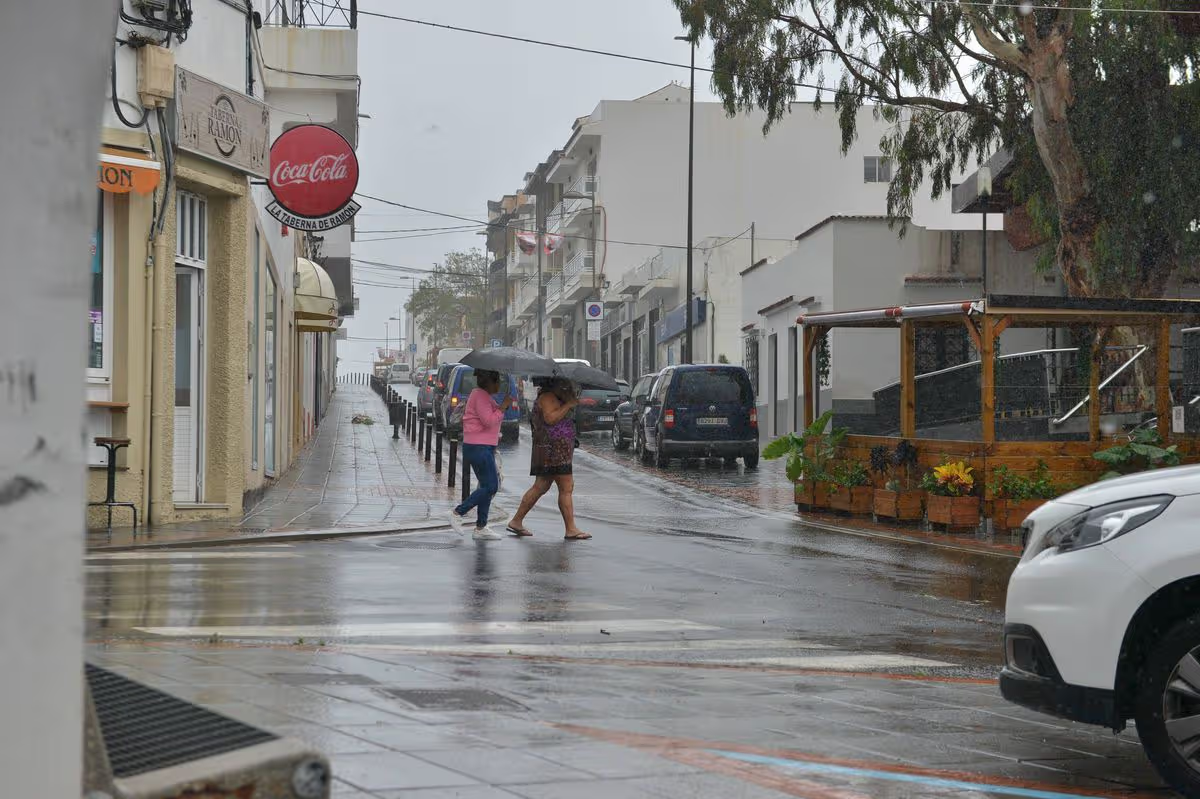
“The rain showers are on and off, we haven’t really had any rain until now. It was okay this morning, but yeah it is raining. The current temperature’s around 18 degrees, not too cold but the umbrella’s are out, people are sheltering and it’s really not that nice.”
Content cannot be displayed without consent
He added: “Bear in mind, you might get caught in the rain, have a brolly with you. Maybe some of the rain macs as well if you’ve got any, if not buy some because it’s on and off.”
One person wrote: “Weather’s been awful the last three days, can’t wait to go home.”
Whilst another added: “Arrive tomorrow, packed a brolly.”
A third chimed in: “This makes me so happy as someone who was going to go this week and changed to last week! Phew.”
Whilst a fourth asked: “Why is it every time it’s sunny in the UK it rains in Tenerife?”
Another resident of the Canary Islands also posted a weather update on TikTok from Santa Cruz de Tenerife, captioning the clip, ‘Rain, wind and choppy ocean. Flights cancelled and diverted. Flooding in El Médano and roads closed. The storms Theresa and Samuel are hitting Canary Islands.’
He then said in the video: “Here if your weather update from Tenerife South on Friday March 20th, 2026. The two storms – Theresa and Samuel – are hitting the Canary Islands with force.
“As you can see here, we have quite a lot of waves here in the Troya area of Las Americas. The storms have caused quite a few incidents on the island, we have had 11 flights cancelled yesterday, 10 flights have been cancelled during the day today.
“We have had quite a few flights deviated to other airports as well and we have had ferries that have been cancelled because of the conditions out on the see.”
He explained the temperature was currently hovering around 19 degrees and there had been some rain which was “coming and going” along with overcast skies.
Are flights from the UK to Tenerife being cancelled?
Yes, flights from the UK to Tenerife are currently experiencing cancellations and significant disruptions due to severe weather from Storm Therese.
As of Saturday, 21 March 2026, authorities in Tenerife have declared an island-wide emergency due to extreme conditions including heavy rain, strong winds, and rare snowfall over high ground.
Over 36 flights were cancelled earlier this week, with further disruptions reported today. While many cancellations involve inter-island services, several international flights have been diverted or cancelled due to poor visibility and high winds.
Currently, the most affected airport is Tenerife North (TFN), which has seen the greatest impact, though Tenerife South (TFS) – where most UK flights land –is also experiencing delays and some rerouted services.
Conditions are expected to remain hazardous through Saturday, with a gradual improvement predicted for Sunday, 22 March.
Major airlines serving the UK to Tenerife route, such as Ryanair, easyJet, Jet2, and TUI, are urging passengers to check their flight status before heading to the airport
If your flight is cancelled, contact your airline immediately to discuss rebooking or refund options.
THE CANARY Islands are facing huge storms and rain this week, which has even meant snow in places like Tenerife and La Palma.
Here’s what you need to know if you have a holiday booked there.
Sign up for the Travel newsletter
Thank you!
Here is everything you need to know about a trip to the Canaries right nowCredit: AlamyThe storm is continuing the affect the CanariesIt has even brought snow to La Palma and TenerifeCredit: Tenerife Island Council
What is happening in the Canary Islands?
Storm Therese has left the Canary Islands in turmoil as weather warnings have remained in place for several days.
More snow is expected in Tenerife after the mountains in the Teide National Park were blanketed in white on Thursday.
As a result, more than 40 flights have been cancelled this week across the Canaries.
Orange and yellow alerts are in place across the islands, warning of heavy rain, storms, flooding and high waves.
WITH the Iran crisis continuing, it’s no surprise that Brits are changing their holiday plans.
Destinations like Dubai and Doha remain off the travel list, and Brits are avoiding certain long-haul destinations that involve stopovers in the Middle East – but TUI says that other holiday spots are on the rise instead.
Sign up for the Travel newsletter
Thank you!
TUI has revealed the holiday destinations on the rise this yearCredit: AlamyThe islands avoid the Middle East crisis as flights will cross the North Atlantic OceanCredit: Alamy
TUI has revealed that there’s been a change in demand when it comes to Brits booking holidays.
Instead, certain locations are being favoured as a result – in particular, two Caribbean islands.
TUI’s UK&I Managing Director Neil Swanson said: “We’re seeing particularly strong demand for our direct long-haul flights to the Caribbean – especially the Dominican Republic and Jamaica – where point‑to‑point routes give customers added confidence and help them keep their holiday plans on track.”
The islands are popular year-round with Brits thanks to their sunshine, high temperatures and beautiful coastlines.
Flights to the islands are direct and take between eight and ten hours.
They also don’t pass through the Middle East as they head over the North Atlantic Ocean instead.
TUI offers holidays to Jamaica from £899 per person.
In Jamaica, a popular spot is Negril, which is the capital of the island that sits along the western tip.
Over the years it has been visited by famous faces likes Bob Marley and even The Rolling Stones.
It has the Seven Mile Beach, which offers visitors to ride across the sand on horses, and go snorkelling.
TUI offers holidays to Montego Bay too, a destination which is known for being popular with tourists with all-inclusive resorts, white-sand beaches, and nightlife.
It also has breaks to Ocho Rios which has lots of green spaces like the Dunn’s River Falls, the Blue Hole – a natural limestone sinkhole that’s considered a hidden gem.
The Dominican Republic is one of the cheapest islands in the Caribbean to visit tooCredit: Alamy
When it comes to Jamaica, the best months to visit are December through to April when it is at its warmest and most dry.
The best time to visit the Dominican Republic is the same, and TUI offers breaks from from £899 per person.
Laura Evans Fisk, Head of Digital & Engagement at eurochange said: “As we’ve seen transactions for the Dominican peso surge this year ahead of any other currency, we can definitely expect to see the Dominican Republic at the top of travel bucket lists for UK tourists in 2026.
Beaches are beautiful all around the island, but the Dominican Republic also has two of the best in the world – Canto de la Playa and Bahia de las Aguilas.
Canto de la Playa in the Dominican Republic is one of the world’s best beachesCredit: Alamy
Santo Domingo is the island’s capital, where there are find plenty of bars – and average price of a local beer is 150DOP (£1.86).
Other destinations that are on the rise for travellers include Thailand’s Phuket and Goa in India.
He said the reason is that the long-haul flights from TUI “offer customers reassuring alternatives that avoid transiting through the region.”
Neil Swanson added: “Closer to home, destinations across Europe and the Mediterranean continue to perform well, with Spain, Portugal, Greece and Cape Verde seeing increased demand in recent days.”
WHEN it comes to travelling to Greece there are loads of islands to choose from – but now the cheapest spots have been revealed, and you might be surprised.
Greece is a much-loved holiday destination for Brits, and now the islands where you could save over £1,000 have been revealed.
Sign up for the Travel newsletter
Thank you!
The cheaper Greek island destinations have been revealedCredit: GettyThere are a number of alternative islands Brits could head to in Greece that could save them over £1,000 on their holidayCredit: GettyThe cheapest Greek destination is Kefalonia, with a seven-night holiday costing around £596 per personCredit: Alamy
According to new data by TravelSupermarket, Kefalonia – the largest Ionian island – is the cheapest Greek destination.
Looking at average prices for a seven-night holiday between September 16, 2025 and March 15 2026, TravelSupermarket found that Kefalonia cost an average of £596 per person.
Caroline McGuire, Head of Travel (Digital), who has visited the island, said: “Looking out at Myrtos Beach, which is regularly named one of Greece’s top five, it felt like we were being let in on a great secret.
“The bright white shoreline and astonishingly clear aquamarine waters shone back at us, almost completely empty.
“It was so peaceful, in fact, that a digital nomad had set up his van office in the parking lot overlooking the sea.”
In second place is Lefkada, costing around £606 per person.
Instead of heading to Corfu, Lefkada (which is just along the coast) offers fewer crowds.
Also, in comparison to a seven-night break in Corfu, you could save £216 per person, or £864 if travelling as a family of four.
The island of Lefkada is often dubbed the ‘Caribbean of Greece’ thanks to its exotic, Caribbean-like natural landscape.
Across the island, you will find sprawling beaches including Porto Katsiki.
And in the island’s main town, there are lots of alleys to explore, and a long promenade with restaurants and bars littered along it.
In the town, look at the buildings too, as many are in a Venetian architectural style.
Surprisingly, Santorini ranked third most affordable, costing around £637 per person.
The stunning island is one of the most popular destinations in Europe attracting honeymooners and A-listers such as Angelina Jolie and Beyonce.
Lefkada followed in second place and surprisingly, Santorini in thirdCredit: GettySantorini is often thought to be a luxury destination with A-listers visiting, such as BeyonceCredit: Getty
And as a result, many think visiting the island comes with a premium price tag.
But a trip to the white-and-blue island doesn’t need to break the bank.
Hotels can cost from just £35 a night and the island has a good bus network, which costs less than £2 a ticket.
For less busy spots, check out Megalochori, Pygros or Emborio – they all feature cobbled roads, cosy tavernas and authentic Greek food.
Mykonos followed in fourth, costing around £670 per person.
Mykonos is often thought to be one of Greece‘s most glamorous and expensive places to visit.
Another glamourous destination – Mykonos – followed in fourthCredit: Getty
Both destinations are Dodecanese staples, with lots of sunny weather and stunning beaches.
Yet, if you head to Rhodes over Kos you could save a massive £254 per person – or £1,016 for a family of four.
The island is well-known for its 3,000-year-old history with the UNESCO-listed medieval Old Town as well as amazing beaches including Lindos Beach and Faliraki Beach.
Chris Webber, Head of Holidays and Deals at TravelSupermarket, said: “Greek islands are not all created equal when it comes to price — but the expensive ones might not be the islands you’d expect.
“Mykonos costs less to book than Crete. Rhodes is hundreds of pounds cheaper than Kos.
Greek divers surface around me shouting about “megalo” groupers. I’m surrounded by enormous grins above the water and big fish below. A happy place to be. A bunch of us, divers and snorkellers, are hanging around Agios Petros reef off the island of Alonissos, and there’s a reason the groupers are big here. The National Marine Park of Alonissos Northern Sporades, established in 1992, is Greece’s largest working marine protected area (MPA) – two bigger MPAs have just been created, but are not yet operational. The protective measures appear to be working, judging by the size, abundance and diversity of marine life – glassy waters teeming with colourful fish and precious shells make swimming here an absolute dream.
For those who like to go deeper, Alonissos is the site of Greece’s first underwater archaeological park and museum – the impressive Peristera wreck, with its giant cargo of amphorae preserved from the 5th century BC. This one is for certified divers descending with accredited local dive centres. I’m with one of those schools, Ikion Diving, but today we’re doing something more accessible. We’re in the village of Steni Vala for the launch of a citizen science project, the Highly Protected Mediterranean Initiative (much more fun than it sounds). Ikion is partnering with the universities of Thessaloniki and the Aegean to offer free snorkelling and diving trips logging native and alien species. I’m worried about my fish ID skills, but the effervescent biologist Katerina Konsta runs a great briefing and we’re given dive slates with images to mark (imparting a childish delight at playing scientist).
Everyone buddies up. I have come solo, so Katerina is stuck with me, and we complete two gentle transects of the reef. It’s a sea of colour: reds and blues, yellows, silver and gold. Friendly little wrasse, painted combers, sizeable parrotfish and 35 salema porgy accompany us as I try not to double-count them. No sign of invaders – lionfish, rabbitfish, redcoats or bluespotted cornetfish. Back at the dive centre, we input the data, and I’m gratified to find that my card matches Katerina’s, give or take a grouper.
It has been great fun – a very gentle introduction to fieldwork, in what I’m going to declare the best place in the Mediterranean to spot fish. I do not say this lightly. Over several years, I have sailed east to Greece from Gibraltar; my boyfriend, Wolfi, sailed west from Turkey. We both freedived. Neither of us has seen this much life underwater, though he is reminded of particular parts of the Turkish coastline where, as a teenager 20 years ago, he regularly found now-rare giant triton (Charonia tritonis) and giant tun snails (Tonna galea) – a great source of envy as I have never seen either in the wild.
‘A happy place to be’ … Susan Smillie diving off Alonissos. Photograph: Wolfgang Hainzl
With the smug glow of having done something worthwhile, I wander down to the charming harbour, where I find Wolfi soaking up the atmosphere, and I boast about all the groupers I’ve seen. Fish tavernas line the front, but I have a local person’s recommendation, so we’re heading for Tassia’s Cooking (if you can’t get in, Sossinola is also good). Having made friends with so many fish today, I find I just can’t eat one, so I opt for creamy fava bean and vine leaves, followed by moussaka – all homemade, well priced and really good.
A five-minute stroll from Steni Vala’s harbour, behind Glyfa beach, we find our night’s accommodation, Ilya Botanic Suites, by a shady olive grove. Calming and compact, these minimalist rooms reflect the landscape; fine-grained terrazzo softened with vertical wooden blinds and plants, and – the best bit – a small plunge pool to sink into after the hard work of counting fish.
The next day we head north to Gerakas, where I’m in the water for under a minute when I find a beautiful grouper snagged on the end of a tangled line. We get some pliers and release the distressed creature; it heads down to the safety of the rocks and we make for the tiny port of Kalamakia for the excellent Margarita fish taverna (owned by a fisher). Our meal of fresh Thunnus alalunga (Alonissos tuna), scorpion fish and lobster comes to about €180 for two with drinks – expensive by Greek standards, but all locally caught and the quality is excellent.
Kritamo restaurant in Patitiri has great cocktails and modern Greek cuisine. Photograph: Kritamo
Away from the water, Alonissos is surprisingly lush for an Aegean island – Aleppo pines and oaks, maples and olive trees stud the hills. It even boasts a mountain (just, at 475 metres), Kouvouli. At 20km long, the island’s interior is easy to cover over a couple of days (you’re more likely to meet handsome goats than other humans), but, be warned, some roads only loosely resemble that description, and a quad bike is preferable to a car if you don’t want to lose your deposit. There are plenty of bike trails (and beautiful ravine hikes), but in the searing July heat we opt for shady forest walks and quick stops for clifftop views. And, let’s be honest, on a Greek island in summer, the best days start and finish in the sea.
Happily, you can access a range of beaches on both sides of the island for sunrise and sunset views. On the eastern shore is the much-loved Agios Dimitrios, a sweeping triangular stretch of white pebble. It’s organised with cafes and sunbeds, great for families, but for me it’s most stunning from above, that tongue of white plunging like an arrow into turquoise sea. Kokkinokastro is another beautiful beach, and Gialos, with its old windmill perched on the cliffs, offers a wonderfully moody sunset. But my favourite, hands down, is the small and secluded Kremisma beach. Absolutely beautiful. It’s a short walk from a car park and a slightly steep drop (ignore the frayed rope), and there are no sunbeds, no bars, nothing at all (perhaps literally – it’s said to be nudist-friendly, though personally I wouldn’t recommend stripping, which is not customary in Greece).
Off the pebble beach is a rocky little coastline that’s perfect for spotting marine life. Wolfi and I by now are on one baby moray eel each, and I have swooned over a shiny brown cowrie, but he’s ahead on octopus. Competitive, me?
The busy little port town of Patitiri, where you will arrive, is home to most residents and offers plenty of accommodation, shopping, beaches, tavernas and a museum (a steep climb makes a morning visit best). To get a sense of why Alonissos is important, visit the monk seal information centre, run by MOm (the Hellenic Society for the Study and Protection of the Monk Seal). The marine park was established to protect its population of monk seals (one of the most endangered marine mammals in the world). There are gifts, and footage of seals you won’t see up close (a sobering photo of someone with a nasty bite illustrates another reason you shouldn’t try).
For nightlife, don’t miss the tiny and eclectic Drunk Seal bar, at its best after midnight. Overlooking the port, you will find Kritamo restaurant, with great cocktails and a contemporary spin on Greek cuisine. Down among the throng of the town, the old-school taverna Archipelagos cooks Greek classics – goat in tomato, stifado – very well. A few kilometres along the coastline, pretty Votsi and Rousoum Gialos harbours are also worth a stroll for dinner.
Behind and above Patitiri sits Chora, the historic hilltop “old town”, where locals lived until it was devastated by an earthquake in 1965 (establishing the port as the new capital). Most of the stone houses have since been extensively restored, while several churches and the original Byzantine walls survived. It’s beyond charming – all cobbled alleys crowded with candlelit tavernas and flowering balconies. The views over both coastlines make it ideal for sunset and dinner (evening temperatures help with the steep streets). There’s also a museum where landlubbers can “dive” the Peristera shipwreck, using VR to navigate the piles of amphorae.
Great fun, but you don’t need scuba skills or simulation to find real treasures underwater in Alonissos. With Wolfi and I neck and neck in sightings, I end the week on an absolute high, spotting a stunning giant triton snail in the shallows, followed by a giant tun snail partly buried in the sand. Numbers of both have plummeted in the Mediterranean due to overfishing and shell collectors, so it’s a joy to see them alive and well in Alonissos’s practically pristine waters.
Ilya Botanic Suites in Steni Vala has double suites with a hot tub and garden view from £105 a night. Free scuba diving and snorkelling trips: to take part in a reef check in Alonissos, contact Kostas (info@ikiondiving.gr) or check the website (sporadesdiving.gr). Return ferry tickets to Alonissos from Skiathos, about £45; or from Volos, Thessaly (2.5 hours’ drive from Thessaloniki), or Mantoudi, Evia island (2 hours’ drive from Athens, connected by a bridge), about £80
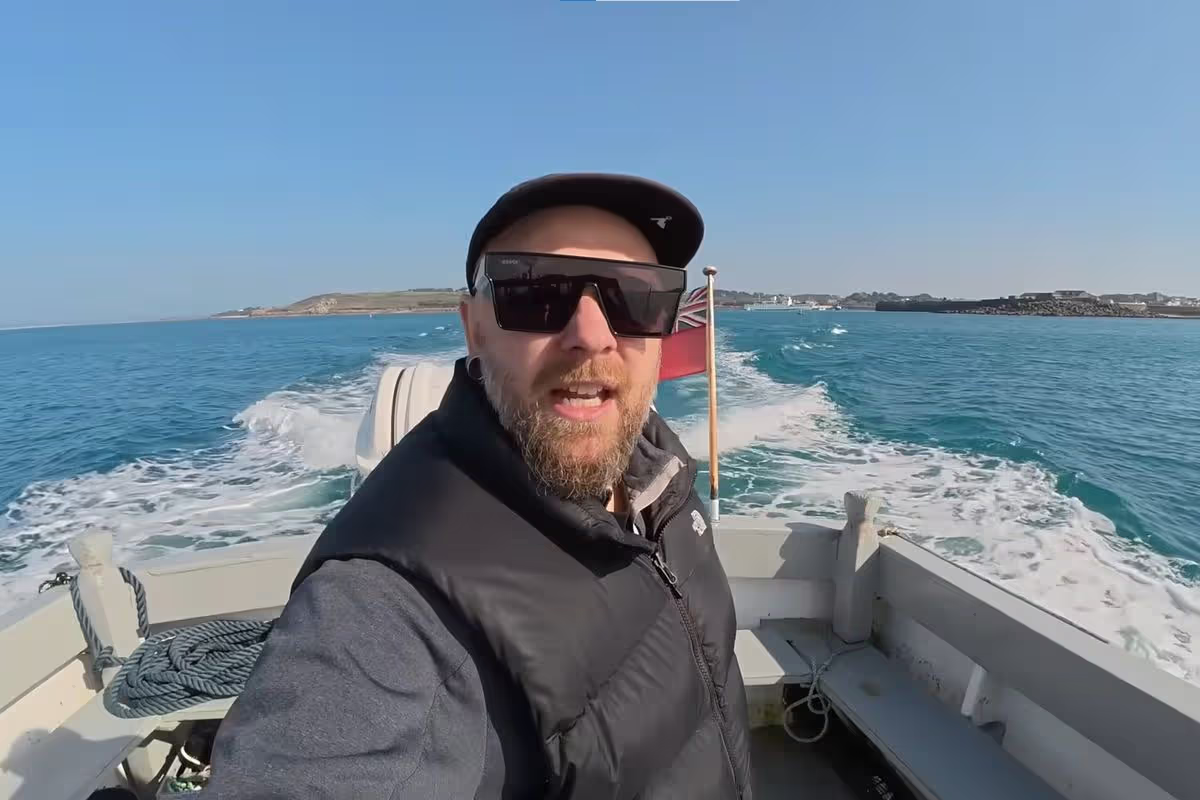
YouTuber Wendall flew to the Isles of Scilly off Cornwall and found stunning golden sandy beaches that he compared to the Caribbean, with experts also praising the remote islands as a UK paradise
YouTuber Wendall went to the Isles of Scilly(Image: YouTube/@WendallExplores)
A traveller who journeyed to some of England’s most isolated islands has insisted certain beaches rival those found in the Caribbean.
YouTuber Wendall, who shares content on the video platform through his eponymous channel, travelled to the Isles of Scilly. The Isles of Scilly comprise five inhabited islands including St Mary’s, Tresco, St Martin’s, Bryher, and St Agnes.
The Isles of Scilly are a compact archipelago situated just off the Cornish coast and have been recognised for generations as a location of significant interest and cultural value to the United Kingdom, reports the Express.
Whilst touring the region by boat, Wendall questioned the vessel’s operator about the standard of the beaches. He observed: “I’ve heard St Martin’s has got the nicest beaches.”
The boat operator responded: “It does have nice, golden, sandy beaches, yes. Nice golden sandy beaches.”
Wendall then remarked: “Caribbean-esque.”
Wendall isn’t alone in highlighting the Isles of Scilly’s beaches, with those at Tresco’s Pentle Bay also garnering considerable acclaim.
Specialists from GO Outdoors recently named Pentle Bay among the finest beaches to explore this spring, thanks to temperatures hovering around 10C and approximately 7.2 hours of daily sunshine.
This reputation is echoed in numerous Google Reviews. One visitor described it as “one of the most beautiful beaches I’ve ever seen,” while another called it a “mini paradise” and a “private gem.”
Discussing the subject, Calum Jones, author at GO Outdoors, commented: “As the days get longer and the weather warms up, spring is the perfect time to explore the stunning coastlines across the UK. From Druridge Bay Beach in the North East to Immeridge Bay in the South West, there are breathtaking beaches to discover all around the country.”
Beaches in this region are not the only ones to attract attention; Cornwall’s shores have also earned widespread acclaim, including Kynance Cove.
Located just a short drive from Falmouth, Kynance Cove has drawn comparisons to beaches on the opposite side of the globe in New South Wales, Australia.
Research conducted by Parkdean Resorts found that Kynance Cove boasts the whitest sand in the UK.
They stated: “Topping the list as the UK’s whitest beach is Kynance Cove in Cornwall. This Cornish cove boasts powder-soft sands made primarily of quartz, giving the beach its bright, white appearance. This breathtaking spot gives even Australia’s iconic coastline a run for its money.”
Escape the UK’s unpredictable weather with these toasty March and April holiday destinations within easy reach of Britain — cheap flights and even cheaper pints, what’s not to love?
06:00, 10 Mar 2026Updated 08:20, 10 Mar 2026
Think fun in the sun as you swim in pristine waters surrounded by the most dramatic scenery(Image: e55evu via Getty Images)
With British weather continuing to swing between dreary downpours and (marginally) pleasant spring sunshine, holidaymakers are still hunting for getaway spots with guaranteed warmth and gentle breezes. That’s where we step in.
If you’re seeking holiday destinations within easy reach of Britain that are gloriously warm at this time of year, whilst remaining incredibly budget-friendly, look no further, because we’ve got you covered.
As the UK starts to shake off winter’s chill, we’ve compiled the finest options for a March-April escape in the meantime, with temperatures across these destinations hovering between 16C to 24C.
Travellers keen to beat the bag charges without breaking the budget have made an Amazon travel bag a bestseller. Rated 4.7 stars out of 5 from almost 3,000 reviews, the Xkdoai bag comes in six colours with prices from £14.99, saving 29% on the usual price.
Without further delay, here’s our selection of sunny destinations within easy reach of the UK you can explore in March and April without emptying your wallet, reports the Express.
La Graciosa
This diminutive Canary Islands treasure is remarkable in every respect – it features absolutely no tarmac roads owing to its heavily protected designation as the largest Marine Reserve in Europe and as a National Park, meaning there are no vehicles on this island whatsoever.
It’s the first hidden island on our list, and an absolute paradise for travellers yearning for tranquillity and isolation, with the island’s untamed, pristine and genuinely secluded nature ideal for those weary of overcrowded tourist hotspots and constant travel mayhem. Reaching La Graciosa couldn’t be simpler.
Take a direct flight from the UK to Lanzarote followed by a short ferry crossing to the island. At the time of writing, a direct one-way flight from London Stansted Airport to César Manrique-Lanzarote Airport on March 11 costs just £29.
From there, jump on a 30-minute ferry from the port of Órzola, which will carry you across to La Graciosa. Prices on this tiny island haven are affordable, with a pint of local beer costing around £2.
Caleta del Sabo, the island’s only village, is a must-see attraction during your stay and Playa de las Conchas is the island’s most celebrated beach.
The breathtaking sandy stretches of Playa de las Cocinas and Playa Francesa are also top-rated draws, providing magnificent views of the imposing Famara cliffs over in Lanzarote.
Del Ámbar, Del Salado, and De la Laja are among the other pristine beaches found on Graciosa. You can even indulge in a boat excursion to the neighbouring Isla de Lobos for some birdwatching.
Comino
The relatively unknown Maltese island of Comino, famous for its dazzlingly brilliant Blue Lagoon, is a gem hiding in plain sight, and our second under-the-radar secret island haven.
With no towns – and therefore no cars – visiting Comino is truly an experience like no other.
Considered a haven for swimmers, snorkellers, hikers and photographers – tourists are known to travel from around the world just to sample a slice of life in this deserted paradise.
To get to Comino, travellers can fly into Malta International Airport – a one-way flight from London Stansted Airport to Malta International Airport on 12 March would set holidaymakers back £51 – and then from mainland Malta, you can hop on one of the regular ferries from Cirkewwa Ferry Terminal, which will whisk you off to Comino in roughly 35 minutes.
As for beverages, pints on Comino can cost anywhere between £2.60 to £4.
Undeniably, the crown jewel of Comino – and arguably the entire Maltese archipelago – is the world-renowned Blue Lagoon, enticing visitors with its pristine white sands and shimmering turquoise waters all year round.
Santa Marija Bay, nestled on the quieter side of Comino, offers a serene beach, shallow waters and none of the tourist throngs found at the Blue Lagoon.
The Santa Marija Caves are another major draw on this island, and trekking up to the iconic Santa Marija Tower is a favourite pastime.
Gran Canaria
Often described as a ‘miniature continent’ due to its near-circular shape, Gran Canaria offers affordable flights, with a direct one-way flight on 13 March (including one carry-on bag) from London Luton Airport to Gran Canaria Airport priced at £29 at the time of writing.
A pint of beer in many spots across Gran Canaria will only set you back £2, and if that’s not tempting enough – there are numerous pubs offering the famed Canary Islands Happy-Hour €1 pints, which equates to roughly £0.87.
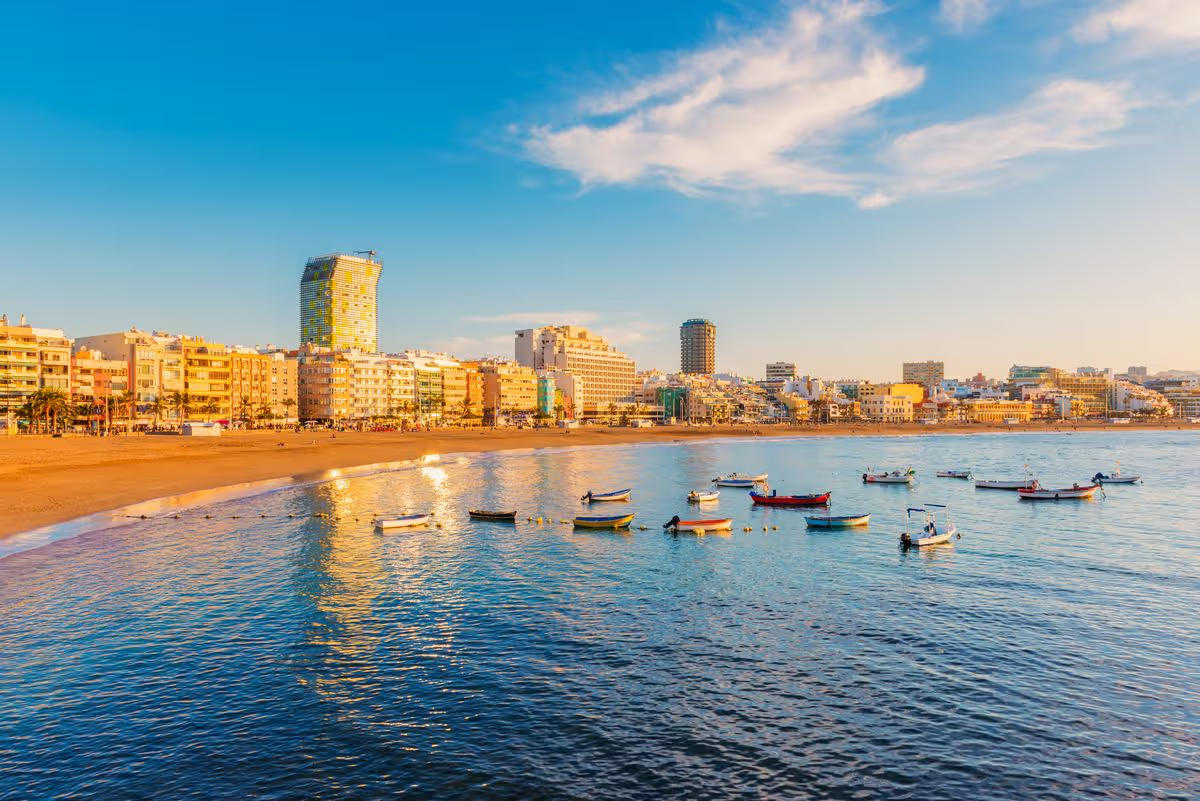
Las Alcaravaneras and Las Canteras, sandy beaches bordering Las Palmas – Gran Canaria’s biggest city, are major tourist attractions catering extensively to holidaymakers.
Additional popular beaches across the island include Maspalomas, Playa del Inglés, San Agustín, Amadores, and Puerto de Mogán. The bustling tourist destination of Puerto Rico is also essential viewing for those wanting a vibrant atmosphere.
Anfi del Mar, Playa de Taurito, and Meloneras Beach are equally excellent choices for visitors to explore.
Roque Nublo, the 80-metre volcanic monolith rock is a major draw for hikers, whilst the ‘Dragon’s Tail’ in the Tamadaba Natural Park offers unrivalled panoramic vistas of the island in the north west.
Charming villages such as Tejada, Artenara, Fataga, and beautiful towns including Santa Lucía de Tirajana and Agüimes are equally worth exploring.
Natural pools, secluded coves off dramatic coastlines, untamed beaches, and vibrant cities – Gran Canaria offers everything.
Lanzarote
As the fourth biggest island in the perpetually popular Canary Islands in Spain, Lanzarote is a breathtaking destination.
Boasting black sand beaches in one area and a rocky landscape in another, the island’s terrain features the Famara mountain ranges in the north and Ajaches to the south.
At the time of writing, a direct one-way flight from London Stansted Airport to César Manrique-Lanzarote Airport on March 11 was just £29, and pints will set you back just £1.30 on this tropical paradise. Lanzarote’s all-inclusive resorts are a massive hit with budget-conscious holidaymakers, with luxurious options available for those looking to indulge.
The island’s unique landscape is another magnet for tourists – boasting mountains, vast craters, red terrain, black sand beaches, crystal clear turquoise waters, white sands, and the cherry on top; an active volcano named Mount Timanfaya which features lava fields formed centuries ago.
When it comes to leisure activities, there’s a wealth of options on this compact island, with activities such as surfing, scuba diving, kiteboarding, and windsurfing popular amongst visitors. Lanzarote also boasts numerous family-friendly beaches, particularly suitable for young children.
Gozo
Despite its small size, Gozo delivers in spades. The island can be accessed via various routes – initially by flying to Malta’s main international airport, then either taking a short yet scenic 25-minute ferry from Cirkewwa Terminal in northern Malta or a 45-minute ferry from the stunning capital Valletta to Gozo.
At the time of writing, a one-way ticket from London Stansted Airport to Malta International Airport on March 12 cost £51. The best part?
Drinks in Gozo are reasonably priced – chilled pints of delicious local beer for just £1.80.
Ramla Bay, regarded as one of Gozo’s best beaches, is a popular attraction, whilst the gantija temples, among the world’s oldest and best-preserved free-standing structures, are must-sees.
The Ta’ Kola Windmill stands as another significant landmark on the island, whilst the Cittadella, Gozo’s recently refurbished historic settlement at the heart of the island’s capital Victoria (Rabat), is another essential destination should you travel to this magnificent retreat.
It’s not just spectacular views on offer in Gozo, as the island also boasts four Michelin guide restaurants – Tmun, Level Nine at The Grand, Al Sale, and Ta’ Frenc.
The culinary and wine scene in Gozo is unmatched, with food and wine tours proving a popular activity amongst visitors.
For those wanting distinctive experiences, look no further than the traditional milking of sheep and goats in Gozo, which is then transformed into traditional Gozitan cheese.
For activity fans, clifftop hiking, kayaking and cycling are superb options for a perfect day out.
Fuerteventura
The oldest island in the Canary Islands Archipelago, Fuerteventura is genuinely stunning. Recognised as an ideal destination for watersports, especially for those passionate about surfing, waterskiing, and windsurfing, this exotic Spanish island embodies sun-drenched enjoyment.
A direct one-way flight from London Luton Airport to Fuerteventura Airport on March 15 costs just £29, and pints are reasonably priced at £1.70 on this vibrant island. With a staggering 152 individual beaches, this Canary Islands jewel boasts a unique landscape.
Some of Fuerteventura’s top beaches include Playa de Sotavento, Playas de Corralejo, Playas de El Cotillo, Playa de Cofete, Playas de Jandia, and Playa de Ajuy.
Popular resort destinations such as Corralejo, Caleta de Fuste and El Cotillo draw in hordes of tourists, with Corralejo’s historic quarter exuding authentic Spanish charm through its narrow lanes, tapas bars and seafood eateries.
The area is particularly renowned for the Corralejo Dunes, while the Calderón Hondo volcano trail is just a stone’s throw away, offering breathtaking panoramic views.
Family-oriented Caleta de Fuste boasts an upscale marina and traditional markets, making it a must-visit on any Fuerteventura itinerary.
El Cotillo is a charming, bustling fishing village famed for its surfing conditions and serene lagoon, whilst the secluded Cofete Beach and the ancient Ajuy Caves are also must-see attractions on the island.
Madeira
Madeira is a truly awe-inspiring destination offering a plethora of activities and experiences for travellers to indulge in, and getting to the island is remarkably straightforward.
A direct one-way flight from London Luton Airport to Madeira Airport on March 16 costs £43 at the time of writing, whilst the average price of a pint of beer is around £2.10.
Often dubbed the ‘Pearl of the Atlantic’, this small Portuguese volcanic island certainly deserves its glowing reputation, with one social media user calling it “unfairly beautiful”, whilst another labelled it “Europe’s Hawaii”.
Calheta Beach and Machico Beach rank amongst the island’s most popular destinations, whilst the Natural Pools of Porto Moniz represent another jewel in this Portuguese island’s collection – and undoubtedly its most famous attraction.
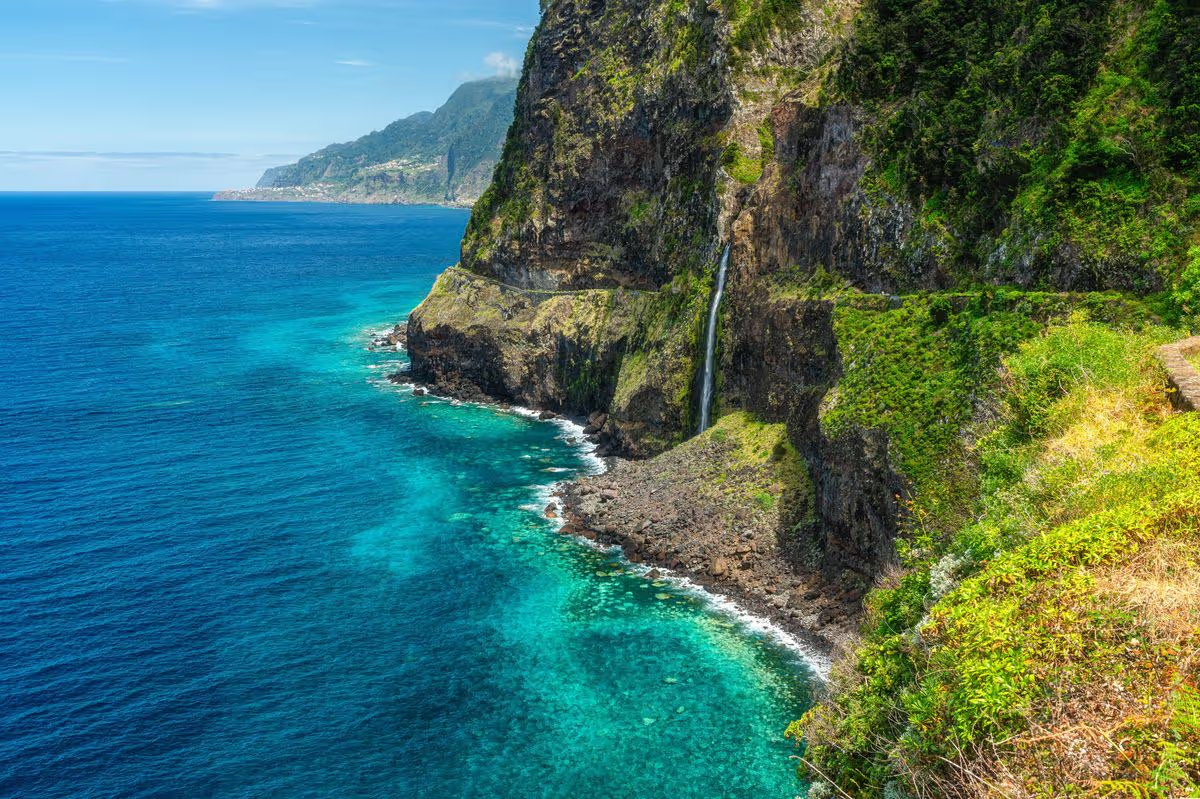
Another essential location in Madeira is Seixal Beach – a stunning natural black sand beach celebrated for its striking lush green setting, towering cliffs and the tumbling waterfall, Miradouro do Veu da Noiva, which flows straight into the sea and presents a magnificent spectacle.
Funchal, the lively historic capital of Madeira, proves a major attraction, with the city famous for the Old Town (Zona Velha), Monte Cable Car & Toboggan Ride, the Monte Palace Tropical Garden, and the Mercado dos Lavradores market.
The Laurissilva of Madeira is a 20-million year old forest praised for its incredible biodiversity, and a walk along its woodland paths is essential. Pico do Areeiro – Madeira’s third-tallest peak represents another unmissable spot, especially for keen hikers.
The trek from Pico do Areeiro to Pico Ruivo delivers an exciting mountain expedition, connecting the island’s three loftiest peaks whilst providing unforgettable panoramas.
A nod to Madeira’s famous wine is unavoidable, with Funchal, the town of Câmara de Lobos, and the adjacent island of Porto Santo celebrated as the premier destinations for wine tastings and vineyard excursions.
Tenerife
Those visiting this breathtaking island can enjoy palm-lined beaches, dramatic volcanoes, enchanting landscapes, verdant forests, and mouth-watering cuisine – all during a single holiday.
The white sand, 1.3-kilometre-long Playa de las Teresitas beach remains a firm favourite with holidaymakers, as does the 850-metre long golden sand expanse of Playa de las Vistas.
Playa Jardin beach with its volcanic black sand also draws those wanting something distinctive during their coastal getaway.
Direct flights to this sun-drenched holiday island are wallet-friendly – at the time of writing, a one-way flight from London Luton Airport to Tenerife South Airport on March 24 was priced at £27 with one free cabin bag allowance, whilst pints cost just £1.30 on average.
The sophisticated Playa del Duque is ideal for upscale dining and relaxed family activities, whilst the sprawling natural beach of Playa de la Tejita provides stunning views of Montaña Roja aka the Red Mountain.
The secluded cove of Playa de Abama is celebrated for its golden sands and excellent snorkelling, and arguably, Tenerife’s most magnificent beach, Playa de Benijo is perfect for an isolated retreat surrounded by nature, remarkable cliffs and gorgeous black sand.
The south-west coastline of Tenerife, especially the area between Los Gigantes, Costa Adeje, and Los Cristianos, is renowned for dolphin and whale watching, while a visit to the Teide National Park and the Corona Forestal Natural Park is absolutely essential.
The colonial town of San Cristobal de la Laguna provides a unique retreat within Tenerife, whilst the island’s capital, Santa Cruz de Tenerife, acts as the lively heart of this sun-drenched paradise.
DOH! Homer – no, not the Simpsons character, I mean the ancient Greek poet – must have got it wrong when he penned his classic Odyssey saga some 3,000 years ago.
For legend has it that the tiny Dodecanese island of Lipsi is his fabled Ogygia, where a saucy siren called Kalypso kept Trojan war hero Odysseus a prisoner for seven years.
Sign up for the Travel newsletter
Thank you!
The picturesque harbor of Lipsi island, Dodecanese, Greece is the type of place nobody should ever want to leaveCredit: AlamyThe rural landscape of Lipsi island shows how laid back life on the archipelago really isCredit: Getty
Now, according to Homer, Odysseus was desperate to escape from Ogygia and flee home to his wife Penelope in Ithaca, on the other side of Greece.
But after my week-long stay in Lipsi I can’t imagine anyone wanting to leave this lovely, laid-back island, lapped by the clear blue water of the Aegean Sea.
Especially with the cooling Meltemi breeze ensuring that, although the temperature can hover in the 30s in summer, it never feels oppressively hot.
Certainly Sally Vavoulas, from Tenterden, Kent, has not wished to leave.
She arrived in Lipsi in 2001, fell under its spell — and is still there.
These days she helps run the island’s excellent winery with husband Manolis. But more of that later.
Lipsi is not one island but an archipelago.
Only three of its 24 isles are occupied — and one has just two residents — while most of the 800-strong population are clustered in a sprawling village on the main isle.
Ferries chug into the little harbour every day from Kos and Samos, a two-hour cruise away — and twice a week from Athens, a longer nine-hour voyage.
Berthed alongside them are millionaires’ luxury superyachts, which have sailed from faraway spots such as the Caribbean and the United States.
Winemaker Sally Vavoulas came to Lipsi in 2001 and has never looked backCredit: Supplied
And tied up farther down the jetty are the locals’ tiny but colourful fishing smacks.
Fortunately, though, those huge skyscraper-like cruise ships are banned from Lipsi.
Lining the quay are a cluster of excellent tavernas — such as Pefko, where owner Nikos looks annoyed when I ask which is the best dish on that night’s menu.
“None is best,” he replies sternly, before breaking into a beaming smile and adding: “Everything’s superb.” Hmm, as I soon discover, Nikos isn’t wrong!
Just down the road there’s Kalypso, a restaurant owned by the brother of village mayor Fotis Mangos and named after the aforementioned siren.
Well, if she dished up a delicious sea bass like the one I tucked into, then no wonder Odysseus stayed for seven years.
Fotis, I have been warned, has a habit of suddenly breaking into song.
He doesn’t after joining me for dinner, but plays a YouTube video of him duetting with a Greek rapper on a little ditty called “Come With Me To Lipsi”.
Malcolm visited the apiary in Lipsi, discovering how the honey is infused with thymeCredit: Supplied
Former PE teacher Fotis is justly proud of his “hidden gem” of an island, and would love to see more British holidaymakers venturing there. September, he says, is ideal as the kids are back at school yet the sun is still hot and the sea remains comfortably warm.
Not too many tourists, though, because Fotis doesn’t want to turn the place into another overcrowded Santorini or Kos.
Probably unlikely, because there are no discos or nightclubs blaring out raucous music.
Nor will you find any sunbeds, parasols or pedalos on the tiny beaches scattered around its coves.
A couple do boast tavernas where you can sip a cold beer or the local aniseed-based ouzo over lunch. But most are virtually deserted and often you have them to yourself.
Two other restaurants in the village worth visiting are Manolis Tastes, whose chef was once voted Best in the Mediterranean, and Plateia, where Despina makes ice cream that is to die for.
One morning I take a 50-minute ramble along winding dirt tracks, following colourful hand-painted signs through the hills to Monodendri — which means “One tree”. It’s supposed to be a nudist beach, although none of the three sun-worshippers stretched out on towels are baring all when I arrive. And I don’t, either.
Small shops on the island give it a very authentic feelCredit: Supplied
But it’s an idyllic, peaceful spot where you hear just the gentle waves. Grand feast
I’ve hired a little runabout car from George’s Rentals but rarely use it. Lipsi is only some 16 square kilometres and you can walk to most places.
One day, hiking past lemon and fig trees, grapevines and donkeys, I bump into Dimitri, the island’s cheesemaker.
He doesn’t speak much English and only makes goat cheese — not surprising as there are twice as many goats as people on the island — but he offers me some. It’s delicious, at 13 euros a kilo.
The island is dotted with white, blue-domed churches, most just tiny family chapels with barely room to swing a cat (of which there are many on Lipsi).
One local tells me there are 400 churches, another reckons about 150.
So I ask the island’s priest as he sits sipping coffee outside a taverna. He reckons 57. And as from time to time Fr Georgios is called out to preach in all of them, he should know.
The biggest is Panagia Charou, or the Virgin Mary of Death Church, where a revered but rather strange icon shows her clutching a crucified Christ on the cross.
Every year on August 23, it seems that a bunch of withered lilies left there by a schoolgirl in 1943 miraculously bloom back to life.
The occasion is marked by a grand feast “filled with dancing and singing, eating and drinking, drawing believers from all corners”.
Panagia Charou is the biggest church on the island of Lipsi, one of at least 50Credit: Shutterstock
Out on another walk, I meet Nikiforos, who makes the island’s honey. He doesn’t speak English but happily shows me round his apiary.
Much of the honey is infused with the taste of thyme, which grows all over Lipsi. But, sadly, time isn’t on my side, and the holiday is almost over.
I manage to squeeze in a visit to Sally’s Lipsi Winery, where I taste four of their locally produced tipples.
One, a sweet red wine called Aposperitis, was served by the Greek President to Charles and Camilla during a state banquet in Athens a few years ago.
Sally wants to know which I prefer. So I umm and aah, before suggesting perhaps I should try a second glass of each.
Which is why, on my last night, I’m afraid I ended up rather tipsy in Lipsi.
GO: Lipsi
GETTING THERE: Jet2, Tui, easyJet, British Airways and Ryanair fly to Kos with return fares this September from £106pp, and from there Dodekanisos Seaways operate daily ferries to Lipsi for around £60 return.
STAYING THERE: The delightful Lipsi Blue Boutique Hotel, a ten-minute stroll from the village, boasts wonderful views of sunsets over the Aegean, and yoga sessions on the terrace. Four nights’ B&B costs from £540.
SPECTACULAR volcanos, breathtaking lakes and ancient jungle cities – explore this Central American gem before the crowds hit, says Picture Director Alan Gittos.
Here’s why it’s time to head to the central American country.
Sign up for the Travel newsletter
Thank you!
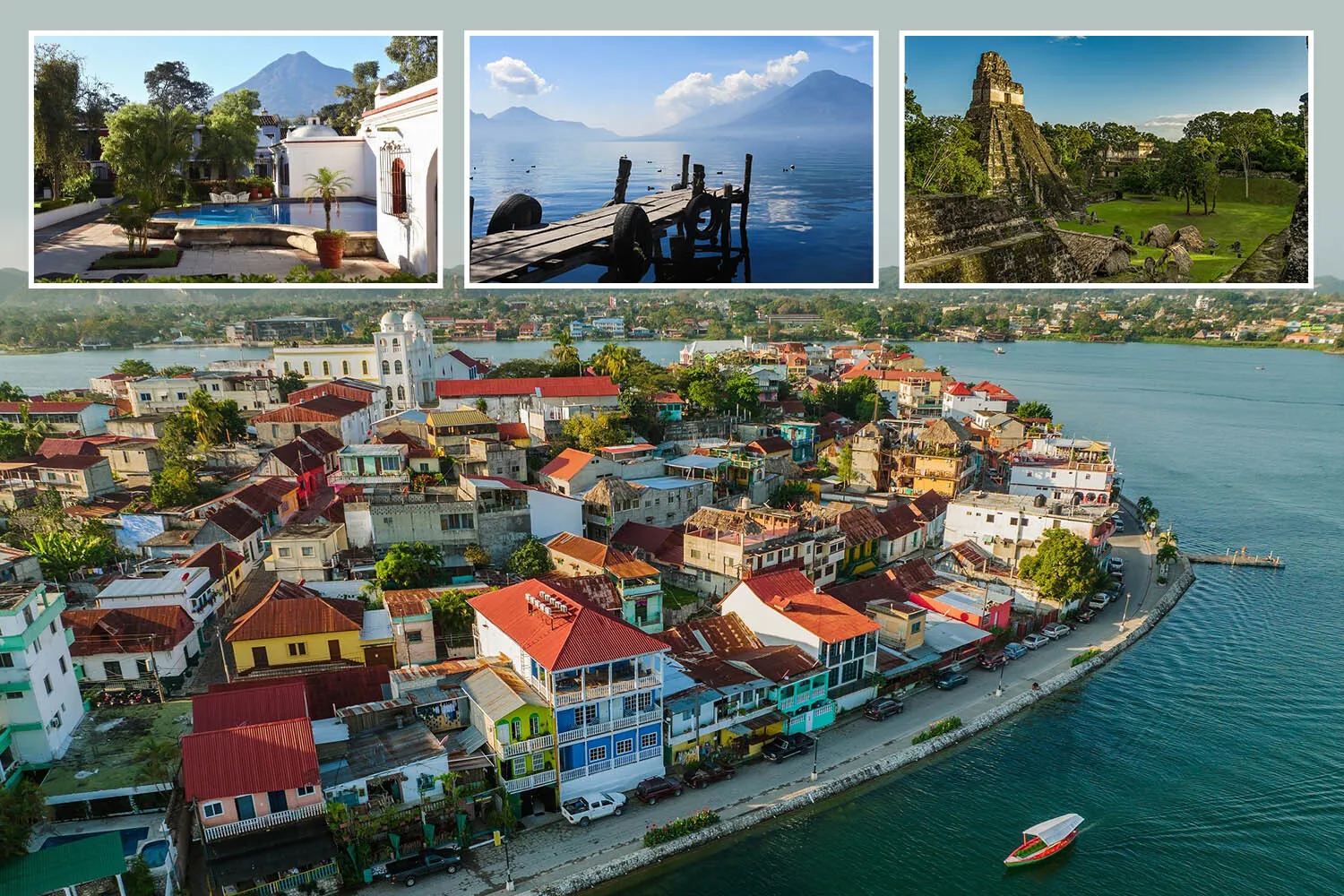
At hotel Villa Colonial, in former capital city Antigua, you can breakfast on the magnificent terrace with a great view of Fuego’s volcanic plumes
1 – Majestic Volcanos
As your flight descends into Guatemala City, you can’t miss the giant volcanoes that guard the highlands and stir the clouds.
Volcán de Fuego (Volcano of Fire) in the Sierra Madre mountains is one of the world’s most active stratovolcanoes.
And at hotel Villa Colonial, in former capital city Antigua, you can breakfast on the magnificent terrace with a great view of Fuego’s volcanic plumes. Stays cost from £77 per night (Villasdeguatemala.com).
To get even closer to playing a real game of The Floor Is Lava, take a trail ride up Volcán Pacaya, an hour’s drive from the city.
Let your horse carry you across dark ash soil to the base of the cone, then toast marshmallows on the geothermal vent – yes, really!
A six-hour horse-riding tour costs £67 per person (Pacayatours.com).
2 – Punchy Plates
For classic dishes in Antigua, head to charming La Fonda de la Calle Real
Breakfast is a big deal here. Try the traditional feast of eggs, black beans and tortilla somewhere atmospheric, such as Raíces Restaurant on the edge of Lake Petén Itzá – it will only set you back £3 (@Raicesrestaurante).
For classic dishes in Antigua, head to charming La Fonda de la Calle Real and order the delicious Chiles Rellenos De Res – battered roasted peppers stuffed with beef mince, £9 (Lafondadelacallereal.com).
After modern fusion cooking? Dig into a trio of ceviche at Maxán, £14, followed by Buñuelos – moreish plantain fritters laced with cardamom, £3 (@Maxangt).
3 – Floating Flores
Visit this small town on a tiny island in Petén as it was the last Mayan kingdom to resistCredit: Getty Images
This small town on a tiny island in Petén was the last Mayan kingdom to resist. Set sail on Lake Petén Itzá to spot kingfishers, vultures and maybe even a crocodile or two.
Expect to pay around £37 for a boat ride from the shore. Once back on dry land, browse the brightly painted shops for textiles, ceramics and souvenirs, then sip a refreshing, bright-green limonada con chaya, made with lime juice and local chaya leaves, £3.40, at La Danta restaurant as the sun sets (Ladantarestaurante.com).
After dark, settle into a charming cabin at nearby Hotel Villa Maya and drift off to the sounds of the rainforest.
Lake Atitlán was described as ‘the most beautiful lake on Earth’ by German explorer Alexander von Humboldt, and at sunrise it is truly bewitchingCredit: Getty Images/iStockphoto
Lake Atitlán was described as “the most beautiful lake on Earth” by German explorer Alexander von Humboldt, and at sunrise it is truly bewitching.
Stroll the water’s edge in Panajachel, then hop on a boat to the sleepy lakeside villages.
Stop off at San Juan La Laguna to meet women-run weaving cooperatives, watch natural-dye workshops and grab a large bag of fresh Arabica coffee, £8, from Café San Juan (Cafesanjuangt.com).
Day tours cost from £74 per person (Getyourguide.com). Finally, be sure to make the short, steep climb to Kaqasiiwaan Viewpoint for a stunning panorama – the £4 entry fee is well worth it.
At the top, sip cold Gallo beer crowned with spiced cucumber rings, £2, from the kiosk. Heaven!
5 – Cacao + Coffee
Marvel at the natural beauty all aroundCredit: Alamy Stock Photo
For thousands of years, maize and cacao have been Guatemala’s sacred crops.
In San Juan La Laguna, stop by Deleite Ancestral and learn to make traditional dishes, such as tz’utujil chicken stew with handmade tortillas – expect to get hands on! – then sample the mouth-watering results (@Deleiteancestral).
In Antigua, join a lively chocolate workshop at Ek Chuah to hear all about cacao’s history, while making sweet treats to take away.
An hour’s workshop costs £19 per person (Chocolateantigua.com). Coffee is the latest big Guatemalan obsession, and at 5,000ft above sea level, Antigua’s volcanic-soil plantations grow some of the world’s finest.
Take a tour of Finca Filadelfia to find out why shade-grown beans taste richer, why only women can plant the seedlings and why medium roast is the national sweet spot.
Finish with a tasting that’s both jittery and blissful. A 90-minute tour costs £19 per person (Facebook.com/fincafiladelfia).
6 – Gemstone shopping
Antigua Guatemala is a UNESCO World Heritage Site, with cobbled streets lined with ceramics, leather goods and exquisite jade jewelleryCredit: Getty Images
Antigua is a UNESCO World Heritage Site and its cobbled streets are filled with shops selling locally made ceramics, leather goods and exquisite jade jewellery. Discover why it’s the Mayans’ favourite gem with a free tour of Casa Del Jade’s museum (Casadeljade.com).
Later, check out the impressive 18th-century Convent of La Merced, with its giant fountain shaped like a water lily, and the Arch of Santa Catalina, £2 entry. But for the most dramatic view, head for Cerro de la Cruz (the hill of the cross) to snap vistas of the city beneath the incredible backdrop of Volcán Agua.
7 – Jungle adventures
Explore Tikal and climb Temple IV for one of the Americas’ most breathtaking views – seen in the first Star Wars filmCredit: Getty Images
Want to hear howler monkeys roar like dinosaurs and spy pyramids emerging from the jungle canopy?
Hit Tikal, a vast site built by the ancient Mayans using only stone-age tools, and climb Temple IV for one of the most extraordinary views in the Americas – it even featured in the first Star Wars film.
Tikal is also a UNESCO World Heritage Site for its biodiversity – back at ground level, coatimundis scramble across paths, spider monkeys hang from branches and leafcutter ants march across the jungle floor.
Tikal is also a UNESCO World Heritage Site for its biodiversityCredit: Getty Images/iStockphoto
Or to channel your inner Indiana Jones, head for the Belize border and pay the £8 entry to explore Yaxhá, a site whose origins are even older than Tikal.
It only receives about 80 visitors a day, so you may feel like the first to discover its huge plazas and temples.
Look out for the famous ball court, where Ancient Mayans played pok ta pok – a game with high stakes, where losing teams faced being sacrificed!