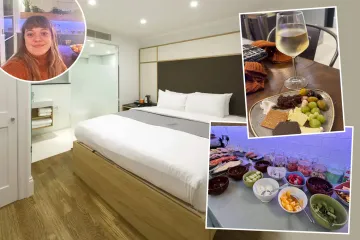
After taking us through stunning caves, with crystal-clear water, she put bait on to our poles and insisted: “You will find it the most relaxing thing you ever do.”
She wasn’t wrong. And now, pardon the pun, I am hooked. We caught fish after fish and it was relaxing, but also exciting and fun.
Back on land, Eva has an agreement with a lovely restaurant, Agkyra, to grill her customers’ catch and they served ours with roasted vegetables and lemon butter.
Although Alex had seen her gut and descale the fish, my husband Chris and I watched in amazement as he tucked in enthusiastically — even picking his way through the bones and asking for more.
I opted for tzatziki and a Greek salad.
With wine, complimentary orange cake and a shot of raki, it cost less than 25 euros for all three of us.
The boat fun was the highlight of our holiday — but not the first exciting trip.
On our flight from Manchester, with Tui, Alex got to visit the cockpit — then the fancy ceiling lights of our airport taxi made us feel like we were in a limo.
Our hotel, The Royal Senses Resort & Spa, which is part of the Curio Collection by Hilton, was also pretty fancy — and not least its reception, with floor-to-ceiling gleaming glass doors and the smartest- looking staff you have ever seen.
By the way, those staff were also the kindest of teams, ensuring each guest felt like a VIP.
Like Yorgos, who ushered us into a golf buggy to whisk us to our room — and let Alex help with the driving.
Along the way, Yorgos pointed out the kids’ club, as well as the main pool, a waterslides zone, adult pool, gym, spa, bar and four restaurants.
The picturesque Rethymno has history and charmCredit: Getty
There are 178 rooms, ranging from doubles to villas, and spread out up a hill so that each has a sea view.
A cable car-style glass lift travels up and down the hill, lest you have to work too hard.
We were upgraded to a room with, joy of joy, a private plunge pool.
Our room had a kingsize bed plus sofa-bed for Alex, plenty of storage, a coffee machine, free bottled water, fluffy white towels and locally made toiletries crafted from olive oil and mandarin.
But we didn’t get to relax in our room for long.
At 5am, Alex was up, trunks on, goggles ready and raring to go. And breakfast only added to his giddiness.
Lifes a beach at the Royal Senses resortCredit: Supplied
Although he tucked into fresh pineapple and watermelon, I struggled to divert him from the temptaion of fresh cookies, pancakes, cakes and waffles.
I loved the Cretan breakfast with rusks, fresh tomato, olive oil and feta cheese while Chris struggled to resist the free- flowing fizz.
The hotel isn’t bang on the beach but its sister, The Royal Blue, is and guests share facilities.
There is a free shuttle bus but we walked.
It took five minutes and there’s a supermarket en route.
Although the city of Rethymno, with an old Venetian harbour, is just 30 minutes and 25 euros away in a taxi, we loved the relaxed vibe in Panormos.
It is six minutes from the hotel by taxi, £7 each way.
Or the green and yellow Magic Train travels by road to and from the village several times a day. It’s £2.60 for kids over five and £4.35 for adults.
It felt like an easy funfair ride and Alex loved it.
Panormos has a sandy beach, church, bakery, supermarket, taxi office and a few tourist shops.
We bought olive oil from a man whose family have farmed locally for hundreds of years.
There are several restaurants, too.
Every room at the resort has a sea viewCredit: Supplied
Our No1 was the Locus Deli, on a cobbled pedestrian street where local musicians played Greek music and Alex ran around, danced and played with the local cats.
We had chicken with pistachios and a fava-bean dip with fresh basil oil.
Even the child pasta was made with chopped local tomatoes.
With drinks, our bill came to less than £50.
The hotel also offered great dining options.
Alex was desperate to try a spot of fishingCredit: Supplied
The evening buffet had amazing variety, plus homemade pizzas that could have come from Italy.
Other treats included a restaurant with Michelin-starred chef — which welcomed kids and offered adult mains from £30 — as well as wine-tasting evenings.
Musicians played of an evening, and the hotel even invited loom weavers to demonstrate their art — we crammed a new bath mat into our suitcase, which was already bulging with pottery after a Tui trip to Margarites.
The mountain town stands on rich clay, and pottery has been made there since 3000BC, during the Minoan period.
But my best trip was to the hotel spa. It’s the largest on Crete, with therapeutic thalassotherapy seawater pool.
I celebrated my birthday on holiday so also had some pocket money.
The Sun’s Jane Atkinson had a go tooCredit: Supplied
And during an hour-long massage for £58, chiropractor Costos rid me of longstanding shoulder knots.
We spent our last night at Geropotamos Beach’s Old River taverna, 1km from the hotel.
As Alex played on the beach and the sun set, we had some very drinkable local wine and reminisced.
We agreed few places could beat Crete, for its warm hospitality, fab food, glorious beauty — and modes of transport.
GO: CRETE
GETTING/STAYING THERE: Seven nights’ bed and breakfast at the 5H Royal Senses Resort & Spa, part of the Curio Collection by Hilton, is from £859 per person including Tui flights from Stansted on May 17, 20kg of hold luggage and airport transfers.
To book your stay, go to tui.co.uk, visit your local Tui holiday store or download the app.
It is just one of the many upcoming projects the reality star has in the works
Kim Kardashian is working on the ‘new Dance Moms’(Image: Stephane Cardinale – Corbis/Corbis via Getty Images)
The makers behind hit dating show Love Island have teamed up with Kim Kardashian for their next reality series project which aims to be the ‘next Dance Moms’.
Having received a green light, the new show is expected to be streaming on Paramount Plus at some point later this year. Reality star Kim Kardashian will serve as executive producer for the new show
The title is a joint production between companies ITV America, which also produces Love Island USA, along with Kim Kardashian Productions and Paramount Sports Entertainment. Executive producers for ITV America are Mioshi Hill, Jordana Hochman, Jeremiah Smith and Tom Ciaccio. Natalie Ento also serves as an executive producer.
Named Team Moms, the series will launch viewers into the world of nationally competition youth baseball in the US. To do this, they will be granted exclusive access to the Legendary Prep Academy in Scottsdale.
Viewers will be immersed in what is Arizona’s first and only baseball prep school. The series follows the coaches, founders and a group of dynamic families.
Their respective teen sons who comprise the starting line-up for one of the most competitive youth baseball programs in the world. It is a feeder to Division 1 college scholarships, NIL deals and ultimately, fame and fortune in the MLB.
Willing to do whatever it takes for their children to excel at America’s favourite pastime, the intensity of the program is only paralleled by the fervour of its athlete’s parents, who will stop at nothing to ensure their kids make it to the big leagues.
It’s clear from the premise that the show hopes to be recreate the magic of Dance Moms which created such stars like Maddie Ziegler and JoJo Siwa.
This isn’t the only television project being produced by All’s Fair star Kim Kardashian. According to her IMDB page, she is also set to produce and star in the series Group Chat.
That is an upcoming drama about five glamorous LA women in their 40s who appear to live flawless lives, but their private group chat reveals the raw, messy reality beneath their polished facades..
She will also star in the series as well as Netflix comedy film The Fifth Wheel. She also has a Kardashians spin-off in the works called Calabasas Behind the Gates, which will focus on the exclusive, gated lives of the extended Kardashian-Jenner circle, including friends and neighbours.
Paramount hope that Team Moms will become another hit in its list of ongoing reality shows which also include Survivor, Big Brother, The Challenge and Making Love.
The island is said to have more pubs per capita than anywhere in Ireland, and perhaps the British Isles. It also has a nightclub run by two OAPs that opens on demand
Every June, hundreds of teenagers descend on Pub Island.
The youth of Donegal leave their hilltop farms, hop on a ferry and head to this mythical land of pints and pork scratchings.
On the busiest days, when Coláiste Árainn Mhóir’s summer Irish course is in full, céilí-practising swing, hundreds of teenagers fill the island’s youth hostels, B&Bs and campsites. In the evenings, once lessons end, they head for the pubs.
The island, actually called Arranmore, is said to have more pubs per capita than anywhere in Ireland, and perhaps the British Isles.
Alongside the hordes of youngsters, the island’s 480 permanent residents, mostly sheep farmers and fishermen, sustain six pubs and an iconic nightclub that opens at midnight if the boozers close.
Smugglers is an institution on Arranmore, introducing generations of islanders and visitors to disco at its late-night parties. Opening hours are irregular.
Partygoers either check Facebook for a “disco this Friday” post or knock on the door at the witching hour and hope. The OAP pals who run it have been known to give in and open up.
An unusual quirk of the island is its lack of police. That leaves plenty of scope for debauchery and no need to call last orders until everyone is done.
“The morning after is like D-Day,” one mainland resident told me, recalling teenage nights on the island before her group caught the ferry home, trying to hide seasick hangovers from parents waiting at the other end.
In the UK, the miserable state of the pub industry is well known. Rising costs and falling demand mean hundreds close each year. The Republic is faring little better. More than 2,100 pubs have shut since 2005, about a quarter of the total. An average of 112 close annually, rising to 128 a year between 2019 and 2024, leaving 6,498 licensed pubs.
Against this backdrop, I travelled to Arranmore to see why this Atlantic community is bucking the trend.
Before arriving, the ferry weaved through an archipelago of islands that narrowed the channel to a handful of meters, providing a view of the derelict Rutland. The once-booming island of over 1,000 was deserted when the herring fisheries collapsed, leaving a crumbly but intact high street. Although officially population-less, it is possible to rent a holiday home on the abandoned island.
Aaranmore hoved into view a minute later, a patchwork of fields dotted with sheep rising up on the hill above Leadgarrow port. The island’s main attraction is the lighthouse, which stands on the western cliffs above sea whipped into a deadly froth. It’s a striking scene, but one that requires a fair tolerance for cold and wind.
Unlike the main strip over in the east, which is protected from the worst of the weather. Here you will find the pubs.
My crawl began up the hill at the charming pods at Aaranmore Glamping, my home for the weekend, which came complete with an incredible sea view and a hot tub. From there, a short walk took me to Neilys.
The only inland pub, it has two sides. In winter, it serves locals dropping in for a quick drink after work. In summer, it caters to tourists with cocktails, craft beer and a pizza van.
Next was Early’s, closest to the ferry and opening onto the beach. A three-generation family business spanning 60 years, it is now run by sisters Kayla and Aisling, who recently took over from Jerry. It is the place for generous plates of food and a chat with the owners, whatever the weather. On quiet evenings, the refurbished band and darts hall sits empty while punters gather around the fire.
At 9.30pm, I made my way to Phil Bans, roughly 10m down the road. It was packed to the rafters with well over 100 people of all ages, many of them wearing football jerseys in support of the national team. Even Ireland’s eventual penalty heartbreak wasn’t enough to kill the good vibes in the cheery room.
Sadly, that was all the pubs I was getting for the night. Smugglers wasn’t opening, and the other pubs have given way to Phil Ban’s superior big-screen setup.
So how does a place support so many pubs?
Being a beautiful island with a lot of weather means many visitors come and are then pushed inside for a warming tipple.
But more than that, Aaranmore is just a very friendly place. In 2017, the community council wrote an open letter to the world, urging people to move there to stop the dwindling population from falling even further. Many, from across Ireland’s 80 million diaspora and beyond, answered the call.
It’s a place that’s used to people from all over coming and staying for more than a quick drink.
Former Dodgers pitcher Trevor Bauer will pitch for a U.S. team for the first time since 2021 when he serves as the opening day starter for the Long Island Ducks of the independent Atlantic League later this month.
Since his last MLB start, on June 28, 2021, Bauer has been accused of sexual assault by four women. He denies all the allegations and has never been charged with a crime.
After Bauer served a 194-game suspension for violating the league’s sexual assault and domestic violence policy, the Dodgers severed ties with the 2020 National League Cy Young Award winner on Jan. 6, 2023, less than two years after signing him to a three-year, $102-million contract.
“We are excited to welcome Trevor to Long Island,” Michael Pfaff, Ducks president and chief business officer, said in a Thursday news release announcing Bauer’s signing. “His talent and knowledge will be important additions to our ballclub, and we are happy to offer him this opportunity to showcase his talents to MLB clubs while giving fans unprecedented access to Ducks baseball.”
According to the release, “Bauer will be ‘Mic’d Up’ for all games and practices for the purposes of content creation to be featured on his and the team’s social media and streaming outlets.”
The Ducks did not immediately respond to further questions from The Times regarding Bauer’s signing.
Bauer is expected to start when the team opens the season at home April 21 against the Hagerstown Flying Boxcars.
“I’m looking forward to competing in front of U.S. fans again this season,” Bauer said in a statement released by his new team. “The Ducks have had some incredible players come through their organization, and I’m excited to be part of that tradition.”
The riverside was heaving. Families spilled from cafes. A marching band trooped on to the bridge, their tasselled metal helmets dazzling in the sun. Priests with bushy beards delivered ageless chants from beneath their cylindrical kalimavkion hats. Men let off shotguns, terrifying the air. Easter Monday in Lefkimmi.
We hadn’t planned this. Simply right place, right time. The capital of southern Corfu, Lefkimmi is a working town, untroubled by tourism. There are Venetian-style houses – variously neat, tatty and decrepit – but no “attractions” to speak of. Just Corfiots doing Corfiot things: chewing the fat in their finest for this religious celebration – Greek Orthodox Easter, which falls on 12 April in 2026 – plus zipping about on scooters, drinking coffee, buying baklava and ice-creams.
“Right place, right time” was my hope for this trip to over-loved Corfu, an island of about 100,000 that, in 2025, was visited by approaching 4 million people. I was returning with fond memories. My first ever foreign holiday was here, in 1986. That was the first time I saw an olive tree, realised water could be that blue, and heard such a cacophony of cicadas it seemed the bushes were electrically charged.
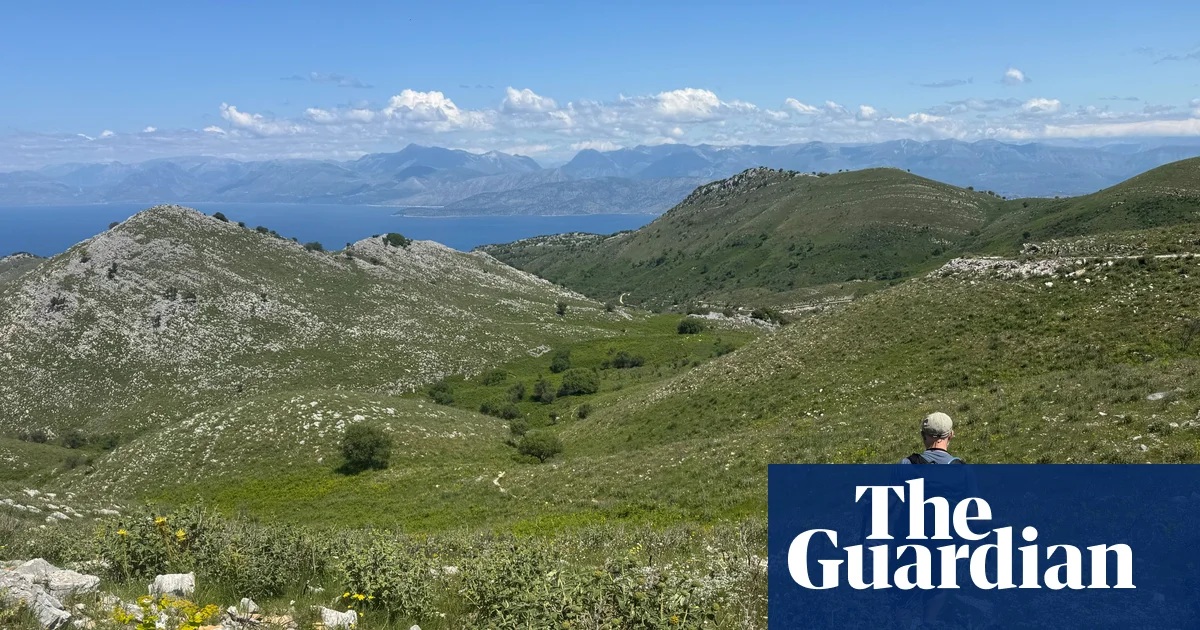
Cape Asprokavos in the far south of the island – close to the starting point for Sarah Baxter’s walk. Photograph: Sarah Baxter
That was 40 years ago. Corfu – the green queen of the Ionian Sea, Gerald Durrell’s “garden of the gods” – was already popular. In the intervening decades, development has been rampant and infrastructure, from roads to water supply, struggles to cope with the summer influx. But how about visiting off-season and off-piste? Winter can be tricky, with many places shut, so my husband and I had chosen to come in spring, exploring largely on foot, via the Corfu trail.
The sun was warm, the land now awake from hibernation as we set out on the 110-mile (180km) route that runs the length of the island, from Kavos to Agios Spyridon. Wriggling along the more rugged, less developed west coast, with deviations into the central hills and wide Ropa valley, it then traverses the mountainous north, always seeking the way less trodden. You could travel by (limited) buses or hire car, but doing some walking is the best way to happen upon Corfu’s offbeat bits.
We covered between 8 and 20 miles a day, though there’s no need to do all that – most walk it much more slowly. But, with our luggage being transported ahead each night to an array of simple pensions, family tavernas and beach hotels, our shoulders were light, so we were keen to roam as much as we could, following the yellow and black signs, arrows daubed on rocks and the GPS files on our phones – the route was largely well marked.
Every day, there were wonders to discover: wizened Mitéra, a 1,500-year-old olive tree near Prasoudi beach; a profusion of wildflowers, in all hues – rosy garlic, hot-purple rock roses, punchy yellow sage; a magical ancient footway between Makrata and Ano Garouna that had fallen out of use until the Corfu trail was blazed 25 years ago. The path traversed a cypress-pierced hillside before plunging into dark, forgotten olive groves that concealed what looked like the remains of a lost city, but was in fact natural rock cloaked in moss.
A few hours after these “ruins”, we arrived in Sinarades and found ourselves at the bottom of a flight of stone steps leading into the Folklore Museum. It couldn’t be open, could it? But yes, Makis beckoned us into this 19th-century farmhouse (entrance a modest €3), empty of visitors but full of the stuff of Corfiot village life: fine costumes, farming paraphernalia, fig cutters, cobblers’ tools.
Tools in the Folklore Museum, Sinarades. Photograph: Sarah Baxter
It was fascinating, getting these glimpses of old Corfu, invariably inland. In the northern mountain village of Sokraki, after the only downpour to spoil our sunny skies, we drank ginger beer at Emily’s cafe, still made the traditional way, using only water, lemon juice, sugar and ginger. Then we wove our way down the narrow streets to the Lithari Olive Oil Museum, where an old family press has been restored.
The following day, we visited Old Perithia, a 14th-century village tucked beneath Mount Pantokrator, the island’s highest point. Like many similar outposts, Perithia was abandoned in the 1960s; unlike many, it has been revived, and is now a lively, living cluster of homes, tavernas, honey shops and a characterful B&B. It was a hot day, so we flopped on to the shady terrace of O Foros cafe and lingered over fresh salad, homemade pie and tsigareli (garlicky wild greens), before descending to the coast via a long-lost path, only rediscovered during the Corfu trail’s creation.
Myrtiotissa beach is reached by a narrow path on the cliffs. Photograph: Constantinos Iliopoulos/Alamy
Despite being ravishingly clear and a respectable 16C (60F), there were very few swimmers in the sea. Such was the case at Myrtiotissa, halfway up the west coast – the spot where Odysseus allegedly washed ashore, and widely known as a nudist beach. A steep, skinny track leads to this cliff-backed sliver of sand, a real Instagrammer snarl-up in summer. But when we walked down, road and beach were deserted enough for us to throw off our inhibitions and clothes, and frisk Nereid-like in the waves.
If there’s one stretch of Corfu coast not to miss it’s Erimitis, the “hermit” peninsula at the island’s north-east. There used to be a naval observation post here, keeping an eye on Albania, about 2 miles away. As such, Erimitis escaped tourist development, leaving it the last stand of pristine Corfiot nature: no villas, no olives, just a scrub of oaks, myrtles and strawberry trees, brackish lagoons, butterflies and birds, herbs and wild orchids, plus rare monk seals and seagrass offshore.
But it’s under threat. In 2012, the government sold the rights to develop a portion of Erimitis to foreign investors. Organisations such as Save Erimitis and the Ionian Environment Foundation are fighting to conserve it.
Leaving the Corfu trail for the day, we picked up a footpath linking upmarket Agios Stefanos to the fishing harbour of Kassiopi, via Erimitis’s edges, a walk of about 5.5 miles. Immediately, there was a different feel here; it was a place without human touch, where the water seemed even clearer. We walked through fairytale tunnels of trees and detoured down a trail that ended at a bank, where a rope dangled down to a forest-backed beach. With no one about, it seemed silly to bother putting on swimmers, so we skinny-dipped again, now accustomed to the temperature, and warmed by the smugness of being here, now, alone. Right time, right place.
WASHINGTON — President Trump is threatening to deploy ground troops to seize critical oil infrastructure on Iran’s Kharg Island, a military gambit that experts say would risk American lives and could still fail to end the war.
If Trump wants to hobble Iran’s oil industry for leverage in negotiations, a better option might be setting up a blockade at sea against ships that have filled up at Kharg Island’s oil terminals, the experts said.
The island — located on the other side of the Persian Gulf from U.S. bases in Kuwait and Saudi Arabia — is the beating heart of Iran’s oil industry, through which 90% of its exports pass. It is important because Iran’s coastline is mostly too shallow for tanker ships to dock.
“Putting people on the ground might be the most psychologically compelling way of striking a blow at Iran,” said Michael Eisenstadt, a former U.S. military analyst who now directs the Military and Security Studies Program at the Washington Institute for Near East Policy.
“On the other hand, you’re putting your own troops at jeopardy,” said Eisenstadt, a retired Army reserve officer who served in Iraq. “It’s not far from the mainland. So they can potentially rain a lot of destruction on the island, if they’re willing to inflict damage on their own infrastructure.”
Seizing Kharg Island could escalate the conflict, said Danny Citrinowicz, an Iran expert at Israel’s Institute for National Security Studies.
He said Iran and its proxies — including Yemen’s Houthi rebels — could intensify their retaliation, including by laying mines in the Strait of Hormuz or striking targets with drones across the Arabian Peninsula, from the Persian Gulf to the Red Sea.
Commodities researchers and investment banks warn major retaliation could have lasting implications for energy prices and the global economy.
“It will be hard to take. It will be hard to hold,” Citrinowicz said of Kharg Island. “And it might damage the economy, but not in a way that will force the Iranians to capitulate.”
Trump says ‘maybe we take Kharg Island’
Trump is under growing pressure to end the monthlong conflict with Iran, which has attacked U.S. bases and allies in the region.
Iran also has largely closed the Strait of Hormuz, a narrow chokepoint through which 20% of the world’s oil normally flows, causing fuel prices to soar and other economic tumult.
Trump said in a social media post Monday that “great progress is being made” in talks with Iran to end military operations. But he said that if a deal is not reached “shortly” and the strait is not immediately reopened, the U.S. would obliterate power plants, oil wells, Kharg Island and possibly even desalination plants.
Trump has raised the idea of American forces seizing Kharg Island.
“Maybe we take Kharg Island, maybe we don’t. We have a lot of options,” Trump told the Financial Times. “It would also mean we had to be there (on Kharg Island) for a while.”
Asked about Iranian defenses there, he said: “I don’t think they have any defense. We could take it very easily.”
Secretary of State Marco Rubio said Friday that ground troops would not be needed to achieve the Trump administration’s goals. He did not repeat that assertion Monday after being asked about plans for U.S. ground troops, saying “the president has several options at his disposal” but diplomacy is Trump’s preference.
“Now, they are making threats about controlling the Hormuz Strait in perpetuity, creating a tolling system and the like,” Rubio told ABC’s “Good Morning America.” “That’s not going to be allowed to happen. And the president has a number of options available to him, if he so chooses, to prevent that from happening.”
U.S. has hit targets on the island crucial to Iran
The U.S. has already struck various targets on the island, including air defenses, a radar site, the airport and a hovercraft base, according to satellite analysis by the Institute for the Study of War and American Enterprise Institute’s Critical Threats Project.
Petras Katinas, an energy researcher at the Royal United Services Institute, said disrupting Kharg Island would not completely halt oil exports as Iran has other small ports. But it would reduce the oil revenue flowing to Iran’s government, “forcing flows through a much smaller, costlier and less efficient export system,” he said.
However, Tehran has too much at stake to surrender over a single asset, no matter how economically significant, said Citrinowicz, the Iran expert at Israel’s Institute for National Security Studies.
While occupying Kharg might offer Washington some leverage in any negotiations, he said the notion that control of the island could be traded for Iran’s stockpile of enriched uranium was far-fetched.
“It’s in no way a decisive blow,” Citrinowicz said.
U.S. troops face risk from Iran’s mainland if they tried to seize Kharg Island
A U.S. Navy ship carrying about 2,500 Marines recently arrived in the Middle East, while at least 1,000 troops from the 82nd Airborne Division are expected soon. Another 2,500 Marines are being deployed from California. The Trump administration has not said what all those troops will be doing, but the 82nd Airborne is trained to parachute into hostile or contested territory to secure key territory and airfields.
One of the reasons American troops would be vulnerable on Kharg Island is its close proximity — about 33 kilometers (21 miles) — to the Iranian mainland, from which missiles, drones and artillery could be fired. Despite continued U.S. and Israeli strikes, the Islamic Republic is still attacking targets across the region, including a Saudi air base hundreds of miles away where more than two dozen American troops were injured last week.
Even with American ships and planes providing support, there would still be a relatively short window of time to shoot down every drone or missile launched from the mainland at the island, Eisenstadt said.
“The coast tends to be mountainous, so the drones can come in through mountain passes where it’s hard for our radar to pick up,” he said. “And we don’t have the warning time.”
Eisenstadt says a sea blockade against ships carrying Iranian oil would be a safer strategy and achieve the same goal of controlling most of Iran’s oil industry.
“Throw up a quarantine that seeks to seize Iranian oil shipments that are exiting the Gulf,” agreed Clayton Seigle, an energy security expert at the Center for Strategic and International Studies. It could be done at a distance “outside the range of the lion’s share of Iran’s weapon systems.”
Seigle argued against destroying Kharg Island’s oil infrastructure, which Trump also suggested.
“We were supposed to be coming to the rescue of the people that had been rising up and protesting for a better future,” Seigle said. “So to cripple Iran’s revenue-generating potential for many years to come would definitely not work in that direction.”
Finley and Metz write for the Associated Press. Metz reported from Ramallah, West Bank.
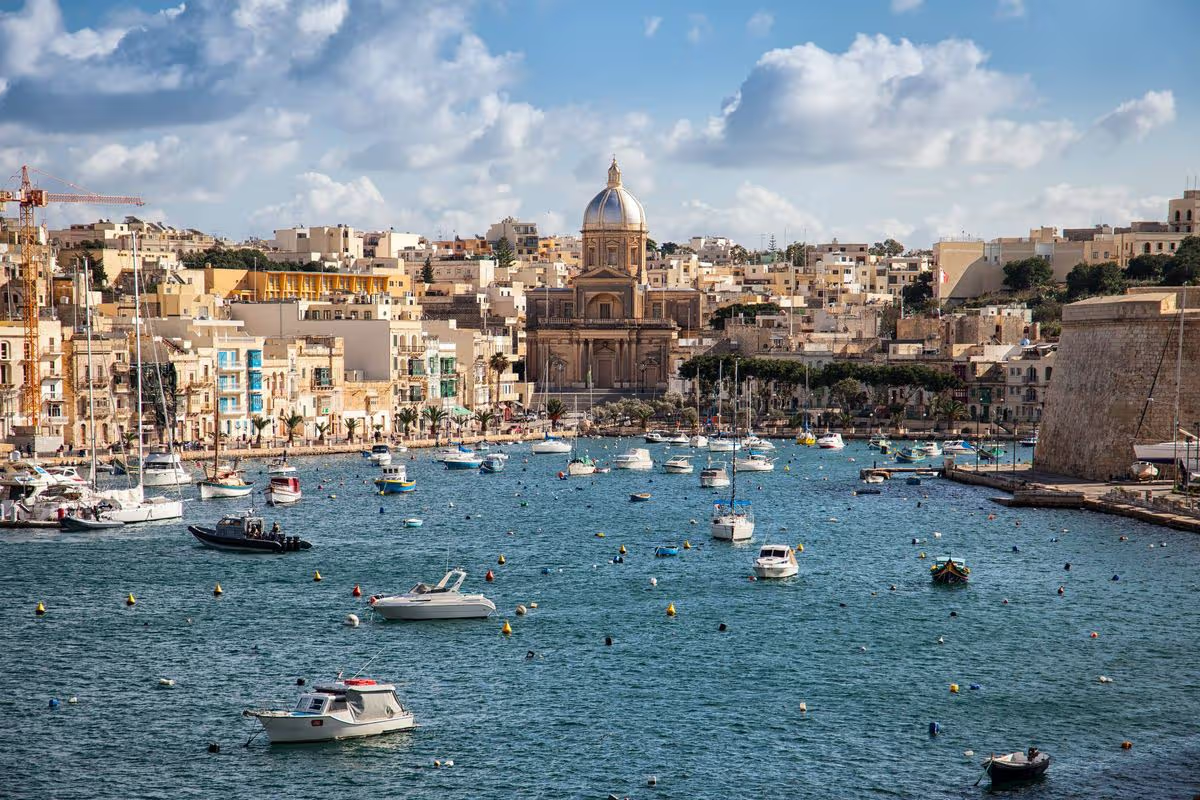
ON hearing that I was going to Malta, my grandfather insisted I check out a street in Valletta affectionately known as “The Gut”.
A quick Google search revealed that this “historically notorious” alleyway used to be the city’s premier red-light and entertainment district for British and American servicemen.
Sign up for the Travel newsletter
Thank you!
The cobbled streets in the capital city, VallettaCredit: GettyThe island is part of the Maltese archipelagoCredit: Getty
Given that Grandad was in Malta during his Navy days in the 1950s, I dread to imagine what he had in mind when suggesting I go there above anywhere else in the country.
Nevertheless, I’m glad I followed his advice because, in the 70-odd years since, it has cleaned up its act.
Located at the opening of The Gut at the time of my visit, (but now in St George’s Square) was Fifty Nine Republic, a restaurant that has featured in the Michelin Guide five years in a row.
Its head chef, Maria Sammut, is one of Malta’s greatest culinary assets — named “Best Maltese Chef” in recent years — and serves some of the finest fare in Valletta.
Her prawn tacos perfectly showcase the best of Maltese seafood — giant, juicy prawns fried in a satisfyingly crispy batter, with bright and delicate pickles elevating each mouthful — which you can enjoy in the sun of St George’s Square, opposite the opulence of the Grandmaster’s Palace.
Something I doubt my grandad did too often on his nights in the city.
It was a well-earned meal, too, after a morning spent getting to know Malta’s more adventurous side.
While the stereotypical image of a tourist in Malta may be that of an older person seeking some relaxing winter sun, there is plenty in the way of activities for holidaymakers with a penchant for getting the adrenaline pumping.
I am typically not that type of person, which I realised as I found myself dangling from a cliff face with little more than a bungee cord and a metal hook for safety, doing something called via ferrata.
It involves scrambling along precarious ledges, using fixed steel cables to ensure anyone who falls is just about kept alive.
The quaint Mgarr HarbourCredit: Getty
So, instead of doing the crossword with a cuppa — my normal morning routine — I had to rely on my minimal upper body strength and uncharacteristically delicate footwork to take me from the bottom of a sheer cliff face right to the top.
As a man who struggles with vertigo, this didn’t come easily, but the impressive landscapes — rugged cliff tops and lush greenery stretching out until they met the shimmering blue sea on the horizon — made it more than worthwhile.
What’s more, I was surprised at how quickly I started to enjoy myself.
The combination of warm weather, pushing 20C in February, spectacular scenery and trying something exciting put a spring in my step — ironically, the last thing I needed as I clambered up to the summit.
Delighted to have survived, I tested my resilience further — horse riding through the countryside of Bidnija village.
Yet this turned out to be an altogether more peaceful affair, as my steed — the majestic Romeo — begrudgingly bore me on his back and clip-clopped through some tranquil and verdant scenes.
Ryan Gray abseils down a cliffCredit: Supplied
Aloe plants rose out of the ground, looking like large desert cacti, making me feel like I was in my own John Wayne movie.
I even tipped the brim of my hat to passers-by as I rode towards the sunset, thoroughly enjoying an activity I would never before have thought to try.
The same thing happened on repeat throughout my visit.
Whether it was e-bike riding along the Dingli Cliffs — the highest point on the island, with vistas stretching for miles over sapphire seas — or abseiling on Gozo, the second-largest island in the Maltese archipelago, my perceptions about what I enjoy doing were constantly being challenged.
That’s not to say I didn’t make the most of a chance to relax in the warmth, while thick grey clouds at home were refusing to let any sunlight through.
Staying at the Marriott Resort & Spa meant I could unwind after my exertions and, come early evening, I could be found on a sunbed by the outdoor pool on the 13th floor, overlooking St Julian’s Bay.
Visit the medieval town of Mdina which featured in Game Of ThronesCredit: GettyRyan explores the streets of MaltaCredit: Supplied
The hotel also has an indoor pool, a gym better equipped than most actual gyms, and a spa offering a range of treatments and massages, including couples’ options.
After a wind-down by the pool, evenings were spent exploring the extensive selection of bars and restaurants.
Although I couldn’t try all the highly recommended eateries, I was particularly impressed by Trattoria AD 1530.
This charming Michelin Guide restaurant is located in the fortified medieval town of Mdina, which Game Of Thrones fans will recognise as King’s Landing from series one.
It perfectly showcases the Italian influence on Maltese cuisine, with its seafood pastas particularly worth a taste.
Then there was Sole by Tarragon, which offers beautiful harbour views, locally-caught seafood and Mediterranean classics.
My advice — order the sea bass, one of their nautical-themed cocktails and the caramel and banana dessert.
I’ll just have to go back and try all the ones I missed another time. I’ll see if my grandad has any more hot tips.
GO: MALTA
GETTING THERE: Direct flights from London Heathrow and Gatwick with KM Malta Airlines are from £84.
AS a veteran showbiz reporter, I’m used to free- flowing champagne, egomaniacal celebrities and all-round general excess.
So who knew a Caribbean cruise could beat any A-lister party?
Sign up for the Travel newsletter
Thank you!
The Sun’s Clemmie Moodie took a Caribbean Cruise aboard the 5,200-guest Arvia as a cruise virginCredit: P&OMake a splash at the on-deck poolCredit: Simon KennedyActivities such a mini-golf are also availableCredit: Simon Kennedy
Drawing back the curtains every morning, before me was a beautiful new backdrop. Different every day, and every day seemingly more stunning. No need for Instagram filters.
Not even Paul Daniels in his prime could have mustered up such magic. Stepping aboard the 5,200-guest Arvia as a cruise virgin, I really did not know what to expect.
Yet absolutely everything on board this P&O Cruises ship — don’t, whatever you do, call it a “big boat” as I did — confounded all expectations.
I had thought, wrongly, I’d be the youngest onboard. How foolish of me.
From singletons enjoying rum-tasting at 11am to older couples, married 55 years and still finding conversational titbits over the lunch table, my gang included a 22-year-old influencer and a 57-year-old rocker in the shape of Blur’s Alex James (who played a stunning sundowner set one evening).
Also on board were more than 2,000 crew. Which goes some way to explaining the pristine levels of both cleanliness and hospitality.
Each cabin is serviced with a personal “butler” who caters for any whim.
With 30 bars and restaurants on board, endless shops, a gym, spin studio, spa, cinema, four pools and an uber-cool jazz club, you could spend a year on board and yet not repeat the same day twice.
Arvia is also utterly vast.
My Garmin watch tells me I average 15,000 steps a day simply from milling around, getting lost and exploring. On the days we moored up, this rocketed to well over 20,000
You’ll never be bored with this level of entertainmentCredit: suppliedHop off the cruise to wander sunsoaked streetsCredit: supplied
The whole mooring bit, naturally, being the very point of a cruise. So after landing in Barbados, we sailed overnight and I awoke in Martinique.
Here, we jumped in a taxi and drove 50 minutes to a Club Med hotel for a day of sunbathing at the picturesque beach club.
Surrounded by turquoise seas and an Insta-worthy backdrop — certainly the influencers among us including ex-Towie star Lydia Bright and MIC’s Ollie Locke were very happy — we enjoyed a rosé-fuelled lunch.
That evening we had dinner at one of the speciality restaurants, Keel and Cow.
The elevated gastro-pub diner may cost a little extra but it is just a little — from £3.50 for a starter of potted chicken and bacon rillette to a melt-in-the-mouth fillet steak for £15.50 that came with chunky chips, onion rings, grilled mushroom and tomato, roasted garlic and an iceberg lettuce wedge with sour cream and bacon crumb — and was well worth the extra cost.
The next morning, I rise early to check the gym. With machines overlooking the gently rolling Caribbean seas, treadmill running, for once, becomes a pleasure, not a pain.
It has everything one might need, plus a full timetable of classes ranging from stretching and Pilates to spin and weights.
As anyone who knows me knows, breakfast is very important to me. I judge places by their fast-breaking offerings. Thankfully, breakfast thrilled.
Clemmie samples some wine onboardCredit: supplied
The Horizon buffet had all the options for a quick brekkie and you could enjoy table service in the main Meridian and Zenith dining rooms.
But it was the 6th Street Diner, an American-themed eatery, that nailed the breakfast brief (think waffles, over-easy eggs, bacon and maple syrup, washed down with endless coffee.)
While there are plenty of included options for dining, it was great to have such a choice if you wanted to spend a little extra. There’s even an extensive room service menu that offers a club sandwich for about £4.
Another joy was sailing around the Caribbean but still only paying in pounds onboard for everything from a beauty must-have in the shops to a drink at the bar.
The biggest jolt of the week, however, came as I went to log on to the wi-fi for the week — £150! Apparently it’s something to do with satellites and lots of other technical jargon, but with my day job kicking off — thank you, Brooklyn Beckham — I had no option but to log in.
Thankfully, P&O offers some great options to buy all-inclusive packages in advance that cost from £49 a day. The Classic includes alcoholic and soft drinks as well as essential wi-fi for browsing and credit towards speciality dining depending on the length of your cruise.
The Deluxe includes a wider range of posh spirits, craft beers and cocktails as well as fast wi-fi for streaming and video calls plus enhanced dining credit.
I’ll know better on my next cruise.
Blur’s Alex James took to the wavesCredit: supplied
Our next port of call was St Kitts and after we sailed in admiring its verdant hills, off I trotted on a catamaran excursion.
What a day. The pinnacle to the most incredible day’s sailing — one accompanied by a banging Nineties soundtrack and copious amounts of champagne — was a spot of snorkelling before a lobster salad lunch.
That evening we had an incredible dinner at Epicurean, the ship’s fine-dining eatery.
After another day at sea, it was time for another highlight: a speedboat to private island White Bay, off the British Virgin Islands – the stuff of Robinson Crusoe dreams. I really did feel like I’d stepped out on to a movie set.
The Sunset bar proved my favourite way to unwind after another busy-busy day of sunbathing, eating, drinking and experiencing all the tropical delights of the Caribbean.
Forget those red carpets — you can give me a blue sea all day long.
GO: Caribbean Cruise
GETTING / SAILING THERE: P&O Cruises has 14-night Caribbean cruises onboard Arvia from £1,649pp. Includes flights from selected UK airports, full-board, children’s clubs and entertainment.
Departing the UK on February 26, 2027, the cruise sails to and from Barbados and calls at Martinique, St Kitts, Tortola, St Maarten, Antigua, St Lucia and Grenada. See pocruises.com.
A BEAUTIFUL resort on a lesser-visited Spanish island has been named the best in the country.
The luxury hotel, Paradisus Melia, which sits on the southern coast of Fuerteventura, has just named the ‘Best Resort in Spain for 2026′.
Sign up for the Travel newsletter
Thank you!
The newly renovated Paradisus Melia has been named the ‘Best Resort in Spain’Credit: Jet2It has four swimming pools and adult-only areas that look over the beachCredit: Jet2
The luxury resort was awarded the title last week by Forbes just a few months after rebranding and reopening in October 2025.
While it’s on the luxe side of a holiday you can book it with the likes of Jet2, TUI and On the Beach from £136 per person per night.
In the summer months, Fuerteventura has average highs of 26C and at the Paradisus Melia, you can cool off in one of its four swimming pools.
Three are freshwater, one saltwater and there’s a children’s section with a slide too.
There’s also a chance to upgrade to the ‘Reserve Pool‘ which is adult-only.
It comes with other perks too like use of the pretty cabanas, access to the exclusive lounge and concierge service along with premium drinks.
All the pools are surrounded by sunloungers, straw woven umbrellas and palm trees.
When it comes to eating and drinking, which you can take advantage of with an all-inclusive package, the hotel has multiple bars and restaurants.
Grab a drink at the cocktail bar, lounge bar or snack bar.
And for food, you can take your pick from one of the eight restaurants.
These include one which is buffet-style, two that are adults-only, and all have dishes that are traditionally Spanish, local, Italian and international.
When it comes to activities, guests can take advantage of the air-conditioned gym.
Or have a go at aqua aerobics, Pilates, table tennis and yoga.
There’s entertainment too and during the evening there’s live music and professional shows.
It’s a luxury stay on an all-inclusive basisCredit: Jet2
Here’s another hotel in Fuerteventura – and it’s set out like a small village…
*If you click on a link in this box, we will earn affiliate revenue
Hotel Club Jandia Princess, Fuerteventura This resort is set up like a small village, with low-rise buildings set among palm trees and six different swimming pools. Entertainment spans from DJ nights to bingo and live sports screenings, plus sports on offer include water polo, rifle shooting and shuffleboard.
When it comes to rooms, each has been newly made over and kept in a minimalist style with relaxing neutral colours and balconies for enjoying the evening sun.
The only board package guests can book is ‘All Inclusive Plus’ which includes buffet-style breakfast and dinner as well as lunch, snacks and drinks.
One holidaymaker said: “We had such a fabulous holiday at this resort. It has definitely raised our bar for all-inclusive holidays.”
With Jet2, two adults can head to Paradisus Melia on May 13, 2026 for a seven-night all inclusive break with transfers and return flights to London Gatwick from £953 per person.
The hotel is fairly isolated, but is minutes from incredible island beaches.
It has beautiful views across Plaża Sotavento and it takes just a minute to get onto the golden sands.
Also nearby is Playa de Sotavento de Jandía which one visitor said is “undoubtedly one of the most beautiful beaches on the island.”
For those who want to head further afield, the nearest town is Costa Calma – you’ll need to take a transfer or taxi here which will take around six-minutes.
While it’s not as vibrant as other Spanish towns, it does have shopping centres, restaurants and beach bars.
YOU can explore a Santorini-like island with whitewashed villages for a fraction of the price of the real deal.
Folegandros is an island in the Cyclades known for both pretty beaches and cheaper hotels than its sister island.
Sign up for the Travel newsletter
Thank you!
The island is a quiet alternative to Santorini with beautiful beaches like LivadakiCredit: AlamyChora is the main town with whitewashed buildings and blue doorwaysCredit: Alamy
Unlike its neighboursMykonos and Santorini, Folegandros doesn’t have an airport or huge hotels – the island didn’t even have electricity until 1974.
It’s been dubbed an ‘under-the-radar Greek island’ seeing much fewer visitors.
Santorini gets around 3.4million visitors each year, meanwhile Folegandros gets 50,000.
There’s still lots to see and visitors will find most of the island’s life in the main town of Chora of which is perched on a cliff around 200 metres high.
It’s where most of the shops, restaurants, cafes and tavernas are found.
Make sure to try Matsata, which is a handmade fresh pasta, which looks similar to tagliatelle, that was founded on Folegandros.
Usually it’s served with cooked meats like rooster, rabbit, or goat in a rich tomato sauce and topped with grated cheese.
For those who want the best island view, take the steep, winding path up to the Church of Panagia.
CNNlisted Chora in their top seven most beautiful villages in Europe, writing: “Santorini’s streets sag with admirers.
“But on Folegandros, a nearby island, you’ll find similar architecture—streets paved in slate, whitewashed buildings decorated with colourful flowers, the occasionalGreekOrthodox church with a bright blue dome—without the crowds.”
Being a Greek island in the Aegean Sea, Folegandros has plenty of beautiful beaches and has been praised for its “emerald-blue” waters.
Some of the island’s top ones include Katergo Beach which has white sands and blue waters.
Visitors have gone as far as to say it’s the “prettiest beach on Folegandros.”
Stays in Kallisti Hotel start from £82 per nightCredit: KallistiThe hotel has incredible views across Chora and its hilltop churchCredit: Kallisti
Another is Livadaki Beach which most visitors access by boat rather than foot.
Its remote location means it is less busy than other beaches on the island and it’s said to be an ideal spot for snorkelling.
Agios Nikolaos Beach is family-friendly with a small bar and taverna on the shoreline.
Depending on the season, the average price of a hotel in Santorini varies but typically ranges from £143–£251 per night – but luxury stays can be as high as £1,000.
While Folegandros does have some luxe stays, there are some more affordable stays too.
The Beachfront Cycladic House can be booked from £74 per night on Booking.com.
The holiday home has a bedroom, a bathroom, a living room, a balcony and it’s just minutes’ walk away from multiple beaches.
Rooms at the Kallisti Hotel which is built in the style of a small village can be booked from £82 per night.
It has a swimmingpool, bar, breakfast room and rooms with balconies with beautiful island views.
The easiest way for Brits to get to Folegandros is by a ferry from Athens which takes around four hours.
Brits can also fly from the UK to Athens in under four hours from as little as £22.
IF you fancy a quiet escape off the coast of the UK, then an island is about to become much easier to get to.
The L-shaped Rathlin Island is six miles off County Antrim in Northern Ireland and is home to just 140 residents.
Sign up for the Travel newsletter
Thank you!
Rathlin Island off the coast of Northern Ireland is home to just 140 peopleCredit: AlamyVisitors can stay ad the Manor House is now owned by the National Trust with rooms from £70 per personCredit: the Manor House
It does get busier during tourist season with holidaymakers hopping over on the ferry – which will relaunch for spring.
And there’s even more on offer with new weekend sailings starting up.
Once on the island, the main port and beach is where you’ll arrive.
Called Church Bay, it’s a small harbour with a gravel shoreline where visitors can spot seals and also check out the island’s only pub.
McCuaig’s Bar sits opposite the bay with an adjoining Ebb and Flow Cafe.
The walls of the bar are decorated with name places from ships that have been wrecked around Rathlin.
In total, there have been over 40 shipwrecks off the coast of Rathlin Island.
The island itself has three lighthouses which are needed because of Rathlin’s unique shape.
It’s on the western tip of Rathlin Island where you’ll find the ‘upside down’ lighthouse.
It was built into the cliff face back in 1912 and has been there to guide in boats and ships ever since.
While it’s not actually upside down, the lighthouse has its lantern room at the bottom of the tower rather than the top – which is traditional.
The reason is that when it guides ships in, the light isn’t obscured by fog that usually settles at the top of the cliff.
The island isn’t just popular for tourists seeking a quiet getaway as it’s also a nature reserve for seabirds.
So you’ll be able to spot razorbills, kittiwakes and puffins.
During the spring and summertime, some of the most popular activities include heading to Knockans viewpoint.
On a clear day, from here you can see across to Donegal.
Seals will be sunbathing at Church Bay and Mill Bay – which is on the east side of the island.
The west lighthouse on the island is considered to be upside downCredit: AlamyRathlin Island is where you’ll spot lots of puffinsCredit: PA
For those who don’t just want a day trip to the island, there is a hotel too.
The Manor House is an 18th century guesthouse with 12 rooms, a restaurant, bar and café.
It has a rich history as the house was built in 1756 for the Gage family, who bought the island 10 years earlier.
The last member of the Gage family to live at the Manor House was Brigadier Rex Gage who died in 1973.
Now, the hotel is owned by the National Trust – single rooms start from £80 and doubles from £140.
Come spring, there will be daily crossings from Ballycastle Harbour to Rathlin Island.
The ferries will run from April 3 to September 20, 2026 with an extra return journey every Saturday and Sunday morning.
The additional return crossings will leave Rathlin at 8.30am and Ballycastle at 9.30am.
It has two ferries, one that’s passenger-only and another that can take larger luggage cases and even pre-booked vehicles onto the island if you fancy driving around.
THERE’S a Caribbean island that is booming in demand but barely any Brits go.
New research conducted by TravelSupermarket has seen a number of Caribbean destinations surge in demand, caused by the ongoing conflict in the Middle East.
Sign up for the Travel newsletter
Thank you!
Turks & Caicos is seeing a huge boom in searches, according to the expertsCredit: GettyThere are amazing floating bars tooCredit: Visit Turks & Caicos IslandsI visited the islands back in 2024 when Virgin launched flightsCredit: Supplied
And the research found that searches to Turks & Caicos were up 119 per cent, when looking at the first two weeks of March compared to the previous two weeks.
The islands are lesser visited by Brits, with the majority of tourists being Americans, with famous as celebs such as Kylie Jenner, Will Smith and Bill Gates visiting too.
This is likely to due to the lack of direct flights.
One of the main draws are the stunning beaches – so beautiful in fact they are often named some of the best in the world.
I spent my jet-lagged mornings walking the length of Grace Bay, with powder soft sand and quiet sunrises.
Even in the evening they were just as beautiful with pink sunsets ending the day.
And there is not just one, but two floating bars.
One of the most popular is Captain Oak’s Tiki Bar, which has even welcomed celebs such as Drake and Jake Harlow.
Tourists have to pay $20 to get there by boat or jet ski.
Otherwise there is the more vibey Noah’s Ark, which has a floating dance floor as well as sea swings.
If you want to stay on land, head to Da Conch Shank on a Wednesday (also named one of the world’s best beach bars) to join the 14-man marching band playing live music throughout the tables.
Captain Oak’s Floating Bar has even been visited by DrakeCredit: Visit Turks & Caicos IslandsSave time for Da Conch Shack, one of the world’s best beach barsCredit: TripAdvisor
Our favourite Caribbean holidays
If you click on a link in this box, we will earn affiliate revenue.
Hotel Capriccio Mare, Dominican Republic
Facing the calm, crystal waters of the Caribbean Sea, Hotel Capriccio Mare looks like a bright white island villa. The hotel’s position on Bavaro’s coastline is perfect for exploring the popular resort town of Punta Cana. Whether it’s strolling the sands to grab a fresh coconut with a straw, or venturing out on a catamaran trip to Saona Island, this dreamy Caribbean resort is not one to miss.
This friendly, family-run hotel is a slice of Caribbean paradise. This hotel sits smak-bang on a sugar-white beach with warm turquoise waters. Enjoy both the beaches of Barbados and its plethora of rum bars – there are about 1,500 of them on the island.
Set on the quiet side of St Kitts’ Frigate Bay, the boutique Sugar Bay Club offers superb value and wonderful views of the Atlantic Ocean. Staff are on hand to assist with island tours, from catamaran cruises to scenic railway excursions.
Amazing Antigua has 365 beaches – one for every day of the year – as well as a fascinating history. This resort in Falmouth Harbour is perfect for exploring the beautiful local area, including Pigeon Point, Nelson’s Dockyard and English Harbour.
Splash out on the Selling Sunset-esque villages if there is a group of you, complete with slides into the ocean and access to the Caribbean’s first ocean-water pool.
(Seven-night deals can be found for just under £3k each if travelling later this year).
The best way to get there is changing in the US with Virgin Atlantic, with flights around 12 hours.
Other airlines including Finnair, American Airlines and JetBlue also have connecting flights.
Otherwise we’ve found seven night holidays with return flights for as little as £1,569 each with loveholidays.
Stay at Wymara Resorts’ villas is you want your own slide into the waterCredit: 2022 Gary James OwnerHoliday packages can be found for under £1,300 eachCredit: Alamy
“Then they arrive on Pag and feel like they’ve landed on the Moon, or even Mars. It’s raw, dramatic and completely unexpected.”
The Mars comparison can be seen via the ‘Life On Mars Trail‘ which starts at the village of Metajna, with multiple trails around the island passing bays and beaches along the way.
One hiker said: “I loved it, it’s just magnificent” and added “bring something to swim in because it is hard to resist.”
While the island is known for its otherworldly natural beauty, the northern part of the island is also famous for nightlife.
Zrće Beach in particular, which is near the main town of Novalja has even been called “Europe‘s party beach”.
Some of the most famous and biggest clubs includePapayawhich is open-air on the beach – it has multiple pools, bars, and dancefloors, and holds summer festivals.
Aquarius is another, which is a bar and restaurant during the day, but from 3pm, hosts huge beach parties.
Papaya is an open-air beach club that opens during the summertimeCredit: TripAdvisor
Meanwhile, the southern side is more peaceful and family-friendly.
Grad Pag, also known as Pag town, is the largest destination in the south and is known for being much more quiet and calmer than the northern town of Novalja.
Vlašići Beach is on the south of the island – it’s quieter than beaches in the north and is known for having pretty clear waters.
When it comes to getting to Pag, the easiest way to visit is by heading to Zadar where visitors can then take an hour car or bus ride.
The cheapest ticket price for a bus trip is as little as £5.
If you hire out a car, you can reach the island by driving across the Pag Bridge from the mainland to the south side.
For anyone wanting to stay on the island, there are Airbnbs starting from £52 per night.
April is a great time for Brits to visit, as the weather is milder than in the height of summer with temperatures around 18C.
It’s when flights are cheap too – in April, flights to Zadar are as little as £15 with Ryanair from London Stansted.
A writer visited the stunning Mediterranean island of Gozo, part of Malta, which boasts 300 days of sunshine, crystal-clear waters, and incredible scenery just a short flight from the UK
Holly Clarke and Chloe Dobinson
02:00, 21 Mar 2026
Holly Clarke visits travels to Gozo a short 20 minute trip from Malta
When off to a European destination during the winter months, its impossible to bank on good weather, however far in the Continent you’re planning on going.
Recently, the Liverpool Echo’s Holly Clarke took a chance with the weather and embarked on a journey to the Maltese Archipelago. Not only did she strike gold in meteorological terms, but the Mediterranean island chain proved to be an absolute treasure.
From exploring the streets of the silent city of Mdina to experiencing the energy and activity of the capital city, Valletta, there genuinely is something for everyone, including fantastic nightlife in St Julian’s, the pristine waters of the Blue Lagoon, and sufficient churches on the island for every day of the year.
Holly departed from Manchester Airport at 7am and was wandering around the breathtaking Balluta Bay by 12pm. Flights are also easily accessible from John Lennon Airport and various other airports throughout the UK.
As much as Holly loved Malta, it was its much smaller, lesser-visited neighbour that really stole her heart.
There are three islands which constitute the Republic of Malta: Malta, Gozo and Comino. Whilst Malta has the largest population out of the three at around 574,000, Gozo has just 39,287 residents, with only two inhabitants on the island of Comino.
Before Holly realised it, she was setting off on a ferry to the island of Gozo, which is developing a new £2million airport that’ll make journeys from Malta considerably quicker. For the time being, the ferry is direct and costs approximately 5 Euros for a return ticket.
Within just 20 minutes, she had arrived on the gorgeous, less-frequented island. The 26-square-mile stretch of land is famed for its rugged terrain and spectacular scenery, and it certainly lived up to expectations. It provides everything from excellent seafood, jaw-dropping views, and crystal-clear waters ideal for swimming.
Gozo is a paradise for outdoor enthusiasts with its dramatic cliffs and deep valleys. Another bonus of the island is that it boasts 300 days of sunshine – that sealed the deal for Holly!
Numerous tourists spend a night or two on the island, but she was aware she’d only be there for a day, so there was no time to waste. Holly’s chosen mode of transport was a tuk-tuk, provided by Yippee Malta, which she absolutely loved.
Holly was driven around by Joe, who has spent his entire life on the island. As she sat in the rear of the tuk-tuk, Holly marvelled at the gorgeous hills, which brought to mind the striking landscapes of the UK. The main distinction was the azure sky and brilliant yellow orb breaking through the clouds, something she hadn’t witnessed for several months back in England.
First stop, a bay named Mgarr ix Xini for a climbing and abseiling experience, run by Gozo Adventures. It provided the ideal chance to embrace a more adventurous side whilst soaking in the stunning valley panoramas.
Having never climbed previously, it’s reasonable to say Holly’s legs were trembling slightly as she gazed up to the summit of the valley where she was meant to be climbing. But after observing the thorough demonstration from Cornil at Gozo Adventures, Holly gave it her best shot and felt incredible afterwards.
After building up an appetite, it was time for Holly’s favourite aspect of any journey: the cuisine. She jumped in a vehicle and made her way to a restaurant on the marina, Il-Kartell. The seafood establishment was the ideal location for lunch, situated on the waterfront, which provided views of the sparkling waters of the Mediterranean.
The restaurant bills itself as “casual dining by the sea”, so she opted for the Linguini Al Kartell and she wasn’t let down. It will rank as one of the most unforgettable pasta dishes she has ever tasted.
It’s evident from just a few brief hours on the island that life there isn’t hurried. Back home, it’s simple to find yourself grabbing a sandwich on the commute to work, or occasionally forgetting to pick up anything at all.
In Malta and Gozo, both residents and tourists spend at least an hour or two enjoying lunch. Beginning with bread and olive oil before diving into a pasta dish and concluding with a double espresso, it was pleasant to find time to decelerate and savour the world a little more.
Nevertheless, there was no opportunity for a mid-afternoon lull as there was so much to explore before the ferry back to Malta. Next on the schedule were the Qbajjar Salt Pans.
The northern coastline is distinguished by a chequerboard of rock-cut saltpans, which are 350-years-old. They are remarkable to observe and are also steeped in history, part of the centuries-old Gozitan tradition of sea-salt production that has been handed down for many generations. On the eastern side of the island lies Għar tal-Mixta. Perched high above Ramla Bay, the cave provided the most stunning panoramic views of the bay and the coastline.
The cave can be accessed via a short 15-minute walk from Ramla Bay beach, and it’s absolutely a must-see on a visit to Gozo if you’re able to make it. Holly entered the cave through a narrow gap in the rocks, then descended a couple of steps to one of the finest views she has ever witnessed.
It was rather crowded with other visitors, even for this time of year, so she patiently waited her turn to capture a photo overlooking the bay.
It wouldn’t be a visit to Gozo without experiencing the iconic Citadel. Situated on a steep hill, the Citadel is a fortified city visible from across the island, towering high in the Gozian skyline.
It is found in Victoria, also referred to as Rabat, the capital of Gozo, and is amongst the island’s most iconic landmarks. The Citadel was formerly a flourishing city before it was converted into a castle in medieval times. Many of the old houses and palaces here have been restored into museums and shops, making it a popular tourist destination.
It’s free to visit, and you could spend hours discovering the fascinating history and exploring its key attractions. We admired the Cathedral of the Assumption, constructed entirely of local limestone. Simply strolling around the Citadel provides panoramic views of the entire island of Gozo. For just 5 Euros, you can also explore the museums and historical sites available. Regrettably, it was time to catch the ferry back to Malta, otherwise she could have easily spent several more hours here.
If Holly had stayed overnight, a sunset viewing at the Citadel or an early morning dip in the crystal-clear waters would have been the perfect end to the trip.
OUR Spotlight On column looks at the best things to see and do in popular holiday destinations, as well as som lesser known spots.
This week, we’re looking towards more tropical climates and shining the light of the Caribbean island of Puerto Rico.
Sign up for the Travel newsletter
Thank you!
Here’s everything you need to know about a holiday to Puerto RicoCredit: AlamyPuerto Rico has been put on the map after Bad Bunny’s performanceCredit: AFP
The Sun’s Deputy Travel Editor Kara Godfrey visited the island and raved about it.
She said: “I don’t know why more Brits don’t visit Puerto Rico when planning a Caribbean island.
“The food and drink scene is amazing – after all, its the home of the pina colada, and you can get the local Medalla Light beer for just $2.50 (£1.84) at some bars.
“My highlight was a food tour of San Juan with The Spoon Experience, where we had amazing coffee, ice cream and snacks.
This compact Caribbean island, which is the birthplace of the rapper and musician, is full of glorious landscapes from lush rainforests to sparkling beaches.
But the top thing for the bucket list has to be a visit to El Yunque National Forest, where visitors can swim beneath waterfalls and spot exotic birds.
The island is home to three of only five bioluminescent bays in the world, including the brightest at Mosquito Bay in Vieques.
HIDDEN GEM
For a real taste of local life, head to the Piñones neighbourhood – also known as the “soul of the island”.
Afro-Caribbean heritage comes alive here through vibrant street food, such as alcapurrias, a tyoe of fried fritter made with with grated yuca and sometimes green banana.
Explorers should ditch the beach and head to Puerto Rico’s Central Mountain Region instead.
This area is known for its coffee production so sampling the freshly roasted brews is a must.
Make sure to try Creole-inspired dishes at traditional taverns while soaking up sweeping interior views.
BEST VIEW
If you don’t fancy trekking up the mountains, then Alma Hotel rooftop bar in Old San Juan is the next best thing.
You can drink in the views, which are undeniably spectacular at sunset, alongside a cocktail.
From this high vantage point you’ll be able to gaze out across the terracotta rooftops, and sparkling bay.
Knock back a plate of oysters alongside a canella old fashioned made with cinnamon-infused bourbon, rosemary syrup and orange bitters.
RATED RESTAURANT
Cocina Abierta in San Juan served a menu of reinterpreted classics like mofongo, traditionally made from mashed and fried green plantains, except here its made with peking duck.
Plates are bold, elegant and sophisticated.
A five-course tasting menu costs around £64 a head and booking is recommended.
Bacoa Finca y Fogón is another great spot that offers farm-to-table dining with a focus on sustainable cooking.
Made up of a maze of candlelit rooms, this chic bar not only serves up creative cocktails, it also hosts regular live music nights.
It’s chaotic, fun, and quintessentially Puerto Rican.
The James Beard award-winning Identidad Cocktail Bar is another top spot for cocktail lovers.
Try the whisky highball which celebrates typical Caribbean ingredients like Glenlivet Caribbean (a type of whisky) muddled with ginger, vanilla, cardamom, bitters and soda.
HOTEL PICK
Dreamcatcher by DW is a boutique vegetarian hotel with just nineteen rooms, that sits a ten-minute drive from Old San Juan.
Quirky suites feature stained-glass windows, old hacienda archways and concrete soaking tubs.
Guests can unwind on tropical terraces in breezy hammocks.
A travel vlogger visited a stunning island nation in Southern Europe with a historic capital city he described as “one of the most beautiful places” he’s ever seen
A vlogger enjoyed a trip to a “beautiful” English-speaking island nation(Image: Getty Images)
A vlogger who enjoyed a trip to an English-speaking island boasting 20C warmth in April has hailed it as “one of the most beautiful places” he’s ever been to. Alex Daltz, a YouTuber on a quest to chronicle his worldwide travels “one vlog at a time”, recently visited a spectacular European nation merely three hours from the UK.
Starting off, Alex pointed his camera towards the stunning panorama from his hotel room balcony, featuring undulating hills and a peaceful expanse of water in the distance, set against brilliant sunshine and clear blue skies.
Switching to a street view, Alex disclosed he was in the ancient capital of Malta, the 16th-century city of Valletta. An island nation in Southern Europe, Malta is positioned south of Sicily in the Mediterranean Sea and north of the north African coastal country of Libya.
SkyScanner reports that the average flight duration from the UK is 3 hours and 16 minutes, with prices beginning at just £29 at the time of writing. TUI suggests travelling between April and October, with April temperatures varying from 15 to 20°C.
A fortified city and UNESCO World Heritage site, Valletta was designated Europe’s Capital of Culture for 2018. Alex swiftly highlighted the city’s cultural appeal, evidently captivated by its characteristic Baroque architecture.
Indeed, he described the capital as “beautiful” with a “chilled out touristy vibe”. He said: “We have just made it to Valletta. One of the most beautiful places I think I’ve ever been because it’s so, so medieval, the whole place.”
Alex added: “It’s literally like you’re walking through the 1500s. I already get like a chilled out touristy vibe already, and I’ve been here like five minutes.”
Content cannot be displayed without consent
Venturing out to find water, Alex could be spotted outside St. John’s Co-Cathedral, a landmark that houses two masterpieces by the renowned Italian painter, Caravaggio, The Beheading of St John the Baptist and St Jerome Writing.
Alex displayed the bustling Valletta streets and subsequently found himself near Fort St Elmo – constructed in the Early Modern period – and the National War Museum, which provides visitors with 7,000 years of Maltese military history.
Among the museum’s highlights are the Gloster Sea Gladiator N5520 FAITH aircraft, Roosevelt’s Jeep “Husky”, and, as pointed out by Alex, the George Cross, the nation’s honour for gallantry during the Second World War.
Subsequently, Alex visited the city of Mdina, another breathtaking Maltese location that functioned as the country’s previous capital. Also referred to as the “Silent City”, inhabitants have resided in the area since before 4000BCE.
Throughout the centuries, the city has been controlled by Phoenicians, Romans, Arabs and even the Normans. For Alex, who recorded himself as he wandered the honey-coloured streets, it was “astonishing” and “mind-blowing”.
Other Maltese highlights showcased by Alex included local catacombs and the Blue Lagoon, where the fortunate YouTuber experienced some of the “most blue water” he’s ever seen.
Jamaica has seen a spike in demand from UK holidaymakers seeking sunshine destinations, with TUI offering direct flights from the UK and temperatures reaching 30C in April
11:44, 17 Mar 2026Updated 11:44, 17 Mar 2026
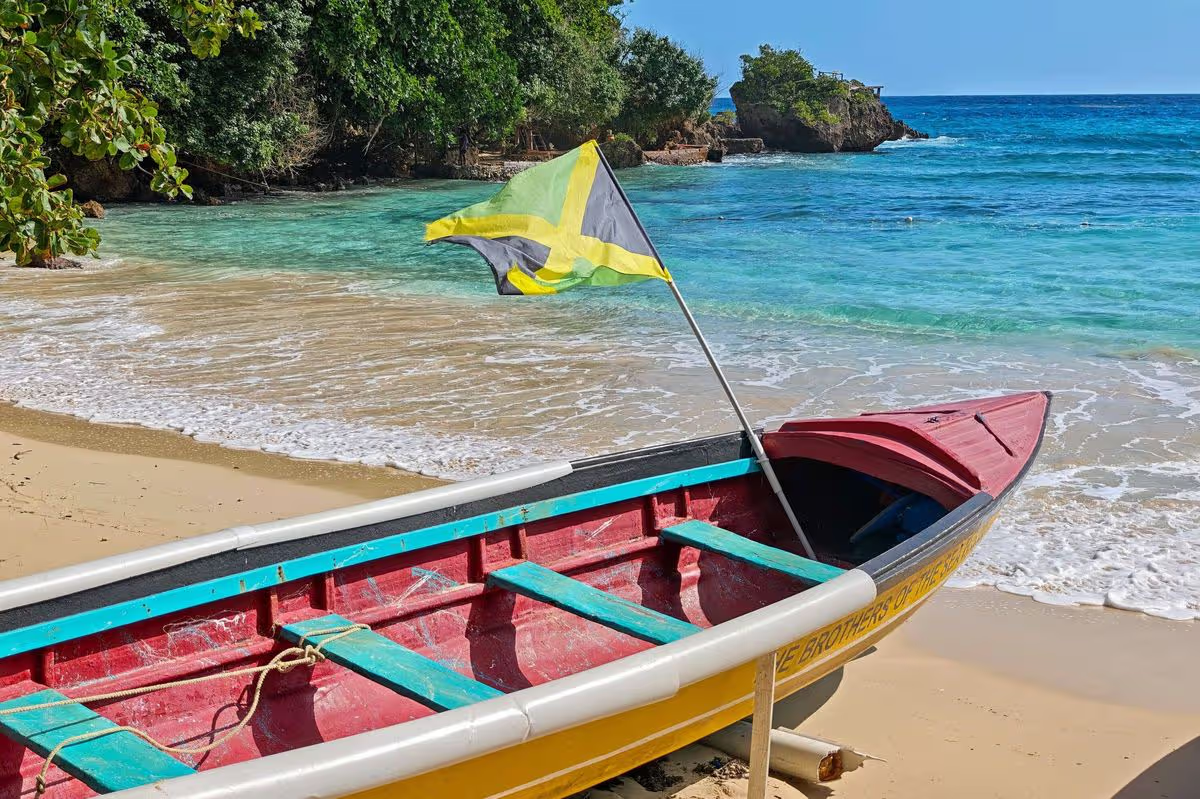
Jamaica has seen a surge in popularity with Brits(Image: Getty)
Brits are trading Dubai for a sun-drenched island offering direct flights and balmy 30C temperatures in April. This shift comes as holidaymakers begin to seek out traveldestinations that bypass the Middle East.
Travellers bound for the region have faced disruption due to ongoing instability and conflict in Iran. British Airways has already confirmed that flights to Dubai, Bahrain, Tel Aviv and Amman in Jordan have been suspended until at least 31 May. This has triggered a surge in bookings for locations such as Portugal, Spain, France and certain US states.
However, one Caribbean island has seen a notable increase in interest. Alongside destinations like the Dominican Republic, Phuket in Thailand and Goa in India, Jamaicahas experienced a boom in demand, according to Neil Swanson, managing director of TUI UK and Ireland, who spoke to the BBC.
The airline provides direct flights from Manchester to this sunny isle. However, passengers should brace themselves for a journey expected to exceed 10 hours, reports the Express.
Once they’ve landed on this petite island, home to approximately 2.8 million inhabitants, Brits can bask in the sunshine and immerse themselves in the local culture. The average daytime temperature in Jamaica for April fluctuates between 25 to 30C, dipping to around 22 to 24C at night.
Travel expert Mark Wolters reckons visitors to Jamaica rarely need to pack a jacket. In a YouTube video on his Wolter’s World channel, he explained: “You’re going to be fine with shorts and a t-shirt all-year round, that’s not going to be a problem.
“The busy season here starts January, December and it goes through March. The time when you don’t want to come here is July/August because it is insanely hot.”
According to Visit Jamaica, tourists “feel the vibe” the moment they arrive on the island, becoming absorbed in the music, nightlife, and cuisine. It states: “Tasting your way through the island is a great way to connect with the history of Jamaica as you learn more about what makes our food so special with each dish you try.
“Savour every delicious bite and come back to ‘Mmmmm!’ Jamaicans celebrate life with food, so you know it is made with love.”
Jamaica features an impressive selection of stunning beaches that extend for miles. Negril’s Seven Mile Beach is celebrated for its spectacular sunsets and lively atmosphere whilst Montego Bay Marine Park is favoured by holidaymakers keen to discover the underwater realm showcasing vibrant wildlife.
The Blue Mountains rise majestically above Jamaica and consistently draw outdoor enthusiasts. Those visiting the mountains can even taste the world-famous Jamaican Blue Mountain Coffee.
The island also boasts captivating waterfalls and verdant rainforests. In April, it plays host to a unique carnival that parades through the streets of Kingston.
The carnival season is accompanied by a week of breakfast parties, soca cruises, Jamaican music and extravagant costumes. Besides being reachable by plane, Jamaica is a favoured destination for cruise holidays.
The island is hugely popular with UK tourists(Image: MICHAEL WORKMAN via Getty Images)
For those seeking some sunnier climes, a popular holiday spot boasting temperatures of up to 23C next month could be just a £19 flight away.
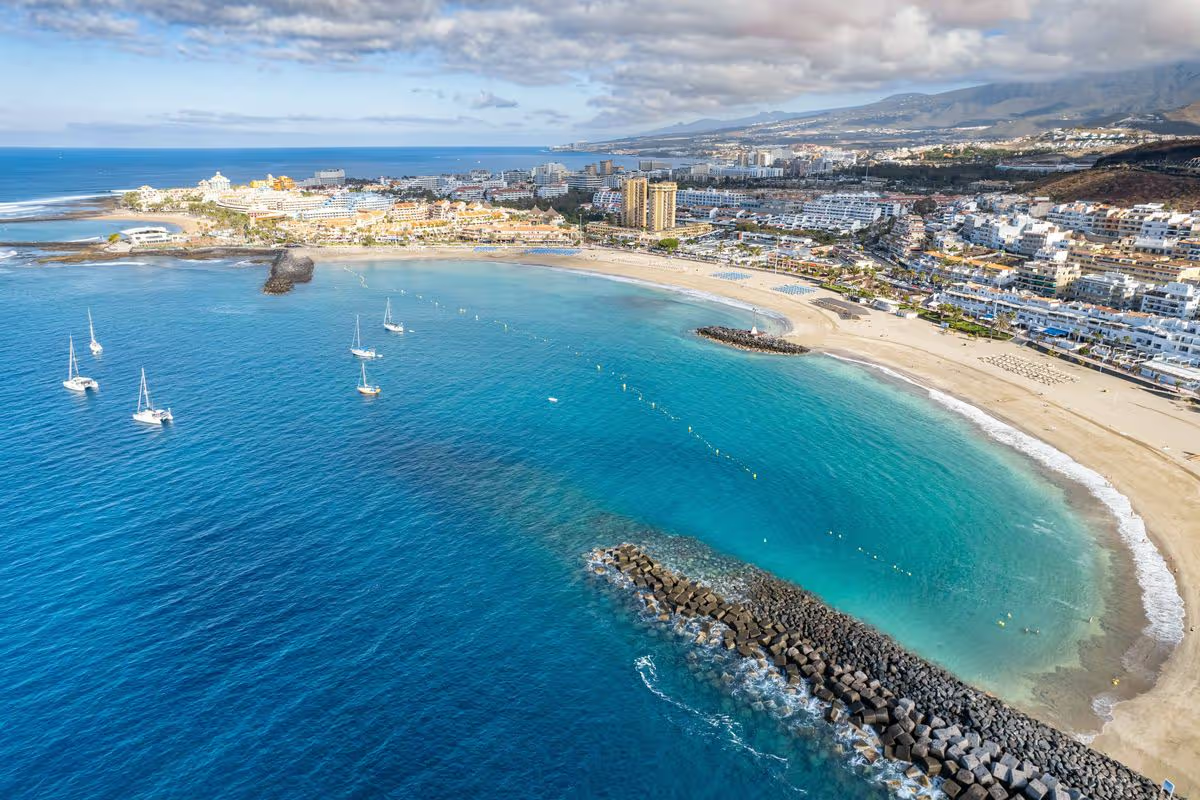
Ryanair is offering direct flights from London to Tenerife South throughout April, presenting an opportunity for budget-conscious travellers to grab a deal. The Canary Island basks in approximately nine hours of sunshine each day and enjoys average high temperatures of 23C in March. In contrast, London’s average high temperature for April is a mere 15C. This consistently balmy climate is a significant attraction for UK holidaymakers heading to Tenerife.
Hello Canary Islands portrays Tenerife as an “island of a thousand experiences”. It elaborates: “There are a thousand things you can do at any time of year, thanks to the mild climate and the enormous range of activities on offer on the largest of the Canary Islands.”
Ryanair is providing one-way fares to Tenerife throughout April starting from £19. At the time of writing, a flight on Monday, April 13, is available at this price from London Stansted – departing at 8.40pm and arriving at 1.10am.
There are also several basic fare seats on other April dates currently priced at £22, and others starting from £24.99 one-way. The cheapest return flight we could find for April was £24.99, meaning you could potentially secure a return trip for just £43.99.
There is no time difference between the UK and Tenerife. All flight prices were accurate, according to Ryanair’s website, at the time of publication.
Connected to the German mainland by a single rail causeway, Sylt is just over three hours from Hamburg by direct train. The largest of the North Frisian islands, it slices through the North Sea and the Wadden Sea, with salt marshes and mudflats to the east and 25 miles of white sands sweeping along the western coast, grassy dunes buffering the bracing winds.
Relatively unknown to UK visitors, the island has long been a popular destination for Germans and appeals to an affluent crowd, although not exclusively. Luxury hotels and pioneering health resorts sit side by side with multistorey apartment blocks, modest campsites and laid-back surfing schools.
Trains from Hamburg – soon to be upgraded with the new intercity (ICE L) fleet – arrive in Westerland, the largest town on the island, which expanded significantly during the 60s and 70s. Alternative bases include well-heeled Kampen or Keitum, the latter known for its maritime history and traditional thatched houses. Designated nature reserves cover other parts of the island, from the shifting dunes in List to the vast Braderup Heath, partly managed by a hardy breed of sheep.
Grab a coffee from Kaffeerösterei Sylt, order the herring sandwich from Hafenkiosk 24 and don’t miss the salty Sylter Royal oysters from Germany’s only commercial oyster farm. The restaurant Oma Wilma focuses on hearty fare, while the shop and bistro Käseklub, located on an old goat farm, serves a curated selection of cheeses. Where to stay: Villa Klasen is a recently renovated boutique hotel in a charming art-nouveau style building with doubles from €120B&B Kate Mann
Sherkin, Ireland
The ruins of a Franciscan friary on Sherkin. Photograph: David Lyons/Alamy
It takes an hour and three-quarters by car, plus another 10 minutes by ferry, to get from Cork city, with its lively markets and revelrous pubs, to the relative tranquillity of Sherkin, one of the seven inhabited islands off the coast of West Cork.
None of these islands is especially large – the biggest, Bere Island, takes up about seven square miles – but they are all remarkably different, from sheltered little Garinish with its fine Edwardian gardens, to the ruggedness of Dursey, exposed to the elements at the tip of the Beara peninsula.
Sherkin is the one I know best. A few years back, I joined a group of friends who go there for a fortnight every summer, staying at a simple but appealing retreat called Sherkin North Shore. The kids do sailing courses down on Roaringwater Bay while the adults generally lounge around and enjoy life in a lower gear. There’s a sauna and a cafe where owner Michael O’Connor and his family cook terrific communal dinners. They also stage a (by all reports excellent) music festival, Open Ear, on the June bank holiday weekend.
Sherkin has three marked walking trails, taking you through the lush interior to white-sand beaches and a stunning horseshoe-shaped cove. Down towards the harbour, you’ll find the island’s only pub, the Jolly Roger, which serves chowder and toasties, and hosts music sessions in the busier months. And dotted around the island are artists’ studios (opening times vary, but you can call ahead to arrange a visit).
The buzzy mainland town of Baltimore is the gateway to Sherkin and also to Cape Clear farther south.
The other islands all have separate access points. For Heir or Hare Island, drive to Cunnamore Pier, half an hour west of Baltimore, and hop across on the ferry. You’ll be rewarded in the summer months by a brilliant restaurant and cookery school called Island Cottage – I had the good fortune to go for lunch in 2019 and the food was hearty and delicious. Where to stay: Sherkin North Shorehas rooms from €65 a night per adult, €30 for under-13s) and camping from €80 for a bell tent, €15 for a pitch Killian Fox
Torcello, Italy
The Ponte del Diavolo (devil’s bridge) on Torcello Photograph: PhotoFires/Getty Images
Venice is a city full of attractions, from its beautiful bridges to its Renaissance galleries and hidden spots to enjoy cicchetti or small plates. After a few days, however, the narrow streets and winding canals packed with tourists often spur a desire to escape the island. For many that will mean a trip to Murano, famous for its glass-making heritage, or even Burano, with its wildly coloured houses, both a short boat journey away. But for a real change of pace, switch to a smaller boat at Burano for the short ride to the sparsely populated island of Torcello, at the northern end of the Venetian lagoon.
The first thing that strikes you as you disembark is the sense of space. Following a wide path through the centre of the island, with water on one side and trees on the other, will bring you past green fields and quaint houses to the Ponte del Diavolo,or devil’s bridge, a rare example of an old Venetian bridge without parapets. If you find yourself feeling peckish, stop off at Taverna Tipica Veneziana, where you can get a selection of fried seafood and vegetarian meals. If you sit in the garden, you can see the restaurant’s goats and guinea pigs.
Continuing on the path will lead you to the main attraction: the Basilica of Santa Maria Assunta, founded in 639. It is unassuming from the outside, but the interior walls are decorated with stunning 11th-century mosaics, including a depiction of the last judgment.
Finish your visit by enjoying an ice-cream next to the church by the water’s edge, before retracing your steps back to the buzz of the city or, better still, stay overnight to enjoy the peace of the island once the day trippers have left.
Where to stay: Junior Suites Venezia has a restaurant, coffee shop, garden and doubles from £183 for a two-night stay Kitty Croft
Frioul islands, France
Pomègues in the Frioul islands is an easy day trip from Marseille. Photograph: Yann Guichaoua /Getty Images
Just 20 minutes by boat from the Vieux Port of Marseille, the Frioul islands, part of the protected Calanques national park, make a great day trip from the city – but it’s even better to stay longer to enjoy the wild beauty.
The two main islands, Rattoneau and Pomègues (each about 1.5 miles long), are linked by a 19th-century dyke, and hiking trails wind across the white limestone landscape to secluded swimming coves, pretty creeks and viewpoints back across the sparkling Med to town.
The ferry arrives at Rattoneau, where a few restaurants, shops and houses cluster around the harbour. Eat here or stock up on supplies, as there’s little elsewhere. Ou Sinon restaurant is a good choice for fresh seafood (try organic sea bass farmed on Pomègues).
About half an hour on foot from the port, Saint-Estève is the biggest beach on Rattoneau – sheltered, sandy and good for snorkelling (and there’s a small bar). Nearby, the 19th-century Hôpital Caroline, once used to quarantine travellers, is sometimes used for concerts today, while the old fort and second world war bunkers reveal the islands’ strategic importance. Across on Pomègues, it’s worth taking the long hike to the picturesque, remote cove Calanque de la Crine.
There are two other islands in the archipelago: tiny, rocky Tiboulen, used mostly for diving, and If island, home to a 16th-century fortress turned prison, the Château d’If (made famous by Alexandre Dumas’s The Count of Monte Cristo). Some ferries stop here en route to Rattoneau. Where to stay: accommodation is limited to mainly rental apartments near the harbour. La Daurade du Frioul is a one-bed apartment right on the beach, from £70 a night Jane Dunford
Cíes islands, Spain
Praia de Rodas. Photograph: Jarana Creatives/Getty Images
For a Caribbean-like break on a camping budget, it’s hard to beat the car-free Cíes islands in north-western Spain. This archipelago off the Galician city of Vigo has the white-sand beaches, the turquoise sea and even the exclusivity – visitor numbers are limited as the islands are part of a national park, and overnight stays are allowed only at Easter and in summer (15 May to 14 September). Admittedly, the illusion is shattered when dipping a toe in the chilly Atlantic …
To reach the islands, visitors must request a free authorisation code up to 90 days in advance (at autorizacionillasatlanticas.xunta.gal), then use it to buy a boat ticket (details at turismodevigo.org). There are daily crossings from Vigo to Monteagudo island (45 minutes), which is linked to Faro island by a sandbar across a lagoon; the third island, San Martiño, can only be reached by private boat.
Rodas, the biggest beach, is a short walk from the pier, and has kayaks and snorkels to rent – there are no tropical fish, but plenty of octopuses, lobsters and crabs, and often bottlenose dolphins. Seven quieter beaches can be discovered along four hiking trails, which link lighthouses, viewpoints, forests and a bird observatory. The beachside Restaurante Playa de Rodas specialises in seafood – scallops, razor clams, Galician barnacles – and local albariño wine. Where to stay: Camping Islas Cíes on Faro island has an excellent restaurant, tents with beds and pitches from €10.90, plus €10.90 per adult, €7.90 per child, booking essential Rachel Dixon
Though if you want to head to a seaside town without the crowds, the Croatian Tourism Board recommends visiting Komiza on the island, which according to the board is where fishing on the eastern coast of the Adriatic was born.
The town dates back to the 12th century and is surrounded by pretty villages to discover as well.
Stiniva Beach is just an 18 minute drive from the town and is the number one thing to do on the island of Vis, according to TripAdvisor.
The cove has crystal clear waters and pebbles, like many other beaches across the island.
From the road, it is about a 20 minute hike down to the beach, though many visitors note it isn’t easy, so sturdy shoes are recommended.
Boat tours go to the beach too, though, which is probably a better option for the more elderly.
One recent visitor said: “Stiniva Beach is hands down the most beautiful beach I’ve ever seen in my life.
“Tucked away in a secluded cove with crystal-clear water and beautiful high cliffs surrounding you, it feels like stepping into a hidden paradise.
“The atmosphere is peaceful and almost surreal, especially in the early morning when the light is soft and the crowds haven’t arrived yet.”
If you want to head to a more accessible beach, opt for Gusarica Beach which is right by the town centre.
The beach features small pebbles and it is a great spot to go paddleboarding.
The island and Komiža more specifically, was also used as a filming destination for Mamma Mia! Here We Go Again.
The area was also used to film parts of Mamma Mia! Here We Go AgainCredit: Alamy
In the second film, Harry and Bill have dinner in a Greek tavern.
In reality, the tavern is a restaurant called Jastožera and does have the amazing view that you see in the film.
The restaurant is located by a 15th century fortress that connects two cliffs and created an open air sea pool used for lobster breeding.
Since 1883, the restaurant has been owned by the Komizan family Marinkovic-Mestrezane and today you can visit to try fresh lobster dishes.
Komiža is a great base for visiting the Blue Cave on Bisevo island as well, which is an even smaller island.
The “island of peace and purity”, according to BlueCave-Bisevo.com, is known for its Blue Cave, which was revealed by Viennese painter Eugen Baron Ransonnet in 1884.
Since, tourists flock to the cave which has since become protected as a geomorphological natural monument.
What makes the cave so special is that it captures an unusual light phenomenon which gives everything in the cave a blue glow.
In 2019, research revealed that the blue glow is created by morning light hitting the yellow sandy bottom and illuminating the interior of the cave.
Nearby, you can also explore Blue Cave, which ‘glows’Credit: Alamy
Visitors can only head to the cave on an organised trip, which are available between April 1 and November 1.
Tickets to the cove can be purchased in the gift shop in Mezuporat Cove, near the cave entrance.
They cost 75 Croatian kuna (£8.67) per adult and 35 kuna (£4.05) for children, but in the peak season rise to 100 kuna (£11.56) per adult and 50 kuna (£5.78) per child.
If you book a Blue Cave tour from Split, your entrance will be included in your ticket.
The best way to get to Komiža is by flying to Split, with flights usually costing from £24 one-way.
Once in Split, hop on the ferry to Vis which usually costs between €6.50 (£5.66) and €26 (£22.63) per person.
It is just after dawn and from a viewpoint on Looe Island, Cornwall, I watch two seals on the beach below. The pair entwine in the surf, her freckled, creamy belly against his, flippers wrapped around each other, eyes closed in blissful bonding. I feel like a peeping Tom, watching from behind a bush. It feels too intimate a moment to be spying upon, but the emerald-eyed cormorants guarding the beach seem unbothered.
I had arrived on Looe Island, also known as St George’s Island, off the south coast of Cornwall, the previous morning via the romantically named Night Riviera sleeper train from London, changing early in the morning in Liskeard, then 15 minutes across the waves in a small fishing boat. The island is managed by the Cornwall Wildlife Trust and can only be accessed on organised visits, and while most people come on day trips, I’m staying for a little longer. I have come loaded down with all the food and bedding I will need for my three-night visit, but also with the mental baggage of workaday life. Now, that weight lifts as I watch the male seal court his lady in the shallows.
Rain threatens, and I return to Smuggler’s Cottage, a pretty whitewashed house that sleeps two, tucked into a garden of fruit trees and fading flower heads. The cottage, with a bedroom, tiny kitchen, bathroom and cosy living room with a wood burner, is a homely place and was once lived in by a pipe-smoking, fist-fighting smuggler called Black Joan and her brother, Finn. The rain drips steadily from the sycamore trees clambering up the hillside and clings like frost to the spiders’ webs hanging from the windowsills. I snuggle back into bed with a cup of tea and feel the warmth that comes from a wildlife encounter in which the wildlife never knew you were there.
Undoubtedly it was to preserve moments such as these that the former owner of Looe Island, Roselyn “Babs” Atkins, left her home to the Cornwall Wildlife Trust as a nature reserve. Babs and her sister, Evelyn “Attie” Atkins, were women who defied the conventions of their time. The pair never married and instead invested in their careers and took up hobbies such as mountaineering and rifle shooting. Then, when Attie was in her mid-50s, the chance came to realise a long-held dream to own an island. She bought Looe Island along with her sister in 1965 for £22,000 and became a daffodil farmer; Babs joined her later when she retired.
Smuggler’s Cottage, a cosy holiday home for two on Looe Island
Cornwall Wildlife Trust took over the island in 2004, after Babs’s death, and the charity manages the 9 hectares (22 acres) of woodland, maritime grassland and rocky shoreline for the benefit of wildlife, including one of Cornwall’s largest breeding colonies of great black-backed gulls (stately birds with a wingspan of over 1.5 metres) and marine wildlife such as the graceful compass jellyfish, which can be spotted in the rock pools.
Apart from the cottage, visitors can stay in a bell tent, which sleeps two, overlooking Trelawny Island to the south-east, where breakers crash on the rocks and seals sleep, nose skywards, kissing the surf. Additional revenue comes from the landing fee charged to day trippers, who come across with Looe Sea Safari a few times a day when the weather allows. There is also a diminutive museum and giftshop, where wardens Claire and Jon, who live on the island year-round, sell homemade chutney, chillies from their veg garden and charming books on island life written by Evelyn Atkins.
Today, the seas are too rough for day trippers and I have the island to myself. I read in a meadow, something I never find the time to do at home, and explore the winding pathways that climb steeply up to the summit, 47 metres above the sea.
There’s a self-guided trail (free from the bookshop) for further exploration. One of the stops is Babs’s meadow, where she is buried looking out over her beloved home. The whole route could easily be walked in an hour, but why rush? The trail winds past Island House, Roselyn and Evelyn’s old home, and follows the coastline, with views out over the reefs that fringe the island, before returning through woodland bright with bird calls.
In the afternoon, I head for a swim on the island’s main beach, where the black-backed gulls roost in between fishing trips. I try hard to follow Claire’s instructions, staying close to the tree line and not looking in the birds’ direction to avoid disturbing them, and am delighted when the colony largely ignores me. The sea is icy and the surf threatens to pummel me, but I spot silver striped mackerel swimming inches away and relish the thrill of taking a dip from a little-visited cove. Afterwards, dried and bundled in layers, I sit propped up between the boulders, hands warming around a cup of hot chocolate from my Thermos as I catch the last light of the dying sun. I gaze across the water, my mind clearer than it has been in weeks, as the gulls take off into the wind and sail past along the coast.
Aerial view of Looe estuary. Photograph: Wirestock/Getty Images
When I watch the two seals again later that evening with Claire and Jon, she explains that they hope to encourage visitors to respect coastal wildlife and minimise disturbance. “When the seals are resting,” she says, “they are laying down layers of fat from their meals, which helps the adults survive the winter and enriches the milk females give to their pups. Each time they are woken by a boat, even if it’s only for a few minutes, they use up a little bit of energy and the effect accumulates.”
For each seal, disturbance can be the difference between life and death, she says, but agrees that protection needs to be balanced against the need for people to engage with wildlife in order to increase empathy and support. Staying on – or visiting – a nature reserve is one way that people can get to know the wildlife on its terms. “The island forces them to slow down, to notice the small things,” Jon says. “People put their phones away and spend the afternoon watching a spider building its web.”
After only a day watching the seals, I can already feel that kinship. After all, these animals look so much like us that they were once mistaken for mermaids. It is these priceless moments of connection that Claire and Jon hope will stay with guests and teach them to be humble in the way they live alongside other creatures.
I have come to realise, as Babs and Attie did before me, that it is the lordly gulls and the amorous seals who are the real owners of the island. Still, I am grateful for the opportunity to share their home, if only for a few days, and for the sense of peace and reconnection with the wilder world it has allowed me.
The trip was provided by the Cornwall Wildlife Trust. Smuggler’s Cottage is available to rent from spring until October and costs £450 for a three-night stay for two. Looe Sea Safari runs day trips either side of high tide in daylight hours and fair weather, £12 adults, £7 children 10 and under, plus Cornwall Wildlife Trust’s landing fee of £8 adults, £3 children.
March 14 (UPI) — President Donald Trump announced that U.S. forces “totally obliterated” every military target on Iran’s Kharg Island, a key port that exports the vast majority of Iran’s oil.
In a post on Truth Social on Friday evening, Trump described the attack as “one of the most powerful bombing raids in the History of the Middle East.”
He said he directed U.S. Central Command to carry out the bombings after Iran halted ships’ passage through the Straight of Hormuz. About 20% of the world’s crude oil passes through the strait.
“For reasons of decency, I have chosen NOT to wipe out the Oil Infrastructure on the island,” Trump wrote.
“However, should Iran, or anyone else, do anything to interfere with the Free and Safe Passage of Ships through the Strait of Hormuz, I will immediately reconsider this decision.”
Kharg Island is about 15 miles south of the Iranian mainland through which about 90% of the country’s oil exports pass, The Washington Post reported. It’s a critical piece of Iran’s economy and a full attack on the oil infrastructure there could hinder Iran’s ability to pay its military.
Iranian officials said the site was “proceeding normally” after the U.S. attack.
In response to Friday’s bombings on Kharg Island, Iran threatened its own attack on key oil infrastructure in the United Arab Emirates, CNN reported.
Oil has been a key factor in the war in Iran, which began Feb. 28 with surprise U.S. and Israeli airstrikes on dozens of Iranian sites. AAA reported Saturday that the average price of a gallon of gasoline was $3.68 in the United States, up 23% since the start of the war.
This could, in turn, have a dramatic impact on other aspects of the U.S. economy, including food prices, jet fuel and fertilizer.
An Iranian man raises a portrait of new supreme leader Mojtaba Khamenei during a rally on Revolution Street in Tehran on March 9, 2026. Photo by Hossein Esmaeili/UPI | License Photo