Weekly insights and analysis on the latest developments in military technology, strategy, and foreign policy.
Merops drones effectively counter Iranian Shahed attacks. The Merops interceptor drones, initially used in Ukraine, have been deployed to protect U.S. troops from Iranian Shahed-136 munitions.
Cost-effective solution against expensive threats. Each Merops drone costs about $15,000, significantly less than the $30,000 to $50,000 Shaheds they intercept, offering a favorable cost ratio.
Potential for further cost reduction with larger orders. Prices could drop to $3,000 to $5,000 per unit with increased production, making them even more economical.
Streamlined acquisition process enabled rapid deployment. The Army’s reorganization of its acquisition process allowed for quick deployment of Merops drones in conflict zones.
Merops drones part of a layered defense strategy. While not as advanced as Patriot missiles, Merops drones can be deployed in large numbers for effective area coverage.
Bottom line: Merops interceptor drones have proven to be a cost-effective and efficient defense against Iranian Shahed drones, protecting U.S. troops and equipment. Their success in Ukraine and streamlined acquisition process suggest a growing role for such low-cost solutions in future military strategies.
The Army’s top official pointed to low-cost interceptor drones first sent to Ukraine as one defense against Iranian barrages of Shahed-136 one-way attack munitions. During Congressional testimony on Thursday, Army Secretary Daniel Driscoll lauded the Merops interceptor and the process to get it quickly into the hands of troops in the Middle East.
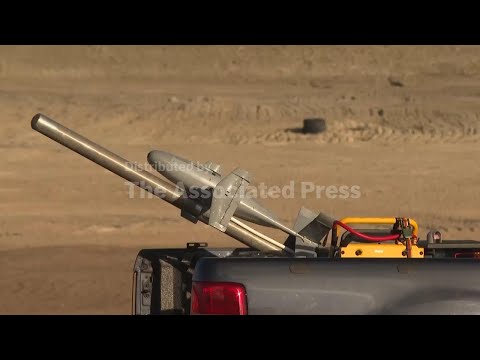
The Merops is a small, relatively inexpensive drone built specifically to zip through the skies and intercept long-range one-way attack drones. As we have previously reported, Ukraine has been using several locally produced drones, as well as Merops, to counter Russian Shaheds successfully for some time now, proving-out the concept.
“When the conflict kicked off, within about eight days, we were able to purchase…13,000 Merops, which are incredible,” Driscoll exclaimed. “They’re about $15,000 a piece right now. We think as they scale, they’ll get less than [$10,000] and we’re able to take Shaheds down that cost $30,000 to $50,000, which is amazing because that puts us on the right end of the cost curve, and we will make that trade all day long.”
The U.S. has its own interceptors that have been in service for years, such as Raytheon’s Coyote, but they cost roughly 10 times more.
A new system to identify and take down Russian drones is deployed to NATO’s eastern flank
In a recent interview with Bloomberg, Driscoll said that larger orders could drive that to $3,000 to $5,000 per interceptor. Given the success in Ukraine, it is likely that the Pentagon and other customers would see far less risk when it comes to ordering large numbers.
As we noted in a story last month, the Pentagon sent thousands of these drone interceptors to the Middle East. Iranian strikes on U.S. military facilities killed U.S. troops and caused damage to bases and equipment. Driscoll did not offer more specifics about how often they were used, how many Shaheds they downed or exactly where they were deployed.
Merops was “developed as part of the US-backed Project Eagle initiative, which includes contributions from Swift Beat, a company associated with former Google CEO Eric Schmidt,” according to the Ukraine Defense Tech Community (DTC), a marketplace for modern weaponry. “The system is built around Surveyor drones, which act as airborne interceptors capable of destroying enemy UAVs mid-flight.”
A U.S. Army soldier launches an AS3 Surveyor interceptor drone, part of the U.S. counter-drone system known as ‘MEROPS,’ during a live-fire demonstration at the Deba training grounds in Subcarpathian Voivodeship, Poland, on November 18, 2025. (Photo by Artur Widak/Anadolu via Getty Images) Anadolu
Each Merops unit “includes a command station, launch platforms, and a fleet of Surveyor drones,” DTC explained. “These interceptors can operate autonomously or be remotely piloted and are equipped with onboard sensors for target tracking.”
While full technical specifications remain undisclosed, they can reportedly reach speeds of over 280 km/h (175 mph). “The platform is considered fast enough to intercept jet-powered drones such as the Russian Geran-3, which can exceed 300 km/h,” DTC pointed out.
A Polish soldier launches an interception drone of the American MEROPS counter drone system during tests at the Nowa Deba military training ground, south-eastern Poland, on November 18, 2025. (Photo by Wojtek RADWANSKI / AFP) WOJTEK RADWANSKI
Driscoll said the ability to field Merops so quickly is because the Army streamlined its acquisition process.
“Fundamentally, one of the core problems was our own bureaucracy, our own infrastructure, our own decision-making organizations had decayed from any sort of speed and rationality,” he testified. “The reason we’ve been able to move fast since the conflict in Iran started is because of work 10, 12, 14 months ago to reorganize our acquisitions department.”
“And practically,” he added, “what that did is it took us from a 16-step decision-making process – where each of the bodies along those 16 steps could veto it and start it back over, and it could take two to seven years to purchase something.”
“We put everybody into a group who could make decisions on the fly,” the secretary noted. “And so a lot of the things the Army has worked on in the previous year are paying dividends as we try to make decisions quickly.”
You can watch Driscoll’s testimony on Merops at the 36-minute mark of the video below.
Budget Hearing – The United States Army
In Ukraine, Merops has proven to be a far cheaper alternative to munitions like Patriot interceptors and even far less advanced missiles for downing Shahed drones which have caused widespread destruction across that country. While these drones have neither the payload nor range of the far more expensive Patriot munitions, they can be deployed in great numbers giving them the ability to cover larger geographical areas. That helps keep the magazine depth of more sophisticated effectors from being quickly depleted and turns the disastrous ‘exchange ratio’ between cost of target versus effector on its head. In many cases, these systems would still need to be part of a layered defense, especially when used as point defense at high value installations and infrastructure.
Now that these weapons have helped save American lives and equipment, Merops success means we will likely be seeing more low-cost drone interceptors like it in the future.
What does Donald Trump’s naval blockade of Iranian ports look like and can it achieve what the US president wants? It is hard to know when the planning appears to have been done on the fly, according to war studies lecturer Samir Puri.
April 13 (UPI) — The U.S. military said it will begin blocking all ships from leaving or entering Iran’s ports on Monday morning in line with a maritime blockade ordered by U.S. President Donald Trump to cut off Iranian oil exports.
U.S. Central Command said in a news release Sunday that the blockade would be enforced equitably against vessels of all nations sailing to or from Iranian ports, including all those on the Persian Gulf and Gulf of Oman, but stressed vessels serving ports in neighboring countries would be left alone.
“CENTCOM forces will not impede freedom of navigation for vessels transiting the Strait of Hormuz to and from non-Iranian ports,” said the news release, which instructs the masters of all ships to monitor “Notice to Mariners” broadcasts and make radio contact with U.S. naval forces on bridge-to-bridge channels in Gulf of Oman and Strait of Hormuz approaches.
The blockade would effectively cut off Iran’s international trade by preventing it from importing or exporting anything by sea, in particular its energy exports on which it is reliant for hard currency.
Further details would be communicated in a formal notice that would be provided to commercial ships and operators prior to the start of the blockade, due to come into force at 10 a.m. EDT, CENTCOM said.
The statement clarified comments by Trump early Sunday in which he appeared to announce a total blockade of the Strait of Hormuz in response to the failure of peace talks in Pakistan at the weekend.
Trump had said the U.S. Navy “will begin the process of BLOCKADING any and all Ships trying to enter, or leave, the Strait of Hormuz.”
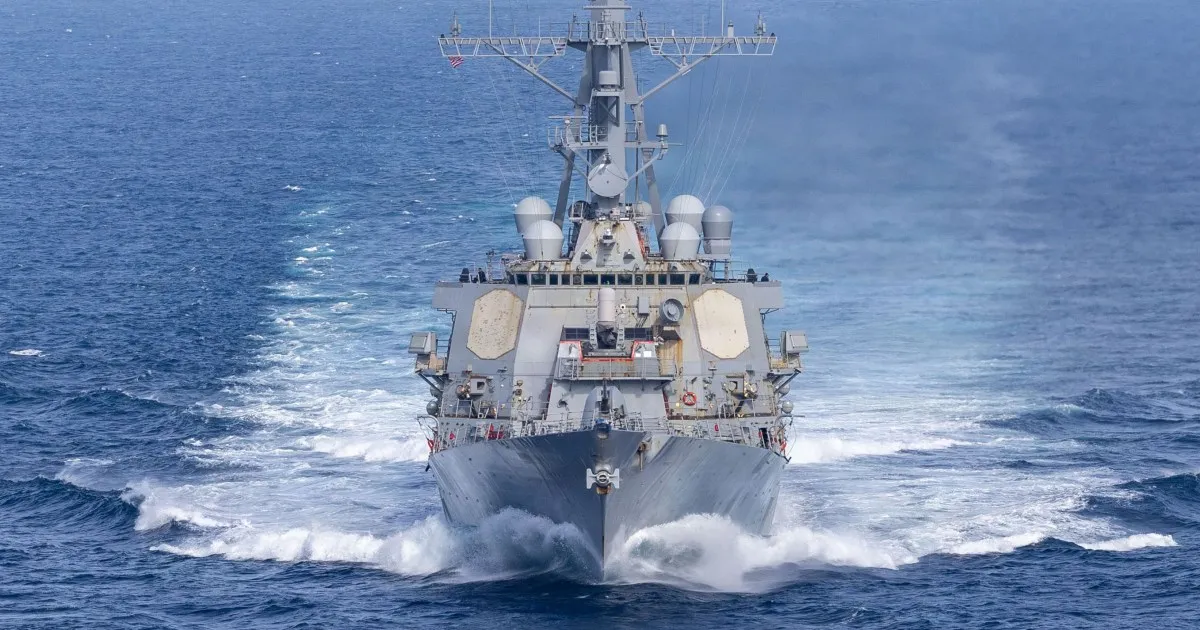
On Saturday, CENTCOM announced that the U.S. Navy guided-missile destroyers USS Frank E. Peterson USS Michael Murphy had transited the Strait of Hormuz and operated in the Persian Gulf, preparatory to clearing Iranian mines and reopening the shipping route to commercial vessels.
Tehran responded to the development with unspecified threats against the ports of its neighbors and raised the specter of widening the conflict to the Red Sea, the other sea passage in the region that is critical to the global economy.
“Security in the Persian Gulf and the Sea of Oman is either for everyone or for NO ONE. If Iran’s ports are threatened, NO PORT in the region will be safe,” the Iranian military’s central command said in a statement carried by state-run broadcaster IRIB.
“Naval blockade of Iran? Bab al-mandeb Coming soon?!,” IRIB said earlier in a post referencing the narrow strait at the southern entrance to the Red Sea, which leads to the Suez Canal, where Iran-backed Houthi rebels attacked around 100 commercial ships November 2023 through September 2025.
Oil prices rose in response to the developments while stock markets retreated.
The benchmark Brent crude and West Texas Intermediate both climbed back above $100 a barrel with the Brent contract for June delivery changing hands at $102.31 per barrel in mid-morning trade in London while the WTI contract for May was trading at $104.44.
The FTSE 100 in London was down 0.33%, the DAX in Frankfurt fell almost 1.2% and France’s CAC 40 was off by almost 1%.
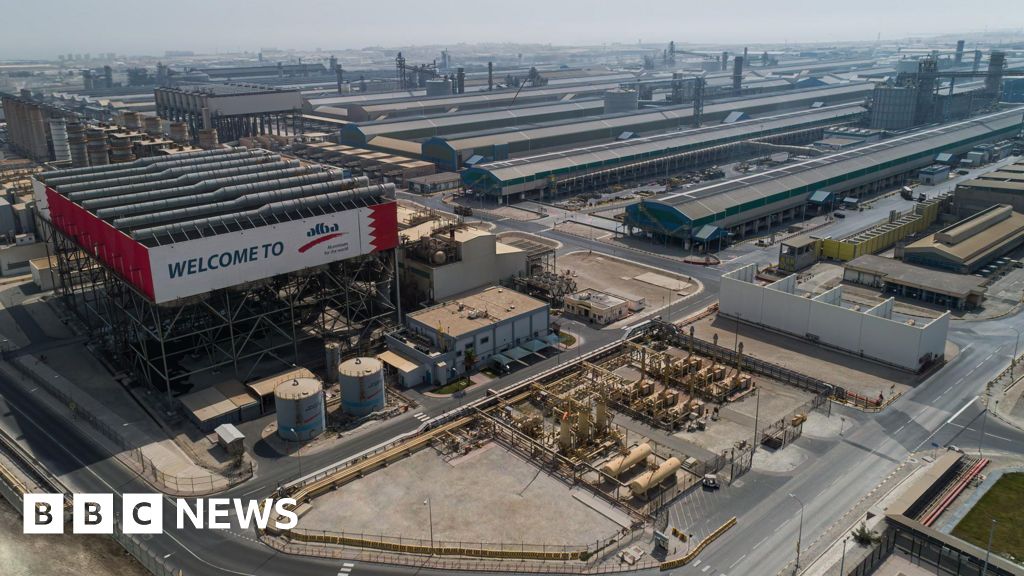
Former U.S. special envoy to the region David Satterfield expressed concerns over the blockade, warning that if shipping continued to be affected current supply disruption would widen beyond oil, with serious implications for Gulf countries’ exports of many other critical materials from aluminum and helium to polymers and fertilizer feed stocks.
“The Gulf is a critical global supply point, far beyond hydrocarbons — and the impact if this goes on for several more weeks is going to become quite profound, beyond just the cost of petrol and diesel at the pump,” Satterfield told the BBC.
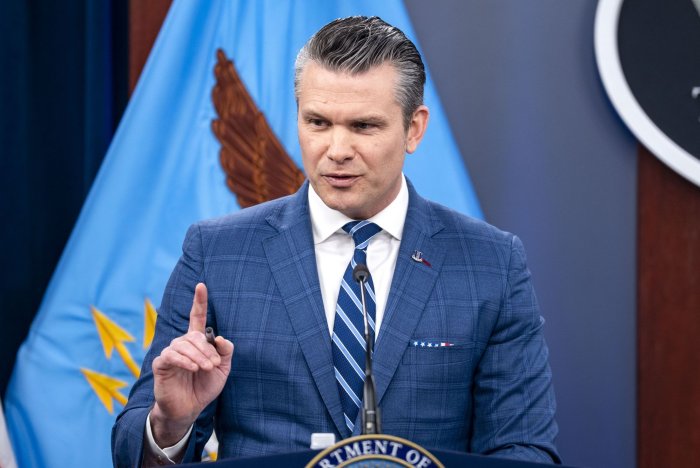
Secretary of Defense Pete Hegseth speaks during a press briefing at the Pentagon on Wednesday. Yesterday, the United States and Iran agreed to a two-week ceasefire, with the U.S. suspending bombing in Iran for two weeks if the country reopens the Straight of Hormuz. Photo by Bonnie Cash/UPI | License Photo
Vessels will still be able to transit Strait of Hormuz to and from non-Iranian ports, says CENTCOM; Iran warns any approaching military vessels will be breaching ceasefire.
Published On 13 Apr 202613 Apr 2026
The United States military has announced it will begin blockading all Iranian ports on Monday, its latest move to exert pressure on Tehran after marathon peace talks in Pakistan concluded without a deal.
In a statement on Sunday evening, US Central Command (CENTCOM) said the blockade would apply to “all maritime traffic entering and exiting Iranian ports” from 10am Eastern Time (14:00 GMT) on April 13. That includes “vessels of all nations entering or departing Iranian ports and coastal areas”, including those on the Gulf and the Gulf of Oman.
Recommended Stories
list of 3 itemsend of list
However, US forces “will not impede freedom of navigation for vessels transiting the Strait of Hormuz to and from non-Iranian ports,” CENTCOM said, in an apparent scaling back from President Donald Trump’s earlier threat to blockade the entire strait and pursue ships paying tolls to Iran.
“There are a lot of questions here,” said Al Jazeera’s Heidi Zhou-Castro from Washington, DC, pointing to “conflicting information” coming out of the US side.
“Trump said the blockade would target any and all ships trying to enter or leave the Strait of Hormuz. But CENTCOM is saying this would only target ships going to or from Iranian ports.”
The price of US crude oil jumped 8 percent to $104.24 a barrel after the US blockade threat. Brent crude oil, the international standard, increased 7 percent to $102.29.
Iran has essentially taken control over the Strait of Hormuz, a vital chokepoint for the global energy market, since the US and Israel launched a war against the country on February 28. Traffic through the waterway has since slowed to a trickle, nearly paralysing about one-fifth of the world’s oil and liquefied natural gas shipments.
Iran has continued to move its own vessels through the strait, while allowing limited passage of ships from other countries. Iranian officials have discussed setting up a toll system after the fighting ends.
In a statement responding to Trump’s blockade threat, Iran’s Islamic Revolutionary Guard Corps said any approaching military vessels would be in breach of a US-Iran ceasefire – meant to be in effect until April 22 – and “will be dealt with severely”.
The US-declared blockade appears to be triggered by the failure of the talks in Pakistan’s capital, Islamabad, raising fears of renewed fighting.
Iranian officials blamed the US side for failing to reach a deal, with Minister of Foreign Affairs Abbas Araghchi saying US negotiators shifted the “goalposts” and obstructed efforts when a memorandum of understanding was “just inches away”.
Zohreh Kharazmi, an associate professor at the University of Tehran, said the US “is not in a position to dictate” to Iranians how to behave, or “to choose which vessels may pass”.
“If this blockade becomes a contest between the resilience of the Islamic Republic and the resilience of global markets, it will not take long to see who is losing,” she said, adding that Iran “is ready for a prolonged war”.
“Technically, they [the US] cannot control the situation. With Hollywood-style strategies, they cannot prevail in this battleground.”
Tehran, Iran – Iranian authorities say the United States needs to do more if an agreement is to be made to end the war as they urge their supporters to maintain control of the streets.
The US delegation at Saturday’s marathon talks in Islamabad, Pakistan, “ultimately failed to gain the trust of the Iranian delegation in this round of negotiations”, said Mohammad Bagher Ghalibaf, the parliament speaker who led the Iranian team.
Recommended Stories
list of 3 itemsend of list
US President Donald Trump said on Sunday that the US Navy will immediately begin the process of “blockading any and all ships trying to enter, or leave, the Strait of Hormuz” in Iran’s southern waters. He also said the US military remains “locked and loaded” and will “finish up” Iran at the “appropriate moment”.
The fact that the Iranian delegation did not accede to Washington’s core demands of eliminating nuclear enrichment on Iranian soil and ending Iranian control over the Strait of Hormuz was welcomed by Iranian authorities on Sunday as they projected defiance.
Judiciary chief Gholam-Hossein Mohseni-Ejei thanked the delegation that went to Islamabad and said they “guarded the rights” of the supporters of Iran’s government, including paramilitary forces converging on main squares, streets and mosques in Tehran and other cities every night for more than six weeks.
When the delegations were engaged in the talks on Saturday night, a member of the aerospace division of the Islamic Revolutionary Guard Corps (IRGC) was shown by state television telling flag-waving supporters in downtown Tehran not to be concerned.
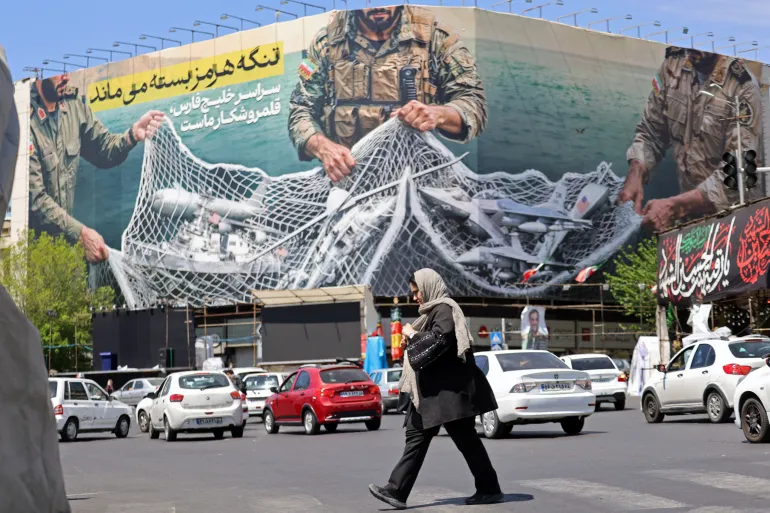
A billboard reading, ‘The Strait of Hormuz remains closed,’ is displayed in Revolution Square in Tehran on April 12, 2026 [Atta Kenare/AFP]
“If the enemy does not understand, we will make them understand,” the man who was wearing military attire and a black mask to conceal his identity said to cheers from the crowd, some of whom demanded more missile and drone attacks from the IRGC.
State television also said it was Trump, not Tehran, that wished to “restore his image” through the negotiations and his “excessive demands” were the reason the talks failed.
The Ministry of Foreign Affairs said it did not expect to reach an agreement after only one day of negotiations.
Multiple lawmakers in the hardliner-dominated parliament said they were happy that the talks did not yield results because they believed Iran had the upper hand in the war.
Hamidreza Haji-Babaei, the parliament speaker’s deputy, said the only thing acceptable to the establishment supporters who are on the streets is a United Nations Security Council resolution that would signal “surrender” for the US and lead to the lifting of sanctions against Iran and its leaders.
Amir Hossein Sabeti, a Tehran lawmaker affiliated with the Paydari faction of hardliners, said he was thankful to the negotiating team for “not backing away from red lines” and “there is no way left but to show resistance in the field against these evildoers and demons”.
More escalation ahead
This comes after some pro-state voices said they were disheartened by the abrupt announcement overnight into Wednesday of a two-week ceasefire and direct negotiations on ending the war with the US.
To assuage internal concerns, the Iranian delegation to Islamabad had more than 85 members, according to local media, including dozens of representatives from state-affiliated media and analysts close to different factions.
In addition to Ghalibaf, a former IRGC commander who advanced Iran’s missile programme, senior members of the team included Foreign Minister Abbas Araghchi, hardline diplomat Ali Bagheri Kani, Defence Council head and former security chief Ali Akbar Ahmadian and moderate central bank chief Abdolnasser Hemmati.
The talks on Saturday established that a diplomatic breakthrough was not close and that more escalation was likely, even if there is no immediate return to full-fledged fighting.
“What he [Trump] has been saying after the negotiations is just excessive talk. He is saying his wishes out loud,” Ebrahim Azizi, the head of the national security commission of Iran’s parliament, told state television on Sunday afternoon about Trump’s announced naval blockade and new threats.
The IRGC has threatened that it will respond to any passage of military vessels through the Strait of Hormuz with full force. It also rejected the US military’s announcement during the talks that two US warships had passed through the strait in preparation for an operation to clear naval mines blocking the strategic waterway.
Russian President Vladimir Putin told Iranian President Masoud Pezeshkian in a phone call on Sunday that he is ready to continue diplomatically facilitating a peace settlement in the Middle East.
Pezeshkian, who has been tasked mainly with working on domestic affairs, has supported continuity of the establishment and backing for Mojtaba Khamenei, the supreme leader who has not been seen or heard from outside of written statements since Israel and the US launched the war on February 28. His government announced that schools and universities will be held online, using a limited local intranet, until further notice.
Iran’s economy continues to suffer from chronic inflation with more jobs lost in 2026 as the state continues to impose a near-total internet shutdown.
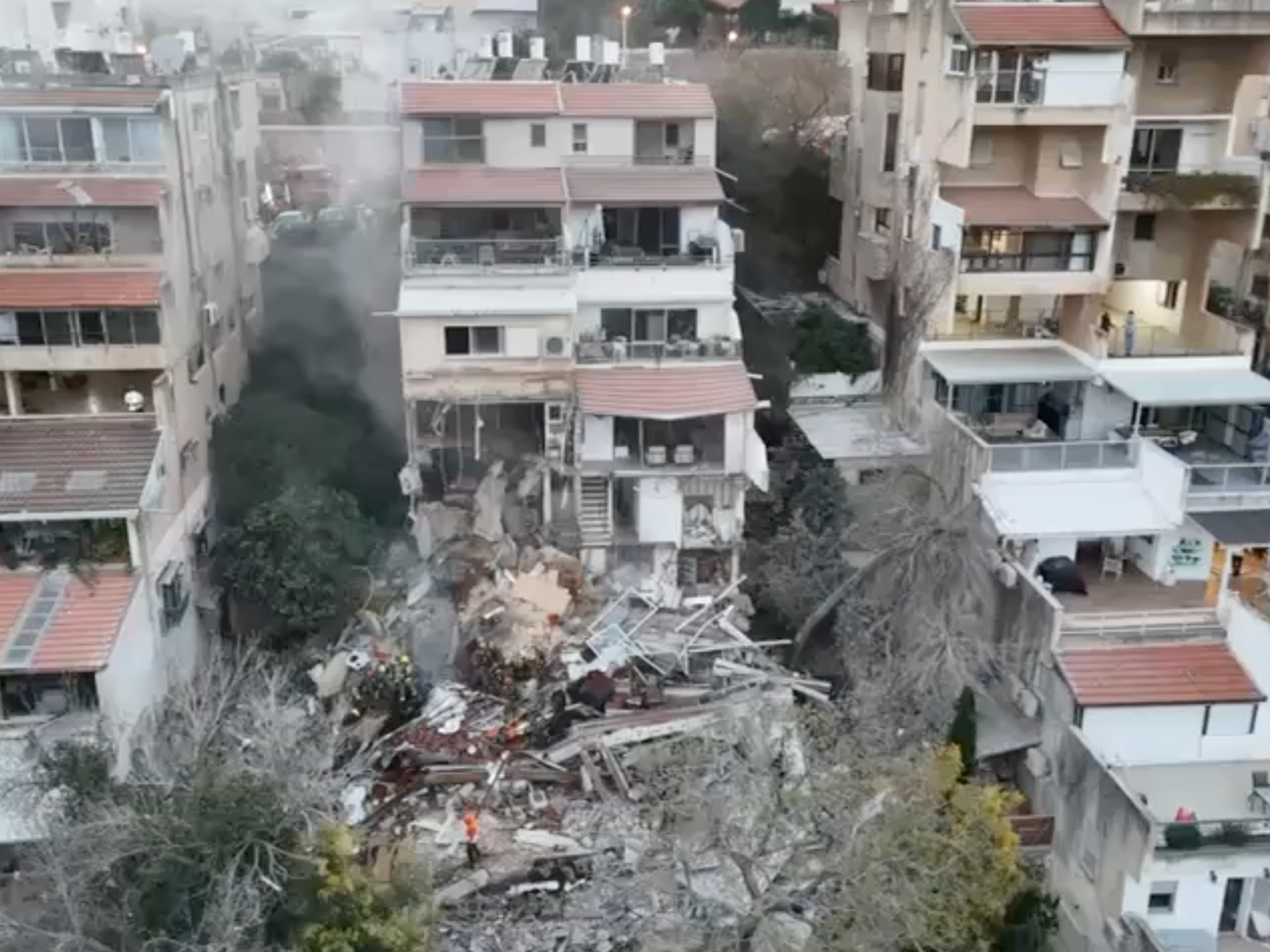
Video captured the moment of a direct hit by an Iranian missile on a residential building in Israel’s Haifa. Multiple injuries were reported and some people are feared trapped under the rubble of the partially collapsed structure.
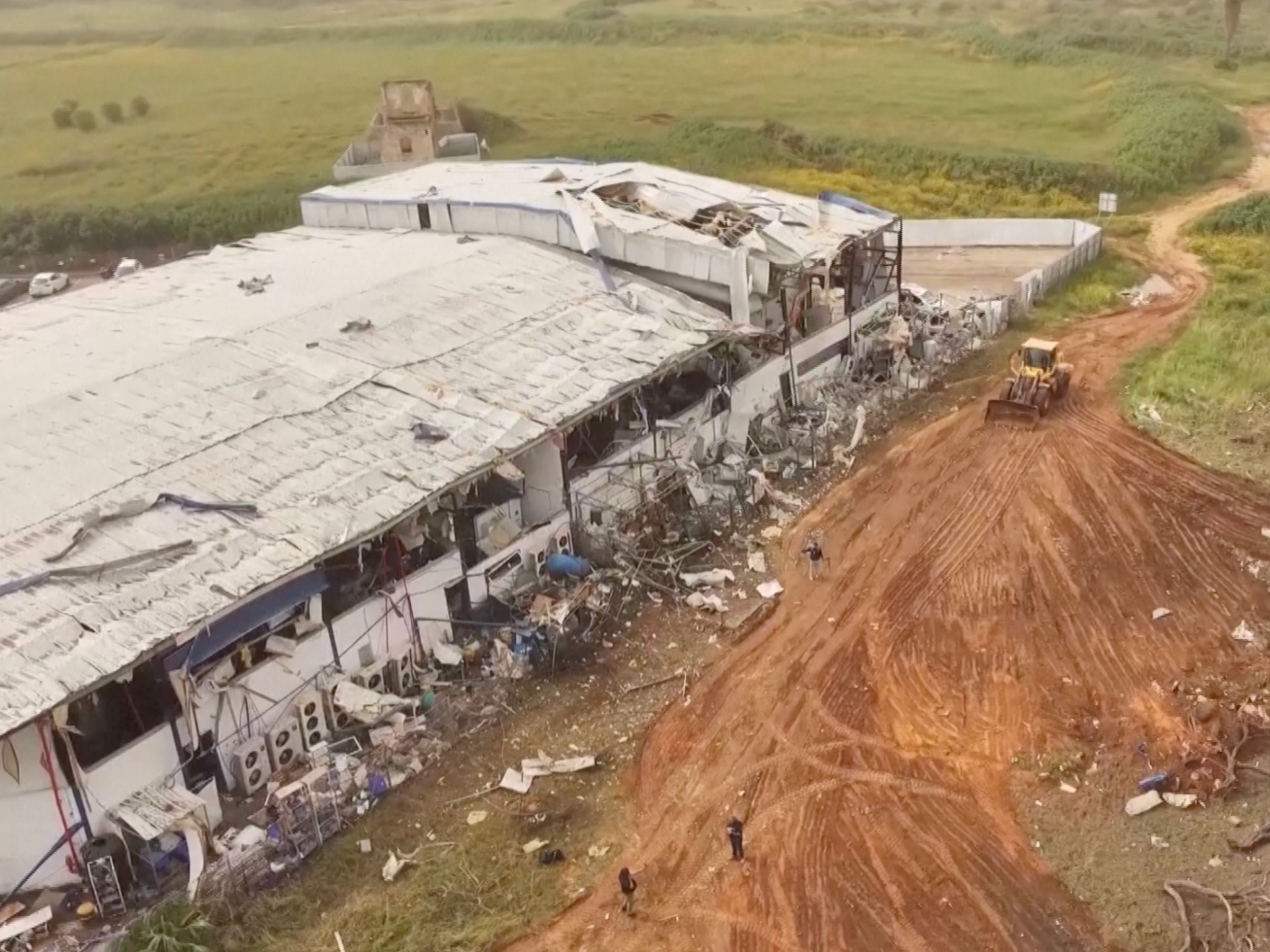
Drone footage from Israel shows damage to a factory in Petah Tikva after debris from an intercepted Iranian missile struck the site. The attack comes as Israel says it continues to intercept incoming missiles, on the 35th day of the US-Israeli war on Iran.
Weekly insights and analysis on the latest developments in military technology, strategy, and foreign policy.
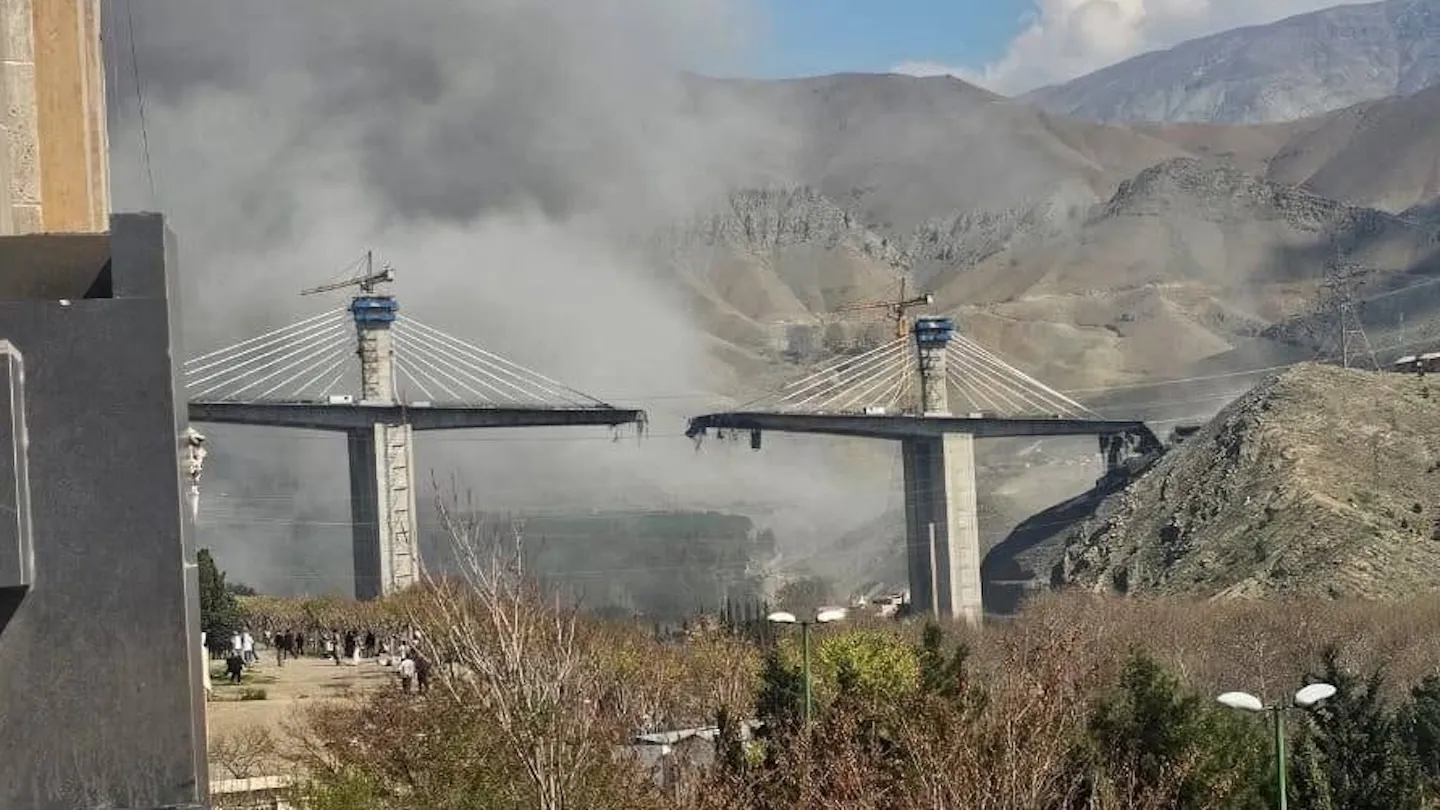
A major bridge near Tehran was struck today by what Iran has said were U.S.-Israeli strikes. The B1 bridge in Alborz province, one of the tallest in the Middle East, was hit in two waves of attacks, separated by around an hour, Iranian state TV reported. The bridge provides a critical link between Tehran and Karaj. The attack comes a day after U.S. President Donald Trump’s threat to bomb Iran “back to the Stone Ages.”
Iran threatens regional bridges, including in Israel, after ‘engineering masterpiece’ hit
“A few minutes ago, the American-Zionist enemy once again targeted the B1 bridge in Karaj,” a city west of Tehran, state TV said earlier today, adding that the first strike had caused two civilian casualties.
It said the a later attack took place as emergency teams were deployed to the site to help victims of the first strike. We cannot confirm this claim.
US/Israeli airstrikes targeted the B1 Bridge in Karaj, northern Iran.
This is one of the tallest bridges in Iran. There are reports of several injuries. pic.twitter.com/umYCcL746c
Imagery posted to social media showed a clear breach in the road bridge, which connects Tehran and Karaj. While a key logistics node between the two regions.
Earlier today, the B1 Bridge on the Karaj Northern Bypass in western Tehran, Iran was targeted in a U.S. and/or Israeli strike, amidst an uptempo in joint U.S.-Israeli strike operations, announced by U.S. President Donald J. Trump last night. pic.twitter.com/Gm0NA2RZOC
Earlier this week, Trump’s threatened to “completely obliterate,” all Iranian electrical-generation plants and oil wells. This led to questions about whether the U.S. military was being primed to commit potential war crimes under international law, with the campaign expanding to include civilian targets as a matter of policy.
When asked about this point, White House press secretary Karoline Leavitt said that Trump’s statement showed that Iran’s “best move is to make a deal.”
“The United States Armed Forces has capabilities beyond their wildest imagination, and the president is not afraid to use them,” she said.
US and Israeli forces struck the B1 bridge connecting Tehran to western regions, hitting Iran’s highest bridge linking Tehran and Karaj, a major transport artery opened earlier this year. #Iranpic.twitter.com/Sb4y1t2Z6s
In response to the bridge strike today, Iran has threatened to hit regional bridges, including in Israel.
Iranian statements also referenced potential targets in Kuwait, Abu Dhabi, Jordan and Iraq, signaling a possible widening of threats to regional infrastructure.
UPDATES
UPDATE: 3:15 PM EST –
In a post on his Truth Social site, Trump confirmed that the U.S. attacked the B1 bridge and said there will be more such strikes unless Iran agrees to a peace treaty.
“The biggest bridge in Iran comes tumbling down, never to be used again — Much more to follow!,” Trump proclaimed. “IT IS TIME FOR IRAN TO MAKE A DEAL BEFORE IT IS TOO LATE, AND THERE IS NOTHING LEFT OF WHAT STILL COULD BECOME A GREAT COUNTRY!”
UAE Maj. Gen. Major Nasser Al Humaidi told MSN News Now that his country is not ruling out joining Epic Fury as a combatant.
UPDATE: 3:00 PM EST –
Unverified footage claims to show the impact of an Iranian ballistic missile in the Israeli city of Petah Tikva, to the east of Tel Aviv, this evening.
According to Israeli officials familiar with the situation, the talks are proceeding along two separate tracks. On one front, U.S. Vice President JD Vance is engaging with Pakistan’s army chief, Asim Munir, who is regarded as a crucial intermediary with Tehran. At the same time, U.S. envoy Steve Witkoff has been communicating directly with Iran’s foreign minister, Abbas Araghchi.
Israel sees mixed signals in US-Iran talks, fears temporary ceasefire
Officials say talks are being held via two channels: Vice President JD Vance is in contact with Pakistan’s army chief, who relays messages to Tehran, while envoy…https://t.co/9S1uVLSC39pic.twitter.com/Qr1V4wUncY
Based on this still photo, the legitimacy of which cannot be fully confirmed, airstrikes against the B1 bridge earlier today involved 2,000-pound class Joint Direct Attack Munitions (JDAM), weapons widely used by Israel and the United States.
Adm. Brad Cooper, the commander of U.S. Central Command (CENTCOM), has laid out his assessment of Operation Epic Fury, with the campaign against Iran now in its fifth week.
“It is my operational assessment that we are making undeniable progress,” Cooper said. “We don’t see their navy sailing. We don’t see their aircraft flying, and their air and missile defense systems have largely been destroyed.”
“Now in our 5th week of the campaign, it is my operational assessment that we are making undeniable progress. We don’t see their navy sailing. We don’t see their aircraft flying, and their air and missile defense systems have largely been destroyed.” – Adm. Brad Cooper, CENTCOM… pic.twitter.com/cTHgYJDxCF
Another U.S. Air Force’s prized E-3 Airborne Warning and Control System (AWACS) aircraft appears to be heading toward the CENTCOM region. Publicly available flight-tracking data showed the aircraft heading out over the Atlantic this morning. This comes after an E-3 was destroyed in an Iranian attack on Prince Sultan Air Base in Saudi Arabia on March 27 — another example may also have been damaged in the same raid.
🇸🇦🇺🇸PSAB BDA: The Day After High-res imagery from the morning of Mar 28 gives us a clear look at Prince Sultan Air Base (PSAB) following the early morning Mar 27 strike. The damage is significant, but the response is baffling.
Speaking last night, U.S. President Donald Trump once more laid out a “two to three week” timeframe as he justified his choice to engage in the war.
In his first national address since the conflict with Iran began, Trump defended the burden the war is placing on both the United States and the global community, while still insisting that an end to the fighting is within reach.
Speaking on Wednesday night, Trump claimed that Iran had been severely weakened and that the most difficult phase of the conflict was over. However, he also warned that the U.S. military would continue to strike Iran “very aggressively” over the coming two to three weeks.
“Tonight, I’m pleased to say that these core strategic objectives are nearing completion,” Trump said. “In these past four weeks, our armed forces have delivered swift, decisive, overwhelming victories on the battlefield — victories like few people have ever seen before.”
In response to Trump’s address, Iran vowed to launch “crushing” attacks on the United States and Israel, and fired missiles at Tel Aviv. Israeli air defenses were in action, and police responded to “several” impact sites. Four people were reportedly lightly injured in the Tel Aviv area.
The Iranian military command center Khatam Al-Anbiya put out a statement carried on state TV warning the United States and Israel to expect “more crushing, broader, and more destructive actions.”
“With trust in Almighty God, this war will continue until your humiliation, disgrace, permanent and certain regret, and surrender,” said the statement.
The IRGC carried out the 89th wave of Operation True Promise 4 against American and Israeli targets in the region, emphasizing that the situation in the Strait of Hormuz is under the full control of Iranian naval forces. pic.twitter.com/fvU0ljm6eI
According to the semi-official Tasnim News Agency, the commander of the Iranian Armed Forces has now ordered operational headquarters “to ensure that no invading forces survive if the enemy launches a ground offensive.” The commander has reportedly also issued a directive to units calling for “highly cautious monitoring of hostile movements and timely execution of counterattack plans.”
Army Sets ZERO-SURVIVAL RULE for Enemy Invasion
Iranian Army Commander ordered operational HQs to ensure that no invading forces survive if the enemy launches a ground offensive, stressing highly cautious monitoring of hostile movements & timely execution of counter-attack plans https://t.co/hdrDudD5ZB
Meanwhile, another bellicose statement came from Mohammad-Bagher Ghalibaf, the speaker of the Islamic Republic of Iran’s parliament, under the warning “You Come for Our Home… You Meet the Whole Family.”
Russia also issued an Ironic statement in response to Trump’s speech, with Kremlin spokesman Dmitry Peskov saying: “President Putin is a staunch supporter of the idea that all disagreements should be resolved exclusively through political and diplomatic means.”
Kremlin spokesman Dmitry Peskov responds to questions about Trump’s speech last night: “President Putin is a staunch supporter of the idea that all disagreements should be resolved exclusively through political and diplomatic means.” pic.twitter.com/6p6GKWjVdX
Meanwhile, Israel has continued to strike targets in Iran, with the Israel Defense Forces (IDF) stating that the latest attacks have targeted, among others, an Islamic Revolutionary Guard Corps (IRGC) Ground Forces base and a mobile command post used by regime commanders in Tehran, as well as a ballistic missile storage site in the Tabriz area.
🎯STRUCK: An IRGC Ground Forces base and a mobile command post used by regime commanders in Tehran.
Additionally, a ballistic missile storage site belonging to the missile unit in the Tabriz area was also struck.
The Israeli military says it has completed its planned strikes on critical military-industrial and nuclear-related targets in Iran, claiming that nearly all sites designated in advance as “vital and strategic” have now been put out of operation.
❗️ Israeli Air Force completes all planned strikes on Iran’s military industries and nuclear program; almost all strategic sites designated as vital targets were knocked out (Ynet)
A video showing a column of black smoke apparently rising from the vicinity of Mashhad International Airport in Mashhad, Razavi Khorasan province, suggests that a fuel depot located there may have been among the recent targets of U.S.-Israeli airstrikes. The airport is a dual-purpose civilian/military facility.
The semi-official Tasnim News Agency has published photos that is claims show wreckage of U.S. military MQ-9 Reaper drones brought down by Iranian air defenses in the Shiraz area. While multiple MQ-9s have been lost over Iran in the conflict so far, it seems that the wreckage actually shows the Chinese-made Wing Loong 2, a drone that is operated by Saudi Arabia and the United Arab Emirates.
China stated today that the effective closure of the Strait of Hormuz to commercial traffic stems from U.S. and Israeli strikes on Iran, following a call by President Trump for affected nations to take control of the vital maritime route.
Trump argued that countries dependent on oil shipments through the Strait of Hormuz should “handle the security of that corridor,” which Tehran has effectively shut down in response to the joint U.S.-Israeli attacks, the Straits Times reports.
According to Reuters, around 40 countries are now discussing joint action to reopen the Strait of Hormuz, the U.K. government has said.
British Foreign Minister Yvette Cooper said Iranian “recklessness” in blockading the waterway was “hitting our global economic security” as she chaired the virtual meeting, which included France, Germany, Canada, the United Arab Emirates, and India.
(Reuters) – About 40 countries are discussing joint action to reopen the Strait of Hormuz to stop Iran holding “the global economy hostage,” Britain said on Thursday, after U.S. President Donald Trump said securing the waterway was for others to resolve.
Concerns over the possibility of prolonged Iranian control of the Strait of Hormuz are prompting Gulf states to reconsider expensive pipeline projects designed to bypass the strategic chokepoint and maintain oil and gas exports.
According to the Financial Times, officials and energy sector leaders consider that building new pipelines may be the most viable way to lessen the region’s long-term exposure to disruptions in the strait, despite the high costs, political challenges, and lengthy timelines such infrastructure would involve.
NEW: Gulf states are reconsidering costly pipeline projects to bypass the Strait of Hormuz amid fears of prolonged Iranian control threatening vital oil and gas exports.
The Philippines says that Iran has pledged to allow the safe passage of oil shipments through the strait.
Officials said a “productive phone conversation” between the Philippine foreign secretary, Theresa Lazaro, and her Iranian counterpart, Abbas Araghchi, had opened the door to crucial oil shipments.
The effect on the global energy, industrial, and financial markets of the more than 4,000 Iranian projectiles launched against the Gulf Cooperation Council (GCC) states since March 19 is analyzed by the International Institute of Strategic Studies (IISS) in one of its latest reports.
The IISS notes that, while only a few of these projectiles hit their intended targets, “Iran’s decision to strike its neighbours will reshape how they define their security and defence priorities.”
Since the US and Israel began their air campaign against Iran, the Islamic Republic has launched wide-ranging drone and missile attacks against all six GCC states.
While only a few of the more than 4,000 Iranian projectiles launched against GCC states have hit their intended… pic.twitter.com/jYTgZolSEk
The Iran-backed Lebanese militia, Hezbollah, also launched another round of rocket attacks on Israel on Thursday, as residents marked the Passover holiday.
According to the Magen David Adom emergency service, two men sustained minor injuries from a Hezbollah strike, DPA reports.
Iran and its Lebanese Hezbollah militia proxy fire rockets again at Israel, where people are currently celebrating Passoverhttps://t.co/cmrJC3pFXJ
The following video purports to show Hezbollah employing rocket launchers hidden within civilian homes and firing from residential areas.
This is outstanding footage. Over the years, I’ve seen all different types of military intelligence and surveillance about how Hezbollah built their missile launching capabilities within houses. Here’s the how they built a house around a mobile launcher. https://t.co/bhUuDh7tml
— Lt. Col. (R) Peter Lerner (@LTCPeterLerner) April 2, 2026
As well as rockets, Hezbollah appears to now be using a previously unknown Iranian jet drone design. The drone looks to draw inspiration from the Do-DT25, a target drone originally developed by EADS of Germany and now an Airbus product.
Lebanese Hezbollah started using an unnamed Iranian jet drone design. Looks like it might have been inspired by the Airbus Do-DT-35 target drone. pic.twitter.com/uU7xgOiJBP
A senior Houthi official toldAl-Monitor that the group could seek to shut down the Bab el-Mandab Strait if any Gulf states join the U.S. and Israeli military action against Iran.
The official indicated that such a move would be a possible response to regional involvement in the strikes, escalating pressure on key maritime routes.
“We bear a religious, moral, and humanitarian responsibility that precludes us from standing idly by,” Houthi Deputy Information Minister Mohammed Mansour said.
NEW: The Houthis’ Deputy Info Minister tells me closing the Bab el Mandab strait is an option “if any Gulf state becomes directly involved in military operations” https://t.co/Z1HRA05qmi
While the footage cannot be verified, a video has been shared on social media with the claim that it shows an overnight drone strike on the U.S General Consulate in Erbil, Iraq, launched by Iran-backed Iraqi militia.
Overnight, an Iraqi militia drone struck the U.S General Consulate in Erbil, Iraqi Kurdistan.
Also in Iraq, the U.S. Embassy in Baghdad has issued a warning that pro-Iran armed groups in the country may launch an attack against the city in the next one or two days.
Iraq: Iraqi terrorist militia groups aligned with Iran may intend to conduct attacks in central Baghdad in the next 24-48 hours. Iran and Iran-aligned terrorist militias have conducted widespread attacks against U.S. citizens and targets associated with the United States… pic.twitter.com/8R5ClIH6YL
A statement from the embassy on X requests help to “stop the terrorist attacks against the United States Embassy in Baghdad or anywhere else.”
ساعدونا على وقف الهجمات الإرهابية ضد سفارة الولايات المتحدة الأمريكية في بغداد أو أي مكان أخر.
إذا كان لديكم أي معلومات عن الميليشيات الإرهابية المتحالفة مع إيران أو عن الأفراد المسؤولين عن هذه الهجمات، أرسلوها إلينا اليوم. https://t.co/NQYudL5hXx
— U.S. Embassy Baghdad (@USEmbBaghdad) April 2, 2026
The video below claims to show an airstrike against an Iranian-backed Iraqi militia, specifically the Popular Mobilization Forces (PMF), in the Mosul region.
Meanwhile, Iranian media outlets have released satellite imagery that they claim shows damage at a U.S. military complex in Tell Beydar, northern Syria. If verified, these strikes were likely also carried out by pro-Iranian militias in Iraq.
Iranian media outlets have released satellite imagery confirming damage at a U.S. military complex in Tell Beydar, Hasakah Governorate, northern Syria.
Publicly available ship-tracking data shows the movement of several U.S. Navy warships around the Strait of Gibraltar, the point of access to the Mediterranean in recent hours. The vessels comprise the Arleigh Burke class destroyers USS Gonzalez, which departed Naval Station Norfolk, Virginia, last month. The other vessels are an unidentified landing ship and an unidentified Arleigh Burke class destroyer.
Some US warship traffic near strait of Gibraltar area past 24 hours.
Also en route to the Middle East is the aircraft carrier USS George H.W. Bush, which is expected to relieve the USS Gerald R. Ford, which was damaged by a fire and is now undergoing repairs in Crete.
The Australian Daily Telegraph reports that a contingent of elite soldiers from the Special Air Service Regiment, a special forces unit of the Australian Army, has been deployed to the Middle East amid fears the conflict in the region could escalate.
The Albanese Labor Government has sent SAS troops into the Middle East while this awful and illegal US and Israeli War on Iran expands.
The Chief of Staff of the Army, General Pierre Schill, has confirmed that the French Army is deploying Tigre attack helicopters to the Middle East for the counter-drone mission. Unconfirmed reports suggest that a pair of the rotorcraft have already been deployed to the United Arab Emirates.
France’s Army Chief of Staff confirmed that, in mid-March, two Tiger attack helicopters were quietly deployed to the UAE to help counter Iranian loitering munitions.
Compared to the Air Force’s Rafale fighters, Army Tigre helicopters have proven to be significantly more… pic.twitter.com/pOZykfofFT
The final group of 200 Russian employees at the Bushehr nuclear plant, along with their families, will be evacuated from Iran this week, according to the head of Rosatom, the Russian state nuclear corporation.
The head of Russia’s state-run atomic company Rosatom says more than 200 employees at the Bushehr nuclear plant, along with their families, will be evacuated from Iran this week– the final group of evacuees pic.twitter.com/8q9ergcgAR
As well as nuclear sites, it appears that other facilities connected to the potential production of weapons of mass destruction (WMD) continue to be hit in Iran, including an apparent strike on the Pasteur Institute. The institute has been listed by the United Kingdom and Japan for potential WMD-related procurement and proliferation, specifically for biological and chemical weapons proliferation.
If confirmed, this shows continued strikes on entities–here the Pasteur Institute of #Iran–which have been listed by the UK and Japan for potential WMD-related procurement and proliferation, specifically for biological and chemical weapons proliferation. @statedept has found… pic.twitter.com/3fObJZFSdZ
Jassim al-Budaiwi calls on UN Security Council to guarantee ‘uninterrupted navigation through all strategic waterways’.
Published On 2 Apr 20262 Apr 2026
The head of the Gulf Cooperation Council (GCC) has called on the United Nations to act to immediately halt Iranian attacks across the region, condemning the strikes as a “flagrant violation” of international law and the United Nations Charter.
Speaking at the UN Security Council (UNSC) on Thursday, GCC Secretary-General Jassim al-Budaiwi urged the council to “take all necessary measures” to bring an end to Iran’s attacks on Gulf countries.
Recommended Stories
list of 3 itemsend of list
The UNSC must “take all necessary means” to “protect maritime corridors and guarantee the uninterrupted maritime navigation through all strategic waterways” in the region, al-Budaiwi said.
He also stressed that the six GCC states – Saudi Arabia, Qatar, Bahrain, Oman, Kuwait and the United Arab Emirates – must be included in any talks or deals with Iran “to enhance regional security and prevent further escalation or the repetition of such attacks in the future”.
“The GCC reaffirms the urgent need to immediately halt these attacks; restore security, stability and calm in the region, and ensure the safety of air and maritime navigation, the safety of international supply chains, and the protection of global energy markets,” al-Budaiwi said.
Iran has carried out daily missile and drone attacks across the Middle East, including in Arab Gulf nations, since the United States and Israel launched a war against the country on February 28.
While Iranian officials have said they are acting in self-defence and striking US and Israeli-linked targets, the attacks have struck civilian sites across the Gulf, including several of the region’s critical energy facilities.
Iran also has effectively closed the Strait of Hormuz, a key Gulf waterway through which about one-fifth of the world’s oil and liquified natural gas supplies transit, sending global energy prices skyrocketing.
Reporting from the Emirati city of Dubai on Thursday evening, Al Jazeera’s Zein Basravi said frustrations are growing across the Gulf as the US-Israeli war on Iran drags on.
“The GCC countries were from day one – months before this war even began – trying to keep it from happening. But it was like trying to stop a slow-moving car crash. And effectively, that crash has happened in their front yard,” Basravi said.
He noted that 85 percent of the projectiles fired by Iran have targeted Gulf countries, with the UAE the hardest hit.
“Their primary threats are the retaliatory attacks by Iran,” Basravi said of the GCC. “And their primary focus is bringing that to an immediate close – and that means ending the conflict as soon as possible.”
A senior Iranian official has laughed in response to US President Donald Trump’s claim that Iran’s president has asked for a ceasefire, Al Jazeera’s Ali Hashem says Trump’s comments come a day after Iran’s foreign minister said his country was not looking for a ceasefire.
Tehran, Iran – Strikes by the United States and Israel have hit Tehran, Isfahan, and other Iranian cities, as local commanders said they were prepared for a war of attrition involving potential US ground incursions.
Numerous air raids struck areas across the capital before and after midnight – and periodically throughout Tuesday – once more leading to electricity outages in multiple areas. The Ministry of Energy confirmed that shrapnel and shock waves damaged a main power transfer line, but said the disruption was fixed within hours.
Recommended Stories
list of 3 itemsend of list
A number of industrial areas in nearby Karaj and surrounding towns were also struck, while the Israeli army released a new aerial map to warn citizens to stay away from an area of Vardavard, located west of Tehran, pending attacks. The area is a base for multiple pharmaceutical companies.
Authorities reported extensive damage was done to a major pharmaceuticals company, Tofigh Darou, which was believed to have been targeted with multiple projectiles.
Iran produces more than 90 percent of its medicine domestically due to US sanctions, and the company is among the top producers of ingredients used in a wide range of drugs, including cancer medication and immunomodulator medication used to treat multiple sclerosis.
In central Iran’s Isfahan, residents were shocked after a large number of heavy bunker-buster bombs were dropped over a mountainous area next to the metropolis in an apparent attempt to target military installations. The munitions caused secondary explosions that were some of the largest recorded since the start of the war over a month ago and lit up the night sky, followed by massive sounds that reverberated across the city.
In Zanjan to the northwest of Iran, local media showed footage of considerable destruction after a building described as the “administrative department” of Hosseinieh Azam, a major religious centre, was hit. At least four people were killed and others injured, according to local authorities, who did not identify the deceased.
Iranian authorities say that more than 2,000 people have been killed in US-Israeli strikes since the start of the war on February 28, and a large number of residential units, schools, hospitals, and historical sites have been impacted.
US and Israeli warplanes this week also bombed multiple civilian nuclear sites, the country’s top steel manufacturers and their electricity sources, petrochemical plants, and the Iran University of Science and Technology in Tehran, where an imaging satellite had been developed. A professor at the university, who had helped advance Iran’s missile programme, was assassinated along with his two children at their home in northern Tehran last week.
US President Donald Trump again threatened to attack oil and gas installations, destroy power generation plants, and “possibly” obliterate all of Iran’s water desalination plants.
‘Wish they will take to the grave’
The top commanders of Iran’s Islamic Revolutionary Guard Corps (IRGC), currently believed to be running the war and deciding the future of the country, have continued to signal defiance after this week’s attacks.
The spokesman of the Khatam al-Anbiya Central Headquarters of the IRGC said on Tuesday that Tehran’s enemies are “humiliated and on the path of destruction” as the US raises the prospects of launching ground attacks on strategic islands on Iran’s southern shores.
The idea of gaining dominance over the Strait of Hormuz through military attack is a “wish they [the US] will take forever to the grave”, Ebrahim Zolfaghari said in a video message as an Iranian drone attack sparked fire on a Kuwaiti tanker at Dubai Port.
The IRGC also released footage of ballistic missiles fired towards Israel and countries across the region, as well as footage of shooting down what it said were two of the US military’s advanced MQ-9 Reaper drones. It said retaliatory attacks would be launched against technology companies linked to the US and Israel in the region.
State television aired a programme where analysts said they believed a ground military incursion by US soldiers amassing in the region could militarily benefit the Islamic Republic, as they could sustain losses while trying to take over fortified positions held by the IRGC on the islands.
“American vessels are the most vulnerable point of the enemy,” Ali Fadavi, one of the most senior remaining commanders of the IRGC, told state television during an interview broadcast on Tuesday.
He claimed that US warships are generating “fake signals” from their transponders and are actually situated far further from Iranian shores than they show, which the commander said reflected “full preparedness of our forces”.
Ali Akbar Velayati, a former foreign minister and longtime foreign policy adviser to the late Supreme Leader Ayatollah Ali Khamenei, said in a social media post that any ground aggression would escalate the war into an “historical and civilisational defence”, in reference to Israel and US officials branding the conflict a war for civilisation.
Iran announces more executions
Iranian authorities continue to warn through state media that they take any form of local dissent seriously, and are prepared to exact punishments that include execution by hanging.
Two more people were executed on Tuesday morning, the judiciary confirmed, saying they were armed members of the foreign-based Mojahedin-e-Khalq (MEK) group that is considered a “terrorist” outfit by Tehran.
This comes after executions on Monday, as well as others over recent weeks, some of which were also related to Iran’s nationwide protests in January, when thousands were gunned down on the streets of Tehran and cities across the country.
The United Nations and human rights organisations accuse state forces of carrying out an unprecedented crackdown against peaceful protesters, but the authorities blame “terrorists” and “rioters” backed by the US and Israel.
Iran’s judiciary spokesman Alireza Jahangir told state television on Tuesday that new indictments have been issued against 200 “mercenaries” who are accused of assisting the US and Israel, including by recording footage of air strikes and sending them to foreign-based outlets in defiance of the theocratic establishment.
The judiciary reiterated that punishments for national security charges will include full confiscation of assets, as well as execution. A number of local and foreign-based Iranian celebrities and businesspeople have already had their assets seized for opposing the Islamic Republic.
The government of President Masoud Pezeshkian late on Monday held its first cabinet meeting since the start of the war, with an image showing a makeshift space decorated with a blue covering at an undisclosed location serving as the meeting place.
Israel’s Channel 14 alleged in a report that Pezeshkian has been pushing to gain negotiating powers with the US, as Trump claims talks have advanced. But the Israeli outlet said IRGC chief Ahmad Vahidi declined the request and did not want to give concessions to the US and Israel. Iran has not commented on the report.
“Any decision-making about ending the war will be adopted strictly while considering all raised conditions and in the framework of ensuring dignity, security and interests of the great Iranian nation,” Pezeshkian was quoted as saying during the cabinet meeting, in reference to Iran’s demands for guarantees and reparations.
Witnesses have captured intense US-Israeli attacks on Isfahan, a city in Iran with a population of 2.3M, and home to the Badr military airbase. Huge explosions and fires have lit up the night sky.
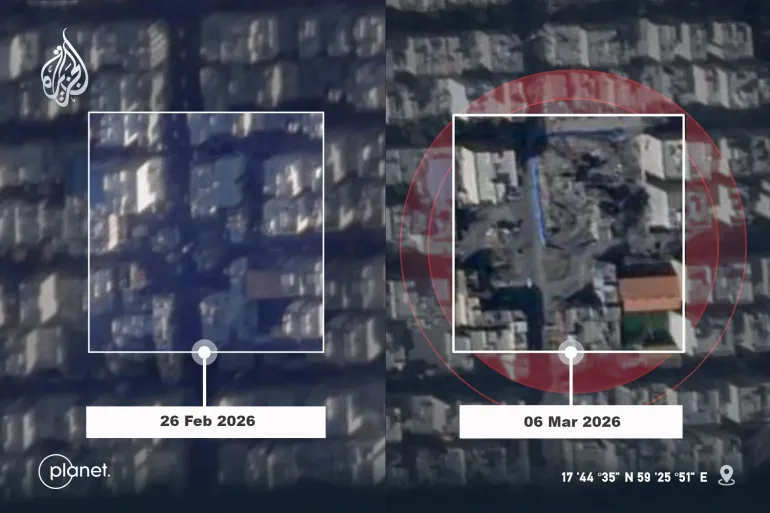
In the densely populated neighbourhoods of southern Tehran, the 11th Criminal Investigation Base once stood as a mundane symbol of local law enforcement. Its detectives investigated economic crimes, fraud and petty thefts.
The building housed no ballistic missiles, no uranium centrifuges and no military command centres. Today, it is a crater. In the opening wave of the United States-Israel war on Iran, warplanes wiped the local police station off the map.
Satellite imagery provided by Planet Labs shows the destruction of the 11th Criminal Investigation Base in southern Tehran on February 26 and March 6, 2026. [Al Jazeera/Planet]
It was not an isolated incident. An investigation by Al Jazeera’s Digital Investigations unit has verified that at least 75 internal security sites were destroyed or damaged in bombardments by Israel and the US from February 28 to March 10. The targeted facilities included local police stations, criminal investigation headquarters, public security offices and checkpoints operated by the Basij paramilitary force.
Al Jazeera mapped the strikes using open-source data, cross-referencing field reports with satellite imagery to confirm the destruction. However, conducting independent verification has grown increasingly difficult. On March 6, commercial satellite providers Planet Labs and Vantor restricted imagery over the Middle East, later expanding the blackout to impose a 14-day delay on all images of Iran.
While the companies said the blackout prevents hostile actors from endangering civilians, independent journalist Ken Klippenstein recently revealed a leaked US Space Force directive dictating how commercial satellite firms describe damage. The leak exposed a deliberate US effort to control the flow of information and obscure the reality of the battlefield.
Targeting population centres
The spatial distribution of the 75 verified strikes revealed a clear and deliberate strategy. Warplanes bypassed isolated military installations to hit the infrastructure Tehran uses to police its citizens.
An Al Jazeera map details the geographic distribution of the 75 internal security sites targeted by US-Israeli strikes, showing a heavy concentration in Tehran and western provinces. [Al Jazeera]
The capital alone absorbed 31 strikes, more than 40 percent of the total targets. Sanandaj, the capital of Kurdistan province, suffered eight strikes. The remaining targets were clustered tightly in major western and central cities, including Isfahan, Kermanshah and Hamedan. Meanwhile, Iran’s sprawling eastern and southeastern provinces remained largely untouched by this campaign.
By overlaying the strike coordinates with demographic maps, the investigation shows a near-perfect alignment with urban density. More than 70 percent of Iran’s population lives in these targeted western urban areas.
A population density map of Iran demonstrates how the strike locations closely align with the country’s most heavily populated urban centres. [Al Jazeera]
The strikes systematically targeted the Law Enforcement Command, known as FARAJA, and the Basij network. FARAJA, elevated in 2021 by late Supreme Leader Ali Khamenei to operate alongside the military, is currently led by Ahmad-Reza Radan. It manages daily urban law enforcement and riot control. The Basij, an immense volunteer paramilitary force deeply embedded in Iranian neighbourhoods, acts as the state’s ultimate tool for social control.
Engineering state collapse
The pattern of the US-Israeli air strikes points to an objective far removed from dismantling nuclear facilities or degrading military infrastructure. It reveals a calculated attempt to engineer the collapse of the Iranian state.
On February 28, US President Donald Trump launched the war and in a video address urged Iranians to take over their government once the bombs stopped falling. Israeli Prime Minister Benjamin Netanyahu echoed this sentiment in Farsi, calling on millions of Iranians to take to the streets and describing the military strategy as breaking the Iranian government’s bones.
The military planning, however, preceded events on the ground that Trump and Netanyahu pointed to for justification for their war. Israeli Defence Minister Israel Katz revealed in early March that Israel had been planning to strike Iran in mid-2026, long before January’s deadly government crackdown across Iran against economic protests.
Satellite imagery captures extensive damage to the Beheshti Basij headquarters in Tehran’s District 8 after the initial wave of strikes. [Al Jazeera/Planet]
This approach aligns with a broader Israeli doctrine. Daniel Levy, a former Israeli government adviser, previously told Al Jazeera that Israel has no interest in a smooth political transition in Tehran. What Israel wants is the collapse of the government and the state, Levy said, adding that if the repercussions spread to Iraq, the Gulf and the entire region, that is better from Israel’s point of view.
A failing strategy
Still, a month into the war, the US-Israeli strategy to spark an internal revolution through the systematic destruction of Iran’s internal security apparatus appears to be failing.
Iranians are living under daily bombardments. As missiles destroy civilian infrastructure and oil refineries burn, daily survival has eclipsed any coordinated political uprising. The United Nations special rapporteur on human rights in Iran has warned that civilians are facing a simultaneous military and human rights crisis.
Rather than collapsing, Iran’s internal security apparatus has adapted. During Ramadan, FARAJA deployed 24-hour patrols across Tehran, and riot police shut down public gatherings before the Persian New Year holiday. After the March 17 assassination of Basij commander Gholamreza Soleimani, Israeli forces released footage of strikes on mobile Basij checkpoints, indicating that Iranian security forces are still controlling the streets.
The US attempt to dismantle state security from the air mirrors its disastrous 2003 de-Baathification policy in neighbouring Iraq, which barred members of the former ruling Baath Party from holding government jobs, dismantled local policing and birthed a devastating sectarian war. Unlike in Iraq, Washington today has no troops on the ground in Iran to fill a security void it is trying to create.
Beneath the rubble of the 11th Criminal Investigation Base and dozens of stations like it, the US and Israel are aiming to bury the Iranian state and spark a popular revolt. Instead, they have trapped millions of civilians in a burning country.
A post-doctoral fellow in Tehran has told Al Jazeera there was no warning before US-Israeli strikes hit the Iran University of Science and Technology on March 28. Helyeh Doutaghi says the attack reflects a wider pattern and raises questions about what defines ‘legitimate retaliation’.
The Israel Defense Forces (IDF) confirmed it had killed Ali Shoeib, who worked for the Hezbollah-affiliated Al Manar TV, describing him as a “terrorist” from Iranian-backed Hezbollah’s elite Radwan Force who had “operated for years under the guise of a journalist”.
Weekly insights and analysis on the latest developments in military technology, strategy, and foreign policy.
Info is slowly dripping out as to the extent of the Iranian attack on Prince Sultan Air Base in Saudi Arabia that occurred on March 27th. Multiple U.S. military aircraft are reported to have been damaged. This is beyond the toll on U.S. service members, which sits at 10 injured, some of critically. While high-resolution commercial satellite imagery of the Middle East from U.S. companies remains delayed for weeks, foreign satellite images purport to show major damage on the base’s main apron. Now, photos from ground level appears to show one of the USAF’s prizedE-3 Airborne Warning and Control System (AWACS) aircraft totally destroyed.
The images were first posted on the Air Force amn/nco/snco Facebook page and has since spread across social media. The photos show E-3 serial #81-0005’s rear fuselage totally burned out and destroyed. There is debris all around the aircraft. It’s worth noting that a direct strike, while certainly possible here, is often not required to destroy an aircraft. The shrapnel from a nearby impact can and especially if a fire is ignited. The attack reportedly included long-range one-way attack drones and ballistic missiles.
It’s important to note that we cannot confirm the authenticity of the images at this time, but they appear, at least after a cursory examination, to look authentic. This assessment could change and we will update this post if it does.
Satellite imagery from prior to when major U.S. commercial providers, specifically Plant Labs, began delaying photos of the Middle East, shows aircraft parked across the main apron and other high-value assets, like the E-3s, parked on isolated taxiways around the airfield. This is clearly an attempt to minimize damage from Iranian long-range weapons by spreading out the aircraft. It’s very possible these aircraft were shuffled around in order to make targeting more challenging.
At least five other tankers were also damaged in a strike on Prince Sultan Air Base earlier in the conflict. The installation, which sits outside of Riyadh, has come under repeated attack. It is a major operating location for American aircraft supporting the war effort.
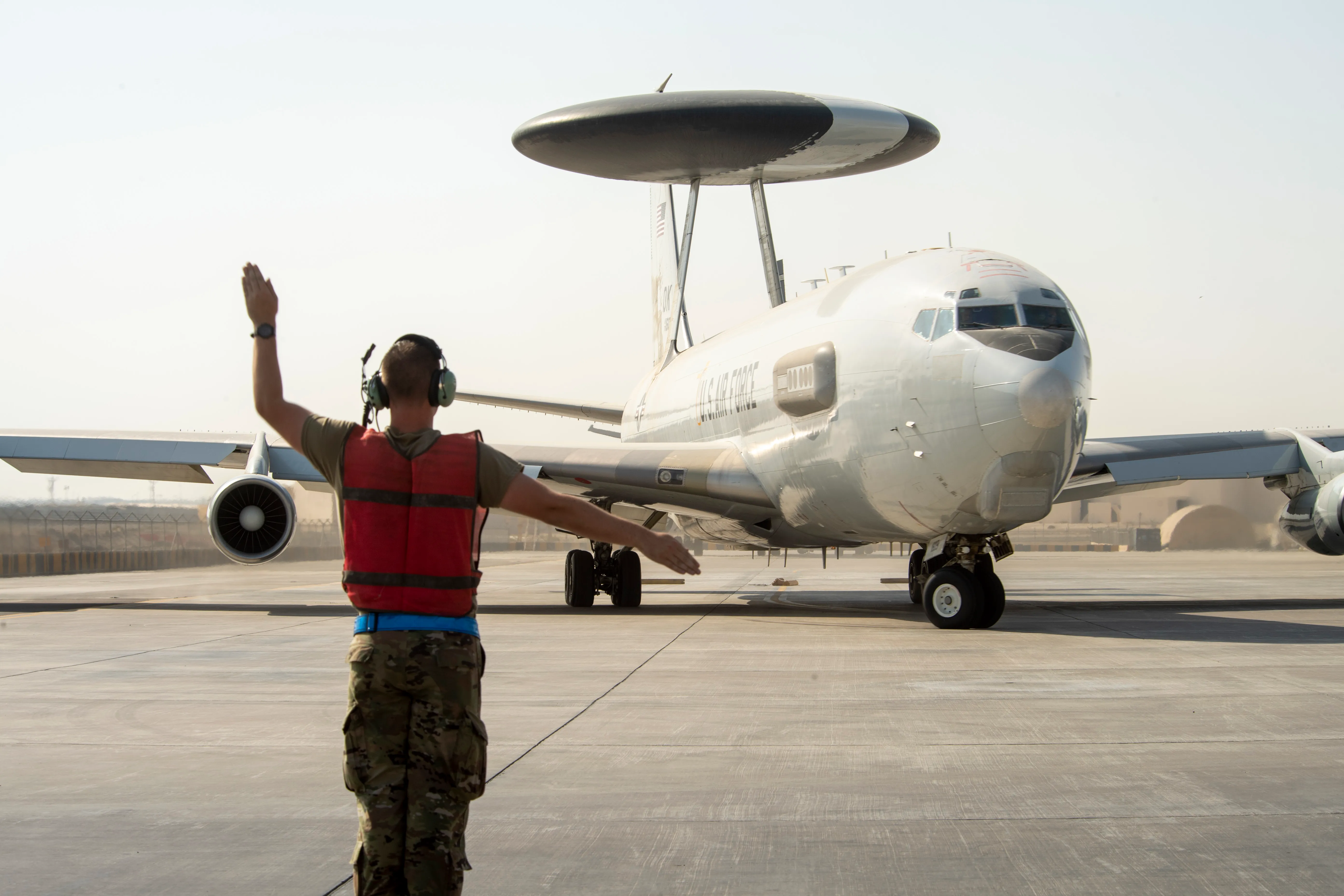
U.S. Air Force Senior Airman Stephen Baker, an E-3 Sentry crew chief, 380th Expeditionary Aircraft Maintenance Squadron, marshals a U.S. Air Force E-3 Sentry Airborne Warning and Control System (AWACS) aircraft on Al Dhafra Air Base, United Arab Emirates, May 19, 2021. (U.S. Air Force photo by Master Sgt. Wolfram M. Stumpf) Master Sgt. Wolfram Stumpf
The USAF wanted to migrate much of the airborne early warning tracking duties to a new space sensing layer, but that technology is still years away from operational maturity. The E-7 Wedgetail was ordered to provide an interim bridge solution to augment the E-3s and eventually take their place until a space sensing layer can take on at least most of the mission. The USAF then tried to cut the E-7 in its last budget and procure a handful of E-2D Hawkeyes as a less expensive interim solution. This bizarre move, which would have led to massive capability gaps at a time of increasing airborne early warning and control demand, has since been heavily disputed by congress and now the USAF’s E-7 program appears that it could be headed back on track. Still, the loss of one of the E-3s in a dwindling fleet, and now a delay in the already late to the party E-7 program, puts the U.S. in an increasingly concerning predicament.
Iran has been somewhat successful at targeting key radar installations around the region that enable America and its allies’ air defenses. The fact that they would target an E-3 should come as absolutely no surprise. As for how they acquired the targeting data, satellite imagery is still available from China and Russia is likely providing them imagery as well. There are many other ways to obtain time critical info like where aircraft are parked on a base that is from far far lower tech sources, including classic human intelligence.
A Cold War era hardened aircraft shelter (HAS). (USAF)
It also comes at a time when America’s most capable adversaries are dumping large sums of money into protecting their aircraft on the ground. Even in the Pacific, where a major war could break out with a near-peer competitor that is armed to the teeth with long-range weaponry, these improvements have been nearly non-existent. Only now, after Al Udeid Air Base in Qatar, America’s largest in the region, has been repeatedly attacked during the war with Iran, has the Pentagon budged at exploring hardening some of its infrastructure there.
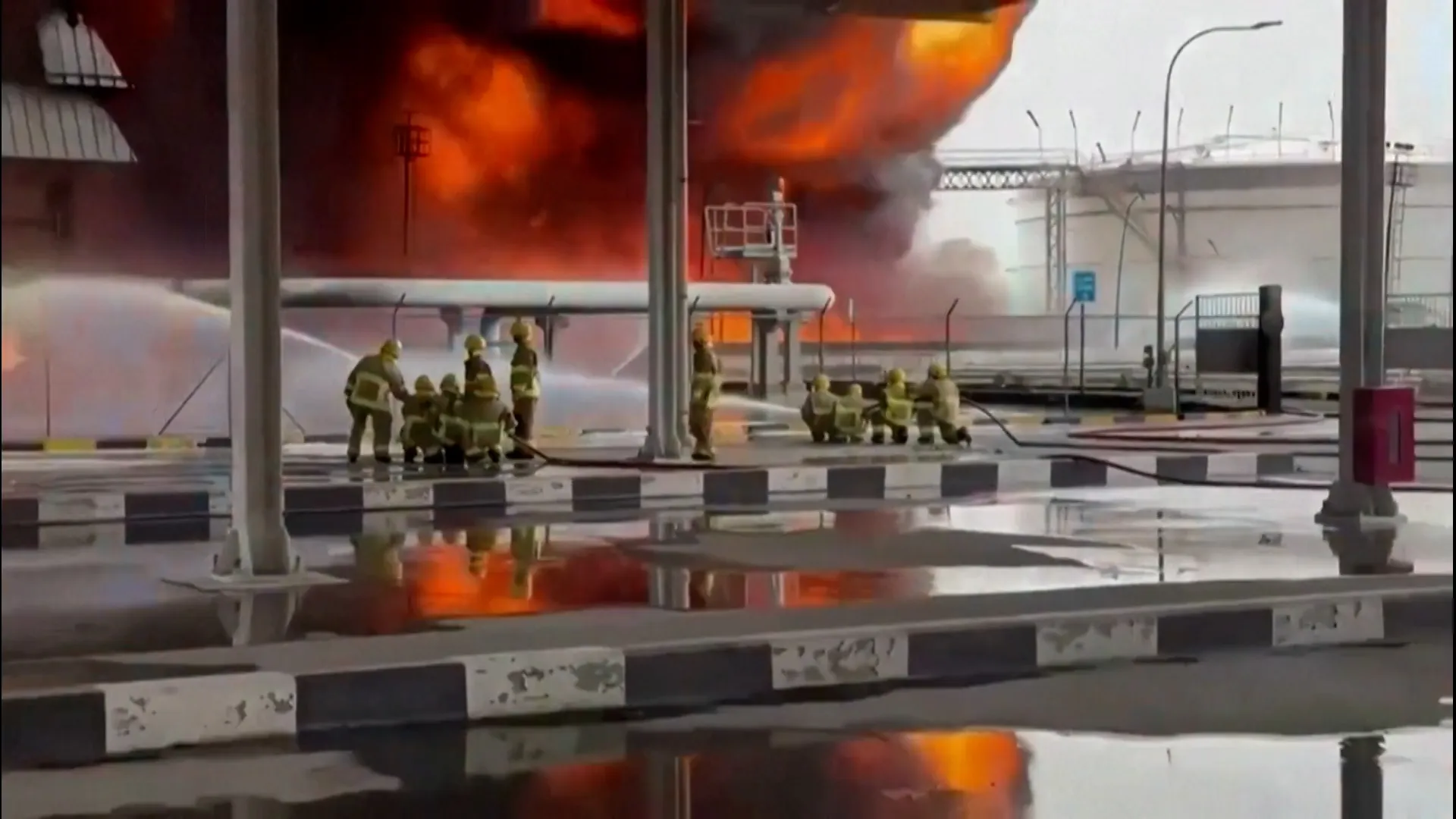
Thick, black smoke rose from Kuwait International Airport Saturday after suspected Iranian drone strikes damaged radar systems and fuel storage facilities, state media said. No fatalities were reported. The airport has been repeatedly targeted since the US-Israeli war on Iran erupted.
A pair of U.S. Air Force F-16Cs from the 457th Expeditionary Fighter Squadron sit prior to take-off from Prince Sultan Air Base in Saudi Arabia, June 13, 2023. On Friday, an Iranian missile and drone attack at the base injured 10 U.S. service members. File Photo by Tech. Sgt. Alexander Frank/U.S. Air Force
March 27 (UPI) — An Iranian attack on an air base in Saudi Arabia on Friday injured 10 U.S. service members — two seriously — unnamed officials familiar with the incident told media outlets.
The attack took place at the Saudi military’s Prince Sultan Air Base in Al Kharj, striking a building where the U.S. service members were, U.S. officials told The Wall Street Journal. NBC News and CBS News also confirmed the attack, citing unnamed sources.
Iran used missiles and drones to carry out the attack, which also damaged multiple refueling vehicles.
Since the start of the war in Iran a month ago, more than 300 Americans have been injured and 13 killed.
The United States and Israel began attacks on Iran beginning Feb. 28 amid stalling talks regarding Iran’s nuclear program. On Thursday, President Donald Trump said the United States would forgo attacks on Iran’s energy sites for 10 days to give time for further negotiations to end the war.
Iran on Friday blamed Israeli for contradicting Trump’s 10-day delay by launching attacks on infrastructure sites, including an energy plant.
The U.S. Air Force’s 378th Air Expeditionary Wing has been based at Prince Sultan base since 2019.
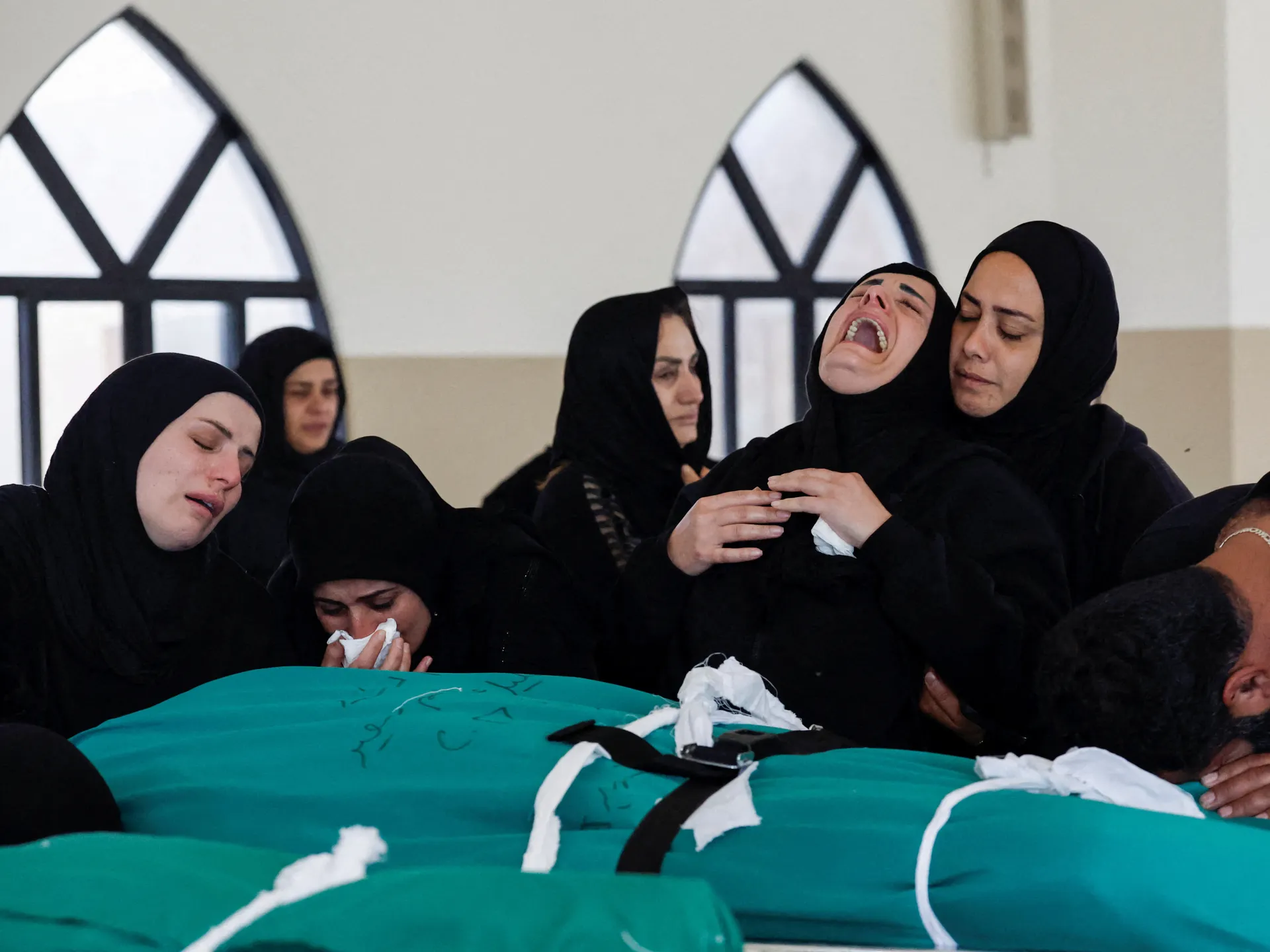
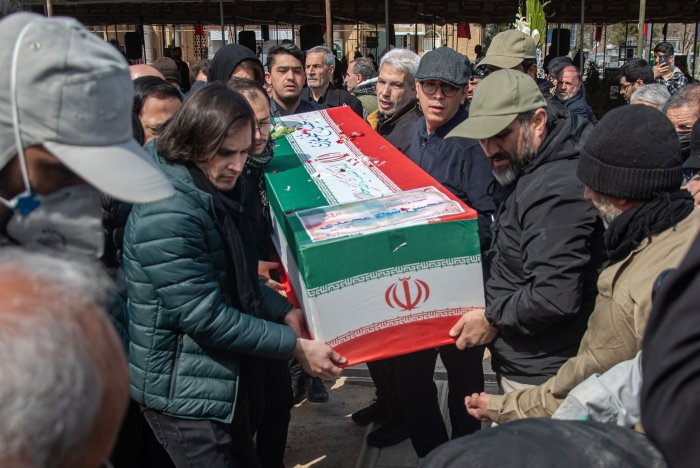
Iranians attend a funeral for a person killed in recent U.S.-Israel airstrikes at Behesht-e Zahra cemetery on the southern outskirts of Tehran in Iran on March 9, 2026. Photo by Hossein Esmaeili/UPI | License Photo
Weekly insights and analysis on the latest developments in military technology, strategy, and foreign policy.
Videos have emerged showing an apparent very close call for a U.S. Navy F/A-18E/F Super Hornet after it was targeted by an Iranian man-portable air defense system (MANPADS) while conducting a low-level strafing run during an Operation Epic Fury mission. The persistent threat posed by Iranian air defenses, whatever is left of them, is something that we have repeatedly drawn attention to.
The videos have been geolocated to the port of Chabahar in Iran’s Sistan and Baluchestan province, which is located along the country’s eastern shore, near the Pakistan border. This would explain, at least to a degree, why the Super Hornet is operating so low over hostile territory. This coastal area was hit hard by strikes from the start of the war, and the near proximity to the ocean means combat search and rescue would be easier to execute in a pinch. There is also a better understanding of what air defense threats remain than, say, in the eastern part of the country.
GeoConfirmed Iran.
A U.S. Navy F/A-18 was hit near the Iranian city of Chabahar after being targeted with what appears to be a MANPADS system. He was flying near or above the Imam Ali Independent IRGC Naval Base.
The date of the incident is unconfirmed, but it is reported to have occurred yesterday.
Better video of a U.S. Navy F/A-18 Super Hornet fighter jet being targeted by the Iranians with a surface-to-air missile, perhaps fired from MANPADS, over the city of Chabahar in southern Iran on Wednesday.
— Status-6 (War & Military News) (@Archer83Able) March 25, 2026
Previously, we have seen plenty of evidence of Super Hornets conducting strafing runs with their M61A1 Vulcan rotary cannons in coastal areas of Iran. Some of these are seen in the videos posted directly below.
Strafing run happened last week, but Navy Super Hornets have continued to operate at low level over Chabahar since. https://t.co/J5JT3FaywK
In the sequence, the distinctive zipping sound of the cannon can be heard, as well as a puff of smoke as the rounds are unleashed.
The F/A-18 makes a left-hand turn before the missile comes into view. It is unclear if the pilot was aware of the threat and maneuvered to avoid it or was unaware of the missile. There is no obvious sign of infrared countermeasures being deployed, although BOL IR-type countermeasures can be harder to see in daylight.
The missile is then seen exploding behind the aircraft, leaving shrapnel in its wake.
While it is not immediately obvious whether or not the F/A-18 was struck, it appears to have escaped relatively unscathed, suggesting this may have been a very lucky near-miss for the crew of the jet.
The Islamic Revolutionary Guard Corps (IRGC) claimed that the Super Hornet crashed in the Indian Ocean. Iran’s Fars News Agency published the statement from the IRGC:
“The enemy F-18 fighter jet was accurately hit in the sky of Chabahar by missiles from the IRGC Navy’s advanced modern air defense system, under the command of the country’s integrated air defense network, and crashed in the Indian Ocean.”
U.S. Central Command responded by denying that any U.S. fighter aircraft had been shot down by Iran, but its statement on X did not immediately rule out a near-miss or damage to the aircraft.
🚫FALSE: The Islamic Revolutionary Guard Corps announced a U.S. F/A-18 fighter was struck over Chabahar using new advanced air defense systems.
There have been multiple Iranian claims of U.S. aircraft being hit by air defenses. So far, however, there is credible evidence for only one previous such incident.
This was the U.S. Air Force F-35A that the IRGC claimed was hit over Iran, and which U.S. officials confirmed made an emergency landing, with the pilot having sustained shrapnel injuries. The IRGC released a video that they claimed shows the F-35 being hit by a missile, as seen through a forward-looking infrared (FLIR) system.
Iran’s IRGC released a footage reportedly showing U.S. F-35 jet being hit over Iran.
As we have explained in the past, while the U.S. has claimed air supremacy over Iran, it certainly does not yet possess it across the entire country. There remain very real risks, especially as the air campaign moves more toward increasing direct attacks farther east in the country, bringing aircraft closer to potential lingering threats.
U.S. forces continue to eliminate threats presented by the Iranian regime, striking over 10,000 targets since the start of Operation Epic Fury. pic.twitter.com/6rTIWG9NBC
For all the defense-suppression missions that have been flown, Iran still possesses road-mobile air defenses as well as more exotic types that can pop up virtually anywhere and give aircrews very little time to react. These systems can be easily hidden and will remain a threat on the battlefield long after static air defenses are destroyed. Beyond that, there are MANPADS, which, while less of a menace in terms of outright performance and engagement envelopes, are impossible to entirely remove from the battlespace.
UPDATES:
We have ended our rolling coverage on Epic Fury for the day.
UPDATE: 4:30 PM EST –
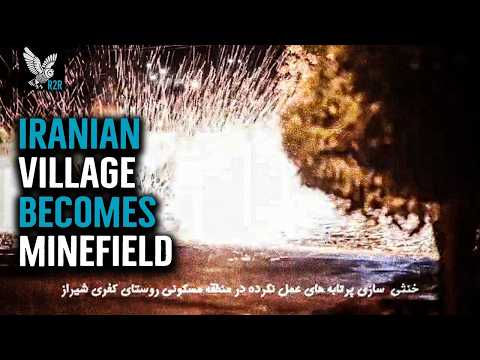
The open-source researchers at the Bellingcat organization say they have identified the mines found overnight in Kafari, Iran, as U.S.-made BLU-91/B anti-tank mines, usually associated with the Gator Scatterable Mine System.
Bellingcat identified the mines found overnight in Kafari, Iran as US BLU-91/B anti-tank mines from the Gator Scatterable Mine System. At least two people were reportedly killed.
There have been suggestions that the mines may have been dropped along roads to try to prevent Iranian mobile missile launchers from deploying out of their mountain bases and heading to launch sites.
It looks as if President Trump has suspended his ultimatum on the Strait of Hormuz for another 10 days. Trump, under increasing domestic pressure as oil prices soar, had last week warned that the U.S. military would “obliterate” Iranian power plants if the strait is not open before a 48-hour deadline.
UPDATE: 4:00 PM EST –
U.S. Secretary of State Marco Rubio stated today that a “growing amount of energy” is flowing through the Strait of Hormuz as indirect contacts between the United States and Iran show progress.
“There’s a growing amount of energy that’s been flowing through the strait, not as much as should be flowing, but some of it has picked up. There’s been some progress in regards to the exchange of messages, but that’s an ongoing and fluid process, and not one we’re going to negotiate or talk about in the media,” Rubio explained to reporters.
Marco Rubio on Iran:
Some concrete progress has been made, as you’ve seen and as has been documented already.
There’s a growing amount of energy that’s been flowing through the Strait — not as much as should be flowing, but some of it has picked up. pic.twitter.com/du9zZ5AEgt
President Donald Trump today reiterated his estimated timeline for ending the war with Iran, saying that he still plans for it to last just four to six weeks.
Trump made the statement during a Cabinet meeting at the White House, telling reporters that the U.S. is already “way ahead of schedule” on the conflict.
“We estimated it would take approximately 4 to 6 weeks to achieve our mission, and we’re way ahead of schedule. If you look at what we’ve done in terms of the destruction of that country, I mean, we’re way ahead,” Trump said.
UPDATE: 3:50 PM EST –
President Trump has slated the U.K. Royal Navy’s Queen Elizabeth class aircraft carriers as “toys” compared to the flattops of the U.S. Navy.
In his latest spat with the United Kingdom, Trump said America “doesn’t need” British help in the conflict, despite repeatedly criticizing its reluctance to get involved.
Relations between Trump and U.K. Prime Minister Keir Starmer have been tense ever since Starmer refused America permission to launch its initial strikes on Iran from RAF bases.
UPDATE: 3:40 PM EST –
Trump has revealed the nature of the “present” from Iranian officials, which he alluded to earlier this week.
Trump said that Iran has allowed 10 oil tankers through the Strait of Hormuz as a sign of good faith for talks to end the war. Trump told reporters: “[Iran said] we’re going to let you have eight boats of oil, eight boats, eight big boats of oil. This was two days ago. And they’ll sail up tomorrow. That was three days ago. And I didn’t think much about it. And then I watched the news, and they said, a very good anchor actually happened to be Fox. But I watched it, and they said something unusual is happening. There are eight boats that are going right up the middle of the strait. Eight big tankers are going loaded up with oil right through. And I said, well, I guess, I guess they were right. And they were they were real. And I think they were Pakistani-flagged. And, I said, well, I guess we’re dealing with the right people. And, actually, they then apologized for something they said, and they said, we’re going to send two more boats. And we ended up being 10 boats.”
Today, however, publicly available ship-tracking data revealed only two Iran-linked LPG carriers were seen leaving the Persian Gulf, possibly the “extra two” vessels Trump referred to.
Bloomberg tanker data shows no sign of the eight oil ships Trump mentioned in the Hormuz Strait.
Only two Iran-linked LPG carriers were seen leaving the Persian Gulf Thursday, possibly the “extra two” he referred to.
In its latest update on the situation in the Middle East, the U.K. Ministry of Defense claims that Russia was likely providing intelligence and training to the Iranian military ahead of the United States and Israel launching their operations. Russian expertise for Iran likely encompassed drone technology and electronic warfare, drawing from their own experience in Ukraine.
The commander of U.S. Central Command (CENTCOM), Adm. Brad Cooper, has provided his view on the death of Iran’s Islamic Revolutionary Guard Corps (IRGC) Navy commander in an Israeli airstrike.
According to Cooper, under Adm. Alireza Tangsiri’s command for eight years, the IRGC Navy “harassed thousands of innocent merchant mariners, attacked hundreds of vessels with one-way attack drones and missiles, and killed countless innocent civilians.”
We are seeing a major airlift operation underway at the remote American outpost in the Indian Ocean, Diego Garcia. Five C-17s and a C-5 were visible on the main ramp at the airfield today. This is a sudden uptick in aerial logistics on the island.
There has been a contingent of KC-135R tankers that have been using the island, as well as a handful of F-16s protecting it. And while a transport or two would be seen coming and going, this is an airlift operation that is much larger. There had been some talk that air defenses were being moved from Asia to the island after Iran supposedly took two ballistic missile shots at it. The Navy also continues to use its port facilities there to support ships that are taking part in Epic Fury. The USS Tripoli and its escorts just stopped by there on their way to the Middle East, for instance. But this could also be the logistics surge before a bomber deployment. While B-52s and B-1s operate at a high tempo from RAF Fairford in the UK, the B-2s are still flying missions from the United States. This could be about to change.
Planet Labs
Russia is close to completing a phased shipment of drones to Iran, according to Western intelligence reports about Moscow’s efforts to keep its embattled partner in the fight against Israel and the United States. As well as drones, Moscow is set to provide Tehran with medicine and food, the Financial Timesreports. However, Russia appears to have turned down Iranian requests for long-range air defense systems.
The British newspaper cites two officials who were briefed on the intelligence report. They state that senior Iranian and Russian officials began secret discussions on the delivery of drones only days after Israel and the United States attacked Iran.
The first shipment of Russian-made drones reportedly began to be delivered to Iran in early March and was due to be completed at the end of the same month.
The reports provide the first firm indication since the start of the war that Moscow is providing Iran with lethal, as well as non-lethal, support. Russia is also understood to provide Iran with other critical military capabilities, including satellite imagery, targeting data, and intelligence support.
Although the types of drones included in the deal are not disclosed, they very likely include the Geran-2, which is a Russian-based version of the Iranian Shahed-136.
Inside a Russian factory where licensed production of the Iranian Shahed-series one-way attack drone is taking place. via X
Asked about Moscow sending drones to Iran, Kremlin spokesperson Dmitry Peskov told the FT: “There are a lot of fakes going around right now. One thing is true — we are continuing our dialogue with the Iranian leadership.”
Russian support for Iran is not just about ensuring that Iran remains able to hit back at Israel and the United States, but also about securing its own interests: namely, keeping a pro-Kremlin regime in control in Tehran.
Publicly, Moscow has voiced its support for Tehran but has presented its support as humanitarian, rather than military. In particular, Russia has publicized its provision of humanitarian aid to Iran since the start of the conflict.
On the other hand, the Russian provision of Geran-series drones makes a lot of sense for Iran. So far, Tehran has relied heavily on long-range one-way attack drones to hit targets across the Middle East. Reportedly, it has fired more than 3,000 of these drones since the start of the fighting.
While the Shahed-136 is notably cheap to manufacture, Iran is clearly burning through its accessible stocks of the drones, while its production capacity is also coming under attack by Israel and the United States. With a production line already up and running in Russia, and reportedly churning out thousands of Geran drones each month, Iran would clearly benefit from tapping into this supply.
Russia has also been producing more advanced versions of the one-way attack drones for use in its own war in Ukraine. Modifications include measures to better evade air defences and to carry heavier and more varied payloads, as well as more precise navigation systems. Such developments would likely be of interest to Iran, as well.
Ultimately, in the next stage of the deepening Russia-Iran relationship, Tehran could start to manufacture drones incorporating some of the advances that have been introduced and combat-tested by Russia.
Regardless, Israel is already actively interdicting shipments between Iran and Russia on the Caspian Sea via airstrikes. Moving large volumes of drones across that waterway will be an increasing challenge as those shipments will be a top target of the IAF and Mossad.
At the same time, Tehran looks set to miss out on advanced air defense capabilities that it had requested from Russia.
Russia has declined, however, Iranian requests for the S-400, the FTreports, based on information provided by current and former Western officials. It is assumed that Moscow wants to avoid further escalation with the United States, especially if Iran were to use the S-400 to target U.S. military jets.
However, Russia did close a deal last December to deliver 500 Verba man-portable air defense systems (MANPADS) as well as 2,500 of the associated 9M336 missiles over three years. The Verba was developed as a replacement for the widely used Igla. Its primary advantage is its advanced multispectral seeker, operating in the ultraviolet, near infrared, and mid-infrared bands, for improved discrimination between targets and decoys.
An official marketing video showing the Verba (SA-29 Gizmo) MANPADS:
Verba MANPADS
U.S. President Donald Trump has issued another warning to Iran, while repeating his claim that Tehran is “begging” for a deal to end the war.
Trump warned that Tehran “better get serious soon, before it is too late.”
It is unclear whether Iran is serious about negotiations, after reports that the Trump administration offered Tehran a 15-point ceasefire plan earlier this week. The plan was reportedly presented to Iranian officials via Pakistan.
In public, Tehran has said it rejects the proposal, although there have been suggestions that Iranian officials are at least reviewing it.
Iranian Foreign Minister Abbas Araghchi told state media that his government has not engaged in talks to end the war and that it does not plan on any negotiations. While he acknowledged the United States had tried to send messages to Iran through other nations, he said that was “not a conversation nor a negotiation.”
Writing on his Truth Social app, Trump said: “The Iranian negotiators are very different and ‘strange.’ They are ‘begging’ us to make a deal, which they should be doing since they have been militarily obliterated, with zero chance of a comeback, and yet they publicly state that they are only ‘looking at our proposal.’ WRONG!!! They better get serious soon, before it is too late, because once that happens, there is NO TURNING BACK, and it won’t be pretty!”
The White House has reiterated this hard line, with a warning that the U.S. military was prepared to “unleash hell” if Iran did not accept defeat. Press secretary Karoline Leavitt said the U.S. president preferred a peaceful path but was prepared to “hit [Iran] harder than they have ever been hit before” if necessary.
‘President Trump does not bluff and he is prepared to unleash hell. Iran should not miscalculate again’
Negotiations as soon as this weekend seem less likely, at least according to Ishaq Dar, the foreign minister and deputy prime minister of Pakistan. In a statement on X, he wrote:
“There has been unnecessary speculation in the media regarding peace talks to end the ongoing conflict in the Middle East. In reality, U.S.-Iran indirect talks are taking place through messages being relayed by Pakistan. In this context, the United States has shared 15 points, being deliberated upon by Iran. Brotherly countries of Turkiye and Egypt, among others, are also extending their support to this initiative. Pakistan remains fully committed to promoting peace and continues to make every effort to ensure stability in the region and beyond. Dialogue and Diplomacy is the only way forward!”
Options for what the U.S. military might do next include deploying ground forcesand/or a massive bombing campaign, according to Axios, which cites two U.S. officials and two sources with knowledge of the ongoing discussions.
In terms of ground forces, the United States is looking at the option of invading or blockading Kharg Island; invading the island of Larak, another strategic outpost in the Strait of Hormuz; seizing the strategic island of Abu Musa and two smaller islands, which lie near the western entrance to the strait; and blocking or seizing ships that are exporting Iranian oil on the eastern side of the Hormuz Strait.
Axios: The Pentagon is developing military options for a “final blow” in Iran that could include the use of ground forces and a massive bombing campaign, according to two U.S. officials and two sources with knowledge. pic.twitter.com/M1ozZbZUPA
The possibility of the U.S. military seizing one or more islands belonging to Iran or taking control of the Strait of Hormuz is also unlikely to find favor with Israeli officials.
Operations of this kind would be “complex and fraught with danger,” and would likely trigger “massive Iranian attacks on energy infrastructure, the laying of mines, and, in any case, a severe escalation.” This is the assessment of unnamed Israeli security officials speaking to journalist Nadav Eyal.
Exclusive – Israeli security officials: The option of seizing islands in Iran (Kharg or others) or the Strait of Hormuz is “complex and fraught with danger,” and would likely trigger “massive Iranian attacks on energy infrastructure, the laying of mines, and, in any case, a…
Trump has also lashed out at NATO allies for doing “absolutely nothing” to assist the United States in the conflict.
Adopting all caps for his Truth Social post, Trump wrote: “NATO NATIONS HAVE DONE ABSOLUTELY NOTHING TO HELP WITH THE LUNATIC NATION, NOW MILITARILY DECIMATED, OF IRAN. THE U.S.A. NEEDS NOTHING FROM NATO, BUT ‘NEVER FORGET’ THIS VERY IMPORTANT POINT IN TIME!”
Trump: “NATO NATIONS HAVE DONE ABSOLUTELY NOTHING TO HELP WITH THE LUNATIC NATION, NOW MILITARILY DECIMATED, OF IRAN. THE U.S.A. NEEDS NOTHING FROM NATO, BUT ‘NEVER FORGET’ THIS VERY IMPORTANT POINT IN TIME! President DONALD J. TRUMP” pic.twitter.com/E7eqLHUXMg
Israel has announced the latest senior Iranian military official to have been killed in an airstrike: the commander of the Islamic Revolutionary Guard Corps (IRGC) Navy.
Prime Minister Netanyahu:
“We continue to forcefully strike the targets of the Iranian terrorist regime.
Last night, we eliminated the Commander of the IRGC Navy. This man had a great deal of blood on his hands; he was also the one who led the closure of the Strait of Hormuz. pic.twitter.com/XZPXK4ivXt
According to the Israeli defence minister, Israel Katz, the Iranian naval commander of the IRGC, Alireza Tangsiri, was killed along with other “senior officers of the naval command” in an overnight strike in southern Iran. Tangsiri was “directly responsible for the terrorist operation of mining and blocking the Strait of Hormuz” and has been “blown up,” Katz said in a video statement. Iran has yet to comment.
According to The New York Times, citing three Israeli officials, Tangsiri was targeted while he was in an apartment hideout alongside other IRGC officers. Some Israeli media outlets report that Tangsiri was killed in a strike in the southern Iranian city of Bandar Abbas.
BREAKING:
The IRGC Navy Commander Alireza Tangsiri has been eliminated in an Israeli airstrike in Bandar Abbas.
Israel’s military said today that it had carried out a wave of strikes across Iran, including extensively in the central city of Isfahan. It said Israeli forces “completed a wide-scale wave of strikes targeting infrastructure” of the regime.
Meanwhile, Iran has launched further attacks on Israel, with reports of explosions in Jerusalem, as well as in the central town of Kafr Qasim. Both those areas have seen non-stop air raid alerts today, with reports that Iran launched at least six missiles, including some apparently carrying cluster munitions.
Reports indicate that missile fragments or cluster munitions struck the outskirts of Jerusalem, while more missile debris reportedly came down in the Modiin area, just outside Jerusalem.
An Iranian missile attack on Kafr Qasim reportedly left six people “lightly injured by blast effects.” The city’s mayor, Haitham Taha, said the blast this morning was caused by cluster munitions. A video purportedly taken in Kafr Qasim this morning showed a car being flipped over by a nearby blast.
Iranian bombardment of U.S. military facilities in the wider region appears to be having a significant effect, according to a report from The New York Times.
Citing military personnel and American officials, the newspaper states that many U.S. troops have been forced to relocate from their bases to hotels and office spaces throughout the region.
“So now much of the land-based military is, in essence, fighting the war while working remotely, with the exception of fighter pilots and crews operating and maintaining warplanes and conducting strikes,” the article contends.
NYT: Iran’s missile and drone attacks have driven U.S. forces from U.S. military bases, “forcing many American troops to relocate to hotels and office spaces throughout the region.”
The need to keep the U.S. military and its allies in the Middle East supplied with weapons could be bad news for Ukraine. The Washington Postreports that the Pentagon is considering whether to divert to the Middle East critical munitions earmarked for Ukraine. The report cites three people familiar with the matter, but notes that a final decision to redirect the equipment has not yet been made.
The weapons that could be diverted away from Ukraine would almost certainly include air defense interceptor missiles, badly needed by Kyiv, but also by allies in the Middle East that continue to come under Iranian drone and missile attack.
‘The Pentagon is considering whether to divert weapons intended for Ukraine to the Middle East as the war in Iran depletes some of the U.S. military’s most critical munitions, according to three people familiar with the matter.⁰….⁰The weapons that could be diverted away from…
The Israel Defense Forces (IDF) remain heavily engaged on a second front in Lebanon. Israeli Prime Minister Benjamin Netanyahu has said that Israel will expand its occupation of southern Lebanon, creating what he described as a “larger buffer zone” to push back the threat of Hezbollah.
Today, the IDF confirmed that another Israeli soldier has been killed in combat in southern Lebanon, amid ongoing fighting with Hezbollah militants along the border. Reportedly, the soldier, part of the Golani Brigade’s Reconnaissance Unit, was killed in an exchange of fire with Hezbollah gunmen, during which another Israeli soldier was lightly hurt.
This brings the number of Israeli soldiers killed in southern Lebanon to three, after the military said two were killed on March 8.
Hezbollah chief Naim Qassem has said any negotiations with Israel would amount to “surrender,” and the Iran-backed group is continuing to launch attacks on Israel.
Hezbollah chief Naim Qassem says negotiations with Israel under fire would amount to “surrender,” as the #Iran-backed group launched attacks and #Israel said it is expanding a “buffer zone” inside #Lebanon.https://t.co/NvOLxb3J7M
In Abu Dhabi, the capital of the United Arab Emirates, two people were killed by falling debris after an Iranian missile was intercepted, according to local media. In a post on X, the official Abu Dhabi Media Office said three others were injured in the incident. Since the war began, at least 10 people have been reported killed in the UAE from Iranian attacks.
Abu Dhabi authorities have responded to an incident involving falling debris in Sweihan street, following the successful interception of a ballistic missile by air defence systems. The incident resulted in the deaths of two unidentified individuals, three injuries, and damage to…
Kuwait has said it had arrested six people over an alleged Hezbollah plot to assassinate leaders in the Gulf state. The interior ministry said five of those arrested were Kuwaiti citizens. It added that 14 more members of the group had fled the country.
Kuwait says it has uncovered a Hezbollah plot to assassinate state leaders.
The Interior Ministry reported that six suspects, five of them Kuwaiti, confessed to espionage and terrorist activities, including assassination training. pic.twitter.com/Qc80Brf7y7
An Iranian envoy has said South Korean ships could pass through the Strait of Hormuz only after coordinating with Tehran, the Yonhap News Agencyreported.
Iranian Ambassador to South Korea Saeed Koozechi said that his country has asked Seoul to provide details of the vessels stranded in the key waterway. Reportedly, 26 South Korean ships with about 180 crew members aboard remain stranded in the shipping lane, effectively blocked by Iran following attacks by the United States and Israel.
Weekly insights and analysis on the latest developments in military technology, strategy, and foreign policy.
Iran is accusing the U.S. of dropping anti-tank landmines in an area near one of its underground missile facilities (often referred to as missile cities) that it claims killed several people. While we cannot independently verify the provenance of the images provided by Iranian media or the casualty claims, the use of these munitions would make sense. Despite an intense bombing campaign against Iran’s missiles and launch sites, the Islamic Republic is still firing these weapons at targets across the Middle East. A highly-targeted area-denial campaign around specific missile facilities using mines could help reduce that threat.
The accusation about the landmines came Thursday morning in the form of social media posts by Iran’s official Tasnim news agency.
“These explosive packages resemble ready-made canned food, are somewhat larger than tuna cans, and contain explosives that detonate after being opened, causing casualties,” Tasnim wrote on Telegram. “These packages have been dropped in the skies over the southern suburbs of Shiraz, especially in the village of Kafari, and unfortunately have caused the martyrdom of several people in these areas.”
The Tasnim posts included several pictures of what appear to be BLU-91/B scatterable anti-tank landmines.
جنایت جدید آمریکایی ـ صهیونی در برخی مناطق کشور
رهاسازی بستههای انفجاری با جنگنده
این بستههای انفجاری شبیه کنسرو آماده بوده و حاوی مواد منفجرهای است که بعد از بازگشایی منفجر شده و باعث تلفات جانی میگردد #انتقام_سختpic.twitter.com/0mChpxVhLP
“This video shows at least three mines approximately two kilometres away from the entrance to what is reported to be Shiraz South Missile Base, an Iranian ‘missile city,’” Bellingcat added. The video shows several of the mines scattered in a village.
In Major Escalation, Epstein Regime Rains Electro-Magnetic Mines Down On Iranian Village
“The US is the only participant in the war known to possess these mines,” Bellingcat posited. “They were developed after the US stopped supplying arms to Iran. A review of Stockholm International Peace Research Institute’s (SIPRI) Arms Transfer Database, and US Major Arms Sales does not show any transfers of these mines to Israel.”
We cannot independently verify the origin of the mines seen in the video, but it seems unlikely that Iranians would have access to them. Still, it is possible they did, or have produced dummies or clones, and placed them there for propaganda value. U.S. Central Command declined to say if these mines are being used during Epic Fury.
Iran has been able to preserve a number of its missile launchers, which could involve moving them in and out of underground facilities like the one near Shiraz or hiding them elsewhere in the area and moving them to designated launch points. This is occurring even after these facilities have been repeatedly bombed. These aerial attacks have focused on keeping their entrances caved in. These strikes are on top of the vast, resource-consuming interdiction effort to hunt for and strike launchers that are exposed. So, continued launches from these areas would be a major reason why resorting to deploying anti-tank mines there makes sense and would have a high military value.
🚨 WATCH: CENTCOM releases footage of strikes on fortified missile bases in southern Iran. The first footage includes hits on tunnel entrances and on mobile and stationary launchers at the missile base in Hajjiabad, Iran. pic.twitter.com/wuoi5GEhqp
— Major Sammer Pal Toorr (Infantry Combat Veteran) (@samartoor3086) March 22, 2026
The IDF publishes footage showing a recent airstrike on an Iranian ballistic missile launcher in western Iran that it says was primed for an attack on Israel.
In additional strikes yesterday, the military says the Israeli Air Force hit several ballistic missile storage and… pic.twitter.com/UVE5bTAJNd
— Emanuel (Mannie) Fabian (@manniefabian) March 24, 2026
CENTCOM:
The Iranian regime is using mobile launchers to indiscriminately fire missiles in an attempt to inflict maximum harm across the region.
U.S. forces are hunting these threats down and without apology or hesitation, we are taking them out.pic.twitter.com/l4lxbTlAf4
Designed to attack tanks and trucks, the mines could destroy or disable the launchers and likely the payloads they carry. They could also make roads to and around the underground missile cities unpassable. Even limiting where the launchers could go within these areas could make them more vulnerable.
The mines are part of the Gator family of systems that includes the air-delivered BLU-91/B and a companion anti-personnel type (BLU-92/B). Different mixes of the mines can be loaded with several types of bomb-like air-dropped dispensers, which break open after release to disperse their payloads over a targeted area.
U.S. Army FM-20-32 Mine/Countermine field manual.
Each mine and dispenser combination has its own designation. Cluster munitions loaded with Gator mines can be employed by many of the U.S. combat aircraft known to be taking part in Operation Epic Fury today, including bombers. The last known combat employment of Gator mines appears to have been during the Gulf War in 1991. There were unconfirmed reports of Gator use in the opening phases of the war in Afghanistan in 2001.
Air-delivered BLU-91s and BLU-92s both have box-like “aeroballistic adaptors.” That feature is absent on related mines in U.S. Army service that are laid via launchers mounted UH-60 Black Hawk helicopters and trucks.
mines
From a humanitarian viewpoint, there is concern about collateral damage from civilians inadvertently setting them off or picking them up without knowing what they are. Gator mines are not known to have anti-handling features but can still be dangerous to move. They can also be preset to self-destruct after four hours, 48 hours, or 15 days. It’s worth noting that the mines do not always detonate themselves or otherwise function intended, as is the case with all munitions.
That being said, the missile cities are removed from urban areas and sit within large, tightly controlled perimeters. Mining these areas, where civilians have no access, would present a far lower danger to innocent lives than mining random roads or ones near military bases in urban areas.
Of note is that in terms of the mines themselves, the pictures circulating online so far only appear to show BLU-91s having been used in Iran. These are readily distinguishable from BLU-92 anti-personnel mines, which have four ports on top of their main bodies through which spring-loaded trip wires are fired after the mine activates. The tops of the BLU-91s are flat. Gator mine cluster munitions are typically loaded with some amount of both types of mine, but types containing only BLU-91s have at least been tested in the past.
The distinction is important. While the U.S. is not a signatory to the international treaty known as the Ottawa Convention which banned the application or storage of anti-personnel landmines, it does not allow the use of them. There are no such preclusions against anti-tank mines.
It remains to be seen whether the mines, if truly dropped by the U.S., are an isolated incident or part of a broader campaign as Epic Fury drags into a second month. However, deploying an area denial capability like air-dropped anti-tank mines in places where the missiles are known to be stored and around known launch points could prove to be an effective measure in trying to stop Iran’s barrages from continuing.
Iranian missiles have caused widespread damage across Israel in the latest wave of attacks, as President Donald Trump says US-Israeli strikes have destroyed the majority of Iran’s missile launchers.