What’s done is done.
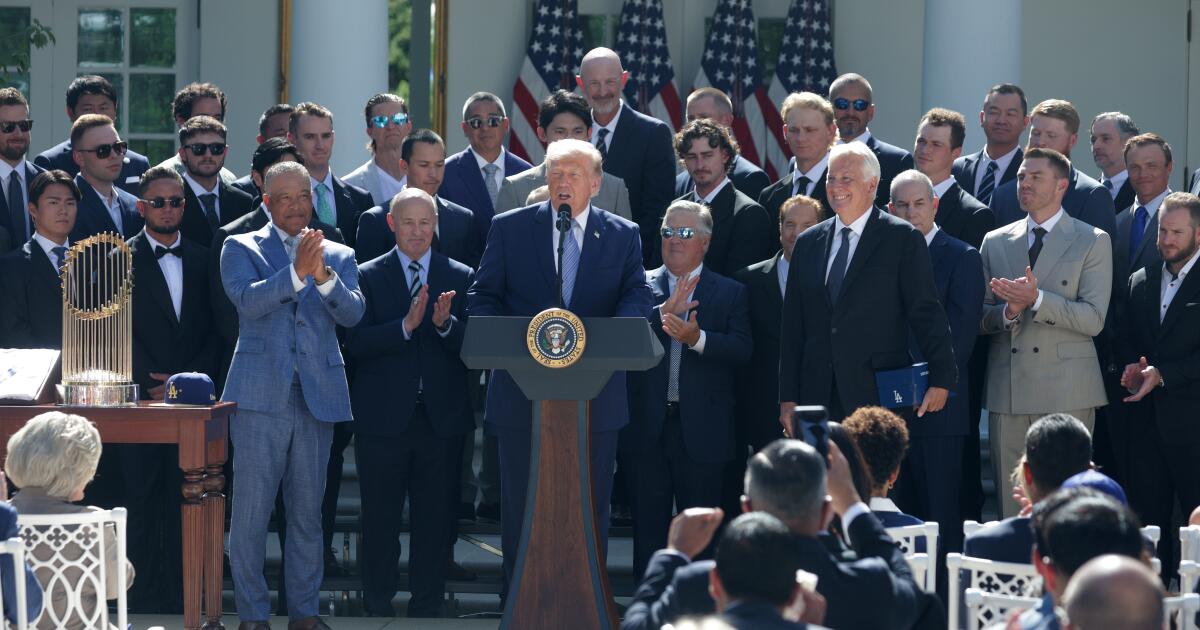
The Dodgers went to the White House on Thursday and met with President Trump for the second year in a row, following back-to-back World Series championships.
At the time of their visit, the Dodgers had the best record in Major League Baseball with 65 wins and 38 losses. Winning three titles in a row won’t be easy, but assuming they pull off another victory in October, here are five reasons the Dodgers should not go back to the White House next year.
What’s the point?
Ceremonial visits have been going on for years, and both Democratic and Republican presidents have embraced the tradition with athletes from various sports.
If you’d like to know why I didn’t have anything to say in 2021, when the Dodgers visited President Biden at the White House, that’s a good question.
I didn’t dwell on it at the time because I think such visits are kind of ho-hum. But now we’ve had three visits in five years, and in my head, this hammers home the point that baseball players have nothing to gain from a visit. They’re baseball players, and as such, there is no higher honor than winning the World Series.
I like baseball, but it’s not like these guys are astronauts, just back from the moon.
If the Dodgers want to mark their achievement and honor the game of baseball in the nation’s capital, fine. They should go to the Smithsonian as a team and visit the display where Jackie Robinson’s jersey is enshrined.
They’re being put in an awkward position
As Dodgers shortstop Mookie Betts put it in saying that he wouldn’t join his teammates, he couldn’t win either way.
“If I do” go, he said, “people are gonna hate me. If I don’t, people are gonna hate me.”
That’s an exaggeration, but I get his point. Dodger utility man Kiké Hernandez said he wasn’t going, either, explaining that he was busy rehabbing an injury.
The Dodgers should take the pressure off the players by politely declining an invitation to visit.
Besides, people like baseball because it’s an escape, a distraction, a diversion. You want to have a clear head as you try to remember why you willingly packed up your kids and paid $400 for lousy seats and food at Dodger Stadium to watch Kyle Tucker, at $60 million a year, foul out to the catcher.
You do not want to think about the American political cesspool as you watch the Dodgers rally from behind, win in late innings, and inch ever closer to going back to the White House again next year.
They’re being used
The players were apparently told they could make their own decision about whether to go to the White House.
What they should have been told was that they were being exploited.
When a president hosts a team at the White House, there is only one reason.
It’s a photo op.
Not for the team, but for the president.
Baseball might no longer be the national pastime, but it’s a part of American culture, with fans of every political stripe in every state. There’s kind of a folksy quality in the manufactured banter between a president and the ballplayers. He can fawn over them and joke with them and look more like a regular guy — one of the boys.
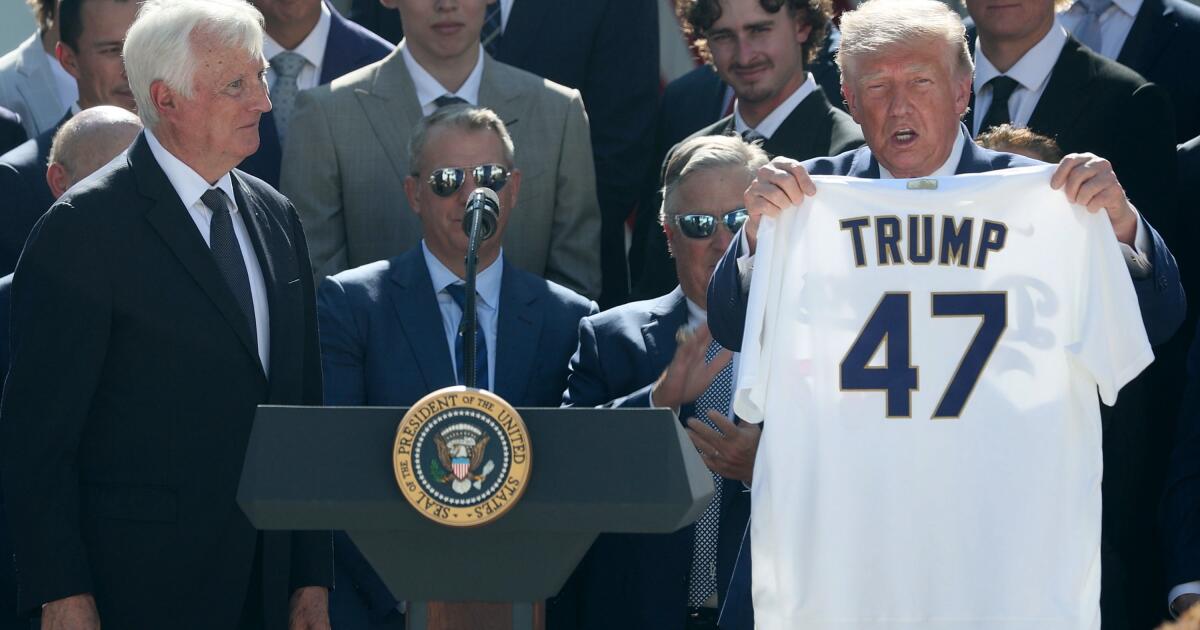
“This is really a special team,” Trump said during the Dodger visit. “It’s special winners. They’re champions, and just unbelievable.”
Yeah, we knew that when they beat the Blue Jays.
Nine months ago.
Too much ring kissing is a turnoff
If you are going to go, can you at least not embarrass yourself?
Dodgers Chairman Mark Walter handed Trump a Dodgers jersey and World Series ring at the White House. Somehow, he managed to restrain himself from bending to one knee and kissing the president’s ring.
“Thank you for welcoming us today, Mr. President,” Walter said. “We’re proud of that team and what it has achieved, and we hope to be back here again next year.”
As The Times’ Maddie Lee noted, this was just days after Bloomberg reported that “two insurance companies controlled by Walter, as well as Guggenheim Partners, where Walter is chief executive, are being investigated by federal prosecutors for potential financial improprieties.”
“No charges have been filed,” Lee wrote. “Representatives from the parent company of the insurance firms as well as from TWC Global — the Walter business empire that controls his sporting investments, including the Dodgers and Lakers — have told reporters they are cooperating with the investigation.”
So that’s another problem with the Dodgers’ visit.
How can we not wonder about ulterior motives?
It’s hard to keep track of who’s kissing whose ring.
Politics is unavoidable
The Dodger brain trust has attempted to cast White House visits as an exercise in tradition, not politics.
“Like I’ve always said, my company line, my personal line is I hope that we get this invitation every year,” Dodgers manager Dave Roberts said before the visit. “Because that’s the goal: to win a championship, to get this invitation to the White House. And I’m not a politician, and I’m doing something that teams have done for decades. And so that’s where I stand, really. I’m a baseball coach. That’s what I do.”
That couldn’t be more naive.
The Dodgers love to project a wholesome, family-friendly essence. But American discourse has not been more vulgar, polarizing or politicized in my lifetime, and I’m reminded of the line, “Lie down with dogs, get up with fleas.”
In Trump’s world, there are only two kinds of people: friends and foes. The Dodgers are now friends, and when Venezuelan World Series hero Miguel Rojas was singled out by Trump, who launched an unprovoked attack on his country, that reeked of calculated political staging.
The White House itself has been a staging ground for political assaults on the Dodgers’ home state and on immigrants who come from regions of the world that are home to some of the Dodger players. Election integrity has been politicized. The Supreme Court has been politicized. The water quality in the reflecting pool has been politicized. And at a White House cage fight, a former first lady was brazenly disparaged.
You can’t peel off your baseball uniform, put on your wedding suit, and stand there with the president, smiling and shaking hands and being voluntarily patronized, without having made a political statement.
Better to stick to what you know best.
And besides.
Trump is a Yankees fan.
steve.lopez@latimes.com

![Security forces and emergency personnel work at the site of a strike north of al-Miqdadiyah district in Iraq’s Dayala province on July 29, 2026 [AFP]](https://i0.wp.com/www.aljazeera.com/wp-content/uploads/2026/07/afp_6a69d312160b-1785320210.jpg?w=640&ssl=1)