intact

THAAD Kill Vehicle’s Infrared Seeker Appears To Have Been Found In Syria Intact

An advanced imaging infrared seeker from a U.S.-made Terminal High Altitude Area Defense (THAAD) anti-ballistic missile interceptor looks to have been recovered largely intact in Syria. This could be a major intelligence loss that may allow adversaries to gain valuable insights into the capabilities of THAAD, which is being very heavily employed in the current conflict with Iran. THAAD has also been an important player in blunting previous Iranian missile barrages against Israel, and is a key component of the U.S. military’s global missile defense architecture.

A video, seen below, began circulating on social media earlier today showing the THAAD seeker, as well as other portions of the interceptor, on the ground. The clip is said to have been shot in the vicinity of the Syrian city of Suwayda in the southwestern corner of the country, though TWZ cannot immediately verify this independently. However, Suwayda is some 25 miles north of the border with Jordan and around 55 miles to the east of Israel’s internationally recognized boundaries. The U.S. military is currently reported to have THAAD batteries in Israel and Jordan.

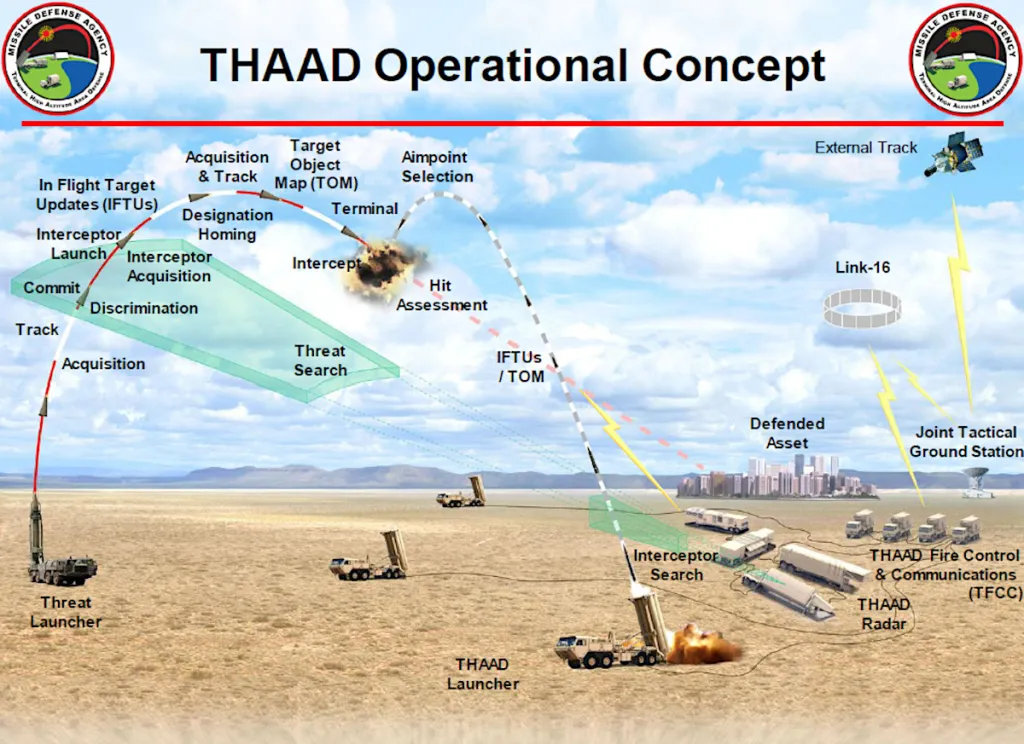
As its name indicates, THAAD is designed to intercept short, medium, and intermediate-range ballistic missiles in the terminal phase of flight. Depending on a variety of factors, including the physical position of the launcher relative to the threat, the system can attempt intercepts against targets just as they begin their descent into Earth’s atmosphere.

THAAD cues its interceptors before their launch, either using its own powerful AN/TPY-2 radar or via data from offboard sensors through the Command, Control, Battle Management and Communication (C2BMC) network.

A Missile Defense Agency graphic giving a very general overview of how THAAD executes an intercept using its organic AN/TPY-2 radar. MDA

After launch, the so-called “kill vehicle” at the front end detaches from the rocket booster at the rear. A shroud at the front, which covers the seeker and the rest of the kill vehicle, also breaks away. That shroud is also seen on the ground in the newly emerged video.

The remains of the THAAD interceptor’s nose shroud seen in the newly emerged video. capture via X

Freed from the shroud, the kill vehicle uses its conformal infrared seeker to find and home in on the target missile. In general, imaging infrared has the benefit of being a passive guidance method that is immune to radiofrequency countermeasures, such as jamming or decoys designed to mimic the radar signature of a real threat.

THAAD’s interceptors are hit-to-kill types that are designed to destroy their targets through sheer force of impact. As such, the kill vehicles do not contain any kind of explosive warhead. Each one does have several small rocket motors that help it precisely maneuver into position to slam into the incoming missile. These are collectively known as the Divert and Attitude Control System (DACS).

A graphic the Missile Defense Agency has released in the past, offering a general breakdown of the THAAD interceptor’s components. MDA

“The unique DACS provides two kinds of propulsion: one for attitude control and another for kill-vehicle maneuvering. The DACS uses six thrusters to provide roll, pitch, and yaw control for the interceptor,” according to L3Harris, which supplies this component of the interceptor. “These thrusters work together to precisely stabilize the interceptor-seeker field of view for proper target visibility. The seeker’s target data are then converted into maneuvering or divert commands that actuate the other four DACS thrusters as required. The four divert thrusters provide short, forceful pulses to quickly and accurately position the THAAD kill vehicle for target intercept.”

In the video, the entire kill vehicle is intact enough that the ports for some of these rockets are plainly visible.

Two of the ports through which rockets fire to help the THAAD kill vehicle maneuver can be seen in this capture from the video that emerged online earlier today. capture via X

The fact that the kill vehicle and shroud were recovered on the ground so close together and in relatively good condition points to a failure of some kind, but the exact circumstances remain unknown. What has since happened to the debris is also not known.

Gaining access to a THAAD interceptor seeker, as well as the rest of the kill vehicle, would give an adversary new insights into its performance envelope and other capabilities. That information could then be used in the development of new countermeasures, as well as tactics, techniques, and procedures to reduce the interceptor’s effectiveness. This would be on top of what Iran, as well as countries like Russia and China, have already been gleaning just from observing THAAD’s performance in the current conflict, as well as prior engagements.

Deep intelligence exploitation of the physical design of the seeker and the kill vehicle, as well as the materials used to make them, could be beneficial for supporting other developments, as well. The kill vehicle and the systems within have to survive the stresses of traveling at hypersonic speeds, typically defined as anything above Mach 5, as it screams toward its target. Adversaries like China could leverage this information to improve their own anti-ballistic missile capabilities or attempt to clone THAAD more directly.

A full-scale model of a THAAD seeker is prepared for a test in a high-speed wind tunnel. USAF

Employing highly advanced weaponry of any kind always carries at least a degree of risk of intelligence loss. Even just in the course of normal operations, the most reliable systems can still fail and fall into the wrong hands. This is not the first time TWZ has called attention to this reality, including in regard to the recovery of sensitive components of surface-to-air interceptors. The U.S. government, as well as China, Russia, and many other countries, have extensive foreign materiel exploitation programs poised to seize on any opportunity to acquire weapon systems and other equipment for extensive analysis, testing, and even reverse engineering.

Though we do not know what happened to the THAAD seeker and the rest of the kill vehicle seen in the video, this may not be the last time we see such debris in Syria or elsewhere in the region, given how extensively these interceptors are being used as Iranian ballistic missile attacks continue.

Contact the author: joe@twz.com
Joseph has been a member of The War Zone team since early 2017. Prior to that, he was an Associate Editor at War Is Boring, and his byline has appeared in other publications, including Small Arms Review, Small Arms Defense Journal, Reuters, We Are the Mighty, and Task & Purpose.


Source link

‘Kim’s Convenience’ review: Back onstage with sitcom warmth intact

“Kim’s Convenience” may not win points for originality, but originality isn’t really the point of an immigrant family drama meant to be instantly, one might say universally, recognizable.

The play, which opened Tuesday at the Ahmanson Theatre, was a runaway hit at the 2011 Toronto Fringe Festival. That success led to a larger production at Toronto’s Soulpepper Theatre that brought more attention to the show, paving the way for runs off-Broadway, in London’s West End and Washington, D.C.

But the show’s familiarity has another source. “Kim’s Convenience,” which was turned into a sitcom for Canada’s CBC, found an international audience on Netflix.

The story is set in Toronto, and the Kim family (owners of the titular convenience store) is of Korean background. But immigrants from Ireland, Italy, Latin America, India and Eastern Europe and their more assimilated children won’t have any problems relating to the generational conflicts at the heart of this gentle comedy.

Author Ins Choi, who once played the role of the prodigal son, has matured into the part of Appa, the patriarch who left Korea with his wife, Umma (Esther Chung), to start a new life in Canada. He opened a 7-Eleven-style shop, which he once considered calling 7-12, and has been living above the store with his family in what has been an all-hands operation.

Appa made sacrifices to give his son and daughter a better life — and he’s more than happy to tick off a list of what everyone owes him. He’s a mostly benevolent tyrant, but his crotchety side can get ugly and he’s not always in control of his temper. His son Jung (Ryan Jinn) ran away at 16, absconding with money from the store safe, after one of Appa’s flare-ups sent him to the hospital.

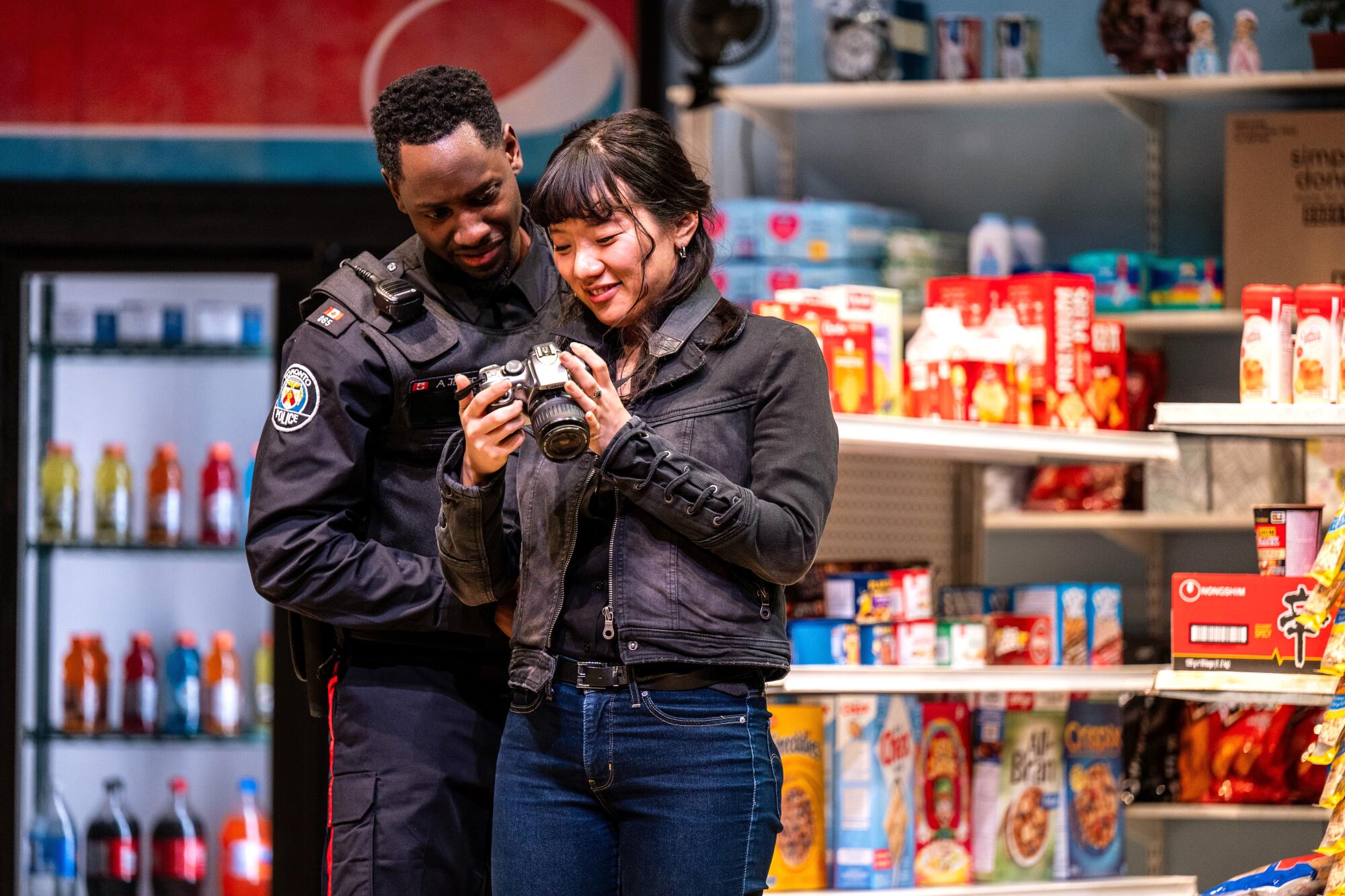
Janet (Kelly Seo), Appa’s 30-year-old unmarried daughter, bears the brunt of being the adult child who remained at home. She still works at the store, though her true calling is photography. Her father considers this just a hobby, a weekend recreation that shouldn’t interfere with her taking over the store one day. But she has other ideas for her future.

Change is coming whether Appa likes it or not. A Walmart is heading to the area, and with this news comes an unexpected offer for the shop that would allow him to comfortably retire. But selling the store is tantamount to discarding his story.

Brandon McKnight, left, and Kelly Seo in "Kim's Convenience."

Brandon McKnight, left, and Kelly Seo in “Kim’s Convenience.”

(Dahlia Katz)

He explains this to Janet, hoping that she’ll continue his legacy. But she’s put her life on hold for too long. Both her parents never let her forget that she still doesn’t have a husband. But how can she get married when her father subjects any man she dates to the third degree?

Alex (Brandon McKnight), the police officer who answers the 911 call Appa had Janet place to report a Japanese car parked illegally by the store (he still hasn’t forgiven Japan for its invasion of Korea), turns out to be a childhood friend of Jung’s — and someone Janet used to have a crush on. The sparks between them are obvious, and Appa, the soul of indiscretion, can’t help meddling in his overbearing way.

Choi isn’t averse to shtick, if the result is an explosion of audience laughter. One comic gimmick involves Appa’s superhuman grip that can subdue even the mightiest of men. A shoplifter (also played by McKnight, who portrays all the customers and passersby) learns the hard way that Appa is not to be underestimated.

Esther Chung, left, and Ins Choi in "Kim's Convenience" at the Ahmanson.

Esther Chung, left, and Ins Choi in “Kim’s Convenience” at the Ahmanson.

(Dahlia Katz)

The scene involves an unsavory routine on how to recognize a shoplifter. Janet challenges Appa’s racist assumptions, but father knows best and no one can convince him otherwise. Janet can’t win with him, but don’t count Appa’s daughter out.

Or his son, for that matter. Jung, who had a stint in rehab, hasn’t had an easy path in life, but he’s stayed in touch with his mother and eventually he and his dad will have their dramatically inevitable reckoning. There’s something determinedly hopeful about “Kim’s Convenience,” which like the store it’s named after, wants its patrons to leave satisfied.

The cast members, under the direction of Weyni Mengesha, all deserve high customer ratings. Choi’s Appa is impossible to stay mad at even when he’s said or done something unforgivable. He doesn’t mean to offend, though other people’s feelings are a luxury he has never been able to afford.

Still, his paternal bluntness is not without its infuriating charm, as when he informs his headstrong daughter, “You have to understand, now is desperation time for you. Sudden death, overtime, penalty kick shoot out. Expiration date is over. Take over store is only choice you having.”

Esther Chung and Ryan Jinn in "Kim's Convenience" at the Ahmanson.

Esther Chung and Ryan Jinn in “Kim’s Convenience” at the Ahmanson.

(Dahlia Katz)

Seo’s Janet is as feisty as she is loyal, making it easy to root for her and her quickly budding romance with McKnight’s worthy Alex. Chung’s Umma doesn’t take up a lot of room in the play, but her maternal presence registers sharply nonetheless. Jinn endows Jung with hidden dimensions of pain and regret.

But the most vivid performance might in fact be the convenience store itself, brought to fluorescent, sanitized, colorful life by scenic designer Joanna Yu and lighting designer Wen-Ling Liao. Nicole Eun-Ju Bell’s video and projection designs subtly transpose the setting when, for instance, Umma meets up with her son at church. The production seems right at home at the Ahmanson, a function of both the broad sitcom-friendly style and the warm Korean American reception that was audible at Tuesday’s opening.

“Kim’s Convenience” has an eager-to-please TV sensibility that can seem formulaic at times. But representation, particularly these days, can be a radical act, and there’s something heartening at the sight of the Kim family enjoying their turn in the mainstream spotlight.

‘Kim’s Convenience’

Where: Ahmanson Theatre, 135 N. Grand Ave., L.A.

When: 7:30 p.m. Tuesdays-Thursdays, 8 p.m. Fridays, 2 and 8 p.m. Saturdays, 1 and 7 p.m. Sundays. Ends April 19

Tickets: Start at $40.25

Contact: (213) 628-2772 or centertheatregroup.org

Running time: 1 hour, 20 minutes (no intermission)

Source link